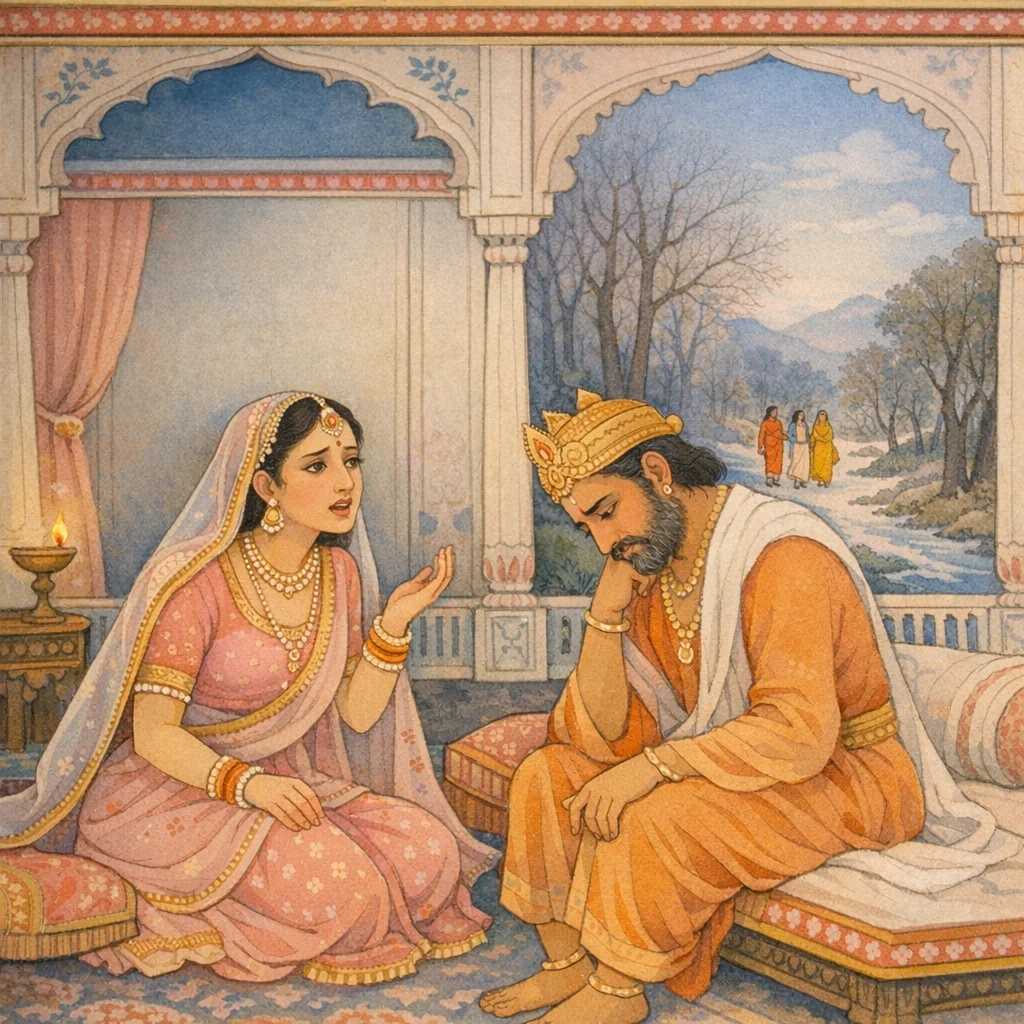
Sarga 61
कौसल्याविलापः — Kausalya’s Lament and Ethical Analogies on Kingship
अयोध्याकाण्ड
In this sarga, after Rama has gone to the forest, Kausalya—overwhelmed by fierce grief—pours out a torrent of words to King Dasaratha. She first questions how Rama, Sita, and Lakshmana can endure the hardships of forest life: Sita’s tenderness and her upbringing in royal comforts, the coarse fare of the wild, the assaults of heat and cold, and the dangers and terrifying cries of the jungle. She then condemns Dasaratha’s decision as a deed devoid of compassion, insisting that his own beloved ones are worthy of happiness. Pointing out that Bharata’s renunciation of kingship is unlikely, she employs a chain of ethical analogies: in a śrāddha one feeds one’s kin first and only afterward seeks the best brahmanas, who refuse to eat “after others”; a tiger will not accept food already seized by another; sacrificial materials of a yajña are not fit for reuse. Likewise, a kingdom already “enjoyed by another” should not be accepted. Through these images she reveals Rama’s self-respect and steadfastness in dharma: he would not brook dishonor and, in wrath, could rend even mountains, yet out of reverence for his father he will not raise his hand against Dasaratha. The sarga closes by stating the traditional supports of a woman’s dharma—husband, son, and kinsmen—and by laying bare Kausalya’s sense of abandonment and her impulse toward self-destruction.
Shlokas
Verse 1
वनं गते धर्मपरे रामे रमयतां वरे।कौसल्या रुदती स्वार्ता भर्तारमिदमब्रवीत्।।2.61.1।।
When Rāma—devoted to dharma and foremost among those who gladden others—had gone to the forest, Kauśalyā, weeping in bitter anguish, spoke these words to her husband.
Verse 2
यद्यपि त्रिषु लोकेषु प्रथितं ते महद्यशः।सानुक्रोशो वदान्यश्च प्रियवादी च राघवः।।2.61.2।।
Although your great fame is renowned throughout the three worlds—that you, O Rāghava, are compassionate, generous, and sweet of speech—
Verse 3
कथं नरवरश्रेष्ठ पुत्रौ तौ सह सीतया।दुःखितौ सुखसंवृद्धौ वने दुःखं सहिष्यतः।।2.61.3।।
O best of kings, how will those two sons of yours, together with Sita—reared in comfort and now stricken with sorrow—endure suffering in the forest?
Verse 4
सा नूनं तरुणी श्यामा सुकुमारी सुखोचिता।कथमुष्णं च शीतं च मैथिली प्रसहिष्यते।।2.61.4।।
She is surely young, dark-hued, tender, and accustomed to comfort—how will Maithilī endure both heat and cold?
Verse 5
भुक्त्वाऽशनं विशालाक्षी सूपदं शान्वितं शुभम्।वन्यं नैवारमाहारं कथं सीतोपभोक्ष्यते।।2.61.5।।
Sītā, large-eyed and used to fine meals with soups and seasonings—how will she eat forest fare made of wild rice?
Verse 6
गीतवादित्रनिर्घोषं श्रुत्वा शुभमनिन्दिता।कथं क्रव्यादसिंहानां शब्दं श्रोष्यत्यशोभनम्।।2.61.6।।
Accustomed to the auspicious sounds of songs and instruments, how will blameless Sītā bear to hear the inauspicious cries of lions and other flesh-eaters?
Verse 7
महेन्द्रध्वजसङ्काशः क्व नु शेते महाभुजः।भुजं परिघसङ्काशमुपधाय महाबलः।।2.61.7।।
Where now does that mighty, long-armed Rāma—lofty like Indra’s banner—lie down to sleep, using as his pillow an arm like an iron bar?
Verse 8
पद्मवर्णं सुकेशान्तं पद्मनिश्श्वासमुत्तमम्।कदा द्रक्ष्यामि रामस्य वदनं पुष्करेक्षणम्।।2.61.8।।
When shall I again behold Rāma’s excellent face—lotus-hued, framed by beautiful hair, with lotus-fragrant breath, and eyes like blue lotuses?
Verse 9
वज्रसारमयं नूनं हृदयं मे न संशयः।अपश्यन्त्या न तं यद्वै फलतीदं सहस्रधा।।2.61.9।।
Surely my heart is made of vajra—there is no doubt—for though I do not see him, it still does not shatter into a thousand pieces.
Verse 10
यत्त्वयाऽकरुणं कर्म व्यपोह्य मम बान्धवाः।निरस्ताः परिधावन्ति सुखार्हाः कृपणा वने।।2.61.10।।
Because of the heartless deed you have done, my kinsmen—who deserved comfort—have been cast out and now wander pitiably in the forest.
Verse 11
यदि पञ्चदशे वर्षे राघवः पुनरेष्यति।जह्याद्राज्यं च कोषं च भरतो नोपलक्षयते।।2.61.11।।
Even if Rāghava returns in the fifteenth year, it does not seem that Bharata will relinquish the kingdom and the treasury.
Verse 12
भोजयन्ति किल श्राद्धे केचित्स्वानेव बान्धवान्।ततः पश्चात्समीक्षन्ते कृतकार्या द्विजर्षभान्।।2.61.12।।
Some, it is said, at a śrāddha first feed only their own kinsmen; then afterward—thinking their duty fulfilled—they seek out the best of brāhmaṇas.
Verse 13
तत्र ये गुणवन्तश्च विद्वांसश्च द्विजातयः।न पश्चात्तेऽभिमन्यन्ते सुधामपि सुरोपमाः।।2.61.13।।
There, the twice-born who are virtuous and learned—godlike in bearing—do not accept what is offered after others, even if it were amṛta, the nectar of immortality.
Verse 14
ब्राह्मणेष्वपि तृप्तेषु पश्चाद्भोक्तुं द्विजर्षभाः।नाभ्युपैतुमलं प्राज्ञा श्शृङ्गच्छेदमिवर्षभाः।।2.61.14।।
Even when the brāhmaṇas are satisfied, the wise—best among the twice-born—will not consent to eat afterward, like bulls that cannot endure the cutting of their horns.
Verse 15
एवं कनीयसा भ्रात्रा भुक्तं राज्यं विशाम्पते।भ्राता ज्येष्ठो वरिष्ठश्च किमर्थं नावमंस्यते।।2.61.15।।
So too, O lord of men: if the younger brother has already ‘enjoyed’ the kingdom, why should not the elder, worthier brother disdain it?
Verse 16
न परेणाऽहृतं भक्ष्यं व्याघ्रः खादितुमिच्छति।एवमेतन्नरव्याघ्रः परलीढं न मन्यते।।2.61.16।।
A tiger does not wish to eat food procured by another beast; so too Rāma—the tiger among men—will not accept a kingdom already “tasted” and enjoyed by others.
Verse 17
हविराज्यं पुरोडाशाः कुशा यूपाश्च खादिराः।नैतानि यातयामानि कुर्वन्ति पुनरध्वरे।।2.61.17।।
Offerings—ghee, sacrificial cakes, kuśa grass, and khadira-wood posts—once time-worn and already used, are not employed again in a sacrifice.
Verse 18
तथा ह्यात्तमिदं राज्यं हृतसारां सुरामिव।नाभिमन्तुमलं रामो नष्टसोममिवाध्वरम्।।2.61.18।।
So too, this kingdom—already enjoyed by others—would be like liquor whose essence has been drained; Rāma is not fit to accept it, like a sacrifice in which the Soma has been lost.
Verse 19
न चेमां धर्षणां राम सङ्गच्छेदत्यमर्षणः।दारयेन्मन्दरमपि स हि क्रुद्धश्शितैश्शरैः।।2.61.19।।
Rāma, of unyielding resolve, would not submit to such an indignity; if angered, he could even split Mount Mandara with his sharp arrows.
Verse 20
त्वां तु नोत्सहते हन्तुं महात्मा पितृगौरवात्।ससोमार्कग्रहगणं नभस्ताराविचित्रितम्।।2.61.20।।पातयेद्योदिवं क्रुद्धस्सत्वां न व्यतिवर्तते।प्रक्षोभयेद्वारये द्वा महीं शैलशताचिताम्।।2.61.21।।
But the great-souled Rāma cannot bring himself to strike you, out of reverence for his father. Even one who, in anger, could pull down the star-strewn sky with its Sun, Moon, and planets, does not transgress you; he would rather shake—nay, even rend—the earth ringed with hundreds of mountains than violate filial duty.
Verse 21
त्वां तु नोत्सहते हन्तुं महात्मा पितृगौरवात्।ससोमार्कग्रहगणं नभस्ताराविचित्रितम्।।2.61.20।।पातयेद्योदिवं क्रुद्धस्सत्वां न व्यतिवर्तते।प्रक्षोभयेद्वारये द्वा महीं शैलशताचिताम्।।2.61.21।।
But the great-souled Rāma cannot bring himself to strike you, out of reverence for his father. Even one who, in anger, could pull down the star-strewn sky with its Sun, Moon, and planets, does not transgress you; he would rather shake—nay, even rend—the earth ringed with hundreds of mountains than violate filial duty.
Verse 22
नैवं विधमसत्कारं राघवो मर्षयिष्यति।बलवानिव शार्दूलो वालधेरभिमर्शनम्।।2.61.22।।
Rāghava will not endure an insult of this kind—just as a powerful tiger will not tolerate the handling of its tail.
Verse 23
नैतस्य सहिता लोका भयं कुर्युर्महामृथे।अधर्मंत्विह धर्मात्मा लोकं धर्मेण योजयेत्।।2.61.23।।
Even if all the worlds united against him in a great battle, they would not make him afraid. Here, where unrighteousness prevails, that righteous-souled one would set the world back upon dharma through dharma itself.
Verse 24
नन्वसौ काञ्चनैर्बाणैर्महावीर्यो महाभुजः।युगान्त इव भूतानि सागरानपि निर्दहेत्।।2.61.24।।
Indeed, that mighty hero, the great-armed one—by his golden arrows—could burn up beings and even the oceans, as at the world’s end.
Verse 25
स तादृशस्सिंहबलो वृषभाक्षो नरर्षभः।स्वयमेव हतः पित्रा जलजेनात्मजो यथा।।2.61.25।।
Such a Rāma—bull among men, lion-strong, with bull-like eyes—has been slain by his own father, as a fish destroys its own offspring.
Verse 26
द्विजातिचरितो धर्मश्शास्त्रदृष्टस्सनातनः।यदि ते धर्मनिरते त्वया पुत्रे विवासिते।।2.61.26।।
If the eternal dharma—seen in the śāstras and practiced by the twice-born—truly stands with you, how could you have banished your son who is devoted to righteousness?
Verse 27
गतिरेका पतिर्नार्या द्वितीया गतिरात्मजः।तृतीया ज्ञातयो राजंश्चतुर्थी नेह विद्यते।।2.61.27।।
O king, a woman has but one refuge—her husband; her second refuge is her son; her third, her kin. In this world there is no fourth.
Verse 28
Truly, I have no purpose with you any longer. Rama has taken refuge in the forest, and I do not wish to go there. In every way, I have been ruined by you.
Verse 29
वनं गते धर्मपरे रामे रमयतां वरे।कौसल्या रुदती स्वार्ता भर्तारमिदमब्रवीत्।।2.61.1।।
When Rama—devoted to dharma and foremost in pleasing others—had gone to the forest, Kausalya, sobbing in bitter anguish, spoke these words to her husband.
Verse 30
वनं गते धर्मपरे रामे रमयतां वरे।कौसल्या रुदती स्वार्ता भर्तारमिदमब्रवीत्।।2.61.1।।
When Rama—devoted to dharma and foremost in pleasing others—had gone to the forest, Kausalya, sobbing in bitter anguish, addressed her husband.
Frequently Asked Questions
The dilemma is whether a kingdom obtained through an ethically compromised succession (Rama’s banishment and Bharata’s accession) can be legitimately accepted or restored. Kausalya argues that Rama, by temperament and dharma, will not accept a ‘parabhukta’ (already-enjoyed/tainted) sovereignty, making the political settlement unstable even if the exile term ends.
The discourse frames legitimacy as inseparable from moral provenance: what is ‘used’ or ‘tasted’ in ritual and in polity becomes inappropriate for the highest standards. Through ritual and animal analogies, the Sarga teaches that dharma includes honor-bound refusal of compromised gains, and that filial respect can restrain even overwhelming power.
Culturally, the Sarga foregrounds श्राद्ध and यज्ञ (adhvara) norms—order of feeding, purity hierarchy, and non-reuse of consecrated materials (havis, ajya, purodasha, kusha, yupa, khadira). Geographically, ‘vana’ (forest exile) and mythic-cosmic imagery (Mandara mountain, sun–moon–planets, star-filled sky, mountain-ringed earth) are used as rhetorical landmarks to measure Rama’s power and restraint.