Sarga 115
पादुकाभिषेकः — The Consecration of Rama’s Sandals and Bharata’s Trusteeship at Nandigrama
अयोध्याकाण्ड
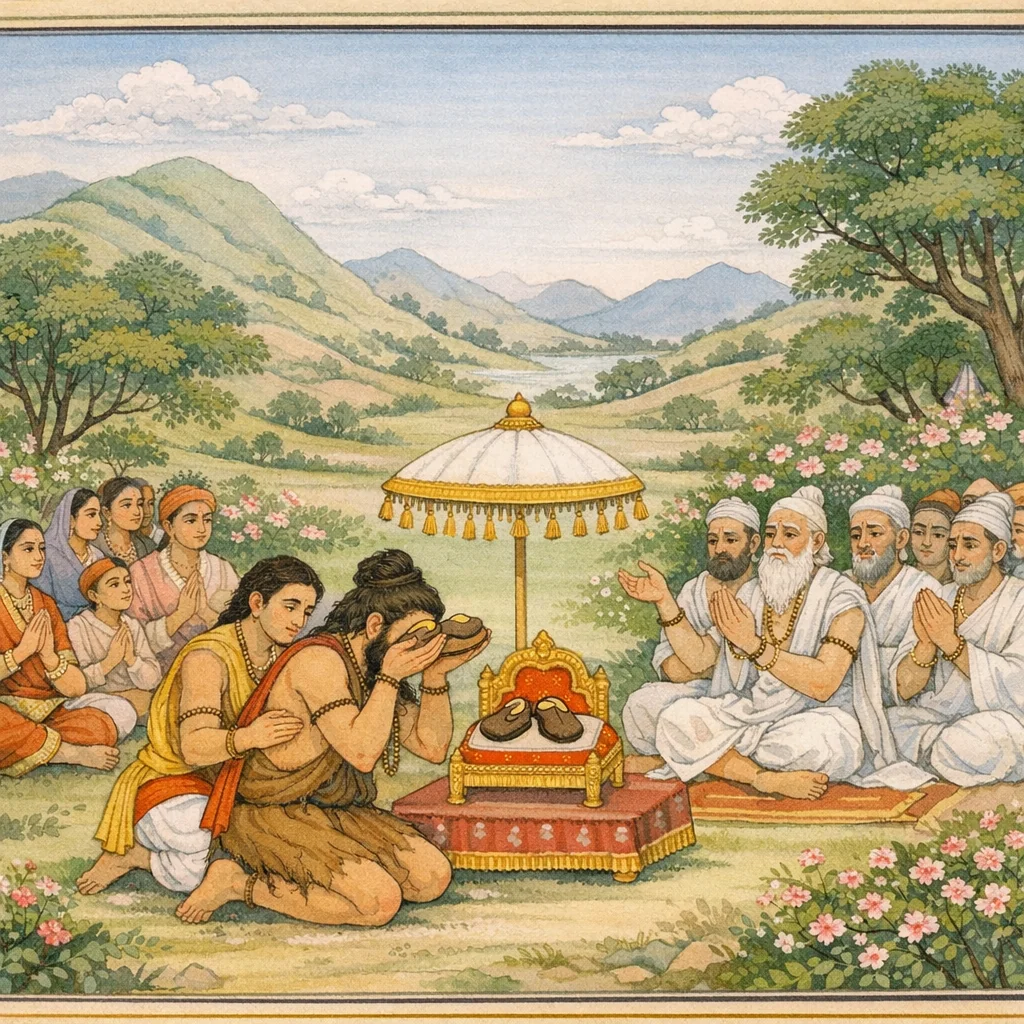
Sarga 115 formalizes Bharata’s political-ethical answer to the succession crisis through a ritual of delegated sovereignty. After placing his mothers safely in Ayodhyā, Bharata—grief-stricken yet steadfast in his vow—addresses the elders and asks leave to depart for Nandigrāma, declaring that without Rāma he would rather dwell with sorrow than enjoy kingship. The ministers and Vasiṣṭha praise his brother-devotion and his adherence to the noble path; the chariot is readied, and Bharata leaves with Śatrughna, preceded by brahmin preceptors. The army and citizens follow of their own accord, showing public assent. Reaching Nandigrāma, Bharata bears Rāma’s gold-adorned sandals upon his head and proclaims the kingdom a trust deposited in him by Rāma, as one who holds nothing as his own in the spirit of renunciation (sannyāsa). He installs the sandals as the juridical and symbolic seat of dharma, and orders that royal emblems—the parasol and fan—be held over them. He resolves to guard the realm until Rāma’s return, when he will restore Ayodhyā and the kingdom and resume service. The chapter closes with Bharata living ascetically—bark garments and matted locks—ruling only as subordinate to the sandals. All matters and offerings are first reported and presented to them, turning governance into accountable, sacred stewardship.
Shlokas
Verse 1
ततो निक्षिप्य मातृ़ स्स अयोध्यायां दृढ व्रतः।भरत श्शोकसन्तप्तो गुरूनिदमथाब्रवीत्।।।।
Then Bharata—steadfast in his vow—having settled the mothers in Ayodhyā, and scorched by grief, spoke these words to the elders.
Verse 2
नन्दिग्रामं गमिष्यामि सर्वानामन्त्रयेऽद्य वः।तत्र दुःखमिदं सर्वं सहिष्ये राघवं विना।।।।
Today I take leave of you all; I shall go to Nandigrāma. There, without Rāghava, I will endure all this sorrow.
Verse 3
गतश्च वा दिवं राजा वनस्थश्च गुरुर्मम।रामं प्रतीक्षे राज्याय स हि राजा महायशाः।।।।
The king has gone to heaven, and my elder brother—my revered guide—dwells in the forest. I shall wait for Rama to take up the kingdom, for he alone is the illustrious, greatly renowned king.
Verse 4
एतच्छ्रुत्वा शुभं वाक्यं भरतस्य महात्मनः।अब्रुवन्मन्त्रिणस्सर्वे वसिष्ठश्च पुरोहितः।।।।
Hearing these auspicious words of the great-souled Bharata, all the ministers—and Vasiṣṭha, the royal priest—responded.
Verse 5
सुभृशं श्लाघनीयं च यदुक्तं भरत त्वया।वचनं भ्रातृवात्सल्यादनुरूपं तवैव तत्।।।।
O Bharata, the words you have spoken—born of deep affection for your brother—are exceedingly commendable, and such conduct truly befits you.
Verse 6
नित्यं ते बन्धुलुब्धस्य तिष्ठतो भ्रातृसौहृदे।आर्यमार्गं प्रपन्नस्य नानुमन्येत कः पुमान्।।।।
Since you are ever devoted to your kin, steadfast in goodwill toward your brothers, and established on the noble path—what person would not approve of your resolve?
Verse 7
मन्त्रिणां वचनं श्रुत्वा यथाभिलषितं प्रियम्।अब्रवीत्सारथिं वाक्यं रथो मे युज्यतामिति।।।।
Having heard the ministers’ pleasing words, in accord with what he desired, he said to the charioteer: “Harness my chariot.”
Verse 8
प्रहृष्टवदन स्सर्वा मातृ़ स्समभिवाद्य सः।आरुरोह रथं श्रीमान् शत्रुघ्नेन समन्वितः।।।।
With a radiant, joyful face, the illustrious Bharata bowed in reverence to all his mothers and then, accompanied by Śatrughna, mounted the chariot.
Verse 9
आरुह्य च रथं शीघ्रं शत्रुघ्नभरतावुभौ।ययतुः परमप्रीतौ वृतौ मन्त्रिपुरोहितैः।।।।
Bharata and Śatrughna, both exceedingly pleased, quickly mounted the chariot and set forth, surrounded by ministers and priests.
Verse 10
अग्रतो गुरव: सर्वे वसिष्ठप्रमुखा द्विजाः।प्रययुः प्राङ्ग्मुखा स्सर्वे नन्दिग्रामो यतोऽभवत्।।।।
All the elders—brahmins headed by Vasiṣṭha—went ahead, facing east, proceeding toward the side where Nandigrāma lay.
Verse 11
बलं च तदनाहूतं गजाश्वरथसङ्कुलम्।प्रययौ भरते याते सर्वे च पुरवासिनः।।।।
And when Bharata set out, the army—thronged with elephants, horses, and chariots—also departed unbidden, and so did all the citizens of the city.
Verse 12
रथस्थः स तु धर्मात्मा भरतो भ्रातृवत्सलः।नन्दिग्रामं ययौ तूर्णं शिरस्यादाय पादुके।।।।
Bharata—righteous and devoted to his brother—rode in his chariot swiftly to Nandigrāma, bearing Rāma’s sandals upon his head.
Verse 13
ततस्तु भरतः क्षिप्रं नन्दिग्रामं प्रविश्य सः।अवतीर्य रथात्तूर्णं गुरूनिदमुवाच ह।।।।
Then Bharata swiftly entered Nandigrāma; alighting at once from the chariot, he addressed the elders and spoke these words.
Verse 14
एतद्राज्यं मम भ्रात्रा दत्तं सन्नयासवत्स्वयम्।योगक्षेमवहे चेमे पादुके हेमभूषिते।।।।
This kingdom my brother himself entrusted to me as a sacred deposit. And these gold-adorned sandals, bearing the charge of the realm’s safety and welfare, were also given into my care.
Verse 15
भरत श्शिरसा कृत्वा सन्न्यासं पादुके ततः।अब्रवीद्धुःखसंतप्त स्सर्वं प्रकृतिमण्डलम्।।।।
Then Bharata, placing the entrusted sandals upon his head, and scorched by grief, spoke to the entire assembly of the realm.
Verse 16
छत्रं धारयत क्षिप्रमार्यपादाविमौ मतौ।आभ्यां राज्ये स्थितो धर्मः पादुकाभ्यां गुरोर्मम।।।।
Hold up the royal parasol at once. These are accepted as the venerable feet of my brother; by these sandals of my revered elder, dharma shall stand established in the kingdom.
Verse 17
भ्रात्रा हि मयि संन्यासो निक्षिप्त स्सौहृदादयम्।तमिमं पालयिष्यामि राघवागमनं प्रति।।।।
Indeed, out of affection my brother has placed this trust in me. I shall preserve this sacred deposit until Rāghava returns.
Verse 18
क्षिप्रं संयोजयित्वातु राघवस्य पुनस्स्वयम्।चरणौ तौ तु रामस्य द्रक्ष्यामि सहपादुकौ।।।।
And soon, I myself shall reunite them with Rāghava again; I shall behold Rama’s very feet together with these sandals.
Verse 19
ततो निक्षिप्तभारोऽहं राघवेण समागतः।निवेद्य गुरवे राज्यं भजिष्ये गुरुवृत्तिताम्।।।।
Then, upon my reunion with Rāghava and freed of this burden, I shall return the kingdom to my revered elder and live in the discipline of serving him.
Verse 20
राघवाय च सन्यासं दत्त्वेमे वरपादुके।राज्यं चेदमयोध्यां च धूतपापो भवामि च।।।।
When I restore to Rāghava this entrusted charge—these excellent sandals, this kingdom, and this city of Ayodhyā—then I shall be free of sin.
Verse 21
अभिषिक्ते तु काकुत्स्थे प्रहृष्टमुदिते जने।प्रीतिर्मम यशश्चैव भवेद्राज्याच्चतुर्गुणम्।।।।
When Kakutstha (Rāma) is consecrated and the people rejoice in gladness, my joy and my good name will be fourfold greater than any joy derived from ruling.
Verse 22
एवं तु विलपन्दीनो भरत स्समहायशाः।नन्दिग्रामेऽकरोद्राज्यं दुःखितो मन्त्रिभिस्सह।।।।
Thus, lamenting and desolate, the illustrious Bharata—grief-stricken—made Nandigrāma his seat and governed the kingdom together with his ministers.
Verse 23
स वल्कलजटाधारी मुनिवेषधरः प्रभुः।नन्दिग्रामेऽवसद्वीर स्ससैन्यो भरतस्तदा।।।।
Then Bharata—lordly yet heroic—clad in bark garments and wearing matted locks, having assumed a sage’s attire, dwelt at Nandigrāma together with his army.
Verse 24
रामागमनमाकाङ्क्षन्भरतो भ्रातृवत्सलः।भ्रातुर्वचनकारी च प्रतिज्ञापारगस्तथा।।।।पादुके त्वभिषिच्याथ नन्दिग्रामेऽवसत्तदा।
Longing for Rama’s return, Bharata—devoted to his brother, obedient to his brother’s word, and steadfast in his vow—consecrated the sandals and then dwelt at Nandigrāma.
Verse 25
स वालव्यजनं छत्रं धारयामास स स्वयं।भरत श्शासनं सर्वं पादुकाभ्यां निवेदयन्।।।।
He himself bore the royal parasol and the yak-tail fan; and Bharata submitted every directive of rule first to the pair of sandals.
Verse 26
ततस्तु भरत शश्रीमानभिषिच्याऽऽर्यपादुके।तदधीनस्तदा राज्यं कारयामास सर्वदा।।।।
Thereafter, illustrious Bharata, having consecrated the noble sandals, administered the kingdom ever after as one wholly subordinate to them.
Verse 27
तदा हि यत्कार्यमुपैति किञ्चिदुपायनं चोपहृतं महार्हम्।स पादुकाभ्यां प्रथमं निवेद्य चकार पश्चाद्भरतो यथावत्।।।।
Indeed, whenever any matter—however small—arose, or whenever a most precious gift was brought, Bharata first presented it to the sandals and only afterward acted, in due and proper manner.
Frequently Asked Questions
The dilemma is whether Bharata should assume kingship as possession or preserve it as delegated duty in Rama’s absence. Bharata resolves it by treating the kingdom as a trust deposited by Rama and by installing Rama’s sandals as the authoritative symbol, thereby refusing personal appropriation of power while maintaining administrative continuity.
Authority is legitimate when subordinated to dharma rather than desire: governance can be exercised as stewardship with accountability, ritual-symbolic restraint, and transparent intent. Bharata’s conduct models how grief and duty can coexist—renunciation expressed not by abandoning responsibility, but by refusing ownership of it.
Ayodhya and Nandigrāma are the principal locales, marking a shift from the royal capital to a liminal regency-seat. Culturally, the chapter highlights consecration practices (abhiṣeka) applied to a symbolic regent (the sandals), alongside royal insignia (parasol, chamaras) that publicly encode legitimacy and the continuity of rājadharma.