Sarga 66
लक्ष्मणोपदेशः — Lakshmana Consoles Rama on Fate, Fortitude, and Right Action
अरण्यकाण्ड
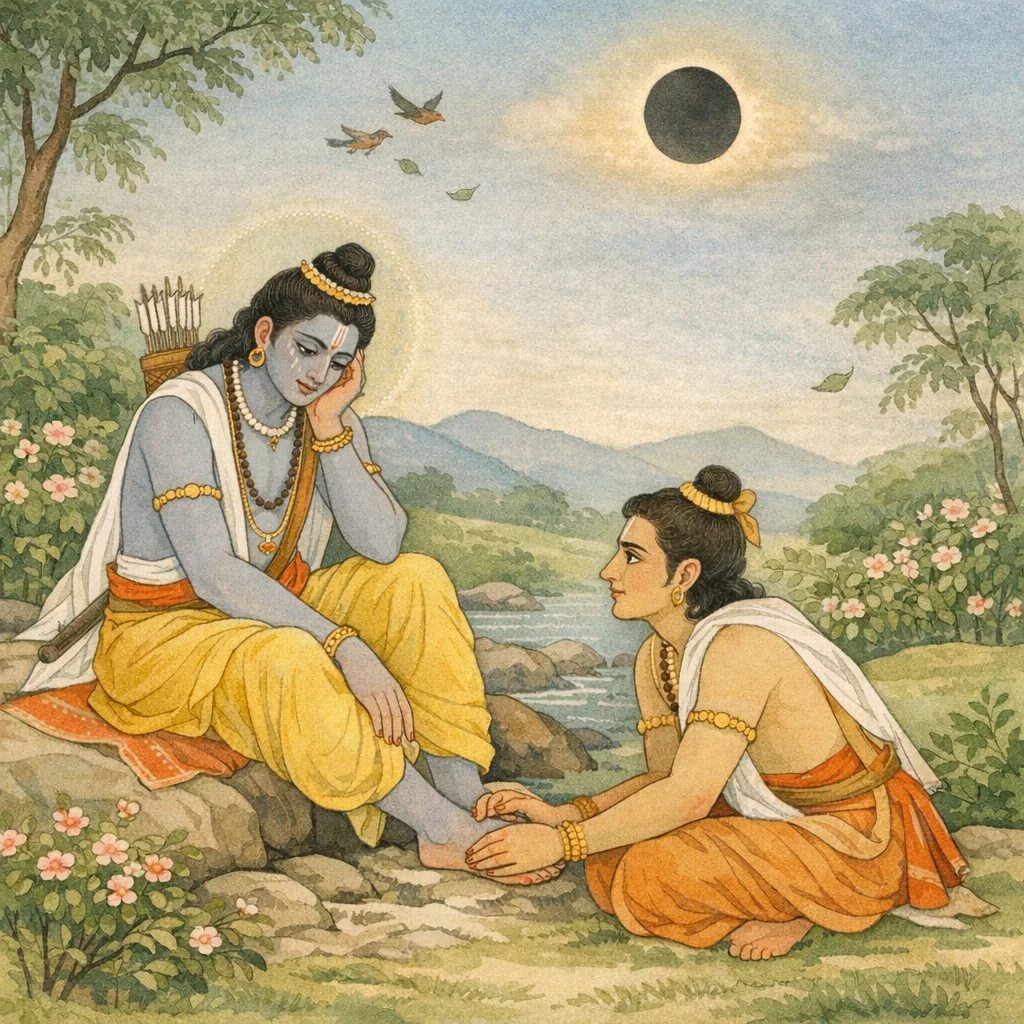
In Sarga 66, in the wake of crushing grief, Rama is shown overwhelmed—weeping “like an orphan,” confused, and momentarily unable to act. Lakshmana consoles him with devoted closeness, pressing Rama’s feet and restoring his clarity through firm, affectionate counsel. Lakshmana’s upadeśa unfolds through exempla and cosmic analogy: even Sun and Moon suffer eclipse; great beings and even the gods cannot evade daiva (fate). He recalls that justice and its counter-movements are heard to operate even among the deities, such as Indra. He then reframes Rama’s lament as unworthy of a truth-seeing leader, urging buddhi (discerning intellect) to distinguish auspicious from inauspicious and to recognize that steady, lucid action alone yields desired results. Praising Rama’s near-unfathomable intellect, he says grief has merely “put knowledge to sleep.” The counsel culminates in strategic restraint: weigh divine and human prowess, avoid indiscriminate destruction, identify the sinful enemy precisely, and then uproot him—turning sorrow into disciplined right action.
Shlokas
Verse 1
तं तथा शोकसन्तप्तं विलपन्तमनाथवत्।मोहेन महताविष्टं परिद्यूनमचेतनम्।।3.66.1।।ततस्सौमित्रिराश्वास्य मुहूर्तादिव लक्ष्मणः।रामं सम्बोधयामास चरणौ चाभिपीडयन्।।3.66.2।।
Seeing Rama consumed by grief—wailing helplessly like one without refuge, overwhelmed by profound bewilderment, sunk in misery and as if senseless—Lakshmana, son of Sumitra, quickly tried to console him. In supplication and service he pressed Rama’s feet and spoke to rouse him from his collapse.
Verse 2
तं तथा शोकसन्तप्तं विलपन्तमनाथवत्।मोहेन महताविष्टं परिद्यूनमचेतनम्।।3.66.1।।ततस्सौमित्रिराश्वास्य मुहूर्तादिव लक्ष्मणः।रामं सम्बोधयामास चरणौ चाभिपीडयन्।।3.66.2।।
Then Lakshmana, son of Sumitra, after consoling him as if in a moment, pressed Rama’s feet and began to rouse him and address him.
Verse 3
महता तपसा राम महता चापि कर्मणा।राज्ञा दशरथेनासि लब्धोऽमृतमिवामरैः।।3.66.3।।
O Rama, by great austerity and by great deeds, King Dasharatha obtained you—just as the gods obtained amrita, the nectar of immortality.
Verse 4
तव चैव गुणैर्बद्धस्त्वद्वियोगान्महीपतिः।राजा देवत्वमापन्नो भरतस्य यथाश्रुतम्।।3.66.4।।
Bound to you by your very virtues, the king—the lord of the earth—on being separated from you attained the state of the gods, as we have heard from Bharata.
Verse 5
यदि दुःखमिदं प्राप्तं काकुत्स्थ न सहिष्यसे।प्राकृतश्चाल्पसत्त्वश्च इतरः कस्सहिष्यति।।3.66.5।।
O Kakutstha, if you will not endure this sorrow that has come upon you, who else—an ordinary person of little strength—could endure it?
Verse 6
दुःखितो हि भवान्लोकांस्तेजसा यदि धक्ष्यते।आर्ताः प्रजा नरव्याघ्र क्व नु यास्यन्ति निर्वृतिम्।।3.66.6।।
For if you, in grief, were to scorch the worlds with your splendor, O tiger among men, where would the afflicted people find peace?
Verse 7
लोकस्वभाव एवैष ययातिर्नहुषात्मजः।गतश्शक्रेण सालोक्यमनयस्तं समस्पृशत्।।3.66.7।।
This is indeed the way of the world: Yayati, son of Nahusha, attained the same realm as Indra, yet misfortune touched him because of a curse.
Verse 8
महर्षिर्यो वसिष्ठस्तु यः पितुर्नः पुरोहितः।अह्ना पुत्रशतं जज्ञे तथैवास्य पुनर्हतम्।।3.66.8।।
Even the great sage Vasistha—our father’s family priest—had a hundred sons born in a single day; and in the same manner, they were again slain.
Verse 9
या चेयं जगतां माता देवी लोकनमस्कृता।अस्याश्च चलनं भूमेर्दृश्यते सत्यसंश्रव।।3.66.9।।
Even this Earth—mother of the worlds, a goddess revered by all—may be seen to tremble at times, O you whose fame is grounded in truth.
Verse 10
यौ धर्मौ जगतां नेत्रौ यत्र सर्वं प्रतिष्ठितम्।आदित्यचन्द्रौ ग्रहणमभ्युपेतौ महाबलौ।।3.66.10।।
Even the mighty Sun and Moon—the two “eyes” of the world, righteous powers on which all stands—must at times undergo eclipse. Thus, the appearance of affliction does not negate inner order or dharma.
Verse 11
सुमहान्त्यपि भूतानि देवाश्च पुरुषर्षभ।न दैवस्य प्रमुञ्चन्ति सर्वभूतानि देहिनः।।3.66.11।।
O bull among men, no embodied being is released from what is ordained: even great beings, even the gods, do not escape the workings of fate. Therefore, do not let grief destroy discernment.
Verse 12
शक्रादिष्वपि देवेषु वर्तमानौ नयानयौ।श्रूयेते नरशार्दूल न त्वं शोचितुमर्हसि।।3.66.12।।
O tiger among men, it is said that even among the gods—Indra and the rest—both right conduct and its opposite are at work. Since such fluctuations occur even there, you are not fit to sink into lamentation.
Verse 13
नष्टायामपि वैदेह्यां हृतायामपि चानघशोचितुं नार्हसे वीर यथान्यः प्राकृतस्तथा।।3.66.13।।
O sinless hero, even if Vaidehī were lost—or even carried away—you should not grieve like an ordinary man. Your dharma calls for strength of mind and purposeful action, not helpless lament.
Verse 14
त्वव्दिधा न हि शोचन्ति सततं सत्यदर्शिनः।सुमहत्स्वपि कृच्छ्रेषु रामानिर्विण्णदर्शनाः।।3.66.14।।
Those like you, O Rama—truth-seeing and clear-sighted—do not continually lament, even in the greatest calamities. A vision grounded in satya does not sink into despondency.
Verse 15
तत्त्वतो हि नरश्रेष्ठ बुद्ध्या समनुचिन्तय।बुध्द्या युक्ता महाप्राज्ञा विजानन्ति शुभाशुभे।।3.66.15।।
O best of men, reflect with your intellect upon the reality of things. The truly wise, endowed with discernment, understand what is auspicious and what is harmful—and choose accordingly.
Verse 16
अदृष्टगुणदोषाणामध्रुवाणां तु कर्मणाम्।नान्तरेण क्रियां तेषां फलमिष्टं प्रवर्तते।।3.66.16।।
For deeds done without recognizing merit and fault, and performed with an unsteady will, the desired result does not arise without proper, directed effort. Right ends require right understanding and right action.
Verse 17
त्वमेव हि पुरा राम मामेवं बहुशोऽन्वशाः।अनुशिष्याद्धि को नु त्वामपि साक्षाद्बृहस्पतिः।।3.66.17।।
O Rama, you yourself once instructed me in these very ways, again and again. Who indeed could instruct you now—even Brihaspati himself? Such counsel already dwells within you.
Verse 18
बुद्धिश्च ते महाप्राज्ञ देवैरपि दुरन्वया।शोकेनाभिप्रसुप्तं ते ज्ञानं सम्बोधयाम्यहम्।।3.66.18।।
O great wise one, your intellect is difficult even for the gods to fathom. Yet your knowledge has been lulled to sleep by grief; I speak only to awaken that wisdom within you.
Verse 19
दिव्यं च मानुषं च त्वमात्मनश्च पराक्रमम्।इक्ष्वाकुवृषभावेक्ष्य यतस्व द्विषतां वधे।।3.66.19।।
O bull among the Ikshvakus, first assess your own prowess—both divine and human—and then strive for the slaying of your foes.
Verse 20
किं तेन सर्वनाशेन कृतेन पुरुषर्षभ।तमेव त्वं रिपुं पापं विज्ञायोद्धर्तुमर्हसि।।3.66.20।।
O Rama, by great austerity and by great deeds, King Dasharatha obtained you—just as the gods obtained amrita, the nectar of immortality.
Frequently Asked Questions
The dilemma is whether Rama’s grief should erupt into uncontrolled retaliation (“burning the worlds”) or be disciplined into dharmic response. Lakshmana urges restraint: do not pursue total destruction; first identify the culpable enemy and then act decisively against that target.
Daiva affects all beings—great and small, human and divine—so sorrow must not eclipse discernment. Lakshmana teaches that buddhi should ‘wake’ knowledge, enabling right judgment of facts and directing effort toward effective action rather than despair.
No specific forest toponyms dominate this sarga; instead it highlights cultural-theological reference points (Indra, Brihaspati, Sun–Moon eclipse) and exemplary narratives (Yayati, Vasistha) used as authoritative frames for ethical instruction.