Sarga 57
मारीचवधोत्तरं रामस्य शङ्का-निमित्त-दर्शनं लक्ष्मण-निग्रहश्च (After Maricha’s Slaying: Omens, Anxiety, and Rama’s Rebuke of Lakshmana)
अरण्यकाण्ड
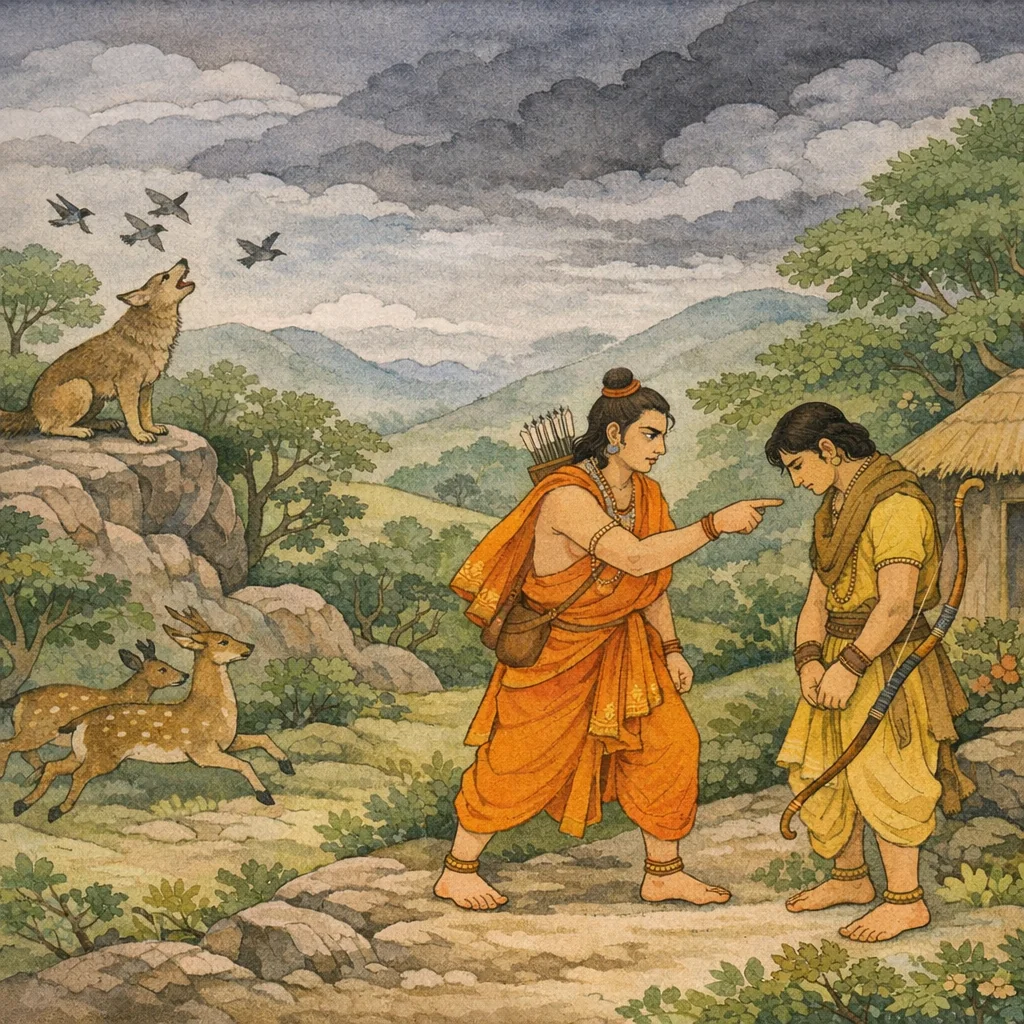
This sarga portrays the immediate aftermath of Rama’s slaying of Maricha, the rakshasa who had assumed a deer-form (kāmarūpin). Rama hastens back toward Janasthana, yet ominous signs arise along the way: the ghastly howl of a jackal, the frightened agitation of animals and birds, and bodily portents such as the throbbing of Rama’s left eye. Rama reads these as warnings of a rakshasa stratagem: as he died, Maricha imitated Rama’s voice to lure Lakshmana away from Sita. Reaching Janasthana in anxious haste, Rama meets Lakshmana, sees his cheerless face, and rebukes him for leaving Sita alone in a demon-haunted forest. The exchange is charged with dharma: Rama’s grief and suspicion become a moral crisis, balancing trust in Lakshmana against urgent fear for Sita’s safety. The chapter teaches how deception (māyā), misjudged duty, and hostile surroundings can fracture vows of protection and hasten irreversible loss.
Shlokas
Verse 1
राक्षसं मृगरूपेण चरन्तं कामरूपिणम्।निहत्य रामो मारीचं तूर्णं पथि न्यवर्तत।।।।
After slaying Marīca—the rākṣasa who moved about in the guise of a deer and could assume forms at will—Rāma swiftly turned back along the path.
Verse 2
तस्य सन्त्वरमाणस्य द्रष्टुकामस्य मैथिलीम्।क्रूरस्वनोऽथ गोमायुर्विननादास्य पृष्ठतः।।।।
As Rāma hurried on, longing to see Maithilī, a jackal behind him suddenly howled with a harsh and ominous cry.
Verse 3
स तस्य स्वरमाज्ञाय दारुणं रोमहर्षणम्।चिन्तयामास गोमायोस्स्वरेण परिशङ्कितः।।।।
Recognizing that dreadful, hair-raising sound as the jackal’s cry, he grew apprehensive and began to brood in anxiety.
Verse 4
अशुभं बत मन्येऽहं गोमायुर्वाश्यते यथा।स्वस्ति स्यादपि वैदेह्या राक्षसैर्भक्षणं विना।।।।
This seems inauspicious to me—the jackal is howling like this. May Vaidehī be safe, and may it be that she has not been devoured by the rākṣasas.
Verse 5
मारीचेन तु विज्ञाय स्वरमालम्ब्य मामकम्।विक्रुष्टं मृगरूपेण लक्ष्मणश्शृणुयाद्यदि।।।।स सौमित्रिस्स्वरं श्रुत्वा तां च हित्वाच मैथिलीम्।तयेह प्रहितः क्षिप्रं मत्सकाशमिहैष्यति।।।।
If Lakṣmaṇa hears Mārīca—having grasped the scheme and, in the guise of a deer, imitating my voice—crying out loudly,
Verse 6
मारीचेन तु विज्ञाय स्वरमालम्ब्य मामकम्।विक्रुष्टं मृगरूपेण लक्ष्मणश्शृणुयाद्यदि।।3.57.5।।स सौमित्रिस्स्वरं श्रुत्वा तां च हित्वाच मैथिलीम्।तयेह प्रहितः क्षिप्रं मत्सकाशमिहैष्यति।।3.57.6।।
Then Saumitri (Lakṣmaṇa), hearing that voice, will abandon Maithilī; sent by her, he will quickly come here to my side.
Verse 7
राक्षसैस्सहितैर्नूनं सीताया ईप्सितो वधः।काञ्चनश्च मृगो भूत्वा व्यपनीयाश्रमात्तु माम्।।।।दूरं नीत्वा तु मारीचो राक्षसोऽभूच्छरा हतः।हा लक्ष्मण हतोऽस्मीति यद्वाक्यं व्याजहार ह।।।।
Surely, together with the rākṣasas, Sītā’s death has been desired and planned. For Mārīca, having become a golden deer, drew me away from the hermitage (āśrama).
Verse 8
राक्षसैस्सहितैर्नूनं सीताया ईप्सितो वधः।काञ्चनश्च मृगो भूत्वा व्यपनीयाश्रमात्तु माम्।।3.57.7।।दूरं नीत्वा तु मारीचो राक्षसोऽभूच्छरा हतः।हा लक्ष्मण हतोऽस्मीति यद्वाक्यं व्याजहार ह।।3.57.8।।
Having taken me far away, Mārīca—the rākṣasa—when struck by my arrows, revealed his true form and uttered: “Ah, Lakṣmaṇa, I am slain!”
Verse 9
अपि स्वस्ति भवेत्ताभ्यां रहिताभ्यां महावने।जनस्थाननिमित्तं हि कृतवैरोऽस्मि राक्षसैः।।।।निमित्तानि च घोराणि दृश्यन्तेऽद्य बहूनि च।
May those two be safe, left without me in this great forest. For because of Janasthāna I have incurred enmity with the rākṣasas; and today many dreadful portents are seen.
Verse 10
इत्येवं चिन्तयन्रामश्श्रुत्वा गोमायुनिस्स्वनम्।।।।आत्मनश्चापनयनान्मृगरूपेण रक्षसा।आजगाम जनस्थानं राघवः परिशङ्कितः।।।।
Thus pondering, and hearing the howl of a jackal, Rāghava grew alarmed, knowing that a rākṣasa in the guise of a deer had drawn him away; and he returned to Janasthāna, anxious and suspicious.
Verse 11
इत्येवं चिन्तयन्रामश्श्रुत्वा गोमायुनिस्स्वनम्।।3.57.10।।आत्मनश्चापनयनान्मृगरूपेण रक्षसा।आजगाम जनस्थानं राघवः परिशङ्कितः।।3.57.11।।
Beasts and birds, their hearts weighed down, came to him in distress; keeping the great-souled one to their left, they uttered dreadful cries.
Verse 12
तं दीनमनसो दीनमासेदुर्मृगपक्षिणः।सव्यं कृत्वा महात्मानं घोरांश्च ससृजुस्स्वरान्।।।।
Beasts and birds, their hearts weighed down, came to him in distress; keeping the great-souled one to their left, they uttered dreadful cries.
Verse 13
तानि दृष्ट्वा निमित्तानि महाघोराणि राघवः।न्यवर्तताथ त्वरितो जवेनाश्रममात्मनः।।।।
Seeing those exceedingly dreadful omens, Rāghava at once turned back and hurried with all speed toward his own hermitage.
Verse 14
सीतां स तु वरारोहां लक्ष्मणं च महाबलम्।आजगाम जनस्थानं चिन्तयन्नेव राघवः।।।।
Rāghava arrived at Janasthāna, his thoughts fixed upon Sītā of graceful form and upon mighty Lakṣmaṇa.
Verse 15
ततो लक्ष्मणमायान्तं ददर्श विगतप्रभम्।ततोऽविदूरे रामेण समीयाय स लक्ष्मणः।।।।विषण्णस्सुविषण्णेन दुःखितो दुःखभागिना।
Then he saw Lakṣmaṇa approaching, his radiance faded. Not far away Lakṣmaṇa came up to Rāma; and Lakṣmaṇa, sorrowful and deeply distressed, found Rāma too cast down—one who shared the same grief.
Verse 16
सञ्जगर्हेऽथ तं भ्राता ज्येष्ठो लक्ष्मणमागतम्।।।।विहाय सीतां विजने वने राक्षससेविते।
Then the elder brother rebuked Lakṣmaṇa who had come, for he had left Sītā alone in the lonely forest frequented by rākṣasas.
Verse 17
गृहीत्वा च करं सव्यं लक्ष्मणं रघुनन्दनः।।।।उवाच मधुरोदर्कमिदं परुषमार्तिमत्।
Then Rāma, delight of the Raghu line, took hold of Lakṣmaṇa’s left hand and, grief-stricken, spoke words that were tender in intent yet harsh in their sting.
Verse 18
अहो लक्ष्मण गर्ह्यं ते कृतं यस्त्वं विहाय ताम्।।।।सीतामिहाऽगतस्सौम्य कच्चित्स्वस्ति भवेदिह।
Alas, Lakṣmaṇa! Blameworthy is what you have done—leaving Sītā behind and coming here. O gentle one, can she truly be safe now?
Verse 19
न मेऽस्ति संशयो वीर सर्वथा जनकात्मजा।।।।विनष्टा भक्षिता वापि राक्षसैर्वनचारिभिः।अशुभान्येव भूयिष्ठं यथा प्रादुर्भवन्ति मे।।।।
O hero, I have no doubt at all: Janaka’s daughter has surely met disaster—either lost or even devoured by the forest-ranging rākṣasas. For inauspicious signs keep rising before me in abundance.
Verse 20
न मेऽस्ति संशयो वीर सर्वथा जनकात्मजा।।3.57.19।।विनष्टा भक्षिता वापि राक्षसैर्वनचारिभिः।अशुभान्येव भूयिष्ठं यथा प्रादुर्भवन्ति मे।।3.57.20।।
O hero, I have no doubt at all: Janaka’s daughter has surely met disaster—either lost or even devoured by the forest-ranging rākṣasas. For inauspicious signs keep rising before me in abundance.
Verse 21
अपि लक्ष्मण सीतायास्सामग्र्यं प्राप्नुयावहे।जीवन्त्याः पुरुषव्याघ्र सुताया जनकस्य वै।।।।
O Lakṣmaṇa—tiger among men—will we ever regain Sītā, Janaka’s daughter, alive and wholly unharmed?
Verse 22
यथा वै मृगसङ्घाश्च गोमायुश्चैव भैरवम्।वाश्यन्ते शकुनाश्चापि प्रदीप्तामभितो दिशम्।।।।अपि स्वस्ति भवेत्तस्या राजपुत्र्या महाबल।
When herds of beasts, the jackal, and even birds cry out in a frightful way, turning toward the blazing quarter—O mighty one—can there still be any hope that the princess is safe?
Verse 23
इदं हि रक्षो मृगसन्निकाशं प्रलोभ्य मां दूरमनुप्रयान्तम्।हतं कथञ्चिन्महता श्रमेण स राक्षसोऽभून्म्रियमाण एव।।।।
For this rākṣasa, disguised like a deer, lured me far away and drew me after him. Only with great exertion did I manage to kill him—and even as he died, he revealed his demonic form.
Verse 24
मनश्च मे दीनमिहाप्रहृष्टं चक्षुश्च सव्यं कुरुते विकारम्।असंशयं लक्ष्मण नास्ति सीता हृता मृता वा पथि वर्तते वा।।।।
My heart is sunk in sorrow, and here my left eye throbs with a strange omen. O Lakṣmaṇa, without doubt Sītā is no longer here—she has been abducted, or she has died, or she lies somewhere along the way.
Frequently Asked Questions
The dharma-crisis centers on protective duty: Lakshmana’s departure from Sita (prompted by the imitated cry) is judged by Rama as a breach of guardianship in a demon-infested wilderness, raising the question of which obligation is higher under deception—responding to a perceived call for aid or maintaining assigned protection.
The sarga teaches that māyā (strategic deception) can weaponize compassion and duty; therefore dharma requires discernment, not only intention. It also portrays how grief can distort judgment, yet functions as a narrative instrument to reveal the stakes of protection, trust, and responsibility.
Janasthana and the forest hermitage setting are foregrounded as contested sacred space where rishis’ refuge intersects with rakshasa mobility; the chapter also highlights the cultural motif of nimitta (omens)—jackal howls, animal behavior, and bodily signs—as a traditional interpretive framework for impending calamity.
Read Valmiki Ramayana in the Vedapath app
Scan the QR code to open this directly in the app, with audio, word-by-word meanings, and more.