Sarga 53
सीताविलापः रावणनिन्दा च (Sita’s Lament and Condemnation of Ravana)
आरण्यकाण्ड
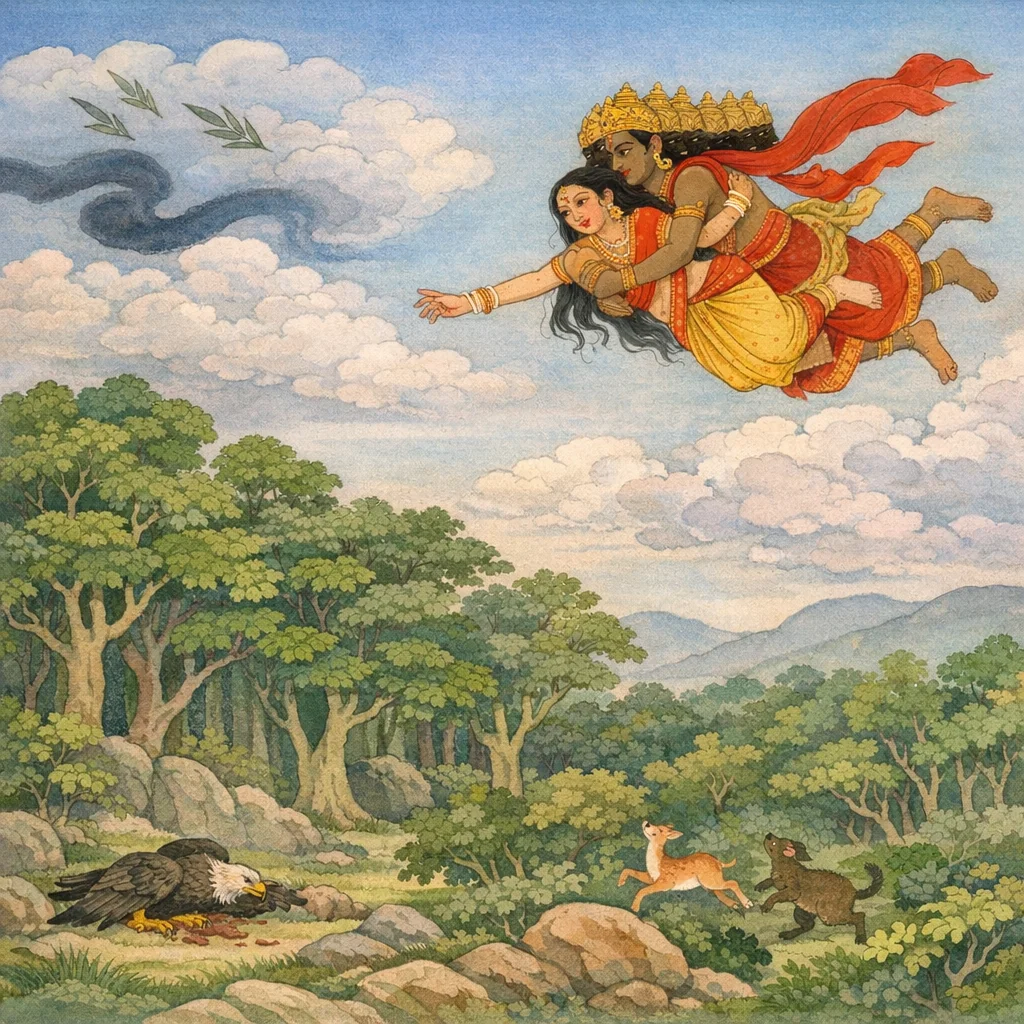
This sarga portrays Sītā’s immediate psychological and ethical response as Rāvaṇa takes flight with her. Seeing him rise into the sky, she is seized by fear and agitation, then addresses him directly in a sustained moral indictment. She condemns the deed as cowardly and adharma—abducting another man’s wife when she is alone—bringing public censure and disgrace upon one’s family. Sītā recalls the fallen Jaṭāyu, who tried to protect her, making his memory both lament and accusation against Rāvaṇa. Her speech then turns from shame to warning and prophecy: she declares that Rāma, blazing with wrath together with Lakṣmaṇa, will destroy Rāvaṇa, and that even with an army he cannot survive within the princes’ sight or endure the “touch” of their arrows. Death-omens and images of the hereafter follow—the noose of death, the Vaitaraṇī river, the sword-leaf forest, and the thorned Śālmalī—marking Rāvaṇa’s impending doom. The sarga ends with Rāvaṇa still carrying away the trembling, struggling princess, while Sītā’s lament continues as a witness to dharma within the narrative.
Shlokas
Verse 1
खमुत्पतन्तं तं दृष्ट्वा मैथिली जनकात्मजा।दुःखिता परमोद्विग्ना भये महति वर्तिनी।।3.53.1।।
Seeing him rise into the sky, Maithilī—Janaka’s daughter—was filled with sorrow, deeply shaken, and overwhelmed by great fear.
Verse 2
रोषरोदनताम्राक्षी भीमाक्षं राक्षसाधिपम्।रुदन्ती करुणं सीता ह्रियमाणेदमब्रवीत्।।3.53.2।।
As she was being carried away, Sītā wept piteously—her eyes reddened by anger and grief—and, facing the rākṣasa-lord with his terrifying gaze, she spoke these words.
Verse 3
न व्यपत्रपसे नीच कर्मणानेन रावण।ज्ञात्वा विरहितां यन्मां चोरयित्वा पलायसे।।3.53.3।।
O base Rāvaṇa—are you not ashamed of this deed, that, knowing me to be separated from my protector, you steal me away and flee?
Verse 4
त्वयैव नूनं दुष्टात्मन् भीरुणा हर्तुमिच्छता।ममापवाहितो भर्ता मृगरूपेण मायया।।3.53.4।।
Indeed, O wicked one, it was you—timid at heart and intent on abducting me—who lured my husband away by deceit, taking the form of a deer through māyā.
Verse 5
यो हि मामुद्यतस्त्रातुं सोऽप्ययं विनिपातितः।गृध्रराजः पुराणोऽसौ श्वशुरस्य सखा मम।।3.53.5।।
Even he who rose up to protect me has been struck down—this ancient king of vultures, a friend of my father-in-law.
Verse 6
परमं खलु ते वीर्यं दृश्यते राक्षसाधम।विश्राव्य नामधेयं हि युद्धे नास्मि जिता त्वया।।3.53.6।।
Your “supreme valor” is plainly on display, O vilest of rākṣasas; yet in an openly declared battle, even after proclaiming your name, you have not conquered me.
Verse 7
ईदृशं गर्हितं कर्म कथं कृत्वा न लज्जसे।स्त्रियाश्च हरणं नीच रहिते च परस्य च।।3.53.7।।
How do you feel no shame after doing such a condemned deed—abducting another man’s wife when she is alone, O base one?
Verse 8
कथयिष्यन्ति लोकेषु पुरुषाः कर्म कुत्सितम्।सुनृशंसमधर्मिष्ठं तव शौण्डीर्यमानिनः।।3.53.8।।
People across the world will speak of your deed as contemptible—cruel and utterly against dharma—though you imagine yourself to be heroic.
Verse 9
धिक्ते शौर्यं च सत्त्वं च यत्त्वं कथितवांस्तदा।कुलाक्रोशकरं लोके धिक्ते चारित्रमीदृशम्।।3.53.9।।
Shame on that “heroism” and “strength” you once proclaimed! Shame on such conduct of yours—bringing disgrace upon your lineage before the world.
Verse 10
किं कर्तुं शक्यमेवं हि यज्जवेनैव धावसि।मुहूर्तमपि तिष्ठस्व न जीवन्प्रतियास्यसि।।3.53.10।।
What can be done, when you flee with such speed? Stay even for a moment—you will not return alive.
Verse 11
न हि चक्षुष्पथं प्राप्य तयोः पार्थिवपुत्रयोः।ससैन्योऽपि समर्थस्त्वं मुहूर्तमपि जीवितुम्।।3.53.11।।
For if you come within the sight of those two royal princes, you will not be able to live even a moment—even with your army.
Verse 12
न त्वं तयोश्शरस्पर्शं सोढुं शक्तः कथञ्चन।वने प्रज्वलितस्येव स्पर्शमग्नेर्विहंगमः।।3.53.12।।
You cannot, in any way, endure even the touch of their arrows—just as a bird cannot bear the touch of a forest fire.
Verse 13
साधु कुर्वाऽऽत्मनः पथ्यं साधु मां मुञ्च रावण।मत्प्रधर्षणरुष्टो हि भ्रात्रा सह पतिर्मम।।3.53.13।।विधास्यति विनाशाय त्वं मां यदि न मुञ्चसि।
Do what is truly wholesome for yourself, Rāvaṇa—act rightly and release me. For my husband, enraged by this assault upon me, together with his brother, will bring about your destruction if you do not let me go.
Verse 14
येन त्वं व्यवसायेन बलान्मां हर्तुमिच्छसि।।3.53.14।।व्यवसायस्स ते नीच भविष्यति निरर्थकः।
By whatever scheme you seek to carry me off by force—O base one—that very effort of yours will prove futile.
Verse 15
न ह्यहं तमपश्यन्ती भर्तारं विबुधोपमम्।।3.53.15।।उत्सहे शत्रुवशगा प्राणान्धारयितुं चिरम्।
For I cannot bear to sustain my life for long—held under an enemy’s power—without seeing my husband, who is like a god.
Verse 16
न नूनं चात्मनः पथ्यं श्रेयो वा समवेक्षसे।।3.53.16।।मृत्युकाले यथा मर्त्यो विपरीतानि सेवते।
Surely you cannot discern what is truly beneficial or good for yourself—just as mortals, when death is near, take to what is contrary to their own welfare.
Verse 17
मुमूर्षूणां हि सर्वेषां यत्पथ्यं तन्न रोचते।।3.53.17।।पश्याम्यद्य हि कण्ठेत्वां कालपाशावपाशितम्।
For all who are bent on death, what is salutary never pleases them. And today I see the noose of Time wound about your neck.
Verse 18
यथा चास्मिन्भयस्थाने न बिभेषि दशानन।।3.53.18।।व्यक्तं हिरण्मयान् हि त्वं सम्पश्यसि महीरुहान्।
O Daśānana, since in this very place of terror you feel no fear, it is plain that you are seeing golden trees—an omen that death draws near.
Verse 19
नदीं वैतरणीं घोरां रुधिरौघनिवाहिनीम्।।3.53.19।।असिपत्रवनं चैव भीमं पश्यसि रावण।
O Rāvaṇa, you behold the dreadful Vaitaraṇī river, bearing torrents of blood, and also the terrifying forest whose leaves are swords.
Verse 20
तप्तकाञ्चनपुष्पां च वैडूर्यप्रवरच्छदाम्।।3.53.20।।द्रक्ष्यसे शाल्मलीं तीक्ष्णामायसैः कण्टकैश्चिताम्।
You will behold the sharp śālmalī tree—bearing blazing golden blossoms and a covering like excellent vaidūrya—yet studded with iron thorns.
Verse 21
न हि त्वमीदृशं कृत्वा तस्यालीकं महात्मनः।।3.53.21।।धरितुं शक्ष्यसि चिरं विषं पीत्वेव निर्घृणः।
Pitiless one, having committed such deceit against that great-souled man, you will not endure long—like one who has drunk poison.
Verse 22
बद्धस्त्वं कालपाशेन दुर्निवारेण रावण।।3.53.22।।क्वगतो लप्स्यसे शर्म भर्तुर्मम महात्मनः।
O Rāvaṇa, you are bound by the inescapable noose of Time. Where could you go to find peace from my great-souled husband?
Verse 23
निमेषान्तरमात्रेण विना भ्रात्रा महावने।।3.53.23।।राक्षसा निहता येन सहस्राणि चतुर्दश।स कथं राघवो वीरस्सर्वास्त्रकुशलो बली।।3.53.24।।न त्वां हन्याच्छरैस्तीक्ष्णैरिष्टभार्यापहारिणम्।
In this great forest, in no more than the blink of an eye—and without his brother’s help—he by whom fourteen thousand rākṣasas were slain: how could that heroic Rāghava, strong and skilled in every weapon, not kill you with sharp arrows, you who have stolen his beloved wife?
Verse 24
निमेषान्तरमात्रेण विना भ्रात्रा महावने।।3.53.23।।राक्षसा निहता येन सहस्राणि चतुर्दश।स कथं राघवो वीरस्सर्वास्त्रकुशलो बली।।3.53.24।।न त्वां हन्याच्छरैस्तीक्ष्णैरिष्टभार्यापहारिणम्।
In this vast forest, in but the space of a blink, and without his brother’s aid, he slew fourteen thousand rākṣasas. How could that heroic Rāghava—mighty and skilled in every weapon—not strike you down with sharp arrows, you who have abducted his beloved wife?
Verse 25
तच्चान्यच्च परुषं वैदेही रावणाङ्कगा।।3.53.25।।भयशोकसमाविष्टा करुणं विललाप ह।
Vaidehī—held in Rāvaṇa’s grasp—overwhelmed by fear and grief, lamented bitterly, uttering words that were at times harsh and at times pleading.
Verse 26
तथा भृशार्तां बहुचैव भाषिणीं विलापपूर्वं करुणं च भामिनीम्।जहार पापः करुणं विचेष्टतीं नृपात्मजामागतगात्रवेपथुम्।।3.53.26।।
Thus the sinful one carried off the princess—trembling in every limb—uttering many pleas, weeping and lamenting piteously, writhing helplessly in anguish.
Frequently Asked Questions
The pivotal action is Rāvaṇa’s abduction of Sītā while she is separated from Rāma; Sītā frames it as adharma and cowardice—an illegitimate seizure rather than a declared, accountable contest.
Speech becomes ethical resistance: Sītā uses reasoned condemnation, appeal to public moral judgment, and consequence-based warning to assert dharma even under coercion, illustrating that righteousness includes refusing to normalize wrongdoing.
The sarga invokes culturally charged afterlife and omen landscapes—Vaitaraṇī river, Asipatravana, and the thorned Śālmalī—alongside the great forest setting, to map Rāvaṇa’s act onto a cosmology of inevitable punishment.