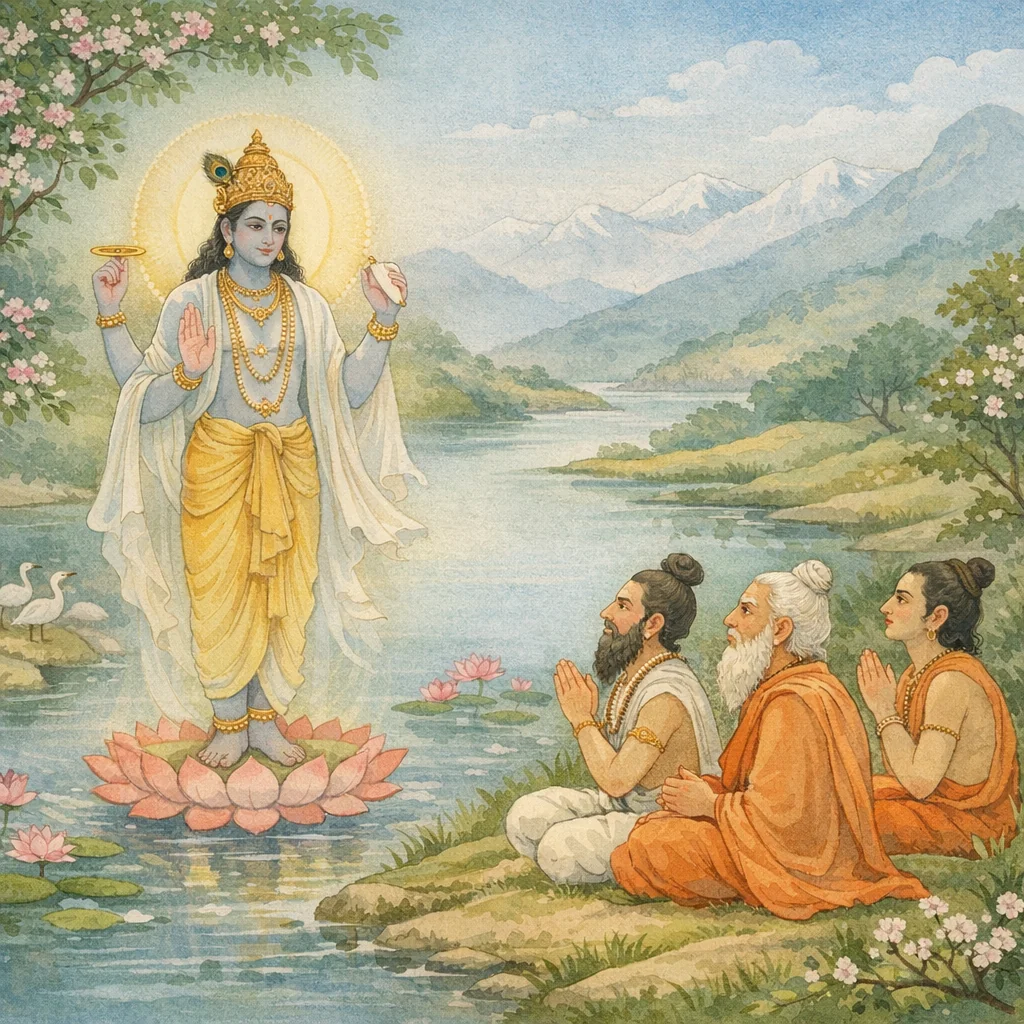
Adhyaya 44
Umā’s Austerity, Kauśikī’s Manifestation, and Skanda’s Birth Leading to Tāraka’s Defeat
Adhyāya 44 opens with a charged exchange between Śiva and Pārvatī: a remark about her complexion (“Kṛṣṇā”) kindles Umā’s anger, and she reflects on the sin of slander and resolves to perform austerities (tapas) to attain the radiant state of Gaurī. A gatekeeping episode involving Vīraka intersects with deception: a Daitya assumes Umā’s form to enter Śiva’s presence, but is exposed by the absence of a bodily mark and is slain. With Brahmā’s intervention and through Pārvatī’s tapas, her dark sheath is cast off and becomes Kauśikī/Caṇḍikā, lion-mounted and charged with a divine commission. The narrative then turns to Skanda’s manifestation through Agni and the Kṛttikās, his consecration, and the climactic war in which Kumāra kills Tāraka. The closing phalaśruti promises fame, prosperity, and fearlessness to devoted reciters and listeners.
Shlokas
Verse 1
शर्व उवाच । शरीरे मम तन्वंगि सिते भास्यसितद्युतिः । भुजंगी वा सिता शुभ्रे संश्लिष्टा चंदनेतरौ
Śarva (Śiva) said: “O slender-limbed one, upon my body—though it is dark in radiance—there shines a white brilliance. O fair one, it is as if a white serpent were clasped close, like sandalwood paste upon another surface.”
Verse 2
चंद्रातपेन संपृक्ता रुधिराम्बरसंवृता । रजनी वा सिते पक्षे दृष्टिदोषं ददासि मे
Smeared with moonlight and wrapped in a blood-red garment—are you the night of the bright fortnight? You are giving me a defect of sight, a blinding illusion.
Verse 3
इत्युक्ता गिरिजा तेन मुक्तकंठा पिनाकिनम् । उवाच कोपरक्ताक्षी भ्रुकुटी विकृतानना
Thus addressed by him, Girijā—her voice unrestrained—spoke to Pinākin (Śiva), her eyes reddened with anger, her brows knit, and her face contorted.
Verse 4
देव्युवाच । स्वकृतेन जनः सर्वो जाड्येन परिभूयते । अवश्यमर्थी प्राप्नोति खंडनं शशिमंडन
The Goddess said: Every person is overcome by dullness through their own deeds. One driven by need inevitably meets with ruin, O Śaśimaṇḍana, Lord crowned with the moon.
Verse 5
तपोभिर्दीर्घचरितैर्या त्वां प्रार्थितवत्यहं । तस्या मेनि यतस्त्वेष ह्यवमानः पदे पदे
I, who had sought you through austerities and long observances—because of that, O Meni, this has become for her an insult at every step.
Verse 6
नैवास्मि कुटिला शर्व विषमा न च धूर्जटे । सविषस्त्वं जगत्ख्यातो व्यक्तदोषाकराश्रयः
I am not deceitful, O Śarva; nor am I harsh, O Dhūrjaṭi. It is you who are famed throughout the world as ‘poisonous,’ a manifest refuge of a mine of faults.
Verse 7
त्वं हि मुष्णासि दशनान्नेत्रहंता भगस्य च । आदित्यस्त्वां विजानाति भगवान्द्वादशात्मकः
You indeed steal the teeth, and you are the destroyer of Bhaga’s eyes. The blessed Āditya—the Lord in twelvefold form—recognizes you for what you are.
Verse 8
मूर्ध्नि शूलं जनयसि स्वैर्दोषैर्मामधिक्षिपन् । यस्त्वं मामात्थकृष्णेति महाकालोसि विश्रुतः
You are causing a stabbing pain in my head, blaming me for faults that are your own. You who addressed me as “Kṛṣṇa”—you are famed as Mahākāla.
Verse 9
यास्याम्यहं परित्यक्तुमात्मानं तपसा गिरिम् । जीवंत्या न मया कृत्यं धूर्तेन परिभूतया
I shall go to the mountain of austerities and abandon my life. Nothing remains for me to do while living, for I have been deceived and dishonored by a rogue.
Verse 10
कापालिकेन क्षुद्रेण श्मशाने नित्यवासिना । भूत्या विलिप्त स्वांगेन मातृमध्यस्थ चारिणा
—by a vile Kāpālika, a constant dweller in the cremation-ground, his own body smeared with ash, roaming amid the Mothers (Mātṛkās).
Verse 11
निशम्य तस्या वचनं कोपतीक्ष्णाक्षरं हरः । उवाचानिष्टसंभ्रांतः प्रचलेनेंदुमौलिना
Hearing her words—sharp-edged with anger—Hara spoke, shaken with displeasure, his moon-crested head trembling.
Verse 12
शर्व उवाच । अगात्मजासि गिरिजे नाहं निंदापरस्तव । चाटूक्तिबुध्या तु मया कृत उन्मादसंश्रयः
Śarva said: O Girijā, you are the daughter of the Mountain; I am not one who finds fault with you. Rather, thinking it mere playful flattery, I spoke in a way that gave shelter to madness (that is, led to delusion).
Verse 13
विकल्पः स्वस्थचित्ते तु गिरिजे न मम क्रमात् । यद्येवं कुपिता भीरु तत्तवाहं न वै पुनः
O Girijā, when the mind is steady there is no room for doubt in my way. If you are thus angered, O timid one, then I shall not speak that to you again.
Verse 14
नर्मवादी भविष्यामि जहि कोपं शुचिस्मिते । शिरसा प्रणतेनैष रचितस्ते मयांजलि
I shall speak gently—abandon your anger, O pure-smiling one. With my head bowed, I have offered you this añjali, a reverent gift.
Verse 15
नि हीनो ह्यपमानेन निंदिते नैति विक्रियाम् । असतां तु सतां न स्यान्मर्मस्पृष्टो नरः किल
A noble person is not diminished by insult, nor disturbed when reviled. Yet among the wicked, even the good may not remain unchanged—when a tender spot is struck, a person indeed reacts.
Verse 16
अनेकैश्चाटुभिर्देवी देवेन प्रतिबोधिता । कोपं तीव्रं न तत्याज सती मर्मणि घट्टिता
Though the Goddess was urged and soothed by the god with many gentle, flattering words, Satī did not relinquish her fierce anger, for she had been struck at the very core of her feeling.
Verse 17
अवष्टब्धमथाच्छिद्य वासः शंकरपाणिना । विपर्यस्तालकावेगाद्गन्तुमैच्छच्च शैलजा
Then, by Śaṅkara’s hand, her garment—held fast—was torn away; and the daughter of the mountain, her locks thrown into disarray by the sudden force, wished to depart.
Verse 18
तस्या व्रजंत्याः कोपेन पुनराह पुरांतकः । सत्यं सर्वैरवयवैस्तनोषि सदृशां पितुः
As she departed in anger, Purāntaka spoke again: “Truly, in every limb you bear the likeness of your father.”
Verse 19
हिमाचलस्य शृंगस्थमेव जालाकुलं मनः । तथा दुरवगाह्येभ्यो गहनो हि तवाशयः
Just as the mind, poised upon the peaks of the Himālaya, becomes entangled like a net, so too your intention is truly deep—hard to fathom even for those who are themselves difficult to comprehend.
Verse 20
काठिन्यमश्मसारेभ्यो वनेभ्यो बहुलां गता । कुटिलत्वं निम्नगाभ्यो दुःसेव्यत्वं हिमादपि
She has taken hardness from rocks, density from forests, crookedness from rivers, and even from snow an unapproachable nature.
Verse 21
संक्रांतं सर्वमेवैतत्तन्वंगि हिमभूधरात् । इत्युक्ता सा पुनः प्राह गिरिशं शैलकन्यका
“O slender-limbed one, all this has indeed passed over from the snowy mountain (Himālaya).” Thus addressed, the mountain-born maiden again spoke to Giriśa (Śiva).
Verse 22
कोपकंपितमूर्द्धा सा प्रस्फुरद्दशनच्छदा । उमोवाच । स्यात्सर्वं दोषदानेन निंदायां गुणिनो बलात्
With her head trembling in anger and her lips quivering over her teeth, Umā said: “In the act of slander, through the force of one who is truly virtuous, everything turns back upon the fault-finder—becoming his own fault.”
Verse 23
तवापि दुष्टसंपर्कात्संक्रांतं सर्वमेव हि । व्यालेभ्योनेकजिह्वत्वं भस्मनोऽस्नेहवृत्तिता
Indeed, through association with the wicked, everything is transmitted even to you: from serpents comes the state of having many tongues, and from ashes comes the nature of being without oiliness—dry and unsoftened.
Verse 24
हृत्कालुष्यं शशांकोत्थं दुर्बाधत्वं विषादपि । किं चात्र बहुनोक्तेन अलं वाचां श्रमेण ते
It removes the heart’s impurity, cures ailments born of the moon, and even the most stubborn afflictions and dejection. But what need is there for many words here? Enough—do not weary yourself with speech.
Verse 25
श्मशानवासान्निर्भीस्त्वं नग्नत्वात्तवनत्रपा । निर्घृणत्वं कपालित्वाद्दया ते विगता चिरम्
Because you dwell in the cremation-ground, you are fearless; because you go naked, you have no shame. Because you bear a skull, you have become pitiless—your compassion has long since vanished.
Verse 26
इत्युक्त्वा मंदिरात्तस्मान्निर्जगाम हिमाद्रिजा । तस्यां व्रजंत्यां देवेश्यां गणैः किलकिलाकृता
Having spoken thus, Himādrijā (Pārvatī), the daughter of the Himālaya, departed from that temple. As the divine mistress proceeded, the gaṇas made loud, jubilant cries.
Verse 27
क्व मातर्गच्छसीत्युक्त्वा रुदद्भिर्धावितं पुनः । विष्टभ्य चरणौ देव्या वीरको बाष्पगद्गदः
Crying, he ran after her again, saying, “Mother, where are you going?” Then Vīraka, his voice choked with tears, clung tightly to the goddess’s feet.
Verse 28
प्रोवाच मातः किन्न्वेतत्क्व यासि कुपितातुरा । अहं त्वामनुयास्यामि व्रजंतीं स्नेहवर्जिताम्
He said: “Mother, what is this? Where are you going, distressed with anger? I will follow you—though you depart devoid of affection.”
Verse 29
नोचेत्पतिष्ये शिखराद्गिरेरस्य त्वयोज्झितः । उन्नम्यवदनं देवी दक्षिणेन तु पाणिना
“Otherwise, cast off by you, I would fall from the summit of this mountain.” Then the Goddess lifted up his face with her right hand.
Verse 30
उवाच वीरकं माता त्वं शोकं पुत्र मा कृथाः । शैलाग्रात्पतितुं नैव न च गंतुं मया सह
The mother said to Vīraka: “My son, do not grieve. I will neither leap from the mountain peak, nor will I go with you.”
Verse 31
युक्तं ते पुत्र गच्छामि येन कार्येण तच्छृणु । कृष्णेत्युक्ता हरेणाहं स्तंभितास्म्यवमानिता
“It is fitting, my son, that I go—listen to the purpose for which I must go. When Hari addressed me saying ‘Kṛṣṇā,’ I was stunned and felt dishonored.”
Verse 32
साहं तपः करिष्यामि येन गौरीत्वमाप्नुयाम् । एष स्त्रीलंपटो देवो यातायां मय्यनंतरम्
Therefore I shall undertake austerities, by which I may attain the state of Gaurī. This god—so lustfully attached to women—will come after me once I have departed.
Verse 33
द्वाररक्षा त्वया कार्या नित्यं रन्ध्रान्ववेक्षणम् । यथा न काचित्प्रविशेद्योषित्तत्र हरांतिकम्
You must keep constant watch at the door, always observing every opening, so that no woman may enter there, into Hara’s private presence.
Verse 34
दृष्ट्वा परस्त्रियं चापि वदेथा मम पुत्रक । शीघ्रमेव करिष्यामि यथायुक्तमनंतरम्
Having seen another man’s wife, speak to me as well, my son; I shall promptly do what is proper, immediately thereafter.
Verse 35
एवमस्त्विति देवेशीं वीरकोवाच सांप्रतम् । मातुराज्ञामृताहार प्लावितांगो गतज्वरः
“So be it,” Vīraka said to the divine lady just then. Bathed in the nectar-like nourishment given by his mother’s command, his body was suffused with vitality and his fever departed.
Verse 36
जगाम रक्षां स द्रष्टुं प्रणिपत्य तु मातरम् । देवी चापश्यदायांतीं सखीं मातुर्विभूषिताम्
After bowing down to his mother, he went to see Rakṣā. The goddess then saw a friend approaching, adorned with her mother’s ornaments.
Verse 37
कुसुमामोहिनीं नाम तस्य शैलस्य देवताम् । सापि दृष्ट्वा गिरिसुतां स्नेहविक्लवमानसा
There was a deity of that mountain named Kusumāmohinī. Seeing the Daughter of the Mountain, she too became emotionally overwhelmed with affection.
Verse 38
क्व पुत्रि गच्छसीत्युच्चैरालिग्योवाच देवता । सा तस्याः सर्वमाचख्यौ शंकरात्कोपकारणम्
Embracing her, the goddess said aloud, “Daughter, where are you going?” Then she told her everything—the cause of Śaṅkara’s anger.
Verse 39
पुनश्चोवाचगिरिजा देवतां मातृसंमिताम् । उमोवाच । नित्यं शैलाधिराजस्य देवतात्वमनिंदिते
Again Girijā spoke to that goddess, who was like a mother. Umā said: “O blameless one, the Lord of Mountains ever abides in divine status.”
Verse 40
सर्वतः सन्निधानं ते मनसातीव वत्सला । अतस्तु ते प्रवक्ष्यामि यद्विधेयं त्वयांबिके
Your presence is felt on every side, and in your heart you are exceedingly tender. Therefore, O Mother Ambikā, I shall now tell you what you must do.
Verse 41
अन्यस्त्रीसंप्रवेशस्तु त्वया रक्ष्यः प्रयत्नतः । सरहस्ये प्रयत्नेन निषेव्यः सततं गिरौ
With care and steadfast diligence you must guard yourself against entanglement with another man’s wife. And with earnest effort, you should always practice the discipline in a secluded, secret place upon the mountain.
Verse 42
पिनाकिनः प्रविष्टायां वक्तव्यं मे त्वयानघे । ततोहं संविधास्यामि यत्क्षमं तदनंतरम्
When the bearer of the Pināka (Śiva) has entered, O blameless one, you must deliver my message. Then, immediately afterward, I shall arrange whatever is fitting and possible.
Verse 43
इत्युक्ता तां तथेत्युक्त्त्वा जगाम सा गिरिं शुभा । उमापि पितुरुद्यानं जगामाद्रिसुताद्भुतम्
Thus addressed, she replied, “So be it,” and the auspicious one went to the mountain. Umā too—the wondrous daughter of the mountain—went to her father’s garden-grove.
Verse 44
अंतरिक्षं समाविश्य मेघमालाविलप्रभम् । भूषणानि ततो न्यस्य वृक्षवल्कलधारिणी
Entering the mid-air, she shone with a splendor like a garland of clouds; then, setting aside her ornaments, she wore garments made of tree-bark.
Verse 45
ग्रीष्मे पंचाग्निसंतप्ता वर्षासु च जलोषिता । वन्याहारा निराहारा शुष्कस्थंडिलशायिनी
In the summer she endured the heat of the five fires; in the rainy season she remained soaked with water. Living on forest fare—or even fasting—she slept upon a dry, bare patch of ground.
Verse 46
एवं साधयती तत्र तपः सा च व्यवस्थिता । ज्ञात्वा गतां गिरिसुतां दैत्यस्तत्रांतरे बली
Thus she continued performing austerities there, remaining firmly resolved. Meanwhile, the mighty Daitya, having learned that the Daughter of the Mountain had gone there, arrived in that interval.
Verse 47
अंधकस्य सुतो हृष्टः पितुर्वधमनुस्मरन् । देवान्सर्वान्विजित्याजौ बकभ्राता रणोत्कटः
Andhaka’s son, exulting as he recalled the slaying of his father, conquered all the gods in battle—he, the brother of Baka, fierce and formidable in war.
Verse 48
आडिर्नामांतरप्रेक्षीसततंचंद्रमौलिनः । आजगामामररिपुः पुरं त्रिपुरघातिनः
Āḍi—ever watching for an opportune moment—came to the city of the moon-crested Lord, the destroyer of Tripura, as an enemy of the gods.
Verse 49
स तत्रागत्य ददृशे वीरकं द्वार्यवस्थितम् । विचिंत्य सोपि च वरं दत्तं कमलयोनिना
Arriving there, he saw Vīraka standing at the doorway. Reflecting, he too recalled the boon bestowed by the Lotus-born (Brahmā).
Verse 50
हते किलांधके दैत्ये गिरिशेनासुरद्विषा । आडिश्चकार विपुलं तपः परमदारुणम्
After the demon Andhaka had indeed been slain by Girīśa (Śiva), the foe of the asuras, Āḍi then undertook abundant austerity—extremely severe.
Verse 51
समागत्याब्रवीद्ब्रह्मा तपसा परितोषितः । किमाडे दानवश्रेष्ठ तपसा प्राप्तुमिच्छसि
Pleased by his austerities, Brahmā came and spoke: “O Āḍa, best among the Dānavas, what do you wish to obtain through your penance?”
Verse 52
ब्रह्माणमाह दैत्यस्तु निर्मृत्युत्वमहं वृणे । ब्रह्मोवाच । जातानामिह संसारे विना मृत्युं न युज्यते
Then the Daitya said to Brahmā, “I choose freedom from death.” Brahmā replied, “For those who are born in this world, existence without death is not possible.”
Verse 53
यतस्ततोपि दैत्येंद्र मृत्युः प्राप्यश्शरीरिभिः । इत्युक्तो दैत्यसिंहस्तु प्रोवाचांबुजसंभवम्
“O lord of the Daityas, in every way death is inevitably attained by embodied beings.” Thus addressed, the lion among the Daityas replied to the Lotus-born (Brahmā).
Verse 54
रूपस्यपरिवर्तो मे यदा स्यात्पद्मसंभव । तदा मृत्युर्मम भवेदन्यथा त्वमरोस्म्यहम्
O Lotus-born (Brahmā), if ever my form should undergo a change, then death would come to me; otherwise, I am deathless.
Verse 55
इत्युक्तस्तु तदोवाच तुष्टः कमलसंभवः । यदा द्वितीयो रूपस्य विवर्त्तस्ते भविष्यति
Thus addressed, the lotus-born one, being pleased, then spoke: “When the second transformation of your form comes to pass…”
Verse 56
तदा ते भविता मृत्युरन्यथा न भविष्यति । इत्युक्तोमरतां मेने दैत्यसूनुर्महाबलः
“Then your death will surely occur; it will not be otherwise.” Thus addressed, the mighty son of a Daitya took himself to be immortal.
Verse 57
तस्मिन्काले त्वसंस्मृत्य तद्वधोपायमात्मनः । प्रतिहर्तुर्दृष्टिपथे वीरकस्याभवंस्तदा
At that time, having forgotten the means of his own slaying, they then came within the range of sight of Vīraka, the defender.
Verse 58
भुजंगरूपी रंध्रेण प्रविवेश दृशःपथम् । परिहृत्य गणेशस्य दानवो रौद्रदुर्जयः
Assuming the form of a serpent, the demon Raudra-durjaya slipped through an opening and came within sight, having evaded Gaṇeśa.
Verse 59
अलक्षितो गणेशेन प्रविश्याथ परां तनुम् । भुजंगरूपं संत्यज्य जग्राहाथ महासुरः
Unnoticed by Gaṇeśa, the great asura entered and assumed a higher form; casting off his serpent-shape, he took on another mighty body.
Verse 60
उमारूपं रमयितुं गिरिशं मूढचेतनः । कृत्वा मायामयं रूपमप्रतर्क्यं मनोहरम्
With a deluded mind, wishing to delight Girīśa by taking on Umā’s form, he fashioned a body of māyā—bewitching, charming, and beyond the reach of reason.
Verse 61
सर्वैरवयवैः पूर्णं सर्वाभिज्ञानबृंहितम् । कृत्वा भगांतरे दंतं दैत्यो वज्रमयं दृढम्
Making it complete in every limb and strengthened by every kind of skill and knowledge, the Daitya fashioned a hard, vajra-like tusk to set in the gap between the teeth.
Verse 62
तीक्ष्णाग्रं बुद्धिमोहेन गिरिशं हंतुमुद्यतः । कृत्वोमारूपसंस्थानं गतो दैत्यो हरांतिकम्
With a sharp-pointed weapon and a mind deluded, the demon set out to slay Girīśa. Assuming Umā’s form and appearance, he went into Hara’s presence.
Verse 63
पापो रम्याकृतिश्चित्र भूषणांबरसंयुतः । तं दृष्ट्वा गिरिशस्तुष्टस्तमालिंग्य महासुरम्
Pāpa, fair in appearance and adorned with wondrous ornaments and garments—seeing that great asura, Girīśa was pleased and embraced him.
Verse 64
मन्यमानो गिरिसुतां सर्वैरवयवांतरैः । अपृच्छत्साधुभावं ते गिरिपुत्रि न कृत्रिमम्
Deeming you in every feature and in all your marks to be the Mountain’s daughter, he questioned you, O daughter of the Mountain, about your true goodness—without any pretense.
Verse 65
या त्वं मदाशयं ज्ञात्वा प्राप्तेह वरवर्णिनी । त्वया विरहितं शून्यं मम स्थानं जगत्त्रयम्
O fair lady, since you have understood my heart’s intent and have come here, without you my abode—and indeed the three worlds—seems empty.
Verse 66
प्राप्ता प्रसन्नवदने युक्तमेवंविधं त्वयि । इत्युक्तो दानवेंद्रस्तु तं बभाषे स्मितं शनैः
With a serene countenance he said, “Such conduct indeed befits you.” Thus addressed, the lord of the Dānavas replied slowly, with a gentle smile.
Verse 67
स चाबुध्यदभिज्ञानैः प्राह त्रिपुरघातिनम् । दैत्य उवाच । यातास्मि तपसः कामाद्वरं लब्धुं हिमाचलम्
Recognizing him by the signs, he spoke to the slayer of Tripura. The Daitya said: “Driven by the desire to perform tapas and obtain a boon, I have come to the Himālaya mountain.”
Verse 68
रतिश्च तत्र मेनाभूत्ततः प्राप्ता त्वदंतिकम् । इत्युक्तः शंकरः शंकां चित्ते प्राप्तो विचारयन्
“And there Rati appeared to me; from there she came near to you.” Thus addressed, Śaṅkara, as a doubt arose in his mind, began to reflect.
Verse 69
हृदयेन समाधाय देवः प्रहसिताननः । कुपिता कुपितं बुद्ध्वा प्रकृत्या च दृढव्रता
Composing himself within his heart, the God, his face smiling, spoke. Yet she, angered, took him to be angered; by nature she was steadfast in her vow.
Verse 70
अप्राप्तकामा संप्राप्ता किमेतत्संविजानती । इति चिंत्य हरस्तस्या अभिज्ञानं विचारयन्
Thinking, “She who had not attained her desired aim has now come—what can this mean, and what does she understand?”, Hara reflected, examining the sign by which she might be recognized.
Verse 71
नापश्यद्वामपार्श्वे तु तदंकं पद्मलक्षणम् । लोम्नामावर्तरचितं ततो देवः पिनाकधृक्
Then Pināka-bearing Śiva did not see on the left side that mark bearing the sign of a lotus, formed by the whorled arrangement of hairs.
Verse 72
बुद्ध्वा तां दानवीं मायामाकारं गूहयंस्ततः । मेढ्रदंष्ट्रास्त्रमादाय दानवं तमसादयत्
Recognizing that as a Dānava’s demonic māyā, he then concealed his own form; taking up the weapon called Meḍhradaṃṣṭrāstra, he struck down the Dānava.
Verse 73
न चाबुध्यत तद्वृत्तं वीरको द्वाररक्षकः । कुसुमामोदिनं दृष्ट्वा स्त्रीरूपं दानवेश्वरम्
But Vīraka, the gatekeeper, did not understand what had happened; seeing the lord of the Dānavas in a woman’s form, fragrant with the scent of flowers, he failed to recognize the truth of the situation.
Verse 74
दूतेन मारुतेनाशु बोधिता हिमशैलजा । श्रुत्वा वायुमुखाद्देवी क्रोधरक्ताविलेक्षणा
Quickly informed by the wind as a messenger, the daughter of Himālaya heard the report from Vāyu’s own mouth; and the Goddess’ eyes grew clouded and reddened with anger.
Verse 75
अपश्यद्वीरकं पुत्रं हृदयेनैव दूयता । देव्युवाच । मातरं मां परित्यज्य यस्मात्त्वं स्नेहविक्लवाम्
Seeing her son Vīraka, she was pained in the very depths of her heart. The Goddess said: “Since you have abandoned me—your mother—when I was overcome with affection…”
Verse 76
विहितावसरः स्त्रीणां शंकरस्य रहोविधौ । तस्मात्ते मानुषे रूक्षा जडा हृदयवर्जिता
In Śaṅkara’s secret rite, women have been assigned a prescribed role. Therefore, among human beings they are spoken of as harsh, dull, and devoid of tenderness of heart.
Verse 77
गणेशाकारसदृशी शिला माता भविष्यति । निमित्त एष विख्यातो वीरकस्य सुतादरात्
A stone resembling the form of Gaṇeśa will become the Mother. This sign is well known, arising from the devoted reverence of Vīraka’s son.
Verse 78
संभवे प्रक्रमे चैव विचित्राख्या न संशयः । एवमुत्सृष्टशापायां गिरिपुत्र्यामनंतरं
In the account of Sambhava and in the course of events as well, there is no doubt that it is called ‘Vicitrākhyā’. Thus, immediately after the mountain-born maiden had been released from the curse, …
Verse 79
निर्जगाम मुखात्क्रोधः सिंहरूपी महाबलः । स तु सिंहः करालास्यः सटाजटिलकंधरः
From his mouth sprang forth wrath, assuming the form of a mighty lion. That lion bore a fearsome, gaping maw, and a thick neck tangled with mane-like locks.
Verse 80
ऊर्ध्वप्रोद्भूतलांगूलो दंष्ट्रोत्कटमुखावटः । व्यादितास्यो लंबजिह्वः क्षामः कुक्षिबलादिषु
With its tail raised high, its mouth made dreadful by jutting fangs, its jaws gaping and its long tongue hanging down, it was emaciated—its belly, its strength, and all else had wasted away.
Verse 81
अस्यास्ये वर्तितुं देवी व्यवस्थितवती तदा । ज्ञात्वा मनोगतं तस्या भगवांश्चतुराननः
Then the Goddess resolved to remain at its mouth; and the Blessed Four-faced Lord (Brahmā), understanding what was in her mind, responded accordingly.
Verse 82
आजगामाश्रमपदं संपदामाश्रयं यतः । आगम्योवाच देवेशो गिरिजां स्पष्टया गिरा
He came to the hermitage, an abode that shelters prosperity. Having arrived, the Lord of the gods spoke to Girijā (Pārvatī) in clear words.
Verse 83
ब्रह्मोवाच । किं पुनः प्राप्तुकामासि किमलभ्यं ददामि ते । विरम्यतामतिक्लेशात्तपसोस्मान्मदाज्ञया
Brahmā said: “What is it that you still wish to obtain? What unattainable thing is there that I cannot grant you? By my command, desist from this austerity that brings excessive hardship.”
Verse 84
तच्छ्रुत्वोवाचगिरिजा गुरोर्गौरवयंत्रितं । वाक्यं वाचाहरोद्गीर्णवर्णनिर्गमवांछितं
Hearing this, Girijā (Pārvatī) spoke; yet, restrained by reverence for her guru, she yearned to utter the words, her voice faltering as she wished the syllables to come forth.
Verse 85
देव्युवाच । तपसा दुष्करेणाप्तः पतिर्वै शंकरो मया । समां श्यामलवर्णेति बहुशः प्रोक्तवान्रहः
The Goddess said: “By severe and difficult austerities I obtained Śaṅkara as my husband. Again and again, in private, he told me: ‘You are dark-complexioned, my beloved.’”
Verse 86
तस्मादहं कांचनाभवर्णा तन्नामसंयुता । भर्तुर्भूतपतेरंगमेकतो निर्विषं भवेत्
Therefore I, golden-hued and bearing that very name, shall cause one part of my husband Bhūtapati’s body to become free from poison.
Verse 87
तस्यास्तद्भाषितं श्रुत्वा प्रोवाच जगदीश्वरः । एवं भव त्वं भूयश्च भर्तुर्देहार्द्धचारिणी
Hearing her words, the Lord of the universe replied: “So be it. And from now on, become the one who shares half of your husband’s body.”
Verse 88
ततस्तत्याजतां कृष्णां फुल्लनीलोत्पलत्वचं । त्वक्च साप्यभवद्भीमा घंटाहस्तात्रिलोचना
Then she cast off her dark skin, like a fully-bloomed blue lotus; and that very skin became a terrifying being—three-eyed, holding a bell in her hand.
Verse 89
नानाभरणसंपूर्णा पीतकौशेयधारिणी । तामब्रवीत्ततो ब्रह्मा देवीं नीलांबुजत्विषं
Adorned with many ornaments and clad in yellow silk, the Goddess—radiant like a blue lotus—was then addressed by Brahmā.
Verse 90
निशे भूधरजा देह संपर्का त्वं मदाज्ञया । संप्राप्ता कृतकृत्यत्वमेकानंशा पुरो ह्यसि
O Night—born of the Mountain—by my command you have come into contact with a body. You have attained the state of having fulfilled your task; you are indeed a single portion of that power standing before me.
Verse 91
य एष सिंहः प्रोद्भूतो देव्याः क्रोधाद्वरानने । स तेस्तु वाहनं देवि केतौ चास्तु महाबलः
O fair-faced Goddess, this lion that has sprung forth from the Goddess’s wrath—let him be your mount, O Devī; and let Ketu also be mighty in strength.
Verse 92
गच्छ विंध्याचलं तत्र सुरकार्यं करिष्यसि । पंचालो नाम यक्षोयं यक्षलक्षपदानुगः
“Go to the Vindhya mountain; there you will accomplish a task for the gods. This Yakṣa here is named Pañcāla, a follower in the retinue of Yakṣa-lakṣa (Kubera).”
Verse 93
दत्तस्ते किंकरो देवि मया मायाशतैर्युतः । इत्युक्त्वा कौशिकी देवी विंध्यशैलं जगाम ह
“O Goddess, I have given you this attendant, endowed by me with hundreds of magical powers.” Having said this, the goddess Kauśikī went to the Vindhya mountain.
Verse 94
उमापि प्राप्तसंकल्पा जगाम गिरिशांतिकं । प्रविशंतीं तु तां द्वारादपहृत्य समाहितः
Umā too, having formed her resolve, went to Giriśa (Śiva). But as she was about to enter, he—self-possessed and composed—drew her back from the doorway.
Verse 95
रुरोध वीरको देवीं हेमवेत्रलताधरः । तामुवाच च कोपेन रूपे तु व्यभिचारिणीं
Vīraka restrained the goddess, holding a golden staff. Then, in anger, he addressed her: “you who are unfaithful in form.”
Verse 96
प्रयोजनं न तेत्रास्ति गच्छ यावन्न भक्ष्यसे । देव्यारूपधरो दैत्यो देवं वंचितुमागतः
You have no purpose here—go, before you are devoured. A demon, having assumed the form of the Goddess, has come to deceive the god.
Verse 97
प्रविष्टो न च दृष्टोसौ स च देवेन घातितः । घातिते चाहमाज्ञप्तो नीलकंठेन कोपिना
He entered, yet was not seen; and he was slain by the god. After he had been slain, I was commanded by the wrathful Nīlakaṇṭha.
Verse 98
द्वारे त्वनवधानं ते यस्मात्पश्यामि वै ततः । भविष्यसि न मे द्वास्थो वर्षपूगाननेकशः
Because I see that you are negligent at the gate, therefore you shall not be my gatekeeper for many multitudes of years.
Verse 99
अतस्ते नात्र दास्यामि प्रवेशं गम्यतां द्रुतम् । एकां मुक्त्वा गिरिसुतां मातरं स्नेहवत्सलाम्
Therefore I shall not grant you entry here; depart at once. Leave Girisutā’s mother alone—she is tender and full of affection.
Verse 100
प्रवेशं लभते नान्या नारी कमललोचने । इत्युक्त्वा तु तदा देवी चिंतयामास चेतसा
“No other woman gains entry, O lotus-eyed one.” Having spoken thus, the goddess then pondered within her heart.
Verse 101
नारी नैव स दैतेयो वायुर्मे यामभाषत । वृथैव वीरकश्शप्तो मया क्रोधपरीतया
“He was not a Daitya at all—he was a woman,” Vāyu told me. “In vain, then, did I curse Vīraka, for I was overcome by anger.”
Verse 102
अकार्यं क्रियते मूढैः प्रायः क्रोधसमन्वितैः । क्रोधेन नश्यते कीर्तिः क्रोधो हंति स्थितां श्रियम्
Foolish people, mostly driven by anger, tend to do what should not be done. Through anger one’s good fame is destroyed, and anger strikes down even firmly established prosperity.
Verse 103
अपरिच्छिन्नतत्वार्था पुत्रं शापितवत्यहं । विपरीतार्थबुद्धीनां सुलभो विपदागमः
Not having discerned the true reality, I cursed my son; for those whose understanding turns toward the wrong meaning, calamity arrives with ease.
Verse 104
संचिंत्यैवमुवाचेदं वीरकं प्रति शैलजा । सज्जलज्जाविकारेण वदनेनाम्बुजत्विषा
Having thus reflected, Śailajā (Pārvatī) spoke these words to Vīraka; her face shone like a lotus, softened by modest, bashful feeling.
Verse 105
देव्युवाच । अहं वीरक ते माता न तेस्तु मनसो भ्रमः । शंकरस्यास्मि दयिता सुता तुहिनभूभृतः
The Goddess said: “O Vīraka, I am your mother—let no delusion arise in your mind. I am Śaṅkara’s beloved, and the daughter of the lord of the snowy mountains.”
Verse 106
मम गात्रच्छविभ्रांत्या मा शंकां पुत्र धारय । तुष्टेन गौरता दत्ता ममेयं पद्मजन्मना
O son, do not harbor doubt because of the radiance of my limbs. This fair complexion of mine was granted by the Lotus-born (Brahmā) when he was pleased.
Verse 107
मया शप्तोस्यविदिते वृत्तांते दैत्यनिर्मिते । ज्ञात्वा नारीप्रवेशं तु शंकरे रहसि स्थिते
I cursed him when the matter, contrived by the daityas, was still unknown to me; but after learning of the woman’s entry while Śaṅkara was in secret seclusion, I understood what had occurred.
Verse 108
ननिवर्तयितुं शक्यः शापः किंतु ब्रवीमि ते । शीघ्रमेष्यसि मानुष्यात्सर्वकामसमन्वितः
The curse cannot be averted; nevertheless, I tell you this: you will soon return from the human state, endowed with the fulfillment of all desires.
Verse 109
शिरसा तु ततो वंद्य मातरं पूर्णमानसः । उवाच साध्वीं पूर्णेन्दु द्युतिं तुहिनशैलजां
Then, bowing his head in reverence and with a fully composed mind, he addressed the virtuous Mother—Pārvatī, daughter of the Himālaya—radiant with the luster of the full moon.
Verse 110
वीरक उवाच । नतसुरासुरमौलिलसन्मणिप्रवरकांतिकरालिनखाङ्घ्रिके । नगसुते शरणागतवत्सले नवनमोवनतार्त्तिविनाशिनि
Vīraka said: O Daughter of the Mountain, whose feet and fierce nails shine with the superb radiance of the finest jewels upon the bowed heads of gods and asuras; O loving guardian of those who seek refuge—again and again I bow to you, destroyer of the distress of the humble.
Verse 111
तपनमंडलमंडितकंधरे पृथुसुवर्णनगद्युतिहारिके । विषमभंगविषंगमभीषितो गिरिसुते भवतीमहमाश्रये
O Daughter of the Mountain, whose neck is adorned with a circle like the sun’s orb, who bears the radiant splendor of vast golden ornaments—terrified by the breaking of balance and by the peril of separation, I take refuge in you.
Verse 112
जगतिकाप्रणताभिमता ददौ झटिति सिद्धिमृते भवतीं यथा । जगतिकां प्रणमेच्छशिशेखरो भुवनभृन्मुनयो भवतीं यथा
As Jagatikā—beloved of those who bow to her—swiftly grants accomplishment, so may you also, O Lady. As Śiśekhara (Śiva) longs to bow to Jagatikā, so do the sages who uphold the worlds long to bow to you.
Verse 113
विमलयोगविनिर्मितदुर्जये सुतनुतुल्यमहेश्वरमंडली । विदलितांधकबांधवसंहतिः सुरवरैः प्रथमं त्वमभिष्टुता
O invincible one, fashioned by stainless yoga and hard to overcome; O Maheśvara, whose retinue is like the host of the gods—you shattered the assembled kinsmen of Andhaka; therefore the foremost of the gods first offered praise to you.
Verse 114
सितसटापटलोद्धतकंधराभवमहामृगराजरयस्थिता । विमलशक्तिमुखानलपिंगला यतभुजौघनिपिष्टमहासुरा
Mounted upon the swift king of great beasts, the lion, her neck uplifted beneath a canopy of white mane, she—golden-brown like the flame from the mouth of her stainless Śakti—crushed the mighty asuras beneath the press of her restrained multitude of arms.
Verse 115
निगदिता भुवनैरतिचंडिकाजननिशुंभनिशुंभनिषूदिनी । प्रणतचिंतितदा भवदा नवप्रशमनैकरतिस्तरसा भुवि
Throughout the worlds she is proclaimed as the exceedingly fierce Mother, Caṇḍikā, the slayer of Śuṃbha and Niśuṃbha—she who grants what the bowed devotee holds in mind, bestows well-being, and upon the earth swiftly delights in the single work of quelling freshly arising afflictions.
Verse 116
वियतिवायुपथे ज्वलनाकुलेवनितले तव देवि च यद्वपुः । तदजितेप्रतिमे प्रणमाम्यहं भुवनभाविनिते भववल्लभे
O Goddess, your very form abides in the sky, on the path of the winds, and upon the fire-filled earth. O incomparable, unconquered One, I bow to that form of yours, sustainer of the worlds, beloved of Bhava (Śiva).
Verse 117
जलधयो ललितोद्धतवीचयो हुतवहो द्युतिदग्धचराचरः । फणसहस्रभृतश्च भुजंगमास्त्वमभिधास्यसि मामभयंकरा
The oceans with their playful, surging waves; the fire that by its radiance scorches all moving and unmoving beings; and the serpents bearing a thousand hoods—you will command them all, O bestower of fearlessness; make me fearless.
Verse 118
भगवति स्थिरभक्तजनाश्रये प्रतिगतो भवतीचरणाश्रयं । करणजातमिहास्तु ममाश्रवैतवविलासमुखानुभवास्यदम्
O Blessed Goddess, refuge of steadfast devotees—having come to the shelter of your feet, may all my faculties here be devoted to hearing and directly experiencing the manifestations of your divine līlā.
Verse 119
सुप्रसन्ना ततो देवी वीरकस्येति संस्तुता । प्रविवेश शुभंभर्तुर्भुवनं भूधरात्मजा
Then the Goddess, greatly pleased and praised as “the wife of Vīraka,” entered the auspicious abode of her husband—the mountain-born daughter.
Verse 120
द्वास्थोपि वीरको देवान्हरदर्शनकांक्षिणः । व्यसर्जयत्स्वकानेव गृहानादरपूर्वकं
Vīraka, though stationed as a gatekeeper, respectfully dismissed those divine beings who longed for the sight of Hara, sending them back to their own homes.
Verse 121
नास्त्यत्रावसरो देवा देव्याः सह वृषाकपिः । निभृतः क्रीडतीत्युक्ता ययुस्ते च यथागतं
“There is no opportunity for you here, O gods—Vṛṣākapi is privately sporting with the Goddess.” Thus addressed, they departed, returning the way they had come.
Verse 122
गते वर्षसहस्रे तु देवास्त्वरितमानसाः । ज्वलनं चोदयामासुर्ज्ञातुं शंकरचेष्टितं
When a thousand years had passed, the gods—their minds stirred with urgency—prompted Agni (the Fire-god), wishing to learn what Śaṅkara’s intention and action truly were.
Verse 123
प्रविश्य पक्षिरंध्रेण शुकरूपी हुताशनः । ददर्श शयने सर्वं रतौ गिरिजया सह
Entering through the opening used by birds, Hutaśana (the Fire-god), assuming the form of a boar, saw everything upon the bed—(Śiva) engaged in love together with Girijā (Pārvatī).
Verse 124
ददर्श तं च देवेशो हुताशं शुकरूपिणं । तमुवाच महादेवः किंचित्कोपसमन्वितः
The Lord of the gods beheld him—Hutāśa, Fire, in the form of a boar. Then Mahādeva spoke to him, with anger somewhat aroused.
Verse 125
शर्व उवाच । निषिक्तमर्धं देव्यां मे वीर्यं च शुकविग्रह । लज्जया विरतिश्चास्य त्वमर्धं पिब पावक
Śarva (Śiva) said: “Half of my potency has been placed within the Goddess; the other half—taking the form of seed—was restrained through modesty and self-control. O Pāvaka, drink that remaining half.”
Verse 126
यस्मात्तु त्वत्कृते विघ्नं तस्मात्त्वय्युपपद्यते । इत्युक्तः प्राञ्जलिर्वह्निरपिबद्वीर्यमाहितं
“Since the obstruction has arisen because of you, it is fitting that it be removed through you.” Thus addressed, Vahni (Agni), with folded hands, drank the deposited potency.
Verse 127
तेनाप्लुतास्ततो देवास्तन्मुखा ऋभवो यतः । विपाट्य जठरं तेषां वीर्यं माहेश्वरं ततः
Thereupon the gods were flooded by that power; and the Ṛbhus, turning toward them, then—splitting open their bellies—drew forth from them the potency born of Mahādeva.
Verse 128
निष्क्रांतं तप्तहेमाभं वितते शंकराश्रमे । तस्मिन्सरो महज्जातं विमलं बहुयोजनं
Having emerged—shining like heated gold—within the expansive hermitage of Śaṅkara, there arose a great lake, pure and stretching across many yojanas.
Verse 129
प्रोत्फुल्लहेमकमलं नानाविहगनादितम् । तच्छ्रुत्वा तु सरो देवी जातं हेममहांबुजम्
There was a fully blossomed golden lotus, filled with the calls of many kinds of birds. Hearing that sound, the Devī knew that a great golden lotus had arisen in the lake.
Verse 130
जगाम कौतुकाविष्टा तत्सरः कनकांबुजम् । तत्र कृत्वा जलक्रीडां तदब्जकृतशेखरा
Filled with curiosity, she went to that lake of golden lotuses. There she sported in the water and fashioned for herself a crest-ornament from those lotus-flowers.
Verse 131
उपविष्टा ततस्तस्य तीरे देवी सखीवृता । पातुकामा च तत्तोयं स्वादुनिर्मलपंकजम्
Then the Devī, surrounded by her companions, sat upon its bank, wishing to drink that water—sweet, pure, and filled with lotuses.
Verse 132
अपश्यत्कृत्तिकास्तास्स षडर्कद्युतिसन्निभाः । पद्मपत्रे तु तद्वारि गृहीत्वा प्रस्थिता गृहम्
He saw those Kṛttikās, radiant like the splendor of six suns; and, having taken that water in a lotus-leaf, he set out for his home.
Verse 133
हर्षात्सोवाच पास्यामि पद्मपत्रे स्थितं पयः । ततःस्ता ऊचुरखिलाः कृत्तिका हिमशैलजाम्
In delight he said, “I will behold the milk resting upon a lotus leaf.” Then all those Kṛttikās spoke to Himāśailajā, the daughter of the Himalaya.
Verse 134
कृत्तिका ऊचुः । दास्यामो दयिते गर्भे संभूतो यो भविष्यति । सोस्माकमपि पुत्रः स्यादस्मत्त्राता च वृत्तिमान्
The Kṛttikās said: “Beloved one, we shall devote our care to the child who will be born from your womb. Let him be our son as well—our protector, endowed with righteous conduct.”
Verse 135
त्रिषु लोकेषु विख्यातः सर्वेष्वपि शुभानने । इत्युक्तोवाच गिरिजा कथं मद्गात्रसंभवैः
“He is renowned in the three worlds—indeed among all,” O fair-faced one. Thus addressed, Girijā (Pārvatī) spoke: “How can this be, if it has arisen from my own body?”
Verse 136
सर्वैरवयवैर्युक्तो भवतीभ्यः सुतो भवेत् । ततस्तां कृत्तिका ऊचुर्विधास्यामोस्य वै वयम्
“From you all, a son shall be born, complete in every limb.” Then the Kṛttikās said to her, “Indeed, we shall make the proper arrangements for him.”
Verse 137
उत्तमान्युत्तमांगानि यद्येवं तु भविष्यति । उक्ता वै शैलजा प्राह भवत्वेवमनिंदिताः
“If indeed it is to be so—that the most excellent limbs become the highest perfection,” then Śailajā, thus addressed, said: “So be it, O blameless ones.”
Verse 138
ततस्तु हर्षसंपूर्णा पद्मपत्रस्थितं पयः । तस्यै ददुस्तया चापि तत्पीतं क्रमशो जलम्
Then, filled with joy, they gave her milk placed upon a lotus leaf; and she, in turn, drank that water little by little, gradually.
Verse 139
पीते तु सलिले चैव तस्मिन्नेव क्षणे वरः । विपाट्य देव्याश्च ततो दक्षिणं कुक्षिमुद्गतः
But as soon as the water was drunk, in that very moment the Blessed One tore open the Goddess’s right side and emerged from her womb.
Verse 140
निश्चक्रामाद्भुतो बालो रोगशोकविनाशनः । प्रभाकरकरव्रात प्रकारप्रकरप्रभुः
An astonishing child came forth—destroyer of disease and sorrow—radiant like clustered rays of the sun, the Lord of manifold forms and varied manifestations.
Verse 141
गृहीतनिर्मलोदग्र शक्तिशूलांकुशोनलः । दीप्तो मारयितुं दैत्यानुत्थितः कनकच्छविः
Holding spotless, lofty weapons—his spear, trident, goad, and blazing fire—he rose up, radiant as gold, aflame to slay the Daityas.
Verse 142
एतस्मात्कारणादेव कुमारश्चापि सोभवत् । वामं विदार्य निष्क्रांतस्ततो देव्याः पुनः शिशुः
For this very reason, he indeed became a youthful prince; then, splitting open the left side, he emerged—once again a child of the Goddess.
Verse 143
स्कंदोथ वदनाद्वह्नेः शुभ्रात्षड्वदनोरिहा । कृत्तिकासलिलादेव शाखाभिः सविशेषतः
Then Skanda—born from the brilliant mouth of Agni—became six-faced here; and this occurred specifically through the branching streams of the Kṛttikās’ water.
Verse 144
शाखाः शिवाः समाख्याताः षट्सुवक्त्रेषु विस्तृताः । यतस्ततो विशाखोसौ ख्यातो लोकेषु षण्मुखः
The auspicious branches were thus named, spreading through the six faces; therefore the Six-faced One is famed in the worlds as Viśākha.
Verse 145
स्कंदो विशाखः षड्वक्त्रः कार्तिकेयश्च विश्रुतः । पक्षे चैत्रस्य बहुले पंचदश्यां महाबलौ
He is renowned as Skanda, Viśākha, the Six-faced One, and as Kārtikeya. In the dark fortnight of Caitra, on the fifteenth lunar day, he is of great might.
Verse 146
संभूतावर्कसदृशौ विशाले शरकानने । सिते पक्षे तु पंचम्यां तथैतौ पावकानलौ
In the vast reed-forest, those two—blazing like the sun—came into being; and on the fifth lunar day of the bright fortnight, they indeed became Fire and Flame.
Verse 147
बालकाभ्यां चकारैकं संध्यायामेव भूतये । तस्यामेव ततः षष्ठ्यामभिषिक्तो गुहः प्रभुः
For the welfare of all, he performed a single rite at twilight with the two boys; and then, on that very sixth lunar day, Lord Guha was consecrated and installed.
Verse 148
सर्वैरमरसंघातैर्ब्रह्मोपेंद्रेंद्र भास्करैः । गंधमाल्यैः शुभैर्धूपैस्तथा क्रीडनकैरपि
By all the assembled hosts of immortals—together with Brahmā, Upendra (Viṣṇu), Indra, and Bhāskara (the Sun)—and also with auspicious perfumes, garlands, sacred incense, and even playthings for festivity and worship.
Verse 149
छत्रैश्चामरजालैश्च भूषणैश्च विलेपनैः । अभिषिक्तो विधानेन यथावत्षण्मुखः प्रभुः
With royal umbrellas and clusters of cāmara fly-whisks, adorned with ornaments and fragrant unguents, the six-faced Lord (Ṣaṇmukha) was duly consecrated according to the prescribed rite.
Verse 150
सुतामस्मै ददौ शक्रो देवसेनेति विश्रुताम् । पत्न्यर्थं देवदेवेशो ददौ विष्णुरथायुधम्
To him, Śakra (Indra) gave his daughter, famed as Devasenā. And for the sake of marriage, the Lord of the gods bestowed upon Viṣṇuratha a divine weapon.
Verse 151
यक्षाणां दशलक्षाणि ददावस्य धनाधिपः । ददौ हुताशनस्तेजो ददौ वायुश्च वाहनम्
The lord of wealth granted him ten million Yakṣas. Fire bestowed radiant energy, and Vāyu also granted him a swift conveyance.
Verse 152
ददौ क्रीडनकं त्वष्टा कुक्कुटं कामरूपिणम् । एवं सुरास्तु ते सर्वे परिवारमनन्तकम्
Tvaṣṭṛ gave him a plaything—a rooster able to assume any form. Thus all those gods became an endless retinue around him.
Verse 153
ददुर्मुदितचेतस्काः स्कंदायादित्यवर्चसे । जानुभ्यामवनौ स्थित्वा सुरसंघास्तमस्तुवन्
Rejoicing at heart, the hosts of gods offered homage to Skanda, radiant like the Sun; kneeling on the ground with both knees, they praised him.
Verse 154
स्तोत्रेणानेन वरदं षण्मुखं मुख्यशः सुराः । देवा ऊचुः । नमः कुमाराय महाप्रभाय स्कंदाय चास्कंदितदानवाय
With this hymn, the foremost of the gods praised the boon-giving Six-faced Lord. The gods said: “Homage to Kumāra, the supremely mighty; homage to Skanda, who has never recoiled before the Dānavas.”
Verse 155
नवार्कबिंबप्रतिमप्रभाव नमोस्तु गुह्याय गुहाय तुभ्यम् । नमोस्तु ते लोकभयापहाय नमोस्तु ते लोककृपापराय
Obeisance to You whose radiance is like the orb of the newly risen sun. Obeisance to You—the mysterious One, Guha, who dwells in the cave of the heart. Obeisance to You who dispels the fear of the worlds; obeisance to You who is supremely compassionate to the worlds.
Verse 156
नमो विशालामललोचनाय नमो विशाखाय महाव्रताय । नमो नमस्तेस्तु रणोत्कटाय नमो मयूरोज्ज्वलवाहनाय
Salutations to the One with vast, spotless eyes; salutations to Viśākha, the great observer of sacred vows. Salutations—again and again—to the fierce in battle; salutations to the One whose radiant mount is the peacock.
Verse 157
नमोस्तु केयूरधराय तुभ्यं नमो धृतोदग्रपताकिने ते । नमः प्रभावप्रणताय तेस्तु नमोऽस्तु घंटाधरधैर्यशालिने
Salutations to You, the wearer of armlets; salutations to You who bears the lofty banner. Salutations to You before whose radiance all bow down; salutations to the courageous One who bears the bell.
Verse 158
कुमार उवाच । कं वः कामं प्रयच्छामि भवंतो ब्रूतनिर्वृताः । यद्यप्य साध्यं कृत्यं नो हृदये चिंतितं चिरम्
Kumāra said: “What boon shall I grant you? Speak, being satisfied. For long we have pondered in our hearts a task—though it seems difficult to accomplish.”
Verse 159
इत्युक्तास्तु सुरास्तेन प्रोचुः प्रणतमौलयः । सर्व एव महात्मानं गुहं मुदितमानसाः
Thus addressed by him, the gods—bowing their heads—replied; all of them, with joyful hearts, praised the great-souled Guha.
Verse 160
दैत्येंद्रस्तारको नाम सर्वामरकुलांतकृत् । बलवान्दुर्जयस्तीक्ष्णो दुराचारोतिकोपनः
There was a lord of the Dānavas named Tāraka, a destroyer of the entire race of the immortals; mighty, hard to conquer, fierce, of wicked conduct, and exceedingly wrathful.
Verse 161
तमेव जहि दुर्धर्षं दैत्यं सर्वविनाशनम् । उपस्थितः कृत्यशेषो ह्यस्माकं च भयावहः
Slay that very invincible demon, the destroyer of all. For the remnant of the sorcerous rite now stands present—and it is terrifying to us as well.
Verse 162
हिरण्यकशिपुश्चोग्रो ह्यवध्यो देवतागणैः । यज्ञघ्नः पापकर्मा वै येन ब्रह्मापि तापितः
Hiraṇyakaśipu, fierce in nature, was invincible to the hosts of gods. A destroyer of sacrifices and a doer of sinful deeds, he even caused Brahmā himself to suffer.
Verse 163
एतौ हरस्व भद्रं ते तावकं च महाबलम् । एवमुक्तस्तथेत्युक्त्वा सर्वामरपदानुगः
“Take these—may it be well with you—and also take your exceedingly mighty power.” Thus addressed, he replied, “So be it,” and then proceeded, attended by all who held the ranks of the gods.
Verse 164
जगाम जगतांनाथस्तूयमानोमरेश्वरैः । तारकस्य वधार्थाय जगतां कंटकस्य च
The Lord of the worlds set forth, praised by the lords of the immortals, to slay Tāraka—the thorn and menace of the worlds.
Verse 165
ततश्च प्रेषयामास शक्रो गूढसमाश्रयः । दूतं दानवसिंहस्य परुषाक्षरवादिनम्
Then Śakra (Indra), acting from concealment, sent as a messenger one who served the lion among the Dānavas—whose speech was harsh in every word.
Verse 166
स तु गत्वाब्रवीद्दैत्यमभयो भीमदर्शनम् । दूत उवाच । शक्रस्त्वामाह देवेशो दैत्यकेतुं दिवस्पतिः
He went and spoke to the Daitya, fearless and terrible to behold. The messenger said: “Śakra, lord of the gods and ruler of heaven, addresses you, O Daityaketu.”
Verse 167
तारकासुर तच्छक्त्या घटयस्व यथेच्छया । यज्जगज्ज्वलनोद्दीप्तं किल्बिषं च त्वया कृतम्
O Tārakāsura, with that very power, set things right as you will; for the sin you have wrought has set the whole world ablaze with burning fire.
Verse 168
तस्याहं सादकस्तेद्य राजास्मि भुवनत्रये । श्रुत्वैतदद्भुतं वाक्यं कोपसंरक्तलोचनः
“I am his accomplisher, and indeed I am king over the three worlds.” Hearing these astonishing words, he blazed with rage, his eyes reddened with anger.
Verse 169
उवाच दूतं दुष्टात्मा नष्टप्रायविभूतिकः । तारक उवाच । दृष्टं ते पौरुषं शक्र शतशोथ महारणे
The wicked-souled Tāraka, whose might was almost undone, spoke to the messenger: “O Śakra (Indra), I have beheld your valor—hundreds of times—in the great battle.”
Verse 170
निस्त्रपत्वान्न ते शांतिर्विद्यते शक्र दुर्मते । एवमुक्ते गते दूते चिंतयामास दानवः
“Because you are shameless, O Śakra, peace shall never be yours, you of wicked mind.” When the messenger had spoken thus and departed, the Dānava fell into thought.
Verse 171
नालब्धसंश्रयः शक्रो वक्तुमेवमिहार्हति । जातः स्कंदोधुना शक्राज्ज्ञायते समुपाश्रयात्
Śakra, having found no refuge, is not fit to speak in such a manner here. For Skanda has now been born from Śakra—this is known by the very mark of his dependence upon that support.
Verse 172
निमित्तौघांस्तदा दुष्टान्सोपश्यन्नाशवेदिनः । पांसुवर्षमसृक्पातं गगनादवनीतले
Then, beholding a flood of evil omens and sensing ruin close at hand, they saw dust raining down and drops of blood falling from the sky upon the earth.
Verse 173
वामनेत्रप्रकंपं च वक्त्रशोषं मनोमयम् । स्वकानां वक्त्रपद्मानां म्लानतां च व्यलोकयत्
He observed the trembling of the left eye, a mind-born dryness upon the face, and also the fading of the lotus-like faces of his own people.
Verse 174
दुष्टांश्च प्राणिनो रौद्रान्सोपश्यद्दुष्टवादिनः । तदचिंत्यैव दितिजो न्यस्तचित्तोभवत्क्षणात्
He beheld wicked, fierce creatures, utterers of vile words. Reflecting on that inconceivable sight, the Daitya at once became inwardly subdued; in a moment his mind was laid down and calmed.
Verse 175
यावद्गजघटाघंटा घनत्काररवोत्कटाम् । तद्वत्तुरंगसंघातहेषोत्साहविभूषिताम्
As far as the loud, dense pealing of the bells upon the elephants’ temples resounded, and likewise as far as the massed horses could be heard—adorned with spirited neighing and martial ardor.
Verse 176
सैन्यैस्सेनान्तरोदग्र ध्वजराजैर्विराजिताम् । विमानैश्चाद्भुताकारैश्चलितामलचामरैः
It was resplendent with troops, and with lofty royal banners rising amid the ranks; and with wondrously shaped aerial cars, while spotless chowries swayed and fluttered.
Verse 177
विभूषणपिनद्धां च किन्नरोद्गीतनादिताम् । नाना नाकतरूत्फुल्ल कुसुमापीडधारिणीम्
And he beheld her adorned with ornaments, resonant with the songs of the Kinnaras, and wearing a chaplet of blossoms—flowers that had bloomed upon the many celestial trees.
Verse 178
विशोकास्त्रपरिस्फार चर्मनिर्मलदर्शिनीं । विद्युत्पुष्टद्युतिधरां नानावाद्यविनादिताम्
She appeared resplendent—her armor and weapons gleaming without blemish, her form radiant and clear to behold; she bore a brilliance like strengthened lightning, and she was accompanied by the reverberation of many kinds of musical instruments.
Verse 179
सेनां नाकसदां दैत्यः प्रासादस्थो व्यलोकयत् । सचिंतयामास तदा किंचिद्विभ्रांतमानसः
From his palace the demon watched the army of the gods; then, his mind somewhat unsettled, he began to ponder.
Verse 180
अपूर्वः को भवेद्योद्धा यो मया न विनिर्जितः । ततश्चिंताकुलो दैत्यः शुश्राव कटुकाक्षरम् । सिद्धवंदिभिरुद्घुष्टमिदं हृदयदारुणम्
“Who could be such an unprecedented warrior—one whom I have not conquered?” Then the Daitya, beset with anxiety, heard harsh words—proclaimed aloud by Siddhas and bards—piercing and cruel to the heart.
Verse 181
जयातुलशक्तिदीधितिपंजरभुजदंडप्रचंडतर । रभससुरवदनकुमुदविकासनविलासनेत्र कुमारवर
Victory to you, excellent Prince Kumāra—whose arms are like mighty staffs, terrible in their irresistible power and radiant as a cage of blazing light; whose playful eyes make the lotus-faces of the gods swiftly bloom!
Verse 182
जय दितिजकुलमहोदधि बडवानल मधुरमयूररथ सुरमकुट कोटि कुंचित चरण नखांकुर महासेन
Victory to you, Mahāsena—like the submarine fire that dries up the vast ocean of the Daitya clans; riding a sweet-sounding peacock-chariot; whose crown is praised by hosts of gods; whose slightly curled feet have nail-tips that shine like fresh sprouts.
Verse 183
जय चलितललित चूडाकलापनवविमलकमल । दंडकांत दैत्येशवंश दुःसह दावानल
Victory to you—whose moving, graceful crest-ornaments are like fresh, spotless lotuses; O beloved of Daṇḍaka, you are an unbearable forest-fire to the lineage of the lord of demons.
Verse 184
जय विशाखविभोजय बालसप्तवासर भुवनालिशोकशमन जय सकललोक दितिसुतधुरंधरनाशक स्कंद
Victory to you, Skanda—O lord associated with Viśākhā! Victory to you, youthful keeper of the seven-day vow, who removes the sorrows of the worlds. Victory to you, destroyer of the mighty champions among the sons of Diti, protector of all the worlds.
Verse 185
श्रुत्वैतत्तारकः सर्वमुद्घुष्टं देववंदिभिः । सस्मार ब्रह्मणो वाक्यं वधं बालादुपस्थितं
Hearing all this proclamation loudly voiced by the gods’ panegyrists, Tāraka remembered Brahmā’s words—that his death, at the hands of a mere boy, had now drawn near.
Verse 186
स्मृत्वा धर्मौघविध्वंसी सदा वीरपदानुगः । मंदिरान्निर्जगामाशु शोकग्रस्तेन चेतसा
Remembering the destroyer of the flood of unrighteousness, ever devoted to the path of the heroic, he quickly went out from the temple, his mind overwhelmed with grief.
Verse 187
कालनेमिमुखा दैत्याः संत्रस्ता भ्रांतचेतसः । स्वेष्वनीकेषु च तदा त्वरा विस्मितचेतसः
The Daityas, led by Kālanemi, terrified and bewildered in mind, then hurried back to their own divisions, their hearts filled with astonishment.
Verse 188
हिरण्यकशिपुः प्राह दानवानां धुरंधरः । त्रपाकरं भवेन्मह्यं बालस्यास्य पलायनम्
Hiraṇyakaśipu, the foremost leader among the Dānavas, said: “This flight of this boy would bring disgrace upon me.”
Verse 189
यद्यहं हंतवे यामि सोपि वै कमलाश्रितः । हत्वाहं बालकं चैनं दुःस्पर्शः स्यामकारणं
If I go to slay him, he too abides under the protection of the Lotus-born (Brahmā). Were I to kill this very boy, my touch would become impure—thus becoming the cause of disgrace.
Verse 190
यात धावत गृह्णीत योजयध्वं वरूथिनीम् । कुमारं तारको दृष्ट्वा बभाषे भीषणाकृतिः
“Go! Run! Seize him! Marshal the battalions!” Seeing the youthful Kumāra, Tāraka—of dreadful form—spoke thus.
Verse 191
किं बाल योद्धुकामोसि क्रीडकंदुकलीलया । येनातपो निसृष्टस्ते सत्संगरविभाषक
Why, child, do you wish to fight as though it were merely a game of ball-play? By such conduct your austerity is cast aside—O you who speak loudly in the company of the good.
Verse 192
बालत्वादथ ते बुद्धिरेवं स्वल्पार्थदर्शिनी । कुमारोपि तमग्रस्थं बभाषे हर्षवत्तमं
Then, because of their childishness, their understanding became narrow, seeing only little; yet the young Kumāra, standing in front, spoke to him with the greatest delight.
Verse 193
शृणु तारक शास्त्रार्थ इह नैव निरूप्यते । शस्त्रैरर्था न दृश्यंते समरे निर्भरं भये
Listen, Tāraka: the true purport of the śāstras is not established here. In battle, when fear is overwhelming, meanings and principles are not perceived—only weapons are seen.
Verse 194
शिशुत्वं मावमंस्था मे शिशुः कष्टो भुजंगमः । दुष्प्रेक्षो भास्करो बालस्तथाहं दुर्जयः शिशुः
Do not despise my childhood. Even a young serpent is perilous; and the sun, though ‘young’ at dawn, is hard to gaze upon. So too am I—though a child—difficult to overcome.
Verse 195
अल्पाक्षरो न मंत्रः किं सस्फुरो दैत्य दृश्यते । कुमारे प्रोक्तवत्येवं दैत्यश्चिक्षेप मुद्गरं
“How can this be a mantra, when it has so few syllables? And why does the Daitya appear to be trembling?” Thus spoke the maiden; and the demon then hurled his mace.
Verse 196
कुमारस्तं निरासोग्रं चक्रेणामोघवर्चसा । ततश्चिक्षेप दैत्येंद्रो भिंदिपालमयोमयं
Kumāra repelled that fierce assault with his discus of unfailing radiance. Then the lord of the Daityas hurled an iron-made bhindipāla (javelin).
Verse 197
करेण तं च जग्राह कार्तिकेयोमरारिहा । गदां मुमोच दैत्याय समुत्थाय खरस्वनाम्
And Kārtikeya, the slayer of the foes of the gods, seized it with his hand; then, rising up, he hurled his mace at the Daitya with a harsh roaring sound.
Verse 198
तया हतस्ततो दैत्यश्चकम्पेचलराडिव । मेने च दुर्जयं दैत्यस्तदाबालं सुदुःसहं
Struck by her, the Daitya trembled like a mountain king in an earthquake; and the demon deemed that child, at that time, unconquerable and exceedingly hard to endure.
Verse 199
चिंतयामास बुद्ध्या वै प्राप्तः कालो न संशयः । कंपितं च समालोक्य कालनेमि पुरोगमाः
He pondered with his intellect: “The appointed time has come—there is no doubt.” And seeing the trembling commotion, those led by Kālanemi advanced.
Verse 200
सर्वे देत्यैश्वरा जघ्नुः कुमारं रणदारुणं । स तैः प्रहारैरस्पृष्टस्तथा क्लैशैर्महाद्युतिः
All the lords of the Daityas struck at the youth, fierce in battle; yet that greatly radiant one remained untouched by their blows, and likewise untroubled by their afflictions.