Adhyaya 16
Brahmā’s Puṣkara Sacrifice: Kokāmukha Tīrtha, Varāha’s Aid, and the Arrival of Gāyatrī
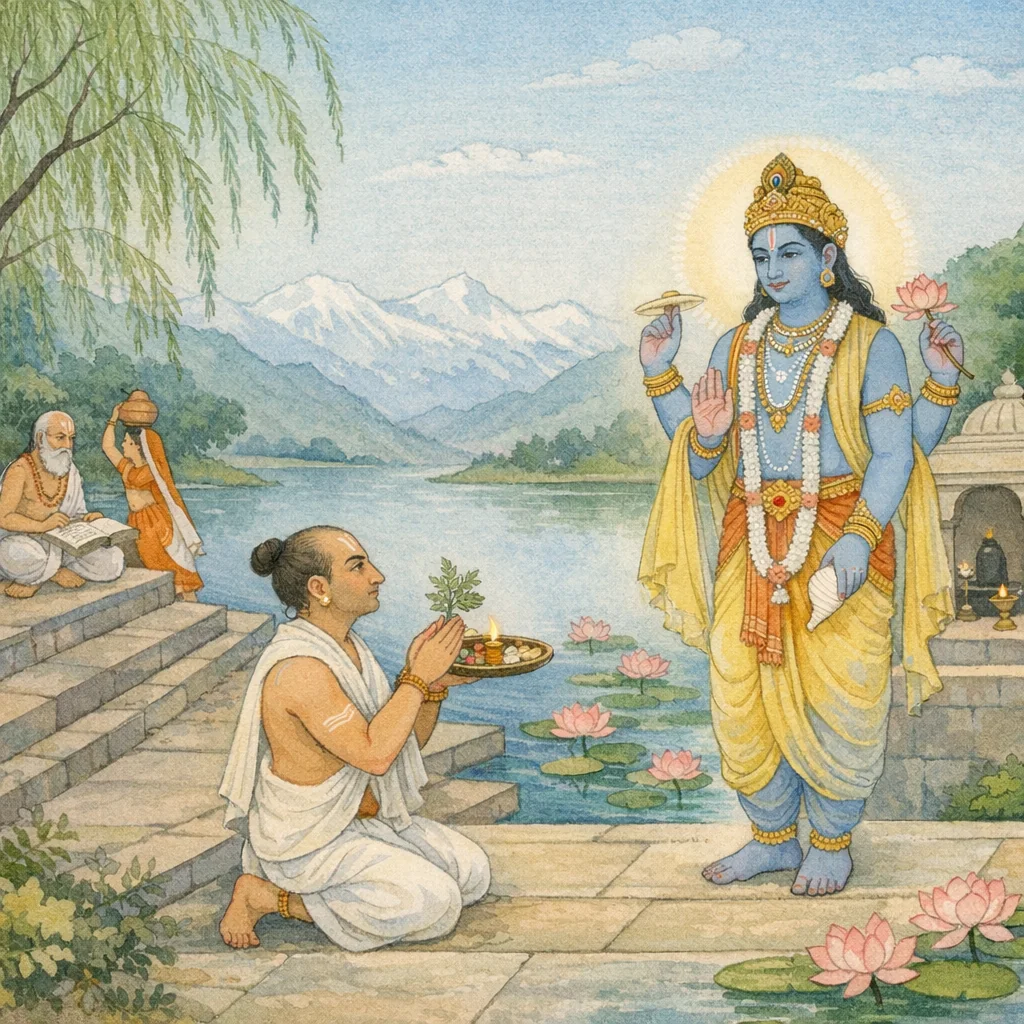
PP.1.16 opens with Bhīṣma asking for a full account of Puṣkara’s tīrtha-origins and of Brahmā’s sacrifice—its priests, allotted shares, materials, altar, and dakṣiṇā. Pulastya undertakes the questions and explains that the very framework of yajña underlies creation: the sacred fires, the Vedas, herbs, living beings, and even measures of time. Viṣṇu manifests as Varāha in connection with Kokāmukha tīrtha and promises protection; cosmic tranquility prevails as gods and beings assemble. The officiants are appointed: Bhṛgu as Hotṛ, Pulastya as Adhvaryu, Marīci as Udgātṛ, and Nārada as Brahmā (the rite’s overseer). When Sāvitrī is delayed, Brahmā commands Indra to bring another wife so the sacrifice may proceed. Indra finds an Abhīra/gopī maiden, later known as Gāyatrī; Brahmā weds her by the Gandharva form, and the thousand-yuga sacrifice continues.
Shlokas
Verse 1
भीष्म उवाच । यदेतत्कथितं ब्रह्मंस्तीर्थमाहात्म्यमुत्तमम् । कमलस्याभिपातेन तीर्थं जातं धरातले
Bhīṣma said: “O Brahmin, this excellent account of the greatness of the sacred tīrtha has been told. By the descent of a lotus, the tīrtha came into being upon the surface of the earth.”
Verse 2
तत्रस्थेन भगवता विष्णुना शंकरेण च । यत्कृतं मुनिशार्दूल तत्सर्वं परिकीर्त्तय
O tiger among sages, recount in full everything that was done there by the Blessed Lord Viṣṇu and by Śaṅkara (Śiva), who were present at that place.
Verse 3
कथं यज्ञो हि देवेन विभुना तत्र कारितः । के सदस्या ऋत्विजश्च ब्राह्मणाः के समागताः
How, indeed, was the sacrifice (yajña) performed there by the mighty Lord? Who were the officiating members, who were the priests (ṛtvij-s), and which brāhmaṇas had assembled?
Verse 4
के भागास्तस्य यज्ञस्य किं द्रव्यं का चदक्षिणा । का वेदी किं प्रमाणं च कृतं तत्र विरंचिना
What were the shares in that sacrifice? What was the sacrificial substance, and what was the priestly fee (dakṣiṇā)? What was the altar (vedī), what were its dimensions, and how was it arranged there by Virañci (Brahmā)?
Verse 5
यो याज्यः सर्वदेवानां वेदैः सर्वत्र पठ्यते । कं च काममभिध्यायन्वेधा यज्ञं चकार ह
He who is to be worshipped by all the gods, and whose praise is recited everywhere in the Vedas—meditating on that very desire, the Creator Brahmā indeed performed a sacrifice (yajña).
Verse 6
यथासौ देवदेवेशो ह्यजरश्चामरश्च ह । तथा चैवाक्षयः स्वर्गस्तस्य देवस्य दृश्यते
Just as that Lord of the gods is unborn and deathless, so too an imperishable heaven is seen to belong to that very Deity.
Verse 7
अन्येषां चैव देवानां दत्तः स्वर्गो महात्मना । अग्निहोत्रार्थमुत्पन्ना वेदा ओषधयस्तथा
And for the other gods as well, the great-souled one granted heaven; and for the purpose of the Agnihotra, the Vedas and also the medicinal herbs came into being.
Verse 8
ये चान्ये पशवो भूमौ सर्वे ते यज्ञकारणात् । सृष्टा भगवतानेन इत्येषा वैदिकी श्रुतिः
And whatever other animals exist upon the earth—all of them were created by the Lord for the purpose of sacrifice. This, indeed, is the Vedic teaching (śruti).
Verse 9
तदत्र कौतुकं मह्यं श्रुत्वेदं तव भाषितम् । यं काममधिकृत्यैकं यत्फलं यां च भावनां
Now, having heard what you have spoken, I am curious about this: with reference to that single desire—what is its result, and what is the contemplation (bhāvanā) to be adopted?
Verse 10
कृतश्चानेन वै यज्ञः सर्वं शंसितुमर्हसि । शतरूपा च या नारी सावित्री सा त्विहोच्यते
Truly, by him this yajña has been performed; now you should recount everything. And that woman who is Śatarūpā—here she is spoken of as Sāvitrī.
Verse 11
भार्या सा ब्रह्मणः प्रोक्ताः ऋषीणां जननी च सा । पुलस्त्याद्यान्मुनीन्सप्त दक्षाद्यांस्तु प्रजापतीन्
She is declared to be Brahmā’s wife, and she is also the mother of the Ṛṣis—of the seven sages beginning with Pulastya, and of the Prajāpatis beginning with Dakṣa.
Verse 12
स्वायंभुवादींश्च मनून्सावित्री समजीजनत् । धर्मपत्नीं तु तां ब्रह्मा पुत्रिणीं ब्रह्मणः प्रियः
Sāvitrī gave birth to the Manus beginning with Svāyambhuva. And Brahmā—dear to Brahman—accepted her as his lawful wife (dharma-patnī), as though she were his own daughter.
Verse 13
पतिव्रतां महाभागां सुव्रतां चारुहासिनीं । कथं सतीं परित्यज्य भार्यामन्यामविंदत
How could he abandon such a devoted pativratā—noble, virtuous in her vows, and sweetly smiling—and then take another woman as his spouse?
Verse 14
किं नाम्नी किं समाचारा कस्य सा तनया विभोः । क्व सा दृष्टा हि देवेन केन चास्य प्रदर्शिता
What is her name, and what is her conduct? O mighty one, whose daughter is she? Where indeed was she seen by the god, and by whom was she shown to him?
Verse 15
किं रूपा सा तु देवेशी दृष्टा चित्तविमोहिनी । यां तु दृष्ट्वा स देवेशः कामस्य वशमेयिवान्
What was the form of that Goddess—so enchanting that, once seen, she bewitched the mind—upon seeing whom even the Lord of the gods came under the sway of Kāma (desire)?
Verse 16
वर्णतो रूपतश्चैव सावित्र्यास्त्वधिका मुने । या मोहितवती देवं सर्वलोकेश्वरं विभुम्
O sage, in complexion and in beauty she surpassed Sāvitrī—she who bewitched the god, the mighty Lord of all the worlds, all-pervading.
Verse 17
यथा गृहीतवान्देवो नारीं तां लोकसुंदरीं । यथा प्रवृत्तो यज्ञोसौ तथा सर्वं प्रकीर्तय
Tell me in full how the god took that woman, the beauty of the worlds, and how that sacrifice (yajña) then proceeded.
Verse 18
तां दृष्ट्वा ब्रह्मणः पार्श्वे सावित्री किं चकार ह । सावित्र्यां तु तदा ब्रह्मा कां तु वृत्तिमवर्त्तत
Seeing her at Brahmā’s side, what indeed did Sāvitrī do? And at that time, what course of action did Brahmā adopt toward Sāvitrī?
Verse 19
सन्निधौ कानि वाक्यानि सावित्री ब्रह्मणा तदा । उक्ताप्युक्तवती भूयः सर्वं शंसितुमर्हसि
In Brahmā’s presence then, what words did Sāvitrī speak? Even if they have already been told, please relate everything again in full.
Verse 20
किं कृतं तत्र युष्माभिः कोपो वाथ क्षमापि वा । यत्कृतं तत्र यद्दृष्टं यत्तवोक्तं मया त्विह
What did you do there? Was it anger—or was it forgiveness? Whatever was done there, whatever was seen there, and whatever you spoke—tell me all of it here.
Verse 21
विस्तरेणेह सर्वाणि कर्माणि परमेष्ठिनः । श्रोतुमिच्छाम्यशेषेण विधेर्यज्ञविधिं परं
Here I wish to hear in full detail, without omission, all the deeds of Parameṣṭhin (Brahmā), and especially the supreme procedure of Vidhi’s (Brahmā’s) sacrifice (yajña).
Verse 22
कर्मणामानुपूर्व्यं च प्रारंभो होत्रमेव च । होतुर्भक्षो यथाऽचापि प्रथमा कस्य कारिता
Who first instituted the proper sequence of ritual acts, their commencement, the sacrificial offering itself, and also the prescribed share for the officiating priest (hotṛ)?
Verse 23
कथं च भगवान्विष्णुः साहाय्यं केन कीदृशं । अमरैर्वा कृतं यच्च तद्भवान्वक्तुमर्हति
And how did the Blessed Lord Viṣṇu render assistance—by whom, and of what kind? And whatever was done by the immortals (the gods)—you are worthy to tell that.
Verse 24
देवलोकं परित्यज्य कथं मर्त्यमुपागतः । गार्हपत्यं च विधिना अन्वाहार्यं च दक्षिणम्
Having abandoned Devaloka, the world of the gods, how did you come to the realm of mortals? And how, according to due rite, did you establish the Gārhapatya fire, the Anvāhārya (Dakṣiṇa) fire, and the Dakṣiṇa sacrificial fire?
Verse 25
अग्निमाहवनीयं च वेदीं चैव तथा स्रुवम् । प्रोक्षणीयं स्रुचं चैव आवभृथ्यं तथैव च
And (he prepared) the Āhavanīya sacred fire, the altar, and the ladle; likewise the vessel of sprinkling-water, the offering-spoon, and also the concluding purificatory bath rite.
Verse 26
अग्नींस्त्रींश्च यथा चक्रे हव्यभागवहान्हि वै । हव्यादांश्च सुरांश्चक्रे कव्यादांश्च पितॄनपि
Just as he created the thirty fires—indeed, the bearers of the portions of the oblation—so too he created the gods as the consumers of the havya, and the Pitṛs as the consumers of the kavya.
Verse 27
भागार्थं यज्ञविधिना ये यज्ञा यज्ञकर्मणि । यूपान्समित्कुशं सोमं पवित्रं परिधीनपि
For the sake of obtaining one’s due share (of sacrificial merit), those sacrifices performed according to ritual rule include also the sacrificial posts (yūpas), fuel-sticks, kuśa grass, Soma, the purification-strainer, and the enclosing sticks (paridhis).
Verse 28
यज्ञियानि च द्रव्याणि यथा ब्रह्मा चकार ह । विबभ्राज पुरा यश्च पारमेष्ठ्येन कर्मणा
Just as Brahmā once fashioned the sacrificial substances, so too he—through his supreme work as Creator—shone forth brilliantly in ancient times.
Verse 29
क्षणा निमेषाः काष्ठाश्च कलास्त्रैकाल्यमेव च । मुहूर्तास्तिथयो मासा दिनं संवत्सरस्तथा
Moments, eye-blinks, kāṣṭhās, kalās, and the triad of times; likewise muhūrtas, tithis (lunar days), months, a day, and also the year.
Verse 30
ऋतवः कालयोगाश्च प्रमाणं त्रिविधं पुरा । आयुः क्षेत्राण्यपचयं लक्षणं रूपसौष्ठवम्
The seasons and the conjunctions of time; the ancient threefold standards of measure; lifespan, the bodily fields (organs and constituents), decline, distinguishing marks, and the excellence of form—beauty and symmetry.
Verse 31
त्रयो वर्णास्त्रयो लोकास्त्रैविद्यं पावकास्त्रयः । त्रैकाल्यं त्रीणि कर्माणि त्रयो वर्णास्त्रयो गुणाः
There are three varṇas, three worlds, and the threefold Vedic knowledge; there are three sacred fires. There are the three divisions of time and three kinds of rites; there are three varṇas and three guṇas.
Verse 32
सृष्टा लोकाः पराः स्रष्ट्रा ये चान्येनल्पचेतसा । या गतिर्धर्मयुक्तानां या गतिः पापकर्मणां
The Creator has fashioned the higher worlds, and also other realms for those of lesser understanding. (Now tell me) what is the destination of those devoted to dharma, and what is the destination of those who commit sinful deeds?
Verse 33
चातुर्वर्ण्यस्य प्रभवश्चातुर्वर्ण्यस्य रक्षिता । चतुर्विद्यस्य यो वेत्ता चतुराश्रमसंश्रयः
He is the source of the four varṇas and the protector of that fourfold order; he is the knower of the four kinds of learning and the support of the four āśramas, the stages of life.
Verse 34
यः परं श्रूयते ज्योतिर्यः परं श्रूयते तपः । यः परं परतः प्राह परं यः परमात्मवान्
He is spoken of as the Supreme Light; he is spoken of as the Supreme Austerity (tapas). He declares the Supreme as transcending even the beyond; he is the one endowed with the Supreme Self, the Paramātman.
Verse 35
सेतुर्यो लोकसेतूनां मेध्यो यो मेध्यकर्मणाम् । वेद्यो यो वेदविदुषां यः प्रभुः प्रभवात्मनाम्
He is the bridge among the bridges of the worlds; the supremely purifying one among purifying rites; the one truly knowable to the knowers of the Vedas; and the Lord of those whose very nature is mastery and origination.
Verse 36
असुभूतश्च भूतानामग्निभूतोग्निवर्चसाम् । मनुष्याणां मनोभूतस्तपोभूतस्तपस्विनाम्
He becomes the vital breath of all beings; among the radiant ones he becomes fire. Among humans he becomes the mind, and among ascetics he becomes austerity (tapas) itself.
Verse 37
विनयो नयवृत्तीनां तेजस्तेजस्विनामपि । इत्येतत्सर्वमखिलान्सृजन्लोकपितामहः
Humility is the conduct of the well-guided, and splendor belongs even to the radiant; thus, creating all of this in its entirety, the Grandfather of the worlds (Brahmā) brought forth the beings.
Verse 38
यज्ञाद्गतिं कामन्वैच्छत्कथं यज्ञे मतिः कृता । एष मे संशयो ब्रह्मन्नेष मे संशयः परः
Desiring the higher attainment that comes from the yajña, how was his resolve fixed upon the sacrifice? O Brahman, this is my doubt—indeed, this is my greatest doubt.
Verse 39
आश्चर्यः परमो ब्रह्मा देवैर्दैत्यैश्च पठ्यते । कर्मणाश्चर्यभूतोपि तत्त्वतः स इहोच्यते
The Supreme Brahman is proclaimed as “the wondrous” by both the gods and the demons. Though He appears wondrous through His deeds, here His true reality is being stated.
Verse 40
पुलस्त्य उवाच । प्रश्नभारो महानेष त्वयोक्तो ब्रह्मणश्च यः । यथाशक्ति तु वक्ष्यामि श्रूयतां तत्परं यशः
Pulastya said: Truly great is the burden of questions you have asked, even concerning Brahmā. Yet, according to my ability, I shall explain it. Listen to that most excellent account of glory.
Verse 41
सहस्रास्यं सहस्राक्षं सहस्रचरणं च यम् । सहस्रश्रवणं चैव सहस्रकरमव्ययम्
Him they describe as having a thousand faces, a thousand eyes, and a thousand feet; indeed, a thousand ears as well—possessing a thousand hands, imperishable.
Verse 42
सहस्रजिह्वं साहस्रं सहस्रपरमं प्रभुं । सहस्रदं सहस्रादिं सहस्रभुजमव्ययम्
I adore the sovereign Lord—of a thousand tongues, of thousandfold might; the Supreme beyond all thousands; the master who grants by the thousand; the primal source of the thousand; of a thousand arms; imperishable.
Verse 43
हवनं सवनं चैव हव्यं होतारमेव च । पात्राणि च पवित्राणि वेदीं दीक्षां चरुं स्रुवम्
The fire-offering and the Soma-pressing rite, the oblation itself and the officiating priest; the vessels and the purifying means; the altar, the consecration, the sacrificial porridge, and the ladle—these are enumerated as elements of the Vedic sacrifice.
Verse 44
स्रुक्सोममवभृच्चैव प्रोक्षणीं दक्षिणा धनम् । अद्ध्वर्युं सामगं विप्रं सदस्यान्सदनं सदः
He also created the ladle, the Soma (rite/oblation), and the concluding bath (avabhṛtha); the sprinkling vessel, the sacrificial fee, and wealth; the Adhvaryu priest, the Sāmaga singer-priest, the learned Brāhmaṇa; the officiating members of the assembly, the sacrificial hall, and the ritual session itself.
Verse 45
यूपं समित्कुशं दर्वी चमसोलूखलानि च । प्राग्वंशं यज्ञभूमिं च होतारं बन्धनं च यत्
The sacrificial post, the fuel-sticks and kuśa-grass, the ladle, the cups and mortars; the eastern enclosure, the sacrificial ground, the officiating priest, and whatever binding-cord there is—
Verse 46
ह्रस्वान्यतिप्रमाणानि प्रमाणस्थावराणि च । प्रायश्चित्तानि वाजाश्च स्थंडिलानि कुशास्तथा
Also there are short rites, over-extended measures, and fixed standard measures; expiatory rites and Vāja-sacrifices; and likewise the sthaṇḍilas—ritual ground-plots—and the arrangements of kuśa-grass.
Verse 47
मंत्रं यज्ञं च हवनं वह्निभागं भवं च यं । अग्रेभुजं होमभुजं शुभार्चिषमुदायुधं
He is the mantra, the sacrifice, and the oblation; He receives the portion offered into the fire; He is Bhava (Śiva); He is the foremost enjoyer and the enjoyer of the homa—whose flames are auspicious, and who is armed with uplifted weapons.
Verse 48
आहुर्वेदविदो विप्रा यो यज्ञः शाश्वतः प्रभुः । यां पृच्छसि महाराज पुण्यां दिव्यामिमां कथां
The brahmins who know the Vedas declare: this sacrifice is the eternal, sovereign Lord. O great king, the sacred, divine narrative that you ask about—
Verse 49
यदर्थं भगवान्ब्रह्मा भूमौ यज्ञमथाकरोत् । हितार्थं सुरमर्त्यानां लोकानां प्रभवाय च
For that very purpose the blessed Lord Brahmā performed a sacrifice upon the earth: for the welfare of gods and mortals, and for the manifestation—the coming into being—of the worlds.
Verse 50
ब्रह्माथ कपिलश्चैव परमेष्ठी तथैव च । देवाः सप्तर्षयश्चैव त्र्यंबकश्च महायशाः
Brahmā, Kapila, and Parameṣṭhī as well; the gods and the Seven Ṛṣis; and Tryambaka (Śiva) too—of great renown.
Verse 51
सनत्कुमारश्च महानुभावो मनुर्महात्मा भगवान्प्रजापतिः । पुराणदेवोथ तथा प्रचक्रे प्रदीप्तवैश्वानरतुल्यतेजाः
Sanatkumāra—of great majesty—and Manu, the great-souled, the blessed Lord Prajāpati, the ancient divine being, then set it in motion, blazing with a brilliance equal to the fire Vaiśvānara.
Verse 52
पुरा कमलजातस्य स्वपतस्तस्य कोटरे । पुष्करे यत्र संभूता देवा ऋषिगणास्तथा
In ancient times, while the lotus-born (Brahmā) lay asleep within that hollow, at Puṣkara there came into being the gods, and likewise the hosts of sages.
Verse 53
एष पौष्करको नाम प्रादुर्भावो महात्मनः । पुराणं कथ्यते यत्र वेदस्मृतिसुसंहितं
This is the manifestation known as Pauṣkaraka of the great-souled one; it is the place where the Purāṇa—well compiled in harmony with the Vedas and the Smṛtis—is taught.
Verse 54
वराहस्तु श्रुतिमुखः प्रादुर्भूतो विरिंचिनः । सहायार्थं सुरश्रेष्ठो वाराहं रूपमास्थितः
Then the divine Boar—whose face was the Vedas—manifested before Viriñci (Brahmā). For the sake of assistance, the foremost of the gods assumed the form of a boar.
Verse 55
विस्तीर्णं पुष्करे कृत्वा तीर्थं कोकामुखं हि तत् । वेदपादो यूपदंष्ट्रः क्रतुहस्तश्चितीमुखः
Having made it expansive at Puṣkara, that sacred ford is indeed called Kokāmukha—whose feet are the Vedas, whose tusks are the sacrificial posts, whose hands are the rites, and whose face is the altar-fire.
Verse 56
अग्निजिह्वो दर्भरोमा ब्रह्मशीर्षो महातपाः । अहोरात्रेक्षणो दिव्यो वेदांगः श्रुतिभूषणः
A divine being—fire-tongued, with kuśa-grass for hair, Brahmā as his head, and of great austerity—whose gaze is day and night; a limb of the Veda, an ornament of sacred revelation.
Verse 57
आज्यनासः स्रुवतुंडः सामघोषस्वनो महान् । सत्यधर्ममयः श्रीमान्कर्मविक्रमसत्कृतः
He is “Ghee-nosed,” “Ladle-beaked,” great in the resonance of Sāman-chants; filled with truth and dharma, illustrious, and honored for the valor of his deeds.
Verse 58
प्रायश्चित्तनखो धीरः पशुजानुर्मखाकृतिः । उद्गात्रांत्रो होमलिंगो फलबीजमहौषधिः
He is steadfast; his nails are acts of expiation. His knees are the sacrificial beasts; his very form is the sacrifice. His intestines are the Udgātṛ priest; his emblem is the fire-offering; and he is the great medicinal power found in fruits and seeds.
Verse 59
वाय्वंतरात्मा मंत्रास्थिरापस्फिक्सोमशोणितः । वेदस्कंधो हविर्गंधो हव्यकव्यातिवेगवान्
Inwardly he is the moving breath, Vāyu, and the inner Self; he is the mantra, steadfastness, the waters, the hips, Soma and blood. He is the trunk of the Veda, the fragrance of the oblation, and the one of exceedingly swift power who bears both offerings to the gods and offerings to the ancestors.
Verse 60
प्राग्वंशकायो द्युतिमान्नानादीक्षाभिरर्चितः । दक्षिणाहृदयो योगी महासत्रमयो महान्
His body faced the east and shone with radiance; he was honored by many kinds of dīkṣā. His heart inclined to the south; a yogin, he was great—his very being was a mighty mahāsatra.
Verse 61
उपाकर्मेष्टिरुचिरः प्रवर्ग्यावर्तभूषणः । छायापत्नीसहायो वै मणिशृंगमिवोच्छ्रितः
Beautiful with the Upākarman rite and the iṣṭi-offering, adorned with the sacred Pravargya and its ritual āvarta, and attended by his shadow-wife, he rose aloft like a shining peak of jewels.
Verse 62
सर्वलोकहितात्मा यो दंष्ट्रयाभ्युज्जहारगाम् । ततः स्वस्थानमानीय पृथिवीं पृथिवीधरः
He whose very nature is the welfare of all worlds—raising up the Earth with his tusk—then brought her back and set her again in her proper place, he, the Bearer of the Earth.
Verse 63
ततो जगाम निर्वाणं पृथिवीधारणाद्धरिः । एवमादिवराहेण धृत्वा ब्रह्महितार्थिना
Then Hari attained nirvāṇa after bearing the Earth. Thus, by the Primeval Varāha—who upheld her seeking the welfare of Brahmā—this deed was accomplished.
Verse 64
उद्धृता पुष्करे पृथ्वी सागरांबुगता पुरा । वृतः शमदमाभ्यां यो दिव्ये कोकामुखे स्थितः
Formerly, the Earth, sunk into the ocean’s waters, was raised up at Puṣkara. He who abides in the divine Kokāmukha, surrounded by tranquillity and self-restraint, is to be revered.
Verse 65
आदित्यैर्वसुभिः साध्यैर्मरुद्भिर्दैवतैः सह । रुद्रैर्विश्वसहायैश्च यक्षराक्षसकिन्नरैः
Along with the Ādityas, Vasus, Sādhyas, Maruts, and other divine beings; with the Rudras who aid the universe; and with the Yakṣas, Rākṣasas, and Kinnaras.
Verse 66
दिग्भिर्विदिग्भिः पृथिवी नदीभिः सह सागरैः । चराचरगुरुः श्रीमान्ब्रह्मा ब्रह्मविदांवरः
With the directions and intermediate directions, with the earth, with rivers together with the oceans—all these were present; and the glorious Brahmā was there, the guru of all moving and unmoving beings, foremost among the knowers of Brahman.
Verse 67
उवाच वचनं कोकामुखं तीर्थं त्वया विभो । पालनीयं सदा गोप्यं रक्षा कार्या मखे त्विह
He spoke these words: “O Lord, this sacred ford called Kokāmukha should always be preserved by you, kept secret, and protected here during the sacrifice.”
Verse 68
एवं करिष्ये भगवंस्तदा ब्रह्माणमुक्तवान् । उवाच तं पुनर्ब्रह्मा विष्णुं देवं पुरः स्थितम्
“So shall I do, O Blessed One,” he said then to Brahmā. Thereupon Brahmā again addressed Viṣṇu, the divine Lord, who stood before him.
Verse 69
त्वं हि मे परमो देवस्त्वं हि मे परमो गुरुः । त्वं हि मे परमं धाम शक्रादीनां सुरोत्तम
You are indeed my supreme God; you are indeed my highest teacher. You are indeed my ultimate refuge—O best of the gods, surpassing Indra and the rest.
Verse 70
उत्फुल्लामलपद्माक्ष शत्रुपक्ष क्षयावह । यथा यज्ञेन मे ध्वंसो दानवैश्च विधीयते
O you whose lotus-like eyes are pure and fully blossomed, O destroyer of the enemy host—so is my ruin being wrought by this sacrifice and by the Dānavas.
Verse 71
तथा त्वया विधातव्यं प्रणतस्य नमोस्तु ते । विष्णुरुवाच । भयं त्यजस्व देवेश क्षयं नेष्यामि दानवान्
“So should you act; to the one who bows (to you), homage be to you.” Viṣṇu said: “Cast off fear, O Lord of the gods; I shall bring the Dānavas to destruction.”
Verse 72
ये चान्ते विघ्नकर्तारो यातुधानास्तथाऽसुराः । घातयिष्याम्यहं सर्वान्स्वस्ति तिष्ठ पितामह
And those who, at the end, become makers of obstacles—whether yātudhānas or asuras—I shall slay them all. Abide in auspiciousness and safety, O Pitāmaha, Grandfather.
Verse 73
एवमुक्त्वा स्थितस्तत्र साहाय्येन कृतक्षणः । प्रववुश्च शिवा वाताः प्रसन्नाश्च दिशो दश
Having spoken thus, he remained there, and with assistance the moment was duly set in order. Auspicious winds began to blow, and the ten directions became serene and clear.
Verse 74
सुप्रभाणि च ज्योतींषि चंद्रं चक्रुः प्रदक्षिणम् । न विग्रहं ग्रहाश्चक्रुः प्रसेदुश्चापि सिंधवः
The brilliantly shining luminaries and the planets made a reverential circumambulation of the Moon. The planets caused no disturbance, and the oceans too became calm and clear.
Verse 75
नीरजस्का भूमिरासीत्सकला ह्लाददास्त्वपः । जग्मुः स्वमार्गं सरितो नापि चुक्षुभुरर्णवाः
The earth was wholly free of dust, and the waters were altogether delightful. The rivers kept to their proper courses, and even the oceans did not grow turbulent.
Verse 76
आसन्शुभानींद्रियाणि नराणामंतरात्मनाम् । महर्षयो वीतशोका वेदानुच्चैरवाचयन्
The senses of men became auspicious and inwardly attuned; and the great sages, free from sorrow, recited the Vedas aloud.
Verse 77
यज्ञे तस्मिन्हविः पाके शिवा आसंश्च पावकाः । प्रवृत्तधर्मसद्वृत्ता लोका मुदितमानसाः
In that sacrifice, as the oblations were being cooked, the fires blazed auspiciously; people, devoted to dharma and good conduct, were cheerful at heart.
Verse 78
विष्णोः सत्यप्रतिज्ञस्य श्रुत्वारिनिधना गिरः । ततो देवाः समायाता दानवा राक्षसैस्सह
Hearing the unfailing words of Viṣṇu, whose vow is ever true, then the gods assembled—along with the Dānavas and the Rākṣasas.
Verse 79
भूतप्रेतपिशाचाश्च सर्वे तत्रागताः क्रमात् । गंधर्वाप्सरसश्चैव नागा विद्याधरागणाः
In due order, all the bhūtas, pretas, and piśācas arrived there; and likewise the gandharvas and apsarases, along with the nāgas and the hosts of vidyādharas.
Verse 80
वानस्पत्याश्चौषधयो यच्चेहेद्यच्च नेहति । ब्रह्मादेशान्मारुतेन आनीताः सर्वतो दिशः
Trees and medicinal herbs—those that move and those that do not—were, by Brahmā’s command, borne by the wind from every direction.
Verse 81
यज्ञपर्वतमासाद्य दक्षिणामभितोदिशम् । सुरा उत्तरतः सर्वे मर्यादापर्वते स्थिताः
Having reached Yajña Mountain and the southern region all around, all the gods were stationed to the north, upon Maryādā Mountain.
Verse 82
गंधर्वाप्सरसश्चैव मुनयो वेदपारगाः । पश्चिमां दिशमास्थाय स्थितास्तत्र महाक्रतौ
There, at that great sacrificial rite, the Gandharvas and Apsarases, along with sages well-versed in the Vedas, took their place, standing in the western direction.
Verse 83
सर्वे देवनिकायाश्च दानवाश्चासुरागणाः । अमर्षं पृष्ठतः कृत्वा सुप्रीतास्ते परस्परम्
All the hosts of gods, the Dānavas, and the groups of Asuras—casting their resentment behind them—became mutually delighted with one another.
Verse 84
ऋषीन्पर्यचरन्सर्वे शुश्रूषन्ब्राह्मणांस्तथा । ऋषयो ब्रह्मर्षयश्च द्विजा देवर्षयस्तथा
All of them attended upon the sages and likewise served the brāhmaṇas—(including) the ṛṣis, the brahmarṣis, the twice-born, and also the devarṣis.
Verse 85
राजर्षयो मुख्यतमास्समायाताः समंततः । कतमश्च सुरोप्यत्र क्रतौ याज्यो भविष्यति
The foremost royal sages have assembled from every direction. Which deity, in this sacrifice, shall be the one to receive the offering?
Verse 86
पशवः पक्षिणश्चैव तत्र याता दिदृक्षवः । ब्राह्मणा भोक्तुकामाश्च सर्वे वर्णानुपूर्वशः
Animals and birds too went there, eager to behold it; and the Brahmins, wishing to partake of the sacrificial feast, all arrived in due order according to the succession of the varṇas.
Verse 87
स्वयं च वरुणो रत्नं दक्षश्चान्नं स्वयं ददौ । आगत्यवरुणोलोकात्पक्वंचान्नंस्वतोपचत्
Varuṇa himself bestowed a jewel, and Dakṣa himself provided the food. Having come from Varuṇa’s realm, he also cooked the meal with his own hands until it was fully prepared.
Verse 88
वायुर्भक्षविकारांश्च रसपाची दिवाकरः । अन्नपाचनकृत्सोमो मतिदाता बृहस्पतिः
Vāyu presides over the transformations of what is eaten; the Sun digests and ripens the bodily juices; Soma brings about the digestion of food; and Bṛhaspati bestows intelligence.
Verse 89
धनदानं धनाध्यक्षो वस्त्राणि विविधानि च । सरस्वती नदाध्यक्षो गंगादेवी सनर्मदा
Dhanada (Kubera) is the lord of wealth and the bestower of wealth, and he also presides over garments of many kinds. Sarasvatī is foremost among rivers; and the goddess Gaṅgā, together with the Narmadā, is likewise praised.
Verse 90
याश्चान्याः सरितः पुण्याः कूपाश्चैव जलाशयाः । पल्वलानि तटाकानि कुंडानि विविधानि च
And other sacred rivers too, as well as wells and reservoirs of water—marshes, ponds, and many kinds of bathing-tanks (kuṇḍas) likewise.
Verse 91
प्रस्रवाणि च मुख्यानि देवखातान्यनेकशः । जलाशयानि सर्वाणि समुद्राः सप्तसंख्यकाः
There are also the foremost mountain-springs and many divinely fashioned water-courses; all kinds of reservoirs of water exist, and the oceans are reckoned as seven.
Verse 92
लवणेक्षुसुरासर्पिर्दधिदुग्धजलैः समम् । सप्तलोकाः सपातालाः सप्तद्वीपाः सपत्तनाः
Together with the oceans of salt, sugarcane-juice, liquor, ghee, curd, milk, and pure water—there are the seven worlds with the Pātālas, and the seven continents with their cities.
Verse 93
वृक्षा वल्ल्यः सतृणानि शाकानि च फलानि च । पृथिवीवायुराकाशमापोज्योतिश्च पंचमम्
Trees, creepers, grasses, herbs, and fruits—and likewise earth, wind, space, water, and as the fifth, fire and light—these are the manifested categories.
Verse 94
सविग्रहाणि भूतानि धर्मशास्त्राणि यानि च । वेदभाष्याणि सूत्राणि ब्रह्मणा निर्मितं च यत्
All embodied beings, and the Dharma-śāstras as well, the commentaries on the Vedas and the sūtras—whatever has been fashioned by Brahmā, all that is included herein.
Verse 95
अमूर्तं मूर्तमत्यन्तं मूर्तदृश्यं तथाखिलम् । एवं कृते तथास्मिंस्तु यज्ञे पैतामहे तदा
Then, in that ancestral sacrifice of Brahmā—the Paitāmaha-yajña—when all had been arranged in this manner, the reality that is formless yet taking form, supremely embodied, visible in embodied appearance, and indeed the whole of manifestation, was thus comprehended.
Verse 96
देवानां संनिधौ तत्र ऋषिभिश्च समागमे । ब्रह्मणो दक्षिणे पार्श्वे स्थितो विष्णुः सनातनः
There, in the presence of the gods and in the assembly of sages, the eternal Viṣṇu stood at Brahmā’s right side.
Verse 97
वामपार्श्वे स्थितो रुद्रः पिनाकी वरदः प्रभुः । ऋत्विजां चापि वरणं कृतं तत्र महात्मना
On the left stood Rudra—bearer of the Pināka, gracious giver of boons, the Lord. There too, the great-souled one appointed the officiating priests.
Verse 98
भृगुर्होतावृतस्तत्र पुलस्त्योध्वर्य्युसत्तमः । तत्रोद्गाता मरीचिस्तु ब्रह्मा वै नारदः कृतः
There, Bhṛgu was chosen as the Hotṛ priest, and Pulastya—the best of Adhvaryus. Marīci served as the Udgātṛ, and Nārada was appointed as Brahmā, the supervising priest of the rite.
Verse 99
सनत्कुमारादयो ये सदस्यास्तत्र ते भवन् । प्रजापतयो दक्षाद्या वर्णा ब्राह्मणपूर्वकाः
There were members of that assembly such as Sanatkumāra and others; and there were also the Prajāpatis beginning with Dakṣa, and the social orders (varṇas) beginning with the Brāhmaṇas.
Verse 100
ब्रह्मणश्च समीपे तु कृता ऋत्विग्विकल्पना । वस्त्रैराभरणैर्युक्ताः कृता वैश्रवणेन ते
Near Brahmā, the arrangement and selection of the officiating priests was made; and they were appointed by Vaiśravaṇa (Kubera), furnished with garments and ornaments.
Verse 101
अंगुलीयैः सकटकैर्मकुटैर्भूषिता द्विजाः । चत्वारो द्वौ दशान्ये च त षोडशर्त्विजः
The twice-born (brāhmaṇas) were adorned with rings, earrings, and crowns; four, two, and another ten—thus they were the sixteen officiating priests (ṛtvijas).
Verse 102
ब्रह्मणा पूजिताः सर्वे प्रणिपातपुरःसरम् । अनुग्राह्यो भवद्भिस्तु सर्वैरस्मिन्क्रताविह
All of you, having been honored by Brahmā—with obeisance placed first—should now all show your favor to him here in this sacrifice.
Verse 103
पत्नी ममैषा सावित्री यूयं मे शरणंद्विजाः । विश्वकर्माणमाहूय ब्रह्मणः शीर्षमुंडनं
“This Sāvitrī is my wife, and you Brahmins are my refuge. Summon Viśvakarman and shave (tonsure) Brahmā’s head.”
Verse 104
यज्ञे तु विहितं तस्य कारितं द्विजसत्तमैः । आतसेयानि वस्त्राणि दंपत्यर्थे तथा द्विजैः
In the sacrifice, what was prescribed for him was duly carried out by the most excellent of the twice-born. And likewise, linen garments were procured by the Brahmins for the benefit of the married couple.
Verse 105
ब्रह्मघोषेण ते विप्रा नादयानास्त्रिविष्टपम् । पालयंतो जगच्चेदं क्षत्रियाः सायुधाः स्थिताः
Those brāhmaṇas, resounding with the Vedic chant—the “Brahma-sound”—made even Triviṣṭapa reverberate; and the kṣatriyas stood armed, safeguarding this very world.
Verse 106
भक्ष्यप्रकारान्विविधिन्वैश्यास्तत्र प्रचक्रिरे । रसबाहुल्ययुक्तं च भक्ष्यं भोज्यं कृतं ततः
There the Vaiśyas prepared many kinds of foods. Then they made dishes to be served and eaten, rich in flavorful juices and abundance.
Verse 107
अश्रुतं प्रागदृष्टं च दृष्ट्वा तुष्टः प्रजापतिः । प्राग्वाटेति ददौ नाम वैश्यानां सृष्टिकृद्विभुः
Seeing something previously unheard of and never before seen, Prajāpati was pleased; the all-powerful Creator gave the Vaiśyas the name “Prāgvāṭa.”
Verse 108
द्विजानां पादशुश्रूषा शूद्रैः कार्या सदा त्विह । पादप्रक्षालनं भोज्यमुच्छिष्टस्य प्रमार्जनं
Here, the Śūdras should always render service at the feet of the twice-born: washing their feet, eating what remains from their meal, and cleaning away their leftovers.
Verse 109
तेपि चक्रुस्तदा तत्र तेभ्यो भूयः पितामहः । शूश्रूषार्थं मया यूयं तुरीये तु पदे कृताः
They too did so there at that time. Then Grandfather Brahmā again said to them: “For the sake of service, I have placed you in the fourth station.”
Verse 110
द्विजानां क्षत्रबन्धूनां बन्धूनां च भवद्विधैः । त्रिभ्यश्शुश्रूषणा कार्येत्युक्त्वा ब्रह्मा तथाऽकरोत्
Having declared, “By people like you, service should be rendered to the three—namely, the twice-born, the kṣatra-bandhus, and one’s own kinsmen,” Brahmā acted accordingly.
Verse 111
द्वाराध्यक्षं तथा शक्रं वरुणं रसदायकम् । वित्तप्रदं वैश्रवणं पवनं गंधदायिनम्
He is the guardian of the gate; likewise Śakra (Indra); Varuṇa, the giver of taste; Vaiśravaṇa (Kubera), the bestower of wealth; and Pavana (Vāyu), the giver of fragrance.
Verse 112
उद्योतकारिणं सूर्यं प्रभुत्वे माधवः स्थितः । सोमः सोमप्रदस्तेषां वामपक्ष पथाश्रितः
Mādhava abides in sovereignty as the Sun who brings forth illumination; and Soma—the giver of the lunar essence to them—abides on their left-side path.
Verse 113
सुसत्कृता च पत्नी सा सवित्री च वरांगना । अध्वर्युणा समाहूता एहि देवि त्वरान्विता
That noble lady Savitrī—duly honored as his wife—was summoned by the adhvaryu priest: “Come, O goddess, quickly, without delay.”
Verse 114
उत्थिताश्चाग्नयः सर्वे दीक्षाकाल उपागतः । व्यग्रा सा कार्यकरणे स्त्रीस्वभावेन नागता
All the sacred fires had been kindled, and the time for initiation had arrived. Yet she, distracted in attending to the required duties, did not come—such was her nature as a woman.
Verse 115
इहवै न कृतं किंचिद्द्वारे वै मंडनं मया । भित्त्यां वैचित्रकर्माणि स्वस्तिकं प्रांगणेन तु
Here I have made no decoration at the doorway; yet upon the walls I have fashioned ornamental designs, and in the courtyard I have drawn a sacred svastika.
Verse 116
प्रक्षालनं च भांडानां न कृतं किमपि त्विह । लक्ष्मीरद्यापि नायाता पत्नीनारायणस्य या
And here no washing of the vessels has been done at all; therefore Lakṣmī—the consort of Nārāyaṇa—has not come even today.
Verse 117
अग्नेः पत्नी तथा स्वाहा धूम्रोर्णा तु यमस्य तु । वारुणी वै तथा गौरी वायोर्वै सुप्रभा तथा
Svāhā is the wife of Agni; Dhūmrorṇā is the wife of Yama. Likewise Vāruṇī is the consort of Varuṇa, and Gaurī the consort of Vāyu; so too is Suprabhā.
Verse 119
ऋद्धिर्वैश्रवणी भार्या शम्भोर्गौरी जगत्प्रिया । मेधा श्रद्धा विभूतिश्च अनसूया धृतिः क्षमा
Ṛddhi is the wife of Vaiśravaṇa (Kubera); and for Śambhu (Śiva), [his consort is] Gaurī, beloved of the world. So too are Medhā, Śraddhā, Vibhūti, Anasūyā, Dhṛti, and Kṣamā.
Verse 120
गंगा सरस्वती चैव नाद्या याताश्च कन्यकाः । इंद्राणी चंद्रपत्नी तु रोहिणी शशिनः प्रियाः
Gaṅgā and Sarasvatī, and likewise the maidens who had gone to the river Nadyā; also Indrāṇī, and Rohiṇī—the wife of the Moon, beloved of Śaśin.
Verse 121
अरुंधती वसिष्ठस्य सप्तर्षीणां च याः स्त्रियः । अनसूयात्रिपत्नी च तथान्याः प्रमदा इह
Arundhatī, the wife of Vasiṣṭha, and the wives of the Seven Ṛṣis, and Anasūyā—the wife of Atri—as well as other noble women here (are spoken of).
Verse 122
वध्वो दुहितरश्चैव सख्यो भगिनिकास्तथा । नाद्यागतास्तु ताः सर्वा अहं तावत्स्थिता चिरं
“Daughters-in-law, daughters, friends, and likewise sisters—none of them have come today. So I have remained here, waiting, for a long time.”
Verse 123
नाहमेकाकिनी यास्ये यावन्नायांति ता स्त्रियः । ब्रूहि गत्वा विरंचिं तु तिष्ठ तावन्मुहूर्तकम्
“I will not go alone until those women arrive. Go and inform Virañci (Brahmā), and remain here for just a little while.”
Verse 124
सर्वाभिः सहिता चाहमागच्छामि त्वरान्विता । सर्वैः परिवृतः शोभां देवैः सह महामते
Accompanied by them all, I am coming swiftly; surrounded by all the gods, I arrive in splendor, O great-minded one.
Verse 125
भवान्प्राप्नोति परमां तथाहं तु न संशयः । वदमानां तथाध्वर्युस्त्यक्त्वा ब्रह्माणमागतः
“You will attain the supreme state—of this I have no doubt.” As he was speaking thus, the adhvaryu (priest) came, having left Brahmā.
Verse 126
सावित्री व्याकुला देव प्रसक्ता गृहकर्माणि । सख्यो नाभ्यागता यावत्तावन्नागमनं मम
O God, Sāvitrī is distressed and occupied with the duties of the household. Until her friends arrive, I shall not come.
Verse 127
एवमुक्तोस्मि वै देव कालश्चाप्यतिवर्त्तते । यत्तेद्य रुचितं तावत्तत्कुरुष्व पितामह
Thus have I spoken, O Lord, and time, too, is passing away. Therefore, whatever pleases you today—do it at once, O Pitāmaha, revered Grandfather.
Verse 128
एवमुक्तस्तदा ब्रह्मा किंचित्कोपसमन्वितः । पत्नीं चान्यां मदर्थे वै शीघ्रं शक्र इहानय
Thus addressed, Brahmā, somewhat seized by anger, said: “O Śakra, quickly bring here another wife for my sake.”
Verse 129
यथा प्रवर्तते यज्ञः कालहीनो न जायते । तथा शीघ्रं विधित्स्व त्वं नारीं कांचिदुपानय
Just as a sacrifice proceeds and cannot come to fruition without the proper time, so you too must act swiftly as prescribed—bring here some woman.
Verse 130
यावद्यज्ञसमाप्तिर्मे वर्णे त्वां मा कृथा मनः । भूयोपि तां प्रमोक्ष्यामि समाप्तौ तु क्रतोरिह
Until my sacrifice is completed, do not set your mind on speaking of this. When this rite here is finished, I shall release her again.
Verse 131
एवमुक्तस्तदा शक्रो गत्वा सर्वं धरातलं । स्त्रियो दृष्टाश्च यास्तेन सर्वाः परपरिग्रहाः
Thus addressed, Śakra (Indra) then went across the entire surface of the earth; and whatever women he saw there—all of them were the wives of other men.
Verse 132
आभीरकन्या रूपाढ्या सुनासा चारुलोचना । न देवी न च गंधर्वी नासुरी न च पन्नगी
A beautiful Abhīra maiden—graced with beauty, with a fine nose and lovely eyes—she was neither a goddess, nor a Gandharva woman, nor a demoness, nor a serpent-maiden.
Verse 133
न चास्ति तादृशी कन्या यादृशी सा वरांगना । ददर्श तां सुचार्वंगीं श्रियं देवीमिवापराम्
There is no maiden like her, that excellent woman. He beheld her—of lovely limbs—like another Goddess Śrī herself.
Verse 134
संक्षिपन्तीं मनोवृत्ति विभवं रूपसंपदा । यद्यत्तु वस्तुसौंदर्याद्विशिष्टं लभ्यते क्वचित्
Worldly prosperity and beauty compress and constrain the mind’s natural movement; and whatever exceptional quality is sometimes gained, it is only on account of the beauty of some object.
Verse 135
तत्तच्छरीरसंलग्नं तन्वंग्या ददृशे वरम् । तां दृष्ट्वा चिंतयामास यद्येषा कन्यका भवेत्
Then the slender-limbed maiden saw that excellent one, closely joined to that very body. Seeing her, he began to ponder: “If only she were a maiden (fit for marriage)…”
Verse 136
तन्मत्तः कृतपुण्योन्यो न देवो भुवि विद्यते । योषिद्रत्नमिदं सेयं सद्भाग्यायां पितामहः
On this earth there is no god other than he who is so blessed with fortune and so abundant in merit. This jewel among women—this Sā (Seyā)—was bestowed by Pitāmaha (Brahmā) upon the virtuous Bhāgyā.
Verse 137
सरागो यदि वा स्यात्तु सफलस्त्वेष मे श्रमः । नीलाभ्र कनकांभोज विद्रुमाभां ददर्श तां
“If she is indeed in love, then this effort of mine will bear fruit.” Thus he beheld her—radiant like a dark-blue cloud, like a golden lotus, and like red coral.
Verse 138
त्विषं संबिभ्रतीमंगैः केशगंडे क्षणाधरैः । मन्मथाशोकवृक्षस्य प्रोद्भिन्नां कलिकामिव
Radiance shone from her limbs—her hair, cheeks, and quivering lower lip—like a freshly sprouted bud upon the aśoka tree of Manmatha, the god of Love.
Verse 139
प्रदग्धहृच्छयेनैव नेत्रवह्निशिखोत्करैः । धात्रा कथं हि सा सृष्टा प्रतिरूपमपश्यता
With his heart already scorched by desire, and his eyes blazing with tongues of fire—how indeed could the Creator have fashioned her without first beholding such a matchless form?
Verse 140
कल्पिता चेत्स्वयं बुध्या नैपुण्यस्य गतिः परा । उत्तुंगाग्राविमौ सृष्टौ यन्मे संपश्यतः सुखं
If, by my own intellect, I have conceived the supreme course of skillful creation, then great indeed is the joy I feel as I behold these two creations with their lofty peaks.
Verse 141
पयोधरौ नातिचित्रं कस्य संजायते हृदि । रागोपहतदेहोयमधरो यद्यपि स्फुटम्
Who would not feel a stirring in the heart at the sight of breasts? Yet this body is wounded by passion, though the lip appears clearly to the eye, alluring.
Verse 142
तथापि सेवमानस्य निर्वाणं संप्रयच्छति । वहद्भिरपि कौटिल्यमलकैः सुखमर्प्यते
Even so, to one who serves, it grants nirvāṇa—liberation; and even when borne along with crooked, impure qualities like an amalaka, it still bestows happiness.
Verse 143
दोषोपि गुणवद्भाति भूरिसौंदर्यमाश्रितः । नेत्रयोर्भूषितावंता वाकर्णाभ्याशमागतौ
Even a fault can appear like a virtue when it is joined to abundant beauty; and the ornamented corners of the eyes seemed to reach close to the ears.
Verse 144
कारणाद्भावचैतन्यं प्रवदंति हि तद्विदः । कर्णयोर्भूषणे नेत्रे नेत्रयोः श्रवणाविमौ
Those who know the truth declare that consciousness in embodied existence arises from the causal source. For the ears, the ornaments are the eyes; and for the eyes, these two—hearing—are their support.
Verse 145
कुंडलांजनयोरत्र नावकाशोस्ति कश्चन । न तद्युक्तं कटाक्षाणां यद्द्विधाकरणं हृदि
Here there is no room at all for both the earring and the añjana (collyrium); it is not proper that sidelong glances should create a division within the heart.
Verse 146
तवसंबंधिनोयेऽत्र कथं ते दुःखभागिनः । सर्वसुंदरतामेति विकारः प्राकृतैर्गुणैः
How could those here who are bound to You ever partake of sorrow? Even a mere modification of nature, through the material guṇas, comes to attain perfect beauty.
Verse 147
वृद्धे क्षणशतानां तु दृष्टमेषा मया धनम् । धात्रा कौशल्यसीमेयं रूपोत्पत्तौ सुदर्शिता
O venerable one, in these hundreds of fleeting moments I have beheld this treasure. In the very arising of her beauty, the Creator has displayed in her the utmost limit of skill.
Verse 148
करोत्येषा मनो नॄणां सस्नेहं कृतिविभ्रमैः । एवं विमृशतस्तस्य तद्रूपापहृतत्विषः
By her artful gestures and coquettish graces, she makes the minds of men tender with attachment. As he thus reflected, his radiance was stolen away by her beauty.
Verse 149
निरंतरोद्गतैश्छन्नमभवत्पुलकैर्वपुः । तां वीक्ष्य नवहेमाभां पद्मपत्रायतेक्षणाम्
On seeing her—shining like freshly wrought gold, with eyes long like lotus petals—his body became covered with continuously rising goosebumps.
Verse 150
देवानामथ यक्षाणां गंधर्वोरगरक्षसाम् । नाना दृष्टा मया नार्यो नेदृशी रूपसंपदा
Among the devas, the Yakṣas, the Gandharvas, the Nāgas, and the Rākṣasas, I have seen many women—but none possessed such a wealth of beauty as this one.
Verse 151
त्रैलोक्यांतर्गतं यद्यद्वस्तुतत्तत्प्रधानतः । समादाय विधात्रास्याः कृता रूपस्य संस्थितिः
Whatever realities abide within the three worlds—taking from each its essential predominance—the Creator gathered them together and thus established the settled form of this creation.
Verse 152
इंद्र उवाच । कासि कस्य कुतश्च त्वमागता सुभ्रु कथ्यताम् । एकाकिनी किमर्थं च वीथीमध्येषु तिष्ठसि
Indra said: “Who are you? Whose are you—daughter or wife—and from where have you come, O fair-browed one? Tell me. And why do you stand alone in the midst of the streets?”
Verse 153
यान्येतान्यंगसंस्थानि भूषणानि बिभर्षि च । नैतानि तव भूषायै त्वमेतेषां हि भूषणम्
The ornaments you wear upon your limbs do not truly beautify you; rather, you are the very ornament that lends beauty to them.
Verse 154
न देवी न च गंधर्वी नासुरी न च पन्नगी । किन्नरी दृष्टपूर्वा वा यादृशी त्वं सुलोचने
You are neither a goddess, nor a Gandharvī, nor an Asurī, nor a serpent-maiden; nor have I ever seen a Kinnarī like you. O fair-eyed one, what manner of being are you?
Verse 155
उक्ता मयापि बहुशः कस्माद्दत्से हि नोत्तरम् । त्रपान्विता तु सा कन्या शक्रं प्रोवाच वेपती
Though I have spoken to you many times, why do you give no reply? Then that maiden, overcome with shame and trembling, spoke to Śakra (Indra).
Verse 156
गोपकन्या त्वहं वीर विक्रीणामीह गोरसम् । नवनीतमिदं शुद्धं दधि चेदं विमंडकम्
“O hero, I am a cowherd maiden; here I sell the produce of the cow. This is pure fresh butter, and this is curd—unmixed and unadulterated.”
Verse 157
दध्ना चैवात्र तक्रेण रसेनापि परंतप । अर्थी येनासि तद्ब्रूहि प्रगृह्णीष्व यथेप्सितम्
“Here there is curd, and also buttermilk and whey, O subduer of foes. Tell me what you desire; take whatever you wish.”
Verse 158
एवमुक्तस्तदा शक्रो गृहीत्वा तां करे दृढम् । अनयत्तां विशालाक्षीं यत्र ब्रह्मा व्यवस्थितः
Thus addressed, Śakra (Indra) then firmly took her by the hand and led that wide-eyed woman to the place where Brahmā was stationed.
Verse 159
नीयमाना तु सा तेन क्रोशंती पितृमातरौ । हा तात मातर्हा भ्रातर्नयत्येष नरो बलात्
But as she was being carried off by him, she cried out to her father and mother: “O father! O mother! O brother! This man is taking me away by force!”
Verse 160
यदि वास्ति मया कार्यं पितरं मे प्रयाचय । स दास्यति हि मां नूनं भवतः सत्यमुच्यते
If you have any need of me, then ask my father for me. Surely he will give me to you—what you have said is true.
Verse 161
का हि नाभिलषेत्कन्या भर्तांरं भक्तिवत्सलम् । नादेयमपि ते किंचित्पितुर्मे धर्मवत्सल
What maiden would not yearn for a husband who is tender toward devotion? O beloved, devoted to dharma—there is nothing at all that my father should not give to you.
Verse 162
प्रसादये तं शिरसा मां स तुष्टः प्रदास्यति । पितुश्चित्तमविज्ञाय यद्यात्मानं ददामि ते
I shall appease him with bowed head; once pleased, he will grant me to you. But without knowing my father’s intention, how can I give myself to you?
Verse 163
धर्मो हि विपुलो नश्येत्तेन त्वां न प्रसादये । भविष्यामि वशे तुभ्यं यदि तातः प्रदास्यति
Indeed, a great dharma would be ruined; therefore I do not seek to win your favor. I will come under your authority only if my father gives me to you.
Verse 164
इत्थमाभाष्यमाणस्तु तदा शक्रोऽनयच्च ताम् । ब्रह्मणः पुरतः स्थाप्य प्राहास्यार्थे मयाऽबले
Thus addressed, Indra then led her there; placing her before Brahmā, he said—seeking to make sport of her—“O helpless one, by me…”.
Verse 165
आनीतासि विशालाक्षि मा शुचो वरवर्णिनि । गोपकन्यामसौ दृष्ट्वा गौरवर्णां महाद्युतिम्
“You have been brought here, O large-eyed one; do not grieve, O fair-complexioned lady. Having seen that cowherd maiden—golden-hued and of great radiance—(he spoke thus).”
Verse 166
कमलामेव तां मेने पुंडरीकनिभेक्षणाम् । तप्तकांचनसद्भित्ति सदृशा पीनवक्षसम्
He deemed her to be Lakṣmī herself—lotus-eyed—her full breasts like the gleaming wall of heated gold.
Verse 167
मत्तेभहस्तवृत्तोरुं रक्तोत्तुंग नखत्विषं । तं दृष्ट्वाऽमन्यतात्मानं सापि मन्मनथचरम्
Seeing him—whose thighs were rounded like the trunk of an intoxicated elephant and whose lofty nails shone red—she too, upon beholding him, felt herself moving under the sway of Manmatha, the god of love.
Verse 168
तत्प्राप्तिहेतु क धिया गतचित्तेव लक्ष्यते । प्रभुत्वमात्मनो दाने गोपकन्याप्यमन्यत
With what intent, seeking to attain that, does she appear so wholly absorbed in mind? Even the cowherd maiden deemed herself sovereign in the very act of giving.
Verse 169
यद्येष मां सुरूपत्वादिच्छत्यादातुमाग्रहात् । नास्ति सीमंतिनी काचिन्मत्तो धन्यतरा भुवि
If, because of my beauty and the like, he insists on taking me, then on earth there is no married woman more blessed than I.
Verse 170
अनेनाहं समानीता यच्चक्षुर्गोचरं गता । अस्य त्यागे भवेन्मृत्युरत्यागे जीवितं सुखम्
By him I have been brought here and have come within the range of your sight. If you abandon this, there will be death; if you do not abandon it, there will be a life of happiness.
Verse 171
भवेयमपमानाच्च धिग्रूपा दुःखदायिनी । दृश्यते चक्षुषानेन यापि योषित्प्रसादतः
Because of this humiliation, may I become of cursed form, a bringer of sorrow—though this very eye beholds me only through the favor of a woman.
Verse 172
सापि धन्या न संदेहः किं पुनर्यां परिष्वजेत् । जगद्रूपमशेषं हि पृथक्संचारमाश्रितम्
She too is blessed—there is no doubt. How much more blessed, then, is she whom he embraces; for he has assumed the entire universe as his form, though he appears to move about separately in distinct manifestations.
Verse 173
लावण्यं तदिहैकस्थं दर्शितं विश्वयोनिना । अस्योपमा स्मरः साध्वी मन्मथस्य त्विषोपमा
Here, concentrated in a single place, that beauty was revealed by the Source of the universe. For her, even Smara is a fitting comparison; and her radiance is comparable to that of Manmatha.
Verse 174
तिरस्कृतस्तु शोकोयं पिता माता न कारणम् । यदि मां नैष आदत्ते स्वल्पं मयि न भाषते
But this sorrow is born of being slighted; my father and mother are not the cause. It is because he does not accept me, and speaks to me only a little.
Verse 175
अस्यानुस्मरणान्मृत्युः प्रभविष्यति शोकजः । अनागसि च पत्न्यां तु क्षिप्रं यातेयमीदृशी
By remembering her thus, death born of grief will arise; and though his wife is blameless, this woman will quickly depart in such a manner.
Verse 176
कुचयोर्मणिशोभायै शुद्धाम्बुज समद्युतिः । मुखमस्य प्रपश्यंत्या मनो मे ध्यानमागतम्
Seeing his face—radiant like a pure lotus, and gleaming like a jewel upon the breasts—my mind entered into deep meditation.
Verse 177
अस्यांगस्पर्शसंयोगान्न चेत्त्वं बहु मन्यसे । स्पृशन्नटसि तर्हि न त्वं शरीरं वितथं परम्
If you do not regard this bodily contact and conjunction as significant, then—even as you keep touching and moving about—you cannot truly claim that the body is utterly unreal.
Verse 178
अथवास्य न दोषोस्ति यदृच्छाचारको ह्यसि । मुषितः स्मर नूनं त्वं संरक्ष स्वां प्रियां रतिम्
Or else, there is no fault in this—since you are one who acts as chance dictates. Surely you have been robbed; remember, and protect your own beloved Rati.
Verse 179
त्वत्तोपि दृश्यते येन रूपेणायं स्मराधिकः । ममानेन मनोरत्न सर्वस्वं च हृतं दृढम्
By the beauty in which he is seen, he surpasses even you and is greater than Kāma himself. O jewel of my heart, by him my entire being has been firmly carried away.
Verse 180
शोभा या दृश्यते वक्त्रे सा कुतः शशलक्ष्मणि । नोपमा सकलं कस्य निष्कलंकेन शस्यते
O Moon, marked with the hare, from where does the beauty seen in your face arise? For no complete comparison can rightly be made between anything and that which is utterly stainless.
Verse 181
समानभावतां याति पंकजं नास्य नेत्रयोः । कोपमा जलशंखेन प्राप्ता श्रवणशंङ्खयोः
The lotus comes to match the radiance of his eyes; and his ears attain the likeness of water-born conches.
Verse 182
विद्रुमोप्यधरस्यास्य लभते नोपमां ध्रुवम् । आत्मस्थममृतं ह्येष संस्रवंश्चेष्टते ध्रुवम्
Even coral cannot truly equal the beauty of his lips. For within himself he bears the nectar of immortality, and surely it overflows without cease.
Verse 183
यदि किंचिच्छुभं कर्म जन्मांतरशतैः कृतम् । तत्प्रसादात्पुनर्भर्ता भवत्वेष ममेप्सितः
If I have performed any auspicious deed through hundreds of former births, then by the merit of that grace, may this very one become my husband again—he whom I desire.
Verse 184
एवं चिंतापराधीना यावत्सा गोपकन्यका । तावद्ब्रह्मा हरिं प्राह यज्ञार्थं सत्वरं वचः
While the cowherd maiden remained thus, overcome and distressed by anxious thoughts, Brahmā swiftly addressed Hari with urgent words, for the sake of the sacrifice.
Verse 185
देवी चैषा महाभागा गायत्री नामतः प्रभो । एवमुक्ते तदा विष्णुर्ब्रह्माणं प्रोक्तवानिदम्
“And she is indeed a most fortunate goddess, O Lord—named Gāyatrī.” When this had been said, Viṣṇu then spoke the following to Brahmā.
Verse 186
तदेनामुद्वहस्वाद्य मया दत्तां जगत्प्रभो । गांधर्वेण विवाहेन विकल्पं मा कृथाश्चिरम्
Therefore, O Lord of the world, marry her today—she has been given by me. Let it be by a Gāndharva marriage; do not delay long by seeking other alternatives.
Verse 187
अमुं गृहाण देवाद्य अस्याः पाणिमनाकुलम् । गांधेर्वेण विवाहेन उपयेमे पितामहः
“O foremost of the gods, take her hand without hesitation. By the Gāndharva form of marriage, the Grandfather (Brahmā) himself once wedded her.”
Verse 188
तामवाप्य तदा ब्रह्मा जगादाद्ध्वर्युसत्तमम् । कृता पत्नी मया ह्येषा सदने मे निवेशय
Having obtained her, Brahmā then said to the foremost of the adhvaryu priests: “Truly I have made her your wife; place her within my dwelling.”
Verse 189
मृगशृंगधरा बाला क्षौमवस्त्रावगुंठिता । पत्नीशालां तदा नीता ऋत्विग्भिर्वेदपारगैः
Then the young maiden, bearing deer-horns and veiled in a linen garment, was led by the officiating priests—versed in the Vedas—to the wife’s pavilion (patnīśālā).
Verse 190
औदुंबेरण दंडेन प्रावृतो मृगचर्मणा । महाध्वरे तदा ब्रह्मा धाम्ना स्वेनैव शोभते
Clad in a deer-skin and bearing a staff of udumbara wood, Brahmā then shines in the great sacrificial rite by his own inherent splendor alone.
Verse 191
प्रारब्धं च ततो होत्रं ब्राह्मणैर्वेदपारगैः । भृगुणा सहितैः कर्म वेदोक्तं तैः कृतं तदा । तथा युगसहस्रं तु स यज्ञः पुष्करेऽभवत्
Then the Brahmins, well-versed in the Vedas, began the oblation-rites (hotra); together with Bhṛgu they performed at that time the ritual acts enjoined by the Veda. Thus that sacrifice at Puṣkara continued for a thousand yugas.