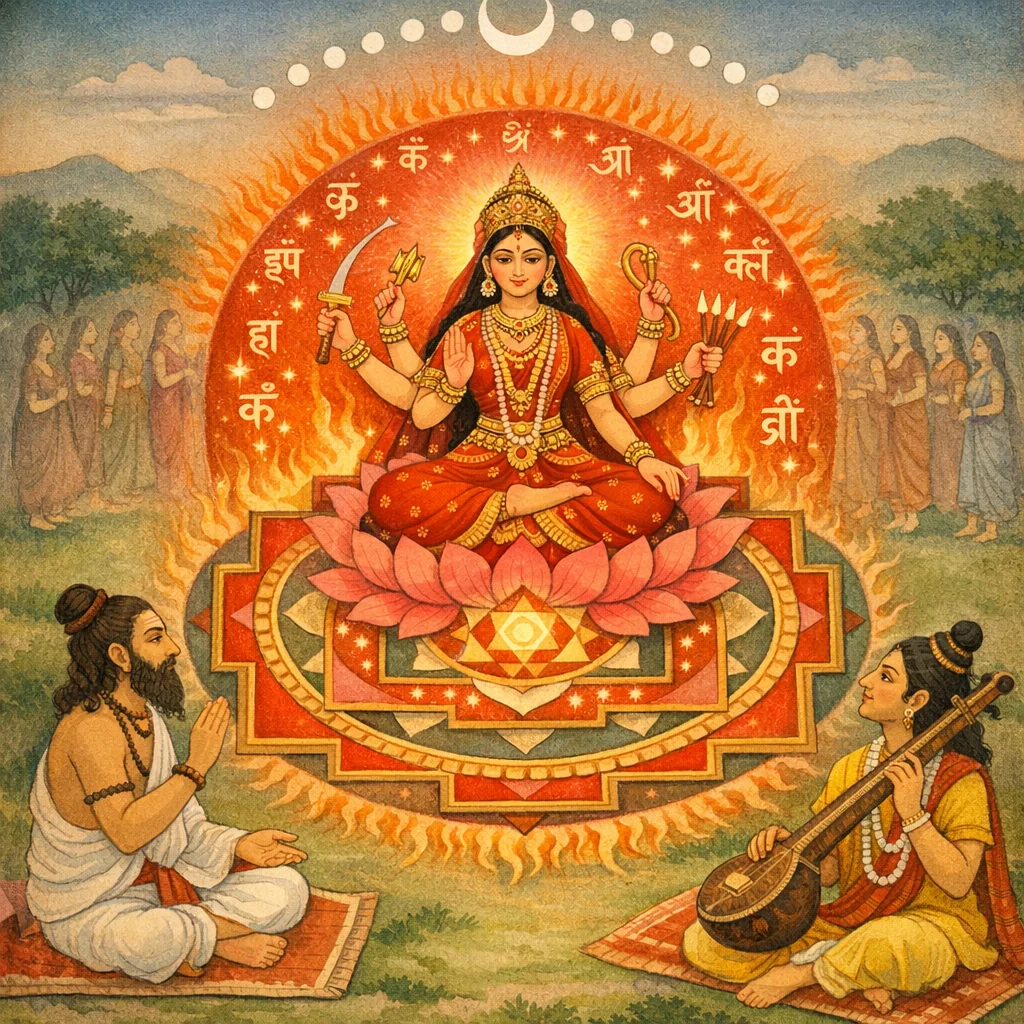
Rādhā-sambaddha-mantra-vyākhyā (Rādhā-Related Mantras Explained)
Sūta relates that after hearing the rites of sacrificial worship, Nārada asks Sanatkumāra about the proper veneration of Śrī Rādhā as the primordial Mother and about the kalās of divine manifestation. Sanatkumāra begins a “most secret” teaching: he names the chief sakhīs such as Candrāvalī and Lalitā, and lists a wider circle of thirty-two companions, then sets forth the doctrine of sixteen kalās and subsidiary kalās pervading sacred speech. The chapter then turns to mantra-śāstra, giving coded phonetic and elemental designations for mantra formation, classifications of Haṃsa metre/recitation, and connections to Tripurasundarī/Śrīvidyā lineages. It prescribes nyāsa (aṅga and vyāpaka), yantra construction (petalled lotuses, hexagon, square, bhūpuras), and detailed dhyāna iconography (color, arms, weapons, ornaments). A large section maps specific vidyās and mantras to the Nityā goddesses aligned with lunar tithis—Kāmeśvarī, Bhagamālinī, Nityaklinnā, Bheruṇḍā, Mahāvajreśvarī, Dūtī/Vahnivāsinī, Tvaritā, Nīlapatākā, Vijayā, Jvālāmālinī, Maṅgalā—concluding that such worship grants siddhi, prosperity, and the destruction of sin.
Shlokas
Verse 1
सूत उवाच । श्रुत्वेत्थं यजनं विप्रा मन्त्रध्यानपुरःसरम् । सर्वासामवताराणां नारदो देवदर्शनः ॥ १ ॥
Sūta said: O brāhmaṇas, having thus heard of the sacrificial worship—preceded by mantra-recitation and meditative contemplation—Nārada, the seer who beholds the gods, then spoke regarding all the divine descents (avatāras).
Verse 2
सर्वाद्याया जगन्मातुः श्रीराधायाः समर्चनम् । अवतारकलानां हि पप्रच्छ विनयान्वितः ॥ २ ॥
With humility, he inquired into the proper worship of Śrī Rādhā—the Primordial One, the Mother of the universe—and also into the divine portions (kalās) within the Lord’s incarnations.
Verse 3
नारद उवाच । धन्योऽस्मिकृतकृत्योऽस्मि जातोऽहं त्वत्प्रसादतः । पज्जगन्मातृमंत्राणां वैभवं श्रुतवान्मुने ॥ ३ ॥
Nārada said: “Blessed am I; by your grace my life has found fulfillment. O sage, I have now heard the greatness and potency of the mantras of the Divine Mothers who pervade the worlds.”
Verse 4
यथा लक्ष्मीमुखानां तु अवताराः प्रकीर्तिताः । तथा राधावताराणां श्रोतुमिच्छामि वैभवम् ॥ ४ ॥
Just as the incarnations of Lakṣmī and the other divine consorts have been proclaimed, so too I wish to hear the glory and majesty of the incarnations of Rādhā.
Verse 5
यत्संख्याकाश्च यद्रूपा यत्प्रभावा विदांवर । राधावतारास्तान्सत्यं कीर्तयाशेषसिद्धिदान् ॥ ५ ॥
O best among the learned, truly recount the Rādhā-avatāras—their number, their forms, and their powers—for they bestow every kind of spiritual attainment (siddhi).
Verse 6
एतच्छुत्वा वचस्तस्य नारदस्य विधेः सुतः । सनत्कुमारः प्रोवाच ध्यात्वा राधापदांबुजम् ॥ ६ ॥
Having heard these words of Nārada, Sanatkumāra—the son of Brahmā (Vidhi)—meditated upon the lotus-feet of Rādhā and then began to speak.
Verse 7
सनत्कुमार उवाच । श्रृणु विप्र प्रवक्ष्यामि रहस्यातिरहस्यकम् । राधावतारचरितं भजतामिष्टिसिद्धिदम् ॥ ७ ॥
Sanatkumāra said: Listen, O brāhmaṇa; I shall proclaim a secret—indeed, the most secret—namely, the account of Rādhā’s divine descent (avatāra), which grants the fulfillment of cherished aims to those who worship with bhakti.
Verse 8
चन्द्रावली च ललिता द्वे सख्यौ सुप्रिये सदा । मालावतीमुखाष्टानां चन्द्रावल्यधिपास्मृता ॥ ८ ॥
Candrāvalī and Lalitā are the two ever-beloved sakhīs. Among the group of eight headed by Mālāvatī, Candrāvalī is remembered as the leader.
Verse 9
कलावतीमुखाष्टानामीश्वरी ललिता मता । राधाचरणपूजायामुक्ता मालावतीमुखाः ॥ ९ ॥
Among the eight beginning with Kalāvatī, the sovereign Goddess is held to be Lalitā; and in the worship of Rādhā’s feet, those forms are spoken of as beginning with Mālāvatī.
Verse 10
ललिताधीश्वरीणां तु नामानि श्रृणु सांप्रतम् । कलावती मधुमती विशाखा श्यामलाभिधा ॥ १० ॥
Now listen to the names of Lalitādhīśvarī: Kalāvatī, Madhumatī, Viśākhā, and the one known as Śyāmalā.
Verse 11
शैब्या वृन्दा श्रीधराख्या सर्वास्तुत्तुल्यविग्रहाः । सुशीलाप्रमुखा श्चान्याः सख्यो द्वात्रिंशदीरिताः ॥ ११ ॥
Śaibyā, Vṛndā, and the one known as Śrīdharā—along with all the others of equally excellent form, such as Suśīlā and the rest—are said to be thirty-two female companions (sakhīs).
Verse 12
ताः श्रृणुष्व महाभाग नामतः प्रवदामि ते । सुशीलां शशिलेखा च यमुना माधवी रतिः ॥ १२ ॥
Listen to them, O greatly fortunate one; I shall declare them to you by name—Suśīlā, Śaśilekhā, Yamunā, Mādhavī, and Rati.
Verse 13
कदम्बमाला कुन्ती च जाह्नवी च स्वयंप्रभा । चन्द्रानना पद्ममुखी सावित्री च सुधामुखी ॥ १३ ॥
Kadambamālā, Kuntī, Jāhnavī, and Svayaṃprabhā; Candrānanā, Padmamukhī, Sāvitrī, and Sudhāmukhī—these too are named.
Verse 14
शुभा पद्मा पारिजाता गौरिणी सर्वमंगला । कालिका कमला दुर्गा विरजा भारती सुरा ॥ १४ ॥
She is Śubhā, Padmā, and Pārijātā; Gaurī, the All-Blessing. She is Kālīkā, Kamalā, Durgā, Virajā, Bhāratī, and Surā—known by many sacred names and forms.
Verse 15
गंगा मधुमती चैव सुन्दरी चन्दना सती । अपर्णा मनसानन्दा द्वात्रिंशद्राधिकाप्रियाः ॥ १५ ॥
Gaṅgā, Madhumatī, Sundarī, Candanā, Satī, Aparṇā, and Manasānandā—these are names, and they are dear to Rādhikā; thus the list extends to thirty-two in all.
Verse 16
कदाचिद्छलिला देवी पुंरूपा कृष्णविग्रहा । ससर्ज षोडशकलास्ताः सर्वास्तत्समप्रभाः ॥ १६ ॥
At one time, the goddess Chalilā—assuming a male form with a dark, Kṛṣṇa-like body—created sixteen kalās (manifest aspects), all of them radiant with the same splendor as herself.
Verse 17
तासा मन्त्रं तथा ध्यानं यन्त्रार्चादिक्रमं तथा । वर्णये सर्वतंत्रेषु रहस्यं मुनिसत्तम ॥ १७ ॥
O best of sages, I shall describe their mantras, their meditative visualizations, and the procedures beginning with yantra and worship—thus revealing the secret teaching found throughout all Tantras.
Verse 18
वातो मरुच्चाग्रिवह्नी धराक्ष्मे जलचारिणी । विमुखं चरशुचिविभू वनस्वशक्तयः स्वराः ॥ १८ ॥
The vowels are classified as wind, storm-wind, fire-bearers, earth and sky, and water-movers; also as “turned away,” “moving,” “pure,” and “all-pervading”; and as “forest,” “wealth,” and “power.”
Verse 19
प्राणस्तेजः स्थिरा वायुर्वायुश्चापि प्रभा तथा । ज्यकुमभ्रं तथा नादो दावकः पाथ इत्यथ ॥ १९ ॥
Now the tradition enumerates: prāṇa (vital breath), tejas (radiant heat), sthirā (steadiness), vāyu (wind), and again vāyu; also prabhā (lustre), jyakumabhra, nāda (sound resonance), dāvaka (fire), and pātha (recitation/reading).
Verse 20
व्योमरयः शिखी गोत्रा तोयं शून्यजवीद्युतिः । भूमी रसो नमो व्याप्तं दाहश्चापि रसांबु च ॥ २० ॥
“Sky, rays, fire, lineage, water, the void, swiftness, brilliance; earth, taste, the salutation ‘namo’, pervasion, burning, and also sap and water”—these too are stated as technical designations used in Vedic and śāstric enumeration.
Verse 21
वियत्स्पर्शश्च हृद्धंसहलाग्रासो हलात्मिकाः । चन्द्रावली च ललिता हंसेला नायके मते ॥ २१ ॥
According to the Nayaka-mata, these (technical) names are: Viyatsparśa, Hṛddhaṁsa, Halāgrāsa, Halātmikā, Candrāvalī, Lalitā, and Haṁselā.
Verse 22
ग्रासस्थिता स्वयं राधा स्वयं शक्तिस्वरूपिणी । शेषास्तु षोडशकला द्वात्रिंशत्तत्कलाः स्मृताः ॥ २२ ॥
Śrī Rādhā herself abides in the divine sphere called “grāsa” and is truly the very embodiment of Śakti. The remaining manifestations are remembered as sixteen kalās, and as thirty-two subsidiary kalās belonging to that Śakti.
Verse 23
वाङ्मयं निखिलं व्याप्तमाभिरेव मुनीश्वर । ललिताप्रमुखाणां तु षोडशीत्वमुपागता ॥ २३ ॥
O best of sages, the entire body of sacred speech is pervaded by these (forms); and those beginning with Lalitā have indeed attained the state of “Ṣoḍaśī,” the “Sixteen.”
Verse 24
श्रीराधा सुन्दरी देवी तांत्रिकैः परिकीर्त्यते । कुरुकुल्ला च वाराही चन्द्रालिललिते उभे ॥ २४ ॥
Śrī Rādhā, the beautiful Devī, is celebrated in the Tantric tradition. She is also spoken of as Kurukullā and as Vārāhī—both being forms known as Candrālī and Lalitā.
Verse 25
संभूते मन्त्रवर्गं तेऽभिधास्येऽहं यथातथम् । हृत्प्राणेलाहंसदावह्निस्वैर्ललितेरिता ॥ २५ ॥
O Sambhūta, I shall now declare to you, exactly as it is, the group of mantras—those taught in the mode of the heart and the vital-breath, expressed through the seed syllables “lā” and “haṃsa”, and set in motion by the inner fire, in the free, playful flow of Lalitā.
Verse 26
त्रिविधा हंसभेदेव श्रृणु तां च यथाक्रमम् । हंसाद्ययाऽद्या मध्या स्यादादिमध्यस्थहंसया ॥ २६ ॥
Now listen, in due order, to this threefold classification of the metre called Haṃsa: the first variety begins with “haṃsa”, the middle variety has “haṃsa” in the middle, and the last variety is that in which “haṃsa” stands at both the beginning and the middle.
Verse 27
तृतीया प्रकृतिः सैव तुर्या तैरंत्यमायया । आसु तुर्याभवन्मुक्त्यै तिस्रोऽन्याः स्युश्चसंपदे ॥ २७ ॥
That very third mode of nature becomes the Fourth, turīya, through the final and transcendent māyā. Abiding in turīya leads to liberation (mokṣa); the other three remain for worldly attainment and prosperity.
Verse 28
इति त्रिपुरसुंदर्या विद्या सरुमतसमीरिता । दाहभूमीरसाक्ष्मास्वैर्वशिनीबीजमीरितम् ॥ २८ ॥
Thus, according to the Sarumata tradition, the Vidyā of Tripurasundarī has been taught; and the Vaśinī-bīja has been declared through the mystic syllables “dāha”, “bhūmī”, “rasa”, and “akṣmā”.
Verse 29
प्राणो रसाशक्तियुतः कामेश्वर्यक्षरं महत् । शून्यमंबुरसावह्निस्वयोगान्मोहनीमनुः ॥ २९ ॥
When the syllable “prāṇa” is joined with the power of “rasa” and combined with the great syllable of Kāmeśvarī, and then, by its proper junctions, conjoined with “śūnya”, “ambu”, “rasa”, “vahni”, and “sva”, it becomes the Mohanī-mantra, the formula of enchantment.
Verse 30
व्याप्तं रसाक्ष्मास्वयुतं विमलाबीजमीरितम् । ज्यानभोदाहवह्निस्वयोगैः स्यादरुणामनुः ॥ ३० ॥
When the syllable “vyāpta” is joined with the syllables indicated by the code-words “rasa” and “akṣmā”, and combined with the pure seed-syllable (vimalabīja) as taught, then—through the prescribed conjunctions denoted by “jyāna”, “bho”, “dāha”, and “vahni”—it becomes the mantra of Aruṇā.
Verse 31
जयिन्यास्तु समुद्दिष्टः सर्वत्र जयदायकः । कं नभोदाहसहितं व्याप्तक्ष्मास्वयुतं मनुः ॥ ३१ ॥
For the deity Jayinī, a mantra is prescribed that bestows victory everywhere. Its mantric syllable is “kaṃ”, joined with the seed-syllables of sky and fire and combined with that which pervades the earth—thus the formula is taught.
Verse 32
सर्वेश्वर्याः समाख्यातः सर्वसिद्धिकरः परः । ग्रासो नभोदाहवह्निस्वैर्युक्तः कौलिनीमनुः ॥ ३२ ॥
This Kaulinī-Manu is proclaimed as the supreme bestower of all sovereign powers and the highest accomplisher of every siddhi; it is formed by combining the syllables “grāsa,” “nabhas,” “dāha,” “vahni,” and “svaira.”
Verse 33
एतैर्मनुभिरष्टाभिः शक्तिभिर्वर्गसंयुक्तैः । वाग्देवतांतैर्न्यासः स्याद्येन देव्यात्मको भवेत् ॥ ३३ ॥
With these eight mantras—joined with their respective śaktis and arranged by the phonetic classes (vargas)—one should perform the nyāsa ending in Vāgdevatā, the deity of speech; thereby one becomes imbued with the nature of the Goddess.
Verse 34
रंध्रे भाले तथाज्ञायां गले हृदि तथा न्यसेत् । नाभावाधारके पादद्वये मूलाग्रकावधि ॥ ३४ ॥
One should perform nyāsa in the cranial aperture, on the forehead, at the ājñā (brow-center), at the throat, and in the heart; likewise at the navel and at the ādhāra (base), and on both feet—thus, from the root up to the tip, through the whole bodily axis.
Verse 35
षड्दीर्घाढ्येन बीजेन कुर्याश्चैव षडंगकम् । लोहितां ललितां बाणचापपाशसृणीः करैः ॥ ३५ ॥
With the seed-mantra endowed with six long vowels, one should perform the sixfold (ṣaḍaṅga) nyāsa. Then one should meditate upon the Goddess as red-hued and graceful, holding in her hands the arrow, bow, noose (pāśa), and goad (aṅkuśa).
Verse 36
दधानां कामराजांके यन्त्रीतां मुदुतां स्मरेत् । मध्यस्थदेवी त्वेकैव षोडशाकारतः स्थाता ॥ ३६ ॥
One should meditate on the Goddess as seated in the lap of Kāmarāja, gently composed and established within the yantra. The central Goddess is one alone, yet she stands forth in sixteen forms (aspects).
Verse 37
यतस्तस्मात्तनौ तस्यास्त्वन्याः पंचदशार्चयेत् । ऋषिः शिवश्छंद उक्ता देवता ललितादिकाः ॥ ३७ ॥
Therefore, upon that very body of the Devī, one should worship the other fifteen manifestations. The ṛṣi is said to be Śiva; the chandas (metre) is declared; and the deities are Lalitā and the rest.
Verse 38
सर्वासामपि नित्यानामावृतीर्नामसंचये । पटले तु प्रयोगांश्च वक्ष्याम्यग्रे सविस्तरम् ॥ ३८ ॥
In the compilation of divine names, I have also recorded the prescribed repetitions (āvṛtti) for all the daily rites. In the paṭala on ritual procedure, I shall later explain their practical applications in full detail.
Verse 39
अथ षोडशनित्यासु द्वितीया या समीरिता । कामेश्वरीति तां सर्वकामदां श्रृणु नारद ॥ ३९ ॥
Now, among the sixteen Nityā goddesses, the one proclaimed as the second is called Kāmeśvarī. O Nārada, listen to her—she bestows the fulfillment of all desired aims.
Verse 40
शुचिः स्वेन युतस्त्वाद्यो ललिता स्याद्द्वितीयकः । शून्यमग्नियुतं पश्चाद्रयोव्याप्तेन संयुतम् ॥ ४० ॥
The first syllable/term is “Śuci”, joined with its own marker; the second is to be “Lalitā”. Thereafter, “Śūnya” is to be joined with “Agni”, and then combined with that which is pervaded by “Raya”.
Verse 41
प्राणो रसाग्निसहितः शून्ययुग्मं चरान्वितम् । नभोगोत्रा पुनश्चैषां दाहेन समयोजिता ॥ ४१ ॥
Prāṇa, together with Rasa and Agni, is joined with the pair of zeros and combined with the “moving” (variable) factors. Again, for these, the “sky-gotra” (nabhogotra) is applied, and they are properly connected through the operation called dāha (“burning”).
Verse 42
अंबु स्याच्चरसंयुक्तं नवशक्तियुतं च हृत् । एषा कामेश्वरी नित्या कामदैकादशाक्षरी ॥ ४२ ॥
“Ambu” should be joined with “cara”, and then with “hṛt” endowed with the nine Śaktis. This is the eternal Kāmeśvarī—the wish-fulfilling mantra of eleven syllables.
Verse 43
मूलविद्याक्षरैरेव कुर्यादंगानि षट् क्रमात् । एकेन हृदयं शीर्षं तावताथो द्वयं द्वयात् ॥ ४३ ॥
Using only the syllables of the mūla-vidyā, one should perform the sixfold aṅga-nyāsa in proper order: with one syllable each, install the Heart and the Head; then, with two syllables at a time, install the remaining limbs in pairs.
Verse 44
चतुर्भिर्नयनं तद्वदस्त्रमेकेन कीर्तितम् । दृक्श्रोत्रनासाद्वितये जिह्वाहृन्नाभिगुह्यके ॥ ४४ ॥
The eye is said to be represented by four (marks/units); likewise, the astra—weapon—is described by a single one. This is to be understood with respect to the organs of perception—eye, ear, and the pair of nostrils—as well as the tongue, the heart, the navel, and the secret organ.
Verse 45
व्यापकत्वेन सर्वांगे मूर्द्धादिप्रपदावधि । न्यसेद्विद्याक्षराण्येषु स्थानेषु तदनंतरम् ॥ ४५ ॥
Then, considering the mantra’s all-pervading nature (vyāpaka), one should perform nyāsa of the Vidyā’s syllables throughout the entire body—from the crown of the head down to the feet—upon their respective stations.
Verse 46
समस्तेन व्यापकं तु कुर्यादुक्तक्रमेण तु । अथ ध्यानं प्रवक्ष्यामि नित्यपूजासु चोदितम् ॥ ४६ ॥
Having thus performed the all-pervading rite (vyāpaka) in the manner already stated, I shall now explain the dhyāna—meditation enjoined for the daily worship.
Verse 47
येन देवी सुप्रसन्ना ददातीष्टमयत्नतः । बालार्ककोटिसंकाशां माणिक्यमुकुटोज्ज्वलाम् ॥ ४७ ॥
By this practice the Goddess, exceedingly pleased, bestows the wished‑for boon without effort—radiant like ten million rising suns, shining with a crown brilliant with rubies (māṇikya).
Verse 48
हारग्रैवेयकांचीभिरूर्मिकानूपुरादिभिः । मंडितां रक्तवसनां रत्नाभरणशोभिताम् ॥ ४८ ॥
Adorned with necklaces, collar‑ornaments, girdles, bracelets, anklets, and the like; clad in red garments; and resplendent with jeweled ornaments.
Verse 49
षड्भुजां त्रीक्षणामिंदुकलाकलितमौलिकाम् । पञ्चाष्टषोडशद्वंद्वषट्कोणचतुरस्रगाम् ॥ ४९ ॥
Meditate upon Her as six‑armed, three‑eyed, with the crescent moon adorning Her crown, and as abiding in the yantra formed of paired petals—fivefold, eightfold, and sixteenfold—together with the hexagon and the square.
Verse 50
मंदस्मितलसद्वक्त्रां दयामंथरवीक्षणाम् । पाशांकुशौ च पुंड्रेक्षुचापं पुष्पशिलीमुखम् ॥ ५० ॥
Her face shines with a gentle smile, and Her gaze is softened and slowed by compassion. In Her hands are the noose (pāśa) and the goad (aṅkuśa), and also the sugarcane bow and flower‑arrows.
Verse 51
रत्नपात्रं सीधुपूर्णं वरदं बिभ्रतीं करैः । ततः प्रयोगान्कुर्वीत सिद्धे मत्रे तु साधकः ॥ ५१ ॥
Holding a jeweled vessel filled with sīdhu (fermented liquor) and the boon‑granting hand, the sādhaka—once the mantra has been perfected (siddha)—should then proceed to perform the prescribed ritual applications (prayoga).
Verse 52
तृतीयामथ वक्ष्यामि नाम्ना तु भगमालिनी । कामेश्वर्यादिरादिः स्याद्रसश्चापस्थिरारसः ॥ ५२ ॥
Now I shall explain the third arrangement, called Bhagamālinī. Its opening deity-name is Kāmeśvarī, and the associated rasa is the sequence known as “bow—steady rasa.”
Verse 53
धरायुक्सचरा पश्चात्स्थिरा पश्चाद्रसः स्मृतः । स्थिराशून्येऽग्निसंयुक्ते रसः स्यात्तदनंतरम् ॥ ५३ ॥
After the state called “the mobile joined with earth,” the “fixed” is taught; and after the fixed, rasa is remembered. When the fixed is emptied of its former quality and conjoined with fire, then immediately it becomes rasa.
Verse 54
स्थिरा भूसहिता गोत्रा सदाहोऽग्निरसः स्थिरा । नभश्च मरुता युक्तं रसवर्णसमन्वितम् ॥ ५४ ॥
Earth is steady and compact, bearing the gotra (supporting lineages or strata). Fire ever burns, with taste as its defining essence. Ether too, when joined with wind, is endowed with taste and color.
Verse 55
ततो रसः स्थिरा पश्चान्मरुता सह योजिता । अंबहंसचरोऽथिक्तो रसोऽथ स्यात्स्थिरा पुनः ॥ ५५ ॥
Thereafter, rasa becomes steady; then it is joined with the movement of the winds (vāyu). Next, moving like a swan upon the waters, it grows intensified; and then that rasa again becomes steady.
Verse 56
स्थिराधरान्विता हंसो व्याप्तेन च चरेण च । रसः स्थिरा ततो व्याप्तं भूयुतं शून्यमग्नियुक् ॥ ५६ ॥
The Haṁsa (the inner Self) is supported by the steady base, and it moves through both the all-pervading and the mobile. Rasa is steady; from it arises the all-pervading state—abundant, void-like, and joined with fire.
Verse 57
रसः स्थिरा ततः साग्निशून्यं तवियुतो मरुत् । रयः शून्यं चाग्नियुतं हृदाहंसाच्च तत्परम् ॥ ५७ ॥
“Rasa” is set firm; then that which is without fire, joined with “tavi,” is called “marut” (wind). “Rayaḥ” is void; and, joined with “agni” (fire), it becomes the form “hṛdāhaṃsā.” From that, the next result is obtained.
Verse 58
रसः स्थिरांबु च वियत्स्वयुतं प्राण एव च । दाहोऽग्रियुग्रसस्तस्मास्थिराक्ष्मा दाहसंयुता । सचरः स्याज्जवीपूर्वविद्या तर्तीयतः क्रमात् ॥ ५८ ॥
Rasa (essence), the stable waters, and space together with prāṇa (the vital breath) are set forth; then comes “dāha”—fire, the devourer. From that arise stable forms, together with heat. Thus, with the movement of living beings, the sequence proceeds in the third division, according to the order taught in the earlier science.
Verse 59
चतुष्टयमथार्णानां रसस्तदनु च स्थिरा । हृदंबुयुक् क्ष्मया दाहः सचरः स्याज्जवी च हृत् ॥ ५९ ॥
Next, the set of four (letters) belongs to the oceans; then comes the letter “ra,” followed by “sthi” and “rā.” Joined with “hṛd” and “ambu,” and with “kṣmā” added, it yields “dāha”; with “cara” it becomes “sacara”; and with “javī” it becomes “hṛt”.
Verse 60
दाहोंऽबुमरुता युक्तो व्योम्नि साग्निरसस्तुतः । स्थिरा तु मरुता युक्ता शून्यं साग्निनभश्चरौ ॥ ६० ॥
The sound “dāhoṃ,” joined with water and wind, is established in the sky as a syllabic essence attended by fire. But when it is steady and joined with wind, it becomes the “void”; thus, moving through space, it is accompanied by fire and ether.
Verse 61
हंसो व्याप्तमरुद्युक्तः शून्यं व्याप्तमतोंऽबु च । दाहो गोत्राचरयुता तथा दाहस्तथा रयः ॥ ६१ ॥
“Haṁsa” (the supreme Self) is pervaded by the moving wind; the void, too, is pervaded—and so is water. There is “dāha” (burning, heat) along with the movement of lineages and conduct; likewise there is burning, and likewise there are currents (rayaḥ), flows of impulse.
Verse 62
हृद्धरासहितं दाहरयौ चरसमन्वितौ । रसः स्थिरा ततः प्राणो रसाग्निसहितो भवेत् ॥ ६२ ॥
When the heart and its supporting channels are joined, and the digestive fire moves with its proper motion, the body’s rasa (nutritive essence) becomes steady; thereafter prāṇa, the vital breath, is endowed with both rasa and agni.
Verse 63
शून्ययुग्मं चरयुतं ततः पूर्वमतः परम् । शून्ययुग्मं च गोत्रा स्याद्वाहयुक्तांबुना चरः ॥ ६३ ॥
Take a pair of zeros and add the number denoted by “cara”; then, from that, take what is earlier and what is later in the sequence. A pair of zeros is said to indicate “gotra”; and “cara,” joined with “vāha” and “ambu,” yields the intended value by this code.
Verse 64
प्राणो रसा चरयुतो गोत्रव्यसिमतः परम् । गोत्रादाहमरुद्युक्ता त्वंबुन्यासमतो भवेत् ॥ ६४ ॥
Prāṇa, together with rasa and the moving currents of life, is declared supreme beyond the bounds of gotra (lineage). From the notion of gotra arises the “I”-sense joined with the winds (vāyus); by that, the placing of “you” in the waters (tvaṃ-bhu-nyāsa) is accomplished.
Verse 65
युक्तोनांभश्च भूयुक्तं वाश्चरेण समन्वितम् । ग्रासो धरायुतः पश्चाद्रसः शक्त्या समन्वितः ॥ ६५ ॥
When the watery principle is properly joined with the earthy principle, and air is conjoined with movement, then grāsa—the act of taking in, of ingestion—arises together with the earth-element; thereafter rasa, taste and essence, is produced, conjoined with śakti, power.
Verse 66
ग्रासो भूसहितो विप्र रसो व्याप्तं ततश्च हृत् । दाहोनांबु च हृत्पश्चाद्रयेंऽबुमरुदन्वितः ॥ ६६ ॥
O brāhmaṇa, the morsel of food (grāsa), together with the earth-element, becomes suffused with rasa; thereafter it is carried to the heart. Then the burning heat (digestive fire) and the watery element act, and after the heart it proceeds swiftly, accompanied by water and wind.
Verse 67
शून्यं च केवलं चैव रसश्च सचरस्थिरा । वियदंबुयुतं दाहस्त्वग्नियुक्सयुतः शुचिः ॥ ६७ ॥
(These are the technical designations:) “Void” and “the Sole One”; “Rasa” together with all that is moving and unmoving; “sky joined with water”; “burning”—that which is joined with fire; and “pure”.
Verse 68
भूमी रसाक्ष्मास्वयुता पंचैकांतरिताः स्थिराः । तदंतरित बीजानि स्वसंयुक्तानि पंच वै ॥ ६८ ॥
Earth, Water, Fire, Air, and Space—these five, firmly established, are set in an alternating order. And between them are five “seeds” (subtle causal factors), each conjoined with its own corresponding element.
Verse 69
तानि क्रमाज्ज्यासचरो रसो भूश्च नभोयुता । हंसश्चरयुतो द्विः स्यात्ततः प्राणो रसाग्नियुक् ॥ ६९ ॥
In due order, these are to be derived: first “jyāsacara”, then “rasa”; then “bhū” joined with “nabhas”. “Haṃsa” combined with “cara” becomes doubled; thereafter comes “prāṇa” joined with “rasa” and “agni”.
Verse 70
शून्ययुग्मं चरयुतं हृद्दाहोंबुमरुद्युतः । व्योमाग्निसहितं पश्चाद्रसश्च मरुता स्थिरा ॥ ७० ॥
“(Take) the pair of zeros joined with ‘cara’; (then) the group indicated by heart-burning, water, and wind; afterwards (add) that which is joined with ether and fire; and then ‘rasa’—with wind remaining fixed (as the constant).”
Verse 71
शून्यं साग्निनभश्चैव चरेण सहितं तथा । अंबु पश्चाद्वियत्तस्मान्नभश्च मरुदन्वितम् ॥ ७१ ॥
From the void (śūnya) arises space joined with fire; likewise, along with motion (cara). Thereafter comes water; and from that emerges space again—now accompanied by wind.
Verse 72
शून्यं व्याप्तं च दद्युक्तं रयदाहस्ववह्निभिः । हंसः सदाहोंबगुरसा चरस्वैः संयुतो भवेत् ॥ ७२ ॥
When the terms “śūnya” and “vyāpta” are joined with “dad‑yukta”, together with the sounds ‘raya’, ‘dāha’, ‘sva’, and ‘vahni’, the resulting (technical) formation becomes “haṃsa”, linked with the sequence ‘sadāhoṃba‑gurasā’ and ‘carasvai’.
Verse 73
हंसः सदाहवह्निस्वैर्युक्तमंत्यमुदीरितम् । सप्तत्रिंशच्छतार्णैः स्यान्नित्या सौभागमालिनी ॥ ७३ ॥
The mantra called “Haṃsa,” together with the final utterance joined to ‘sadā,’ ‘havas,’ ‘agni,’ and ‘svair’—when recited as a garland of 3,700 syllables—becomes the ever-effective “Saubhāgya-mālinī,” bestower of unceasing good fortune.
Verse 74
अंगानि मंत्रवर्णैः स्युराद्येन हृदुदीरितम् । ततश्चतृर्भिः शीर्षं स्याच्छिखा त्रिभिरुदीरिता ॥ ७४ ॥
In nyāsa, the limbs are to be assigned with the mantra’s syllables. With the first syllable one touches and invokes the Heart; then with four syllables the Head is assigned; and with three syllables the Topknot (śikhā) is assigned, as taught.
Verse 75
गुणवेदाक्षरैः शेषाण्यंगानि षडिति क्रमात् । अरुणामरुणाकल्पां सुंदरीं सुस्मिताननाम् ॥ ७५ ॥
Then, in proper sequence, one assigns the remaining six limbs with the syllables denoting the guṇas and the Veda. Thereafter one should meditate upon Her—crimson-hued, radiant like dawn, beautiful, with a gently smiling face.
Verse 76
त्रिनेत्रां बाहुभिः षड्भिरुपेतां कमलासनाम् । कह्लारपाशपुंड्रेक्षुकोदंडान्वामबाहुभिः ॥ ७६ ॥
He should contemplate Her as three-eyed, endowed with six arms, seated upon a lotus; and in Her left hands holding a blue lotus, a noose (pāśa), a sugarcane stalk, and a bow.
Verse 77
दधानां दक्षिणैः पद्ममंकुशं पुष्पसायकम् । तथाविधाभिः परितो युतां शक्तिगणैः स्तुतैः ॥ ७७ ॥
In her right hands she bears a lotus, a goad (aṅkuśa), and the flower-arrow; and on every side she is encircled by praised hosts of Śaktis of the same kind.
Verse 78
अक्षरोक्ताभिरन्याभिः स्मरोन्मादमदात्मभिः । एषा तृतीया कथिता वनिता जनमोहिनी ॥ ७८ ॥
With other utterances, spoken syllable by syllable, whose very nature is desire, frenzy, and intoxication—this is declared the third kind of woman, the enchantress who deludes people.
Verse 79
चतुर्थीं श्रृणु विप्रेन्द्र नित्यक्लिन्नासमाह्वयाम् । हंसस्तु दाहवह्निस्वैर्युक्तः प्रथममुच्यते ॥ ७९ ॥
O best of brāhmaṇas, hear now the fourth classification, called Nityaklinnā. In it, the first is said to be Haṁsa, associated with the fire of burning and with independence (svairya).
Verse 80
कामेश्वर्यास्तृतीयादिवर्णानामष्टकं भवेत् । हृदंबुमरुता युक्तः स एवैकादशाक्षरः ॥ ८० ॥
The set of eight syllables is formed from the third and subsequent letters of (the mantra of) Kāmeśvarī. When joined with the syllables ‘hṛd’, ‘ambu’, and ‘marut’, it becomes the eleven-syllabled mantra.
Verse 81
एकादशाक्षरी चेयं विद्यार्णैरंगकल्पनम् । आद्येन मन्त्रवर्णेन हृदयं समुदीरितम् ॥ ८१ ॥
This is the eleven-syllabled sacred formula; its placement upon the limbs (nyāsa) is to be arranged by the wise, oceans of knowledge. By the first letter of the mantra, the ‘heart’ (hṛdaya-nyāsa) is to be pronounced and established.
Verse 82
द्वाभ्यां द्वाभ्यां तु शेषाणि अंगानि परिकल्पयेत् । न्यसेदंगुष्ठमूलादिकनिष्ठाग्रांतमूर्द्ध्वगम् ॥ ८२ ॥
Then, using pairs of fingers, one should assign and perform nyāsa upon the remaining limbs. One should place the mantra beginning at the base of the thumb, moving upward, and ending at the tip of the little finger.
Verse 83
शेषं तद्वलये न्यस्य हृद्दृक्छ्रोत्रे नसोर्द्वयोः । त्वचि ध्वजे च पायौ च पादयो रर्णकान्न्यसेत् ॥ ८३ ॥
Placing what remains upon the ring finger, one should then perform nyāsa upon the heart, the eyes, the ears, and the two nostrils; and one should also place the appointed syllables upon the skin, the dhvaja (banner), the anus, and the feet.
Verse 84
अरुणामरुणाकल्पामरुणांशुकधारिणीम् । अरुणस्रग्विलेपां तां चारुस्मेरमुखांबुजाम् ॥ ८४ ॥
I meditate upon that Devī Arunā—crimson in hue, adorned with crimson ornaments, clad in crimson garments, garlanded and anointed with crimson substances—whose lotus-like face shines with a gentle, beautiful smile.
Verse 85
नेत्रत्रयोल्लसद्वक्त्रां भालेघर्मांबुमौक्तिके । विराजमानां मुकुटलसदर्द्धेंदुशेखराम् ॥ ८५ ॥
Her face shone with three eyes; upon her forehead gleamed pearls as though formed from beads of perspiration; and she appeared resplendent, crowned with a diadem set with a radiant half-moon crest.
Verse 86
चतुर्भिर्बाहुभिः पाशमंकुशं पानपात्रकम् । अभयं बिभ्रतीं पद्ममध्यासीनां मदालसाम् ॥ ८६ ॥
With her four arms she bears the pāśa (noose), the aṅkuśa (goad), the drinking-cup, and the Abhaya gesture of fearlessness. Seated in the midst of a lotus, she appears languid, as though intoxicated with divine rapture.
Verse 87
ध्यात्वैवं पूजयेन्नित्यक्किन्नां नित्यां स्वशक्तिभिः । पुण्या चतुर्थी गदिता नित्याक्किन्नाह्वया मुने ॥ ८७ ॥
Having thus meditated, one should worship Nityāklinnā—the eternal Goddess—daily, according to one’s own capacity. This meritorious observance on the fourth lunar day, O sage, has been declared by the name “Nityāklinnā.”
Verse 88
वनिता नवनीतस्य दाविकाग्निर्जयादिना । भूः स्वेन युक्ता प्रथमं प्राणो दाहेन तद्युतः ॥ ८८ ॥
A woman is likened to fresh butter; the forest-fire, by its conquering power and the like, consumes it. The principle “Bhū” (Earth) comes first, joined to its own quality; and “Prāṇa” (vital breath) is endowed with burning energy and shines through that.
Verse 89
रसो दाहेन तद्युक्तं प्रभादाहेन तद्युता । ज्या च दाहेन तद्युक्ता नित्याक्लिन्नांतगद्वयम् ॥ ८९ ॥
“Rasa” is to be conjoined with “dāha”; “Prabhā” is likewise joined with “prabhā-dāha”; and “Jyā” too is joined with “dāha”—thus forming the pair of mantric/technical expressions whose ending is “nityāklinnā”.
Verse 90
एषा नवाक्षरी नित्या भेरुण्डा सर्वसिद्धिदा । प्रणवं ठद्वयं त्यक्त्वा मध्यस्थैः षड्भिरक्षरैः ॥ ९० ॥
This is the eternal nine-syllabled mantra, called Bheruṇḍā, the giver of all attainments. One should omit the praṇava (Oṁ) and the pair of syllables “ṭha,” and form it with the six syllables placed in the middle.
Verse 91
षडंगानि प्रकुर्वीत वर्णन्यासं ततः परम् । रंध्राद्यामुखकंठेषु हन्नाभ्यां धारयद्वयम् ॥ ९१ ॥
One should perform the sixfold limb-nyāsa first, and then the placement of letters (varṇa-nyāsa). Thereafter, one should mentally install and hold the pair of seed-syllables “ha” and “na” in the bodily apertures, in the mouth, and in the throat.
Verse 92
न्यसेन्मंत्रार्णनवकं मातृकान्यासपूर्वकम् । अथ ध्यानं प्रवक्ष्यामि देव्याः सर्वार्थसिद्धिदम् ॥ ९२ ॥
Having first performed the mātṛkā-nyāsa, one should then install the nine mantra-syllables. Now I shall teach the meditation on the Goddess, which grants the accomplishment of all aims.
Verse 93
तप्तकांचनसंकाशदेहां नेत्रत्रयान्विताम् । चारुस्मितां चितमुखीं दिव्यालंकारभूषिताम् ॥ ९३ ॥
Her body shone like refined gold; she was endowed with three eyes, wore a lovely smile, had a radiant face, and was adorned with divine ornaments.
Verse 94
ताटंकहारकेयूररत्नस्तबकमंडिताम् । रसनानूपुरोर्म्यादिभूषणैरतिसुन्दरीम् ॥ ९४ ॥
She was exceedingly beautiful, adorned with earrings, a necklace, armlets, and clusters of gems, and further embellished with ornaments such as a jeweled girdle, anklets, and rings.
Verse 95
पाशांकुशौ चर्मखङ्गौ गदावह्निधनुःशरान् । करैर्दधानामासीना पूजायां मत्पसस्थिताम् ॥ ९५ ॥
Holding in her hands a noose and a goad, a shield and a sword, a mace, fire, a bow and arrows—she sat for worship, established in the Lord’s supreme abode.
Verse 96
शक्तीश्च तत्समाकारतेजोहेतिभिरन्विताः । पूजयेत्तद्वदभितः स्मितास्या विजयादिकाः ॥ ९६ ॥
One should also worship the divine Śaktis, whose forms resemble His, radiant with splendor and bearing weapons. Likewise, all around, one should worship the smiling-faced deities such as Vijayā and others.
Verse 97
पंचमीय समाख्याता भेरुंडाख्या मुनीश्वर । यस्याः स्मरणतो नश्येद्गरलं त्रिविधं क्षणात् ॥ ९७ ॥
O great sage, the fifth vidyā is taught as the one named Bheruṇḍā; by mere remembrance of it, the threefold poison is destroyed in an instant.
Verse 98
या तु षष्ठी द्विजश्रेष्ठ सा नित्या वह्निवासिनी । तद्विधानं श्रृणुष्वाद्य साधकानां सुसिद्धिदम् ॥ ९८ ॥
But the sixth, O best of the twice-born, is ever-present and dwells in the sacred fire. Now listen to its procedure, which bestows excellent accomplishment upon spiritual practitioners.
Verse 99
भेरुंडाद्यमिहाद्यं स्यान्नित्यक्लिन्नाद्यनंतरम् । ततोंऽबुशून्ये हंसाग्निह्युत्तमंबुमरुद्युतम् ॥ ९९ ॥
Here, the series begins with “Bheruṇḍa”; immediately after it comes the one beginning with “Nityaklinna”. Then, in the arrangement without the “water” element, the sequence proceeds as “Haṃsa” and “Agni”; and then the set endowed with “excellent water” and “wind” is stated.
Verse 100
हृदग्निना युतं शून्यं व्याप्तेन शुचिना च युक् । शून्यं नभः शक्तियुतं नवार्णेयमुदाहृता ॥ १०० ॥
The “void” (śūnya) joined with the fire of the heart, and also united with the all-pervading Pure One; and the “void”—the sky (nabhas) endowed with Śakti—this is declared to be the Navārṇa, the nine-syllabled formula.
Verse 101
विद्या द्वितीयबीजेन स्वरान्दीर्घान्नियोजयेत् । मायांतान्षड्भिरेवां गान्याचरेत्सकरांगयोः ॥ १०१ ॥
In the mantric vidyā, one should lengthen the vowels by applying the second bīja; and for syllables ending in “māyā”, one should perform the prescribed chanting with the six auxiliary factors, together with the “ka” and “ra” aṅgas.
Verse 102
नवाक्षराणि विद्याया नवरंध्रेषु विन्यसेत् । व्यापकं च समस्तेन कुर्यादेवात्मसिद्धये ॥ १०२ ॥
One should, by nyāsa, place the nine syllables of the sacred Vidyā into the body’s nine apertures; and, contemplating it in its fullness as all-pervading, one should do so for the attainment of Self-realization (Ātman-siddhi).
Verse 103
सर्वास्वपि च विद्यासु व्यापकन्यासमाचरेत् । तप्तकांचनसंकाशां नवयौवनसुन्दरीम् ॥ १०३ ॥
And in all branches of sacred knowledge, one should perform the all-pervading nyāsa (vyāpaka-nyāsa); thus one should meditate upon Her—radiant like heated gold, a lovely maiden in the freshness of youthful bloom.
Verse 104
चारुस्मेरमुखांभोजां विलसन्नयनत्रयाम् । अष्टाभिर्बाहुभिर्युक्तां माणिक्याभरणोज्ज्वलाम् ॥ १०४ ॥
He beheld Her lotus-like face adorned with a gentle, lovely smile; Her three radiant eyes gleamed; endowed with eight arms, She shone brilliantly, resplendent with ruby ornaments.
Verse 105
पद्मरागकिरीटांशुसंभेदारुणितांबराम् । पीतकौशेयवसनां रत्नमंजीरमेखलाम् ॥ १०५ ॥
Her garments were flushed crimson by the mingled radiance streaming from a ruby-studded crown; She was clad in yellow silk, and adorned with jeweled anklets and a gem-set girdle.
Verse 106
रक्तमौक्तिकसकंभिन्नस्तबकाभरणोज्ज्वलाम् । रत्नाब्जकंबुपुंड्रेक्षुचापपूर्णेन्दुमंडलम् ॥ १०६ ॥
Radiant with clustered ornaments, inlaid and diversified with red pearls, She bore the emblems of a jewel-lotus, the conch (śaṅkha), the sacred puṇḍra mark, the sugarcane bow, and the disc of the full moon.
Verse 107
दधानां बाहुभिर्वामैः कह्लारं हेमश्रृंगकम् । पुष्पेषुं मातुलिंगं च दधानां दक्षिणैः करैः ॥ १०७ ॥
With her left arms she bears the kahlāra lotus and a golden-horned emblem; with her right hands she holds a flower-arrow and the mātuliṅga citron fruit.
Verse 108
स्वस्वनामाभिरभितः शक्तिभिः परिवारिताम् । एवं ध्यात्वार्चयेद्वह्निवासिनीं वह्निविग्रहम् ॥ १०८ ॥
Thus, having meditated upon the Fire-dwelling Goddess—encircled on every side by her powers bearing their own names—one should worship her as the very embodiment of Fire.
Verse 109
यस्याः स्मरपतो वश्यं जायते भुवनत्रयम् । अथ या सप्तमी नित्या महावज्रेश्वरी मुने ॥ १०९ ॥
By merely remembering Her, the three worlds come under one’s sway. Now, O sage, that ever-abiding Seventh Nityā is known as Mahāvajreśvarī.
Verse 110
तस्या विद्यां प्रवक्ष्यामि साधकानां सुसिद्धिदाम् । द्वितीयं वह्विवासिन्या नित्यक्लिन्ना चतुर्थकम् ॥ ११० ॥
Now I shall teach that Vidyā which grants excellent accomplishment to practitioners. Its second form is called Vahni-vāsinī, and its fourth is called Nitya-klinnā.
Verse 111
पंचमं भगमालाद्यं भेरुंडाया द्वितीयकम् । नित्यक्लिन्नाद्वितीयं च तृतीयं षष्ठसप्तमौ ॥ १११ ॥
The fifth is the Vidyā beginning with Bhagāmālā; the second set belongs to Bheruṇḍā. From Nitya-klinnā are stated the second and the third; likewise, the sixth and the seventh are to be taken in that same order.
Verse 112
अष्टमं नवमं चापि पूर्वं स्यादंतिमं पुनः । द्वयमेकैकमथ च द्वयद्वयमथ द्वयम् ॥ ११२ ॥
The eighth and the ninth are placed first, and again the last is set after them. Then come two taken together, then each one singly; then in pairs of pairs, and again as a pair.
Verse 113
मायया पुटितं कृत्वा कुर्यादंगानि षट् क्रमात् । प्रत्येकं शक्तिपुटुतैर्मंत्रार्णैर्दशभिर्न्यसेत् ॥ ११३ ॥
Having first sealed and fortified it with Māyā, one should then perform the six aṅga-rites in due order; and for each aṅga, one should place (nyāsa) ten mantra-syllables, each empowered by Śakti-sealing.
Verse 114
दृक्छ्रोत्रनासावाग्वक्षोनाभिगुह्येषु च क्रमात् । रक्तां रक्तांबरां रक्तगंघमालाविभूषणाम् ॥ ११४ ॥
Then, in due order—at the eyes, ears, nose, speech, chest, navel, and the secret parts—one should contemplate Her as red: clad in red garments, and adorned with red fragrance, red garlands, and red ornaments.
Verse 115
चतुर्भुजां त्रिनयनां माणिक्यमुकुटोज्ज्वलाम् । पाशांकुशामिक्षुचापं दाडिमीशायकं तथा ॥ ११५ ॥
Meditate on Her as four-armed and three-eyed, radiant with a ruby-studded crown—bearing the noose (pāśa) and the goad (aṅkuśa), and also the sugarcane bow and the pomegranate-arrow.
Verse 116
दधानां बाहुभिर्नेत्रैर्दयासुप्रीतिशीतलैः । पश्यंती साधके अस्त्रषट्कोणाब्जमहीपुरे ॥ ११६ ॥
She, bearing divine arms and eyes—cool and soothing with compassion and deep affection—looks upon the practitioner within the sacred city-ground, formed as a lotus with a hexagon and the “astra” (weapon) arrangement.
Verse 117
चक्रमध्ये सुखासीनां स्मेरवक्त्रसरोरुहाम् । शक्तिभिः स्वस्वरूपाभिरावृतां पीतमध्यगाम् ॥ ११७ ॥
In the midst of the sacred cakra she sat at ease—her lotus-like face gently smiling—encircled by her own Śaktis in their respective forms, and revealing a waist of golden hue.
Verse 118
सिंहासनेऽभितः प्रेंखत्पोतस्थाभिश्च शक्तिभिः । वृतां ताभिर्विनोदानि यातायातादिभिः सदा ॥ ११८ ॥
Around the lion-throne (siṃhāsana) she is ever surrounded by those Śaktis—stationed in swinging skiffs—who ceaselessly provide delights such as going and coming (processions and movements) and other diversions.
Verse 119
कुर्वाणामरुणांभोधौ चिंतयेन्मन्त्रनायकम् । एषा तु सप्तमीप्रोक्ता दूतिं चाप्यष्टमीं श्रृणु ॥ ११९ ॥
While performing this rite, one should meditate on the Lord of Mantras (Mantra-nāyaka) within the reddish ocean of radiance. This is declared as the seventh procedure; now listen also to the “dūtī”, the eighth.
Verse 120
वज्रेश्वर्याद्यमाद्यं स्याद्वियदग्नियुतं ततः । अंबु स्यान्मरुता युक्तं गोत्रा क्ष्मासंयुता ततः ॥ १२० ॥
First comes the seed-syllable (bīja) beginning with “Vajreśvarī”; next it is to be joined with ‘sky/ether’ and ‘fire’. Then it is joined with ‘water’ together with ‘wind’; thereafter it is connected with the gotra, and finally conjoined again with ‘earth’.
Verse 121
रयोव्यासेन शुचिना युतः स्यात्तदनंतरम् । अत्यार्णां वह्निवासिन्या दूती नित्या समीरिताः ॥ १२१ ॥
Thereafter it should be joined with the pure “rayovyāsa” (a subtle, purifying arrangement or dispersion of rays). In that sequence, the dūtī—the messenger abiding in fire (vahnivāsinī)—is declared to be “nityā”, ever-present, and thus is spoken of.
Verse 122
षड्दीर्घस्वरयुक्तेन विद्यायाः स्यात्षडंगकम् । तेनैव पुटितैरर्णैर्न्यसेच्छ्रोत्रादिपञ्चसु ॥ १२२ ॥
When the Vidyā is joined with the six long vowels, it becomes six-limbed. With those very syllables—sealed and fortified—one should perform nyāsa upon the five sense-centres, beginning with the ears.
Verse 123
षष्ठकं नसि विन्यस्य व्यापकं विद्यया न्यसेत् । निदाघकालमध्याह्नदिवाकरसमप्रभाम् ॥ १२३ ॥
Placing the sixth (syllable/part) upon the nose, one should, by the prescribed Vidyā, perform nyāsa of the all-pervading principle, visualizing it as radiant like the midday sun in the heat of summer.
Verse 124
नवरत्नकिरीटां च त्रीक्षणामरुणांबराम् । नानाभरणसंभिन्नदेहकांतिविराजिताम् ॥ १२४ ॥
And (he beheld) her wearing a crown set with nine gems, three-eyed, clad in crimson garments—her bodily radiance shining brilliantly, enhanced by a profusion of diverse ornaments.
Verse 125
शुचिस्मितामष्टभुजा स्तूयमानां महर्षिभिः । पाशं खेटं गदां रत्नचषकं वामबाहुभिः ॥ १२५ ॥
Smiling with radiant purity, eight-armed, and praised by the great seers, she held in her left hands a noose (pāśa), a sword, a mace, and a jewel-studded cup.
Verse 126
दक्षिणैरंकुशं खड्गं कट्टारं कमलं तथा । दधानां साधकाभीष्टदानोद्यमसमन्विताम् ॥ १२६ ॥
In her right hands she holds a goad (aṅkuśa), a sword, a dagger, and also a lotus—endowed with the active power to grant the practitioner (sādhaka) whatever is desired.
Verse 127
ध्यात्वैवं पृनयेद्देवीं दूतीं दुर्न्नीतिनाशिनीम् । इत्येषा कथिता तुभ्यं समस्तापन्निवारिणी ॥ १२७ ॥
Having thus meditated, one should propitiate the Goddess—the divine messenger—who destroys evil counsel and misguidance. Thus has this vidyā been taught to you, the remover of all misfortunes.
Verse 128
श्रीकरी शिवतावासकारिणी सर्वसिद्धिदा । अथ ते नवमीं नित्यां त्वरितां नाम नारद ॥ १२८ ॥
She bestows prosperity, establishes within one the auspicious Śiva-nature, and grants all accomplishments. Now, O Nārada, I shall tell you of the ever-observed ninth-day vow called “Tvaritā.”
Verse 129
प्रवक्ष्यामि यशोविद्याधनारोग्यसुखप्रदाम् । आद्यं तु वह्निवासिन्या दूत्यादिस्तदनन्तरम् ॥ १२९ ॥
I shall now expound the vidyā that bestows fame, learning, wealth, health, and happiness. First comes the vidyā of Vahnivāsinī; after that, in due sequence, follow those beginning with Dūtyā.
Verse 130
हंसो धरा स्वयं युक्तस्तेजश्चरसमन्वितम् । वायुः प्रभाचरयुता ग्रासशक्तिसमन्वितः ॥ १३० ॥
The Haṁsa is, by its own nature, joined with Earth; Fire is endowed with mobility; and Wind, accompanied by light and motion, is furnished with the power to seize and consume.
Verse 131
हृदार येण दाहेन वह्निस्वाष्टमं तथा । हंसः क्ष्माखंयुतो ग्रासश्चरयुक्तो द्वितीयकः ॥ १३१ ॥
By the burning heat produced through the ‘hṛdāra’ (heart-centered) operation, Fire is stated as the eighth. Likewise, the Haṁsa is described as the “second”—joined with earth and space, and accompanied by the movements of swallowing and roaming.
Verse 132
द्वितिर्नादयुता नित्या त्वरिता द्वादशाक्षरी । विद्या चतुर्थवर्णादिसप्तभिस्त्वक्षरैस्तथा ॥ १३२ ॥
Dvitī, joined with the mystic sound (nāda), is eternal. Tvaritā is a twelve-syllabled mantra. Likewise, this Vidyā is formed of seven syllables beginning with the fourth letter (of the series).
Verse 133
कुर्यादंगानि युग्मार्णैः षट्क्रमेण करांगयोः । शिरोललाटकंठेषु हृन्नाभ्याधारके तथा ॥ १३३ ॥
One should perform the nyāsa of the mantra’s limbs using pairs of syllables, in the sixfold sequence—first upon the limbs of the hands; then upon the head, forehead, and throat; and also upon the heart, navel, and the ādhāra (base).
Verse 134
ऊरुयुग्मे तथा जानुद्वये जंघाद्वये तथा । पादयुग्मे तथा वर्णान्मंत्रजान्दश विन्यसेत् ॥ १३४ ॥
Likewise, on the pair of thighs, on both knees, on both shanks, and on the pair of feet, one should place (perform nyāsa of) the ten syllables that arise from the mantra—assigning the mantra-sounds to these limbs in due order.
Verse 135
द्वितीयोपांत्यमध्यस्थैर्मंत्रार्णैरितरैरपि । ताराद्यैः श्रृणु तद्ध्यानं सर्वसिद्धिविधायकम् ॥ १३५ ॥
Using the mantra-syllables that stand in the second, the penultimate, and the middle positions—and also the other syllables beginning with Tārā—listen to that meditation, which bestows every attainment (siddhi).
Verse 136
श्यामवर्णशुभाकारां नवयौवनशोभिताम् । द्विद्विक्रमादष्टनागैः कल्पिताभरणोज्ज्वलैः ॥ १३६ ॥
Dark-hued and of auspicious, beautiful form, she shone with the splendor of fresh youth, radiant with ornaments fashioned with the (mythic) measures of two strides and the eight Nāgas.
Verse 137
ताटंकमंगदं तद्वद्रसना नूपुरं च तैः । विप्रक्षत्रियविट्शूद्रजातिभिर्भीमविग्रहैः ॥ १३७ ॥
By them were fashioned ear-ornaments and armlets, likewise girdles and anklets—made by fearsome-bodied beings belonging to the four social orders: brāhmaṇa, kṣatriya, vaiśya, and śūdra.
Verse 138
पल्लवांशुकसंवीतां शिखिपिच्छकृतैः शुभैः । वलयैर्भूषितभुजां माणिक्यमुकुटोज्ज्वलाम् ॥ १३८ ॥
Clad in tender-leaf garments, adorned with auspicious ornaments made of peacock feathers, her arms beautified with bangles, and radiant with a ruby-studded crown.
Verse 139
बर्हिबर्हिकृतापीडां तच्छत्रां तत्पताकिनीम् । गुंजागुणलसद्वक्षः कुचकुंकुममंडलाम् ॥ १३९ ॥
He beheld her crowned with a diadem fashioned of peacock-feathers, bearing a parasol and banners; her chest gleamed with strings of guñjā-beads, and her breasts were marked with circles of saffron (kuṅkuma).
Verse 140
त्रिनेत्रां चारुवदनां मंदस्मितमुखांबुजाम् । पाशांकुशवराभीतिलसद्भुजचतुष्टयाम् ॥ १४० ॥
She is three-eyed, with a lovely face and a lotus-like countenance graced by a gentle smile; and she shines with four radiant arms bearing the noose, the goad, the boon-giving gesture, and the gesture of fearlessness.
Verse 141
ध्यात्वैवं तोतलां देवीं पूजयेच्छक्तिभिर्वृताम् । तदग्रस्था लु फट्कारी शरचापकरोज्ज्वला ॥ १४१ ॥
Having thus meditated upon the goddess Totalā, one should worship her as surrounded by the Śaktis. In her forefront stands the Śakti Phaṭkārī, radiant, holding arrows and a bow in her hands.
Verse 142
प्रसीदेत्फलदाने च साधकानां त्वरान्वितां । एषा तु नवमी नित्या त्वरितोक्ता मुनीश्वर ॥ १४२ ॥
She is pleased to grant fruits to practitioners who strive with swift urgency. This ninth lunar day, Navamī, is ever efficacious; it is proclaimed as the rite of Tvaritā, O lord of sages.
Verse 143
विध्नदुःस्वप्रशमनी सर्वाभीष्टप्रदायिनी । शुचिः स्वेन युतस्त्वाद्यो रसावह्निसमन्वितः ॥ १४३ ॥
She pacifies obstacles and evil dreams, and bestows all desired aims. Pure and endowed with her own innate power, she is primordial in nature and united with rasa (essence), vāyu (wind), and agni (fire).
Verse 144
प्राणो द्वितीयः स्वयुतो वनदुच्छक्तिभिः परः । इतीरिता त्र्यक्षराख्या नित्येयं कुलसुंदरी ॥ १४४ ॥
“The second syllable is ‘prāṇa’, joined with ‘sva’, and placed beyond—i.e., following—the powers signified by ‘vana’ and ‘du’. Thus is declared the ever-present Kulasundarī, famed as the three-syllabled mantra.”
Verse 145
यस्याः स्मरण मात्रेण सर्वज्ञत्वं प्रजायते । त्रिभिस्तैरुदितैर्मूलवर्णैः कुर्य्यात्षडंगकम् ॥ १४५ ॥
By her mere remembrance, omniscience arises. Using those three proclaimed root-syllables, one should construct the ṣaḍaṅga—the sixfold auxiliary.
Verse 146
आदिमध्यावसानेषु पूजाजपविधिक्रमात् । प्रत्येक तैस्त्रिभिर्बीजैर्दीर्घस्वरसमन्वितैः ॥ १४६ ॥
According to the prescribed sequence of worship and mantra-recitation, at the beginning, in the middle, and at the end, one should each time perform it with those three seed-mantras, uttered with prolonged vowels.
Verse 147
कुर्यात्करांगवक्त्राणां न्यासं प्रोक्तं यथाविधि । ऊर्द्ध्वप्राग्दक्षिणोदक्च पश्चिमाधस्नाग्नभिः ॥ १४७ ॥
One should perform the prescribed nyāsa (ritual placement of mantras) upon the hands, the limbs, and the face, exactly as taught. It is to be done in the order of directions—upward, east, south, and north—and likewise west and downward, together with the mantras of purificatory bathing and of the sacred fire (Agni).
Verse 148
सुविनद्यंतरस्थैस्तन्नदात्मसु यथाक्रमम् । आधाररंध्रहृत्स्वेकं द्वितीयं लोचनत्रये ॥ १४८ ॥
Then, carefully sounding the inner resonance that abides within the nāḍīs (subtle channels), one should proceed in due order through those sound-forms: the first placement is in the ādhāra (root), the brahmarandhra (crown aperture), and the heart; the second is in the triad of the eyes.
Verse 149
तृतीयं श्रोत्रचिबुके चतुर्थं घ्राणतालुषु । पंचमं चांसनाभीषु ततः पाणिपदद्वये ॥ १४९ ॥
The third is placed in the ears and the chin; the fourth in the nose and the palate. The fifth is in the shoulders and the navel; and thereafter in both the hands and the feet.
Verse 150
मूलमध्याग्रतो न्यस्येन्नवधा मूलवर्णकैः । लोहितां लोहिताकारशक्तिंबृदनिषेविताम् ॥ १५० ॥
One should perform nyāsa at the root, the middle, and the tip, placing the mantric syllables ninefold by means of the root-letters. Thereafter one should contemplate the red Śakti—red in form—attended by a host of divine servants.
Verse 151
लोहितांशुकभूषास्रग्लेपनां षण्मुखांबुजाम् । अनर्घ्यरत्नघटितमाणिक्यमुकुटोज्वलाम् ॥ १५१ ॥
Clad in red garments, adorned with ornaments, garlands, and sacred unguents, she is the six-lotus-faced one (the sixfold lotus aspect), radiant with a ruby crown fashioned from priceless gems.
Verse 152
रत्नस्तबकसंभिन्नलसद्वक्षःस्थलां शुभाम् । कारुण्यानंदपरमा मरुणांबुजविष्टराम् ॥ १५२ ॥
Auspicious and radiant, her splendid breast is adorned with clusters of jewels; supreme in compassion and bliss, she is seated upon a lotus.
Verse 153
भुजैर्द्वादशभिर्युक्तां सर्वेषां सर्ववाङ्मयीम् । प्रवालाक्षस्रजं पद्मं कुंडिकां रत्ननिर्मिताम् ॥ १५३ ॥
Endowed with twelve arms, embodying the speech and learning of all traditions, she holds a lotus, a garland of coral and rudrākṣa beads, and a water-pot (kuṇḍikā) fashioned of gems.
Verse 154
रत्नपूर्णं तु चषकं लुंगीं व्याख्यानमुद्रिकाम् । दधानां दक्षिणैर्वामैः पुस्तकं चारुणोत्पलम् ॥ १५४ ॥
In her right hands she holds a jewel-filled cup, a small pouch, and the teaching gesture (mudrā of exposition); in her left hands she holds a book and a beautiful lotus.
Verse 155
हैमीं च लेखनीं रत्नमालां कंबुवरं भुजैः । अभितः स्तूयमानां च देवगंधर्वकिन्नरैः ॥ १५५ ॥
And (he beheld) a golden stylus, a garland of gems, and an excellent conch held in her arms—while that revered figure was praised on all sides by the gods, Gandharvas, and Kinnaras.
Verse 156
यक्षराक्षसदैत्यर्षिसिद्धविद्याधरादिभिः । ध्यात्वैवमर्चयेन्नित्यां वाग्लक्ष्मीकान्तिसिद्धये ॥ १५६ ॥
Having thus meditated upon the Goddess, one should worship her daily—together with Yakṣas, Rākṣasas, Daityas, Ṛṣis, Siddhas, Vidyādharas, and the like—in order to attain perfection in speech, prosperity, and radiant splendor.
Verse 157
सितां केवलवाक्सिद्ध्यै लक्ष्म्यै हेमप्रभामपि । धूमाभां वैरिविद्विष्ट्यै मृतये निग्रहाय च ॥ १५७ ॥
One should employ the white form/rite solely for attaining the siddhi of speech; the golden-lustrous form for prosperity and for Śrī Lakṣmī; and the smoke-hued form for subjugating hostile foes, for bringing about death, and for restraint (nigraha).
Verse 158
नीलां च मूकीकरणे स्मरेत्तत्तदपेक्षया । इत्येषा दशमी नित्या प्रोक्ता ते कुलसुन्दरी ॥ १५८ ॥
For the purpose of rendering someone speechless (mūkī-karaṇa), one should remember Nīlā with that very intention. Thus, O Kulasundarī, this eternal (nityā) form called “Daśamī,” the Tenth, has been taught to you.
Verse 159
नित्यानित्यां तु दशमीं त्रिकुटां वच्मि सांप्रतम् । हंसश्च हृत्प्राणरसादाहकर्णैः समन्वितः ॥ १५९ ॥
Now I shall describe Daśamī (the tenth lunar day), which is of two kinds—regular and occasional—and is known as Trikuṭā. It is also associated with the Haṃsa, endowed with the heart, the vital-breath (prāṇa), the essence (rasa), burning heat, and the ears.
Verse 160
विद्यया कुलसुंदर्या योजितः संप्रदायतः । नित्यानित्यत्रिवर्णेयं ष़ड्भिः कूटाक्षरैर्युता ॥ १६० ॥
United with the auspicious Vidyā called Kulasundarī, and established through the lineage of transmission (sampradāya), this teaching is to be understood in a threefold form—pertaining to the eternal and the non-eternal—and it is furnished with six encoded, esoteric syllables (kūṭākṣara).
Verse 161
प्रतिलोमादिभी रूपैर्द्विसप्ततिभिदा मता । यस्या भजनतः सिद्धो नरः स्यात्खेचरः सुखी ॥ १६१ ॥
With forms such as the ‘pratiloma’ (reverse) and others, it is held to be divided into seventy-two varieties. By practicing it in bhajana (worship and recitation), a person becomes perfected and becomes a happy khecara—one who moves in the sky.
Verse 162
निग्रहानुग्रहौ कर्तुं क्षमः स्याद्भुवनत्रये । दीर्घस्वरसमेताभ्यां हंसहृभ्द्यां षडंगकम् ॥ १६२ ॥
He becomes able, throughout the three worlds, both to restrain and to bestow grace. By joining the two syllables “haṃsa” and “hṛbh” with long vowels, the six auxiliary disciplines (ṣaḍaṅga/vedāṅga) are signified.
Verse 163
भ्रूमध्ये कण्ठहृन्नाभिगुह्याधारेषु च क्रमात् । विद्याक्षराणि क्रमशो न्यसेद्विंदुयुतानि च ॥ १६३ ॥
In proper sequence—at the space between the eyebrows, the throat, the heart, the navel, the secret place, and the base—one should successively place (nyāsa) the syllables of the vidyā, each accompanied by the bindu.
Verse 164
व्यापकं च समस्तेन विधाय विधिना पुनः । ध्यायेत्समस्तसंपत्तिहेतोः सर्वात्मिकां शिवाम् ॥ १६४ ॥
Having again duly performed the complete rite in its entirety, one should meditate on Śivā—the all-pervading Goddess, the Self of all—who is the cause of every prosperity and every accomplishment.
Verse 165
उद्यद्भास्करबिंबाभां माणिक्यमुकुटोज्ज्वलाम् । पद्मरागकृताकल्पामरुणांशुकधारिणीम् ॥ १६५ ॥
She shone like the disc of the rising sun, radiant with a ruby crown; adorned with ornaments fashioned of red lotus-gems (padmarāga), and wearing crimson garments.
Verse 166
चारुस्मितलसद्वक्त्रषट्सरोजविराजिताम् । प्रतिवक्त्रं त्रिनयनां भुजैर्द्वादशभिर्युताम् ॥ १६६ ॥
She shone with six lotus-like faces, radiant with charming smiles; on each face she bore three eyes, and she was endowed with twelve arms.
Verse 167
पाशाक्षगुणपुंड्रेक्षुचापखेटत्रिशूलकान् । करैर्वामैर्दधानां च अङ्कुशं पुस्तकं तथा ॥ १६७ ॥
In her left hands she bears the noose (pāśa), the die (akṣa), the bowstring, the puṇḍra mark, the sugarcane bow, the sword, and the trident; and she also carries the goad (aṅkuśa) and the sacred book.
Verse 168
पुष्पेषुमंबुजं चैव नृकपालाभये तथा । दधानां दक्षिणैर्हस्तैर्ध्यायेद्देवीमनन्यधीः ॥ १६८ ॥
With an unwavering, one-pointed mind, one should meditate upon the Goddess: in her right hands she holds flowers, a lotus, a human skull, and the Abhaya mudrā, the gesture that grants fearlessness.
Verse 169
इत्येषैकादशी प्रोक्ता द्वादशीं श्रृणु नारद । त्वरितोयांत्यमाद्यं स्याद्युतिदोहचरस्वयुक् ॥ १६९ ॥
Thus the Ekādaśī observance has been taught. Now, O Nārada, hear the rule for Dvādaśī: when there is urgency to conclude the vow in due order, one should first undertake the fitting concluding rite, duly accompanied by the prescribed acts such as offerings and related observances.
Verse 170
हृञ्च दाहक्ष्मास्वयुतं वज्रेशीपञ्चमं तथा । मरुत्स्वयुक्तो मध्याढ्यो दशम्याः परतः पुनः ॥ १७० ॥
“The syllable ‘hṛñ’ is to be joined, as prescribed, with ‘dāha’ and ‘kṣmā’; likewise, the fifth is ‘vajreśī’. Then, conjoined with ‘marut’, it is to be placed in the middle; and again, it is to be set after the tenth.”
Verse 171
भूमी रसाक्ष्मास्वयुता वज्रेशीत्यष्टमः क्रमात् । षडक्षराणि त्वरिता तृतीयं तदनंतरम् ॥ १७१ ॥
In proper sequence, the eighth is stated as: “Bhūmī, Rasā, Kṣmā, together with Sva, and Vajreśī.” After that is given the six-syllabled mantra called Tvaritā, and immediately thereafter the third.
Verse 172
द्युतिर्दाहचरस्वेन अस्या आद्यमनन्तरम् । उक्ता नीलपताकाख्या नित्या सप्तदशाक्षरी ॥ १७२ ॥
Immediately after this, the first (syllable) is declared as “Dyuti”; then comes “Dāha-carasvena.” This is the eternal seventeen-syllabled mantra known as “Nīlapatākā.”
Verse 173
द्विद्विपक्षाक्षिषड्वर्णैर्मंत्रोत्थैरंगकल्पनम् । श्रोत्रादिनासायुगले वाचि कण्ठे हृदि क्रमात् ॥ १७३ ॥
With mantra-born syllables—counted as two, two, wings, eyes, and six—one should perform aṅga-kalpanā (nyāsa) in due order: at the ears first, then the pair of nostrils, then the speech (mouth), the throat, and finally the heart.
Verse 174
नाभावाधारकेऽथापि पादसंधिषु च क्रमात् । मन्त्राक्षराणि क्रमशो न्यसेत्सप्तदशापि च ॥ १७४ ॥
Then, at the navel (the ādhāra-support) and also, in due order, at the junctions of the feet, one should sequentially place the mantra’s syllables—indeed, all seventeen of them.
Verse 175
व्यापकं च समस्तेन विदध्याञ्च यथाविधि । इन्द्रनीलनिभां भास्वन्मणिमौलिविराजिताम् ॥ १७५ ॥
And one should, according to the prescribed rite, duly fashion the all-pervading form in its entirety—dark-blue like sapphire, radiant, and adorned with a shining jewel-crown.
Verse 176
पञ्चवक्त्रां त्रिनयनामरुणांशुकधारिणीम् । दशहस्तां लसन्मुक्तामण्याभरणमंडिताम् ॥ १७६ ॥
One should contemplate Her as five-faced and three-eyed, clad in crimson garments, ten-armed, and adorned with radiant pearl-and-gem ornaments.
Verse 177
रत्नस्तबकसंपन्नदेहां चारुस्मिताननाम् । पाशं पताकां चर्मापि शार्ङ्गचापं वरं करैः ॥ १७७ ॥
Her body is adorned with clusters of jewels, and her face is graced with a lovely smile. In her hands she bears a noose, a banner, a leather shield, and the excellent Śārṅga bow.
Verse 178
दधानां वामपार्श्वस्थैः सर्वाभरणभूषितैः । अंकुशे च तथा शर्क्ति खङ्गं बाणं तथाभयम् ॥ १७८ ॥
Adorned with every ornament, and with attendants positioned on her left side, she holds the goad; likewise the spear, the sword, the arrow, and also the gesture of fearlessness (abhaya).
Verse 179
दधानां दक्षिणैर्हस्तैरासीनां पद्मविष्टरे । स्वाकारवर्णवेषास्यपाण्यायुधविभूषणैः ॥ १७९ ॥
Seated upon a lotus-throne, she bore auspicious gifts in her right hands, and shone in her own distinctive form—her complexion, attire, face, hands, weapons, and ornaments all radiant in proper array.
Verse 180
शक्तिवृन्दैर्वृतां ध्यायेद्देवीं नित्यार्चनक्रमे । त्रिषट्कोणयुतं पद्ममष्टपत्रं ततो बहिः ॥ १८० ॥
In the course of daily worship, one should meditate upon the Goddess as surrounded by groups of divine powers (śaktis); and visualize a lotus bearing the six-pointed figure formed by two interpenetrating triangles, with an eight-petalled lotus outside it.
Verse 181
अष्टास्रं भूपुरद्वन्द्वावृतं तत्पुरयुग्मकम् । चतुर्द्वारयुतं दिक्षु शाखाभिश्च समन्वितम् ॥ १८१ ॥
It is eight-cornered, enclosed by a pair of surrounding bhūpuras; it contains a pair of inner enclosures (puras), provided with four gates in the directions, and endowed with branching extensions.
Verse 182
कृत्वा नामावृतां शक्तिं गणैस्तत्रार्चयेच्छिवाम् । एषा ते द्वादशी नित्या प्रोक्ता नीलपताकिनी ॥ १८२ ॥
Having prepared a Śakti (ritual emblem/diagram) encircled with the sacred Names, one should there worship Śivā together with the Gaṇas. This, for you, is the perpetual Dvādaśī observance that has been declared—the vow called Nīlapatākinī.
Verse 183
समरे विजयं खङ्गपादुकांजनसिद्धिदा । वेतालयक्षिणीचेटपिशाचादिप्रसाधिनी ॥ १८३ ॥
She grants victory in battle, bestows siddhis such as mastery over the sword, magical sandals, and collyrium; and she subdues beings like vetālas, yakṣiṇīs, goblin-servitors, piśācas, and the like.
Verse 184
निधानबिलसिद्धान्नसाधिनी कामचोदिता । अथ त्रयोदेशीं नित्यां वक्ष्यामि श्रृणु नारद ॥ १८४ ॥
Prompted by desire, she became the accomplisher of the perfected food obtained from the treasure-cave. Now I shall describe the daily observance of Trayodaśī; listen, O Nārada.
Verse 185
रसो नभस्तथा दाहो व्याप्तक्ष्मावनपूर्विका । खेन युक्ता भवेन्नित्या विजयैकाक्षरा मुने ॥ १८५ ॥
‘Rasa’, ‘Nabhas’, and ‘Dāha’, together with the sequence beginning with ‘Vyāpta’, ‘Kṣmā’, and ‘Vana’—when these are joined with ‘Kha’, they invariably become the single-syllabled “Vijayā”, O sage.
Verse 186
विद्याया व्यंजनैर्दीर्घस्वरयुक्तैश्चतुष्टयम् । शेषाभ्यां च द्वयं कुर्यात्षडंगानि करांगयोः ॥ १८६ ॥
For the mantric vidyā, one should form a set of four using the consonants joined with long vowels; and with the remaining two one should make a pair—thus arranging the six limbs (ṣaḍaṅga) on the hand-limbs (karāṅga).
Verse 187
ज्ञानेंद्रियेषु श्रोत्रादिष्वथ चित्ते च विन्यसेत् । अक्षराणि क्रमाद्बिन्दुयुतान्यन्यत्तु पूर्ववत् ॥ १८७ ॥
One should perform nyāsa by placing the syllables in proper sequence upon the organs of perception—beginning with the ear—and also upon the mind; the letters are to be applied one after another together with the bindu, while the remaining steps are to be done as previously taught.
Verse 188
पञ्च वक्त्रां दशभुजां प्रतिवक्त्रं त्रिलोचनाम् । भास्वन्मुकुटविन्यासचन्द्रलेखाविराजिताम् ॥ १८८ ॥
She is five-faced and ten-armed; upon each face are three eyes. She shines, adorned with a radiant array of crowns, made splendid by the ornament of the crescent moon.
Verse 189
सर्वाभरणसंयुक्तां पीतांबरसमुज्ज्वलाम् । उद्यद्भास्वद्बिंबतुल्यदेहकांतिं शुचिस्मिताम् ॥ १८९ ॥
Adorned with every ornament, she shines in a yellow garment; her bodily splendor is like a radiant orb rising in brilliance, and she smiles with pure serenity.
Verse 190
शंखं पाशं खेटचापौ कह्लारं वामबाहुभिः । चक्रं तथांकुशं खङ्गं सायकं मातुलुं गकम् ॥ १९० ॥
In her left hands she holds the conch, the noose, the shield and the bow, and a lotus; and likewise the discus, the goad, the sword, the arrow, and the mātuluṅga (citron).
Verse 191
दधानां दक्षिणैर्हस्तैः प्रयोगे भीमदर्शनाम् । उपासनेति सौम्यां च सिंहोपरि कृतासनाम् ॥ १९१ ॥
In prayoga (ritual application), she is to be visualized as fearsome in appearance, bearing (implements or mudrās) in her right hands; but in upāsanā (devotional contemplation), she is gentle—seated upon a lion as her throne.
Verse 192
व्याघ्रारूढाभिरभितः शक्तिभिः परिवारिताम् । समरे पूजनेऽन्येषु प्रयोगेषु सुखासनाम् ॥ १९२ ॥
She is encompassed on every side by Śaktis mounted upon tigers; in battle, in worship, and in other ritual applications, she is to be contemplated as seated at ease in sukhasana.
Verse 193
शक्तयश्चापि पूजायां सुखासनसमन्विताः । सर्वा देव्याः समाकारमुखपाण्यायुधा अपि ॥ १९३ ॥
And in the rite of worship, the attendant Śaktis too are to be envisioned as seated in sukhasana; all those goddesses are to be contemplated in like form—similar in face, hands, and even in their weapons.
Verse 194
चतुरस्रद्वयं कृत्वा चतुर्द्वारोपशोभितम् । शाखष्टकसमोपेतं तत्र प्राग्वत्समर्चयेत् ॥ १९४ ॥
Having made a pair of square enclosures, adorned with four gateways and furnished with eight branches, one should there, as prescribed, worship the calf facing east.
Verse 195
तदंतर्वृतयुग्मांतरष्टकोणं विधाय तु । तदंतश्च तथा पद्मं षोडशच्छदसंयुतम् ॥ १९५ ॥
Then, within that, draw an eight-angled figure in the space between the pair of circles; and within that again, draw a lotus furnished with sixteen petals.
Verse 196
तथैवाष्टच्छद पद्मं विधायावाह्य तत्र ताम् । तत्तच्छक्त्या वृतां सम्यगुपचारैस्तथार्चयेत् ॥ १९६ ॥
In the same manner, fashion an eight-petalled lotus and invoke Her there. Then, with Her rightly surrounded by the respective śaktis, one should duly worship Her with the proper upacāras, the ritual offerings.
Verse 197
एषा त्रiयोदशी प्रोक्ता वादेयुद्धे जयप्रदा । चतुर्दशीं प्रवक्ष्येऽथ नित्यां वै सर्वमंगलाम् ॥ १९७ ॥
Thus, Trayodaśī (the thirteenth lunar day) is declared to bestow victory in contests of debate and disputation. Now I shall explain Caturdaśī (the fourteenth lunar day), ever to be observed and wholly auspicious.
Verse 198
हृदंबुवनयुक्तं खं नित्या स्यात्सर्वमंगला ॥ १९८ ॥
May the syllable “kha”, joined with “hṛt” (heart), “ambu” (water), and “vana” (forest), ever become the source of all auspiciousness.
Verse 199
एकाक्षर्यनया सिद्धो जायते खेचरः क्षणात् । षड्दीर्घाढ्यां मूलविद्यां षडंगेषु प्रविन्यसेत् ॥ १९९ ॥
By this one-syllabled method, the perfected practitioner becomes a “sky-goer” (khecara) in an instant. One should then carefully perform nyāsa, placing the root-mantra—endowed with six long vowels—upon the six limbs of the body.
Verse 200
तां नित्यां जातरूपाभां मुक्तामाणिक्यभूषणाम् । माणिक्यमुकुटां नेत्रद्वयप्रेंखद्दयापराम् ॥ २०० ॥
I beheld Her as eternal, radiant like refined gold, adorned with pearls and rubies, wearing a ruby crown, and supremely compassionate—her two eyes gently moving with a tender, swaying grace.
Frequently Asked Questions
Within a Śākta-tantric lens, divine ‘descent’ is expressed as graded manifestation (kalā) and time-structured powers (Nityās aligned to tithis). This reframes avatāra discourse into a ritual ontology where Śakti pervades speech (mantra), body (nyāsa), and cosmos (yantra), enabling both siddhi and liberation.
Nyāsa (aṅga, varṇa, and vyāpaka placements), yantra/cakra construction with multi-petalled lotuses and bhūpuras, and dhyāna iconography tied to specific mantras/vidyās. The chapter also uses coded phonetic-elemental terms to generate mantra syllables, reflecting tantric mantra-grammar.
Sanatkumāra is the principal authority who reveals the ‘most secret’ teaching to Nārada; Sūta functions as the narrative transmitter to the brāhmaṇa audience.