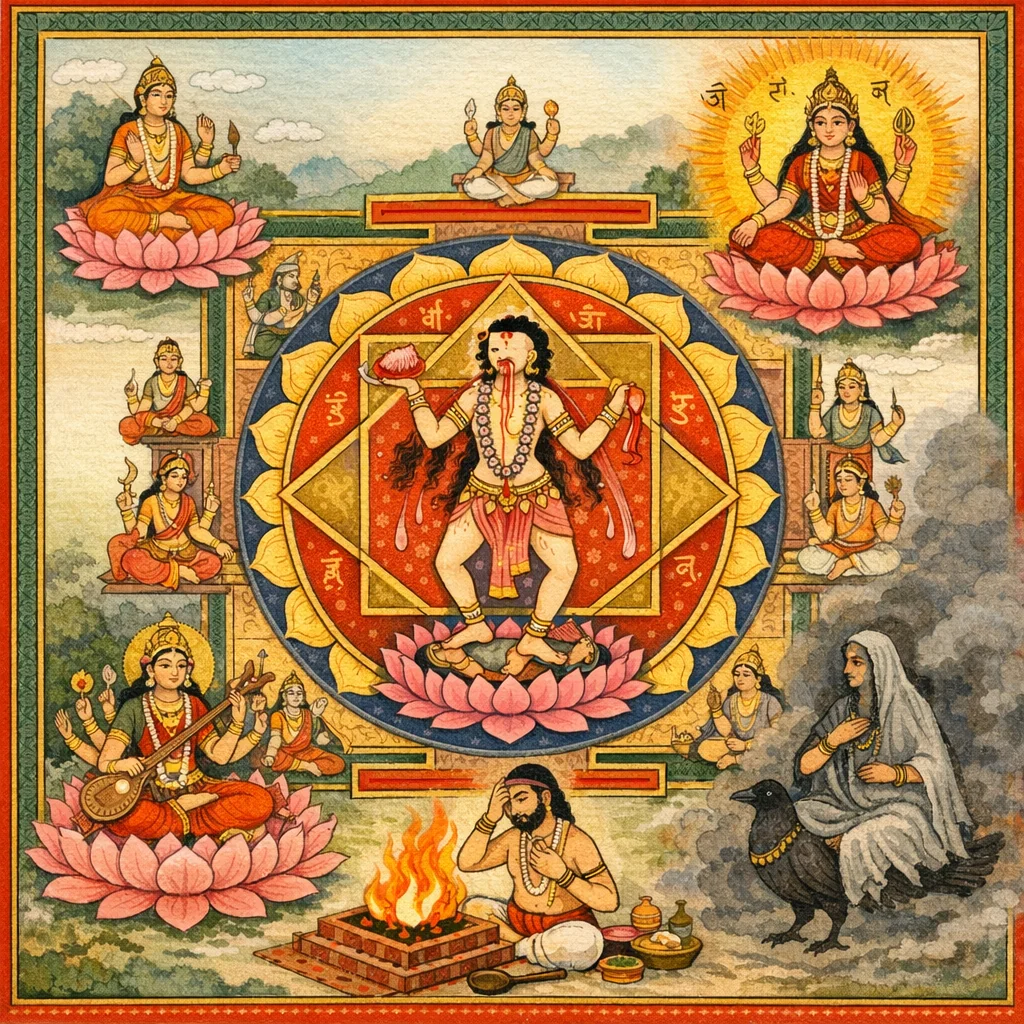
The Description of the Four Durgā Mantras
Sanatkumāra continues instructing the twice-born, turning from Lakṣmī’s manifestations to those of Durgā. He first sets out Chinnamastā’s extended mantra system—its parts, ṛṣi–chandas–devatā, bīja/śakti, ṣaḍaṅga and protective nyāsas—along with a vivid dhyāna of the self-decapitated Goddess attended by her companions. Large-scale japa and homa are prescribed, followed by a detailed maṇḍala/pīṭha worship with directional deities, gate-guardians, and limb-deities, and a list of homa offerings with their claimed siddhis (prosperity, eloquence, attraction, stambhana, uccāṭana, longevity). Next comes Tripurabhairavī’s mantra structure (three bījas forming a fivefold kūṭa), extensive nyāsas (navayoni, bāṇa-nyāsa), and a sun-radiant dhyāna with further homa rules. The teaching then moves to Mātaṅgī: intricate body-placements, protective “armor” by syllable-count, an 8/16-petalled lotus-maṇḍala with attendant deities, and rites for influence, rain, fever-removal, and prosperity. Finally Dhūmāvatī is introduced with ṛṣi/chandas/devatā framing, a stark dhyāna, and hostile rites for obstruction and fever, concluding that four Durgā-descents or mantra-sets have been taught.
Shlokas
Verse 1
सनत्कुमार उवाच । अवतारत्रयं लक्ष्म्याः कथित ते द्विजोत्तम । दुर्गायाश्चाभिधास्यामि सर्वलोकोपकारकान् ॥ १ ॥
Sanatkumāra said: “O best among the twice-born, I have told you of the three avatāras of Lakṣmī. Now I shall also describe the avatāras of Durgā, which bring benefit to all the worlds.”
Verse 2
प्रणवः श्रीः शिवायुग्मं वाणीवैरोचनीपदम् । वज्राद्यं क्षुधिता सूक्ष्मा मृता स्वाग्नींदुसंयुता ॥ २ ॥
The Praṇava “Oṁ”, “Śrī”, the paired names of Śiva, the word of Vāṇī (Sarasvatī) and the term “Vairocana”; then the terms beginning with “Vajra”; “Kṣudhitā” (the Hungry), “Sūkṣmā” (the Subtle), “Mṛtā” (the Dead), together with “Svāgnī” and “Indu”—all these are to be employed and assigned according to the prescribed rite.
Verse 3
प्रतिष्ठाप्य शिवा फट् च स्वाहांतोऽत्यष्टिवर्णवान् । भैरवोऽस्य मुनिः सम्राट् छन्दो मन्त्रस्य देवता ॥ ३ ॥
After establishing the mantra, one should add “śivā” and then “phaṭ”; it concludes with “svāhā” and contains more than eighty syllables. For this mantra, Bhairava is the seer (ṛṣi), Samrāṭ is the metre (chandas), and its deity (devatā) is declared accordingly.
Verse 4
छिन्नमस्ता रमा बीजं स्वाहा शक्तिरुदीरिता । आं खङ्गाय हृदाख्यातमीं खङ्गाय शिरः स्मृतम् ॥ ४ ॥
For Chinnamastā, the bīja (seed-syllable) is said to be “ramā”, and the śakti is declared as “svāhā”. The syllable “āṃ” is taught as the heart-mantra—“unto the sword”—and “īṃ” is remembered as the head-mantra—“unto the sword”.
Verse 5
ऊं वज्राय शिखा प्रोक्ता ऐं पाशाय तनुच्छदम् । औमंकुशाय नेत्रं स्याद्विसर्गो वसुरक्षयुक् ॥ ५ ॥
The syllable “ūṃ”, for the Vajra, is taught as the śikhā-nyāsa; “aiṃ”, for the Pāśa, is the covering of the body. For the Aṅkuśa, “aum” is to be placed as the nyāsa of the eyes; and the visarga, joined with the “Vasu-protection”, is also applied as a protective seal.
Verse 6
मायायुग्मं चास्त्रमंगं मनवः प्रणवादिकाः । स्वाहांताश्चैवमंगानि कृत्वा ध्यायेद्थांबिकाम् ॥ ६ ॥
Having arranged the paired “māyā” syllables as the limb of the weapon-mantra (astra-aṅga), and the mantras beginning with the Praṇava (Oṁ) and ending with “svāhā” as the various ritual limbs, one should then meditate upon Ambikā.
Verse 7
भानुमण्डलसंस्थानां प्रविकीर्णालकं शिरः । छिन्नं स्वकं स्फारमुखं स्वरक्तं प्रपिबद्गलत् ॥ ७ ॥
A head—shaped like the orb of the Sun—its hair scattered, severed from its own body, with a gaping mouth, was drinking its own blood as it flowed down.
Verse 8
उपरिस्थां रतासक्तरतिमन्मथयोर्निजे । डाकिनीवर्णिनीसख्यौ दृष्ट्वा मोदभराकुलाम् ॥ ८ ॥
Seeing her seated above—within their own sphere—Rati and Manmatha, inflamed by passion, beheld the two companions, Ḍākinī and Varṇinī, overwhelmed with delight.
Verse 9
ध्यात्वैवं प्रजपेल्लक्षचतुष्कं तद्दशांशतः । पालाशैर्विल्वजैर्वापि जुहुयात्कुसुमैः फलैः ॥ ९ ॥
Having thus meditated, one should perform japa to the measure of four lakhs (400,000 repetitions); and then, as a tenth part of that count, one should offer oblations into the fire using palāśa or bilva (wood/leaves), or with flowers and fruits.
Verse 10
आधारशक्तिमारभ्य परतत्त्वांतपूजिते । पीठे जयाख्या विजया जिता चापि पराजिता ॥ १० ॥
Beginning with Ādhāra-Śakti and ending with the worship of the Supreme Principle, upon that sacred pedestal (pīṭha) are (the powers) named Jayā, Vijayā, Jitā, and also Parājitā.
Verse 11
नित्या विलासिनी षष्ठी दोग्ध्य घोरा च मंगला । दिक्षु मध्ये च संपूज्या नव पीठस्य शक्तयः ॥ ११ ॥
Nityā, Vilāsinī, Ṣaṣṭhī, Dogdhyā, Ghorā, and Maṅgalā—these are the Śaktis of the nine pīṭhas, to be worshipped in the directions and also in the center.
Verse 12
सर्वबुद्धिप्रदे वर्णनीये सर्वभृगुः सदृक् । सिद्धिप्रदे डाकिनीये तारो वज्रः सभौतिकः ॥ १२ ॥
In the invocation that bestows all intelligence, He is the One worthy of praise—like Bhṛgu among the sages, of auspicious vision. In the invocation that grants attainments (siddhis), He is the Ḍākinī; He is Tārā; He is Vajra—present and efficacious within embodied, material existence.
Verse 13
खङ्गीशो रोचनीयेंते भगं धेहि नमोंतकः । तारादिपीठमन्त्रोऽयं वेदरामाक्षरो मतः ॥ १३ ॥
“(The mantra is formed as:) ‘Khaṅgīśaḥ; rocanīyente; bhagaṃ dhehi; namoṃtakaḥ.’ This is the Pīṭha-mantra beginning with ‘tārā’, and it is regarded as a ‘Vedarāma’ syllabic formula (akṣara-mantra).”
Verse 14
समर्प्यासनमेतेन तत्र संपूजयेच्छिवाम् । त्रिकोणमध्यषट्कोणपद्मभूपुरमध्यतः ॥ १४ ॥
Having thus offered the seat (āsana) by this mantra, one should then worship Śivā with full rites, placing her at the very center of the sacred diagram—within the bhūpura enclosure, in the lotus, in the hexagon, and in the central triangle.
Verse 15
बाह्यावरणमारभ्य पूजयेत्प्रतिलोमतः । भूपुरे बाह्यभागेषु वज्रादीनि प्रपूजयेत् ॥ १५ ॥
Beginning with the outer enclosure, one should perform the worship in reverse order (moving inward). And on the outer sections of the bhūpura—the square boundary of the maṇḍala—one should especially worship the Vajra and the other protective emblems or deities.
Verse 16
तदंतः सुरराजादीन्पूजयेद्धरितां पतीन् । भूपुरस्य चतुर्द्वार्षु द्वारपालान्यजेदथ ॥ १६ ॥
Then, within that enclosure, one should worship Indra and the other lords of the gods, the protectors of the quarters; and thereafter, at the four gates of the bhūpura—the ritual boundary—one should offer worship to the gate-guardians (dvārapālas).
Verse 17
करालविकरालाख्यावतिकालस्तृतीयकः । महाकालश्चतुर्थः स्यादथ पद्मेष्टशक्तयः ॥ १७ ॥
The third division of Time is called Atikāla, known as “Karāla” and “Vikarāla.” The fourth is said to be Mahākāla. Thereafter are described the powers (śakti) of Padmeṣṭa (Brahmā).
Verse 18
एकलिंगा योगिनी च डाकिनी भैरवी तथा । महाभैरवकेंद्राक्षी त्वसितांगी तु सप्तमी ॥ १८ ॥
Ekaliṅgā, Yoginī, Ḍākinī, and Bhairavī; also Mahābhairava-kendrākṣī and Asitāṅgī—these constitute the seventh series.
Verse 19
संहारिण्यष्टमी चेति षट्कोणेष्वंगमूर्तयः । त्रिकोणगा छिन्नमस्ता पार्श्वयोस्तु सखीद्वयम् ॥ १९ ॥
“Saṃhāriṇī” and “Aṣṭamī” are to be placed as limb-deities (aṅga-mūrti) in the six corners of the hexagram. In the central triangle is Chinnamastā, and on her two sides are the pair of attendant companions.
Verse 20
डाकिनीवर्णनीसंज्ञं तारावाग्भ्यां प्रपूजयेत् । एवं पूजादिभिः सिद्धे मन्त्रे मंत्री मनोरथान् ॥ २० ॥
One should duly worship the mantra known as “Ḍākinī-varṇanī” with the seed-syllables Tārā and Vāk. Thus, when the mantra is perfected through worship and related observances, the mantra-practitioner attains the desired aims.
Verse 21
प्राप्नुयान्निखिलान्सद्यो दुर्लभांस्तत्प्रसादतः । श्रीपुष्पैर्लभते लक्ष्मीं तत्फैलश्च समीहितम् ॥ २१ ॥
By the grace of that rite, one immediately attains all things—even those difficult to obtain. By offering auspicious flowers, one gains Lakṣmī (prosperity), and likewise the desired fruit of that act.
Verse 22
वाक्सिद्धिं मालतीपुष्पैश्चंपकैर्हवनात्सुखम् । घृताक्तं छागमांसं यो जुहुयात्प्रत्यहं शतम् ॥ २२ ॥
By offering oblations into the sacred fire with mālatī and campaka flowers, one attains perfection of speech; and whoever, day after day, offers a hundred oblations of goat-meat anointed with ghee gains comfort and well-being.
Verse 23
मासमेकं तु वशगास्तस्य स्युः सर्वपार्थिवाः । करवीरसुमैः श्वतैर्लक्षसंख्यैर्जुहोति यः ॥ २३ ॥
But whoever, for one month, offers a hundred thousand oblations in a homa with white karavīra flowers makes all kings on earth subject to his will.
Verse 24
रोगजालं पराभूय सुखी जीवेच्छतं समाः । रक्तौ स्तत्संख्यया हुत्वा वशयेन्मंत्रिणो नृपान् ॥ २४ ॥
Having overcome the entire net of diseases, one should live happily for a hundred years. By offering into the fire, in the stated number, the substance called “rakta,” one brings ministers and kings under one’s influence.
Verse 25
फलैर्हुत्वामुयाल्लक्ष्मीमुदुंबरपलाशजैः । गोमायुमांसैस्तामेव कवितां पायसांधसा ॥ २५ ॥
By offering oblations of fruits—especially those from the udumbara and palāśa trees—one gains prosperity, the grace of Lakṣmī. By offering the meat of the gomāyu (jackal), one attains kavitā, poetic inspiration; and by offering pāyasa, rice cooked in milk, one receives that same gift of poetry.
Verse 26
बंधूककुसुमैर्भाग्यं कर्मिकारैः समीहितम् । तिलतंडुलहोमेन वशयेन्निखिलाञ्जनान् ॥ २६ ॥
With bandhūka flowers, ritualists seek good fortune; and by a fire-offering made with sesame and rice, one may bring all people under one’s influence.
Verse 27
नारीरजोभिराकृष्टैर्मृगमांसैः समीहितम् । स्तंभनं माहिषैर्मांसैः पंकजैः सघृतैरपि ॥ २७ ॥
By using venison drawn by a woman’s menstrual fluid, one may accomplish the desired aim. For the rite of stambhana (immobilization), buffalo-meat is employed; likewise, lotus-flowers mixed with ghee may also effect it.
Verse 28
चिताग्नौ परभृत्पक्षैर्जुर्हुयादरिमृत्यवे । उन्मत्तकाष्ठदीप्तेऽग्नौ तत्फलं वायसच्छदैः ॥ २८ ॥
In the funeral pyre’s fire, one should offer the cuckoo’s (parabhṛt) feathers as an oblation to bring about an enemy’s death. If the fire blazes with unmattaka wood, the same result is gained by offering a crow’s feathers.
Verse 29
द्यूते वने नृपद्वारे समरे वैरिसंकटे । विजयं लभते मंत्री ध्यायन्देवीं जपन्मनुम् ॥ २९ ॥
In gambling, in the forest, at the king’s gate, in battle, and amid dangers raised by enemies, the mantra-practitioner gains victory by meditating on the Goddess and repeating the mantra.
Verse 30
भुक्त्यै मुक्त्यै सितां ध्यायेदुच्चाटे नीलरोचिषम् । रक्तां वश्ये मृतौ धूम्रां स्तंभने कनकप्रभाम् ॥ ३० ॥
For worldly enjoyment and for liberation, one should meditate on the deity in a white form. For uccāṭa (expulsion), contemplate a blue-radiant form; for vaśya (subjugation), a red form; in matters of mṛtyu (death), a smoke-hued form; and for stambhana (immobilization), a golden-lustrous form.
Verse 31
निशि दद्याद्बलिं तस्यै सिद्धये मदिरादिना । गोपनीयः प्रयोगोऽय प्रोच्यते सर्वसिद्धिदः ॥ ३१ ॥
At night, one should offer her a bali for the attainment of siddhi, using wine and similar offerings. This practice is declared to be secret, and it is said to bestow every kind of accomplishment.
Verse 32
भूताहे कृष्णपक्षस्य मध्यरात्रे तमोघने । स्नात्त्वा रक्ताम्बरधरो रक्तमाल्यानुलेपनः ॥ ३२ ॥
On the Bhūtāha day in the dark fortnight, at midnight when the darkness is thick, having bathed, one should don red garments and apply red garlands and red unguents.
Verse 33
आनीय पूजयेन्नारीं छिन्नमस्तास्वरूपिणीम् । सुन्दरीं यौवनाक्रांतां नरपञ्चकगामिनीम् ॥ ३३ ॥
Having brought such a woman, one should worship her as the very embodiment of Chinnamastā—beautiful, in the fullness of youth, and accompanied by a group of five men.
Verse 34
सुस्मितां मुक्तकबीरीं भूषादानप्रतोषिताम् । विवस्त्रां पूजयित्वैनामयुतं प्रजपेन्मनुम् ॥ ३४ ॥
Having worshipped her—smiling gently, adorned with a pearl necklace, pleased by the gift of ornaments, and unclothed—one should then recite the mantra ten thousand times.
Verse 35
बलिं दत्त्वा निशां नीत्वा संप्रेष्य धनतोषिताम् । भोजयेद्विविधैरन्नैर्ब्राह्यणान्भोजनादिना ॥ ३५ ॥
Having offered the bali (ritual offering) and having passed the night, he should send her off, satisfied with gifts of wealth; and he should then feed the brāhmaṇas with various kinds of food and with proper hospitality.
Verse 36
अनेन विधिना लक्ष्मीं पुत्रान्पौत्रान्धनं यशः । नारीमायुः सुखं धर्ममिष्टं च समवाप्नुयात् ॥ ३६ ॥
By following this procedure, one would attain Lakṣmī (prosperity), sons and grandsons, wealth, fame, a wife, long life, happiness, dharma, and also whatever is desired.
Verse 37
तस्यां रात्रौ व्रतं कार्यं विद्याकामेन मंत्रिणा । मनोरथेषु चान्येषु गच्छेत्तां प्रजपन्मनुम् ॥ ३७ ॥
On that night, the mantra-practitioner who longs for learning should observe a sacred vow (vrata). And for other aims as well, one should undertake it while continually reciting the prescribed mantra.
Verse 38
उषस्युत्थाय शय्यायामुपविष्टो जपेच्छतम् । षण्मासाभ्यन्तरेमन्त्री कवित्वेन जयेत्कविम् ॥ ३८ ॥
Rising at dawn and sitting upon one’s bed, one should repeat it a hundred times. Within six months, the mantra-practitioner will surpass even a poet through the power of poetic inspiration.
Verse 39
शिवेन कीलिता चेयं तदुत्कीलनमुच्यते । मायां तारपुटां मंत्री जपेदष्टोत्तरं शतम् ॥ ३९ ॥
This mantric operation has been ‘nailed down’ (sealed) by Śiva; its release is called ‘utkīlana’ (unsealing). To effect that, the practitioner should recite the Māyā–Tārapuṭā mantra one hundred and eight times.
Verse 40
मन्त्रस्यादौ तथैवांते भवेत्सिद्धिप्रदा तु सा । उदिता छिन्नमस्तेयं कलौ शीघ्रमभीष्टदा ॥ ४० ॥
Placed at the beginning of a mantra—and likewise at its end—she becomes the giver of accomplishment (siddhi). It is declared that this is Chinnamastā; in the Kali age she quickly bestows the desired result.
Verse 41
अवतारांतरं देव्या वच्मि ते मुनिसत्तम । ज्ञानामृतारुणा श्वेताक्रोधिनींदुसमन्विता ॥ ४१ ॥
O best of sages, I shall tell you of another manifestation of the Goddess: she is dawn-red with the nectar of knowledge, radiant and white, free from anger, and endowed with moon-like serenity.
Verse 42
शांतिस्तथाविधा चापि नीचसर्गान्वितास्तथा । वाग्भवं कामराजाख्यं शक्तिबीजाह्वयं तथा ॥ ४२ ॥
Likewise there is the bīja called Śānti, and others of that same kind, as well as those connected with lower emanations. (There are) the bījas known as Vāgbhava, Kāmarāja, and also the one called Śaktibīja.
Verse 43
त्रिभिर्बीजैः पंचकूटात्मिका त्रिपुरभैरवी । ऋषिः स्याद्दक्षिणामूर्तिश्छन्दः पंक्तिरुदीरिता ॥ ४३ ॥
With three seed-syllables (bījas), Tripurabhairavī is constituted as the fivefold kūṭa, the five-part mantra-structure. The seer (ṛṣi) is said to be Dakṣiṇāmūrti, and the metre (chandas) is declared to be Paṅkti.
Verse 44
देवता देशिकैरुक्ता देवी त्रिपुरभैरवी । नाभेराचरणं न्यस्य वाग्भवं मन्त्रवित्पुनः ॥ ४४ ॥
The deity, as declared by the teachers, is the Goddess Tripurabhairavī. Then the knower of mantra should again perform nyāsa, placing (the mantra) from the navel down to the feet, and thereafter apply the Vāgbhava bīja.
Verse 45
हृदयान्नाभिपर्यंतं कामबीजं प्रविन्यसेत् । शिरसो हृत्प्रदेशांतं तार्तीयं विन्यसेत्ततः ॥ ४५ ॥
One should carefully place the Kāma-bīja from the heart down to the navel. Then, from the head down to the region of the heart, one should place the Tārtīya, the third bīja/mantra, thereafter.
Verse 46
आद्यं द्वितीयं करयोस्तार्तीयमुभयं न्यसेत् । मूलाधारे हृदि न्यस्य भूयो बीजत्रयं क्रमात् ॥ ४६ ॥
He should place the first and the second seed-mantras upon the two hands, and the third upon both (hands together). Then, having placed them at the mūlādhāra and at the heart, he should again install the triad of seed-mantras in due order.
Verse 47
नवयोन्यात्मकं न्यासं कुर्याद्बीजैस्त्रिभिः पुनः । बालोदितप्रकारेण मूर्तिन्यासमथाचरेत् ॥ ४७ ॥
Next, one should perform the nyāsa called “navayoni,” of the nature of the nine sources, again with the three bīja-mantras; thereafter, following the method taught earlier, one should carry out the mūrti-nyāsa, installing the Deity’s form upon the body.
Verse 48
स्वस्वबीजादिकं पूर्वं मूर्ध्नीशानमनोभवम् । न्यसेद्वक्त्रे तत्पुरुषं मकरध्वजमात्मवित् ॥ ४८ ॥
First, the knower of the Self should place the respective bīja and the rest upon the crown of the head, contemplating Īśāna as “mind-born”; then he should place Tatpuruṣa upon the face, knowing him as Makaradhvaja.
Verse 49
हृद्यघोरकुमारादिकंदर्प्पं तदनंतरम् । गुह्यदेशे प्रविन्यस्येद्वामदेवादिमन्मथम् ॥ ४९ ॥
Next, one should install by nyāsa Kandarpa (Kāmadeva), beginning with Aghora-kumāra, in the region of the heart; thereafter, one should place Vāmadeva and the rest—as Manmatha—in the secret (genital) region.
Verse 50
सद्योजातं कामदेवं पादयोर्विन्यसेत्ततः । ऊर्द्ध्वंप्राग्दक्षिणोदीच्यपश्चिमेषु मुखेषु तान् ॥ ५० ॥
Then one should place by nyāsa Sadyojāta and Kāmadeva at the feet; thereafter, one should place them upon the faces oriented upward, east, south, north, and west.
Verse 51
प्रविन्यसेद्य धापूर्व भृगुर्व्योमाग्निसंस्थितः । सद्यादिपञ्चह्रस्वाद्या बीजमेषां प्रकीर्तितम् ॥ ५१ ॥
One should arrange these sounds/units in proper sequence, beginning with “dhā”; then the “Bhṛgu” group is to be placed in the stations of space and fire. Their seed-syllables are declared to be the five beginning with “sadya”, and those beginning with the short vowels.
Verse 52
षड्दीर्घयुक्तेनाद्येन बीजेनांगक्रिया मता । पञ्चबाणांस्ततो न्यस्येन्मन्त्री त्रैलोक्यमोहनान् ॥ ५२ ॥
The consecration of the limbs (aṅga-kriyā) is held to be performed with the first seed-syllable (bīja), endowed with six long vowels. Thereafter, the knower of mantra should perform nyāsa, placing the five arrows that enchant the three worlds.
Verse 53
द्रामाद्यां द्राविणीं मूर्ध्निं द्रामाद्यां क्षोभणी पदे । क्लींवशीकरणीं वक्त्रे गुह्ये ब्लृं बीजपूर्विकाम् ॥ ५३ ॥
By nyāsa, place upon the head the prosperity-bestowing syllable Drāviṇī beginning with “drām”; upon the feet the activating syllable Kṣobhaṇī beginning with “drām”; upon the mouth the “klīṃ” that accomplishes vaśīkaraṇa (attraction and subjugation); and upon the secret place the syllable preceded by the bīja “blṛṃ”.
Verse 54
आकर्षणीं हृदि पुनः सर्वांतभृगुसंस्थिताम् । संमोहनीं क्रमादेवं बाणन्यासोऽयमीरितः ॥ ५४ ॥
Then place Ākarṣaṇī once more in the heart; and place Saṃmohanī, abiding in all the ends, in the “bhṛgu” position. Thus, in proper sequence, this method of bāṇa-nyāsa has been taught.
Verse 55
भालभ्रूमध्यवदने घंटिकाकण्ठहृत्सु च । नाभ्यधिष्ठानयोः पञ्च ताराद्याः सुभगादिकाः ॥ ५५ ॥
In the forehead, between the eyebrows, and in the face; likewise in the uvula (the “little bell”), the throat, and the heart; and again in the navel and the pelvic base (adhiṣṭhāna)—there are five power-centres beginning with Tārā, along with others such as Subhagā.
Verse 56
मस्तकाविधि नाभेश्च मंत्रिणा सुभगा भगा । भगसर्पिण्यथ परा भगमालिन्यनंतरम् ॥ ५६ ॥
Then the knower of mantra should perform nyāsa upon the head and at the navel, invoking Subhagā and Bhagā; then Bhagasarpiṇī; thereafter Parā; and next Bhagamālinī.
Verse 57
अनंगानंगकुसुमा भूयश्चानंगमेखला । अनंगमदना सर्वा मदविभ्रममंथरा ॥ ५७ ॥
She is once more Anangā; her blossoms are “Ananga-flowers”; her girdle is Ananga; all of her is Ananga’s very Madana—made languid by the intoxication of swaying delusion.
Verse 58
प्रधानदेवता वर्णभूषणाद्यैरलंकृताः । अक्षस्रक्पुस्तकाभीतिवरदाढ्यकरांबुजाः ॥ ५८ ॥
The presiding deities are adorned with colors, ornaments, and the like; and their lotus-hands are richly furnished with a rosary, a garland, a book, the gesture of fearlessness, and the boon-bestowing gesture.
Verse 59
वाक्कामब्लूं स्त्रीं सरांते ताराः पंच प्रकीर्तिताः । ततः कुर्याद्भूषणाख्यं न्यासमुक्तदिशा मुने ॥ ५९ ॥
The five “tārā” seed-syllables are taught as: vāk, kāma, blūṃ, strīṃ, and that which ends in “sarā”. Thereafter, O sage, one should perform the nyāsa called “Bhūṣaṇa” in the prescribed directions.
Verse 60
एवं न्यस्तशरीरोऽसौ ध्यायेत्त्रिपुरभैरवीम् । सहस्रभानुसंकाशामरुणक्षौमवाससीम् ॥ ६० ॥
Thus, having placed nyāsa upon his body, he should meditate on Tripurabhairavī—radiant like a thousand suns, clad in crimson linen garments.
Verse 61
शिरोमालामसृग्लिप्तस्तनीं जपवटीं करैः । विद्यामभीतिं च वरं दधतीं त्रीक्षणाननाम् ॥ ६१ ॥
Her bosom is smeared with blood, and she wears a garland upon her head; with her hands she bears a rosary and a skull-bowl, and she grants vidyā, fearlessness, and boons—she is the three-eyed Goddess with an awe-inspiring face.
Verse 62
दीक्षां प्राप्य जपेन्मंत्रं तत्त्वलक्षं जितेंद्रियः । पुष्पैर्भानुसहस्राणि जुहुयाद्बह्मवृक्षजैः ॥ ६२ ॥
Having received dīkṣā, the self-controlled practitioner should recite in japa the mantra that reveals the true tattva. Then, with flowers born of the brahma-tree, he should offer into the sacred fire a thousand oblations, each radiant like the Sun.
Verse 63
त्रिमध्वक्तैः प्रसूनैर्वा करवीरसमुद्भवैः । पद्मं वसुदलोपेतं नवयोन्यष्टकर्णिकम् ॥ ६३ ॥
Or else, using karavīra (oleander) blossoms endowed with the threefold sweetness of honey, one should fashion a lotus: with eight petals and a pericarp marked by nine yoni-divisions.
Verse 64
इच्छादिशक्तिभिर्युक्तं भैरव्याः पीठमर्चयेत् । इच्छा ज्ञाना क्रिया पश्चात्कामिनी कामदायिनी ॥ ६४ ॥
One should worship Bhairavī’s sacred pīṭha, endowed with the śakti-powers beginning with Icchā (Will). Thereafter come the śaktis named Icchā, Jñānā (Knowledge), and Kriyā (Action); and then Kāminī, the bestower of desired attainments.
Verse 65
रतिप्रिया मदानन्दा नवमी स्यान्मनोन्मनी । वरदाभयधारिण्यः संप्रोक्ता नव शक्तयः ॥ ६५ ॥
Ratipriyā and Madānandā are mentioned; the ninth is said to be Manonmanī. Thus nine Śaktis are declared—bearers of the mudrās of granting boons and bestowing abhaya, fearlessness.
Verse 66
वाग्भवं लोहितो रायै श्रीकंठो लोहितोऽनलः । दीर्घवान्यै परा पश्चादपरायौ हसौ युतः ॥ ६६ ॥
The seed-syllable “vāgbhava” is to be set in nyāsa in the red position for Rā (prosperity). “Śrīkaṇṭha” is placed in the red position and in fire. For the long “vānī”, “parā” is placed afterward; and for “aparā”, the two syllables “ha” and “sa” are joined.
Verse 67
सदाशिवमहाप्रेतङेंतं पद्मासनं नमः । अनेन मनुना दद्यादासनं श्रीगुरुक्रमम् ॥ ६७ ॥
Salutations to the lotus-seat (padmāsana) associated with Sadāśiva and the Great Preta. With this mantra, one should offer the seat according to the auspicious sequence of worship of the Guru (Śrī-guru-krama).
Verse 68
प्राङ्मध्ययोन्यंतराले पूजयेत्कल्पयेत्ततः । पंचभिः प्रणवैर्मूर्तिं तस्यामावाह्य देवताम् ॥ ६८ ॥
Then one should perform worship in the space between the eastern and the central divisions, and thereafter arrange the rite. With the fivefold Oṁ (praṇava), one should form the deity’s image and invoke (āvāhana) the deity into that form.
Verse 69
पूजयेदगमोक्तेन विधानेन समाहितः । तारावाक्छक्तिकमला हसखूफ्रें हसौः स्मृताः ॥ ६९ ॥
With a collected mind, one should perform the worship according to the procedure taught in the Āgamas. The mantric designations are remembered as: Tārā, Vāk, Śakti, and Kamalā; and also as “hasakhūphreṃ” and “hasauḥ.”
Verse 70
वामकोणे यजेद्देव्या रतिमिंदुसमप्रभाम् । सृणिपाशधरां सौम्यां मदविभ्रमविह्वलाम् ॥ ७० ॥
In the left corner, one should worship the Goddess Rati, radiant like the moon—gentle in form, holding a goad and a noose, and appearing intoxicated with the charming sway of amorous delight.
Verse 71
प्रीतिं तक्षिणकोणस्थां तप्तकांचनसन्निभाम् । अङ्कुशं प्रणतं दोभ्यां धारयन्तीं समर्चयेत् ॥ ७१ ॥
One should duly worship Prīti, stationed in the south-eastern corner, radiant like heated gold, holding an elephant-goad (aṅkuśa), and reverently bearing it with both hands.
Verse 72
अग्रे मनोभवां रक्तां रक्तपुष्पाद्यलंकृताम् । इक्षुकार्मुकपुष्पेषुधारिणीं सस्मिताननाम् ॥ ७२ ॥
Before him stood Manobhavā, Kāma’s beloved—crimson in hue, adorned with red flowers and the like—bearing a sugarcane bow and flower-arrows, her face gently smiling.
Verse 73
अङ्गान्यभ्यर्चयेत्पश्चाद्यथापूर्वं विधानवित् । दिक्ष्वग्रे च निजैर्मंत्रैः पूजयेद्बाणदेवताः ॥ ७३ ॥
Afterwards, the knower of the prescribed rite should worship the subsidiary limbs in the proper sequence taught earlier; then, in the directions and before him, he should honor the deities of the arrows with their respective mantras.
Verse 74
हस्ताब्जैर्धृतपुष्पेषुप्रणामामृतसप्रभाः । अष्टयोनिष्वष्टशक्तीः पूजयेत्सुभगादिकाः ॥ ७४ ॥
With lotus-like hands holding flower-arrows, radiant as the nectar of reverent salutations, one should worship the eight Śaktis—beginning with Subhagā—within the eight yoni-forms, the sources of manifestation.
Verse 75
मातरो भैरवांकस्था मदविभ्रमविह्वलाः । अष्टपत्रेषु संपूज्या यथावत्कुसुमादिभिः ॥ ७५ ॥
The Mother-goddesses, seated upon Bhairava’s lap and swayed by the intoxication of divine ecstasy, should be duly worshipped upon the eight petals of the lotus-diagram with flowers and the other prescribed offerings.
Verse 76
लोकपालांस्ततो दिक्षु तेषामस्त्राणि तद्बहिः । पूर्वजन्मकृतैः पुण्यैर्ज्ञात्वैनां परदेवताम् ॥ ७६ ॥
Then, in the several directions, he beheld the guardians of the worlds (Lokapālas) and, beyond them, their weapons; and by the merit gathered in former births, he recognized Her as the Supreme Deity.
Verse 77
यो भजेदुक्तमार्गेण स भवेत्संपदां पदम् । एवं सिद्धमनुर्मंत्री साधयेदिष्टमात्मनः ॥ ७७ ॥
Whoever worships by the taught method becomes a foundation of prosperity. Thus, when the mantra has been duly accomplished, the mantra-practitioner attains for himself the desired goal.
Verse 78
जुहुयादरुणांभोंजैरदोषैर्मधुराप्लुतैः । लक्षसंख्यं तदर्द्धं वा प्रत्यहं भोजयेद्द्विजान् ॥ ७८ ॥
He should offer fire-oblations with flawless aruna-grains, well-soaked in sweetness; and every day he should feed brāhmaṇas—either a lakh in number, or half of that.
Verse 79
वनिता युवती रम्याः प्रीणयेद्देवताधिया । होमांते धनधान्याद्यैस्तोषयेद्गुरुमात्मनः ॥ ७९ ॥
With the thought that they are divine, one should honour and please women—maidens, youthful women, and the lovely; and at the conclusion of the homa, one should gratify one’s own guru with gifts such as wealth, grain, and the like.
Verse 80
एवं कृते जगद्वश्यो रमाया भवनं भवेत् । रक्तोत्पलैस्त्रिमध्वक्तैररुणैर्वा हयारिजैः ॥ ८० ॥
When this is performed in this manner, the whole world becomes amenable, and one attains the abode of Ramā (Śrī-Lakṣmī)—either by offering red lotuses with the three sweet substances mixed together, or by the reddish offerings known as hayārija.
Verse 81
पुष्पैः पयोन्नैः सघृतैर्होमाद्विश्वं वशं नयेत् । वाक्सिद्धं लभते मन्त्री पलाशकुसुमैर्हुतैः ॥ ८१ ॥
By performing fire-offerings with flowers, milk-rice, and ghee, one may bring the world under one’s influence. By offering palāśa (flame-of-the-forest) blossoms into the fire, the mantra-practitioner attains vāk-siddhi—perfection of speech.
Verse 82
कर्पूरागुरुसंयुक्तं गुग्गुलं जुहुयात्सुधीः । ज्ञानं दिव्यमवाप्नोति तेनैव स भवेत्कविः ॥ ८२ ॥
The wise should offer into the sacred fire guggulu resin blended with camphor and agaru. By that very act one attains divine knowledge, and through it becomes a kavi, a poet-seer.
Verse 83
क्षीराक्तैरमृताखंडैर्होमः सर्वापमृत्युजित् । दूर्वाभघिरायुषे होमः क्षीराक्ताभिर्दिनत्रयम् ॥ ८३ ॥
A homa with pieces of amṛta anointed with milk conquers every form of untimely death. For longevity, one should perform homa with dūrvā grass anointed with milk for three consecutive days.
Verse 84
गिरिकर्णीभवैः पुष्पैर्ब्राह्यणान्वशयेद्धुतैः । कह्लारैः पार्थिवान्पुष्पैस्तद्वधूः कर्णिकारजैः ॥ ८४ ॥
With flowers born of girikarṇī, offered into the sacred fire, one may win over brāhmaṇas; with kahlāra and other earthly blossoms, kings; and with karṇikāra-born flowers, the desired bride.
Verse 85
मल्लिकाकुसुमैर्हुत्वा राजपुत्रान्वशं नयेत् । कोरंटकुसुमैर्वैंश्यान्वृषलान्पाटलोद्भवैः ॥ ८५ ॥
By offering oblations with mallikā (jasmine) blossoms, one may bring princes under one’s influence; with koraṇṭa flowers, the vaiśyas; and with blossoms of the pāṭalā tree, the vṛṣalas (men of the śūdra class).
Verse 86
अनुलोमां विलोमांतस्थितसाध्याह्वयान्वितम् । मन्त्रमुच्चार्य जुहुयान्मंत्री मधुरलोलितैः ॥ ८६ ॥
Having recited the mantra—endowed with the invocations of the Sādhyas placed at the end, in both the direct and the reverse order—the ritual expert should offer oblations into the fire, accompanied by sweet, gently pleasing offerings.
Verse 87
सर्षपैर्मधुसंमिश्रैर्वशयेत्पार्थिवान् क्षणात् । अनेनैव विधानेन तत्पत्नीस्तत्सुतानपि ॥ ८७ ॥
By employing mustard seeds blended with honey, one may bring kings under one’s influence in an instant; by this very same rite, their wives and their sons also may be brought under influence.
Verse 88
जातिबिल्वभवैः पुष्पैर्मधुरत्रयसंयुतैः । नरनारीनरपतीन्होमेन वशयेत्क्रमात् ॥ ८८ ॥
By offering homa with jasmine and bilva flowers, joined with the three sweet substances, one may—step by step—bring men, women, and even kings under one’s influence.
Verse 89
मालतीबकुलोद्भूतैः पुष्पैश्चन्दनलोलितैः । जुहुयात्कवितां मन्त्री लभते वत्सरांतरे ॥ ८९ ॥
With mālatī and bakula flowers anointed with sandalwood, the mantra-knowing practitioner should offer oblations; within a year, he attains poetic inspiration (kavitā).
Verse 90
मधुरत्रघयसंयुक्तैः फलैर्बिल्वसमुद्भवैः । जुहुयाद्वाशयेल्लोकं श्रियं प्राप्नोति वांछिताम् ॥ ९० ॥
With fruits born of the bilva, combined with sweet sugar and ghee, one should either offer them into the sacred fire or feed people; thereby one attains the desired prosperity (śrī).
Verse 91
साज्यमन्नं प्रजुहुयाद्भवेदन्नसमृद्धिमान् । कस्तूरीकुंकुमोपेतं कर्पूरं जुहुयाद्वशी ॥ ९१ ॥
If one offers cooked food mixed with ghee into the sacred fire, one becomes endowed with abundance of food. And if one offers camphor combined with musk and saffron into the fire, one becomes influential—able to bring others under one’s sway.
Verse 92
कन्दर्पादधिकं सद्यः सौंदर्यमधिगच्छति । लाजान्प्रजुहुयान्मंत्री दधिक्षीरमधुप्लुतान् ॥ ९२ ॥
At once, one attains beauty surpassing even Kāma (Cupid). The mantra-knowing officiant should offer lājā (parched grains) into the sacred fire, soaked in curd, milk, and honey.
Verse 93
विजित्य रोगानखिलान्स जीवेच्छरदां शतम् । पादद्वयं मलयजं पादं कुंकुमकेसरम् ॥ ९३ ॥
Having conquered all diseases, he should live for a hundred autumns. (For the rite,) two pādas (quarters) are to be with sandalwood paste, and one pāda is to be with saffron and its filaments.
Verse 94
पादं गोरोचनांतानि त्रीणि पिष्ट्वाहिमांभसा । विदध्यात्तिलकं भाले यान्पश्येद्यैर्विलोक्यते ॥ ९४ ॥
Grinding together three substances ending with gorocanā (yellow) with water that has been made harmless and purified, one should apply a tilaka on the forehead; whomever one looks upon with it, they in turn look upon one favorably.
Verse 95
यान्स्पृशेत्स्पृश्यते यैर्वा वश्याः स्युस्तस्य तेऽचिरात् । कर्पूरकपिचोराणि समभागानि कल्पयेत् ॥ ९५ ॥
Whomever he touches—or by whom he is touched—those persons quickly come under his influence. For this, one should prepare camphor and the so-called kapicorā in equal proportions.
Verse 96
चतुर्भुजा जटामांसी तावती रोचना मता । कुंकुमं समभागं स्याद्दिग्भातं चन्दनं मतम् ॥ ९६ ॥
Jatāmāṃsī is prescribed in a fourfold measure; rocanā is to be taken in the same measure. Saffron (kuṅkuma) should be in an equal share, and sandalwood (candana) is stated to be ‘digbhāta’—i.e., taken in the proportion indicated for that component in the formula.
Verse 97
अगुरुर्नवभागं स्यादितिभागक्रमेण च । हिमाद्भिः कन्यया पिष्टमेतत्सर्वं सुसाधितम् ॥ ९७ ॥
Aloeswood (aguru) should make up nine parts, according to the prescribed order of proportions. All of this should be finely ground by a maiden with water chilled by snow; thus the preparation is properly accomplished.
Verse 98
आदाय तिलकं भाले कुर्य्याद्भूमिपतीन्नरान् । वनितामदगर्वाढ्या मदोन्मत्तान्मतंदजान् ॥ ९८ ॥
Taking the tilaka and placing it upon the forehead, one can make men into rulers of the earth; and it subdues women swollen with pride and intoxication, as well as those maddened by arrogance—like wild rutting elephants.
Verse 99
सिंहव्याघ्रान्महासर्पान्भूतवेतालराक्षसान् । दर्शनादेव वशयेत्तिलकं धारयन्नरः ॥ ९९ ॥
A man who wears the tilaka brings lions, tigers, great serpents, and even bhūtas, vetālas, and rākṣasas under control merely by being seen.
Verse 100
इत्येषा भैरवी प्रोक्ता ह्यवतारांतरं श्रृणु । वाङ्माया कमला तारो नमोंते भगवत्यथ ॥ १०० ॥
Thus has Bhairavī been described. Now hear of another manifestation: O Bhagavatī—Vāṅmayā, Kamalā, and Tārā—salutations to you.
Verse 101
श्रीमातंगेश्वरि वदेत्सर्वजनमनोहरि । सर्वादिसुखराज्यंते सर्वादिसुखरंजनी ॥ १०१ ॥
One should utter: “O Śrī Mātaṅgeśvarī, enchantress of the minds of all people; bestower of every kind of happiness, granting sovereignty and fulfillment; O you who delight all joys.”
Verse 102
सर्वराजवशं पश्चात्करिसर्वपदं वदेत् । स्त्रीपुरुषवशं सृष्टिविद्याक्रोधिनिकान्विता ॥ १०२ ॥
Thereafter one should recite the formula that brings all kings under control, and then the all-purpose rite connected with the elephant. Endowed with the “creation-vidyā” and the mantra/rite called Krodhinikā, it is said to bring women and men under one’s influence.
Verse 103
सर्वं दुष्टमृगवशं करिसर्वपदं ततः । सर्वसत्त्ववशंकरिसर्वलोकं ततः परम् ॥ १०३ ॥
All (beings) fall under the power of wicked beasts; then comes the elephant that tramples every path. Beyond that is the elephant that brings all creatures under control—and beyond that, (the one) that subdues all the worlds.
Verse 104
अमुकं मे वशं पश्चादानयानलसुन्दरी । अष्टाशीत्यक्षरो मन्त्रो मुन्याद्या भैरवीगताः ॥ १०४ ॥
“Bring such-and-such (a person) under my control, and then bring them to me, O Anala-sundarī.” This is an eighty-eight-syllabled mantra; the sages and others have received it through the Bhairavī tradition.
Verse 105
न्यासान्मंत्री तनौ कुर्याद्वक्ष्यमाणान्यथाक्रमम् । शिरोललाटभ्रूमध्ये तालुकण्ठगलोरसि ॥ १०५ ॥
After performing the nyāsas, the mantra-practitioner should place them upon his own body in the sequence to be described: on the head, the forehead, between the eyebrows, the palate, the throat, the neck, and the chest.
Verse 106
अनाहते भुजद्वंद्वे जठरे नाभिमण्डले । स्वाधिष्ठाने गुप्तदेशे पादयोर्दक्षवामयोः ॥ १०६ ॥
In the Anāhata (heart-center), in both arms, in the belly, at the navel-region, in the Svādhiṣṭhāna, in the secret (genital) place, and in the right and left feet—(the sacred placements are to be made/recognized) in these locations.
Verse 107
मूलाधारे गुदे न्यस्येत्पदान्यष्टादश क्रमात् । गुणैकद्विचतुः षड्भिर्वसुपर्वनवाष्टभिः ॥ १०७ ॥
At the mūlādhāra, in the region of the anus, one should perform nyāsa by placing the mantra-syllables in due sequence—eighteen in order—arranged in the groupings of three, one, two, four, and six, and also in the sets of eight, five, nine, and eight.
Verse 108
नंदपंक्त्यष्टवेदाग्निचन्द्रयुग्मगुणा क्षिभिः । यदुक्लृप्तिरियं प्रोक्ता मंत्रवर्णैर्यथाक्रमम् ॥ १०८ ॥
By the coded number-terms—“Nanda-row,” “eight,” “Vedas,” “fire,” “the pair of moons,” and “guṇas”—this Yadu-arrangement is declared in proper order through the letters of the mantra.
Verse 109
रत्याद्या मृलहृदयभ्रुमध्येषु विचक्षणः । वाक्शक्तिलक्ष्मीबीजाद्या मातंग्यंताः प्रविन्यसेत् ॥ १०९ ॥
A discerning practitioner should duly place (perform nyāsa of) the mantras beginning with Ratyā in the root (mūla), the heart, and the space between the eyebrows; and likewise place those beginning with the seed-mantras of Vāk-Śakti and Lakṣmī, continuing up to the mantra of Mātaṅgī.
Verse 110
शिरोवदनहृद्गुह्यपादेषु विधिना न्यसेत् । हृल्लेखां गगनां रक्तां भूयो मन्त्री करालिकाम् ॥ ११० ॥
According to the prescribed procedure, one should perform nyāsa upon the head, face, heart, secret region, and feet. Then the mantra-practitioner should again mentally place the heart-inscription (hṛllekhā)—the red syllable ‘ga’ (gaganā)—and thereafter place ‘karālikā’ as well.
Verse 111
महोच्छुष्मां स्वनामादिवर्णबीजपुरः सराः । मातंग्यंताः षडंगानि ततः कुर्वीत साधकः ॥ १११ ॥
Then the practitioner should perform the six auxiliaries (ṣaḍaṅgas), beginning with the mantra of Mahocchuṣmā—preceded by seed-syllables formed from the initial letters of her own name and furnished with the proper vowels—and ending with the mantra of Mātaṅgī.
Verse 112
वर्णैश्चतुर्विंशतिभिर्हृत्त्रयोदशभिः शिरः । शिखाष्टादशभिः प्रोक्ता वर्म तावद्भिरक्षरैः ॥ ११२ ॥
With twenty-four syllables the mantric protection is prescribed for the limbs; with thirteen for the heart; for the head likewise with thirteen; and for the crown-tuft (śikhā) it is taught with eighteen—thus the protective armor (varma) is constituted by that very number of syllables.
Verse 113
स्यात्त्रयोदशभिर्नेत्रं द्वाभ्यामस्त्रं प्रकीर्तितम् । बाणन्यासं ततः कुर्याद्भैरवीप्रोक्तवर्त्मना ॥ ११३ ॥
The ‘Netra’ (eye-protection formula) is said to be formed of thirteen (syllables/units), and the ‘Astra’ (weapon-mantra) is declared to be of two. Thereafter one should perform the bāṇa-nyāsa, the installation of the arrow/weapon formulas, according to the method taught by Bhairavī.
Verse 114
मातंगीपदयोश्चान्यं मन्मथान्वदनांशयोः । पार्स्वकट्योर्नाभिदेशे कटिपार्श्वांशके पुनः ॥ ११४ ॥
Another (mantra/mark) should be placed at the feet of Mātaṅgī; another upon the facial portions of Manmatha; another upon the sides and hips; upon the region of the navel; and again upon the side-portions of the waist.
Verse 115
बीजत्रयादिकान्मंत्री मन्मथं मकरध्वजम् । मदनं पुष्पधन्वानं पंचमं कुसुमायुधम् ॥ ११५ ॥
The mantra-knower (mantrī), beginning with the three seed-syllables, invokes Kāma—Manmatha, Makaradhvaja, Madana, Puṣpadhanvan, and fifthly, Kusumāyudha.
Verse 116
षष्ठं कन्दर्पनामानं मनोभवरतिप्रियौ । मातंग्यंतास्ततो न्यस्येत्स्थानेष्वेतेषु मंत्रवित् ॥ ११६ ॥
Then the mantra-knower should place (perform nyāsa of) the sixth name, called ‘Kandarpa’; and the names ‘Manobhava’, ‘Rati-priya’, and those ending with ‘Mātaṅgī’, assigning them to these respective locations.
Verse 117
कुसुमा मेखला चैव मदना मदना तुरा । मदनवेगा सम्भवा च भुवनपालेंदुरेखिका ॥ ११७ ॥
Kusumā, Mekhalā, Madanā, Madanāturā, Madanavegā, Sambhavā, and Bhuvanapālendurēkhikā—these too are named within the sacred enumeration.
Verse 118
अनंगपदपूर्वाश्च मातंग्यंताः समीरिताः । विन्यस्तव्यास्ततो मूलेऽधिष्ठाने मणिपूरके ॥ ११८ ॥
The syllables beginning with “Anaṅga” and ending with “Mātaṅgī” have been declared. Thereafter, by nyāsa, they should be placed at the root, at Svādhiṣṭhāna, and at Maṇipūraka.
Verse 119
हृत्कंठास्ये भ्रुवोर्मध्ये मस्तके चापि मत्रिणा । आद्ये लक्ष्मीसरस्वत्यौ रतिः प्रीतिश्च कृत्तिका ॥ ११९ ॥
The knower of mantra should, by nyāsa, place the divine energies in the heart, the throat, the mouth, between the eyebrows, and also upon the crown. In the first placements are Lakṣmī and Sarasvatī; then are placed Rati, Prīti, and Kṛttikā.
Verse 120
शांतिः पुष्टिः पुनस्तुष्टिमार्तगंपदशेखरा । मूलमन्त्रं पृथङ्न्यस्येन्निजमूर्द्धनि मन्त्रवित् ॥ १२० ॥
Having invoked Śānti, Puṣṭi, and again Tuṣṭi—crowned by the supreme station—the knower of mantras should place the root-mantra separately, by nyāsa, upon his own head.
Verse 121
आधारदेशेऽधिष्ठाने नाभौ पश्चादनाहते । कंठदेशे भ्रवोर्मध्ये बिंदौ भूयः कला पदोः ॥ १२१ ॥
In the region of Ādhāra, at the seat called Adhiṣṭhāna; at the navel; then at Anāhata (the heart); in the throat region; between the eyebrows; at the bindu (subtle point); and again at the Kalā at the feet—the yogin should place awareness in due order.
Verse 122
निरोधिकायामर्द्धेंदुनादे नादांतयोः पुनः । उन्नतांसेषु वक्त्रे च ध्रुवमण्डलके शिवे ॥ १२२ ॥
In the nirodhikā (the restraining inner channel), in the sound like a half-moon, and again at the end-points of the nāda; in the raised shoulders, in the mouth, and in the auspicious, steady sphere (dhruva-maṇḍala)—there one should fix awareness.
Verse 123
मातंग्यंताः प्रविन्यस्ये द्वामां ज्येष्ठमतः परम् । रौद्रीं प्रशांतां श्रद्धाख्यां पुनर्माहेश्वरीमथ ॥ १२३ ॥
Having arranged them in due order up to Mātaṅgī, one should then place Dvāmā, and thereafter Jyeṣṭhā; next Raudrī, then Praśāntā, then the one called Śraddhā, and again thereafter Māheśvarī.
Verse 124
क्रियाशक्तिं सुलक्ष्मीं च सृष्टिं संज्ञां च मोहिनीम् । प्रमथाश्वासिनीं विद्युल्लतां चिच्छक्तिमप्यथ ॥ १२४ ॥
He then also mentions Kriyāśakti (the power of action), Sulakṣmī, Sṛṣṭi (the creative power), Saṁjñā (the power of designation/naming), Mohinī (the enchanting, deluding power), Pramathāśvāsinī, Vidyullatā (the lightning-creeper), and also Cicchakti (the power of pure consciousness).
Verse 125
ततश्च सुन्दरीं निंदां नन्दबुद्धिमिमाः क्रमात् । शिरोभालहृदाधारेष्वेता बीजत्रयाधिकाः ॥ १२५ ॥
Then, in sequence, these mantric forms—Sundarī, Nindā, and Nandabuddhi—are to be placed at the supports of the head, the forehead, and the heart; and they are further augmented by a triad of seed-syllables (bījas).
Verse 126
मातंग्याद्याः प्रविन्यस्येद्यथावद्देशिकोत्तमः । मातंगीं महदाद्यां तां महालक्ष्मीपदादिकाम् ॥ १२६ ॥
The best of teachers should correctly perform the prescribed nyāsa (ritual placement) beginning with Mātaṅgī and the others; and he should duly install that Mātaṅgī—beginning from the principle of Mahat—together with the associated stations such as the seat of Mahālakṣmī.
Verse 127
सिद्धलक्ष्मीपदाद्यां च मूलमाधारमण्डलम् । न्यसेत्तेनैव कुर्वीत व्यापकं देशिकोत्तमः ॥ १२७ ॥
Beginning with the foot-syllables of “Siddha-Lakṣmī,” the excellent teacher should perform nyāsa, placing the root-support maṇḍala; by that very rite he should then make it all-pervading (vyāpaka).
Verse 128
एवं न्यस्तशरीरोऽसौ चिंतयेन्मंत्रदेवताम् । श्यामां शुकोक्तिं श्रृण्वंतीं न्यस्तैकांघ्रिशिरोरुहाम् ॥ १२८ ॥
Thus, having established the body through nyāsa, he should meditate upon the mantra-deity—dark-hued, listening to the parrot’s utterance, with one foot set upon the crest of a head.
Verse 129
शशिखण्डधरां वीणां वादयंतीं मधून्मदाम् । रक्तांशुकां च कह्लारमालाशोभितचूलिकाम् ॥ १२९ ॥
He beheld her—wearing the moon as an ornament, playing the vīṇā, intoxicated with the sweetness of honey; clad in red garments, her hair adorned and beautified by a garland of blue lotuses (kahlāra).
Verse 130
शंखपत्रां तु मातंगीं चित्रकोद्भासिमस्तकाम् । अयुतं प्रजपेन्मंत्रं तद्दशांशं मधूकजैः ॥ १३० ॥
One should meditate upon Mātaṅgī as holding a śaṅkha-patra (conch-shaped leaf) and as having a head radiant with variegated splendor; then one should repeat the mantra ten thousand times, and perform the fire-oblation as one-tenth of that count using offerings born of the madhūka tree.
Verse 131
पुष्पैस्त्रिमधुरोपेतैर्जुहुयान्मंत्रसिद्धये । त्रिकोणकर्णिकं पद्ममष्टपत्रं प्रकल्पयेत् ॥ १३१ ॥
For the attainment of mantra-perfection, one should offer fire-oblations with flowers accompanied by the three sweet substances; and one should arrange a lotus-diagram having a triangular pericarp and eight petals.
Verse 132
अष्टपत्रावृतं बाह्ये वृतं षोडशभिर्दलैः । चतुरस्रीकृतं बाह्ये कांत्या दृष्टिमनोहरम् ॥ १३२ ॥
On the outside it is enclosed by eight lotus-petals, and further encircled by sixteen petals. Externally it is fashioned as a square, and by its radiance it delights the eye and the mind.
Verse 133
एतस्मिन्पूजयेत्पीठे नवशक्तीः क्रमादिमाः । विभूतिपूर्वाः पूर्वोक्ता मातंगीपदपश्चिमाः ॥ १३३ ॥
Upon this sacred pedestal (pīṭha) one should worship, in proper sequence, these nine Śaktis—beginning with Vibhūti as previously stated, and concluding with the Śakti stationed at the step/place of Mātaṅgī.
Verse 134
सर्वांते शक्तिकमलासनाय नम इत्यथ । वाक्सत्यलक्ष्मी बीजाद्य उक्तः पीठार्चने मनुः ॥ १३४ ॥
Then, at the conclusion of all (the preceding mantra-parts), one should add: “Obeisance to the Śakti seated upon the lotus-seat.” Thus is taught the pīṭhārcana-mantra, beginning with the bīja of Vāk, Satya, and Lakṣmī.
Verse 135
मूलेन मूर्तिं संकल्प्य तस्यामावाह्य देवताम् । अर्चयेद्विधिनानेन वक्ष्यमाणेन मन्त्रवित् ॥ १३५ ॥
With the root-mantra, the knower of mantras should mentally fashion the deity’s form (mūrti), invoke (āvāhana) the deity into that form, and then worship according to this prescribed procedure that will be explained next.
Verse 136
रत्याद्यास्त्रिषु कोणेषु पूजयेत्पूर्ववत्सुधीः । हृहृल्लेखाः पंचपूज्या मध्ये दिक्षु च मंत्रिणा ॥ १३६ ॥
The wise practitioner should worship (the deities) beginning with Rati in the three corners, just as previously described. The five mystical syllabic forms ‘hṛ–hṛ’ (lekhās) are to be worshipped by the mantra-knower—at the center and also in the directions.
Verse 137
पाशांकुशाभयाभीष्टधारिण्यो भूतसप्रभाः । अंगानि पूजयेत्पश्चाद्यथापूर्वं विधानवित् ॥ १३७ ॥
Then the knower of the prescribed rite should worship the divine limbs in due order, as taught earlier—radiant forms who bear the noose and goad, bestow fearlessness, and grant the desired boons.
Verse 138
बाणानभ्यर्चयेद्दिक्षु पंचमं पुरतो यजेत् । दलमध्येऽथ संपूज्या अनंगकुसुमादिकाः ॥ १३८ ॥
One should worship the four Bāṇas in the directions, and worship the fifth in front. Then, in the center of the petals, Anaṅgakusumā and the others are to be duly honored.
Verse 139
पाशांकुशाभयाभीष्टधारिण्योऽरुणविग्रहाः । पत्राग्रेषु पुनः पूज्या लक्ष्म्याद्या वल्लकीकराः ॥ १३९ ॥
Again, on the tips of the leaves one should worship Lakṣmī and the others—reddish in form—bearing the noose and goad, granting fearlessness and the desired boons, and holding lutes in their hands.
Verse 140
बहिरष्टदलेष्वर्च्या मन्मथाद्या मदोद्धताः । अपरांगा निषंगाद्याः पुष्पास्त्रेषुधनुर्द्धराः ॥ १४० ॥
On the outer eight petals, one should worship Manmatha and the others—intoxicated with pride—external attendants who bear the flower-weapon, quiver, arrows, and bow.
Verse 141
पत्रस्था मातरः पूज्या ब्राह्याद्याः प्रोक्तलक्षणाः । तदग्रेष्वर्चयेद्विद्वानसितांगादिभैरवान् ॥ १४१ ॥
The Mothers (Mātṛkās), beginning with Brāhmī, are to be worshipped as placed upon the leaves, according to the characteristics that have been described. In front of them, the learned practitioner should worship the Bhairavas, beginning with Asitāṅga.
Verse 142
पुनः षोडश पत्रेषु पूज्याः षोडश शक्तयः । वामाद्याः कलवीणाभिर्गायंत्यः श्यामविग्रहाः ॥ १४२ ॥
Again, upon the sixteen petals, the sixteen Śaktis are to be worshipped—beginning with Vāmā—dark-hued in form, singing sweetly to the accompaniment of melodious vīṇās.
Verse 143
चतुरस्रे चतुर्दिक्षु चतस्रः पूजयेत्पुनः । मातंग्याद्यामदोन्मत्ता वीणोल्लसितपाणयः ॥ १४३ ॥
Again, in the four directions of the square maṇḍala, one should worship four goddesses—beginning with Mātaṅgī—intoxicated with divine rapture, their hands gracefully flourishing with the vīṇā.
Verse 144
आग्नेयकोणे विघ्नेशं दुर्गां नैशाचरेः यजेत् । वायव्ये बटुकान् पश्चादीशाने क्षेत्रपं यजेत् ॥ १४४ ॥
In the south-eastern corner one should worship Vighneśa, and also Durgā for protection against night-wanderers (harmful spirits). In the north-western direction one should worship the Baṭukas; and in the north-eastern direction, one should worship Kṣetrapa, the guardian of the sacred precinct.
Verse 145
लोकपाला बहिः पूज्या वज्राद्यैरायुधैः सह । मंत्रेऽस्मिन्संधिते मन्त्री साधयेदिष्टमात्मनः ॥ १४५ ॥
The guardians of the worlds should be worshipped externally, together with their weapons such as the vajra. When this mantra has been properly joined and arranged, the mantra-practitioner should accomplish his desired aim for himself.
Verse 146
मल्लिकाजातिपुन्नागैर्होमाद्भाग्यालयो भवेत् । फलौर्बिल्यसमुद्भूतैस्तत्पत्रैर्वा हुताद्भवेत् ॥ १४६ ॥
By offering oblations in homa with mallikā, jāti, and punnāga flowers, one becomes an abode of good fortune. Likewise, by offering bilva-born fruits—or even its leaves—as oblations, the same auspicious result is obtained.
Verse 147
राजपुत्रस्य राज्याप्तिः पंकजैः श्रियमाप्नुयात् । उत्पलैर्वशयेद्विश्वं क्षारैर्मध्वाश्रितैः स्त्रियम् ॥ १४७ ॥
For a prince, sovereignty is gained by performing homa with lotuses; by lotuses one also attains prosperity and the grace of Śrī. With blue lotuses, it is said, the world may be brought under one’s influence; and with alkaline substances joined with honey, a woman may be attracted.
Verse 148
वंजुलस्य समिद्भोमो वृष्टिं वितनुतेऽचिरात् । क्षीराक्तैरमृताखंडैर्होमान्नाशयति ज्वरम् ॥ १४८ ॥
A homa offered with samidh fuel-sticks of the vaṃjula tree swiftly brings rainfall. And by casting into the fire pieces of amṛtā (guḍūcī) anointed with milk, that homa destroys fever.
Verse 149
दूर्वाभिरायुराप्नोति तन्दुलैर्धनवान्भवेत् । कदंबैर्वश्यमाप्नोति सर्वं त्रिमधुरप्लुतम् ॥ १४९ ॥
By offering dūrvā grass one attains longevity; by offering grains of rice one becomes wealthy. By offering kadamba flowers one gains the power to attract and win others over—provided that everything is presented after being moistened with the “three sweets”: honey, ghee, and sugar.
Verse 150
नंद्यावर्तभवैः पुष्पैर्होमो वाक्सिद्धिदायकः । निंबप्रसूनैर्जुहुयादीप्सितश्रीसमृद्धये ॥ १५० ॥
A homa performed with the flowers of nandyāvarta bestows vāk-siddhi—mastery and efficacy of speech. One should offer nimba (neem) blossoms into the fire to obtain the desired prosperity and abundance of Śrī.
Verse 151
पलाशकुसुमैर्होमात्तेजस्वी जायते नरः । चन्दनागुरुकस्तूरी चन्द्रकुंकुमरोचनाः ॥ १५१ ॥
By offering homa with palāśa blossoms, a person becomes radiant, filled with tejas—spiritual splendor and vigor. Likewise, for oblations are prescribed fragrant substances such as sandalwood, agaru, musk, the cooling perfume called “candra,” saffron, and gorocanā.
Verse 152
वश्याय च प्रियत्वाय हुताश्च तिलकीकृताः । निर्गुंडीमूलहोमेन निगडान्मुच्यते नरः ॥ १५२ ॥
To bring another under one’s influence and to win affection, one should offer oblations into the sacred fire and apply the consecrated substance as tilaka. By performing homa with the root of the nirguṇḍī plant, a man is released from fetters.
Verse 153
निंबतैलान्वितैर्लोणैर्होमः शत्रुविनाशनः । हरिद्राचूर्णसंमिश्रैर्लवणैः स्तंभयेज्जगत् ॥ १५३ ॥
A homa performed with salt mixed with neem oil is said to destroy enemies; and with salt blended with turmeric powder, it is said to bring about stambhana—an immobilizing, restraining power—upon opposing forces in the world.
Verse 154
मातंगीसिद्धविद्यैषा प्रोक्ता ते द्विजसत्तम । अवतारांतरं भूयो वर्णयामि निशामय ॥ १५४ ॥
O best among the twice-born, this Mātaṅgī-siddha knowledge has been taught to you. Now listen, as I again describe yet another incarnation.
Verse 155
दीपकाप्रीतिचन्द्राढ्या द्विधा चेद्रञ्जितापुनः । वतिवह्निप्रियामंत्रो धूमावत्या गजाक्षरः ॥ १५५ ॥
“A mantra-form enriched with ‘lamp’, ‘beloved’, and ‘moon’; when split into two and then again ‘colored/tinged’, the mantra dear to Vati and to Fire is obtained; and, together with Dhūmāvatī, it yields the ‘elephant-syllable’.”
Verse 156
पिप्पलादो मुनिश्छंदो निवृद्धूमावतीश्वरी । बीजेन षड्दीर्घजातियुक्तेन परिकल्पयेत् ॥ १५६ ॥
One should arrange this mantra/rite with the sage Pippalāda as the ṛṣi, (Muni-)chandas as the metre, and the presiding goddess as Nivṛddhūmāvatīśvarī, employing the bīja (seed-syllable) endowed with six long vowels.
Verse 157
ततो धूमावतीं ध्यायेच्छत्रुनिग्रहकारिणीम् । विवर्णां चंचलां दुष्टां दीर्घां च मलिनांबराम् ॥ १५७ ॥
Then one should meditate upon Dhūmāvatī, the Goddess who subdues enemies—pale and discolored, restless, fierce, tall, and clad in soiled garments.
Verse 158
विमुक्तकुंतलां सूक्ष्मां विधवां विरलद्विजाम् । कंकध्वजरथारूढां प्रलंबितपयोधरम् ॥ १५८ ॥
She appeared with her hair loosened, slender and emaciated, a widow with only a few teeth remaining—mounted upon a chariot bearing the banner of a heron, with pendulous breasts.
Verse 159
सूर्यहस्तां निरुक्षांकधृतहस्तांबरान्विताम् । प्रवृद्धलोमां तु भृशं कुटिलाकुटिलेक्षणाम् ॥ १५९ ॥
Her hands shone like the sun; she was clad in garments, holding in her hand a sign marked with the emblem of Nirukta. She was exceedingly hairy, and her gaze was crooked and unsettling.
Verse 160
क्षुत्पिपासार्दितां नित्यं भयदां कलहप्रियाम् । एवंविधां तु संचिंत्य नमः स्वाहा फडंतकम् ॥ १६० ॥
Meditating on her as one perpetually afflicted by hunger and thirst, fear-giving, and fond of quarrel—having thus contemplated such a form—one should utter: “namaḥ, svāhā, phaḍ,” as the terminating protective formula.
Verse 161
बीजं साध्योपरि न्यस्य तस्मिन्स्थाप्य शवं जपेत् । अवष्टभ्य शवं शत्रुनाम्नाथ प्रजपेन्मनुम् ॥ १६१ ॥
Placing the seed-syllable (bīja) above the intended target, and then establishing a śava there, one should perform japa. Having pressed down (subjugated) that śava, one should then repeatedly recite the mantra along with the enemy’s name.
Verse 162
सोष्णीषकंचुको विद्वान्कृष्णे भूते दिवानिशम् । उपवासी श्मशाने वा विपिने शून्यमंदिरे ॥ १६२ ॥
A learned man, wearing a turban and an upper garment, should keep a fast day and night on the dark-lunar day called Kṛṣṇā-bhūtā—whether in a cremation ground, in a forest, or in an empty temple.
Verse 163
मंत्रस्य सिद्ध्यै यतवाग्ध्यायन्देवीं निरंतरम् । सहस्रादूर्द्धूतः शत्रुर्ज्वरेण परिगृह्यते ॥ १६३ ॥
For the successful accomplishment of a mantra, one who restrains speech and meditates on the Goddess continuously causes an enemy—even one driven far away—to be seized by fever.
Verse 164
पंचगव्येन शांतिः स्याज्ज्वरस्य पयसापि वा । मंत्राद्या क्षरमालिख्य शत्रूनाम ततः परम् ॥ १६४ ॥
The fever may be pacified by pañcagavya, or else even by milk. Then, writing the imperishable syllable at the beginning of the mantra, one should thereafter apply it with reference to the enemies.
Verse 165
द्वितीयं मनुवर्णं च शत्रुनामैवमालिखेत् । सर्वं मनुदिक्सहस्रजपाच्छवमृतिर्भवेत् ॥ १६५ ॥
One should inscribe the second syllable of the mantra, and likewise write the enemy’s name in that manner. By performing a thousand repetitions in each direction with the complete mantra, there arises “corpse-like death” (a deadly ruin) for that foe.
Verse 166
दग्ध्वा कंकं श्यशानाग्नौ तद्भस्मादाय मन्त्रवित् । विरोधिनाम्नाष्टशतं जप्तमुच्चाटनं रिपोः ॥ १६६ ॥
Having burned a heron in the cremation-ground fire and taking its ash, the knower of mantras should recite the mantra eight hundred times, using the opponent’s name; this is said to be the rite for driving away an enemy.
Verse 167
श्मशानभस्मना कृत्वा शवं तस्योपरि न्यसेत् । विरोधिनामसंरुद्धं कृष्णे पक्षे समुच्चरेत् ॥ १६७ ॥
Fashioning it with ash from the cremation ground, one should place a corpse upon it; then, during the dark fortnight (kṛṣṇa-pakṣa), one should recite it, enclosing it with the adversary’s name, so that the opponent is obstructed.
Verse 168
महिषीक्षीरधूपं च दद्याच्छत्रुविपत्करम् । एवं संक्षेपतः प्रोक्तं अवतारचतुष्टयम् ॥ १६८ ॥
And one should offer incense prepared with buffalo’s milk; it is said to bring ruin upon enemies. Thus, in brief, the set of four rites connected with the divine descents (avatāras) has been stated.
Verse 169
दुर्गाया जगदंबायाः किं पुनः प्रष्टुमिच्छसि ॥ १६९ ॥
Regarding Durgā—Jagadambā, the Mother of the universe—what more do you wish to ask again?
Verse 170
इति श्रीबृहन्नारदीयपुराणे पूर्वभागे बृहदुपाख्याने तृतीयपादे दुर्गामन्त्रचतुष्टयवर्णनं नाम सप्ताशीतितमोऽध्यायः ॥ ८७ ॥
Thus ends the eighty-seventh chapter, entitled “The Description of the Four Durgā Mantras,” in the First Part of the Śrī Bṛhannāradīya Purāṇa, within the Great Narrative, in the Third Section (Pāda).
Frequently Asked Questions
Within Śākta–Tantric ritual logic, nyāsa sacralizes the practitioner’s body as a mantra-maṇḍala, establishing adhikāra (ritual fitness) and protective containment (varma/astramantra) before japa, homa, and siddhi-oriented applications.
It proceeds in four blocks: (1) Chinnamastā—mantra formation, dhyāna, japa/homa, maṇḍala and siddhi substances; (2) Tripurabhairavī—three-bīja kūṭa structure, extensive nyāsa, dhyāna, and homa; (3) Mātaṅgī—complex nyāsa/armor counts, lotus-maṇḍala worship with attendants, and applied rites; (4) Dhūmāvatī—dhyāna plus hostile/obstructive rites and concluding summary.