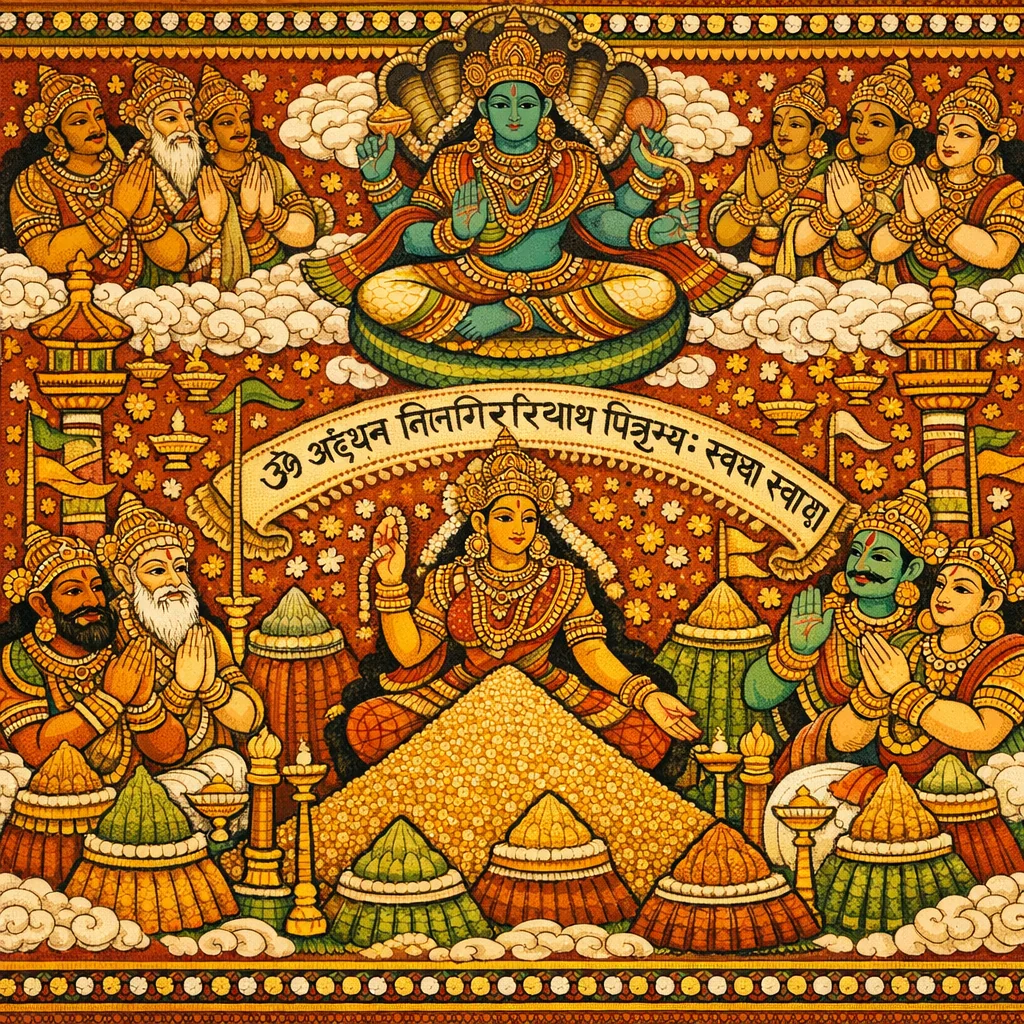
Adhyaya 87: Rite and Merits of the Sesame-Mountain (Tilāśaila/Tilācala) Gift
तिलशैल-दानविधानम् (तिलाचल-प्रदानम्)
Speaker: Īśvara (The Lord, Vaiṣṇava voice)
The Lord continues the sequence of ritual instruction, introducing the tilāśaila/tilācala (sesame-mountain) gift and its salvific merit leading to Viṣṇuloka. He sets out three quantitative grades measured in droṇas, and, as in earlier sections, promises the proper dāna-mantras for the supporting pillars (viṣkambhas) and surrounding features. He gives a mythic-theological rationale for the materials—tila, kuśa, and māṣa—saying they arose from Viṣṇu’s perspiration during the Madhu episode and are therefore fit for śānti. A direct invocation hails Tilācala as the mountain-lord who safeguards the efficacy of havya and kavya, asking it to “lift up” (deliver) the donor. The phala-śruti concludes with attainment of the Vaiṣṇava state with rare return, along with longevity, prosperity in descendants, honor from Pitṛs/Devas/Gandharvas, and ascent to heaven.
Key Concepts
Shlokas in Adhyaya 87
Verse 1
*ईश्वर उवाच अतः परं प्रवक्ष्यामि तिलशैलं विधानतः यत्प्रदानान्नरो याति विष्णुलोकं सनातनम् //
The Lord said: “Now I shall explain, in due procedure, the rite of the ‘sesame-mountain’ (tilaśaila). By making this offering, a man attains the eternal world of Viṣṇu.”
Verse 2
उत्तमो दशभिर् द्रोणैर् मध्यमः पञ्चभिः स्मृतः त्रिभिः कनिष्ठो विप्रेन्द्र तिलशैलः प्रकीर्तितः //
The ‘sesame-mountain’ (tilaśaila) gift is declared to be of three grades, O best of Brahmins: the superior (uttama) is measured as ten droṇas, the middling (madhyama) as five, and the lesser (kaniṣṭha) as three.
Verse 3
पूर्ववच्चापरान्सर्वान् विष्कम्भानभितो गिरीन् दानमन्त्रान् प्रवक्ष्यामि यथावन्मुनिपुंगव //
And, just as before, I shall now properly declare the gift-mantras for all the other supporting pillars (viṣkambhas) and for the mountains surrounding them, O foremost of sages.
Verse 4
यस्मान्मधुवधे विष्णोर् देहस्वेदसमुद्भवाः तिलाः कुशाश्च माषाश्च तस्माच्छान्त्यै भवत्विह //
Because, at the slaying of Madhu, sesame seeds, kuśa grass, and black gram (māṣa) arose from Viṣṇu’s bodily perspiration, therefore let these be employed here for rites of pacification (śānti).
Verse 5
हव्ये कव्ये च यस्माच्च तिला एवाभिरक्षणम् भवादुद्धर शैलेन्द्र तिलाचल नमो ऽस्तु ते //
For in offerings to the gods (havya) and in offerings to the ancestors (kavya), sesame (tilā) is safeguarded and made efficacious through you—O lord of mountains, O Tilācala—raise me up, deliver me. Salutations to you.
Verse 6
इत्यामन्त्र्य च यो दद्यात् तिलाचलमनुत्तमम् स वैष्णवं पदं याति पुनरावृत्तिदुर्लभम् //
Thus, having duly invoked and taken leave, whoever gives the unsurpassed ‘Tilācala’—the ceremonial mound or mountain of sesame as a gift—attains the Vaiṣṇava abode, from which return to rebirth is rarely possible.
Verse 7
दीर्घायुष्यं समाप्नोति पुत्रपौत्रैश्च मोदते पितृभिर्देवगन्धर्वैः पूज्यमानो दिवं व्रजेत् //
He attains long life, rejoices with sons and grandsons, and—being honored by the Pitṛs, the Devas, and the Gandharvas—goes to heaven.
Frequently Asked Questions
Adhyaya 87 instructs the tilāśaila/tilācala dāna—constructing and gifting a “mountain” of sesame—with an explicit promise of attaining Viṣṇuloka/Vaiṣṇava abode and rare return to rebirth. It specifies three graded quantities (uttama 10 droṇas, madhyama 5, kaniṣṭha 3) and frames the rite with mantric invocation and a śānti rationale for using sesame, kuśa, and black gram.
This chapter is primarily Dharma-focused—specifically dāna-dharma and śānti rites—rather than Vāstu or genealogy. It also touches ritual theology (why certain substances are powerful) and the havya–kavya framework linking deva worship and ancestor rites.