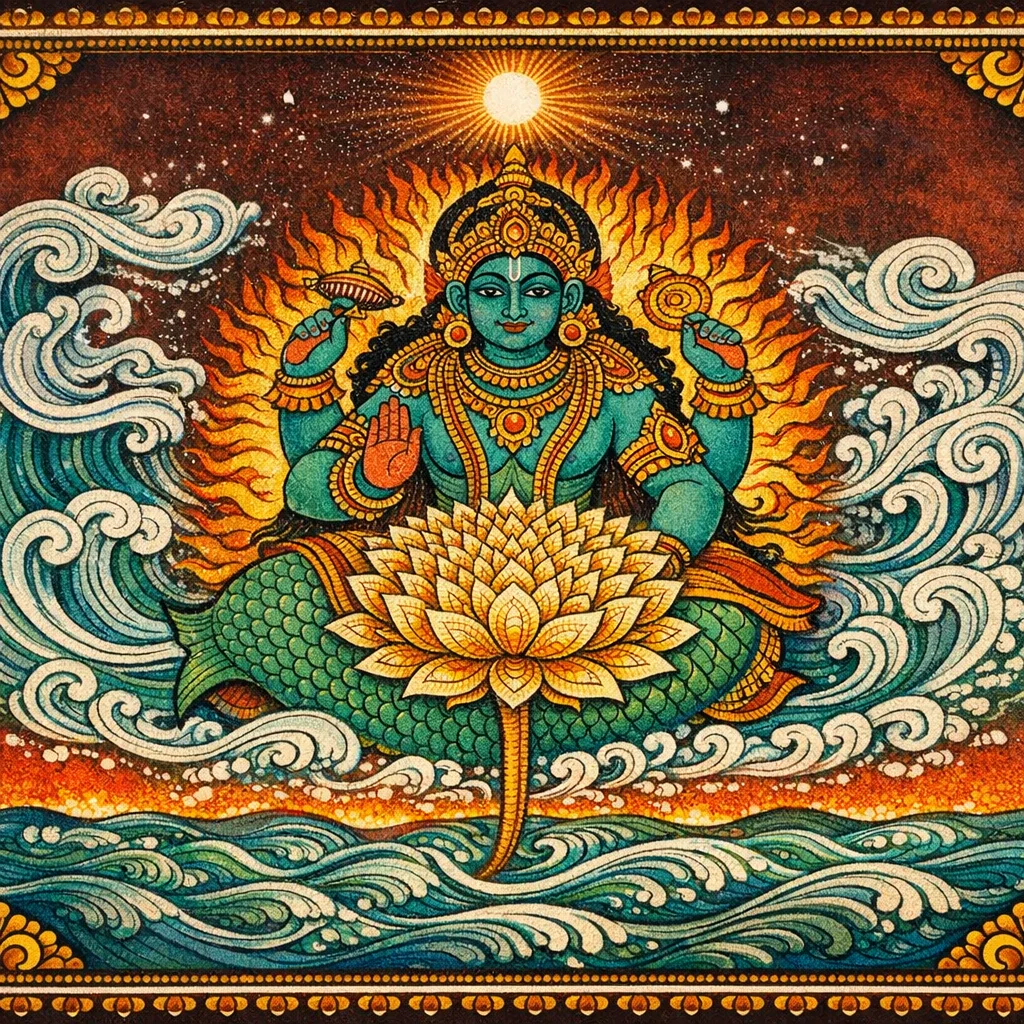
Adhyaya 168: Cosmic Creation: Emergence of the Great Elements and the Navel-Lotus
सृष्टिप्रकरणे महाभूतप्रादुर्भावः तथा नाभिकमलोत्पत्तिः
Speaker: Lord Matsya
Lord Matsya continues the discourse on creation, describing an early withdrawn cosmic state ruled by waters. A subtle pre-existing fissure becomes manifest, allowing sound to arise and Vāyu (wind) to emerge, stirring the ocean. From churning and friction appears Vaiśvānara (cosmic fire), which dries the waters and reveals the vastness of ākāśa, space. The Lord then contemplates world-creation together with the arising of Brahmā; Mahādeva is said to rejoice on seeing the proper order of the elements. Finally, Hari, sporting upon the boundless waters, manifests from his navel a radiant thousand-petalled lotus, preparing the ground for Brahmā and further emanation.
Key Concepts
Shlokas in Adhyaya 168
Verse 1
*मत्स्य उवाच आपवः स विभुर्भूत्वा चारयामास वै तपः छादयित्वात्मनो देहं यादसां कुलसंभवम् //
Lord Matsya said: Having become mighty and masterful, that Āpava indeed undertook austerities; concealing his own body, he assumed an origin within the lineage of the aquatic beings (yādasa).
Verse 2
ततो महात्मातिबलो मतिं लोकस्य सर्जने महतां पञ्चभूतानां विश्वो विश्वमचिन्तयत् //
Then the mighty and great-souled One, the all-pervading Lord, turned His mind to the creation of the worlds, and contemplated the universe through the great five elements.
Verse 3
तस्य चिन्तयमानस्य निर्वाते संस्थिते ऽर्णवे निराकाशे तोयमये सूक्ष्मे जगति गह्वरे //
As he was contemplating, the ocean lay windless and still; in that water-made, subtle, cavern-like state of the world—where even space seemed absent—everything remained contained in a withdrawn condition.
Verse 4
ईषत्संक्षोभयामास सो ऽर्णवं सलिलाश्रयः अनन्तरोर्मिभिः सूक्ष्मम् अथ छिद्रमभूत्पुरा //
Then that One who dwells in the waters gently stirred the ocean; and by the ceaseless succession of subtle waves, a minute opening (a small fissure) that had existed from before became manifest.
Verse 5
शब्दं प्रति तदोद्भूतो मारुतश्छिद्रसंभवः स लब्ध्वान्तरमक्षोभ्यो व्यवर्धत समीरणः //
In response to sound, the Wind (Vāyu) arose—born from an opening (space). Finding room to move, the unagitated air-current then expanded and grew.
Verse 6
विवर्धता बलवता वेगाद्विक्षोभितो ऽर्णवः तस्यार्णवस्य क्षुब्धस्य तस्मिन्नम्भसि मन्थिते कृष्णवर्त्मा समभवत् प्रभुर्वैश्वानरो महान् //
Driven by a mighty, swelling force, the ocean was violently agitated. And when that turbulent sea—its waters churned—there arose a dark-pathed, mighty lord: the great Vaiśvānara (cosmic fire).
Verse 7
ततः संशोषयामास पावकः सलिलं बहु क्षयाज्जलनिधेश्छिद्रम् अभवद्विस्तृतं नभः //
Then the Fire (the cosmic heat) dried up vast quantities of water; as the ocean’s mass diminished, a great opening appeared in the sea, and the sky seemed to spread wide and unobstructed.
Verse 8
आत्मतेजोद्भवाः पुण्या आपो ऽमृतरसोपमाः आकाशं छिद्रसम्भूतं वायुराकाशसंभवः //
From the radiance of the Self arose the holy waters, comparable to the taste of nectar. Ether (ākāśa) arose from space/opening, and wind (vāyu) was born from ether.
Verse 9
आभ्यां संघर्षणोद्भूतं पावकं वायुसंभवम् दृष्ट्वा प्रीतो महादेवो महाभूतविभावनः //
Seeing the fire (Pāvaka) that had arisen from the friction of those two and was generated through the agency of Vāyu (wind), Mahādeva—who illumines and governs the great elements—became pleased.
Verse 10
दृष्ट्वा भूतानि भगवांल् लोकसृष्ट्यर्थमुत्तमम् ब्रह्मणो जन्मसहितं बहुरूपो व्यचिन्तयत् //
Having beheld the beings, the Blessed Lord—assuming many forms—pondered the supreme means for the creation of the worlds, together with the arising (birth) of Brahmā.
Verse 11
चतुर्युगाभिसंख्याते सहस्रयुगपर्यये बहुजन्मा हि विश्वात्मा ब्रह्मणो हविरुच्यते //
When the four-yuga cycle has been fully reckoned, and the span of a thousand such yugas is completed, the Universal Self—taking many births—is then spoken of as Brahmā’s sacrificial oblation.
Verse 12
यत्पृथिव्यां द्विजेन्द्राणां तपसा भावितात्मनाम् ज्ञानं वृष्टं तु विश्वार्थे योगिनां याति मुख्यताम् //
That knowledge which, upon the earth, is showered forth for the good of the world by the foremost of the twice-born—whose selves are refined by austerity—becomes the highest pursuit for yogins.
Verse 13
तं योगवन्तं विज्ञाय सम्पूर्णैश्वर्यमुत्तमम् पदे ब्रह्मणि विश्वेशं न्ययोजयत योगवित् //
Recognizing him to be perfected in Yoga and possessed of the supreme, complete lordly power, the knower of Yoga established that Lord of the Universe in the station of Brahman.
Verse 14
ततस्तस्मिन्महातोये महीशो हरिरच्युतः जले क्रीडंश्च विधिवन् मोदते सर्वलोककृत् //
Then, in that vast expanse of water, the Imperishable Hari—sovereign Lord—sporting in the waters in due order, rejoiced, He who is the creator of all the worlds.
Verse 15
पद्मं नाभ्युद्भवं चैकं समुत्पादितवांस्तदा सहस्रपर्णं विरजं भास्कराभं हिरण्मयम् //
Then he brought forth a single lotus arising from the navel—thousand-petalled, stainless, radiant like the sun, and golden in form.
Verse 16
हुताशनज्वलितशिखोज्ज्वलत्प्रभम् उपस्थितं शरदमलार्कतेजसम् विराजते कमलमुदारवर्चसं महात्मनस्तनुरुहचारुदर्शनम् //
His presence shines with a radiance like fire with blazing flames—like the spotless autumn sun. His body glows with the noble lustre of a lotus, and the fine hairs upon the great-souled One’s limbs are themselves a beautiful sight.
Frequently Asked Questions
The chapter teaches a Purāṇic model of creation as an ordered unfolding from a subtle, water-dominated withdrawn state into manifest cosmos through the mahābhūtas. A key instruction is the causal sequence: an ‘opening’ (chidra) enables sound and ākāśa, from which vāyu arises; vāyu drives agitation and friction, producing Vaiśvānara (cosmic fire), which then transforms the waters and reveals the expanse of space/sky. The narrative culminates in Hari’s navel-lotus, signaling Brahmā’s forthcoming role in structured world-creation.
This adhyaya is primarily Sṛṣṭi (creation/cosmogony), focusing on the origin and sequencing of the mahābhūtas (ākāśa, vāyu, agni/tejas) and the symbolic emergence of the nābhi-kamala (navel-lotus) connected to Brahmā’s birth. It does not present Vāstu-śāstra measurements, temple architecture rules, or explicit Rājadharma instructions in these verses; its relevance to Vāstu is indirect, via the metaphysical foundations of space (ākāśa), movement (vāyu), and fire (agni) that later underlie Vāstu principles.