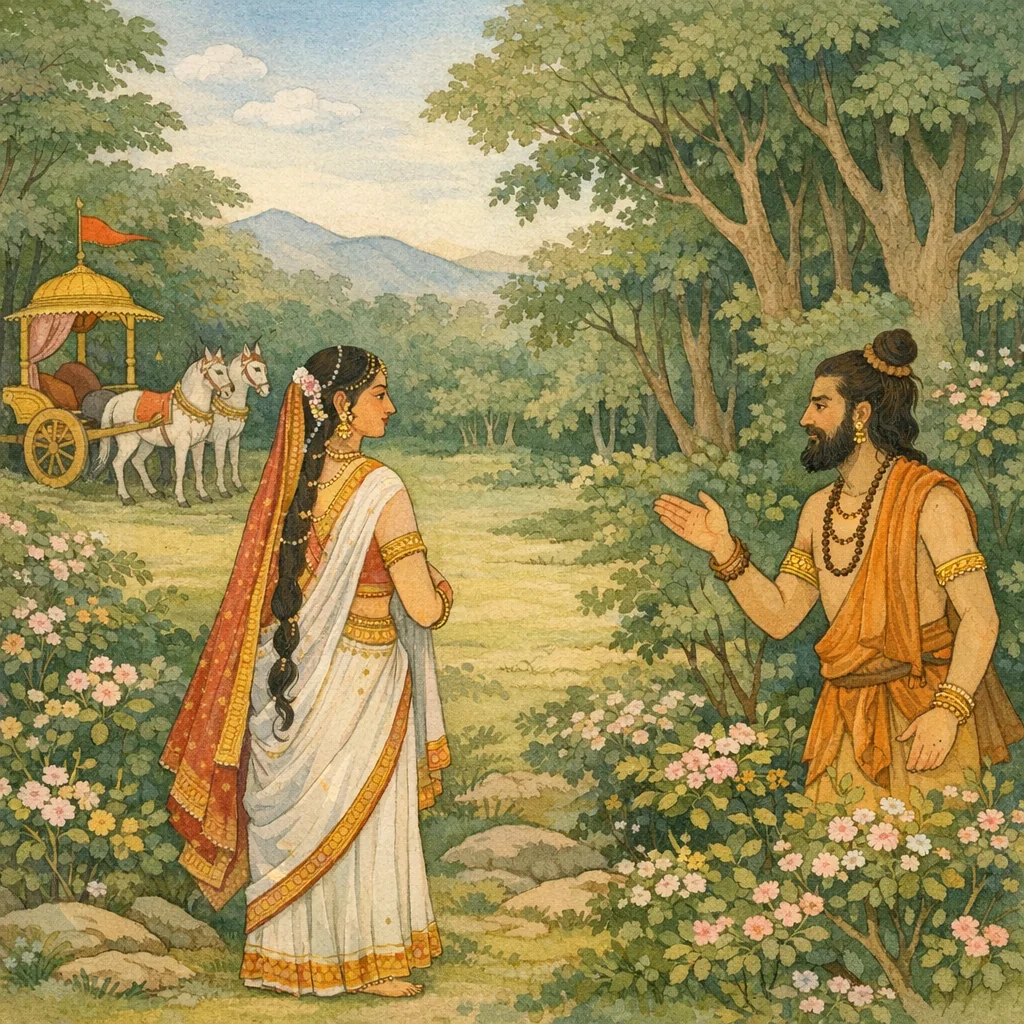
Adhyaya 265
सीता-रावण-संवादः (Sītā–Rāvaṇa Dialogue in the Aśoka Grove)
Upa-parva: Mārkaṇḍeya-saṃvāda / Rāmopākhyāna (Embedded Rāma Narrative as told by Mārkaṇḍeya)
Mārkaṇḍeya describes Sītā seated on a stone surface in distress, attended by rākṣasīs, still marked by residual ornaments yet clothed in soiled garments—an iconography of dislocation and grief. Rāvaṇa approaches, depicted with splendid attire and jewelry, yet framed as intrinsically fearsome despite ornamentation. He addresses Sītā with inducements: urging her to accept him, promising royal status, superior adornments, and enumerating his vast retinues and supernatural associations; he also claims eminent lineage as Viśravas’ son and self-presents as a quasi-lokapāla. Sītā responds with explicit refusal, identifying herself as another’s spouse (paradārā), consistently devoted to her husband, and challenges the ethical incoherence of Rāvaṇa’s claims to prestige while violating dharma. She questions what satisfaction could arise from forcing the unwilling and invokes shame in light of his familial associations (including a renowned brother). After her rebuke and continued grief, Rāvaṇa reiterates that desire afflicts him but asserts he will not unite with her against her will; he then disappears, leaving Sītā guarded and attended, notably by Trijaṭā. The chapter’s thematic center is the contrast between rhetorical power and moral legitimacy, with Sītā’s speech functioning as a normative critique of coercion and status-based entitlement.
Chapter Arc: वन-प्रदेशों की ऋतु-रम्यता के बीच पाण्डवों का मृगया-स्वभाव और निर्भय विचरण—उसी शांत पृष्ठभूमि पर जयद्रथ का आगमन, मानो वन में अचानक काम-तूफान उठ खड़ा हो। → जयद्रथ और उसके साथी एक अनिन्द्य सुन्दरी को देखते हैं; वे उसे अप्सरा, देवकन्या या देव-निर्मित माया समझकर विस्मित होते हैं। जयद्रथ काममोहित होकर निश्चय करता है कि इसी को लेकर जाएगा और अपने मंत्री/सहचर कोटिकास्य को उसकी पहचान और ‘नाथ’ (पति/रक्षक) का पता लगाने भेजता है। → जयद्रथ का अहंकारी संकल्प—“इसे पाकर मुझे अन्य विवाह की आवश्यकता नहीं”—और कोटिकास्य का रथ से उतरकर द्रौपदी के निकट जाकर प्रश्न करना; यहीं से द्रौपदी-हरण की कथा का द्वार खुलता है। → अध्याय का अंत कोटिकास्य के द्रौपदी के पास पहुँचकर पूछताछ आरम्भ करने पर होता है; वास्तविक टकराव अभी शेष है। → कोटिकास्य के प्रश्न के उत्तर में द्रौपदी कौन है, किसकी पत्नी है, और जयद्रथ इस सत्य को जानकर भी क्या करेगा—अगले अध्याय की ओर कथा लटकती है।
Shlokas
Verse 1
हि >> आय ० () हि २ 7 चतुःषष्टर्याधिकद्विशततमो< ध्याय: जयद्रथका द्रौपदीको देखकर मोहित होना और उसके पास कोटिकास्यको भेजना वैशम्पायन उवाच तस्मिन् बहुमृगे5रण्ये अटमाना महारथा: । काम्यके भरतश्रेष्ठा विजहुस्ते यथामरा:,वैशम्पायनजी कहते हैं--जनमेजय! काम्यकवनमें नाना प्रकारके वन्य पशु रहते थे। वहाँ भरतकुलभूषण महारथी पाण्डव सब ओर घूमते हुए देवताओंके समान विहार करते थे
Vaiśaṃpāyana said: In that forest abounding in wild animals, those great chariot-warriors—the foremost of the Bharata line—wandered about in the Kāmyaka woods, passing their days in free ranging as though they were the gods themselves.
Verse 2
प्रेक्षमाणा बहुविधान् वनोद्देशान् समन्ततः । यथर्तुकालरम्याश्व वनराजी: सुपुष्पिता:,वे चारों ओर घूम-घूमकर नाना प्रकारके वन्य प्रदेशों तथा ऋतुकालके अनुसार भलीभाँति खिले हुए फूलोंसे सुशोभित रमणीय वनश्रेणियोंकी शोभा देखते थे
Vaiśampāyana said: As they moved about on every side, they beheld many kinds of forest tracts all around—woodland ranges made delightful by the season, richly adorned with blossoms—thus taking in the beauty of the wilderness during their wandering.
Verse 3
पाण्डवा मृगयाशीलाश्षरन्तस्तन्महद् वनम् | विजहुरिन्द्रप्रतिमाः कज्चित् कालमरिंदम,शत्रुदन जनमेजय! पाण्डवलोग बाघ-चीते आदि हिंसक पशुओंका शिकार किया करते थे। देवराज इन्द्रके समान वे उस महान् वनमें विचरते हुए कुछ कालतक विहार करते रहे
Vaiśampāyana said: O Janamejaya—crusher of foes, punisher of enemies—the Pāṇḍavas, devoted to the hunt, ranged through that vast forest. Resembling Indra in prowess, they spent some time there in roaming and recreation, sustaining themselves by the chase amid the wilderness.
Verse 4
ततस्ते यौगपद्येन ययु: सर्वे चतुर्दिशम् । मृगयां पुरुषव्याप्रा ब्राह्मणार्थे परंतपा:,एक दिनकी बात है, शत्रुओंको संताप देनेवाले पुरुषसिंह पाँचों पाण्डव उद्दीप्त तपस्वी पुरोहित धौम्य तथा महर्षि तृणबिन्दुकी आज्ञासे द्रौपदीको अकेली ही आश्रममें रखकर ब्राह्मणोंकी रक्षाके लिये हिंसक पशुओं-को मारने एक साथ चारों दिशाओंमें (अलग-अलग) चले गये
Then, acting in concert, all of them set out at once toward the four quarters. Those heroic men, tormentors of foes, went on the hunt for the sake of the brāhmaṇas—undertaking the strenuous task of protecting them by driving off and killing dangerous beasts.
Verse 5
द्रौपदीमाश्रमे न्यस्य तृणबिन्दोरनुज्ञया । महर्षेदीप्ततपसो धौम्यस्य च पुरोधस:,एक दिनकी बात है, शत्रुओंको संताप देनेवाले पुरुषसिंह पाँचों पाण्डव उद्दीप्त तपस्वी पुरोहित धौम्य तथा महर्षि तृणबिन्दुकी आज्ञासे द्रौपदीको अकेली ही आश्रममें रखकर ब्राह्मणोंकी रक्षाके लिये हिंसक पशुओं-को मारने एक साथ चारों दिशाओंमें (अलग-अलग) चले गये
Vaiśaṃpāyana said: With the permission of the sage Tṛṇabindu and of the blazing ascetic Dhaumya, their family priest, the Pāṇḍavas left Draupadī in the hermitage and set out—each in a different direction—to kill violent beasts, thereby safeguarding the brahmins.
Verse 6
ततस्तु राजा सिन्धूनां वार्द्धक्षत्रि्महायशा: । विवाहकाम: शाल्वेयान् प्रयात: सो5भवत् तदा,उसी समय सिंधुदेशका महायशस्वी राजा जयद्रथ, जो वृद्धक्षत्रका पुत्र था, विवाहकी इच्छासे शाल्वदेशकी ओर जा रहा था। वह बहुमूल्य राजोचित ठाट-बाटसे सुसज्जित था। अनेक राजाओंके साथ यात्रा करता हुआ वह काम्यकवनमें आ पहुँचा
Then the illustrious king of the Sindhus, Jayadratha—son of Vṛddhakṣatri—set out at that time toward the Śālva country, driven by the desire to secure a marriage alliance. His journey, marked by royal splendor and accompanied by other kings, brought him into the Kāmyaka forest.
Verse 7
महता परिबर्हेण राजयोग्येन संवृतः । राजभिर्बहुभि: सार्धमुपायात् काम्यकं च सः,उसी समय सिंधुदेशका महायशस्वी राजा जयद्रथ, जो वृद्धक्षत्रका पुत्र था, विवाहकी इच्छासे शाल्वदेशकी ओर जा रहा था। वह बहुमूल्य राजोचित ठाट-बाटसे सुसज्जित था। अनेक राजाओंके साथ यात्रा करता हुआ वह काम्यकवनमें आ पहुँचा
Vaiśampāyana said: Surrounded by a great retinue befitting a king, he arrived at Kāmyaka, traveling in company with many kings. The scene reveals royal ambition and worldly desire: a powerful ruler, adorned with costly splendor and upheld by allied princes, enters the forest realm that will soon become the stage for events heavy with moral consequence.
Verse 8
तत्रापश्यत् प्रियां भार्या पाण्डवानां यशस्विनीम् | तिष्ठन्तीमाश्रमद्धारि द्रौपदी निर्जने वने,वहाँ उसने पाण्डवोंकी प्यारी पत्नी यशस्विनी द्रौपदीको दूरसे देखा, जो निर्जन वनमें अपने आश्रमके दरवाजेपर खड़ी थी
There he caught sight of Draupadī—renowned and beloved wife of the Pāṇḍavas—standing at the entrance of the hermitage, alone in the desolate forest. The scene underscores the vulnerability of the righteous in exile and the moral tension created when solitude and danger converge.
Verse 9
विभ्राजमानां वपुषा बिश्रतीं रूपमुत्तमम् | भ्राजयन्तीं वनोद्देशं नीलाभ्रमिव विद्युतम्,वह परम सुन्दर रूप धारण किये अपनी अनुपम कान्तिसे उदभासित हो रही थी और जैसे विद्युत् अपनी प्रभासे नीले मेघसमूहको प्रकाशित करती है, उसी प्रकार वह सुन्दरी अपनी अड्भच्छटासे उस वनप्रान्तको सब ओरसे देदीप्यमान कर रही थी
Vaiśampāyana said: She, bearing a supremely beautiful form, shone with her own radiant body. Like lightning that illuminates a mass of dark-blue clouds, that lovely woman lit up the whole forest-region on every side with her splendor—an image that underscores the power of inner excellence to make even a wilderness appear bright.
Verse 10
अप्सरा देवकन्या वा माया वा देवनिर्मिता । इति कृत्वाञ्जलिं सर्वे ददृशुस्तामनिन्दिताम्,जयद्रथ और उसके सभी साथियोंने उस अनिन््द्य सुन्दरीकी ओर देखा और वे हाथ जोड़कर मन-ही-मन यह विचार करने लगे--'यह कोई अप्सरा है या देवकन्या अथवा देवताओंकी रची हुई माया है?”
Jayadratha and all his companions looked upon that blameless beauty; with hands joined in reverence, they thought to themselves: “Is she an apsarā, a daughter of the gods, or a māyā fashioned by the devas?”
Verse 11
ततः स राजा सिन्धूनां वार्द्ध॑क्षत्रिर्जयद्रथ: । विस्मितस्त्वनवद्याड़ीं दृष्टवा तां दुष्टमानस:,निर्दोष अंगोंवाली उस सुन्दरीको देखकर वृद्धक्षत्र-कुमार सिन्धुराज जयद्रथ चकित रह गया। उसके मनमें दूषित भावनाका उदय हुआ
Then Jayadratha, the Sindhu king—descended from Vṛddhakṣatra—was struck with astonishment on seeing that faultless-limbed lady. But his mind turned corrupt, and an ignoble desire arose within him, setting the stage for an adharma-driven act against an innocent woman.
Verse 12
स कोटिकास्यं राजानमब्रवीत् काममोहित: । कस्य त्वेषानवद्याज्री यदि वापि न मानुषी,उसने काममोहित होकर राजा कोटिकास्यसे कहा--“कोटिक! जरा जाकर पता तो लगाओ, यह सर्वागसुन्दरी किसकी स्त्री है? अथवा यह मनुष्यजातिकी स्त्री है भी या नहीं?
Overcome by desire, he addressed King Koṭikāsya: “Koṭika, go and find out—whose wife is this flawless, exquisitely beautiful woman? Or is she perhaps not even a human woman?”
Verse 13
विवाहार्थों न मे कश्निदिमां प्राप्पातिसुन्दरीम् एतामेवाहमादाय गमिष्यामि स्वमालयम्,“इस अत्यन्त सुन्दरी रमणीको पाकर मुझे और किसीसे विवाह करनेकी आवश्यकता ही नहीं रह जायगी। इसीको लेकर मैं अपने घर लौट जाऊँगा
Vaiśampāyana said: “For the sake of marriage, no one else shall obtain this beautiful woman. Taking her alone, I will return to my own dwelling.”
Verse 14
गच्छ जानीहि सौम्येमां कस्य वात्र कुतो5पि वा । किमर्थमागता सुभ्रूरिदं कण्टकितं वनम्,'सौम्य! जाओ, पता लगाओ, यह किसकी स्त्री है और कहाँसे इस वनमें आयी है? यह सुन्दर भौंहोंवाली युवती काँटोंसे भरे हुए इस जंगलमें किसलिये आयी है?
Vaiśampāyana said: “Go, dear one, and find out whose wife this is, and from where she has come here. For what purpose has this fair-browed woman entered this thorn-filled forest?”
Verse 15
अपि नाम वरारोहा मामेषा लोकसुन्दरी । भजेदद्यायतापाज़्ी सुदती तनुमध्यमा,“क्या यह मनोहर कटिप्रदेशवाली विश्वसुन्दरी मुझे अंगीकार करेगी? इसके नेत्रप्रान्त कितने विशाल हैं, दाँत कैसे सुन्दर हैं और शरीरका मध्यभाग कितना सूक्ष्म है?
Vaiśampāyana said: “Might it be that this world-renowned beauty—graceful in her gait—would accept me today? She is wide-eyed, her teeth are lovely, and her waist is exquisitely slender.”
Verse 16
अप्यहं कृतकाम: स्यामिमां प्राप्य वरस्त्रियम् । गच्छ जानीहि को न्वस्या नाथ इत्येव कोटिक,“यदि मैं इस सुन्दरीको पा जाऊँ तो कृतार्थ हो जाऊँगा। कोटिक! जाओ और पता लगाओ कि इसका पति कौन है?' जयद्रथका यह वचन सुनकर कुण्डलमण्डित कोटिकास्य रथसे उतर पड़ा और जैसे गीदड़ बाघकी स्त्रीसे बात करे, उसी प्रकार उसने द्रौपदीके पास जाकर पूछा
Vaiśampāyana said: “If only I could obtain this excellent woman, I would consider my desire fulfilled. Go, Koṭika—find out who her protector (husband/lord) is.”
Verse 17
स कोटिकास्यस्तच्छुत्वा रथात् प्रस्कन्द्य कुण्डली । उपेत्य पप्रच्छ तदा क्रोष्टा व्याप्रवधूमिव,“यदि मैं इस सुन्दरीको पा जाऊँ तो कृतार्थ हो जाऊँगा। कोटिक! जाओ और पता लगाओ कि इसका पति कौन है?' जयद्रथका यह वचन सुनकर कुण्डलमण्डित कोटिकास्य रथसे उतर पड़ा और जैसे गीदड़ बाघकी स्त्रीसे बात करे, उसी प्रकार उसने द्रौपदीके पास जाकर पूछा
Vaiśampāyana said: Hearing those words, Koṭikāsya—wearing earrings—leapt down from the chariot. Approaching her, he questioned her then, like a jackal speaking to a tigress, implying both his audacity and the peril of provoking a powerful woman. The scene underscores the moral ugliness of treating a woman as an object of acquisition and foreshadows the ethical breach that will invite consequences.
Verse 263
इस प्रकार श्रीमह्ााभारत वनपर्वके अन्तर्गत द्रौपदीहरणपर्वमें दुवॉयाकी कथाविषयक दो सौ तिरसठवाँ अध्याय पूरा हुआ
Thus, in the Śrī Mahābhārata, within the Vana Parva, in the section concerning the abduction of Draupadī, the two-hundred-and-sixty-third chapter—treating the narrative connected with Durvāsā—comes to its close. The colophon marks the completion of this unit, framing the episode as a moral and narrative segment within the larger discourse on dharma, trial, and conduct in adversity.
Verse 264
इति श्रीमहा भारते वनपर्वणि द्रौपदीहरणपर्वणि जयद्रथागमने चतुःषष्ट्यधिकद्विशततमो<5ध्याय:
Thus ends the two-hundred and sixty-fourth chapter of the Vana Parva of the Śrī Mahābhārata, within the section concerning the abduction of Draupadī, specifically the episode of Jayadratha’s arrival. The colophon marks the close of this narrative unit, framing the events as a moral lesson on restraint, the protection owed to the vulnerable, and the consequences that follow from violating dharma.
Frequently Asked Questions
The dilemma contrasts coercive entitlement justified by power and abundance versus principled refusal grounded in fidelity and ethical law: whether status can legitimize a relationship without consent and dharmic propriety.
Moral legitimacy depends on conduct rather than rank; persuasion cannot ethically become compulsion, and self-restraint is presented as a higher marker of authority than possession or lineage.
No explicit phalaśruti appears in the provided verses; the meta-function is implicit—an exemplum within Mārkaṇḍeya’s narration used to instruct listeners by contrastive characterization and ethical argumentation.