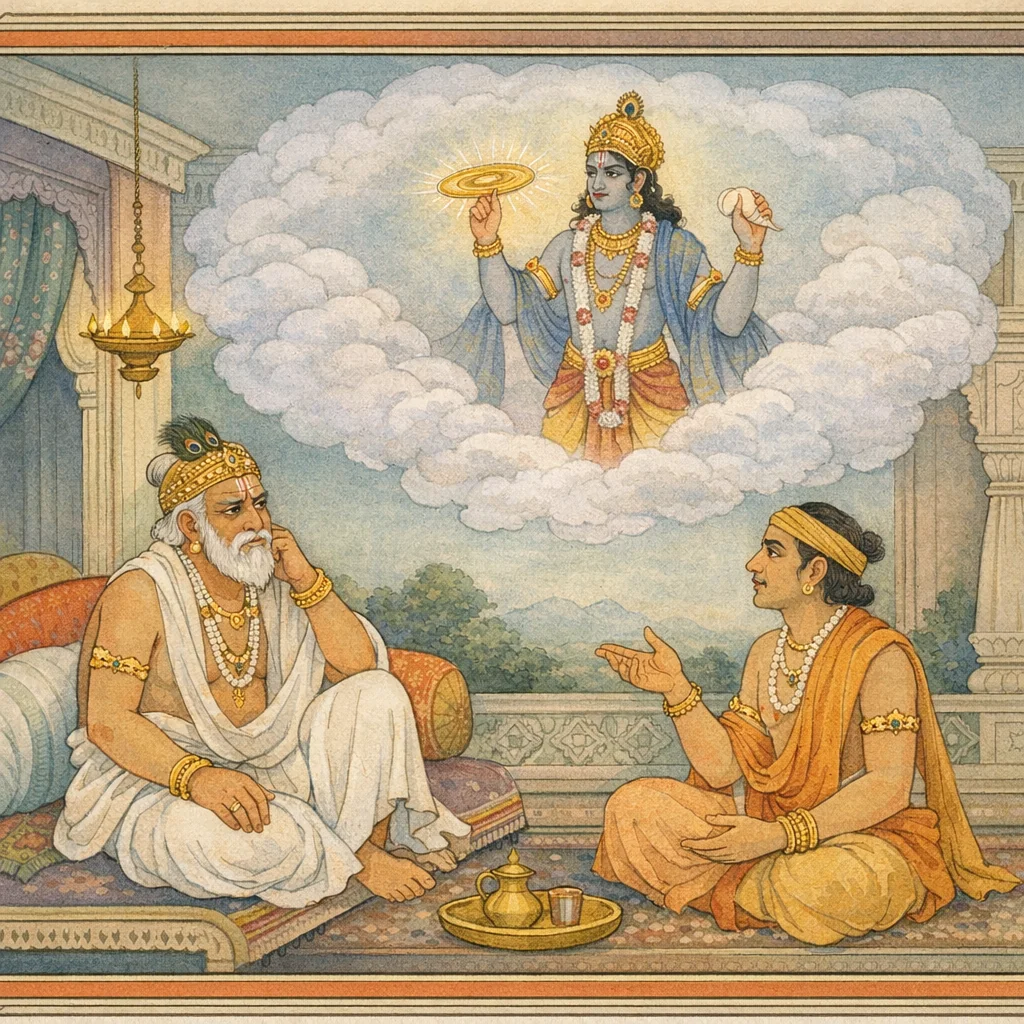
Adhyaya 67
Sañjaya’s Knowledge of Keśava and the Discipline of Indriya-nigraha (संजयस्य केशवज्ञानम्—इन्द्रियनिग्रह-उपदेशः)
Upa-parva: Sañjaya–Dhṛtarāṣṭra Saṃvāda (Udyoga-parva: Adhyāya 67 Context Unit)
Adhyāya 67 presents a multi-voice court dialogue. Dhṛtarāṣṭra asks how Saṃjaya recognizes Mādhava as ‘sarvaloka-maheśvara’ and why he himself does not. Saṃjaya replies that mere ‘vidyā’ without inner qualification fails, while knowledge grounded in purified disposition and devotion enables recognition of Kṛṣṇa as the uncreated agent and the source and dissolution of beings (prabhava–apyaya). Dhṛtarāṣṭra inquires into Saṃjaya’s bhakti; Saṃjaya denies serving illusion (māyā), rejects purposeless adharma, and attributes his understanding to śāstra with a śuddha-bhāva. Dhṛtarāṣṭra urges Duryodhana to take refuge in Hṛṣīkeśa; Duryodhana refuses, citing Kṛṣṇa’s friendship with Arjuna. Dhṛtarāṣṭra laments his son’s envy and disregard for beneficial counsel; Gāndhārī warns that abandoning elders for power will culminate in violent retribution and regret. Vyāsa affirms Dhṛtarāṣṭra’s relationship to Kṛṣṇa and Saṃjaya’s competence, then frames the broader human predicament: those bound by desire repeatedly fall under Yama’s domain. Asked for a fearless path (akutobhaya panthā), Saṃjaya prescribes inner discipline—sense-control, vigilant renunciation of desire, non-injury, and yogic mastery—stating that Keśava is inaccessible to the uncontrolled senses but is realized through āgama-informed yoga and steadiness in truth.
Chapter Arc: धृतराष्ट्र बार-बार पाण्डवों के ‘सार-असार बल’ का रहस्य पूछते हैं; तब संजय अर्जुन और वासुदेव—दोनों धनुर्धरों की परम-पूज्यता और कृष्ण-तत्त्व की ओर कथा को मोड़ते हैं। → संजय बतलाते हैं कि वासुदेव की माया से सुदर्शन-चक्र का अलक्ष्य, अचिन्त्य प्रभाव चलता है—यह केवल अस्त्र नहीं, धर्म-रक्षा का दैवी संकेत है; धृतराष्ट्र की जिज्ञासा अब सैन्य-गणना से उठकर ‘किस ओर विजय’ के प्रश्न में बदलती जाती है। → निर्णायक वाक्य उभरता है—‘यतः सत्यं यतो धर्मो… यतः कृष्णस्ततो जयः’; सत्य, धर्म, लज्जा और सरलता जहाँ हैं, वहीं गोविन्द हैं और वहीं विजय निश्चित है। → संजय कृष्ण को कालचक्र, जगच्चक्र और युगचक्र का नियन्ता बताते हैं—वे आत्मयोग से सब परिवर्तित करते हैं; वे ही काल और मृत्यु तक के ईश्वर हैं, और उनकी माया लोक को मोहित करती है, पर जो उन्हें शरण लेते हैं वे मोह से नहीं गिरते। → धृतराष्ट्र के लिए निष्कर्ष स्पष्ट है—विजय का केन्द्र कृष्ण हैं; पर वह इस सत्य को स्वीकार कर नीति बदलेगा या मोह में अड़ा रहेगा—यही आगे की अनिश्चितता बनती है।
Shlokas
Verse 1
असजन कार (.) आ+औअन+- अष्टषष्टितमो< ध्याय: संजयका धृतराष्ट्रको भगवान् श्रीकृष्णकी महिमा बतलाना संजय उवाच अर्जुनो वासुदेवश्च धन्विनौ परमार्चितौ | कामादन्यत्र सम्भूतौ सर्वभावाय सम्मितौ,संजयने कहा--राजन्! अर्जुन तथा भगवान् श्रीकृष्ण दोनों बड़े सम्मानित धनुर्थर हैं। वे (यद्यपि सदा साथ रहनेवाले नर और नारायण हैं, तथापि) लोककल्याणकी कामनासे पृथक्-पृथक् प्रकट हुए हैं और सब कुछ करनेमें समर्थ हैं
Sanjaya said: O King, Arjuna and Vāsudeva (Śrī Kṛṣṇa) are both supreme archers, honored above all. Though eternally united in essence, they have manifested separately by deliberate will for the welfare of the world, fully equal to every task that must be accomplished.
Verse 2
व्यामान्तरं समास्थाय यथामुक्त मनस्विन: । चक्र तद् वासुदेवस्य मायया वर्तते विभो,प्रभो! उदारचेता भगवान् वासुदेवका सुदर्शन नामक चक्र उनकी मायासे अलक्षित होकर उनके पास रहता है। उसके मध्यभागका विस्तार लगभग साढ़े तीन हाथका है। वह भगवानके संकल्पके अनुसार (विशाल एवं तेजस्वी रूप धारण करके शत्रुसंहारके लिये) प्रयुक्त होता है
Sañjaya said: “That discus of Vāsudeva remains (ever) with him—unperceived by others through his divine power—having a central span of about three and a half cubits. In accordance with the Lord’s resolve, it assumes its vast and blazing form and is employed for the destruction of enemies.”
Verse 3
सापद्ववं कौरवेषु पाण्डवानां सुसम्मतम् । सारासारबल ज्ञातुं तेज:पुञज्जावभासितम्
Sañjaya said: “Among the Kauravas, the Pāṇḍavas’ position was well approved and firmly established. And in order to discern the true strength—what is substantial and what is hollow—there appeared a radiant mass of splendour, blazing forth.”
Verse 4
कौरवोंपर उसका प्रभाव प्रकट नहीं है। पाण्डवोंको वह अत्यन्त प्रिय है। वह सबके सार-असारभूत बलको जाननेमें समर्थ और तेज:पुंजसे प्रकाशित होनेवाला है ।। नरकं शम्बरं चैव कंसं चैद्यं च माधव: । जितवान् घोरसंकाशान् क्रीडन्निव महाबल:,महाबली भगवान् श्रीकृष्णने अत्यन्त भयंकरप्रतीत होनेवाले नरकासुर, शम्बरसुर, कंस तथा शिशुपालको भी खेल-ही-खेलमें जीत लिया
Sañjaya said: Mādhava (Śrī Kṛṣṇa), though supremely mighty, overcame as if in sport those foes who appeared terrifying—Naraka, Śambara, Kaṁsa, and Caidya (Śiśupāla). The statement underscores that true power, guided by righteousness, is not mere violence but mastery that subdues destructive forces without being inwardly shaken by them.
Verse 5
पृथिवीं चान्तरिक्षं च द्यां चैव पुरुषोत्तम: । मनसैव विशिष्टात्मा नयत्यात्मवशं वशी,पूर्णतः स्वाधीन एवं श्रेष्ठस्वरूप पुरुषोत्तम श्रीकृष्ण मनके संकल्पमात्रसे ही भूतल, अन्तरिक्ष तथा स्वर्गलोकको भी अपने अधीन कर सकते हैं
Sanjaya said: The Supreme Person, possessed of an exceptional inner power and perfect self-mastery, can bring the earth, the mid-region, and even heaven under his control by the mere act of his mind. The verse underscores Krishna’s sovereign independence and the ethical implication that true mastery begins with mastery of oneself, not with external force.
Verse 6
भूयो भूयो हि यद् राजन् पृच्छसे पाण्डवानू् प्रति । सारासारबल ज्ञातुं तत् समासेन मे शृणु
Sañjaya said: “O King, since you ask again and again about the Pāṇḍavas—seeking to know what is essential and what is not, and to gauge their true strength—listen as I tell it to you in brief.”
Verse 7
राजन! आप जो बारंबार पाण्डवोंके विषयमें, उनके सार या असारभूत बलको जाननेके लिये मुझसे पूछते रहते हैं, वह सब आप मुझसे संक्षेपमें सुनिये ।। एकतो वा जगत् कृत्स्नमेकतो वा जनार्दन: । सारतो जगत: कृत्स्नादतिरिक्तो जनार्दन:
Sañjaya said: “O King, you ask me again and again about the Pāṇḍavas, wishing to know whether their strength is truly substantial or only seeming; hear my answer in brief. Let the whole world stand on one side, and Janārdana alone on the other—yet in essential worth Janārdana surpasses the entire world.”
Verse 8
एक ओर सम्पूर्ण जगत् हो और दूसरी ओर अकेले भगवान् श्रीकृष्ण हों तो सारभूत बलकी दृष्टिसे वे भगवान् जनार्दन ही सम्पूर्ण जगत्से बढ़कर सिद्ध होंगे ।। भस्म कुर्याज्जगदिदं मनसैव जनार्दन: । न तु कृत्स्नं जगच्छक्तं भस्म कर्तु जनार्दनम्,श्रीकृष्ण अपने मानसिक संकल्पमात्रसे इस सम्पूर्ण जगत्को भस्म कर सकते हैं; परंतु उन्हें भस्म करनेमें यह सारा जगत् समर्थ नहीं हो सकता
Sañjaya said: “Janārdana can reduce this entire world to ashes by mere resolve of his mind; but the whole world together has no power to reduce Janārdana to ashes.”
Verse 9
यतः सत्यं यतो धर्मो यतो द्वीरार्जव॑ यतः । ततो भवति गोविन्दो यतः कृष्णस्ततो जय:,जिस ओर सत्य, धर्म, लज्जा और सरलता है, उसी ओर भगवान् श्रीकृष्ण रहते हैं और जहाँ भगवान् श्रीकृष्ण हैं, वहीं विजय है
Sañjaya said: “Wherever truth is found, wherever dharma prevails, and wherever steadfast integrity and straightforwardness abide—there Govinda is present. And where Kṛṣṇa is, there is victory.”
Verse 10
पृथिवीं चान्तरिक्षं च दिवं च पुरुषोत्तम: । विचेष्टयति भूतात्मा क्रीडन्निव जनार्दन:,समस्त प्राणियोंके आत्मा पुरुषोत्तम भगवान् श्रीकृष्ण खेल-सा करते हुए ही पृथ्वी, अन्तरिक्ष तथा स्वर्गलोकका संचालन करते हैं
Sañjaya said: “The Supreme Person, Janārdana—who is the inner Self of all beings—sets in motion the earth, the mid-region, and heaven, as though it were merely a play.”
Verse 11
स कृत्वा पाण्डवान् सत्र लोक॑ सम्मोहयन्निव । अधर्मनिरतान् मूढान् दग्धुमिच्छति ते सुतान्,वे इस समय समस्त लोकको मोहित-सा करते हुए पाण्डवोंके मिससे आपके अधर्मपरायण मूढ़ पुत्रोंकोी भस्म करना चाहते हैं
Sañjaya said: Having thus gathered the Pāṇḍavas in that assembly, he seems, as it were, to cast a spell of delusion over the whole world; and he wishes to burn to ashes your sons—those deluded men devoted to adharma.
Verse 12
कालचक्रं जगच्चक्रं युगचक्रं च केशव: । आत्मयोगेन भगवान् परिवर्तयतेडनिशम्,ये भगवान् केशव ही अपनी योगशक्तिसे निरन्तर कालचक्र, संसारचक्र तथा युगचक्रको घुमाते रहते हैं
Sañjaya said: By his own divine Yoga, the Blessed Lord Keśava ceaselessly turns the wheel of Time, the wheel of the world’s course, and the wheel of the ages.
Verse 13
कालस्य च हि मृत्योश्व॒ जड़मस्थावरस्य च | ईशते भगवानेक: सत्यमेतद् ब्रवीमि ते,मैं आपसे यह सच कहता हूँ कि एकमात्र भगवान् श्रीकृष्ण ही काल, मृत्यु तथा चराचर जगतके स्वामी एवं शासक हैं
Sañjaya said: Truly, I tell you this—there is one Lord alone who rules over Time and Death, and over the moving and the unmoving world as well.
Verse 14
ईशन्नपि महायोगी सर्वस्य जगतो हरि: । कर्माण्यारभते कर्तु कीनाश इव वर्धन:,महायोगी श्रीहरि सम्पूर्ण जगत्के स्वामी एवं ईश्वर होते हुए भी खेतीको बढ़ानेवाले किसानकी भाँति सदा नये-नये कर्मोका आरम्भ करते रहते हैं
Sañjaya said: Though He is the Lord—Hari, the great yogin and sovereign of the entire world—He still continually sets new actions in motion, like a farmer who labors to make his fields prosper.
Verse 15
तेन वज्चयते लोकान् मायायोगेन केशव: । ये तमेव प्रपद्यन्ते न ते मुहान्ति मानवा:,भगवान् केशव अपनी मायाके प्रभावसे सब लोगोंको मोहमें डाले रहते हैं; किंतु जो मनुष्य केवल उन्हींकी शरण ले लेते हैं, वे उनकी मायासे मोहित नहीं होते हैं
Sañjaya said: By that power, Keśava deludes the worlds through the discipline of māyā. Yet those who take refuge in Him alone are not bewildered by that māyā.
Verse 67
इस प्रकार श्रीमह्ा भारत उद्योगपर्वके अन्तर्गत यानसंधिपर्वमें व्याय और गान्धारीके आगमनसे सम्बन्ध रखनेवाला सरसठवाँ अध्याय पूरा हुआ
Thus ends the sixty-seventh chapter of the Yāna–Saṃdhi section within the Udyoga Parva of the Śrī Mahābhārata, connected with the arrival of Vyāsa and Gāndhārī. This closing colophon marks a narrative transition: the epic frames the unfolding diplomacy and impending conflict by bringing forward revered elders whose presence underscores counsel, restraint, and the moral weight of decisions that lead toward war.
Verse 68
इति श्रीमहाभारते उद्योगपर्वणि यानसंधिपर्वणि संजयवाक्येडष्टषष्टितमो5 ध्याय: ।। ६८ || इस प्रकार श्रीमहाभारत उद्योगपर्वके अन्तर्गत यानसंधिपर्वमें संजयवाक्यविषयक अड़सठवाँ अध्याय पूरा हुआ
Sanjaya said: “Thus, in the Śrī Mahābhārata, within the Udyoga Parva—specifically in the section on the journey and negotiations for peace—ends the sixty-eighth chapter, consisting of Sanjaya’s narration.”
Frequently Asked Questions
The chapter contrasts two ethical orientations: seeking welfare through humility, refuge, and disciplined self-governance versus persisting in pride and envy that rejects corrective counsel—personified by Dhṛtarāṣṭra’s urging and Duryodhana’s refusal.
Realization of the highest principle is not achieved by uncontrolled senses or status-based reasoning; it requires indriya-nigraha, vigilant abandonment of desire, non-injury, and yoga grounded in authoritative teaching (āgama/śāstra), producing steadiness in truth.
No explicit phalaśruti is stated; the meta-commentary functions indirectly by asserting soteriological and practical consequence: disciplined listeners ‘escape great fear’ (mahato bhayāt) and approach peace through the ‘akutobhaya’ path of restraint and knowledge.