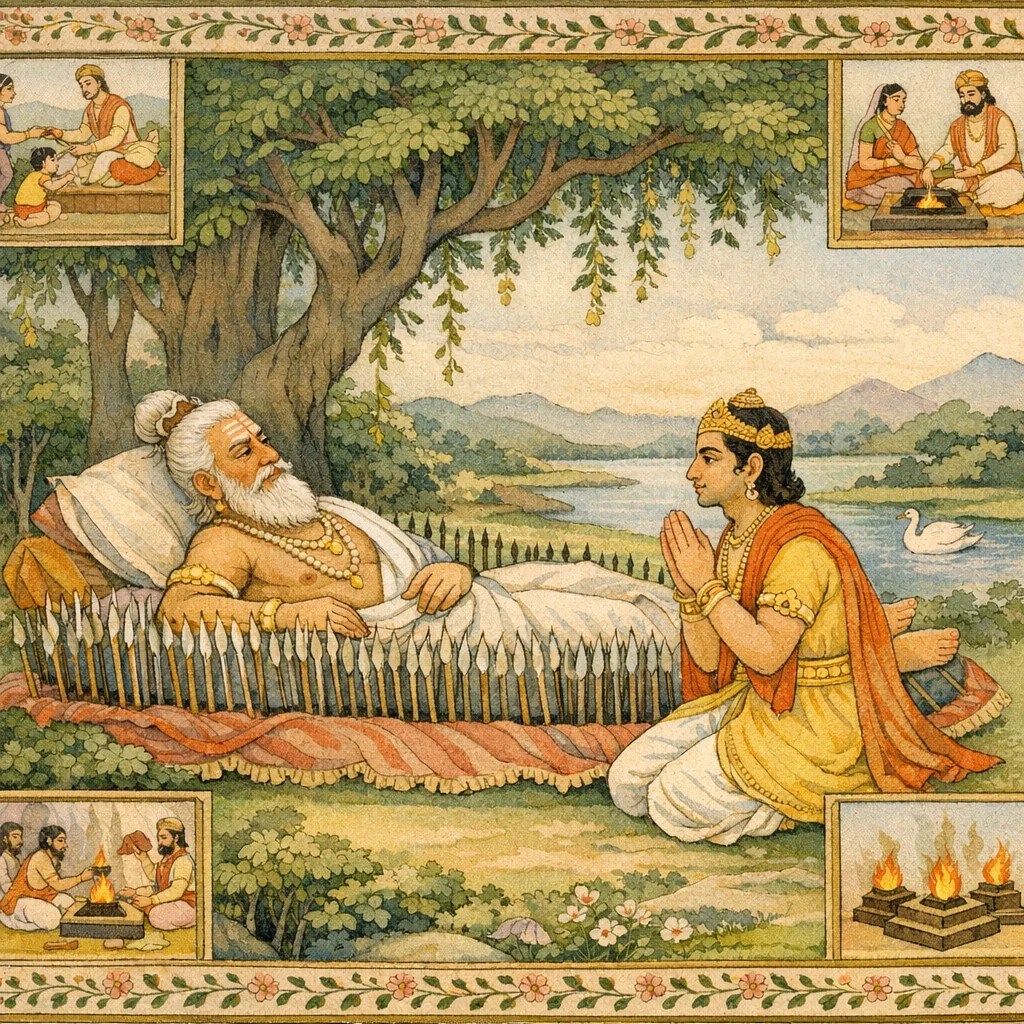
Adhyaya 163
Gautama’s Flight, the Enchanted Grove, and the Arrival of Rājadharma (Nāḍījaṅgha)
Upa-parva: Rājadharmānuśāsana (राजधर्मानुशासन) — Instruction on Kingship and Public Ethics
Bhīṣma recounts that, after night passes, the brāhmaṇa Gautama departs toward the sea and joins a merchant caravan. The caravan is largely destroyed in a mountain ravine by an intoxicated elephant, and Gautama escapes in fear, running north, isolated and disoriented. He reaches a path leading seaward and enters a luxuriant forest—likened to a Nandana-like region—filled with flowering trees (mango groves and fragrant woods), auspicious mountain slopes, and diverse birds, including the human-faced Bhāruṇḍas. In a radiant, level clearing strewn with golden sand, he sees a majestic banyan (nyagrodha) with umbrella-like branches; its base is anointed with sandal-water and adorned with divine flowers. Resting beneath it, Gautama is soothed by a pure wind carrying blossoms and falls asleep as the sun sets. At twilight, a supreme bird arrives from Brahmaloka to his dwelling: Nāḍījaṅgha, also called Bakarāja, identified as a friend dear to Brahmā and born of Kaśyapa. The figure is further associated with the epithet ‘Rājadharma,’ described as radiant and ornamented. Seeing the hungry and thirsty Gautama, the bird welcomes him formally as an honored guest and promises proper hospitality and ritual-appropriate honoring at dawn—establishing the ethical frame of atithi-dharma within a rājadharma discourse setting.
Chapter Arc: युधिष्ठिर, युद्धोत्तर शोक और धर्म-संशय के बीच, भीष्म से पूछते हैं—‘सत्य’ का वास्तविक लक्षण क्या है, वह कैसे प्राप्त होता है, और उसका फल क्या है? → भीष्म सत्य को केवल वाणी की शुद्धता नहीं, बल्कि चारों वर्णों में अविकार, आचार और अंतःकरण की स्थिरता के रूप में स्थापित करते हैं; फिर वे क्रमशः सत्य के आचार-लक्षण गिनाते हैं—दम, अनासक्ति, गाम्भीर्य, धैर्य, अभय, रोग-शमन जैसी अंतर्गुण-सम्पदा—और बताते हैं कि ये सब ज्ञान से साध्य हैं। → भीष्म ‘सत्य’ को अनेक पृथक् गुणों (तेरह आकारों) में प्रकट होकर भी एक ही मूल-तत्त्व के रूप में घोषित करते हैं—ये सब धर्म-रूप अंततः सत्य को ही लक्षित करते और उसी को बढ़ाते हैं; आगे वे सत्य से दान, दक्षिणासहित यज्ञ, त्रेताग्निहोत्र, वेदाध्ययन आदि समस्त वैदिक-धर्मों की सिद्धि को जोड़ते हैं। → अध्याय का निष्कर्ष यह बनता है कि सत्य का शिखर बाह्य कर्मकाण्ड से आगे है—आत्म-हित/अहित, मित्र/शत्रु में समता, इच्छा-द्वेष का क्षय, काम-क्रोध का क्षय—यही सत्य की परिपक्व अवस्था है; सत्य ही धर्मों का आधार और साधना का मेरुदण्ड है।
Shlokas
Verse 1
/ ऑपन-माज बछ। -ज:डि द्विषष्ट्याधिकशततमो< ध्याय: सत्यके लक्षण, स्वरूप और महिमाका वर्णन युधिषछ्िर उवाच सत्यं धर्म प्रशंसन्ति विप्रर्षिपितृदेवता: । सत्यमिच्छाम्यहं श्रीतुं तन््मे ब्रूहि पितामह,युधिष्ठिरने पूछा-पितामह! ब्राह्मण, ऋषि, पितर और देवता-ये सब सत्यभाषणरूप धर्मकी प्रशंसा करते हैं; अत: अब मैं यह सुनना चाहता हूँ कि सत्य क्या है? उसे मुझे बताइये
Yudhiṣṭhira said: “Brahmins, seer-sages, the ancestors, and the gods all extol truthfulness as a form of dharma. Therefore I wish to hear what ‘truth’ truly is—tell me that, O Grandfather.”
Verse 2
सत्यं कि लक्षणं राजन् कथं वा तदवाप्यते । सत्यं प्राप्प भवेत् कि च कथं चैव तदुच्यताम्,राजन! सत्यका लक्षण क्या है? उसकी प्राप्ति कैसे होती है? सत्यका पालन करनेसे क्या लाभ होता है? और कैसे होता है? यह बताइये
Yudhiṣṭhira said: “O King, what is the defining mark of truth? By what means is it attained? Having embraced truth, what benefit arises from it—and in what manner does that come about? Please explain this to me.”
Verse 3
भीष्म उवाच चातुर्वर्ण्यस्य धर्माणां संकरो न प्रशस्यस्ते । अविकारितमं सत्यं सर्ववर्णेषु भारत,भीष्मजीने कहा--भरतनन्दन! ब्राह्मण आदि चारों वर्णोंके जो धर्म हैं, उनका परस्पर सम्मिश्रण अच्छा नहीं माना जाता है। निर्विकार सत्य सभी वर्णोमें प्रतिष्ठित है
Bhishma said: “O scion of Bharata, it is not praised when the duties of the four varṇas are intermingled. Yet truth, unalterable, stands established in all varṇas.”
Verse 4
सत्यं सत्सु सदा धर्म: सत्यं धर्म: सनातन: । सत्यमेव नमस्येत सत्यं हि परमा गति:,सत्पुरुषोंमें सदा सत्यरूप धर्मका ही पालन हुआ है। सत्य ही सनातन धर्म है। सत्यको ही सदा सिर झुकाना चाहिये; क्योंकि सत्य ही जीवकी परम गति है
Bhishma declares that among the truly good, dharma has always taken the form of truthfulness. Truth itself is the eternal dharma. Therefore one should bow to truth alone, for truth is the highest destination and final refuge of the living being.
Verse 5
सत्य॑ं धर्मस्तपो योग: सत्यं ब्रह्म सनातनम् । सत्यं यज्ञ: पर: प्रोक्त: सर्व सत्ये प्रतेष्ठितम्,सत्य ही धर्म, तप और योग है, सत्य ही सनातन ब्रह्म है, सत्यको ही परम यज्ञ कहा गया है तथा सब कुछ सत्यपर ही टिका हुआ है
Bhishma said: Truth itself is dharma, austerity, and yoga; truth is the eternal Brahman. Truth is declared to be the highest sacrifice, and everything in the world stands established upon truth.
Verse 6
आचारानिह सत्यस्य यथावदनुपूर्वश: । लक्षणं च प्रवक्ष्यामि सत्यस्येह यथाक्रमम्,अब मैं तुम्हें क्रमश: सत्यके आचार और लक्षण ठीक-ठीक बताऊँगा
Bhishma said: “Here I shall explain—accurately and in due sequence—the disciplines of conduct that belong to truthfulness, and I shall also set forth, step by step, the defining marks of truth as it is to be understood in this teaching.”
Verse 7
प्राप्पते च यथा सत्यं तच्च श्रोतुमिहाहसि । सत्यं त्रयोदशविधं सर्वलोकेषु भारत,साथ ही यह भी बता देना चाहता हूँ कि उस सत्यकी प्राप्ति कैसे होती है? तुम ध्यान देकर सुनो। भारत! सम्पूर्ण लोकोंमें सत्यके तेरह भेद माने गये हैं
Bhishma said: “You should also hear how truth is to be attained here. O Bharata, throughout all the worlds, truth is recognized as having thirteen distinct forms.”
Verse 8
सत्यं च समता चैव दमश्चैव न संशय: । अमात्सर्य क्षमा चैव ह्वीस्तितिक्षानसूयता,राजेन्द्र! सत्य, समता, दम, मत्सरताका अभाव, क्षमा, लज्जा, तितिक्षा (सहनशीलता), अनसूया, त्याग, परमात्माका ध्यान, आर्यता (श्रेष्ठ आचरण), निरन्तर स्थिर रहनेवाली धृति (धैर्य) तथा अहिंसा--ये तेरह सत्यके ही स्वरूप हैं, इसमें संशय नहीं है
Bhīṣma said: “Truth, equanimity, and self-restraint—of this there is no doubt. Likewise freedom from envy, forgiveness, modesty, forbearance, and the absence of fault-finding: these are declared as integral expressions of truth itself.”
Verse 9
त्यागो ध्यानमथार्यत्वं धृतिश्व॒ सततं स्थिरा । अहिंसा चैव राजेन्द्र सत्याकारास्त्रयोदश,राजेन्द्र! सत्य, समता, दम, मत्सरताका अभाव, क्षमा, लज्जा, तितिक्षा (सहनशीलता), अनसूया, त्याग, परमात्माका ध्यान, आर्यता (श्रेष्ठ आचरण), निरन्तर स्थिर रहनेवाली धृति (धैर्य) तथा अहिंसा--ये तेरह सत्यके ही स्वरूप हैं, इसमें संशय नहीं है
Bhīṣma said: “O king, renunciation, meditation, noble conduct, unwavering and constant fortitude, and non-violence—these (together with the other virtues already stated) are thirteen forms of Truth itself. Truth is not merely speech; it is a whole ethical character expressed as self-restraint, steadiness, and harmlessness.”
Verse 10
सत्य॑ नामाव्ययं नित्यमविकारि तथैव च । सर्वधर्माविरुद्धेन योगेनैतदवाप्यते,नित्य एकरस, अविनाशी और अविकारी होना ही सत्यका लक्षण है। समस्त धर्मोके अनुकूल कर्तव्य-पालनरूप योगके द्वारा इस सत्यकी प्राप्ति होती है
Bhishma said: “That which is called Truth is imperishable, eternal, and unchanging. This Truth is attained through a discipline (yoga) of conduct that does not conflict with any dharma—through the steady performance of duties in harmony with righteousness.”
Verse 11
अपने प्रिय मित्रमें तथा अप्रिय शत्रुमें भी समानभाव रखना “समता” है। इच्छा (राग), द्वेष, काम और क्रोधको मिटा देना ही समताकी प्राप्तिका उपाय है
Bhishma said: To keep the same even-minded regard for a beloved friend and for an unfriendly enemy—this is called equanimity (samatā). The way to attain such equanimity is to uproot desire (attachment), hatred, lust, and anger.
Verse 12
दमो नान्यस्पृहा नित्य॑ गाम्भीर्य धैर्यमेव च । अभयं रोगशमनं ज्ञानेनैतदवाप्यते,किसी दूसरेकी वस्तुको लेनेकी इच्छा न करना, सदा गम्भीरता और धीरता रखना, भयको त्याग देना तथा मनके रोगोंको शान्त कर देना-यह “दम' (मन और इन्द्रियोंके संयम) का लक्षण है। इसकी प्राप्ति ज्ञानसे होती है
Bhishma said: Self-restraint (dama), the mastery of mind and senses, is marked by the constant absence of craving for what belongs to another, by steady depth of character and patience, by fearlessness, and by the calming of the mind’s inner ailments. Such mastery is attained through true knowledge (jñāna).
Verse 13
अमार्सर्य बुधा: प्राहुर्दाने धर्मे च संयम: । अवस्थितेन नित्यं च सत्येनामत्सरी भवेत्,दान और धर्म करते समय मनपर संयम रखना अर्थात् इस विषयमें दूसरोंसे ईर्ष्या न करना इसे विद्वान् लोग “मत्सरताका अभाव” कहते हैं। सदा सत्यका पालन करनेसे ही मनुष्य मत्सरतासे रहित हो सकता है
The wise declare that the absence of envy (amātsarya) is the restraint of the mind while giving (dāna) and while practicing dharma—namely, not begrudging others in these matters. Only by steadfastly adhering to truth (satya) does a person become free from envy.
Verse 14
अक्षमाया: क्षमायाश्ष प्रियाणीहाप्रियाणि च । क्षमते सम्मतः साधु: साध्वाप्रोति च सत्यवाक्,जो सहने और न सहनेयोग्य व्यवहारों तथा प्रिय एवं अप्रिय वचनोंको भी समानरूपसे सहन कर लेता है, वही सर्वसम्मत क्षमाशील श्रेष्ठ पुरुष है। सत्यवादी पुरुषको ही उत्तम रीतिसे क्षमाभावकी प्राप्ति होती है
Bhishma said: The truly good person, approved by all, is the one who endures alike what is bearable and what is hard to bear, and who bears in the same spirit words that are pleasant and words that are unpleasant. Such excellence in forgiveness is properly attained by one who is devoted to truth in speech.
Verse 15
कल्याणं कुरुते बाढं धीमान् न ग्लायते क्वचित् । प्रशान्तवाड्मना नित्यं ह्ीस्तु धर्मादवाप्यते,जो बुद्धिमान् पुरुष भलीभाँति दूसरोंका कल्याण करता है और मनमें कभी खेद नहीं मानता, जिसकी मन-वाणी सदा शान्त रहती है, वह लज्जाशील माना जाता है। यह लज्जा नामक गुण धर्मके आचरणसे प्राप्त होता है
Bhīṣma said: A wise man who earnestly works for the welfare of others never sinks into dejection. One whose mind and speech remain continually calm is known as possessing modesty (hrī), and this quality is attained through the practice of dharma.
Verse 16
धर्मार्थहेतो: क्षमते तितिक्षा क्षान्तिरुच्यते । लोकसंग्रहणार्थ वै सा तु धैर्येण लभ्यते,धर्म और अर्थके लिये मनुष्य जो कष्ट सहन करता है, उसकी वह सहनशीलता 'तितिक्षा” कहलाती है। लोगोंके सामने आदर्श उपस्थित करनेके लिये उसका अवश्य पालन करना चाहिये। तितिक्षाकी प्राप्ति धैर्यसे होती है। (दूसरोंके दोष न देखना “अनसूया' है)
Bhishma said: Endurance that bears hardship for the sake of dharma and artha is called titikṣā—also termed kṣānti (forbearance). It should certainly be practiced to uphold and guide society by one’s own example. Such endurance is attained through steadfastness (dhairya). (Not noticing others’ faults is called anāsūyā.)
Verse 17
त्याग: स्नेहस्य यत् त्यागो विषयाणां तथैव च । रागद्वेषप्रहीणस्य त्यागो भवति नान्यथा,विषयोंकी आसक्तिका जो त्याग है, वही वास्तविक त्याग है। राग-द्वेषसे रहित होनेपर ही त्यागकी सिद्धि होती है, अन्यथा नहीं (परमात्मचिन्तनका नाम ही 'ध्यान” है)
Bhishma said: Renunciation is truly the relinquishing of attachment—of clinging affection and of dependence on sense-objects. Only for one who has abandoned both attraction and aversion does renunciation become real; in any other condition, it is not so.
Verse 18
आर्यता नाम भूतानां यः करोति प्रयत्नतः । शुभं कर्म निराकारो वीतरागस्तथैव च,जो मनुष्य अपनेको प्रकट न करके प्रयत्नपूर्वक प्राणियोंकी भलाईका काम करता रहता है, उसके उस श्रेष्ठ भाव और आचरणका नाम ही “आर्यता' है। यह आसक्तिके त्यागसे प्राप्त होता है
Bhishma said: ‘Āryatā (true nobility) is the name given to that disposition in a person who, with deliberate effort, continually performs beneficial and auspicious deeds for living beings—without self-display and free from attachment. Such nobility is attained through the relinquishment of craving and possessiveness.’
Verse 19
धृतिर्नाम सुखे दुःखे यथा नाप्रोति विक्रियाम् ता भजेत सदा प्राज्ञो य इच्छेद् भूतिमात्मन:,सुख या दु:ख प्राप्त होनेपर मनमें विकार न होना “धृति” है। जो अपनी उन्नति चाहता हो, उस बुद्धिमान् पुरुषको सदा ही 'धृति” का सेवन करना चाहिये
Bhishma said: “Steadfastness (dhṛti) is that state in which, amid pleasure and pain, the mind does not undergo disturbance or change. Therefore, the wise person who seeks his own true welfare and flourishing should constantly cultivate this steadfastness.”
Verse 20
सर्वथा क्षमिणा भाव्यं तथा सत्यपरेण च । वीतहर्षभयक्रोधो धृतिमाप्रोति पण्डित:,मनुष्यको सदा क्षमाशील होना तथा सत्यमें तत्पर रहना चाहिये। जिसने हर्ष, भय और क्रोध तीनोंको त्याग दिया है, उस विद्वान पुरुषको ही “धैर्य” की प्राप्ति होती है
Bhishma said: One should, in every circumstance, cultivate forbearance and remain devoted to truth. The wise person who has cast off elation, fear, and anger alone attains steadfastness of mind—true fortitude that sustains dharma.
Verse 21
अद्रोह: सर्वभूतेषु कर्मणा मनसा गिरा । अनुग्रहश्न दानं च सतां धर्म: सनातन:,मन, वाणी और क्रियाद्वारा सभी प्राणियोंके साथ कभी द्रोह न करना तथा दया और दान--यह श्रेष्ठ पुरुषोंका सनातन धर्म है
Bhishma said: To bear no malice toward any being—by deed, by thought, or by speech—and to show compassion and give generously: this is the eternal dharma of the good and noble.
Verse 22
एते त्रयोदशाकारा: पृथक् सत्यैकलक्षणा: । भजन्ते सत्यमेवेह बृंहयन्ते च भारत,ये पृथक्-पृथक् तेरह रूपोंमें बताये हुए धर्म एकमात्र सत्यको ही लक्षित करानेवाले हैं। ये सत्यका ही आश्रय लेते और उसीकी वृद्धि एवं पुष्टि करते हैं
Bhishma said: “These thirteen distinct forms (of dharma), though described separately, all bear a single defining mark—Truth. Here in this world they take refuge in Truth alone, and, O Bharata, they strengthen and affirm Truth itself.”
Verse 23
नानन््त: शक््यो गुणानां च वक्तुं सत्यस्य पार्थिव | अतः: सत्यं प्रशंसन्ति विप्रा: सपितृदेवता:,पृथ्वीनाथ! सत्यके गुणोंकी सीमा नहीं बतायी जा सकती। इसीलिये पितर और देवताओंके सहित ब्राह्मण सत्यकी प्रशंसा करते हैं
Bhīṣma said: “O king, the virtues of truth are endless and cannot be fully described. Therefore the learned brāhmaṇas—together with the Pitṛs and the gods—praise truth, O lord of the earth.”
Verse 24
नास्ति सत्यात् परो धर्मो नानृतात् पातकं परम् | स्थितिर्हि सत्यं धर्मस्य तस्मात् सत्यं न लोपयेत्,सत्यसे बढ़कर कोई धर्म नहीं और झूठसे बढ़कर कोई पातक नहीं है। सत्य ही धर्मकी आधारशिला है; अतः सत्यका लोप न करे
Bhīṣma said: There is no dharma higher than truth, and no sin greater than falsehood. Truth is the very foundation on which dharma stands; therefore one should never let truth be diminished or abandoned.
Verse 25
उपैति सत्याद् दान॑ हि तथा यज्ञा: सदक्षिणा: । त्रेताग्निहोत्रं वेदाश्न ये चानन््ये धर्मनिश्चया:,दानका, दक्षिणाओंसहित यज्ञका, त्रिविध अग्नियोंमें हवनका, वेदोंके स्वाध्यायका तथा अन्य जो धर्मका निर्णय करनेवाले शास्त्र हैं, उनके भी अध्ययनका फल मनुष्य सत्यसे प्राप्त कर लेता है
Bhishma said: From truthfulness alone a person attains the same merit as from charity, from sacrifices performed with proper priestly fees, from the maintenance of the three sacred fires with daily offerings, from Vedic study, and even from the study of other authoritative treatises that determine dharma.
Verse 26
अश्वमेधसहस्रं च सत्यं च तुलया धृतम् । अश्वमेधसहस्राद्धि सत्यमेव विशिष्यते,यदि एक ओर एक हजार अश्वमेध यज्ञोंको और दूसरी ओर एकमात्र सत्यको तराजूपर रखा जाय तो एक हजार अभश्वमेध यज्ञोंकी अपेक्षा सत्यका ही पलड़ा भारी होगा
Bhīṣma said: “If a thousand Aśvamedha sacrifices are placed on one side of a balance and Truth on the other, Truth alone outweighs even a thousand Aśvamedhas.” The verse declares that moral integrity and truthfulness surpass the greatest ritual attainments, setting ethical dharma above ceremonial merit.
Verse 131
आत्मनीष्टे तथानिष्टे रिपौ च समता तथा । इच्छाद्वेषक्षयं प्राप्प कामक्रोधक्षयं तथा
Bhīṣma said: “One should keep the same even-mindedness toward what is pleasing to oneself and what is displeasing, and likewise toward an enemy. By exhausting desire and aversion, one also exhausts craving and anger—thus establishing the inner discipline that supports dharma.”
Verse 162
इति श्रीमहाभारते शान्तिपर्वणि आपद्धर्मपर्वणि सत्यप्रशंसायां द्विषष्ट्यधिकशततमो<ध्याय:
Thus, in the Śrī Mahābhārata, within the Śānti Parva—specifically the section on conduct in times of distress (Āpaddharma)—in the discourse praising truth, ends the one-hundred-and-sixty-second chapter.
Verse 1619
इस प्रकार श्रीमह्या भारत शान्तिपवकि अन्तर्गत आपद्धर्मपर्वमें तपस्याकी प्रशंयाविषयक एक सौ इकसठवाँ अध्याय पूरा हुआ
Thus, in the Śrī Mahābhārata, within the Śānti Parvan—specifically in the section on dharma in times of distress (Āpaddharma Parvan)—the one-hundred-and-sixty-first chapter, devoted to praising austerity (tapas), comes to its close. The narrative frame remains Bhīṣma’s instruction, marking the completion of a teaching unit that upholds disciplined self-restraint as a stabilizing ethical force when ordinary norms are strained.
Frequently Asked Questions
Gautama’s hunger and thirst produce an impulse toward harm (hiṃsārtha) upon seeing the arriving bird, which is counterbalanced by the bird’s formal hospitality—staging the ethical tension between survival pressure and dharmic restraint.
The chapter frames hospitality as an ethical technology that stabilizes conduct in liminal conditions (travel, danger, scarcity), implying that rājadharma is inseparable from protecting and honoring the vulnerable guest.
No explicit phalaśruti appears within the provided verses; the chapter operates primarily as narrative framing that prepares a didactic exchange on rājadharma and guest-rights in subsequent discourse.