Adhyaya 75
वज्रदत्तेन सह अर्जुनयुद्धम् (Arjuna’s engagement with Vajradatta during the Aśvamedha circuit)
Upa-parva: Aśvamedha-anuyātrā (Arjuna’s horse-escort encounters) — Vajradatta episode
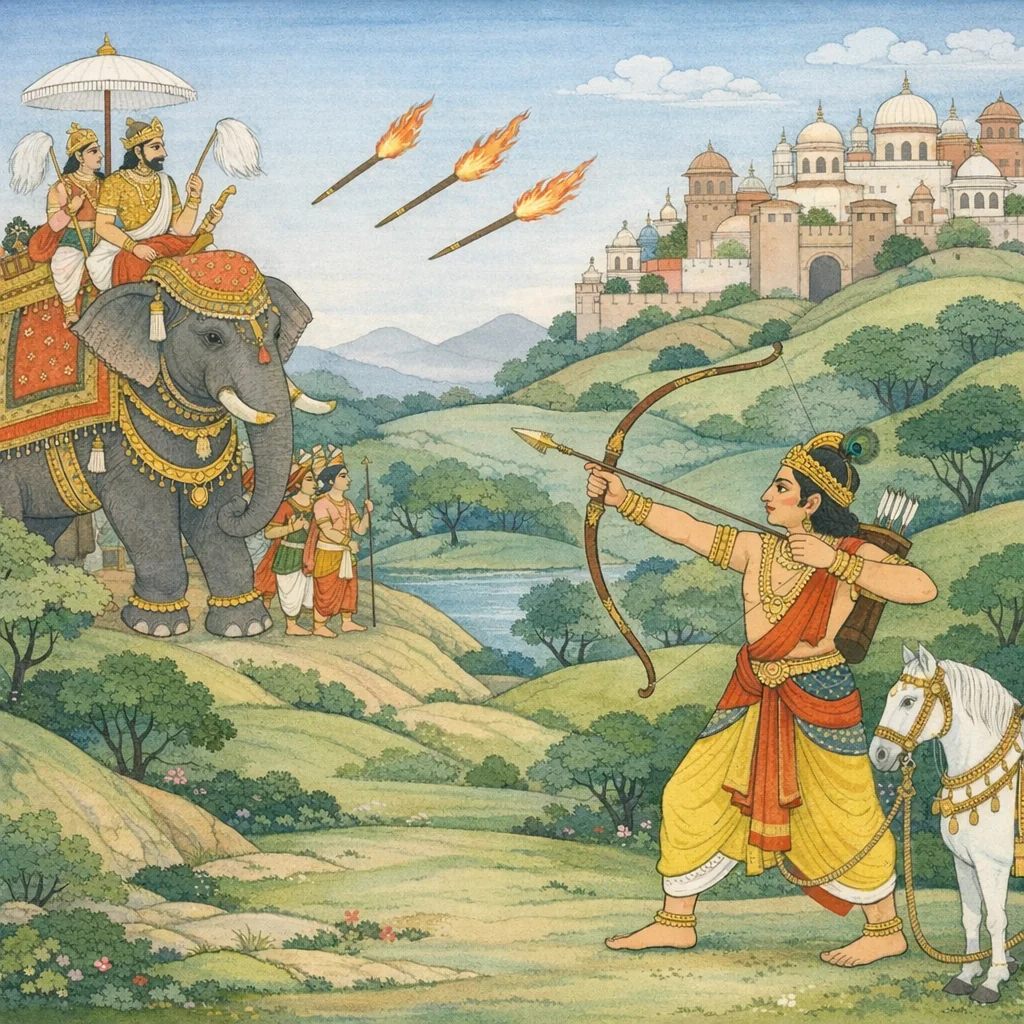
Vaiśaṃpāyana reports that the engagement between Arjuna and the regional ruler continues for three nights, likened to Indra’s struggle with Vṛtra, establishing the encounter’s scale and intensity (1). On the fourth day, Vajradatta—identified as Bhagadatta’s son—issues a direct challenge, framing his hostility as filial obligation: he accuses Arjuna of killing his aged father and vows to perform funerary rites after slaying Arjuna (2–4). He then orders an elephant assault against Arjuna; the elephant advances with noise and sprayed water, described through storm and mountain imagery (5–9). Arjuna remains steady with Gāṇḍīva, recalls prior enmity and the risk of obstruction to the Aśvamedha mission, and checks the elephant with a dense net of arrows, wounding and halting it (10–13). Vajradatta fires sharp arrows, which Arjuna counters with arrow-cutting shafts; as the king renews the elephant charge, Arjuna releases a blazing nārāca that strikes a vital spot and fells the elephant like a thunder-split mountain (14–19). With the immediate threat neutralized, Arjuna addresses Vajradatta without triumphalism, invoking Yudhiṣṭhira’s explicit instruction: kings are not to be killed, and even opposing warriors should be spared; instead, rulers should be invited—along with allies—to attend and acknowledge Yudhiṣṭhira’s Aśvamedha (20–23). Arjuna therefore grants safety, asks Vajradatta to rise, and summons him to come at the auspicious time (Caitrī) for the sacrifice; Vajradatta, defeated, assents (24–26). The chapter thus integrates tactical mastery (anti-elephant engagement) with a governance ethic of restraint and ritual-political consolidation.
Chapter Arc: अश्वमेध का उत्तम घोड़ा प्राग्ज्योतिष की सीमा में प्रवेश करता है, और भगदत्त-पुत्र राजा वज्रदत्त उसे बलपूर्वक पकड़कर नगराभिमुख ले जाने को उद्यत होता है—यज्ञ की प्रतिष्ठा को सीधी चुनौती। → अर्जुन घोड़े की रक्षा हेतु सामने आता है। वज्रदत्त नगर से निकलकर युद्ध-सज्जा करता है, फिर गाण्डीव के बाणों से व्याकुल होकर भी पुनः नगर में प्रवेश कर श्रेष्ठ गजराज पर आरूढ़ होकर राजचिह्नों सहित (श्वेत छत्र, चामर) रणभूमि में लौटता है। दोनों ओर से अस्त्र-वर्षा तीव्र होती जाती है; वज्रदत्त अग्नि-सदृश तोमर धनंजय पर फेंकता है। → वज्रदत्त के उग्र प्रहार देखकर अर्जुन का क्रोध प्रज्वलित होता है; वह हाथी पर सर्प-सम भयंकर, अग्नि-तुल्य तेजस्वी बाणों की वर्षा कर वज्रदत्त की रण-गति को तोड़ देता है और अश्व को छुड़ाने हेतु निर्णायक बढ़त बना लेता है। → वज्रदत्त की चुनौती निष्फल होती है; अर्जुन अश्वमेध-घोड़े की रक्षा करते हुए प्राग्ज्योतिष में अपनी विजय-प्रतिष्ठा स्थापित करता है और यज्ञ-यात्रा आगे बढ़ने योग्य हो जाती है। → अर्जुन की दिग्विजय-यात्रा में अगला कौन-सा राजा अश्व को रोककर धर्म-प्रतिष्ठा की परीक्षा लेगा?
Shlokas
Verse 1
ऑपन-- मा बक। अकाल पञ्चसप्ततितमो< ध्याय: अर्जुनका प्राग्ज्योतिषपुरके राजा वज्रदत्तके साथ युद्ध वैशम्पायन उवाच प्राग्ज्योतिषमथाभ्येत्य व्यचरत् स हयोत्तम: । भगदत्तात्मजस्तत्र निर्ययौ रणकर्कश:,वैशम्पायनजी कहते हैं--जनमेजय! तदनन्तर वह उत्तम अअश्र प्राग्ज्योतिषपुरके पास पहुँचकर विचरने लगा। वहाँ भगदत्तका पुत्र वज्रदत्त राज्य करता था, जो युद्धमें बड़ा ही कठोर था। भरतश्रेष्ठी जब उसे पता लगा कि पाण्डुपुत्र युधिष्ठिरका अश्व मेरे राज्यकी सीमामें आ गया है, तब राजा वज्रदत्त नगरसे बाहर निकला और युद्धके लिये तैयार हो गया
Vaiśampāyana said: “O Janamejaya, thereafter the excellent sacrificial horse, having reached Prāgjyotiṣa, began to roam there. In that land the son of Bhagadatta—Vajradatta—harsh and unyielding in battle, came out, ready for war.”
Verse 2
स हयं पाण्डुपुत्रस्य विषयान्तमुपागतम् । युयुधे भरतश्रेष्ठ वज्जदत्तो महीपति:,वैशम्पायनजी कहते हैं--जनमेजय! तदनन्तर वह उत्तम अअश्र प्राग्ज्योतिषपुरके पास पहुँचकर विचरने लगा। वहाँ भगदत्तका पुत्र वज्रदत्त राज्य करता था, जो युद्धमें बड़ा ही कठोर था। भरतश्रेष्ठी जब उसे पता लगा कि पाण्डुपुत्र युधिष्ठिरका अश्व मेरे राज्यकी सीमामें आ गया है, तब राजा वज्रदत्त नगरसे बाहर निकला और युद्धके लिये तैयार हो गया
Vaiśampāyana said: “O best of the Bharatas, when the sacrificial horse of the son of Pāṇḍu reached the border of his realm, King Vajradatta engaged it in battle.”
Verse 3
सो$भिनिर्याय नगराद् भगदत्तसुतो नृप: । अश्वमायान्तमुन्मथ्य नगराभिमुखो ययौ,नगरसे निकलकर भगदत्तकुमार राजा वज्रदत्तने अपनी ओर आते हुए घोड़ेको बलपूर्वक पकड़ लिया और उसे साथ लेकर वह नगरकी ओर चला
Vaiśampāyana said: The king, the son of Bhagadatta, set out from the city. Seizing the approaching sacrificial horse by force, he turned back toward the city and went on, taking it with him—an act that signals a deliberate challenge to the Aśvamedha’s sovereign claim.
Verse 4
तमालक्ष्य महाबाहु: कुरूणामृषभस्तदा । गाण्डीवं विक्षिपंस्तूर्ण सहसा समुपाद्रवत्,उसको ऐसा करते देख कुरुश्रेष्ठ महाबाहु अर्जुनने गाण्डीव धनुषपर टंकार देते हुए सहसा वेगपूर्वक उसपर धावा किया
Seeing him act in that manner, mighty-armed Arjuna—bull among the Kurus—swiftly made the Gāṇḍīva bow resound and brandished it, then without hesitation rushed upon him with sudden speed.
Verse 5
ततो गाण्डीवनिर्मुक्तिरिषुभिमोहितो नृप: । हयमुत्सृज्य तं वीरस्तत: पार्थमुपाद्रवत्,गाण्डीव धनुषसे छूटे हुए बाणोंके प्रहारसे व्याकुल हो वीर राजा वज्रदत्तने उस घोड़ेको तो छोड़ दिया और स्वयं पुनः नगरमें प्रवेश करके कवच आदिसे सुसज्जित हो एक श्रेष्ठ गजराजपर चढ़कर वह रणकर्कश नरेश युद्धके लिये बाहर निकला। आते ही उसने पार्थपर धावा बोल दिया
Then the king, bewildered and shaken by the arrows loosed from the Gāṇḍīva, let the horse go. The valiant warrior at once rushed at Pārtha (Arjuna), pressing the fight forward despite the punishing volley.
Verse 6
पुन: प्रविश्य नगरं दंशित: स नृपोत्तम:। आरुह्दु नागप्रवरं निर्ययौ रणकर्कश:,गाण्डीव धनुषसे छूटे हुए बाणोंके प्रहारसे व्याकुल हो वीर राजा वज्रदत्तने उस घोड़ेको तो छोड़ दिया और स्वयं पुनः नगरमें प्रवेश करके कवच आदिसे सुसज्जित हो एक श्रेष्ठ गजराजपर चढ़कर वह रणकर्कश नरेश युद्धके लिये बाहर निकला। आते ही उसने पार्थपर धावा बोल दिया
Vaiśampāyana said: Having re-entered the city, that foremost of kings, fully armed, mounted a splendid elephant and—fierce in battle—rode out again for war. Shaken by the blows of arrows loosed from the Gāṇḍīva, the heroic king Vajradatta had let the horse go; now, returning equipped with armor, he came forth and at once charged at Pārtha (Arjuna).
Verse 7
पाण्डुरेणातपत्रेण प्रियमाणेन मूर्थनि । दोधूयता चामरेण श्वेतेन च महारथ:,उसने मस्तकपर श्वेत छत्र धारण कर रखा था। सेवक श्वेत चवँर खुला रहे थे। पाण्डव महारथी पार्थके पास पहुँचकर उस महारथी नरेशने बालचापल्य और मूर्खताके कारण उन्हें युद्धके लिये ललकारा
Vaiśampāyana said: The great chariot-warrior was honored with a pale-white royal parasol held above his head, and with a white yak-tail fan being waved. Thus attended like a king, he approached Pārtha (Arjuna); yet, out of childish rashness and folly, that ruler challenged the Pāṇḍava hero to battle.
Verse 8
ततः पार्थ समासाद्य पाण्डवानां महारथम् | आह्वयामास बीभत्सुं बाल्यान्मोहाच्च संयुगे,उसने मस्तकपर श्वेत छत्र धारण कर रखा था। सेवक श्वेत चवँर खुला रहे थे। पाण्डव महारथी पार्थके पास पहुँचकर उस महारथी नरेशने बालचापल्य और मूर्खताके कारण उन्हें युद्धके लिये ललकारा
Then, approaching Pārtha—the great chariot-warrior among the Pāṇḍavas—that king challenged Bībhatsu (Arjuna) to battle, driven by childish impetuosity and delusion amid the clash of arms.
Verse 9
स वारणं नगप्रख्यं प्रभिन्नकरटामुखम् । प्रेषयामास संक्रुद्धः श्वेताश्वं प्रति पार्थिव:,क्रोधमें भरे हुए राजा वज्रदत्तने श्वेतवाहन अर्जुनकी ओर अपने पर्वताकार विशालकाय गजराजको, जिसके गण्डस्थलसे मदकी धारा बह रही थी, बढ़ाया
Vaiśampāyana said: Enraged, the king sent forward a mountain-like elephant, its temples streaming with rut, and drove it to charge toward Śvetāśva—Arjuna’s chariot bearing the banner of the white horse.
Verse 10
विक्षरन्तं महामेघं परवारणवारणम् । शास्त्रवत् कल्पितं संख्ये विवशं युद्धदुर्मदम्,वह महान् मेघके समान मदकी वर्षा करता था। शत्रुपक्षके हाथियोंको रोकनेमें समर्थ था। उसे शास्त्रीय विधिके अनुसार युद्धके लिये तैयार किया गया था। वह स्वामीके अधीन रहनेवाला और युद्धमें दुर्धर्ष था
Vaiśampāyana said: “It was like a great cloud pouring forth, streaming with rut—an elephant able to check the enemy’s elephants. Prepared for battle according to the prescriptions of the treatises, it was wholly under its master’s control, yet in the fury of war it was formidable and hard to withstand.”
Verse 11
प्रचोद्यमान: स गजस्तेन राज्ञा महाबल: । तदाड्कुशेन विबभावुत्पतिष्यन्निवाम्बरम्,राजा वज्रदत्तने जब अंकुशसे मारकर उस महाबली हाथीको आगे बढ़नेके लिये प्रेरित किया, तब वह इस तरह आगेकी ओर झपटा, मानो वह आकाशमें उड़ जायगा
Vaiśampāyana said: Urged on by that king, the mighty elephant, struck and driven with the goad, surged forward in a leap as if it were about to spring up into the sky.
Verse 12
तमापततन्तं सम्प्रेक्ष्य क्रुद्धो राजन् धनंजय: । भूमिष्ठो वारणगतं योधयामास भारत,राजन्! भरतनन्दन! उसे इस प्रकार आक्रमण करते देख अर्जुन कुपित हो उठे। वे पृथ्वीपर स्थित होते हुए भी हाथीपर चढ़े हुए वज्रदत्तके साथ युद्ध करने लगे
Vaiśampāyana said: O King, seeing him rushing in to attack, Dhanañjaya (Arjuna) became enraged. Though standing on the ground, he engaged in battle with the warrior mounted upon an elephant—thus, O descendant of Bharata, he did not yield the enemy its advantage.
Verse 13
वज्रदत्तस्तत: क्रुद्धो मुमोचाशु धनंजये । तोमरानग्निसंकाशान् शलभानिव वेगितान्,उस समय वज्रदत्तने कुपित होकर तुरंत ही अर्जुनपर अग्निके समान प्रज्वलित तोमर चलाये, जो वेगसे उड़नेवाले पतंगोंके समान जान पड़ते थे
Vaiśampāyana said: Then Vajradatta, inflamed with anger, swiftly hurled at Arjuna blazing javelins, fire-like in their radiance, darting through the air like fast-flying moths.
Verse 14
अर्जुनस्तानसम्प्राप्तान् गाण्डीवप्रभवै: शरैः । द्विधा त्रिधा च चिच्छेद ख एव खगमैस्तदा,वे तोमर अभी पास भी नहीं आने पाये थे कि अर्जुनने गाण्डीव धनुषद्वारा छोड़े गये आकाशचारी बाणोंद्वारा आकाशमें ही एक-एक तोमरके दो-दो, तीन-तीन टुकड़े कर डाले
Vaiśampāyana said: When the javelins came rushing in, Arjuna, with arrows released from the Gāṇḍīva—swift as birds through the sky—cut each missile apart in midair, splitting them into two and even three pieces. The scene underscores disciplined martial skill used as a measured defense: force is met with precise restraint, preventing harm without needless escalation on the ground.
Verse 15
स तान् दृष्टवा तथा छिज्नांस्तोमरान् भगदत्तज: । इषूनसक्तांस्त्वरित: प्राहिणोत् पाण्डवं प्रति,इस प्रकार उन तोमरोंके टुकड़े-टुकड़े हुए देख भगदत्तके पुत्रने पाण्डुनन्दन अर्जुनपर शीघ्रतापूर्वक लगातार बाणोंकी वर्षा आरम्भ कर दी
Vaiśampāyana said: Seeing those javelins shattered into pieces, Bhagadatta’s son swiftly loosed an unbroken volley of arrows against the Pāṇḍava, Arjuna—pressing the battle with relentless force rather than yielding after his weapon was broken.
Verse 16
ततोअर्जुनस्तूर्णतरं रुक्मपुड्खानजिद्दवागान् | प्रेषयामास संक़ुद्धों भगदत्तात्मजं प्रति,तब कुपित हुए अर्जुनने तुरंत ही सोनेके पंखोंसे युक्त सीधे जानेवाले बाण वज्रदत्तपर चलाये। उन बाणोंसे अत्यन्त आहत और घायल होकर उस महासमरमें महातेजस्वी वज्रदत्त हाथीकी पीठसे पृथ्वीपर गिर पड़ा; परंतु इतनेपर भी वह बेहोश नहीं हुआ
Then Arjuna, inflamed with anger, swiftly discharged straight-flying arrows tipped with golden feathers at Vajradatta, the son of Bhagadatta. Struck hard and wounded by those shafts amid that great clash of arms, the mighty and radiant Vajradatta fell from the back of his elephant onto the earth—yet even then he did not lose consciousness.
Verse 17
स तैर्विद्धो महातेजा वज्दत्तो महामृधे । भृशाहत: पपातोर्व्या न त्वेममजहात् स्मृति:,तब कुपित हुए अर्जुनने तुरंत ही सोनेके पंखोंसे युक्त सीधे जानेवाले बाण वज्रदत्तपर चलाये। उन बाणोंसे अत्यन्त आहत और घायल होकर उस महासमरमें महातेजस्वी वज्रदत्त हाथीकी पीठसे पृथ्वीपर गिर पड़ा; परंतु इतनेपर भी वह बेहोश नहीं हुआ
Vaiśampāyana said: Struck by those arrows in the great battle, the radiant Vajradatta—though grievously wounded—fell from his mount to the earth. Yet even then his presence of mind did not abandon him; he did not lose consciousness, holding fast to awareness amid the shock of war.
Verse 18
ततः: स पुनरारुह्म वारणप्रवरं रणे | अव्यग्रः प्रेषयामास जयार्थी विजयं प्रति,तदनन्तर वज्रदत्तनें पुन: उस श्रेष्ठ गजराजपर आरूढ़ हो रणभूमिमें बिना किसी घबराहटके विजयकी अभिलाषा रखकर अर्जुनकी ओर उस हाथीको बढ़ाया
Then he mounted again the foremost of elephants on the battlefield. Unperturbed and intent on victory, he urged it forward toward Vijaya (Arjuna), seeking triumph in the fight.
Verse 19
तस्मै बाणांस्ततो जिष्णुर्निर्मुक्ताशीविषोपमान् | प्रेषयामास संक़्रुद्धो ज्वलितज्वलनोपमान्
Then Jiṣṇu (Arjuna), inflamed with anger, sent forth a volley of arrows—like venomous serpents newly loosed, like blazing fire itself—seeking to check the foe’s aggression by overwhelming force.
Verse 20
स तैर्विद्धो महानागो विस्रवन् रुधिरं वभौ । गैरिकाक्तमिवाम्भोडडद्रिरबहुप्रस्रवणं तदा,उन बाणोंसे घायल होकर वह महानाग खूनकी धारा बहाने लगा। उस समय वह गेरूमिश्रित जलकी धारा बहानेवाले अनेक झरनोंसे युक्त पर्वतके समान जान पड़ता था
Vaiśampāyana said: Pierced by those arrows, the mighty elephant began to pour forth streams of blood. At that moment he seemed like a rain-bearing mountain, streaked with red ochre, from which many springs gush—an image that deepens the pathos of violence and the stark cost of martial action.
Verse 29
यह देख अर्जुनको बड़ा क्रोध हुआ। उन्होंने उस हाथीके ऊपर केंचुलसे निकले हुए सर्पोोके समान भयंकर तथा प्रज्वलित अग्निके तुल्य तेजस्वी बाणोंका प्रहार किया
Seeing this, Arjuna was seized by fierce anger. He struck that elephant with blazing arrows—terrible like serpents slipping out from a shed skin, and radiant as kindled fire—declaring his resolve to check a violent threat with decisive force.
Verse 74
इस प्रकार श्रीमहाभारत आश्वमेधिकपर्वके अन्तर्गत अनुगीतापर्वमें त्रिगतोंकी पराजयविषयक चौहत्तरवाँ अध्याय पूरा हुआ
Thus concludes the seventy-fourth chapter of the Anugītā section within the Aśvamedhika Parva of the Śrī Mahābhārata, dealing with the defeat of the Trigartas.
Verse 75
इति श्रीमहाभारते आश्वमेधिके पर्वणि अनुगीतापर्वणि वज्दत्तयुद्धे पञ्चसप्ततिमो5ध्याय:
Thus ends the seventy-fifth chapter of the Anugītā section within the Aśvamedhika Parva of the Śrī Mahābhārata, in the episode concerning the battle with Vajradatta.
Frequently Asked Questions
Arjuna must reconcile battlefield capability with post-war governance ethics: he must neutralize a lethal threat while refusing to kill a defeated king, prioritizing the Aśvamedha’s political-ritual objective over personal vengeance.
Legitimate power is shown as restrained power: victory is validated not by extermination but by controlled force, adherence to higher instruction (Yudhiṣṭhira’s command), and conversion of hostility into participation in a shared public rite.
No explicit phalaśruti is stated here; the meta-commentary is implicit in the narrative framing—Arjuna’s restraint is presented as the correct interpretive key for understanding the Aśvamedha campaign as moral restoration rather than conquest.