Adhyaya 44
Brahmā’s Enumeration of Primacies (Ādi) and the Supremacy of Knowledge (Jñāna)
Upa-parva: Āśvamedhika-parva (Didactic discourse on origins, hierarchies, and impermanence)
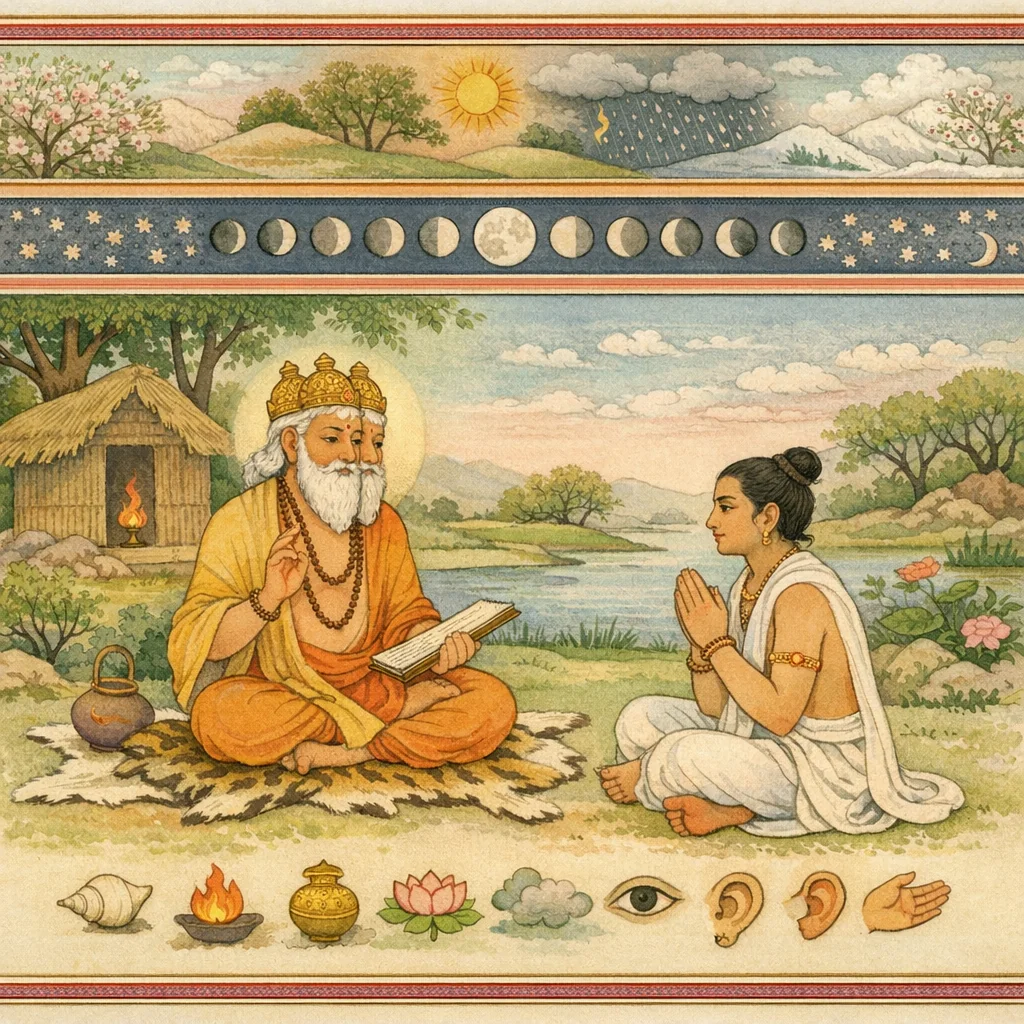
This chapter presents Brahmā as speaker, promising a systematic account of beginnings, defining marks, and methods of apprehension. It proceeds by cataloguing primacies across temporal cycles (day preceding night; months; seasons; lunar mansions), the five elements and their characteristic qualities (earth–smell, water–taste, fire/light–form, wind–touch, space–sound), and a wide range of hierarchical exemplars: the Sun among lights, Agni among elemental forces, Sāvitrī among knowledges, Prajāpati among deities, Oṃkāra among the Vedas and as the “breath” of speech, Gāyatrī among meters, and representative “firsts” among animals, substances, plants, and places (food among edibles, water among drinks, plakṣa among trees, Meru among mountains, Gaṅgā among rivers, the ocean among reservoirs). The discourse then universalizes impermanence: day ends in sunset, night ends in dawn; pleasure and pain alternate; accumulation ends in loss; life ends in death; all created things are non-eternal. Finally, it contrasts perishable religious merits (ritual, gift, austerity, study, vows) with knowledge, asserting that purified knowledge, coupled with composure, non-possessiveness, and egolessness, releases one from demerit.
Chapter Arc: गुरु ब्रह्मोवाच के स्वर में शिष्य के सामने सृष्टि के ‘आदि–मध्य–अन्त’ का सूत्र खोलते हैं—दिन-रात्रि, पक्ष-ऋतु, नक्षत्र और पंचमहाभूतों के गुणों तक, मानो जगत का मानचित्र एक-एक नाम से जाग उठता हो। → सूची मात्र नहीं, एक क्रमबद्ध कारण-कार्य-श्रृंखला बनती जाती है: गन्ध का आधार पृथ्वी, रस का जल, रूप का तेज/आदित्य, स्पर्श का वायु, शब्द का आकाश—और फिर देवताओं, विद्याओं, पर्वतों, दिशाओं के ‘अग्रज’ और ‘आदि’ की स्थापना; शिष्य के लिए प्रश्न तीखा होता है—यदि सबका आदि-कारण निश्चित है, तो मुक्ति का उपाय कहाँ है? → गुरु निर्णायक वाक्य रखते हैं: ‘विशुद्ध ज्ञान’ से प्रशान्त आत्मा, जितेन्द्रिय, निर्मम और निरहंकार होकर मनुष्य सर्व पापों से मुक्त होता है—सृष्टि-क्रम का ज्ञान अंततः आत्म-शुद्धि की सीढ़ी बन जाता है। → अध्याय जगत के तत्त्व-क्रम को आत्म-परिष्कार के निष्कर्ष में बाँध देता है: बाह्य पदार्थों के आदि-अन्त का विवेचन भीतर के अहं-त्याग और इन्द्रिय-जय की साधना में परिणत होता है।
Shlokas
Verse 1
अपन क्रात छा ऑफ क्ााज चतुश्नत्वारिशो< ध्याय: सब पदार्थोके आदि-अन्तका और ज्ञानकी नित्यताका वर्णन ब्रह्मोवाच यदादिमध्यपर्यन्तं ग्रहणोपायमेव च । नामलक्षणसंयुक्तं सर्व वक्ष्यामि तत्त्वतः,ब्रह्माजीने कहा--महर्षिगण! अब मैं सम्पूर्ण पदार्थोंके नाम-लक्षणोंसहित आदि, मध्य और अन्तका तथा उनके ग्रहणके उपायका यथार्थ वर्णन करता हूँ
Brahmā said: “Sages, I shall now explain, in accordance with truth, everything—together with its names and defining marks—its beginning, its middle, and its end, and also the means by which it is to be apprehended. This teaching frames knowledge as a disciplined grasp of reality through clear definitions and right methods, so that understanding does not drift into confusion or mere opinion.”
Verse 2
अह: पूर्व ततो रात्रिमासा: शुक्लादय: स्मृता: । श्रवणादीनि ऋक्षाणि ऋतव: शिशिरादय:,पहले दिन है फिर रात्रि; (अतः दिन रात्रिका आदि है। इसी प्रकार) शुक्लपक्ष महीनेका, श्रवण नक्षत्रोंका और शिशिर ऋतुओंका आदि है
Vāyu said: “Day comes first, and then night. In the same way, the bright fortnight is regarded as the beginning of the month; Śravaṇa is counted as the first among the lunar mansions; and Śiśira is reckoned as the first among the seasons.”
Verse 3
भूमिरादिस्तु गन्धानां रसानामाप एव च | रूपाणां ज्योतिरादित्य: स्पर्शानां वायुरुच्यते
Vāyu-deva said: “Earth is the primary source of scents; water indeed is the primary source of tastes. The Sun—radiant fire—is declared the primary source of forms (visible appearances), and the Wind is said to be the primary source of touch.”
Verse 4
शब्दस्यादिस्तथा55काशमेष भूतकृतो गुण: । गन्धोंका आदि कारण भूमि है। रसोंका जल, रूपोंका ज्योतिर्मय आदित्य, स्पर्शोंका वायु और शब्दका आदिकारण आकाश है। ये गन्ध आदि पज्चभूतोंसे उत्पन्न गुण हैं ।। अतः: परं प्रवक्ष्यामि भूतानामादिमुत्तमम्,अब मैं भूतोंके उत्तम आदिका वर्णन करता हूँ। सूर्य समस्त ग्रहोंका और जठरानल सम्पूर्ण प्राणियोंका आदि बतलाया जाता है। सावित्री सब विद्याओंकी और प्रजापति देवताओंके आदि हैं
Vāyu said: “The earth is the first cause of smell; water of taste; the radiant Sun of form; wind of touch; and space of sound. These—smell and the rest—are qualities that arise from the five great elements. Now I shall declare the supreme primordial source among beings: the Sun is spoken of as the origin among all the planets, and the digestive fire as the origin sustaining all living creatures. Sāvitrī is the fountainhead of all branches of knowledge, and Prajāpati the first among the gods.”
Verse 5
आदित्यो ज्योतिषामादिरमन्निर्भूतादिरुच्यते । सावित्री सर्वविद्यानां देवतानां प्रजापति:,अब मैं भूतोंके उत्तम आदिका वर्णन करता हूँ। सूर्य समस्त ग्रहोंका और जठरानल सम्पूर्ण प्राणियोंका आदि बतलाया जाता है। सावित्री सब विद्याओंकी और प्रजापति देवताओंके आदि हैं
“Among all lights, Āditya—the Sun—is spoken of as the first; and among things born of food, the fire within the belly (the digestive fire) is said to be the first. Sāvitrī (the Gāyatrī) is the first of all branches of knowledge, and Prajāpati is the first among the gods. Now I shall describe the most excellent ‘first beginnings’ among beings: the Sun is the first among the heavenly bodies, and the belly-fire is the first among all creatures. Sāvitrī is the source of all learning, and Prajāpati the source of the deities.”
Verse 6
ओड्कार: सर्ववेदानां वचसां प्राण एव च | यदस्मिन् नियतं लोके सर्व सावित्रिरुच्यते,३“कार सम्पूर्ण वेदोंका और प्राण वाणीका आदि है। इस संसारमें जो नियत उच्चारण है, वह सब गायत्री कहलाता है
Vāyu said: “The syllable Oṃ is the very life-breath of all the Vedas and the first principle of speech. Whatever regulated, prescribed utterance exists in this world—when understood in its sacred, disciplined form—is all called Sāvitrī (the Gāyatrī).”
Verse 7
गायत्री च्छन्दसामादि: प्रजानां सर्ग उच्यते । गावश्चतुष्पदामादिर्मनुष्याणां द्विजातय:,छन्दोंका आदि गायत्री और प्रजाका आदि सृष्टिका प्रारम्भ काल है। गौएँ चौपायोंकी और ब्राह्मण मनुष्योंके आदि हैं
Vāyu said: “Among metres, Gāyatrī is the first; and the beginning of creation is spoken of as the origin of beings. Among four-footed creatures, cows are foremost; and among human beings, the twice-born are regarded as the first.”
Verse 8
श्येन: पतत्रिणामादियर्यज्ञानां हुतमुत्तमम् । सरीसृपाणां सर्वेषां ज्येष्ठ: सर्पो द्विजोत्तमा:
Vāyu-deva said: “Among birds, the hawk is foremost; among sacrifices, the oblation is the highest offering. Among all creeping creatures, the serpent is the eldest and chief—O best of the twice-born.”
Verse 9
द्विजवरो! पक्षियोंमें बाज, यज्ञोंमें उत्तम आहुति और सम्पूर्ण रेंगकर चलनेवाले जीवोंमें साँप श्रेष्ठ है ।। कृतमादिर्युगानां च सर्वेषां नात्र संशय: । हिरण्यं सर्वरत्नानामोषधीनां यवास्तथा,सत्ययुग सम्पूर्ण युगोंका आदि है, इसमें संशय नहीं है। समस्त रत्नोंमें सुवर्ण और उन्नोंमें जौ श्रेष्ठ है
Vāyudeva said: “O best of the twice-born! Among birds, the hawk is foremost; among sacrifices, the supreme oblation is the best; and among all creatures that move by crawling, the serpent is preeminent. Likewise, the Kṛta (Satya) Yuga is the first of all ages—there is no doubt of this. Among all gems, gold is foremost; and among grains and medicinal plants, barley is foremost.”
Verse 10
सर्वेषां भक्ष्यभोज्यानामन्नं परममुच्यते । द्रवाणां चैव सर्वेषां पेयानामाप उत्तमा:
Vāyu-deva said: “Among all things that are eaten and all foods that are enjoyed, cooked grain (anna) is declared the highest. And among all liquids—among all that are drunk—water is the best.”
Verse 11
सम्पूर्ण भक्ष्य-भोज्य पदार्थोंमें अन्न श्रेष्ठ कहा जाता है। बहनेवाले और सभी पीनेयोग्य पदार्थोमें जल उत्तम है ।। स्थावराणां तु भूतानां सर्वेषामविशेषत: । ब्र्मक्षेत्रं सदा पुण्यं प्लक्ष: प्रथमत: स्मृत:,समस्त स्थावर भूतोंमें सामान्यतः ब्रह्मक्षेत्र--पाकर नामवाला वृक्ष श्रेष्ठ एवं पवित्र माना गया है
Vāyu-deva said: “Among all immobile beings, without distinction, the tree known as Brahmakṣetra is regarded as ever sacred; and the plakṣa (a holy fig tree) is remembered as foremost.”
Verse 12
अहं प्रजापतीनां च सर्वेषां नात्र संशय: । मम विष्णुरचिन्त्यात्मा स्वयम्भूरिति स स्मृत:,सम्पूर्ण प्रजापतियोंका आदि मैं हूँ, इसमें संशय नहीं है। मेरे आदि अचिन्त्यात्मा भगवान् विष्णु हैं। उन्हींको स्वयम्भू कहते हैं
Vāyu said: “I am the primordial source of all the Prajāpatis—of this there is no doubt. Yet my own origin is Viṣṇu, whose nature is inconceivable; He is remembered as Svayambhū, the Self-existent.”
Verse 13
पर्वतानां महामेरु: सर्वेषामग्रज: स्मृत: । दिशां च प्रदिशां चोर्ध्व॑ दिक्पूर्वा प्रथणा तथा,समस्त पर्वतोंमें सबसे पहले महामेरुगिरिकी उत्पत्ति हुई है। दिशा और विदिशाओंमें पूर्व दिशा उत्तम और आदि मानी गयी है
Vāyu said: “Among all mountains, Mahāmeru is remembered as the first-born and foremost. Likewise, among the directions and intermediate directions, the eastern quarter is regarded as primary—preeminent and original.”
Verse 14
तथा त्रिपथगा गड्जा नदीनामग्रजा स्मृता । तथा सरोदपानानां सर्वेषां सागरोडग्रज:,सब नदियोंमें त्रिपथगा गंगा ज्येष्ठ मानी गयी है। सरोवरोंमें सर्वप्रथम समुद्रका प्रादुर्भाव हुआ है
Vāyu said: “Just as Tripathagā—Gaṅgā, who flows in three courses—is remembered as the foremost among rivers, so too among all reservoirs and watersheds the Ocean is regarded as the first-born and preeminent.”
Verse 15
देवदानवभूतानां पिशाचोरगरक्षसाम् | नरकिन्नरयक्षाणां सर्वेषामीश्वर: प्रभु:,देव, दानव, भूत, पिशाच, सर्प, राक्षस, मनुष्य, किन्नर और समस्त यक्षोंके स्वामी भगवान् शंकर हैं
Vāyu said: “Śaṅkara is the sovereign Lord and master of all—of gods and Dānavas, of spirits and Piśācas, of serpents and Rākṣasas, and of humans, Kinnaras, and every class of Yakṣa.”
Verse 16
आदिर्विश्वस्थ जगतो विष्णुर्ब्रह्ममयो महान् | भूतं परतरं यस्मात् त्रैलोक्ये नेह विद्यते,सम्पूर्ण जगत्के आदिकारण ब्रह्मस्वरूप महाविष्णु हैं। तीनों लोकोंमें उनसे बढ़कर दूसरा कोई प्राणी नहीं है
Vāyu said: “Viṣṇu—great and of the very nature of Brahman—is the primordial source of this entire universe. In the three worlds there exists no being higher than Him.”
Verse 17
आश्रमाणां च सर्वेषां गार्हस्थ्यं नात्र संशय: । लोकानामादिर व्यक्त सर्वस्यान्तस्तदेव च,सब आश्रमोंका आदि गृहस्थ आश्रम है, इसमें संदेह नहीं है। समस्त जगत्का आदि और अन्त अव्यक्त प्रकृति ही है
Vāyu said: “Of all the stages of life, the householder’s way is the foundation—of this there is no doubt. And as for the worlds: their beginning is the Unmanifest, and their end too is that very same Unmanifest.”
Verse 18
अहान्यस्तमयान्तानि उदयान्ता च शर्वरी । सुखस्यान्तं सदा दु:खं दुःखस्यान्तं सदा सुखम्,दिनका अन्त है सूर्यास्त और रात्रिका अन्त है सूर्योदय। सुखका अन्त सदा दुःख है और दुःखका अन्त सदा सुख है
Vāyu-deva said: “Days end in sunset, and the night ends in sunrise. In the same way, the end of pleasure is ever sorrow, and the end of sorrow is ever pleasure.”
Verse 19
सर्वे क्षयान्ता निचया: पतनान्ता: समुच्छया: । संयोगाश्न वियोगान्ता मरणान्तं च जीवितम्,समस्त संग्रहका अन्त है विनाश, उत्थानका अन्त है पतन, संयोगका अन्त है वियोग और जीवनका अन्त है मृत्यु
Vāyu said: “All accumulations end in depletion; all elevations and piled-up heights end in a fall. Every union ends in separation, and life itself ends in death.”
Verse 20
सर्व कृतं विनाशान्तं जातस्य मरणं ध्रुवम् । अशाश्रवृतं हि लोके5स्मिन् सदा स्थावरजड्रमम्,जिन-जिन वस्तुओंका निर्माण हुआ है, उनका नाश अवश्यम्भावी है। जो जन्म ले चुका है उसकी मृत्यु निश्चित है। इस जगत्में स्थावर या जंगम कोई भी सदा रहनेवाला नहीं है
Vāyu-deva said: “Whatever has been made ends in destruction; for one who is born, death is certain. In this world nothing—whether immobile or moving—endures forever.”
Verse 21
इष्टं दत्त तपो5धीतं॑ व्रतानि नियमाश्च ये । सर्वमेतद् विनाशान्तं ज्ञानस्यान्तो न विद्यते,जितने भी यज्ञ, दान, तप, अध्ययन, व्रत और नियम हैं, उन सबका अन्तमें विनाश होता है, केवल ज्ञानका अन्त नहीं होता
Vāyu said: “Sacrifices duly performed, gifts bestowed, austerities undertaken, study of sacred learning, and all vows and disciplines—every one of these reaches an end in destruction. But knowledge has no end.”
Verse 22
तस्माउज्ञानेन शुद्धेन प्रशान्तात्मा जितेन्द्रिय: । निर्ममो निरहंकारो मुच्यते सर्वपाप्मभि:,इसलिये विशुद्ध ज्ञानके द्वारा जिसका चित्त शान्त हो गया है, जिसकी इन्द्रियाँ वशमें हो चुकी हैं तथा जो ममता और अहंकारसे रहित हो गया है, वह सब पापोंसे मुक्त हो जाता है
Therefore, by pure knowledge, one whose mind has grown tranquil, whose senses are mastered, and who is free from possessiveness and ego, is released from all sins.
Verse 43
इस प्रकार श्रीमह्याभारत आश्वमेधिकपव॑के अन्तर्गत अनुगीतापर्वमें गुरु-शिष्य- संवादविषयक तैंतालीसवाँ अध्याय पूरा हुआ
Thus, in the revered Mahābhārata, within the Āśvamedhika Parva—specifically in the Anugītā section—the forty-third chapter, dealing with the dialogue between teacher and disciple, comes to its close.
Verse 44
इति श्रीमहाभारते आश्वमेधिके पर्वणि अनुगीतापर्वणि गुरुशिष्यसंवादे चतुश्नत्वारिंशो5ध्याय:
Thus ends the forty-fourth chapter of the Guru–Disciple dialogue within the Anugītā section of the Aśvamedhika Parva of the Śrī Mahābhārata.
Frequently Asked Questions
The implicit dilemma is evaluative: whether one should rely primarily on perishable religious merits (ritual, charity, austerity, vows) or orient oneself to knowledge and inner transformation, given that all compounded gains culminate in loss.
Because all conditioned phenomena end—possessions, structures, unions, and even life—the stable directive is to cultivate purified knowledge with composure, non-attachment, and egolessness, which is presented as the means to release from demerit.
Rather than a formal phalaśruti, the chapter concludes with a doctrinal meta-claim: knowledge has no “end” (jñānasyānto na vidyate), and one who is purified in knowledge and free from possessiveness and ego is said to be liberated from all pāpa.