Adhyaya 41
प्रलय-तत्त्वलयः, नीललोहित-रुद्रः, अष्टमूर्तिस्तवः, एवं ब्रह्मणो वैराग्यम्
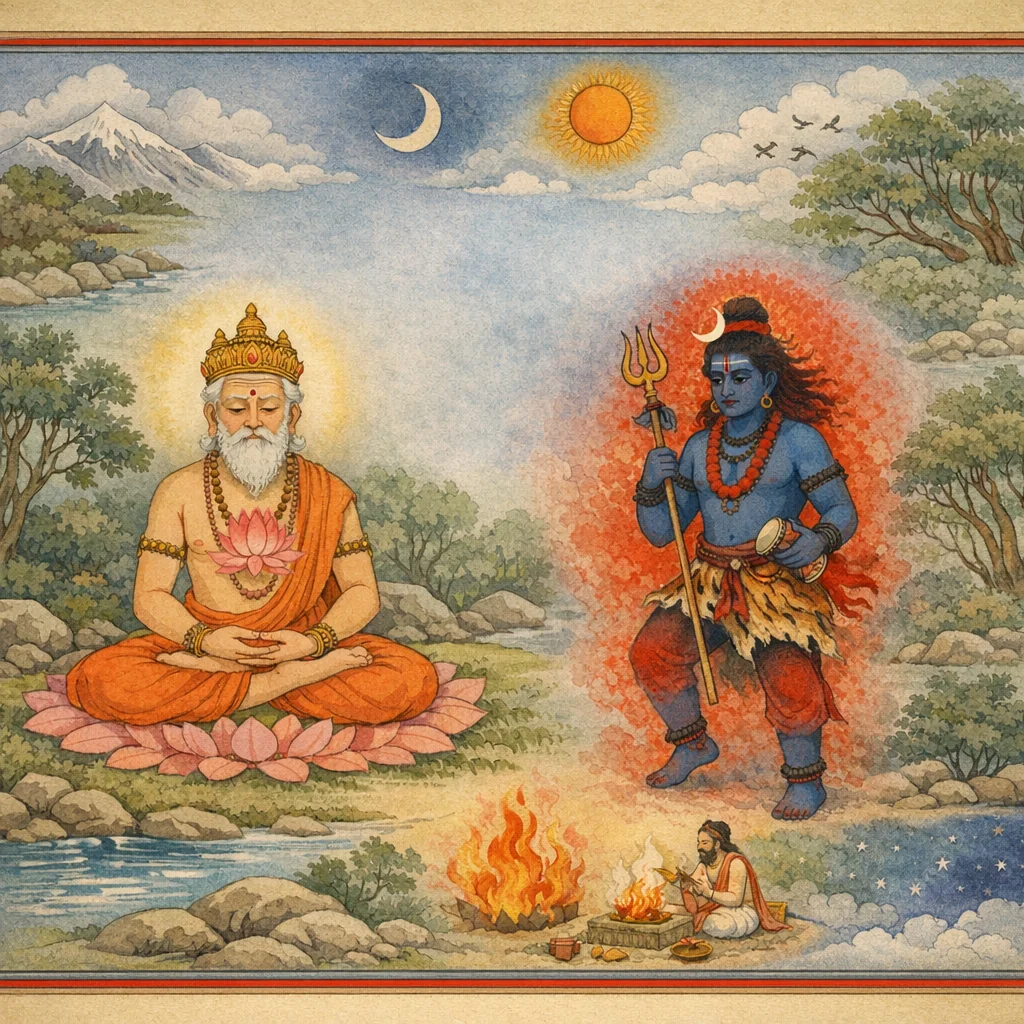
Indra recounts a vast cosmic cycle: after immeasurable ages the elements and subtle principles withdraw—earth is flooded by waters; waters dissolve into fire and wind; the senses and tanmātras subside into ahaṅkāra, then into mahat, and finally into avyaktā. From Śiva-Puruṣa creation begins again, yet Brahmā’s mind-born progeny do not multiply, so Brahmā performs severe tapas toward Īśa. Śiva answers in revelatory forms, evoking Ardhanārīśvara and reasserting Brahmā and Hari under Śiva’s supreme sovereignty. Brahmā enters samādhi, installs Śiva in the heart-lotus, and worships the Imperishable; from this inwardness arises Nīlalohita (the Kāla-form), whom Brahmā praises with the Aṣṭamūrti hymn, identifying Rudra as the cosmic eightfold. Empowered by this grace, creation proceeds, but Brahmā again meets frustration and anger, giving rise to bhūtas and pretas; Rudra manifests, divides into eleven, and with Śakti brings forth many goddesses. Śiva restores Brahmā’s prāṇas, declares himself Paramātman and lord of māyā, and the episode turns toward the theme of the rarity of the deathless ayoni-ja, preparing the way for later teachings on divine grace and liberation.
Shlokas
Verse 1
इति श्रीलिङ्गमहापुराणे पूर्वभागे चतुर्युगपरिमाणं नाम चत्वारिंशो ऽध्यायः इन्द्र उवाच पुनः ससर्ज भगवान् प्रभ्रष्टाः पूर्ववत्प्रजाः सहस्रयुगपर्यन्ते प्रभाते तु पितामहः
Thus, in the Śrī Liṅga Mahāpurāṇa, in the Pūrvabhāga, ends the fortieth chapter titled “The Measure of the Four Yugas.” Indra said: At the dawn marking the completion of a thousand yugas, the Grandsire (Brahmā), the Blessed Lord, again brought forth the beings who had fallen away, recreating the worlds and creatures just as before.
Verse 2
एवं परार्धे विप्रेन्द्र द्विगुणे तु तथा गते तदा धराम्भसि व्याप्ता ह्य् आपो वह्नौ समीरणे
Thus, O best of Brahmins, when that supreme span of time had passed and then doubled as well, the earth became pervaded by water; those waters, in turn, were absorbed into fire, and fire into the wind—showing the ordered withdrawal of the elements as the cosmos returns toward the Lord Pati (Śiva) beyond the bonds of manifestation.
Verse 3
वह्निः समीरणश्चैव व्योम्नि तन्मात्रसंयुतः इन्द्रियाणि दशैकं च तन्मात्राणि द्विजोत्तम
O best of the twice-born, Fire and Wind, and likewise Ether endowed with its subtle essence (tanmātra)—along with the eleven faculties (the ten senses and the mind) and the subtle elements—are thus enumerated in the unfolding of tattvas.
Verse 4
अहङ्कारमनुप्राप्य प्रलीनास्तत्क्षणादहो अभिमानस्तदा तत्र महान्तं व्याप्य वै क्षणात्
Having reached ahaṅkāra (the ego-principle), they were dissolved into it at that very instant. Then, there itself, abhimāna (the sense of “I” and “mine”) swiftly pervaded Mahat (cosmic intelligence) in a moment.
Verse 5
महानपि तथा व्यक्तं प्राप्य लीनो ऽभवद्द्विज अव्यक्तं स्वगुणैः सार्धं प्रलीनमभवद्भवे
O twice-born, even the Mahat-principle, having entered the sphere of the manifest, again became absorbed; and the Unmanifest too, together with its own guṇas, dissolved utterly in Bhava (Śiva)—the Pati beyond manifestation and dissolution.
Verse 6
ततः सृष्टिरभूत्तस्मात् पूर्ववत्पुरुषाच्छिवात् अथ सृष्टास्तदा तस्य मनसा तेन मानसाः
From Him—Śiva, the primordial Person—creation arose again as before. Then, by His will and through His mind, the mind-born beings (mānasas) were brought forth.
Verse 7
न व्यवर्धन्त लोके ऽस्मिन् प्रजाः कमलयोनिना वृद्ध्यर्थं भगवान्ब्रह्मा पुत्रैर्वै मानसैः सह
In this world, the creatures did not proliferate. Therefore the Blessed Brahmā, the Lotus-born, desiring the increase of creation, proceeded together with his mind-born sons.
Verse 8
दुश्चरं विचचारेशं समुद्दिश्य तपः स्वयम् तुष्टस्तु तपसा तस्य भवो ज्ञात्वा स वाञ्छितम्
Undertaking severe austerity on his own, he performed difficult tapas with his mind fixed on the Lord. Pleased by that tapas, Bhava (Śiva) understood his intended desire and stood ready to grant what was sought.
Verse 9
ललाटमध्यं निर्भिद्य ब्रह्मणः पुरुषस्य तु पुत्रस्नेहमिति प्रोच्य स्त्रीपुंरूपो ऽभवत्तदा
Then, piercing the middle of the forehead of Brahmā, the Cosmic Person, and declaring, “This is putra-sneha (filial attachment),” that power at once manifested as a form both woman and man—signifying the arising of pāśa, binding attachment, within creation.
Verse 10
तस्य पुत्रो महादेवो ह्य् अर्धनारीश्वरो ऽभवत् ददाह भगवान्सर्वं ब्रह्माणं च जगद्गुरुम्
From him was born Mahādeva indeed—manifest as Ardhanārīśvara, the Lord who is half Woman. That Blessed One burned up all, even Brahmā, the world’s preceptor, shattering the pride of created power before the supremacy of Pati, Śiva.
Verse 11
अथार्धमात्रां कल्याणीम् आत्मनः परमेश्वरीम् बुभुजे योगमार्गेण वृद्ध्यर्थं जगतां शिवः
Then Śiva, for the increase and flourishing of the worlds, united—by the path of Yoga—with the auspicious Supreme Goddess, who is His own Self, the subtle power called “ardha-mātrā”, the half-measure.
Verse 12
तस्यां हरिं च ब्रह्माणं ससर्ज परमेश्वरः विश्वेश्वरस्तु विश्वात्मा चास्त्रं पाशुपतं तथा
In that cosmic order, the Supreme Lord (Parameśvara)—Lord of the universe and the very Self within all—brought forth Hari and Brahmā, and likewise manifested the Pāśupata weapon, the sovereign means of mastery over bondage.
Verse 13
तस्माद्ब्रह्मा महादेव्याश् चांशजश् च हरिस् तथा अण्डजः पद्मजश्चैव भवाङ्गभव एव च
Therefore Brahmā arose; and from Mahādevī (Śakti) too. Hari (Viṣṇu) likewise came forth as a partial manifestation. He is also described as “born from the cosmic egg” and “born from the lotus”—indeed, as one who arises from the very body of Bhava (Śiva).
Verse 14
एतत्ते कथितं सर्वम् इतिहासं पुरातनम् परार्धं ब्रह्मणो यावत् तावद्भूतिः समासतः
Thus I have told you in full this ancient sacred history—summarized up to the “parārdha” span of Brahmā—so that the course of bhūti, the unfolding of manifested becoming, is understood in essence.
Verse 15
वैराग्यं ब्रह्मणो वक्ष्ये तमोद्भूतं समासतः नारायणो ऽपि भगवान् द्विधा कृत्वात्मनस्तनुम्
I shall briefly declare Brahmā’s vairāgya—dispassion born of tamas. Even Bhagavān Nārāyaṇa, dividing His own body into two, set in motion the further unfolding of the cosmos.
Verse 16
ससर्ज सकलं तस्मात् स्वाङ्गादेव चराचरम् ततो ब्रह्माणमसृजद् ब्रह्मा रुद्रं पितामहः
From Him indeed the whole universe—moving and unmoving—issued forth from His own body. Thereafter He brought forth Brahmā; and Brahmā, the Grandsire, in turn manifested Rudra.
Verse 17
मुने कल्पान्तरे रुद्रो हरिं ब्रह्माणम् ईश्वरम् ततो ब्रह्माणमसृजन् मुने कल्पान्तरे हरिः
O sage, in one kalpa Rudra—the sovereign Lord—manifested Hari as Brahmā; and in another kalpa, O sage, Hari in turn brought forth Brahmā. Thus the functions of creation appear in succession, while the supreme Lord, Pati, remains the inner ruler beyond the changing kalpas.
Verse 18
नारायणं पुनर्ब्रह्मा ब्रह्माणं च पुनर्भवः तदा विचार्य वै ब्रह्मा दुःखं संसार इत्यजः
Again Brahmā contemplated Nārāyaṇa, and again Bhava (Śiva) contemplated Brahmā. Then Brahmā, the Unborn (Aja), reflected and concluded: “This saṃsāra is indeed suffering”—a pāśa, a bond that urges the paśu (soul) to seek the Pati, Śiva.
Verse 19
सर्गं विसृज्य चात्मानम् आत्मन्येव नियोज्य च संहृत्य प्राणसञ्चारं पाषाण इव निश्चलः
Having released outward creation and re-established the self in the Self alone, he withdrew the movement of the life-breath. Like a stone he remained utterly unmoving—absorbed in the stillness of Pati, beyond the bonds of pāśa that bind the paśu.
Verse 20
दशवर्षसहस्राणि समाधिस्थो ऽभवत्प्रभुः अधोमुखं तु यत्पद्मं हृदि संस्थं सुशोभनम्
For ten thousand years the Lord remained absorbed in samādhi. Within the heart there was a splendid lotus, turned downward, abiding there in radiant beauty.
Verse 21
पूरितं पूरकेणैव प्रबुद्धं चाभवत्तदा तदूर्ध्ववक्त्रम् अभवत् कुम्भकेन निरोधितम्
When it was filled by inhalation (pūraka), it became awakened; and, restrained by breath-retention (kumbhaka), its “face” turned upward.
Verse 22
तत्पद्मकर्णिकामध्ये स्थापयामास चेश्वरम् तदोमिति शिवं देवम् अर्धमात्रापरं परम्
He installed the Lord (Īśvara) in the very center of that lotus’s pericarp. Then, as the sacred syllable “Oṁ,” he contemplated Lord Śiva—the Supreme Deity—transcendent, beyond even the subtle half‑measure (ardha-mātrā), the Absolute Reality.
Verse 23
मृणालतन्तुभागैकशतभागे व्यवस्थितम् यमी यमविशुद्धात्मा नियम्यैवं हृदीश्वरम्
Having restrained himself, the disciplined yogin—purified within by yama—should thus regulate and contemplate Hṛdīśvara, the Lord abiding in the heart, as stationed in a space as subtle as one hundredth of a single fiber of a lotus-stalk.
Verse 24
यमपुष्पादिभिः पूज्यं याज्यो ह्ययजदव्ययम् तस्य हृत्कमलस्थस्य नियोगाच्चांशजो विभुः
Worshipped with Yama-flowers and the like, the One truly worthy of sacrifice was adored—the Imperishable Lord. And by the command of that Lord abiding in the lotus of the heart, the all-pervading Mighty One manifested as a divine portion (aṃśa).
Verse 25
ललाटमस्य निर्भिद्य प्रादुरासीत्पितामहात् लोहितो ऽभूत् स्वयं नीलः शिवस्य हृदयोद्भवः
Clefting open the forehead of the Primordial Grandsire (Brahmā), He manifested forth. Though appearing crimson, in truth He was the Blue One—born from Śiva’s very heart.
Verse 26
वह्नेश्चैव तु संयोगात् प्रकृत्य पुरुषः प्रभुः नीलश् च लोहितश्चैव यतः कालाकृतिः पुमान्
From the conjunction with Fire (Agni), the Sovereign Puruṣa—united with Prakṛti—manifests. From Him arise the blue and the red aspects, and from Him comes forth the Person whose very form is Time (Kāla).
Verse 27
नीललोहित इत्युक्तस् तेन देवेन वै प्रभुः ब्रह्मणा भगवान्कालः प्रीतात्मा चाभवद्विभुः
Thus addressed as “Nīlalohita” by that god Brahmā, the all-pervading Lord—Bhagavān Kāla (Śiva), the sovereign Pati—became inwardly pleased.
Verse 28
सुप्रीतमनसं देवं तुष्टाव च पितामहः नामाष्टकेन विश्वात्मा विश्वात्मानं महामुने
O great sage, then Pitāmaha (Brahmā), his mind wholly delighted, praised that God—the Universal Self—by an octad of names; the all-pervading Viśvātmā extolled the Viśvātmā, the Supreme Pati who indwells the entire cosmos.
Verse 29
पितामह उवाच नमस्ते भगवन् रुद्र भास्करामिततेजसे नमो भवाय देवाय रसायाम्बुमयाय ते
Pitāmaha (Brahmā) said: Salutations to You, O Bhagavān Rudra, whose immeasurable radiance is like the Sun. Salutations to Bhava, the Divine One—You who abide as the very essence (rasa) and as the watery principle (ambu), pervading and sustaining all manifestation.
Verse 30
शर्वाय क्षितिरूपाय सदा सुरभिणे नमः ईशाय वायवे तुभ्यं संस्पर्शाय नमो नमः
Salutations to Śarva, whose form is the Earth—ever fragrant and life-bearing. Salutations again and again to Īśa, whose form is the Wind—O Lord, You are the very principle of touch (sparśa).
Verse 31
पशूनां पतये चैव पावकायातितेजसे भीमाय व्योमरूपाय शब्दमात्राय ते नमः
Salutations to You—the Pati, Lord of all paśu, the bound souls; to the Fire (Pāvaka) of surpassing radiance; to the Terrible One (Bhīma); to Him whose form is the vast sky (vyoma); and to Him who is the very essence of Sound alone (śabda-mātra), the subtle Reality grasped in mantra.
Verse 32
महादेवाय सोमाय अमृताय नमो ऽस्तु ते उग्राय यजमानाय नमस्ते कर्मयोगिने
Salutations to You, Mahādeva—Soma, the Deathless Nectar (amṛta) itself. Homage to You, the Fierce One (Ugra); to You, the true Yajamāna, Lord of sacrifice (yajña); and reverence to You, the Master of karma-yoga, who binds action to worship and liberation.
Verse 33
यः पठेच्छृणुयाद्वापि पैतामहमिमं स्तवम् रुद्राय कथितं विप्राञ् श्रावयेद्वा समाहितः
Whoever recites, or even listens to, this Paitāmaha hymn—declared for Rudra—and, with a collected mind, causes the Brahmins to hear it as well, becomes a worthy recipient of its sacred merit.
Verse 34
अष्टमूर्तेस्तु सायुज्यं वर्षादेकादवाप्नुयात् एवं स्तुत्वा महादेवम् अवैक्षत पितामहः
One attains sāyujya—complete union—with the Eight-Formed Lord (Aṣṭamūrti) within eleven years. Having thus praised Mahādeva, Pitāmaha (Brahmā) then beheld Him.
Verse 35
तदाष्टधा महादेवः समातिष्ठत्समन्ततः तदा प्रकाशते भानुः कृष्णवर्त्मा निशाकरः
Then Mahādeva, the Pati of all beings, stood forth everywhere in an eightfold manner. At that very time the Sun shone forth, and the Moon—marked by a dark course—also became manifest, as cosmic signs of His all-pervading power.
Verse 36
क्षितिर्वायुः पुमानंभः सुषिरं सर्वगं तथा तदाप्रभृति तं प्राहुर् अष्टमूर्तिरितीश्वरम्
Earth, wind, the living being, water, space, and that which pervades all—thus, from that time onward they declared that Lord Īśvara is the “Eight-Formed” (Aṣṭamūrti), the Pati who manifests as the very constituents of the cosmos while remaining their inner ruler.
Verse 37
अष्टमूर्तेः प्रसादेन विरञ्चिश्चासृजत्पुनः सृष्ट्वैतद् अखिलं ब्रह्मा पुनः कल्पान्तरे प्रभुः
By the grace of the Eight-Formed Lord (Śiva as Aṣṭamūrti), Virañci (Brahmā) again brought forth creation. Having produced this entire universe, that Lord Brahmā creates again at the end of each aeon (kalpa), in recurring cycles.
Verse 38
सहस्रयुगपर्यन्तं संसुप्ते च चराचरे प्रजाः स्रष्टुमनास् तेपे तत उग्रं तपो महत्
When, for a thousand yugas, the entire moving and unmoving universe lay as though asleep, he—intent on bringing forth beings—then undertook a great and fierce tapas, concentrating his power for creation under the Lord (Pati) who awakens all.
Verse 39
तस्यैवं तप्यमानस्य न किंचित्समवर्तत ततो दीर्घेण कालेन दुःखात्क्रोधो व्यजायत
As he continued performing austerities in this manner, no result manifested at all. Then, after a long time, from the pain of frustration, anger arose within him.
Verse 40
क्रोधाविष्टस्य नेत्राभ्यां प्रापतन्नश्रुबिन्दवः ततस्तेभ्यो ऽश्रुबिन्दुभ्यो भूताः प्रेतास्तदाभवन्
When Rudra was seized by wrath, tear-drops fell from His eyes; and from those very drops of tears, Bhūtas and Pretas came into being at that time.
Verse 41
सर्वांस्तानग्रजान्दृष्ट्वा भूतप्रेतनिशाचरान् अनिन्दत तदा देवो ब्रह्मात्मानम् अजो विभुः
Seeing all those foremost beings—bhūtas, pretas, and night-roaming spirits—Deva Brahmā, the unborn and all-pervading, then censured himself, recognizing his own fault in the chain of manifestation.
Verse 42
जहौ प्राणांश् च भगवान् क्रोधाविष्टः प्रजापतिः ततः प्राणमयो रुद्रः प्रादुरासीत्प्रभोर्मुखात्
Overcome by wrath, the venerable Prajāpati cast forth his vital breaths; and from the Lord’s mouth there manifested Rudra, formed of prāṇa itself—Pati, the sovereign principle who later frees the paśu (bound soul) from pāśa (bondage).
Verse 43
अर्धनारीश्वरो भूत्वा बालार्कसदृशद्युतिः तदैकादशधात्मानं प्रविभज्य व्यवस्थितः
Becoming Ardhanārīśvara—radiant like the newly risen sun—He then differentiated His own Self into eleven forms and abided, fully established, to direct creation.
Verse 44
अर्धेनांशेन सर्वात्मा ससर्जासौ शिवामुमाम् सा चासृजत्तदा लक्ष्मीं दुर्गां श्रेष्ठां सरस्वतीम्
With half of His own essence, the All-Self brought forth Śivā—Umā. And She, in turn, then manifested Lakṣmī, Durgā, and the most excellent Sarasvatī.
Verse 45
वामां रौद्रीं महामायां वैष्णवीं वारिजेक्षणाम् कलां विकिरिणीं चैव कालीं कमलवासिनीम्
I invoke the leftward Power Vāmā, the fierce Rudra-energy Raudrī, Mahāmāyā the Great Enchantress, and Vaiṣṇavī, the all-pervading Viṣṇu-power with lotus-like eyes; also Kalā, the radiant portion of power that scatters rays in every direction, and Kālī, the Lotus-dwelling One. These forms of Śakti are to be contemplated as inseparable from Pati, Lord Śiva.
Verse 46
बलविकरिणीं देवीं बलप्रमथिनीं तथा सर्वभूतस्य दमनीं ससृजे च मनोन्मनीम्
He manifested the Goddess as Balavikariṇī, She who transforms power; as Balapramathinī, She who crushes hostile force; and as Damanī, She who subdues all beings. He also brought forth Manonmanī, the transcendent Śakti who lifts the mind beyond its ordinary movement.
Verse 47
तथान्या बहवः सृष्टास् तया नार्यः सहस्रशः रुद्रैश्चैव महादेवस् ताभिस्त्रिभुवनेश्वरः
Thus many others were created; by her, women were brought forth in thousands. And Mahādeva—together with the Rudras—abided and acted with them, as the Lord of the three worlds.
Verse 48
सर्वात्मनश् च तस्याग्रे ह्य् अतिष्ठत्परमेश्वरः मृतस्य तस्य देवस्य ब्रह्मणः परमेष्ठिनः
And before that Parameśvara—who is the very Self of all—He stood forth, even as that deva Brahmā, the Parameṣṭhin, lay dead.
Verse 49
घृणी ददौ पुनः प्राणान् ब्रह्मपुत्रो महेश्वरः ब्रह्मणः प्रददौ प्राणान् आत्मस्थांस्तु तदा प्रभुः
Then Mahādeva—called the son of Brahmā—out of compassion restored the life-breaths once again. The Lord bestowed upon Brahmā the prāṇas abiding within His own Self, re-establishing Brahmā’s vital power.
Verse 50
प्रहृष्टो ऽभूत्ततो रुद्रः किंचित्प्रत्यागतासवम् अभ्यभाषत देवेशो ब्रह्माणं परमं वचः
Then Rudra rejoiced; regaining a measure of composure, the Lord of the Devas addressed Brahmā with a supreme utterance—an instruction revealing the highest truth of Pati, the Lord.
Verse 51
मा भैर्देव महाभाग विरिञ्च जगतां गुरो मयेह स्थापिताः प्राणास् तस्मादुत्तिष्ठ वै प्रभो
“Do not fear, O illustrious Deva—O Viriñci (Brahmā), Guru of the worlds. Here I have re-established your life-breaths (prāṇas); therefore arise, O Lord.”
Verse 52
श्रुत्वा वचस्ततस्तस्य स्वप्नभूतं मनोगतम् पितामहः प्रसन्नात्मा नेत्रैः फुल्लाम्बुजप्रभैः
Having heard those words—arisen like a dream yet impressed upon the mind—Pitāmaha (Brahmā), his inner being made serene, looked on with eyes radiant like fully blossomed lotuses.
Verse 53
ततः प्रत्यागतप्राणः समुदैक्षन् महेश्वरम् स उद्वीक्ष्य चिरं कालं स्निग्धगंभीरया गिरा
Then, his life-breath restored, he looked up and beheld Maheśvara. After gazing upon Him for a long while, he spoke in a voice that was gentle yet profound.
Verse 54
उवाच भगवान् ब्रह्मा समुत्थाय कृताञ्जलिः भो भो वद महाभाग आनन्दयसि मे मनः
The Blessed Brahmā rose, joined his palms in reverence, and said: “O noble one, speak—speak! You gladden my mind with ānanda (divine joy).”
Verse 55
को भवान् अष्टमूर्तिर् वै स्थित एकादशात्मकः इन्द्र उवाच तस्य तद्वचनं श्रुत्वा व्याजहार महेश्वरः
Indra said: “Who are You—established as the Eight-Formed One (Aṣṭamūrti), and abiding also as the Elevenfold Self?” Hearing his words, Mahādeva (Maheśvara) replied.
Verse 56
स्पृशन्कराभ्यां ब्रह्माणं सुखाभ्यां स सुरारिहा श्रीशङ्कर उवाच मां विद्धि परमात्मानम् एनां मायामजामिति
Touching Brahmā with his auspicious hands, Śrī Śaṅkara—the slayer of the foes of the gods—said: “Know Me as the Paramātman, the Supreme Self; and know this as Māyā, the ajā power, unborn.”
Verse 57
एते वै संस्थिता रुद्रास् त्वां रक्षितुमिहागताः ततः प्रणम्य तं ब्रह्मा देवदेवमुवाच ह
“These Rudras are indeed stationed here; they have come to protect you.” Then Brahmā, having bowed to that Devadeva, Lord of the gods, spoke.
Verse 58
कृताञ्जलिपुटो भूत्वा हर्षगद्गदया गिरा भगवन्देवदेवेश दुःखैराकुलितो ह्यहम्
With palms joined in reverence, and with a voice choked by joy, I speak: “O Bhagavān, O Devadeveśa—Lord of the lords of the gods—truly I am overwhelmed and shaken by sorrows.”
Verse 59
संसारान्मोक्तुमीशान मामिहार्हसि शङ्कर ततः प्रहस्य भगवान् पितामहमुमापतिः
“O Īśāna, O Śaṅkara—here You are able to release me from saṃsāra.” Then the Blessed Umāpati, smiling, addressed Pitāmaha (Brahmā).
Verse 60
तदा रुद्रैर्जगन्नाथस् तया चान्तर्दधे विभुः इन्द्र उवाच तस्माच्छिलाद लोकेषु दुर्लभो वै त्वयोनिजः
Then the Lord of the universe, the all-pervading One, vanished from sight—together with those Rudras and with Her. Indra said: “Therefore, O Śilāda, among the worlds, one who is ‘not born from a womb’ is indeed rare.”
Verse 61
मृत्युहीनः पुमान्विद्धि समृत्युः पद्मजो ऽपि सः किंतु देवेश्वरो रुद्रः प्रसीदति यदीश्वरः
Know that the Supreme Person is free from death; even the Lotus-born (Brahmā) is subject to death. Yet, when Rudra—the Lord of the gods, the Sovereign (Pati)—is gracious, He grants His favor and transcendence beyond mortality.
Verse 62
न दुर्लभो मृत्युहीनस् तव पुत्रो ह्ययोनिजः मया च विष्णुना चैव ब्रह्मणा च महात्मना
“An unborn (non-womb-born) son for you—free from death—is not hard to obtain. Such a boon is granted by me, and also by the great-souled Viṣṇu and Brahmā.”
Verse 63
अयोनिजं मृत्युहीनम् असमर्थं निवेदितुम् शैलादिरुवाच एवं व्याहृत्य विप्रेन्द्रम् अनुगृह्य च तं घृणी
Unable to fully describe the Unborn and Deathless One, Śailādi spoke thus; and having spoken in this way, that compassionate one bestowed grace upon the foremost of brāhmaṇas.
Verse 64
देवैर्वृतो ययौ देवः सितेनेभेन वै प्रभुः
Surrounded by the gods, the Lord—supreme and sovereign—proceeded, mounted upon a white elephant.
Frequently Asked Questions
After Brahmā installs and worships Śiva within the heart-lotus through disciplined prāṇāyāma and concentration, a Rudra-form appears associated with the heart/forehead symbolism—becoming ‘Nīla’ and ‘Lohita’ and identified with Kāla, emphasizing Śiva’s power over time and dissolution.
Rudra is praised as the eightfold cosmic presence—identified with earth, water, fire, wind, space, sun, moon, and the yajamāna (sacrificer)—so that worship of Śiva encompasses the whole universe as his body (viśvarūpa) while pointing to the one Paramātman beyond forms.
The text alludes to internal worship (antar-yāga) by placing Śiva in the heart-lotus and stabilizing prāṇa through pūraka and kumbhaka, culminating in samādhi; this integrates mantra (Oṁ), dhyāna, and devotion as a mokṣa-oriented Śaiva discipline.