Adhyaya 23
Aśauca-vidhi — Rules of Birth/Death Impurity, Sapinda Circles, and Śrāddha Sequence
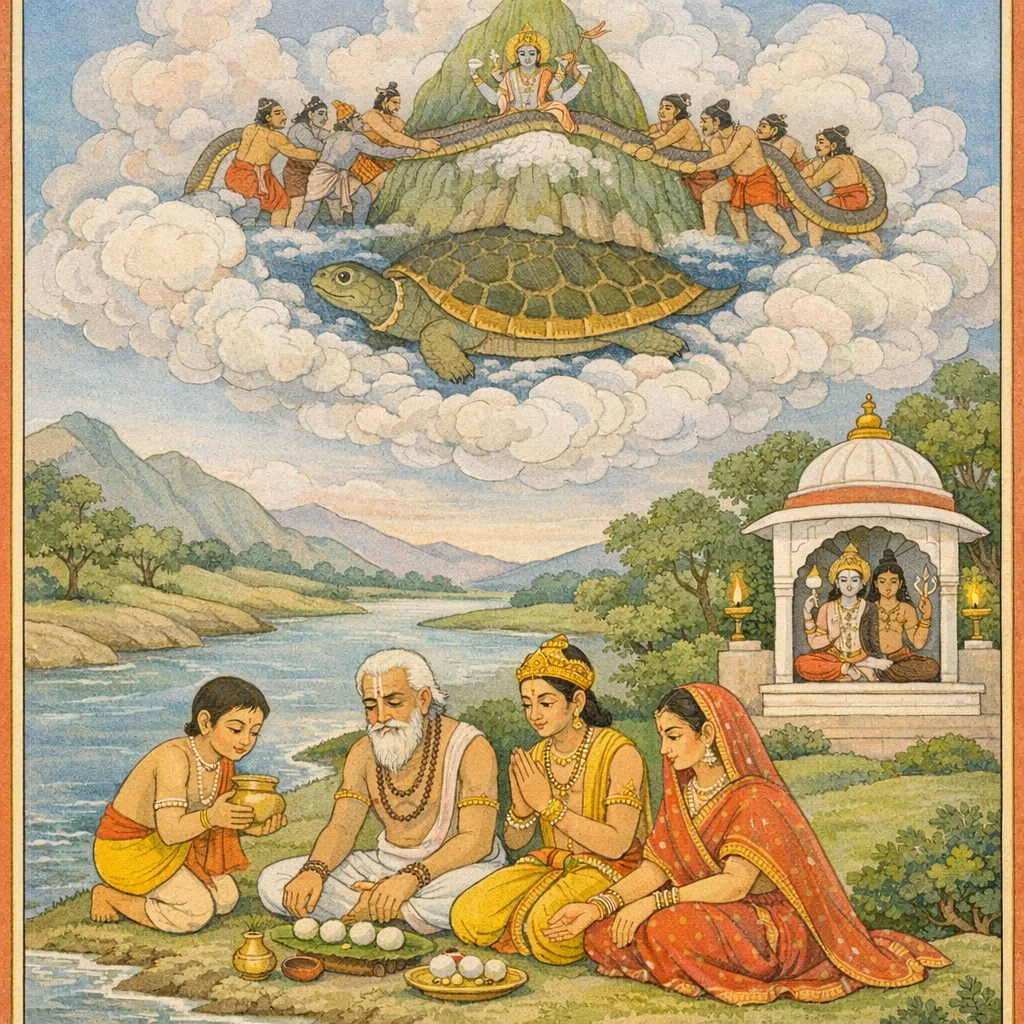
Continuing the Uttara-bhāga’s gṛhastha-centered dharma teaching, Vyāsa systematizes aśauca (ritual impurity) from death (śāvaka) and birth (sūtaka), assigning differing durations by varṇa, eligibility/guṇa-status, and degrees of kinship (sapinda, samānodaka/ekodaka, and household proximity). It prescribes conduct during impurity—permitted daily duties, avoidance of kāmya rites, restrained hospitality to pure brāhmaṇas, and rules of touch and acceptance—while addressing overlaps of multiple events, distant news, and exceptions granting immediate purity (sadyah-śauca) such as calamity, sacrifice, battle deaths, infants, and renunciants. It defines sapinda limits up to seven, clarifies women’s lineage affiliation before and after marriage, and then shifts from impurity reckoning to a sequenced outline of funerary observances: cremation (including effigy rites when the body is absent), ten-day observances, daily piṇḍa offerings, bone-collection, nava-śrāddha feedings, monthly rites through the year, and sapiṇḍīkaraṇa culminating in the annual śrāddha. The chapter closes by reaffirming svadharma and surrender to Īśvara as the inner telos of these outward duties, preparing for the Uttara-bhāga’s later synthesis of dharma and spiritual realization.
Shlokas
Verse 1
इति श्रीकूर्मपुराणे षट्साहस्त्र्यां संहितायामुपरिविभागे द्वाविशो ऽध्यायः इन् रेए निछ्त् ज़ुल्äस्सिगे ज़ेइछेन्: व्यास उवाच दशाहं प्राहुराशौचं सपिण्डेषु विपश्चितः / मृतेषु वाथ जातेषु ब्राह्मणानां द्विजोत्तमाः
Vyāsa said: The wise declare that among sapindas (blood-kin bound by the piṇḍa offering), Brahmins—the best of the twice-born—observe ten days of āśauca (ritual impurity) when death occurs, and likewise when birth occurs.
Verse 2
नित्यानि चैव कर्माणि काम्यानि च विशेषतः / नकुर्याद् विहितं किञ्चित् स्वाध्यायं मनसापिच
One should perform the obligatory daily rites and, above all, avoid desire-driven (kāmya) rituals. No prescribed duty should be neglected; and one should also practice svādhyāya (sacred self-study), even within the mind.
Verse 3
शुचीनक्रोधनान् भूम्यान् शालाग्नौ भावयेद् द्विजान् / शुष्कान्नेन फलैर्वापि वैतानं जुहुयात् तथा
He should invite and duly honor Brahmins who are pure and free from anger, seating them on the ground by the household fire; and likewise he should perform the vaitāna offering, making oblations with dry grains of food or, alternatively, with fruits.
Verse 4
न स्पृशेयुरिमानन्ये न च तेभ्यः समाहरेत् / चतुर्थे पञ्चमे वाह्नि संस्पर्शः कथितो बुधैः
Others should not touch these persons, nor should anything be accepted or taken from them. The wise declare that purification through contact is accomplished by fire on the fourth and fifth days.
Verse 5
सूतके तु सपिण्डानां संस्पर्शो न प्रदुष्यति / सूतकं सूतिकां चैव वर्जयित्वा नृणां पुनः
During sūtaka (death-impurity), contact among sapindas does not cause defilement. For people, one should avoid only the sūtaka itself and the childbirth-impurity called sūtikā, once again.
Verse 6
अधीयानस्तथा यज्वा वेदविच्च पिता भवेत् / संस्पृश्याः सर्व एवैते स्नानान्माता दशाहतः
A father becomes ritually fit when he is devoted to Vedic study, has performed sacrifices (yajña), and is a knower of the Veda. All such persons may be touched; but the mother is purified only after bathing, once ten nights of impurity have passed.
Verse 7
दशाहं निर्गुणे प्रोक्तमशौचं चातिनिर्गुणे / एकद्वित्रिगुणैर्युक्तं चतुस्त्र्येकदिनैः शुचिः
For one called “nirguṇa” (lacking the prescribed qualities), the period of aśauca is declared to be ten days; and for the “ati-nirguṇa” it is the same. But one endowed with one, two, or three prescribed guṇas regains purity respectively in four, three, and one day.
Verse 8
दशाहात् तु परं सम्यगधीयीत जुहोति च / चतुर्थे तस्य संस्पर्शं मनुराह प्रजापतिः
After ten days have passed, one may properly resume Vedic study and offer oblations (āhuti) into the sacred fire; and on the fourth day thereafter, contact with him is permitted—so declared Manu, Prajāpati, lord of creatures.
Verse 9
क्रियाहीनस्य मूर्खस्य महारोगिण एव च / यथेष्टाचरणस्याहुर्मरणान्तमशौवकम्
For one devoid of prescribed rites, for a fool, for one afflicted with grave disease, and for one who lives by mere whim, the state of aśauca is said to last until death.
Verse 10
त्रिरात्रं दशरात्रं वा ब्राह्मणानामशौचकम् / प्राक्संस्कारात् त्रिरात्रं स्यात् तस्मादूर्ध्वं दशाहकम्
For Brahmanas, the period of aśauca is three nights or ten nights. Before the child’s saṃskāras are performed, it should be three nights; after that, it becomes a ten-day (ten-night) observance.
Verse 11
ऊनद्विवार्षिके प्रेते मातापित्रोस्तदिष्यते / त्रिरात्रेण शुचिस्त्वन्यो यदि ह्यत्यन्तनिर्गुणः
If a child dies before completing two years, the prescribed impurity (āśauca) is assigned only to the mother and father. Other relatives regain purity in three nights, especially if they are wholly free from attachment and personal entanglements.
Verse 12
अदन्तजातमरणे पित्रोरेकाहमिष्यते / जातदन्ते त्रिरात्रं स्याद् यदि स्यातां तु निर्गुणौ
If a child dies before the teeth have appeared, the impurity period for the parents is prescribed as one day. If the child has already cut teeth, it should be three nights—provided the parents are otherwise free from disqualifying conditions.
Verse 13
आदन्तजननात् सद्य आचौलादेकरात्रकम् / त्रिरात्रमौपनयनात् सपिण्डानामुदाहृतम्
For sapinda (closely related) kin, impurity arises immediately at the appearance of the first teeth; it lasts one night at the first tonsure (caula); and it is declared to be three nights at the upanayana (initiation).
Verse 14
जातमात्रस्य बालस्य यदि स्यान्मरणं पितुः / मातुश्च सूतकं तत् स्यात् पिता स्यात् स्पृश्य एव च
If, when a child has only just been born, the father should die, then the mother incurs sūtaka (birth-impurity); and the father, as the deceased with respect to the household, is also regarded as ‘touch-impure’ (spṛśya).
Verse 15
सद्यः शौचं सपिण्डानां कर्तव्यं सोदरस्य च / ऊर्ध्वं दशाहादेकाहं सोदरो यदि निर्गुणः
For those who are sapiṇḍas (blood-relatives within the funeral-oblation circle), and also for a full brother, purification is to be performed immediately. But beyond the ten-day period, if the brother is ‘nirguṇa’ (not qualified for the full rites), then only a single day of impurity applies.
Verse 16
अथोर्ध्वं दन्तजननात् सपिण्डानामशौचकम् / एकरात्रं निर्गुणानां चैलादूर्ध्वं त्रिरात्रकम्
Thereafter, when the child’s teeth begin to appear, the sapinda kin (those joined by the ancestral piṇḍa offering) shall observe aśauca, ritual impurity. For those lacking the prescribed ritual qualifications it lasts one night; but from the stage of receiving cloth onward, it is three nights.
Verse 17
अदन्तजातमरणं संभवेद् यदि सत्तमाः / एकरात्रं सपिण्डानां यदि ते ऽत्यन्तनिर्गुणाः
O best of the virtuous: if death occurs for an infant who has not yet cut teeth, then for the sapinda relatives the aśauca is one night—provided they are utterly without the prescribed qualities and observances.
Verse 18
व्रतादेशात् सपिण्डानामर्वाक् स्नानं विधीयते / सर्वेषामेव गुणिनामूर्ध्वं तु विषमं पुनः
By the ordinance of the vrata (sacred vow), bathing is prescribed for the sapinda kin up to a certain limit; but for all who are virtuous and duly qualified, beyond that the rule is again not uniform, differing by status and circumstance.
Verse 19
अर्वाक् षण्मासतः स्त्रीणां यदि स्याद् गर्भसंस्त्रवः / तदा माससमैस्तासामशौचं दिवसैः स्मृतम्
If, for women, a miscarriage (the discharge of the embryo) occurs before six months, then their aśauca is traditionally prescribed for as many days as the number of months of pregnancy.
Verse 20
तत ऊर्ध्वं तु पतने स्त्रीणां द्वादशरात्रिकम् / सद्यः शौचं सपिण्डानां गर्भस्त्रावाच्च वा ततः
Thereafter, in the case of a woman’s death (patana), the aśauca is twelve nights. For the sapinda relatives, however, purification is immediate—so too in the event of miscarriage (the discharge of the fetus).
Verse 21
गर्भच्युतावहोरात्रं सपिण्डे ऽत्यन्तनिर्गुणे / यथेष्टाचरणे ज्ञातौ त्रिरात्रमिति निश्चयः
For a miscarriage (garbha-cyuti), the aśauca (ritual impurity) lasts one day and one night. For a sapinda kinsman utterly devoid of virtue, and for a relative who lives at will without discipline, the impurity is determined as three nights.
Verse 22
यदि स्यात् सूतके सूतिर्मरणे वा मृतिर्भवेत् / शेषेणैव भवेच्छुद्धिरहः शेषे त्रिरात्रकम्
If, during sūtaka (birth-impurity), another birth occurs, or during death-impurity another death occurs, purity is attained by counting only the remaining portion of the already-running term. But if only part of a day remains, the purification period is to be reckoned as three nights.
Verse 23
मरणोत्पत्तियोगे तु मरणाच्छुद्धिरिष्यते / अघवृद्धिमदाशौचमूर्घ्वं चेत् तेन शुध्यति
When death and birth coincide, creating overlapping impurity, purification is prescribed by the death-impurity alone. If the aśauca would otherwise be extended due to additional aghā (funerary impurity), one becomes pure by completing that very death-related term.
Verse 24
अथ चेत् पञ्चमीरात्रिमतीत्य परतो भवेत् / अघवृद्धिमदाशौचं तदा पूर्वेण शुध्यति
Now, if the death occurs after the fifth night has passed—i.e., later than that—then the aśauca arising from death is extended; in that case one becomes purified according to the rule stated earlier.
Verse 25
देशान्तरगतं श्रुत्वा सूतकं शावमेव तु / तावदप्रयतो मर्त्यो यावच्छेषः समाप्यते
On hearing that, in a distant region, sūtaka (birth-impurity) or śāvaka (death-impurity) has occurred, a person remains aprayata (ritually unfit) only until the remaining portion of that term is completed.
Verse 26
अतीते सूतके प्रोक्तं सपिण्डानां त्रिरात्रकम् / तथैव मरणे स्नानमूर्ध्वं संवत्सराद् यदि
When the birth-impurity (sūtaka) has passed, a three-night observance is prescribed for one’s sapinda kin. Likewise, in the case of death, if the due rites have been delayed beyond a year, purification is to be effected chiefly by bathing.
Verse 27
वेदान्तविच्चाधीयानो यो ऽग्निमान् वृत्तिकर्षितः / सद्यः शौचं भवेत् तस्य सर्वावस्थासु सर्वदा
For the Veda-endowed knower of Vedānta who continues his study, maintains the sacred fires (agni), and is constrained by the demands of livelihood, purity is immediate for him—at all times and in every condition.
Verse 28
स्त्रीणामसंस्कृतानां तु प्रदानात् पूर्वतः सदा / सपिण्डानां त्रिरात्रं स्यात् संस्कारे भर्तुरेव हि
For women who have not undergone the saṃskāras, the rite is always to be performed as though they belonged to their family before marriage. For the sapinda relatives, the aśauca is three nights—because in matters of saṃskāra a woman’s sacramental affiliation is held to be with her husband.
Verse 29
अहस्त्वदत्तकन्यानामशौचं मरणे स्मृतम् / ऊनद्विवर्षान्मरणे सद्यः शौचमुदाहृतम्
It is taught that, upon death, there is no aśauca for girls who have not yet been given in marriage. And in the case of the death of a child under two years of age, immediate purification (śauca) is declared.
Verse 30
आदन्तात् सोदरे सद्य आचौलादेकरात्रकम् / आप्रदानात् त्रिरात्रं स्याद् दशरात्रमतः परम्
For one’s own full sibling (sodara), the impurity is immediate. From the stage before teething up to the first tonsure rite (cūḍā), it lasts one night. Up to the pradāna ceremony it is three nights; beyond that, ten nights.
Verse 31
मातामहानां मरणे त्रिरात्रं स्यादशौचकम् / एकोदकानां मरणे सूतके चैतदेव हि
On the death of one’s maternal grandparents, the aśauca (ritual impurity) lasts three nights. Indeed, the same rule applies for the death of ekodaka relatives (those sharing one line of water-offering), and likewise during sūtaka (birth-impurity).
Verse 32
पक्षिणी योनिसम्बन्धे बान्धवेषु तथैव च / एकरात्रं समुद्दिष्टं गुरौ सब्रह्मचारिणि
For a case involving a female bird (as a cause of death/defilement), in birth-related connections and likewise among kinsmen, the prescribed period is one night; and that same one-night period is also declared for one’s guru and for a sabrahmacārin (fellow student).
Verse 33
प्रेते राजनि सज्योतिर्यस्य स्याद् विषये स्थितिः / गृहे मृतासु दत्तासु कन्यकासु त्र्यहं पितुः
When a king has died, in whose realm the sacred fire is maintained as an established institution (sajyoti), the impurity for a father is three days when his daughters—whether living at home or already given in marriage—die.
Verse 34
परपूर्वासु भार्यासु पुत्रेषु कृतकेषु च / त्रिरात्रं स्यात् तथाचार्ये स्वभार्यास्वन्यगासु च
In the case of a wife who formerly belonged to another man (parapūrvā), and in the case of adopted sons (kṛtaka), the impurity lasts three nights; likewise, it is three nights for one’s ācārya. The same three-night period is also prescribed regarding one’s own wives who have gone to another man.
Verse 35
आचार्यपुत्रे पत्न्यां च अहोरात्रमुदाहृतम् / एकाहं स्यादुपाध्याये स्वग्रामे श्रोत्रिये ऽपि च
For the son of one’s ācārya and for his wife, the impurity is declared to be one day and one night. For an upādhyāya (teacher) and also for a śrotriya (Veda-learned Brahmin) in one’s own village, it should be one day.
Verse 36
त्रिरात्रमसपिण्डेषु स्वगृहे संस्थितेषु च / एकाहं चास्ववर्ये स्यादेकरात्रं तदिष्यते
For relatives who are not sapiṇḍa, and also when death occurs among those dwelling in one’s own household, the aśauca period is prescribed as three nights. But for one’s own superior—an elder, one like a teacher—it is one day; for others, a single night is held to be proper.
Verse 37
त्रिरात्रं श्वश्रूमरणे श्वशुरे वै तदेव हि / सद्यः शौचं समुद्दिष्टं सगोत्रे संस्थिते सति
For the death of one’s mother-in-law, the aśauca period is three nights; and for the father-in-law as well, it is the same. But if one of one’s own gotra is present to undertake the rites, immediate purification is prescribed.
Verse 38
शुद्ध्येद् विप्रो दशाहेन द्वादशाहेन भूमिपः / वैश्यः पञ्चदशाहेन शूद्रो मासेन शुद्यति
A Brāhmaṇa becomes purified after ten days; a king (Kṣatriya) after twelve days; a Vaiśya after fifteen days; and a Śūdra is purified after one month.
Verse 39
क्षत्रविट्शूद्रदायादा ये स्युर्विप्रस्य बान्धवाः / तेषामशौचे विप्रस्य दशाहाच्छुद्धिरिष्यते
If a Brāhmaṇa’s relatives who are his heirs belong to the Kṣatriya, Vaiśya, or Śūdra classes, then in their aśauca the Brāhmaṇa is regarded as purified after ten days.
Verse 40
राजन्यवैश्यावप्येवं हीनवर्णासु योनिषु / स्वमेव शौचं कुर्यातां विशुद्ध्यर्थमसंशयम्
Likewise, even Kṣatriyas and Vaiśyas, when born through unions with women of a lower social order, should themselves perform the prescribed acts of purity—without doubt—for the sake of attaining ritual purification.
Verse 41
सर्वे तूत्तरवर्णानामशौचं कुर्युरादृताः / तद्वर्णविधिदृष्टेन स्वं तु शौचं स्वयोनिषु
Let all carefully observe the period of ritual impurity (aśauca) prescribed for the higher varṇas. Yet for those born within their own group, each should follow the purification (śauca) laid down by the rule of that particular varṇa.
Verse 42
षड्रात्रं वा त्रिरात्रं स्यादेकरात्रं क्रमेण हि / वैश्यक्षत्रियविप्राणां शूद्रेष्वाशौचमेव तु
In due order, the aśauca period is six nights, three nights, and one night—for the Vaiśya, the Kṣatriya, and the Vipra (Brāhmaṇa), respectively; but for a Śūdra, aśauca is acknowledged according to the prescribed minimal observance.
Verse 43
अर्धमासो ऽथ षड्रात्रं त्रिरात्रं द्विजपुङ्गवाः / शूद्रक्षत्रियविप्राणां वैश्येष्वाशौचमिष्यते
O best of the twice-born, aśauca is taught as: half a month for a Śūdra, six nights for a Kṣatriya, and three nights for a Vipra (Brāhmaṇa); for a Vaiśya, the intermediate rule is regarded as applicable.
Verse 44
षड्रात्रं वै दशाहं च विप्राणां वैश्यशूद्रयोः / अशौचं क्षत्रिये प्रोक्तं क्रमेण द्विजपुङ्गवाः
O best of the twice-born, in due order aśauca is declared: six nights for Kṣatriyas, and ten days for Vipras (Brāhmaṇas), as well as for Vaiśyas and Śūdras.
Verse 45
शूद्रविट्क्षत्रियाणां तु ब्राह्मणे संस्थिते सति / दशरात्रेण शुद्धिः स्यादित्याह कमलोद्भवः
When a brāhmaṇa has passed away, for Śūdras, Vaiśyas, and Kṣatriyas, purification (śauca) is attained after ten nights—so declares Kamalodbhava (Brahmā).
Verse 46
असपिण्डं द्विजं प्रेतं विप्रो निर्हृत्य बन्धुवत् / अशित्वा च सहोषित्वा दशरात्रेण शुध्यति
If a brāhmaṇa performs the funeral duties for a deceased twice-born who is outside his own sapinda-circle, treating him as a kinsman, and having eaten together and stayed together, he becomes purified after ten nights.
Verse 47
यद्यन्नमत्ति तेषां तु त्रिरात्रेण ततः शुचिः / अनदन्नन्नमह्नैव न च तस्मिन् गृहे वसेत्
If one eats their food, one becomes pure again after three nights. But if one does not eat their food, one is purified that very day—and one should not reside in that house.
Verse 48
सोदकेष्वेतदेव स्यान्मातुराप्तेषु बन्धुषु / दशाहेन शवस्पर्शे सपिण्डश्चैव शुध्यति
For those who are sodaka—kinsmen who share the same libations of water, such as relatives through the mother and other kindred—this very rule applies: if a sapinda has touched a corpse, he becomes purified after ten days.
Verse 49
यदि निर्हरति प्रेतं प्रोलभाक्रान्तमानसः / दशाहेन द्विजः शुध्येद् द्वादशाहेन भूमिपः
If a person, his mind disturbed by fear and agitation, carries out a corpse, then a twice-born man becomes purified after ten days, while a king becomes purified after twelve days.
Verse 50
अर्धमासेन वैश्यस्तु शूद्रो मासेन शुध्यति / षड्रात्रेणाथवा सर्वे त्रिरात्रेणाथवा पुनः
A Vaiśya becomes purified in half a month, while a Śūdra becomes purified in a month. Alternatively, according to the prescribed observance, all may be purified in six nights—or again, in three nights.
Verse 51
अनाथं चैव निर्हृत्य ब्राह्मणं धनवर्जितम् / स्नात्वा संप्राश्य तु घृतं शुध्यन्ति ब्राह्मणादयः
After rescuing and supporting a helpless brāhmaṇa bereft of wealth, brāhmaṇas and the other twice-born are purified by bathing and then partaking of ghṛta (ghee) as a sanctifying intake.
Verse 52
अवरश्चेद् वरं वर्णमवरं वा वरो यदि / अशौचे संस्पृशेत् स्नेहात् तदाशौचेन शुध्यति
If one of a lower varṇa, out of affection, touches a higher varṇa during aśauca (ritual impurity)—or a higher varṇa similarly touches a lower—then the one who touches is purified by observing that very aśauca as prescribed.
Verse 53
प्रेतीभूतं द्विजं विप्रो यो ऽनुगच्छत कामतः / स्नात्वा सचैलं स्पृष्ट्वाग्निं घृतं प्राश्य विशुध्यति
If a brāhmaṇa, knowingly and out of desire, follows a twice-born person who has become a preta (restless departed spirit), he is purified by bathing with his clothes on, touching fire, and then consuming ghṛta (ghee).
Verse 54
एकाहात् क्षत्रिये शुद्धिर्वैश्ये स्याच्च द्व्यहेन तु / शूद्रे दिनत्रयं प्रोक्तं प्राणायामशतं पुनः
For a Kṣatriya, purification is attained after one day; for a Vaiśya, it is said to be after two days. For a Śūdra, three days are prescribed, and additionally one hundred rounds of prāṇāyāma are taught.
Verse 55
अनस्थिसंचिते शूद्रे रौति चेद् ब्राह्मणः स्वकैः / त्रिरात्रं स्यात् तथाशौचमेकाहं त्वन्यथा स्मृतम्
If a brāhmaṇa, together with his own relatives, raises the mourning-cry for a Śūdra whose bones have not yet been gathered, his āśauca (ritual impurity of mourning) is said to last three nights; otherwise it is remembered to be for one day.
Verse 56
अस्थिसंचयनादर्वागेकाहं क्षत्रवैश्ययोः / अन्यथा चैव सज्योतिर्ब्राह्मणे स्नानमेव तु
Before the gathering of the bones after cremation, the period of impurity is one day for Kṣatriyas and Vaiśyas. Otherwise, for a Brāhmaṇa, purification is immediate—by bathing alone.
Verse 57
अनस्थिसंचित् विप्रे ब्राह्मणो रौति चेत् तदा / स्नानेनैव भवेच्छुद्धिः सचैलेन न संशयः
O Brāhmaṇa, if a Brāhmaṇa weeps while having no contact with the gathering of bones, purity is attained by bathing alone—bathing even with one’s clothes on—without doubt.
Verse 58
यस्तैः सहाशनं कुर्याच्छयनादीनि चैव हि / बान्धवो वापरो वापि स दशाहेन शुध्यति
Whoever eats together with them (those in ritual impurity) or shares acts such as sleeping and the like—whether a relative or even an unrelated person—becomes purified after ten days.
Verse 59
यस्तेषामन्नमश्नाति सकृदेवापि कामतः / तदाशौचे निवृत्ते ऽसौ स्नानं कृत्वा विशुध्यति
Whoever, even once, willingly eats the food belonging to such persons—when that period of ritual impurity (āśauca) has ended—becomes purified by performing a bath.
Verse 60
यावत्तदन्नमश्नाति दुर्भिक्षोपहतो नरः / तावन्त्यहान्यशौचं स्यात् प्रायश्चित्तं ततश्चरेत्
For as long as a man, struck by famine, eats that food, for that many days he remains in a state of ritual impurity (aśauca). Thereafter, he should perform the appropriate expiation (prāyaścitta).
Verse 61
दाहाद्यशौचं कर्तव्यं द्विजानामग्निहोत्रिणाम् / सपिण्डानां तु मरणे मरणादितरेषु च
For twice-born householders who maintain the sacred fires of Agnihotra, aśauca—ritual impurity—must be observed beginning with the cremation and its attendant rites; this applies upon the death of one’s sapiṇḍa kin, and likewise in other death-related occasions.
Verse 62
सपिण्डता च पुरुषे सप्तमे विनिवर्तते / समानोदकभावस्तु जन्मनाम्नोरवेदने
The status of being sapiṇḍa—sharing the ancestral piṇḍa-offering—ceases with the seventh person; but the bond of samānodaka, sharing the funeral-water, holds where one does not know the birth and name, that is, when lineage-identifiers are unknown.
Verse 63
पिता पितामहश्चैव तथैव प्रपितामहः / लेपभाजस्त्रयश्चात्मा सापिण्ड्यं साप्तपौरुषण्
The father, the grandfather, and likewise the great-grandfather—these three are the recipients of the piṇḍa-offerings; and the family’s sapiṇḍa bond extends through seven generations.
Verse 64
अप्रत्तानां तथा स्त्रीणां सापिण्ड्यं साप्तपौरुषम् / ऊढानां भर्तुसापिण्ड्यं प्राह देवः पितामहः
For unmarried women, the sapiṇḍa relationship extends through seven generations; but for married women, the sapiṇḍa connection is to be understood as belonging to the husband’s lineage—so declared the divine Pitāmaha, the Grandsire.
Verse 65
ये चैकजाता बहवो भिन्नयोनय एव च / भिन्नवर्णास्तु सापिण्ड्यं भवेत् तेषां त्रिपूरुषम्
And those who are many yet born from one and the same source, but arise through different wombs, and even those of different varṇas—among them, the sapiṇḍa relationship extends only up to three generations (three male ancestors).
Verse 66
कारवः शिल्पिनो वैद्या दासीदासास्तथैव च / दातारो नियमी चैव ब्रह्मविद्ब्रह्मचारिणौ
Artisans, craftsmen, physicians, and likewise female and male servants; so too the charitable giver, the disciplined keeper of restraints, the knower of Brahman (Brahmavid), and the celibate student of sacred learning (brahmacārin)—all are included here.
Verse 67
सत्रिणो व्रतिनस्तावत् सद्यः शौचा उदाहृताः / राजा चैवाभिषिक्तश्च प्राणसत्रिण एव च
Those engaged in a sattra (sacrificial session) and those observing sacred vows (vrata) are declared to possess “immediate purity” (sadyaḥ-śauca). Likewise, a king—especially one consecrated by abhiṣeka—and one devoted to the prāṇa-sattra, the sacrificial observance of offering one’s very life, are also regarded as purified at once.
Verse 68
यज्ञे विवाहकाले च देवयागे तथैव च / सद्यः शौचं समाख्यातं दुर्भिक्षे चाप्युपद्रवे
At the time of yajña (sacrificial rite), at a marriage ceremony, and likewise during devayāga, worship offered to the gods, “immediate purity” (sadyaḥ-śauca) is enjoined; and the same immediate purification applies in famine and in times of calamity.
Verse 69
डिम्बाहवहतानां च विद्युता पार्थिवैर्द्विजैः / सद्यः शौचं समाख्यातं सर्पादिमरणे तथा
For those slain in battle, for infants who die young, for those struck down by lightning, and for dvija—brāhmaṇas—killed by a king, “immediate purity” (sadyaḥ-śauca) is declared; likewise for deaths caused by snakes and similar agencies.
Verse 70
अग्नौ मरुप्रपतने वीराध्वन्यप्यनाशके / ब्राह्मणार्थे च संन्यस्ते सद्यः शौचं विधीयते
If one dies in fire, or by falling in a desert, or on a heroic campaign—even when the body is not recovered—immediate purity (sadyaḥ-śauca) is prescribed. Likewise, if one has been formally consigned as dead for the sake of a brāhmaṇa, immediate purification is enjoined.
Verse 71
नैष्ठिकानां वनस्थानां यतीनां ब्रह्मचारिणाम् / नाशौचं कीर्त्यते सद्भिः पतिते च तथा मृते
For steadfast renunciants, forest-dwellers, yatis (ascetic mendicants), and brahmacārins, the virtuous declare that there is no āśauca (ritual impurity)—even when a fallen person is involved, and likewise even at death.
Verse 72
पतितानां न दाहः स्यान्नान्त्येष्टिर्नास्थिसंचयः / न चाश्रुपातपिण्डौ वा कार्यं श्राद्धादि कङ्क्वचित्
For those who have become fallen (patita), there should be no cremation, no funerary rite (antyeṣṭi), and no gathering of bones. Nor should the rites of libations of tears and offering of piṇḍas be performed; and in no case should śrāddha and related ancestral ceremonies be done for them.
Verse 73
व्यापादयेत् तथात्मानं स्वयं यो ऽग्निविषादिभिः / विहितं तस्य नाशौचं नाग्निर्नाप्युदकादिकम्
But one who destroys his own life by himself—through fire, poison, and the like—for him no āśauca (ritual impurity) is enjoined; nor are the rites involving the sacred fire, water, and related funeral observances to be performed.
Verse 74
अथ कश्चित् प्रमादेन म्रियते ऽग्निविषादिभिः / तस्याशौचं विधातव्यं कार्यं चैवोदकादिकम्
Now, if someone, through negligence, dies by fire, poison, or the like, then āśauca (impurity) must be observed for him, and the customary rites—such as the offering of water and related duties—must likewise be performed.
Verse 75
जाते कुमारे तदहः कामं कुर्यात् प्रतिग्रहम् / हिरण्यधान्यगोवासस्तिलान्नगुडसर्पिषाम्
On the very day a son is born, one may, as is proper and as one wishes, accept gifts—gold, grain, cows, garments, sesame, cooked food, jaggery, and ghee.
Verse 76
फलानि पुष्पं शाकं च लवणं काष्ठमेव च / तोयं दधि घृतं तैलमौषधं क्षीरमेव च / आशौचिनां गृहाद् ग्राह्यं शुष्कान्नं चैव नित्यशः
Fruits, flowers, vegetables, salt, and also firewood; water, curd, ghee, oil, medicine, and milk as well—these may be accepted from the house of those in āśauca (ritual impurity). Likewise, dry food may be taken from them at all times.
Verse 77
आहिताग्निर्यथान्यायं दग्धव्यस्त्रिभिरग्निभिः / अनाहिताग्निर्गृह्येण लौकिकेनेतरो जनः
One who has established the sacred fires (āhitāgni) should, according to rule, be cremated with the three fires; but one who has not established them should be cremated with the domestic (gṛhya) or ordinary (laukika) fire—such is the practice for other people.
Verse 78
देहाभावात् पलाशैस्तु कृत्वा प्रतिकृतिं पुनः / दाहः कार्यो यथान्यायं सपिण्डैः श्रद्धयान्वितैः
When the physical body is not available, a substitute effigy should be fashioned from palāśa wood; then, in accordance with proper rite, the cremation should be performed again by the sapiṇḍa relatives, endowed with faith.
Verse 79
सकृत्प्रसिञ्चन्त्युदकं नामगोत्रेण वाग्यताः / दशाहं बान्धवैः सार्धं सर्वे चैवार्द्रवाससः
Maintaining silence, they sprinkle water once, uttering the departed one’s name and lineage (gotra); and for ten days, together with the kinsmen, all remain wearing damp garments.
Verse 80
पिण्डं प्रतिदिनं दद्युः सायं प्रातर्यथाविधि / प्रेताय च गृहद्वारि चतुर्थे भोजयेद् द्विजान्
Each day one should offer a piṇḍa (rice-ball oblation) in the evening and in the morning, according to the prescribed rule; and at the doorway of the house one should also make the offering for the preta (departed spirit). On the fourth day, one should feed the twice-born (brāhmaṇas).
Verse 81
द्वितीये ऽहनि कर्तव्यं क्षुरकर्म सबान्धवैः / चतुर्थे बान्धवैः सर्वैरस्थनां संचयनं भवेत् / पूर्वं तु भोजयेद् विप्रानयुग्मान् श्रद्धया शुचीन्
On the second day, the shaving-rite (kṣura-karma) should be performed together with one’s relatives. On the fourth day, all the relatives should gather and collect the bones from the cremation ground. But first, with faith (śraddhā) and purity, one should feed pure brāhmaṇas in an odd (non-even) number.
Verse 82
पञ्चमे नवमे चैव तथैवैकादशे ऽहनि / अयुग्मान् भोजयेद् विप्रान् नवश्राद्धं तु तद्विदुः
On the fifth, the ninth, and likewise on the eleventh day, one should feed brāhmaṇas in an odd number; the learned call this observance nava-śrāddha, the ninefold śrāddha.
Verse 83
एकादशे ऽह्नि कुर्वोत प्रेतमुद्दिश्य भावतः / द्वादशे वाथ कर्तव्यमनिन्द्ये त्वथवाहनि / एकं पवित्रमेकोर्ऽघः पिण्डपात्रं तथैव च
On the eleventh day, one should perform the rite with heartfelt sincerity, dedicating it to the preta, the departed spirit. On the twelfth day too it should be done—on an auspicious, blameless day, or else on that very day. For the rite, use a single sacred kuśa ring, a single arghya-offering, and likewise a single vessel for the piṇḍa (rice-ball offering).
Verse 84
एवं मृताह्नि कर्तव्यं प्रतिमासं तु वत्सरम् / सपिण्डीकरणं प्रोक्तं पूर्णे संवत्सरे पुनः
Thus, on the death-anniversary (mṛtāhni), these rites should be performed each month for a full year; and when the year is completely fulfilled, the sapiṇḍīkaraṇa—the rite that joins the departed to the ancestral line (pitṛs)—is prescribed again.
Verse 85
कुर्याच्चत्वारि पात्राणि प्रेतादीनां द्विजोत्तमाः / प्रेतार्थं पितृपात्रेषु पात्रमासेचयेत् ततः
The foremost among the twice-born (dvijottama) should prepare four vessels for the offerings meant for the preta and related rites. Then, for the sake of the preta, he should pour that offering into the vessels intended for the pitṛs, the ancestral fathers.
Verse 86
ये समाना इति द्वाभ्यां पिण्डानप्येवमेव हि / सपिण्डीकरणं श्राद्धं देवपूर्वं विधीयते
Reciting the two verses beginning with “ye samānā…,” one should likewise offer the piṇḍas in the prescribed manner. Thus the śrāddha called sapiṇḍīkaraṇa (the rite that joins the departed to the ancestral line) is to be performed, with offerings to the Devas made first.
Verse 87
पितॄनावाहयेत् तत्र पुनः प्रेतं च निर्दिशेत् / ये सपिण्डीकृताः प्रेतान तेषां स्यात् पृथक्क्रियाः / यस्तु कुर्यात् पृथक् पिण्डं पितृहा सो ऽभिजायते
There he should again invoke the Pitṛs (ancestral Fathers) and also indicate the offering for the preta (departed spirit). Those departed ones who have already been made “of one piṇḍa” through sapiṇḍīkaraṇa should not receive separate rites; but whoever makes a separate piṇḍa-offering for them becomes a pitṛ-hā, one who harms the Fathers.
Verse 88
मृते पितरि वै पुत्रः पिण्डमब्दं समाचरेत् / दद्याच्चान्नं सोदकुम्भं प्रत्यहं प्रेतधर्मतः
When the father has died, the son should perform the piṇḍa-offering for a full year; and, according to the preta-dharma, he should also give food together with a water-pot each day.
Verse 89
पार्वणेन विधानेन संवत्सरिकमिष्यते / प्रतिसंवत्सरं कार्यं विधिरेष सनातनः
The annual rite (saṃvatsarika śrāddha) is to be performed according to the Pārvaṇa procedure. It should be done each year; this ordinance is sanātana, eternal.
Verse 90
मातापित्रोः सुतैः कार्यं पिण्डदानादिकं च यत् / पत्नी कुर्यात् सुताभावे पत्न्य भावे सहोदहः
Whatever ancestral duty for one’s mother and father—such as offering the piṇḍa and related rites—should be performed by the sons. If there are no sons, the wife should perform it; and if there is no wife, then a full brother should do so.
Verse 91
अनेनैव विधाने जीवन् वा श्राद्धमाचरेत् / कृत्वा दानादिकं सर्वं श्रद्धायुक्तः समाहितः
Following precisely this very procedure, one should perform the śrāddha rites even while living; and having completed all acts such as gifts and related offerings, one should do so with faith and a collected, steady mind.
Verse 92
एष वः कथितः सम्यग् गृहस्थानां क्रियाविधिः / स्त्रीणां तु भर्तृशुश्रूषा धर्मो नान्य इहेष्यते
Thus has the proper procedure of duties for householders been correctly explained to you. For women, devoted service to the husband is the dharma here; no other is held to be authoritative in this context.
Verse 93
स्वधर्मपरमो नित्यमीश्विरार्पितमानसः / प्राप्नोति तत् परं स्थानं यदुक्तं वेदवादिभिः
One who is ever devoted to one’s own prescribed duty (svadharma), with the mind surrendered and offered to Īśvara, attains that supreme abode which the expounders of the Veda have declared.
Frequently Asked Questions
One continues obligatory daily duties while avoiding kāmya (desire-motivated) rites, maintains restraint in social exchange (no accepting/taking and restricted touch), and sustains svādhyāya even mentally; limited offerings and carefully regulated brāhmaṇa hospitality are permitted under purity constraints.
Sapinda status is said to end with the seventh person (seven-generation scope), while water-libation relations (samānodaka/ekodaka) apply beyond or where lineage identifiers are uncertain; these categories determine whether impurity is immediate, one night, three nights, ten nights, or otherwise.
It is granted in contexts where dharma’s public or sacrificial demands override extended impurity—e.g., during sacrifices, marriages, deity worship, famine/calamity, certain violent or extraordinary deaths (battle, lightning, snakes), and for renunciant/ascetic life-stages where āśauca is not observed.
It prescribes ten-day observances with daily piṇḍa offerings (including a doorway offering for the preta), shaving and bone-collection on specified days, brāhmaṇa feedings (nava-śrāddha pattern), monthly rites for a year, and then the sapiṇḍīkaraṇa that ritually joins the preta to the pitṛ line, followed by the annual śrāddha.
The chapter frames gṛhastha rites as svadharma offered to Īśvara: faithful performance, inner steadiness, and surrender transform social-ritual obligations into a path aligned with the Veda’s declared supreme abode.