Adhyaya 24
Agnihotra, Seasonal Śrauta Duties, and the Authority of Śruti–Smṛti–Purāṇa
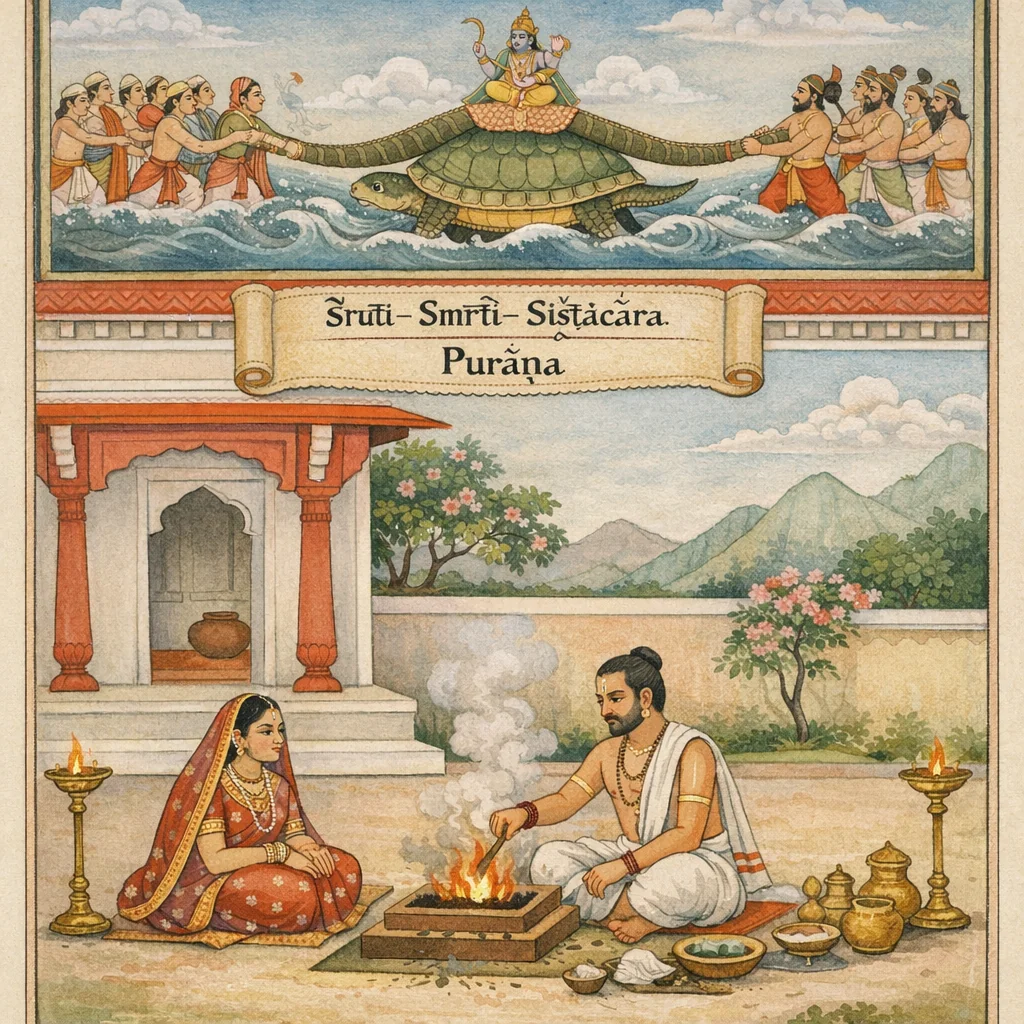
Continuing the prior chapter’s teaching on household dharma, Vyāsa lays out the gṛhastha’s śrauta regimen: daily Agnihotra at dawn and dusk, fortnightly Darśa–Paurṇamāsa, the post‑harvest navaśasya‑iṣṭi, seasonal adhvaras, ayana animal offerings, and annual Soma sacrifices. He forbids eating new grain or meat before the prescribed first-offerings, warning that craving fresh produce without yajña is like consuming one’s own life-breath. Neglecting to establish or maintain the sacred fires brings named hells and degraded rebirth, so brāhmaṇas especially are urged to worship the Supreme Lord through sacrifice. The chapter culminates in a hierarchy of rites—Agnihotra as the highest daily duty, Soma as foremost among sacrifices and a supreme mode of Maheśvara-worship—then turns to authority: dharma is twofold (śrauta and smārta), both rooted in Veda; failing these, śiṣṭācāra stands as a third authority. Finally, Purāṇa and Dharmaśāstra are affirmed as the Veda’s authoritative elucidations, together granting knowledge of Brahman and Dharma and preparing the next unit’s deeper integration of pramāṇa, practice, and liberation-oriented teaching.
Shlokas
Verse 1
इति श्रीकूर्मपुराणे षट्साहस्त्र्यां संहितायामुपरिविभागे त्रयोविंशो ऽध्यायः व्यास उवाच अग्निहोत्रं तु जुहुयादाद्यन्ते ऽहर्निशोः सदा / दर्शेन चैव पक्षान्ते पौर्णमासेन चैव हि
Thus, in the Śrī Kūrma Purāṇa, in the six-thousand-verse Saṃhitā, in the latter division, the twenty-third chapter ends. Vyāsa said: “One should always offer the Agnihotra oblation at the beginning and end of day and night; and at the close of each fortnight one should perform the Darśa rite, and likewise the Paurṇamāsa rite.”
Verse 2
शस्यान्ते नवशस्येष्ट्या तथर्त्वन्ते द्विजो ऽध्वरैः / पशुना त्वयनस्यान्ते समान्ते सौमिकैर्मखैः
At the close of the harvest one should perform the New-Grain offering (navaśasya-iṣṭi); at the close of each season the twice-born should perform Vedic sacrifices (adhvaras). At the end of each half-year (ayana) one should offer an animal sacrifice; and at the end of the year one should perform Soma-sacrifices (saumika makhas).
Verse 3
नानिष्ट्वा नवशस्येष्ट्या पशुना वाग्निमान् द्विजः / नवान्नमद्यान्मांसं वा दीर्घमायुर्जिजीविषुः
A twice-born householder who tends the sacred fires, seeking long life, should not eat new grain or meat until he has first performed the seasonal rite with the first produce (nava-śasya) and, where enjoined, an animal offering.
Verse 4
नवेनान्नेन चानिष्ट्वा पशुहव्येन चागन्यः / प्राणानेवात्तुमिच्छन्ति नवान्नामिषगृद्धिनः
Those who, without first making the proper offering of fresh grain, approach the Fire with an oblation of animal flesh—greedy for new grain and meat—truly seem to wish to consume their very life-breaths (prāṇa).
Verse 5
सावित्रान् शान्तिहोमांश्च कुर्यात् पर्वसु नित्यशः / पितॄंश्चैवाष्टकास्वर्चन् नित्यमन्वष्टकासु च
On sacred festival-days (parvas) one should regularly perform the Sāvitrī recitations and the appeasement fire-offerings (śānti-homas); and one should worship the ancestors (pitṛs) on the Aṣṭakā days, and likewise always on the Anvaṣṭakā observances.
Verse 6
एष धर्मः परो नित्यमपधर्मो ऽन्य उच्यते / त्रयाणामिह वर्णानां गृहस्थाश्रमवासिनाम्
This is the supreme dharma, to be practiced always; whatever is contrary to it is called adharma. This teaching is for the three varṇas here who dwell in the householder stage (gṛhasthāśrama).
Verse 7
नास्तिक्यादथवालस्याद् यो ऽग्नीन् नाधातुमिच्छति / यजेत वा न यज्ञेन स याति नरकान् बहून्
Out of disbelief in the Veda or out of laziness, whoever does not wish to establish the sacred fires—or, having established them, fails to worship through sacrifice (yajña)—goes to many hells.
Verse 8
तामिस्त्रमन्धतामिस्त्रं महारौरवरौरवौ / कुम्भीपाकं वैतरणीमसिपत्रवनं तथा
(There are) Tāmisra, Andhatāmisra, Mahāraurava and Raurava; also Kumbhīpāka, Vaitaraṇī, and likewise the forest of sword-leaves, Asipatravana.
Verse 9
अन्यांश्च नरकान् घोरान् संप्राप्यान्ते सुदुर्मतिः / अन्त्यजानां कुले विप्राः शूद्रयोनौ च जायते
Having undergone other dreadful hells as well, that evil-minded person, at the end (of those torments), is born among the families of the outcaste communities, and also in a Śūdra womb—O brāhmaṇas.
Verse 10
तस्मात् सर्वप्रयत्नेन ब्राह्मणो हि विशेषतः / आधायाग्निं विशुद्धात्मा यजेत परमेश्वरम्
Therefore, with every possible effort—especially a brāhmaṇa—having duly established the sacred fires and becoming purified in mind, should worship Parameśvara, the Supreme Lord, through sacrifice.
Verse 11
अग्निहोत्रात् परो धर्मो द्विजानां नेह विद्यते / तस्मादाराधयेन्नित्यमग्निहोत्रेण शाश्वतम्
For the twice-born, no duty in this world is higher than the Agnihotra. Therefore one should worship the Eternal Lord constantly through the Agnihotra sacrifice.
Verse 12
यश्चाधायाग्निमालस्यान्न यष्टुं देवमिच्छति / सो ऽसौ मूढो न संभाष्यः किं पुनर्नास्तिको जनः
But he who, having installed the sacred fires, out of sheer laziness does not wish to worship the Deity through sacrifice—such a deluded man is not even fit to be spoken with; how much more so an outright unbeliever (nāstika).
Verse 13
यस्य त्रैवार्षिकं भक्तं पर्याप्तं भृत्यवृत्तये / अधिकं चापि विद्येत स सोमं पातुमर्हति
He whose store of grain for three years suffices to sustain his dependents and servants, and who yet has surplus besides—such a man is worthy to drink the Soma.
Verse 14
एष वै सर्वयज्ञानां सोमः प्रथम इष्यते / सोमेनाराधयेद् देवं सोमलोकमहेश्वरम्
Indeed, Soma is held to be the foremost of all sacrifices. By Soma one should worship the Divine—Maheshvara, Lord of the Soma-world.
Verse 15
न सोमयागादधिको महेशाराधने क्रतुः / समो वा विद्यते तस्मात् सोमेनाभ्यर्चयेत् परम्
In the worship of Maheśa, no sacrificial rite is superior to the Soma-sacrifice—nor is any equal to it. Therefore, one should worship the Supreme through Soma, the Soma-offering.
Verse 16
पितामहेन विप्राणामादावभिहितः शुभः / धर्मो विमुक्तये साक्षाच्छ्रौतः स्मार्तो द्विधा पुनः
At the very beginning, the auspicious Dharma was proclaimed by the Grandfather (Brahmā) for the Brahmins—Dharma that directly leads to liberation; and again it is of two kinds: Śrauta (Vedic ritual) and Smārta (based on Smṛti).
Verse 17
श्रौतस्त्रेताग्निसंबन्धात् स्मार्तः पूर्वं मयोदितः / श्रेयस्करतमः श्रौतस्तस्माच्छ्रौतं समाचरेत्
The śrauta discipline is connected with the three sacred fires; the smārta discipline I have described earlier. The śrauta path is most conducive to the highest good; therefore one should duly practice the śrauta rites.
Verse 18
उभावभिहितौ धर्मौ वेदादेव विनिः सृतौ / शिष्टाचारस्तृतीयः स्याच्छ्रतिस्मृत्योरलाभतः
Both of these dharmas are indeed derived from the Veda. When Śruti and Smṛti are not available, the conduct of the cultured and learned (śiṣṭa-ācāra) becomes the third authority.
Verse 19
धर्मेणाभिगतो यैस्तु वेदः सपरिबृंहणः / ते शिष्टा ब्राह्मणाः प्रोक्ता नित्यमात्मगुणान्विताः
Those by whom the Veda—together with its explanatory supplements—is approached through dharma: they are declared to be the cultivated and exemplary Brāhmaṇas (śiṣṭas), ever endowed with the virtues of the Self.
Verse 20
तेषामभिमतो यः स्याच्चेतसा नित्यमेव हि / स धर्मः कथितः सद्भिर्नान्येषामिति धारणा
That which they (the noble and disciplined) continually hold as acceptable in their own conscience—indeed, that is called dharma by the good; the conviction is that it is not so for others (who lack such steadiness and purity of mind).
Verse 21
पुराणं धर्मशास्त्रं च वेदानामुपबृंहणम् / एकस्माद् ब्रह्मविज्ञानं धर्मज्ञानं तथैकतः
The Purāṇa and the Dharmaśāstra are the Vedas’ authoritative elucidation. From a single source one gains both the knowledge of Brahman and, likewise, the knowledge of Dharma—together as one integrated teaching.
Verse 22
धर्मं जिज्ञासमानानां तत्प्रमाणतरं स्मृतम् / धर्मशास्त्रं पुराणं तद् ब्रह्मज्ञाने परा प्रमा
For those who seek to know dharma, that is remembered as the more authoritative means of knowledge: the Dharmaśāstras and the Purāṇas. In the knowledge of Brahman, that becomes the supreme pramāṇa (highest authority).
Verse 23
नान्यतो जायते धर्मो ब्रह्मविद्या च वैदिकी / तस्माद् धर्मं पुराणं च श्रद्धातव्यं द्विजातिभिः
Dharma and the Vedic knowledge of Brahman arise from no other source. Therefore the twice-born should, with śraddhā, place faithful trust in Dharma and in the Purāṇa.
Frequently Asked Questions
Daily Agnihotra at the beginning and end of day and night; fortnightly Darśa and Paurṇamāsa; post-harvest navaśasya-iṣṭi; seasonal adhvaras; half-year (āyana) animal offerings; and annual Soma-sacrifices.
Because consumption without prior yajña is framed as greed that undermines dharma; it is rhetorically equated with consuming one’s own prāṇa, since offerings are the rightful first-share to Fire and the divine order sustaining life.
Agnihotra is described as the highest duty for the twice-born in daily life, while Soma is proclaimed the foremost among sacrifices and the unsurpassed rite for worship of Maheśvara, Lord of the Soma-world.
Śruti and Smṛti are primary; when they are unavailable, śiṣṭācāra (the conduct of cultured, learned exemplars) serves as the third authority. Purāṇa and Dharmaśāstra are affirmed as authoritative Vedic elucidations for both dharma and Brahman-knowledge.
It urges worship of the Supreme Lord through Vedic sacrifice while simultaneously declaring Soma-yāga the supreme mode of worship of Maheśvara—integrating deity-forms within a single Veda-grounded dharmic framework.