Adhyaya 22
Śrāddha-vidhi for Pitṛs: Invitations, Purity, Offerings, and Conduct
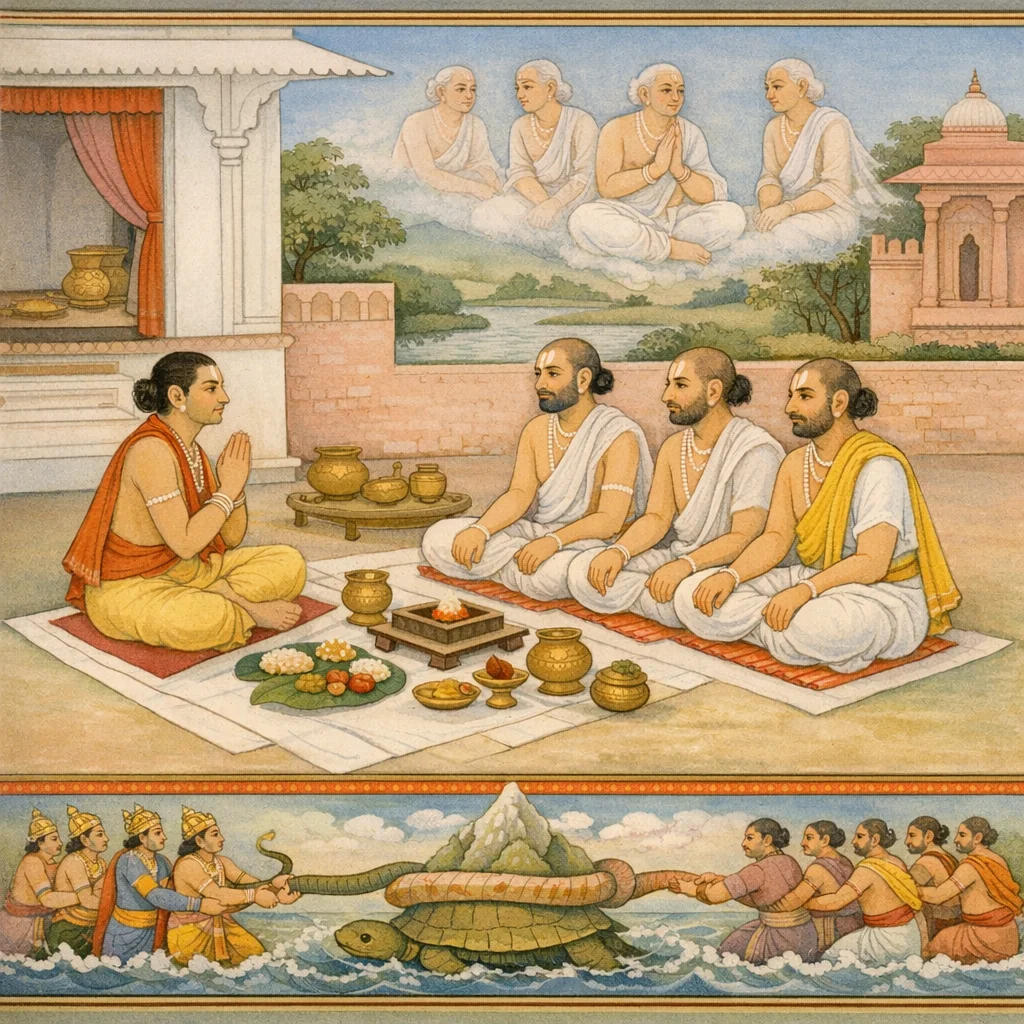
Continuing the Uttara-bhāga’s dharma teaching, Vyāsa sets out a complete procedure for śrāddha: pre-rite invitations and brāhmaṇa qualifications, choice of place, seating directions, mantra-invocations, homa, and the placing of piṇḍas. He explains the metaphysics of participation—Pitṛs arrive at the appointed time, partake subtly alongside the brāhmaṇas, and depart satisfied to higher states. Ritual ethics are then tightened, warning against invited priests abandoning the rite, sexual misconduct, quarrels, and breaches of discipline, since these lessen ancestral nourishment. Detailed liturgy follows: Vaiśvadeva first, east/south seating, darbha/kuśa arrangements, arghya and sesame/barley consecrations, and distinctions of upavīta/prācīnāvīta and knee posture for deva versus pitṛ acts. The feeding sequence culminates in svādhyāya recitation, dismissal formulas, piṇḍa disposal, household distribution, and post-rite brahmacarya. The close turns to special cases (āma-śrāddha without fire, accommodations for poverty), inheritance-linked piṇḍa rules (bījī/kṣetrin), timing variants (ekoddiṣṭa; forenoon prosperity rites), and insists that mātṛyāga precede śrāddha, preparing the next unit on Mothers’ worship and the threefold śrāddha order.
Shlokas
Verse 1
इति श्रीकूर्मपुराणे षट्साहस्त्र्यां संहितायामुपरिविभागे एकविशो ऽध्याय इन् रेए निछ्त् ज़ुल्äस्सिगे ज़ेइछेन्: व्यास उवाच गोमयेनोदकैर्भूमिं शोधयित्वा समाहितः / संनिपात्य द्विजान् सर्वान् साधुभिः संनिमन्त्रयेत्
Thus, in the sacred Śrī Kūrma Purāṇa, in the six‑thousand‑verse Saṃhitā, in the latter division—(the chapter colophon occurs here). Vyāsa said: Having purified the ground with cow‑dung and water, and having become composed, one should gather all the twice‑born, and with the aid of the virtuous, formally invite them for the holy rite.
Verse 2
श्वो भविष्यति मे श्राद्धं पूर्वेद्युरभिपूज्य च / असंभवे परेद्युर्वा यथोक्तैर्लक्षणैर्युतान्
“My śrāddha will be performed tomorrow. Therefore, on the previous day one should respectfully invite and honor the brāhmaṇas; if that is not possible, then one may do so on the following day—selecting those endowed with the prescribed qualifications.”
Verse 3
तस्य ते पितरः श्रुत्वा श्राद्धकालमुपस्थितम् / अन्योन्यं मनसा ध्यात्वा संपतन्ति मनोजवाः
Hearing that the time for his śrāddha has arrived, his Pitṛs (ancestral fathers), recognizing one another in the mind, swiftly descend—moving with the speed of thought.
Verse 4
ब्राह्मणैस्ते सहाश्नन्ति पितरो ह्यन्तरिक्षगाः / वायुभूतास्तु तिष्ठन्ति भुक्त्वा यान्ति परां गतिम्
Those Pitṛs who move in the mid‑region (antarikṣa) partake of the offering along with the brāhmaṇas. Assuming a form of wind, they remain present; and when satisfied, they depart to the highest state.
Verse 5
आमन्त्रिताश्च ते विप्राः श्राद्धकाल उपस्थिते / वसेयुर्नियताः सर्वे ब्रह्मचर्यपरायणाः
When the time for the Śrāddha has arrived, the invited brāhmaṇas should all remain there with disciplined conduct, devoted to brahmacarya.
Verse 6
अक्रोधनो ऽत्वरो ऽमत्तः सत्यवादी समाहितः / भारं मैथुनमध्वानं श्राद्धकृद् वर्जयेज्जपम्
One who undertakes japa should be free from anger, unhurried, not intoxicated, truthful, and mentally collected. During japa one should avoid carrying heavy loads, sexual intercourse, and long journeys; and when performing śrāddha rites one should refrain from japa.
Verse 7
आमन्त्रितो ब्राह्मणो वा यो ऽन्यस्मै कुरुते क्षणम् / स याति नरकं घोरं सूकरत्वां प्रायाति च
If a brāhmaṇa, having been formally invited, even for a moment turns away to serve another, he goes to a dreadful hell—and thereafter attains the state of a pig as well.
Verse 8
आमन्त्रयित्वा यो मोहादन्यं चामन्त्रयेद् द्विजम् / स तस्मादधिकः पापी विष्ठाकीटो ऽभिजायते
If, after having invited one brāhmaṇa, a person—out of delusion—also invites another brāhmaṇa in his place, then he becomes even more sinful than for that earlier fault; he is born as a worm in excrement.
Verse 9
श्राद्धे निमन्त्रितो विप्रो मैथुनं यो ऽधिगच्छति / ब्रह्महत्यामवाप्नोति तिर्यग्योनौ च जायते
A brāhmaṇa who, having been invited for a śrāddha rite, engages in sexual intercourse incurs the sin of brahma-hatyā (the gravest transgression) and is born thereafter in an animal womb.
Verse 10
निमन्त्रितस्तु यो विप्रो ह्यध्वानं याति दुर्मतिः / भवन्ति पितरस्तस्य तं मासं पांशुभोजनाः
But if a brāhmaṇa, though duly invited, foolishly goes off on a journey, then his ancestors (pitṛs) are forced for that month to subsist on dust as their food.
Verse 11
निमन्त्रितस्तु यः श्राद्धे प्रकुर्यात् कलहं द्विजः / भवन्ति तस्य तन्मासं पितरो मलभोजनाः
But if a twice-born man, though invited to a Śrāddha, stirs up quarrel there, then for that whole month his Pitṛs (ancestors) become as eaters of filth, receiving impure and degraded offerings.
Verse 12
तस्मान्निमन्त्रितः श्राद्धे नियतात्मा भवेद् द्विजः / अक्रोधनः शौचपरः कर्ता चैव जितेन्द्रियः
Therefore, a twice-born (brāhmaṇa) invited to a Śrāddha should be self-restrained—free from anger, devoted to purity, skilled in performing the rite, and one who has conquered the senses.
Verse 13
श्वोभूते दक्षिणां गत्वा दिशं दर्भान् समाहितः / समूलानाहरेद् वारि दक्षिणाग्रान् सुनिर्मलान्
At dawn, with a collected mind, he should go to the southern direction and fetch, with water, very pure darbha-grass—taking it up with the roots and with the tips oriented southward.
Verse 14
दक्षिणाप्रवणं स्निग्धं विभक्तं शुभलक्षणम् / शुचिं देशं विविक्तं च गोमयेनोपलेपयेत्
One should prepare a clean and secluded spot—gently sloping to the south, smooth and well-finished, properly set apart, and bearing auspicious signs—and plaster that purified ground with cow-dung.
Verse 15
नदीतीरेषु तीर्थेषु स्वभूमौ चैव सानुषु / विविक्तेषु च तुष्यन्ति दत्तेन पितरः सदा
The Pitṛs (ancestral spirits) are always gratified by offerings made on riverbanks, at tīrthas (sacred pilgrimage sites), on one’s own land, on mountain slopes, and also in secluded places.
Verse 16
पारक्ये भूमिभागे तु पितॄणां नैव निर्वपेत् / स्वामिभिस्तद् विहन्येत मोहाद् यत् क्रियते नरैः
One should never perform śrāddha, the ancestral offering to the Pitṛs, upon another’s land. Whatever men do there in delusion becomes fruitless, for it is nullified by the rightful owners of that place.
Verse 17
अटव्यः पर्वताः पुण्यास्तीर्थान्यायतनानि च / सर्वाण्यस्वामिकान्याहुर्न हि तेषु परिग्रहः
Holy forests, sacred mountains, tīrthas—pilgrimage-fords—and sanctuaries are all declared to be without private ownership; for in such places there is no rightful claim of possession.
Verse 18
तिलान् प्रविकिरेत् तत्र सर्वतो बन्धयेदजान् / असुरोपहतं सर्वं तिलैः शुद्ध्यत्यजेन वा
There one should scatter sesame seeds in every direction and tether goats on all sides. Everything struck by asuric influence is purified—either by sesame seeds or by a goat used in the rite.
Verse 19
ततो ऽन्नं बहुसंस्कारं नैकव्यञ्जनमच्युतम् / चोष्यपेयसमृद्धं च यथाशक्त्या प्रकल्पयेत्
Then, as best as one is able, one should prepare food well-cooked with many refinements, accompanied by various side-dishes, and abundant in both chewable foods and drinkables—offering it to Acyuta, the Imperishable Lord.
Verse 20
ततो निवृत्ते मध्याह्ने लुप्तलोमनखान् द्विजान् / अभिगम्य यथामार्गं प्रयच्छेद् दन्तधावनम्
Then, when midday has passed, one should approach the twice-born who have had their hair and nails trimmed, and in the proper manner provide them with tooth-cleaning sticks for dental purification.
Verse 21
तैलमभ्यञ्जनं स्नानं स्नानीयं च पृथग्विधम् / पात्रैरौदुम्बरैर्दद्याद् वैश्वदैवत्यपूर्वकम्
One should offer, as separate gifts, the oil for anointing, the bath itself, and the various requisites for bathing; and give them in vessels of udumbara-wood, first preceded by the rite of Vaiśvadeva—offerings to the universal deities.
Verse 22
ततः स्नात्वा निवृत्तेभ्यः प्रत्युत्थायकृताञ्जलिः / पाद्यमाचमनीयं च संप्रयच्छेद् यथाक्रमम्
Then, having bathed, one should rise to greet those who have returned, with folded hands, and offer—according to the proper order—water for washing the feet and water for ācamana, the ritual sipping.
Verse 23
ये चात्र विश्वेदेवानां विप्राः पूर्वं निमन्त्रिताः / प्राङ्मुखान्यासनान्येषां त्रिदर्भोपहितानि च
And the brāhmaṇa priests who had earlier been invited here for the rite of the Viśvedevās had seats arranged facing east; and those seats, too, were furnished with three blades of sacred darbha grass.
Verse 24
दक्षिणामुखयुक्तानि पितॄणामासनानि च / दक्षिणाग्रैकदर्भाणि प्रोक्षितानि तिलोदकैः
He should arrange the seats for the Pitṛs—the Ancestors—facing south, place single blades of kuśa grass with their tips turned southward, and then sprinkle them with water mixed with sesame.
Verse 25
तेषूपवेशयेदेतानासनं स्पृश्य स द्विजम् / आसध्वमिति संजल्पन् आसनास्ते पृथक् पृथक्
Having seated them there, the host should touch the seat and, with reverence, the dvija—the brāhmaṇa—saying, “Be seated,” and set out the seats separately for each one.
Verse 26
द्वौ दैवे प्राङ्मुखौ पित्र्ये त्रयश्चोदङ्मुखास्तथा / एकैकं वा भवेत् तत्र देवमातामहेष्वपि
For offerings to the gods, two brāhmaṇas should be seated facing east; for offerings to the ancestors (pitṛs), three should be seated facing north. Or, there one may appoint even one for each—likewise in the rites for the gods, the mother, and the maternal grandfather.
Verse 27
सत्क्रियां देशकालौ च शौचं ब्राह्मणसंपदम् / पञ्चैतान् विस्तरो हन्ति तस्मान्नेहेत विस्तरम्
Proper rites, the fitting place and time, purity, and the competent presence of brāhmaṇas—these five are spoiled by excessive elaboration; therefore one should not pursue needless prolixity in ritual.
Verse 28
अपि वा भोजयेदेकं ब्राह्मणं वेदपारगम् / श्रुतशीलादिसंपन्नमलक्षणविवर्जितम्
Or else, one should feed even a single brāhmaṇa who has mastered the Vedas—endowed with sacred learning, good conduct, and the like, and free from disqualifying faults.
Verse 29
उद्धृत्य पात्रे चान्नं तत् सर्वस्मात् प्रकृतात् पुनः / देवतायतने चास्मै निवेद्यान्यत्प्रवर्तयेत्
Then, having again taken that cooked food from the general portion and placed it in a clean vessel, one should offer it to Him in the deity’s sanctuary as naivedya, and thereafter proceed with the remaining rites.
Verse 30
प्रास्येदग्नौ तदन्नं तु दद्याद् वा ब्रह्मचारिणे / तस्मादेकमपि श्रेष्ठं विद्वांसं भोजयेद् द्विजम्
One should cast that food into the sacred fire (Agni), or else give it to a brahmacārin, a Vedic student. Therefore, even if only one is to be fed, one should feed an excellent, learned twice-born (brāhmaṇa).
Verse 31
भिक्षुको ब्रह्मचारी वा भोजनार्थमुपस्थितः / उपविष्टेषु यः श्राद्धे कामं तमपि भोजयेत्
If a mendicant or a brahmacārin arrives seeking food, then—even when the guests have already been seated for the śrāddha—one should willingly feed him as well.
Verse 32
अतिथिर्यस्य नाश्नाति न तच्छ्राद्धं प्रशस्यते / तस्मात् प्रयत्नाच्छ्राद्धेषु पूज्या ह्यतिथयो द्विजैः
That śrāddha is not praised in which the guest does not partake of food. Therefore, with careful effort, guests should indeed be honored by the twice-born during śrāddha rites.
Verse 33
आतिथ्यरहिते श्राद्धे भुञ्जते ये द्विजातयः / काकयोनिं व्रजन्त्येते दाता चैव न संशयः
If the twice-born partake of a Śrāddha in which hospitality is absent, they fall into the womb of crows; and the donor as well—of this there is no doubt.
Verse 34
हीनाङ्गः पतितः कुष्ठी व्रणी पुक्कसनास्तिकौ / कुक्कुटाः शूकराः श्वानो वर्ज्याः श्राद्धेषु दूरतः
In rites of śrāddha, one should keep far away those who are physically maimed, those fallen from prescribed conduct, lepers, the ulcered or wounded, the pukkasa, and the nāstika; likewise, fowls, pigs, and dogs are to be strictly excluded.
Verse 35
बीभत्सुमशुचिं नग्नं मत्तं धूर्तं रजस्वलाम् / नीलकाषायवसनं पाषण्डांश्च विवर्जयेत्
One should avoid the disgusting and impure—those who are naked, intoxicated, deceitful, and a menstruating woman—as well as those wearing blue or ochre garments as sectarian marks, and also the pāṣaṇḍas (heretical, dharma-opposing sectarians).
Verse 36
यत् तत्र क्रियते कर्म पैतृकं ब्राह्मणान् प्रति / तत्सर्वमेव कर्तव्यं वैश्वदैवत्यपूर्वकम्
Whatever ancestral rite is performed there in relation to the Brāhmaṇas—indeed all of it should be carried out only after first performing the Vaiśvadeva, the offering to the universal deities.
Verse 37
यथोपविष्टान् सर्वांस्तानलङ्कुर्याद् विभूषणः / स्त्रग्दामभिः शिरोवेष्टैर्धूपवासो ऽनुलेपनैः
Then the attendant of honour should adorn them all, just as they are seated—by offering garlands and floral strings, head-wraps, incense, fine garments, and fragrant unguents.
Verse 38
ततस्त्वावाहयेद् देवान् ब्राह्मणानामनुज्ञया / उदङ्मुखो यथान्यायं विश्वे देवास इत्यृचा
Then, with the permission of the brāhmaṇas, he should duly invoke the gods—seated facing north—according to proper rule, by reciting the Ṛgvedic hymn beginning, “viśve devāsaḥ …” (“O All-Gods …”).
Verse 39
द्वे पवित्रे गृहीत्वाथ भाजने क्षालिते पुनः / शं नो देव्या जलं क्षिप्त्वा यवो ऽसीति यवांस्तथा
Then, taking two sanctifying pavitra-grass rings and again using a vessel washed clean, one should sprinkle water while reciting, “May the Goddess grant us auspiciousness”; and likewise consecrate the barley, reciting, “You are barley.”
Verse 40
या दिव्या इति मन्त्रण हस्ते त्वर्घं विनिक्षिपेत् / प्रदद्याद् गन्धमाल्यानि धूपादीनि च शक्तितः
Reciting the mantra beginning with “yā divyā…”, one should place the arghya-offering into the hand (of the deity or the worshipped recipient). Then, according to one’s capacity, one should offer fragrance, garlands, incense, and the other customary items of worship.
Verse 41
अपसव्यं ततः कृत्वा पितॄणां दक्षिणामुखः / आवाहनं ततः कुर्यादुशन्तस्त्वेत्यृचा बुधः
Then, having arranged the sacred thread in the apasavya manner and facing south for the Pitṛs (ancestors), the wise should next perform their invocation (āvāhana), using the Ṛgvedic verse beginning with “uśantaḥ”.
Verse 42
आवाह्य तदनुज्ञातो जपेदायन्तु नस्ततः / शं नो देव्योदकं पात्रे तिलो ऽसीति तिलांस्तथा
Having invoked them and received permission to proceed, he should then recite, “May they come to us.” Thereafter he recites, “O divine Water in the vessel, be auspicious to us,” and likewise over the sesame-seeds, “You are sesame.”
Verse 43
क्षिप्त्वा चार्घं यथापूर्वं दत्त्वा हस्तेषु वै पुनः / संस्त्रवांश्च ततः सर्वान् पात्रे कुर्यात् समाहितः / पितृभ्यः स्थानमेतेन न्युब्जं पात्रं निधापयेत्
Having poured the arghya as before and again placed (water) into the hands, the focused practitioner should then collect all the remaining drippings into a vessel. By this act he establishes the place for the Pitṛs and sets down the vessel turned upside down.
Verse 44
अग्नौ करिष्येत्यादाय पृच्छत्यन्नं घृतप्लुतम् / कुरुष्वेत्यभ्यनुज्ञातो जुहुयादुपवीतवान्
Taking the food drenched with ghee and asking, “Shall I offer this into the fire?”, when permitted with the words “Do so,” the performer, wearing the sacred thread in the proper (upavīta) manner, should make the oblation into Agni.
Verse 45
यज्ञोपवीतिना होमः कर्तव्यः कुशपाणिना / प्राचीनावीतिना पित्र्यं वैश्वदेवं तु होमवत्
Homa should be performed while wearing the sacred thread in the proper (upavīta) manner, with kuśa-grass held in the hand. But the ancestral rite (pitrya) should be done with the sacred thread worn in the reverse (prācīnāvīta) manner; and the Vaiśvadeva offering is to be performed in the same way as a homa.
Verse 46
दक्षिणं पातयेज्जानुं देवान् परिचरन् पुमान् / पितृणां परिचर्यासु पातयेदितरं तथा
While serving the gods, a man should lower his right knee to the ground; and in acts of service to the Pitṛs, the ancestral Fathers, he should likewise lower the other (left) knee.
Verse 47
सोमाय वै पितृमते स्वधा नम इति ब्रुवन् / अग्नये कव्यवाहनाय स्वधेति जुहुयात् ततः
Uttering, “To Soma—aligned with the Pitṛs, the Fathers—svadhā; reverence (namaḥ),” one should then offer an oblation, saying “svadhā,” into Agni, the carrier of the ancestral offering (kavya-vāhana).
Verse 48
अग्न्यभावे तु विप्रस्य पाणावेवोपपादयेत् / महादेवान्तिके वाथ गोष्ठे वा सुसमाहितः
But when a brāhmaṇa has no sacred fire, he should perform the rite in his own cupped hands; or else, well-composed in mind, he may perform it in the presence of Mahādeva, or in a cowshed.
Verse 49
ततस्तैरभ्यनुज्ञातो गत्वा वै दक्षिणां दिशम् / गोमयेनोपतिप्योर्वों स्थानं कृत्वा तु सैकतम्
Then, having received their permission, he proceeded indeed toward the southern direction; and, after plastering the ground with cow-dung, he prepared a sandy spot as a proper place for the rite.
Verse 50
मण्डलं चतुरस्त्रं वा दक्षिणावनतं शुभम् / त्रिरुल्लिखेत् तस्य मध्यं दर्भेणैकेन चैव हि
One should make a sacred diagram—either a circular maṇḍala or a four-sided one—auspicious and gently sloping toward the south; then, with a single blade of darbha grass, one should mark its center three times.
Verse 51
ततः संस्तीर्य तत्स्थाने दर्भान् वैदक्षिणाग्रकान् / त्रीन् पिण्डान् निर्वपेत् तत्र हविः शेषात्समाहितः
Then, spreading kuśa grass there with its tips turned southward, the focused performer should place three rice-balls (piṇḍas) at that spot, using the remainder of the oblation (havis).
Verse 52
न्युप्य पिण्डांस्तु तं हस्तं निमृज्याल्लेपभागिनाम् / तेषु दर्भेष्वथाचम्य त्रिरायम्य शनैरसून् / तदन्नं तु नमस्कुर्यात् पितॄनेव च मन्त्रवित्
After placing the piṇḍa-balls, he should wipe the hand smeared for those who partake of the remnants. Then, upon the darbha grass, he should perform ācamana and, three times, gently regulate the breath. Thereafter, the knower of mantra should reverently salute that food-offering as though saluting the Pitṛs themselves.
Verse 53
उदकं निनयेच्छेषं शनैः पिण्डान्तिके पुनः / अवजिघ्रेच्च तान् पिण्डान् यथान्युप्तान् समाहितः
Then, with composure, he should slowly bring the remaining water again near the piṇḍas, and, with a collected mind, gently smell those piṇḍa-offerings just as they have been placed.
Verse 54
अथ पिण्डावशिष्टान्नं विधिना भोजयेद् द्विजान् / मांसान्यपूपान् विविधान् दद्यात् कृसरपायसम्
Then, in the prescribed manner, one should feed the twice-born with the food remaining after the piṇḍa-offerings; and one should also give various meats and cakes, along with kṛsara and pāyasa (sweet milk-rice).
Verse 55
सूपशाकफलानीक्षून् पयो दधि घृतं मधु / अन्नं चैव यथाकामं विविधं भक्ष्यपेयकम्
He should offer soups, cooked vegetables, fruits, and sugarcane; also milk, curd (dadhi), ghee (ghṛta), and honey—along with food as desired, in many kinds of eatables and drinks.
Verse 56
यद् यदिष्टं द्विजेन्द्राणां तत्सर्वं विनिवेदयेत् / धान्यांस्तिलांश्च विविधान् शर्करा विविधास्तथा
Whatever the foremost among the twice-born desire—one should offer all of that: various grains, diverse sesame seeds, and likewise sugars of different kinds.
Verse 57
उष्णमन्नं द्विजातिभ्यो दातव्यं श्रेय इच्छता / अन्यत्र फलमूलेभ्यः पानकेभ्यस्तथैव च
One who seeks spiritual welfare should give warm, freshly prepared food to the twice-born; except in the case of fruits and roots—and likewise in the case of drinks (pānaka), which may be given otherwise.
Verse 58
नाश्रूणि पातयेज्जातु न कुप्येन्नानृतं वदेत् / न पादेन स्पृशेदन्नं न चैतदवधूनयेत्
One should never let tears fall, should not give way to anger, and should not speak falsehood. One should not touch food with the foot, nor should one shake it off or treat it with contempt.
Verse 59
क्रोधेन चैव यत् दत्तं यद् भुक्तं त्वरया पुनः / यातुधाना विलुम्पन्ति जल्पता चोपपादितम्
Whatever is given in anger, whatever is eaten again in haste, and whatever is offered while talking and making excuses—such acts are plundered by yātudhānas (harmful beings), and their merit is lost.
Verse 60
स्विन्नगात्रो न तिष्ठेत सन्निधौ तु द्विजन्मनाम् / न चात्र श्येनकाकादीन् पक्षिणः प्रतिषेधयेत् / तद्रूपाः पितरस्तत्र समायान्ति बुभुक्षवः
One should not stand before the twice-born while the body is sweaty. Nor should one, during this rite, drive away birds such as hawks and crows; for the ancestors (Pitṛs), assuming those very forms, come there seeking nourishment.
Verse 61
न दद्यात् तत्र हस्तेन प्रत्यक्षलवणं तथा / न चायसेन पात्रेण न चैवाश्रद्धया पुनः
In the act of giving, one should not hand over salt directly with the bare hand; nor should one offer it in an iron vessel; and one must never give without faith (śraddhā).
Verse 62
काञ्चनेन तु पात्रेण राजतौदुम्बरेण वा / दत्तमक्षयतां याति खड्गेन च विशेषतः
A gift offered in a golden vessel—or in a silver or udumbara-wood vessel—attains imperishable merit; and this is especially so when it is accompanied by the donation of a sword.
Verse 63
पात्रे तु मृण्मये यो वै श्राद्धे भोजयते पितन् / स याति नरकं घोरं भोक्ता चैव पुरोधसः
Whoever, at a Śrāddha, feeds the Pitṛs using an earthen vessel goes to a dreadful hell; and so too does the officiating priest (purohita) who partakes in that rite.
Verse 64
न पङ्क्त्यां विषमं दद्यान्न याचेन्न च दापयेत् / याचिता दापिता दाता नरकान् यान्ति दारुणान्
In a seated line of guests at a ritual meal, one should not distribute gifts unequally; one should neither beg nor pressure another to give. The asker, the one compelled to give, and the one who gives under such solicitation all go to dreadful hells.
Verse 65
भुञ्जीरन् वाग्यताः शिष्टा न ब्रूयुः प्राकृतान् गुणान् / तावद्धि पितरो ऽश्नन्ति यावन्नोक्ता हविर्गुणाः
Let the well-bred participants eat in disciplined silence, restraining speech, and not speak of worldly, vulgar matters. For the Pitṛs partake of the havis only so long as the merits and sacred qualities of the oblation are being recited.
Verse 66
नाग्रासनोपविष्टस्तु भुञ्जोत प्रथमं द्विजः / बहूनां पश्यतां सो ऽज्ञः पङ्क्त्या हरति किल्बिषम्
A twice-born should not eat while seated upon the threshold; rather, he should eat first in the proper order. If, in folly, he eats in a row (pankti) while many look on, he casts sin upon that very dining line.
Verse 67
न किञ्चिद् वर्जयेच्छ्राद्धे नियुक्तस्तु द्विजोत्तमः / न मांसं प्रतिषेधेत न चान्यस्यान्नमीक्षयेत्
When a foremost twice-born has been appointed for a Śrāddha, he should reject nothing that is offered according to rule. He should not forbid meat when it is part of the prescribed offering, nor should he cast his eye upon another’s food.
Verse 68
यो नाश्नाति द्विजो मांसं नियुक्तः पितृकर्मणि / स प्रेत्य पशुतां याति संभवानेकविंशतिम्
A twice-born man who, though duly appointed in the ancestral rite (pitṛkarma), does not eat the meat prescribed therein—after death he falls into animal births, undergoing twenty-one successive embodiments.
Verse 69
स्वाध्यायं श्रावयेदेषां धर्मशास्त्राणि चैव हि / इतिहासपुराणानि श्राद्धकल्पांश्च शोभनान्
One should have sacred recitation (svādhyāya) performed for them—indeed the Dharma-śāstras as well—together with the Itihāsas and Purāṇas, and the excellent ritual manuals (kalpas) pertaining to śrāddha.
Verse 70
ततो ऽन्नमुत्सृजेद् भुक्ते अग्रतो विकिरन् भुवि / पृष्ट्वा तृप्ताः स्थ इत्येवं तृप्तानाचामयेत् ततः
Thereafter, when the meal has been eaten, one should set aside food as an offering, scattering it upon the ground in front. Then, asking, “Are you satisfied? Remain in contentment,” one should have the satisfied guests perform ācamana, the ritual sipping of water.
Verse 71
आचान्ताननुजानीयादभितो रम्यतामिति / स्वधास्त्विति च तं ब्रूयुर्ब्राह्मणास्तदनन्तरम्
After they have performed ācamana (sipping water for purification), he should respectfully dismiss them, saying, “May you be delighted and fare well on every side.” Immediately thereafter, the brāhmaṇas should reply, “Svadhā—so be it!”
Verse 72
ततो भुक्तवतां तेषामन्नशेषं निवेदयेत् / यथा ब्रूयुस्तथा कुर्यादनुज्ञातस्तु वै द्विजैः
Then, after those brāhmaṇas have eaten, one should respectfully present to them the remaining portion of the food. And once the twice-born (dvijas) have granted permission, one should act exactly as they instruct.
Verse 73
पित्र्ये स्वदित इत्येव वाक्यं गोष्ठेषु सूनृतम् / संपन्नमित्यभ्युदये दैवे रोचत इत्यपि
In rites for the Pitṛs (ancestral Fathers), one should speak the gentle and truthful word, “It has been well relished (svaditam).” In gatherings too, sweet and honest speech is enjoined. At times of prosperity and auspicious rise, one should say, “It has been successfully accomplished (saṃpannam),” and in divine rites as well, “It is pleasing/approved (rocat[e]).”
Verse 74
विसृज्य ब्राह्मणांस्तान् वै दैवपूर्वं तु वाग्यतः / दक्षिणां दिशमाकाङ् क्षन्याचेतेमान् वरान् पितॄन्
Having duly dismissed those brāhmaṇas, with his speech first directed toward the Devas, he then turned his longing toward the southern quarter and entreated these excellent Pitṛs (ancestral Fathers).
Verse 75
दातारो नो ऽभिवर्धन्तां वेदाः संततिरेव च / श्रद्धा च नो मा व्यगमद् बहुदेयं च नोस्त्त्विति
May our benefactors increase and flourish; may the Vedas—and our lineage as well—endure. May our śraddhā (faith) never depart, and may we always have abundant means to give—so be it.
Verse 76
पिण्डांस्तु गो ऽजविप्रेभ्यो दद्यादग्नौ जले ऽपि वा / मध्यमं तु ततः पिण्डमद्यात् पत्नी सुतार्थिनी
He should offer the piṇḍas (rice-balls) to cows, goats, and brāhmaṇas—or else consign them into fire, or even into water. Thereafter, the wife who longs for a son should eat the middle piṇḍa.
Verse 77
प्रक्षाल्य हस्तावाचम्य ज्ञातीन् शेषेण तोषयेत् / ज्ञातिष्वपि चतुष्टेषु स्वान् भृत्यान् भोजयोत् ततः / पश्चात् स्वयं च पत्नीभिः शेषमन्नं समाचरेत्
Having washed the hands and performed ācamana, one should satisfy one’s kinsmen with the remaining food. Even when the four classes of relatives have been duly attended to, one should thereafter feed one’s own dependents and servants. Finally, together with one’s wives, one should partake of the remaining food oneself, in due order.
Verse 78
नोद्वासयेत् तदुच्छिष्टं यावन्नास्तङ्गतो रविः / ब्रह्मचारी भवेतां तु दम्पती रजनीं तु ताम्
One should not discard that remaining offering so long as the sun has not set. And that night, the husband and wife should live as celibates, observing brahmacarya.
Verse 79
दत्त्वा श्राद्धं तथा भुक्त्वा सेवते यस्तु मैथुनम् / महारौरवमासाद्य कीटयोनिं व्रजेत् पुनः
He who, after offering the śrāddha and then eating, engages in sexual intercourse—having reached the hell called Mahāraurava—falls again into birth as a worm or insect.
Verse 80
शुचिरक्रोधनः शान्तः सत्यवादी समाहितः / स्वाध्यायं च तथाध्वानं कर्ता भोक्ता च वर्जयेत्
One should be pure, free from anger, tranquil, truthful, and inwardly collected. One should maintain svādhyāya (sacred self-study) and dhyāna (meditation), and abandon the notions: “I am the doer” and “I am the enjoyer.”
Verse 81
श्राद्धं भुक्त्वा परश्राद्धं भुञ्जते ये द्विजातयः / महापातिकिभिस्तुल्या यान्ति ते नरकान् बहून्
Those twice-born who, after eating at one śrāddha, go on to eat at another person’s śrāddha are deemed equal to great sinners (mahāpātakins); they proceed to many hells.
Verse 82
एष वो विहितः सम्यक् श्राद्धकल्पः सनातनः / आमेन वर्तयेन्नित्यमुदासीनो ऽथ तत्त्ववित्
Thus, for you, the eternal and correct procedure of Śrāddha has been fully prescribed. Therefore, the knower of truth should regularly follow it in the proper manner—remaining inwardly detached and even-minded.
Verse 83
अनग्निरध्वगो वापि तथैव व्यसनान्वितः / आमश्राद्धं द्विजः कुर्याद् विधिज्ञः श्रद्धयान्वितः / तेनाग्नौ करणं कुर्यात् पिण्डांस्तेनैव निर्वपेत्
Even if a twice-born man is without a sacred fire, or is traveling, or is afflicted by misfortune, he—knowing the proper procedure and endowed with faith—should perform the āma-śrāddha. By means of that rite he should make the offerings into the fire, and by that very means he should also present the piṇḍa-balls.
Verse 84
यो ऽनेन विधिना श्राद्धं कुर्यात् संयतमानसः / व्यपेतकल्पषो नित्यं योगिनां वर्तते पदम्
Whoever, with a disciplined mind, performs the śrāddha according to this prescribed method becomes ever free from taint and continually abides in the state attained by yogins.
Verse 85
तस्मात् सर्वप्रयत्नेन श्राद्धं कुर्याद् द्विजोत्तमः / आराधितो भवेदीशस्तेन सम्यक् सनातनः
Therefore, with every effort, the best of the twice-born should perform the Śrāddha rites; by that, the Eternal Lord (Īśa) is rightly worshipped and becomes fully pleased.
Verse 86
अपि मूलैर्फलैर्वापि प्रकुर्यान्निर्धनो द्विजः / तिलोदकैस्तर्पयेद् वा पितॄन् स्नात्वा समाहितः
Even a poor twice-born man should perform the rite with roots or fruits; or, having bathed and steadied his mind, he should satisfy the Pitṛs, the ancestral spirits, with water mixed with sesame.
Verse 87
न जीवत्पितृको दद्याद्धोमान्तं चाभिधीयते / येषां वापि पिता दद्यात् तेषां चैके प्रचक्षते
One whose father is still living should not make such a gift; and it is said that this rule holds until the homa (fire-offering) is concluded. Yet some authorities declare that if the father himself gives, or authorizes the gift, it is permissible for those sons as well.
Verse 88
पिता पितामहश्चैव तथैव प्रपितामहः / यो यस्य म्रियते तस्मै देयं नान्यस्य तेन तु
The śrāddha gift or oblation should be offered to the very one to whom it is due—father, grandfather, or great-grandfather. Whoever dies as someone’s relative, to him alone it should be given; it is not to be given on account of another.
Verse 89
भोजयेद् वापि जीवन्तं यथाकामं तु भक्तितः / न जीवन्तमतिक्रम्य ददाति श्रूयते श्रुतिः
With devotion one should feed the living person according to his wish. The Śruti declares that one should not bypass the living and give offerings elsewhere.
Verse 90
द्व्यामुष्यायणिको दद्याद् बीजिक्षेत्रिकयोः समम् / ऋक्यादर्धं समादद्यान्नियोगोत्पादितो यदि
A son belonging to two paternal lines (dvyāmuṣyāyaṇika) should divide the estate equally between the begetter (bījī) and the legal husband, the ‘field’ (kṣetrika). But if the child has been produced through niyoga, he should take only half of the share due to the primary heir (ṛkya).
Verse 91
अनियुक्तः सुतो यश्च शुल्कतो जायते त्विह / प्रदद्याद् बीजिने पिण्डं क्षेत्रिणे तु ततो ऽन्यथा
A son born without a sanctioned appointment (niyoga), and a son born through a śulka (bride‑price) arrangement, should here offer the funeral rice‑ball (piṇḍa) to the begetter, the bījī. But for a field‑son (kṣetrija) it is otherwise—the piṇḍa is offered to the husband, the lord of the field (kṣetrin).
Verse 92
द्वौ पिण्डौ निर्वपेत् ताभ्यां क्षेत्रिणे बीजिने तथा / कीर्तयेदथ चैकस्मिन् बीजिनं क्षेत्रिणं ततः
One should offer two piṇḍa-balls—one to the kṣetrin, the lawful husband, and likewise one to the bījin, the begetter. Then, in a single piṇḍa, one should invoke them both together, naming first the begetter and then the husband.
Verse 93
मृताहनि तु कर्तव्यमेकोदिष्टं विधानतः / अशौचे स्वे परिक्षीणे काम्यं वै कामतः पुनः
On the very day of death, the single-offering śrāddha (ekoddiṣṭa) should be performed according to the prescribed rule. When one’s own period of ritual impurity (aśauca) has ended, optional kāmya rites may again be undertaken as one desires.
Verse 94
पूर्वाह्ने चैव कर्तव्यं श्राद्धमभ्युदयार्थिना / देववत्सर्वमेव स्याद् यवैः कार्या तिलक्रिया
One who seeks prosperity should perform the śrāddha in the forenoon. Everything in it should be done as in a rite for the gods; and the sesame-offering procedure (tilakriyā) should be carried out using barley (yava).
Verse 95
दर्भाश्च ऋजवः कार्या युग्मान् वै भोजयेद् द्विजान् / नान्दीमुखास्तु पितरः प्रीयन्तामिति वाचयेत्
One should arrange the kuśa-grass (darbha) straight, and then feed the dvija Brāhmaṇas in pairs. While doing so, one should recite: “May the auspicious Nāndīmukha Pitṛs be pleased.”
Verse 96
मातृश्राद्धं तु पूर्वं स्यात् पितॄणां स्यादनन्तरम् / ततो मातामहानां तु वृद्धौ श्राद्धत्रयं स्मृतम्
The śrāddha for the mother should be performed first, and thereafter the śrāddha for the paternal ancestors. Then, for the maternal grandfathers as well—when one is advanced in age—the tradition remembers a threefold sequence of śrāddhas.
Verse 97
दवपूर्वं प्रदद्याद् वै न कुर्यादप्रदक्षिणम् / प्राङ्मुखो निर्वपेत् पिण्डानुपवीती समाहितः
He should first make the offering with sacred darbha-grass, and he should not perform the rite without observing the proper rightward (clockwise) order. Facing east, composed in mind, and wearing the sacred thread in the appropriate manner, he should place the piṇḍas (rice-balls) as prescribed.
Verse 98
पूर्वं तु मातरः पूज्या भक्त्या वै सगणेश्वराः / स्थण्डिलेषु विचित्रेषु प्रतिमासु द्विजातिषु
First, the Mothers (Mātṛs) should indeed be worshipped with devotion, together with Gaṇeśvara. They are to be honored on decorated ritual ground-diagrams (sthaṇḍilas), through images, and through the twice-born (brāhmaṇa priests).
Verse 99
पुष्पेर्धूपैश्च नैवेद्यैर्गन्धाद्यैर्भूषणैरपि / पूजयित्वा मातृगणं कूर्याच्छ्राद्धत्रयं बुधः
Having worshipped the host of Mothers with flowers, incense, food-offerings (naivedya), fragrances and the like—even with ornaments—the wise person should then perform the threefold śrāddha rites.
Verse 100
अकृत्वा मातृयागं तु यः श्राद्धं परिवेषयेत् / तस्य क्रोधसमाविष्टा हिंसामिच्छन्ति मातरः
Whoever conducts a śrāddha without first performing the mātṛyāga—the offering to the Mothers—the Mothers, seized by anger, desire harm for him.
Frequently Asked Questions
It states that when the śrāddha time arrives the Pitṛs descend swiftly, partake along with the brāhmaṇas while remaining in subtle form (likened to wind), and after satisfaction depart toward the highest state.
A śrāddha is criticized when hospitality fails—especially if the guest does not partake of food; it also warns that improper invitee conduct (turning away, quarrels, sexual activity, journeys) and impure participants can ruin the rite’s fruit for both donor and officiants.
The chapter repeatedly places Vaiśvadeva first: ancestral acts connected to brāhmaṇas should be done only after performing Vaiśvadeva, and the rite’s vessels, bathing gifts, and worship sequence are framed as preceded by Vaiśvadeva.
It authorizes āma-śrāddha: the performer, with faith and knowledge of procedure, may make offerings in cupped hands, or in the presence of Mahādeva or a cowshed, and still present piṇḍas through the adapted method.
It claims that one who performs śrāddha with disciplined mind becomes free from taint and abides in a yogin-like state, and that the rite properly pleases the Eternal Lord (Īśa), making ritual duty an Īśvara-centered soteriological act.