Adhyaya 13
Svāyambhuva Lineage to Dakṣa; Pṛthu’s Devotion; Pāśupata Saṃnyāsa; Dakṣa–Satī Episode
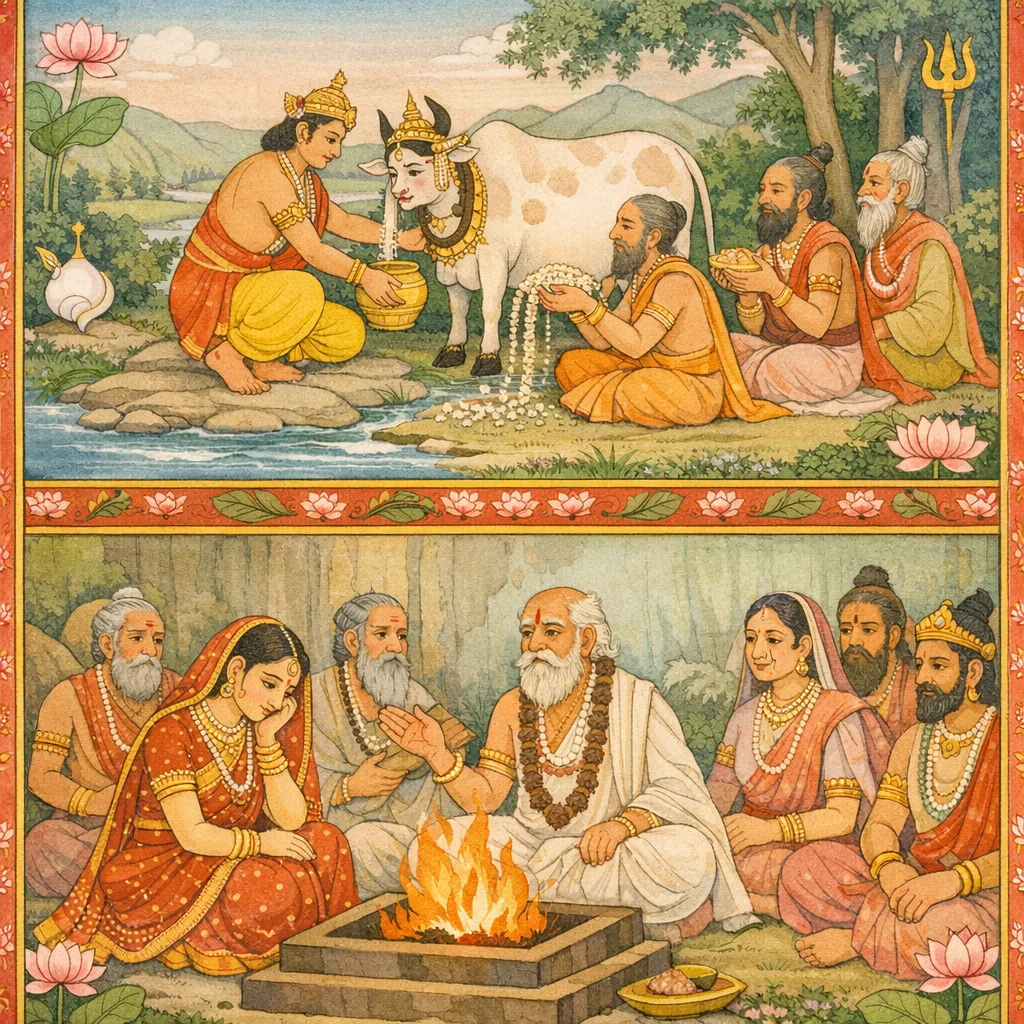
After the previous chapter’s close, Sūta continues the Svāyambhuva-Manu creation lineage: Uttānapāda begets Dhruva, and the descendants culminate in King Pṛthu (Vainya), famed for “milking” the Earth for the welfare of beings. The narrator also affirms a Purāṇic origin—Hari manifest as the Paurāṇika Sūta—thereby validating Purāṇa recitation as a dharmic vocation. The focus then shifts from kingship to renunciation: a royal descendant (Śikhaṇḍana/Suśīla) turns to saṃnyāsa, reaches the Himalayan sacred realm (Mandākinī, Dharmapada), worships Śiva with Veda-born hymns, and receives from the Pāśupata master Śvetāśvatara initiation into saṃnyāsa-vidhi and a liberating mantra. The narrative returns to progeny (Havirdhāna → Prācīnabarhiṣ → the ten Pracetas → Dakṣa) and ends with Dakṣa’s conflict with Rudra, Satī’s self-immolation, Pārvatī’s union with Śiva, and Rudra’s curse—linking genealogical cosmology with sectarian reconciliation in the Purāṇa’s synthesis (Śaiva–Vaiṣṇava harmony). This prepares the next movement into manvantaric history and the consequences of devotion, offense, and austerity.
Shlokas
Verse 1
इति श्रीकूर्मपुराणे षट्साहस्त्र्यां संहितायां पूर्वविभागे द्वादशो ऽध्यायः सूत उवाच प्रियव्रतोत्तानपादौ मनोः स्वायंभुवस्य तु / धर्मज्ञौ सुमहावीर्यौ शतरूपा व्यजीजनत्
Thus, in the Śrī Kūrma Purāṇa, in the Ṣaṭsāhasrī Saṃhitā, in the Pūrvabhāga, the twelfth chapter concludes. Sūta said: From Svāyambhuva Manu, Śatarūpā gave birth to Priyavrata and Uttānapāda—both knowers of dharma and endowed with great heroism.
Verse 2
ततस्तूत्तानपादस्य ध्रुवो नाम सुतो ऽभवत् / भक्तो नारायणे देवे प्राप्तवान् स्थानमुत्तमम्
Then, to Uttānapāda was born a son named Dhruva. Devoted in bhakti to Lord Nārāyaṇa, he attained the highest station.
Verse 3
ध्रुवात् श्लिष्टिञ्च भव्यं च भार्या शम्भुर्व्यजायत / श्लिष्टेराधत्त सुच्छाया पञ्च पुत्रानकल्पषान्
From Dhruva, his wife Śambhu bore Śliṣṭi and Bhavya. And from Śliṣṭi, Succhāyā conceived five sons, all pure and blameless in conduct.
Verse 4
वसिष्ठवचनाद् देवी तपस्तप्त्वा सुदुश्चरम् / आराध्य पुरुषं विष्णुं शालग्रामे जनार्दनम्
On Vasiṣṭha’s instruction, the Goddess undertook austerities most difficult to perform; and, worshipping Viṣṇu—the Supreme Puruṣa—as Janārdana in Śālagrāma, she propitiated Him.
Verse 5
रिपुं रिपुञ्जयं विप्रं वृकलं वृषतेजसम् / नारायणपरान् शुद्धान् स्वधर्मपरिपालकान्
He is the vanquisher of foes: a brahmana-sage who conquers hosts of enemies; fierce as a wolf and radiant with bull-like might—yet inwardly pure, devoted to Nārāyaṇa and steadfast in guarding his own dharma.
Verse 6
रिपोराधत्त बृहती चक्षुषं सर्वतेजसम् / सो ऽजीजनत् पुष्करिण्यां वैरण्यां चाक्षुषं मनुम् / प्रजापतेरात्मजायां वीरणस्य महात्मनः
From Ripu, Bṛhatī bore Cākṣuṣa, radiant with universal splendour. He, in turn, begot Cākṣuṣa Manu upon Puṣkariṇī—the noble Vairaṇyā, daughter of Prajāpati, born of the great-souled Vīraṇa.
Verse 7
मनोरजायन्त दश नड्वलायां महौजसः / कन्यायां सुमहावीर्या वैराजस्य प्रजापतेः
From Naḍvalā were born ten sons—men of great splendor. And from the daughter of Vairāja Prajāpati arose offspring endowed with mighty valor.
Verse 8
ऊरुः पूरुः शतद्युम्नस्तपस्वी सत्यवाक् शुचिः / अग्निष्टुदतिरात्रश्च सुद्युम्नश्चाभिमन्युकः
Ūru, Pūru, and Śatadyumna—an ascetic, truthful in speech, and pure—Agniṣṭut, Atirātra, and Sudyumna, along with Abhimanyu: these are the names recounted in this lineage.
Verse 9
ऊरोरजनयत् पुत्रान् षडाग्नेयी महाबलान् / अङ्गं सुमनसं स्वातिं क्रतुमङ्गिरसं शिवम्
From his thigh, Agneyī—the consort belonging to Agni—bore six sons of great might: Aṅga, Sumanas, Svāti, Kratu, Aṅgirasa, and Śiva.
Verse 10
अङ्गाद् वेनो ऽभवत् पश्चाद् बैन्यो वेनादजायत / यो ऽसौ पृथुरिति ख्यातः प्रजापालो महाबलः
From Aṅga, thereafter, Vena was born; and from Vena was born Bainya—he who is famed as Pṛthu, the mighty protector and ruler of the people.
Verse 11
येन दुग्धा मही पूर्वं प्राजानां हितकारणात् / नियोगाद् ब्रह्मणः सार्धं देवेन्द्रेण महौजसा
By him, in former times, the Earth was “milked” for the welfare of living beings—by the command of Brahmā—together with mighty, radiant Indra, lord of the gods.
Verse 12
वेनपुत्रस्य वितते पुरा पैतामहे मखे / सूतः पौराणिको जज्ञे मायारूपः स्वयं हरिः
Long ago, when Vena’s son performed the Paitāmaha sacrifice, Hari Himself—assuming a form wrought by His māyā—was born as the Paurāṇika Sūta, the sacred narrator of Purāṇic lore.
Verse 13
प्रवक्ता सर्वशास्त्राणां धर्मज्ञो गुणवत्सलः / तं मां नित्त मुनिश्रेष्ठाः पूर्वोद्भूतं सनातनम्
I am the expounder of all śāstras, the knower of Dharma, and the lover of virtue. Know Me always, O best of sages, as the primordial, eternal One who existed before all manifestation.
Verse 14
अस्मिन् मन्वन्तरे व्यासः कृष्णद्वैपायनः स्वयम् / श्रावयामास मां प्रीत्या पुराणं पुरुषो हरिः
In this Manvantara, Vyāsa—Kṛṣṇa-Dvaipāyana himself—lovingly caused me to hear this Purāṇa; for Hari is the Supreme Person (Purusha).
Verse 15
मदन्वये तु ये सूताः संभूता वेदवर्जिताः / तेषां पुराणवक्तृत्वं वृत्तिरासीदजाज्ञया
But those Sūtas born in my lineage, excluded from Vedic study—by the command of Brahmā (Ajā)—came to earn their livelihood by reciting and expounding the Purāṇas.
Verse 16
स तु वैन्यः पृथुर्धोमान् सत्यसंधो जितेन्द्रियः / सार्वभौमो महातेजाः स्वधर्मपरिपालकः
That Vainya—Prithu—was broad in fame and splendour, steadfast in truth, and master of his senses; a universal sovereign of great radiance, he upheld and protected his own dharma.
Verse 17
तस्य बाल्यात् प्रभृत्येव भक्तिर्नारायणे ऽभवत् / गोवर्धनगिरिं प्राप्य तपस्तेपे जितेन्द्रियः
From his very childhood onward, he bore unwavering devotion to Nārāyaṇa. Reaching Mount Govardhana, the self-controlled one performed tapas, having conquered his senses.
Verse 18
तपसा भगवान् प्रीतः शङ्खचक्रगदाधरः / आगत्य देवो राजानं प्राह दामोदरः स्वयम्
Pleased by the king’s austerities, the Blessed Lord—bearing conch, discus, and mace—came in person; and that divine Dāmodara Himself addressed the king.
Verse 19
ध्रमिकौ रूपसंपन्नौ सर्वशस्त्रभृतां वरौ / मत्प्रसादादसंदिग्धं पुत्रौ तव भविष्यतः / एकमुक्त्वा हृषीकेशः स्वकीयां प्रकृतिं गतः
“By My grace, you will surely have two sons—righteous in conduct, endowed with beauty, and foremost among all bearers of weapons.” Having said this, Hṛṣīkeśa returned to His own divine nature and abode.
Verse 20
वैन्यो ऽपि वेदविधिना निश्चलां भक्तिमुद्वहन् / अपालयत् स्वकं राज्यं न्यायेन मधुसूदने
Even King Vainya, upholding unwavering devotion in accordance with Vedic injunctions, protected his own kingdom with justice, O Madhusūdana, slayer of Madhu.
Verse 21
अचिरादेव तन्वङ्गो भार्या तस्य सुचिस्मिता / खिखण्डनं हविर्धानमन्तर्धाना व्यजायत
Before long, Tanvaṅga’s wife, the fair-smiling Sucismitā, gave birth to the sons Khikhaṇḍana and Havirdhāna, and also to a daughter named Antardhānā.
Verse 22
शिखण्डनो ऽभवत् पुत्रः सुशील इति विश्रुतः / धार्मिको रूपसंपन्नो वेदवेदाङ्गपारगः
He had a son named Śikhaṇḍana, renowned as “Suśīla” (the well-conducted). Righteous and fair in form, he was fully accomplished in the Vedas and their auxiliary sciences (Vedāṅgas).
Verse 23
सो ऽधीत्य विधिवद् वेदान् धर्मेण तपसि स्थितः / मतिं चक्रे भाग्ययोगात् संन्यां प्रति धर्मवित्
Having duly studied the Vedas according to rule, and remaining established in dharma and ascetic discipline, that knower of righteousness—by the conjunction of good fortune—turned his mind toward saṃnyāsa, renunciation.
Verse 24
स कृत्वा तीर्थसंसेवां स्वाध्याये तपसि स्थितः / जगाम हिमवत्पृष्ठं कदाचित् सिद्धसेवितम्
Having duly resorted to and served the sacred fords (tīrthas), and remaining steadfast in Vedic study (svādhyāya) and austerity, he once went to the Himalayan heights, a region frequented and attended by perfected sages (siddhas).
Verse 25
तत्र धर्मपदं नाम धर्मसिद्धिप्रदं वनम् / अपश्यद् योगिनां गम्यमगम्यं ब्रह्मविद्विषाम्
There he beheld a forest called Dharmapada, a woodland that bestows the accomplishment of Dharma—accessible to yogins, yet inaccessible to those hostile to the knowers of Brahman.
Verse 26
तत्र मन्दाकिनी नाम सुपुण्या विमला नदी / पद्मोत्पलवनोपेता सिद्धाश्रमविभूषिता
There is the river named Mandākinī—exceedingly meritorious and pure—adorned with groves of lotuses and water-lilies, and beautified by the hermitages (āśramas) of perfected sages (siddhas).
Verse 27
स तस्या दक्षिणे तीरे मुनीन्द्रैर्योगिभिर्वृतम् / सुपुण्यमाश्रमं रम्यमपश्यत् प्रीतिसंयुतः
Then, on the southern bank of that river, filled with joy, he beheld a beautiful and supremely holy hermitage, surrounded by lordly sages and yogins.
Verse 28
मन्दाकिनीजले स्त्रात्वा संतर्प्य पितृदेवताः / अर्चयित्वा महादेवं पुष्पैः पद्मोत्पलादिभिः
Having bathed in the waters of the Mandākinī, and having offered oblations to the Pitṛs and the presiding deities, one should then worship Mahādeva with flowers such as lotus and blue-lotus and the like.
Verse 29
ध्यात्वार्कंसंस्थमीशानं शिरस्याधाय चाञ्जलिम् / संप्रेक्षमाणो भास्वन्तं तुष्टाव परमेश्वरम्
Having meditated on Īśāna, the Lord abiding in the sun, and placing his joined palms upon his head in reverence, he gazed upon the radiant one and praised the Supreme Lord.
Verse 30
रुद्राध्यायेन गिरिशं रुद्रस्य चरितेन च / अन्यैश्च विविधैः स्तोत्रैः शांभवैर्वेदसंभवैः
He worshipped Girīśa (Lord Śiva) by reciting the Rudrādhyāya, by recounting the deeds of Rudra, and also by many other diverse hymns—Śaiva praises born of the Vedas.
Verse 31
अथास्मिन्नन्तरे ऽपश्यत् तमायान्तं महामुनिम् / श्वेताश्वतरनामानं महापाशुपतोत्तमम्
Then, in the meantime, he saw a great sage approaching—named Śvetāśvatara—foremost among the exalted followers of the Pāśupata path (devotees of Śiva).
Verse 32
भस्मसंदिग्धसवाङ्गं कौपीनाच्छादनान्वितम् / तपसा कर्षितात्मानं शुक्लयज्ञोपवीतिनम्
His whole body was anointed with sacred ash; he wore only a loincloth; his self was refined and made lean by tapas; and he bore a pure, white sacred thread (yajñopavīta).
Verse 33
समाप्य संस्तवं शंभोरानन्दास्त्राविलेक्षणः / ववन्दे शिरसा पादौ प्राञ्जलिर्वाक्यमब्रवीत्
Having finished his hymn to Śambhu, his eyes blurred with tears of bliss, he bowed his head to the Lord’s feet; then, with folded hands, he spoke these words.
Verse 34
धन्यो ऽस्म्यनुगृहीतो ऽस्मि यन्मे साक्षान्मुनीश्वरः / योगीश्वरो ऽद्य भगवान् दृष्टो योगविदां वरः
Blessed am I; truly I am graced—because today I have directly beheld the revered Lord of sages, the Blessed Lord of yogins, the foremost among all knowers of Yoga.
Verse 35
अहो मे सुमहद्भाग्यं तपांसि सफलानि मे / किं करिष्यामि शिष्यो ऽहं तव मां पालयानघ
Ah, how great is my fortune—my austerities have truly borne fruit. What shall I do now? I am your disciple; protect me, O sinless one.
Verse 36
सो ऽनुगृह्याथ राजानं सुशीलं शीलसंयुतम् / शिष्यत्वे परिजग्राह तपसा क्षीणकल्पषम्
Then, showing him grace, he accepted the king—gentle and endowed with noble conduct—as a disciple, for his sins had been worn away by tapas.
Verse 37
सांन्यासिकं विधिं कृत्स्नं कारयित्वा विचक्षणः / ददौ तदैश्वरं ज्ञानं स्वशाखाविहितं व्रतम्
Having duly caused the entire discipline of renunciation (saṃnyāsa-vidhi) to be performed, the discerning one then bestowed aiśvara-jñāna—the knowledge of the Lord—and the vow (vrata) enjoined by his own Vedic śākhā.
Verse 38
अशेषवेदसारं तत् पशुपाशविमोचनम् / अन्त्याश्रममिति ख्यातं ब्रह्मादिभिरनुष्ठितम्
That discipline is the very essence of all the Vedas; it is the release of the bound soul from its fetters. It is renowned as the final āśrama, and has been practiced even by Brahmā and the other divine beings.
Verse 39
उवाच शिष्यान् संप्रेक्ष्य ये तदाश्रमवासिनः / ब्राह्मणान् क्षत्रियान् वैश्यान् ब्रह्मचर्यपरायणान्
Having looked upon the disciples who dwelt in that hermitage—Brāhmaṇas, Kṣatriyas, and Vaiśyas devoted to the vow of brahmacarya—he addressed them.
Verse 40
मया प्रवर्तितां शाखामधीत्यैवेह योगिनः / समासते महादेवं ध्यायन्तो निष्कलं शिवम्
Having studied, right here, the sacred śākhā set in motion by me, the yogins abide in contemplation of Mahādeva, meditating upon Śiva as Niṣkala—the partless, attribute-free Absolute.
Verse 41
इह देवो महादेवो रममाणः सहोमया / अध्यास्ते भगवानीशो भक्तानामनुकम्पया
Here Mahādeva abides, rejoicing together with Umā; the Blessed Lord, Īśa, dwells in this place out of compassion for His devotees.
Verse 42
इहाशेषजगद्धाता पुरा नारायणः स्वयम् / आराधयन्महादेवं लोकानां हितकाम्यया
Here, in ancient times, Nārāyaṇa Himself—the sustainer of the entire universe—worshipped Mahādeva, desiring the welfare and beneficence of all the worlds.
Verse 43
इहैव देवमीशानं देवानामपि दैवतम् / आराध्य महतीं सिद्धिं लेभिरे देवदानवाः
Here itself, the gods and the Dānavas attained great spiritual accomplishment by worshipping Īśāna—the Lord, the very Divinity even of the gods.
Verse 44
इहैव मुनयः पूर्वं मरीच्याद्या महेश्वरम् / दृष्ट्वा तपोबलाज्ज्ञानं लेभिरे सार्वकालिकम्
Here itself, in ancient times, the sages—Marīci and the others—having beheld Maheśvara, attained, through the power of austerity, a timeless knowledge.
Verse 45
तस्मात् त्वमपि राजेन्द्र तपोयोगसमन्वितः / तिष्ठ नित्यं मया सार्धं ततः सिद्धिमवाप्स्यसि
Therefore, O best of kings, being endowed with austerity and yogic discipline, remain ever united with me; then you will attain spiritual perfection (siddhi).
Verse 46
एवमाभाष्य विप्रेन्द्रो देवं ध्यात्वा पिनाकिनम् / आचचक्षे महामन्त्रं यथावत् स्वार्थसिद्धये
Having spoken thus, the foremost of Brāhmaṇas—after meditating upon the Lord Pinākin (Śiva, bearer of the bow Pināka)—then properly imparted the great mantra, for the fulfillment of his intended purpose.
Verse 47
सर्वपापोपशमनं वेदसारं विमुक्तिदम् / अग्निरित्यादिकं पुण्यमृषिभिः संप्रवर्तितम्
The sacred recitation beginning with “Agni…”—set in motion by the ṛṣis—is a holy rite that pacifies all sins, embodies the essence of the Veda, and grants liberation (mokṣa).
Verse 48
सो ऽपि तद्वचनाद् राजा सुशीलः श्रद्धयान्वितः / साक्षात् पाशुपतो भूत्वा वेदाभ्यासरतो ऽभवत्
Hearing those words, the virtuous king—endowed with faith—became in truth a follower of Pāśupati (Śiva), and thereafter devoted himself to the disciplined study and practice of the Vedas.
Verse 49
भस्मोद्धूलितसर्वाङ्गः कन्दमूलफलाशनः / शान्तो दान्तो जितक्रोधः संन्यासविधिमाश्रितः
With his entire body dusted with sacred ash (bhasma), living on bulbs, roots, and fruits, peaceful, self-restrained, and having conquered anger, he abided by the prescribed discipline of saṃnyāsa (renunciation).
Verse 50
हविर्धानस्तथाग्नेय्यां जनयामास सत्सुतम् / प्राचीनबर्हिषं नाम्ना धनुर्वेदस्य पारगम्
Havirdhāna, likewise, begot upon Agneyī a noble son named Prācīnabarhiṣ, one who had fully mastered Dhanurveda, the science of archery.
Verse 51
प्राचीनबर्हिर्भागवान् सर्वशस्त्रभृतां वरः / समुद्रतनयायां वै दश पुत्रानजीजनत्
The illustrious Prācīnabarhiṣ—foremost among those who bear every kind of weapon—begot ten sons upon the daughter of the Ocean.
Verse 52
प्रचेतसस्ते विख्याता राजानः प्रथितैजसः / अधीतवन्तः स्वं वेदं नारायणपरायणाः
Those Pracetas were renowned kings, famed for their radiance. Having duly studied their own Vedic tradition, they were wholly devoted, taking refuge in Nārāyaṇa as their supreme goal.
Verse 53
दशभ्यस्तु प्रचेतोभ्यो मारिषायां प्रजापतिः / दक्षो जज्ञे महाभागो यः पूर्वं ब्रह्मणः सुतः
From the ten Pracetas, through Māriṣā, was born the Prajāpati Dakṣa, greatly fortunate, who formerly had been a son of Brahmā.
Verse 54
स तु दक्षो महेशेन रुद्रेण सह धीमता / कृत्वा विवादं रुद्रेण शप्तः प्राचेतसो ऽभवत्
But Dakṣa, having entered into a dispute with the wise Mahādeva—Rudra—was cursed by Rudra, and thereafter became known as Prācetasa.
Verse 55
समायान्तं महादेवो दक्षं देव्या गृहं हरः / दृष्ट्वा यथोचितां पूजां दक्षाय प्रददौ स्वयम्
When Dakṣa arrived at the Goddess’s dwelling, Mahādeva—Hara himself—seeing the fitting honors offered, personally rendered due reverence to Dakṣa.
Verse 56
तदा वै तमसाविष्टः सो ऽदिकां ब्रह्मणः सुतः / पूजामनर्हामन्विच्छन् जगाम कुपितो गृहम्
Then, overcome by tamas—the darkness of delusion—that son of Brahmā, seeking worship not rightfully his, departed in anger to his home.
Verse 57
कदाचित् स्वगृहं प्राप्तां सतीं दक्षः सुदुर्मनाः / भर्त्रा सह विनिन्द्यैनां भर्त्सयामसा वै रुषा
Once, when Satī came to her father’s house, Dakṣa—deeply distressed—reviled her along with her husband and, in anger, harshly reproached her.
Verse 58
अन्ये जामातरः श्रेष्ठा भर्तुस्तव पिनाकिनः / त्वमप्यसत्सुतास्माकं गृहाद् गच्छ यथागतम्
‘There are other sons-in-law more worthy—and your husband is Pinākin (Śiva) himself. You too, being a disgraceful daughter to us, leave our house and go back the way you came.’
Verse 59
तस्य तद्वाक्यमाकर्ण्य सा देवी शङ्करप्रिया / विनिन्द्य पितरं दक्षं ददाहात्मानमात्मना
Hearing those words, the goddess—beloved of Śaṅkara—rebuked her father Dakṣa and, by her own inner power, burned up her own body.
Verse 60
प्रणम्य पशुभर्तारं भर्तारं कृत्तिवाससम् / हिमवद्दुहिता साभूत् तपसा तस्य तोषिता
Having bowed to Paśupati, the Lord of beings—Śiva, the Master who wears the hide—Himavat’s daughter (Pārvatī) became his consort, for she had pleased him through austerity (tapas).
Verse 61
ज्ञात्वा तद्भागवान् रुद्रः प्रपन्नार्तिहरो हरः / शशाप दक्षं कुपितः समागत्याथ तद्गृहम्
Knowing this, the Blessed Rudra—Hara, the remover of the distress of those who take refuge—came to Dakṣa’s house in anger and cursed Dakṣa.
Verse 62
त्यक्त्वा देहमिमं ब्रह्मन् क्षत्रियाणां कुलोद्भवः / स्वस्यां सुतायां मूढात्मा पुत्रमुत्पादयिष्यसि
O Brahmin, after casting off this body, though born in a noble Kshatriya line, you—deluded in mind—will beget a son upon your own daughter.
Verse 63
एवमुक्त्वा महादेवो ययौ कालासपर्वतम् / स्वायंभुवो ऽपि कालेन दक्षः प्राचेतसो ऽभवत्
Having spoken thus, Mahādeva departed for Mount Kālāsa. And in the course of time, Dakṣa—though born as Svāyambhuva—manifested again as Prācetasa.
Verse 64
एतद् वः कथितं सर्वं मनोः स्वायंभुवस्य तु / विसर्गं दक्षपर्यन्तं शृण्वतां पापनाशनम्
Thus I have told you in full the emanational account of creation connected with Svāyambhuva Manu—this lineage up to Dakṣa; for those who listen, it becomes a destroyer of sins.
Frequently Asked Questions
It models rājarṣi kingship as a cosmic service: the king, under Brahmā’s mandate and with deva-support, draws prosperity from Earth for all beings—an emblem of dharma-protection and ordered creation rather than mere conquest.
The chapter presents Śiva-worship (Rudrādhyāya, ash-bearing asceticism, mantra, saṃnyāsa) as a valid liberating discipline while repeatedly affirming Nārāyaṇa as the supreme goal/refuge for devotees, expressing Kurma Purana’s samanvaya framework.
He appears as a foremost Pāśupata sage who accepts the king as disciple, performs the saṃnyāsa-vidhi, and transmits aiśvara-jñāna and a great mantra—linking Vedic authority with Śaiva yogic liberation.