Adhyaya 17
Śravaṇa-Mahātmya: The Śravaṇas, Cosmic Testimony, and the Paths of the Puruṣārthas
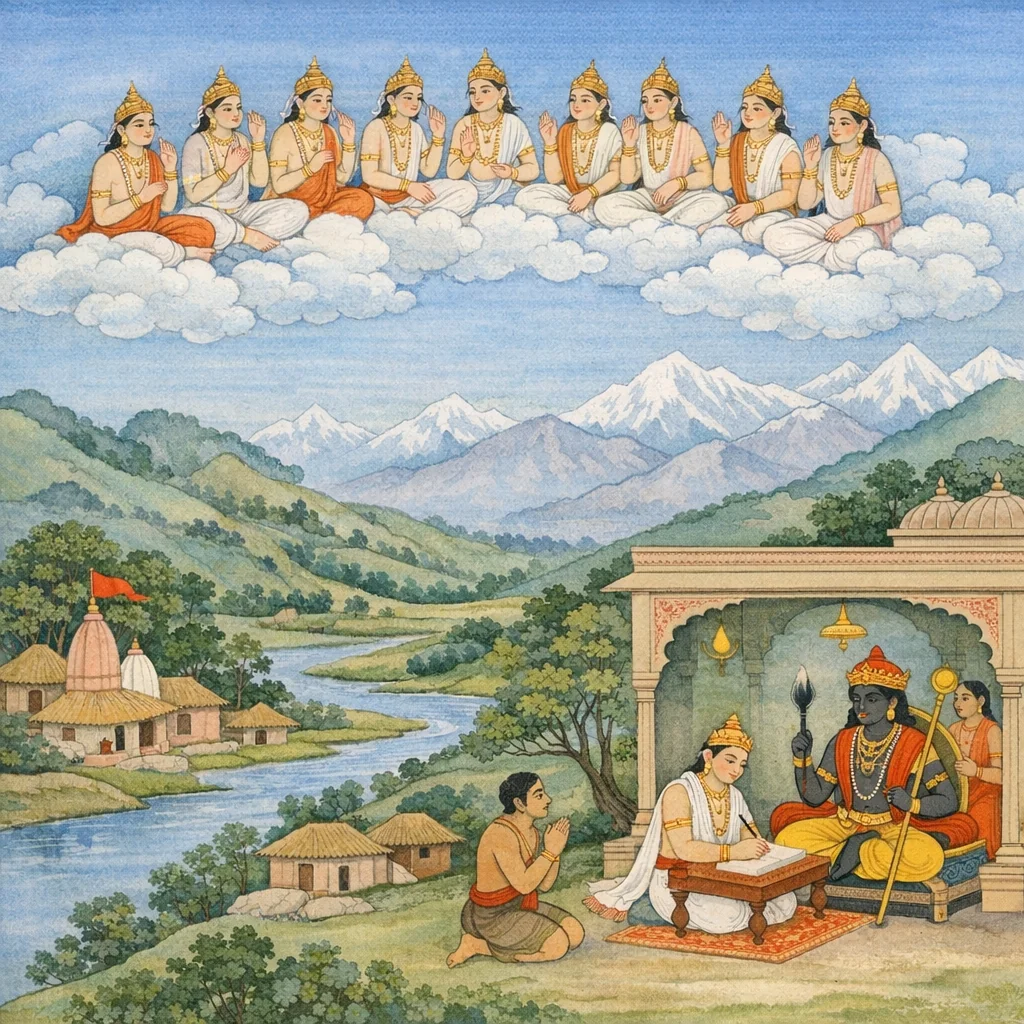
Continuing the Preta Kalpa’s inquiry into Yama’s court and karmic judgment, Garuḍa asks Kṛṣṇa who the śramaṇas are and how beings in the other world learn of human deeds. Kṛṣṇa answers by rooting the afterlife order in creation-history: after cosmic manifestation and the establishment of Yama and Citragupta, Brahmā—urged by the devas—creates twelve radiant witnesses called the Śravaṇas. They hear auspicious and inauspicious speech from afar, observe actions even while stationed in the sky, and at death report all to Dharmarāja. The chapter then turns from mechanism to meaning: the Śravaṇas teach the four aims of life (dharma, artha, kāma, mokṣa), praising dharma as the noble path. Post-mortem travel is shown to match merit—some ride celestial vehicles while others endure harsh routes. It closes with devotional instruction: honor the Śravaṇas and feed Brāhmaṇas as a śravaṇa-linked discipline that purifies sin, grants worldly happiness, and culminates in heavenly honor and approach to Viṣṇu’s abode, preparing for later, fuller accounts of karmic consequences and rites.
Shlokas
Verse 1
प्रेतयात्रादिनिरूपणं नाम षोडशो ऽध्यायः गरुड उवाच / एको मे संशयो देव हृदये सम्प्रबाधते / श्रमणाः कस्य पुत्राश्च कथं यमपुरे स्थिताः
Chapter Sixteen, called “The Exposition of the Preta’s Journey.” Garuḍa said: “O Lord, a single doubt sorely troubles my heart—whose sons are these śramaṇas, these ascetics, and how do they come to be present in Yamapura, Yama’s city of judgment?”
Verse 2
मानुषैश्च कृतं कर्म कस्माज्जानन्ति ते प्रभो / कथं शृण्वन्ति ते सर्वे कस्माज्ज्ञानं समागतम्
“O Lord, how do they come to know the deeds (karma) performed by human beings? How do they all hear of them? From where has this knowledge arisen?”
Verse 3
कुत्र भुञ्जन्ति देवेश क्रथयस्व प्रसादतः / पक्षिराजवचः श्रुत्वा भगवान्वाक्यमब्रवीत्
“O Lord of the gods, where do they partake of the offerings? Tell me graciously.” Hearing the words of the king of birds, Garuḍa, the Blessed Lord replied.
Verse 4
श्रीकृष्ण उवाच / शृणुष्व वचनं सत्यं सर्वेषां सौख्यदायकम् / तदहं कथयिष्यामि श्रवणानां विचेष्टितम्
Śrī Kṛṣṇa said: Listen to this truthful word, which bestows well-being upon all. Now I shall explain the proper observance and discipline of sacred listening (śravaṇa).
Verse 5
एकीभूतं यदा सर्वं जगत्स्थावरजङ्गमम् / क्षीरोदसागरे पूर्वं मयि सुप्ते जगत्पतौ
When the entire universe—both the immovable and the moving—had become one undifferentiated whole, long ago in the Ocean of Milk, I, the Lord of the world, lay in yogic sleep.
Verse 6
नाभिस्थोजस्तपस्तेपे वर्षाणि सुबहून्यपि / एकीभूतं जगत्सृष्टं भूतग्रामचतुर्विधम्
The vital radiance abiding in the navel-region performed tapas, austerities, for very many years; then, from the universe that had been in a state of oneness, the created world arose—together with the fourfold assemblage of beings.
Verse 7
ब्रह्मणा निर्मितं पूर्वं विष्णुना पालितं तदा / रुद्रः संहारमूर्तिश्च निर्मितो ब्रह्मणा ततः
First it was created by Brahmā; then it was protected and sustained by Viṣṇu. Thereafter Rudra—whose very form is dissolution—was also brought forth by Brahmā.
Verse 8
वायुः सर्वगतः सृष्टः सूर्यस्तेजोभिवृद्धिमान् / धर्मराजस्ततः सृष्टश्चित्रगुप्तेन संयुत)
Then Vāyu was created as the all-pervading force; the Sun was created, endowed with ever-increasing radiance (tejas). Thereafter Dharma-rāja (Yama), the king of justice, was created—together with Citragupta, the recorder of deeds.
Verse 9
सृष्ट्वैतदादिकं सर्वं तपस्तेपे तु पद्मजः / गतानि बहुवर्षाणि ब्रह्मणो नाभिपङ्कजे
Having created all this—beginning with the primordial principles—Padmaja (Brahmā) then performed austerities (tapas). Many years passed for Brahmā upon the lotus that sprang from the navel of Viṣṇu.
Verse 10
योयो हि निर्मितः पूर्वं तत्तत्कर्म समाचरेत् / कस्मिंश्चित्समये तत्र ब्रह्मा लोकसमन्वितः
Whatever a being has been fashioned as from before, that very kind of action it naturally performs. And at a certain time, there too, Brahmā—attended by the worlds—appears/abides.
Verse 11
रुद्रो विष्णुस्तथा धर्मः शासयन्ति वसुन्धराम् / न जानीमो वयं किञ्चिल्लोककृत्यमिहोच्यताम्
Rudra, Viṣṇu, and Dharma govern the earth. We do not know anything at all—therefore, let the duties and proper conduct of the world be explained here.
Verse 12
संचिन्त्य ब्रह्मणो मन्त्रं विबुधैः प्रेरितस्तदा
Then, urged on by the wise celestial beings (vibudhas), he contemplated the sacred mantra of Brahmā.
Verse 13
गृहीत्वा पुष्पपत्राणि सोसृजद्द्वादशात्मजान् / तेजोराशीन्विशालाक्षान्ब्रह्मणो वचनात्तु ते
Taking flower-petals and leaves in hand, he then brought forth twelve sons—great, wide-eyed beings, formed of masses of radiant splendor—according to Brahmā’s command.
Verse 14
योयं वदति लोकेस्मिञ्छुभं वा यदि वाशुभम् / प्रापयन्ति ततः शीघ्रं ब्रह्मणः कर्णगोचरम्
Whatever a person speaks in this world—auspicious or inauspicious—is swiftly conveyed and reaches the hearing of Brahmā.
Verse 15
दूराच्छ्रवणविज्ञानं दूराद्दर्शनगोचरम् / सर्वे शृण्वन्ति यत्पक्षिंस्तेनैव श्रवणा मताः
It is known by hearing even from afar, and only when near does it come within the range of sight. Since everyone hears that bird, they are therefore called ‘Śravaṇā’—the hearing-ones.
Verse 16
स्थित्वा चैव तथाकाशे जन्तूनां चेष्टितं च यत् / तज्ज्ञात्वा धर्मराजाग्रे मृत्युकाले वदन्ति च
Stationed in the sky, they observe whatever deeds living beings perform; having known them, at the time of death they declare them before Dharmarāja (Yama).
Verse 17
धर्मं चार्थं च कामं च मोक्षं च कथयन्ति ते / एको हि धर्ममार्गश्च द्वितीयश्चार्थमार्गकः
They expound the four aims—dharma (righteous duty), artha (prosperity), kāma (legitimate desire), and mokṣa (liberation). Indeed, there is one path called the path of dharma, and a second known as the path of artha.
Verse 18
अपरः काममार्गश्च मोक्षमार्गश्चतुर्थकः / उत्तमा धममार्गेण वैनतेय प्रयान्ति हि
Another is the path of desire (kāma), and the fourth is the path of liberation (mokṣa). Yet the noble indeed proceed by the path of dharma, O Vainateya (Garuda).
Verse 19
अर्थदाता विमानैस्तु अश्वैः कामप्रदायकः / हंसयुक्तविमानैश्च मोक्षाकाङ्क्षी विसर्पति
One who gives wealth proceeds in celestial cars; one who grants horses becomes a fulfiller of desires. And the seeker of liberation moves onward in a swan-yoked aerial chariot.
Verse 20
इतरः पादचारेण त्वसिपत्रवनानि च / पाषाणैः कण्टकैः क्लिष्टः पाशबद्धो ऽथ याति वै
Another (soul) goes on foot, and indeed through the forests of sword-like leaves. Tormented by stones and thorns, and bound in a noose, he then proceeds onward.
Verse 21
यः कश्चिन्मानुषे लोके श्रवणान्पूजयेदिह / वर्धन्या जलपात्रेम पक्वान्नपरिपूर्णया
Whoever, in the human world, honours the Śravaṇas here by offering a water-vessel filled with an abundance of cooked food, obtains the fruit of that rite.
Verse 22
श्रवणान्पूजयेत्तत्र मया सह खगेश्वर / तस्याहं तत्प्रदास्यामि यत्सुरैरपि दुर्लभम्
O Lord of birds (Garuda), whoever there worships with attentive listening, together with me, to him I shall grant that boon—something difficult to obtain even for the gods.
Verse 23
संभोज्य ब्राह्मणान् भक्त्या त्वेकादश शुभाञ्छुचीन् / द्वादशं सकलत्रं च मम प्रीत्यै प्रपूजयेत्
Having devoutly and respectfully fed eleven auspicious, pure Brāhmaṇas, one should also honor a twelfth Brāhmaṇa together with his whole household, for the sake of pleasing Me.
Verse 24
देवैः सर्वैश्च संपूज्य स्वर्गं यान्ति सुखेप्सया / तैः पूजितैरह तुष्टश्चित्रगुप्तेन धर्मराट्
Honored and duly worshipped by all the gods, they go to heaven, desiring bliss. “Pleased by those who have thus worshipped,” says Dharmarāja (Yama), “I am satisfied—together with Citragupta.”
Verse 25
तैस्तुष्टैर्मत्पुरं यान्ति लोका धर्मपारायणाः / श्रवणानां च माहात्म्यमुत्पत्तिं चेष्टितं शुभम्
Pleased by those virtuous acts, people devoted to dharma go to My abode. And the auspicious greatness of sacred hearing—its origin and its proper observance—has been set forth.
Verse 26
शृणोति पक्षिशार्दूल स च पापैर्न लिप्यते / इह लोके सुखं भुक्त्वा स्वर्गलोके महीयते
O Garuḍa, tiger among birds, whoever listens to this sacred teaching is not tainted by sins. Having enjoyed happiness in this world, he is honored and exalted in the heavenly realm.
Frequently Asked Questions
It establishes a doctrinal basis for impartial judgment: deeds and speech are witnessed independently and presented in Yama’s court, integrating moral causality (karma) with a formal adjudicatory process overseen by Yama and documented by Citragupta.
Śravaṇa is portrayed as both practice and purifier: listening with devotion aligns the listener with dharma, removes sin’s taint, and—when paired with honoring rites (hospitality, offerings, Brāhmaṇa-feeding)—yields happiness here and honor in heaven, culminating in movement toward Viṣṇu’s abode.