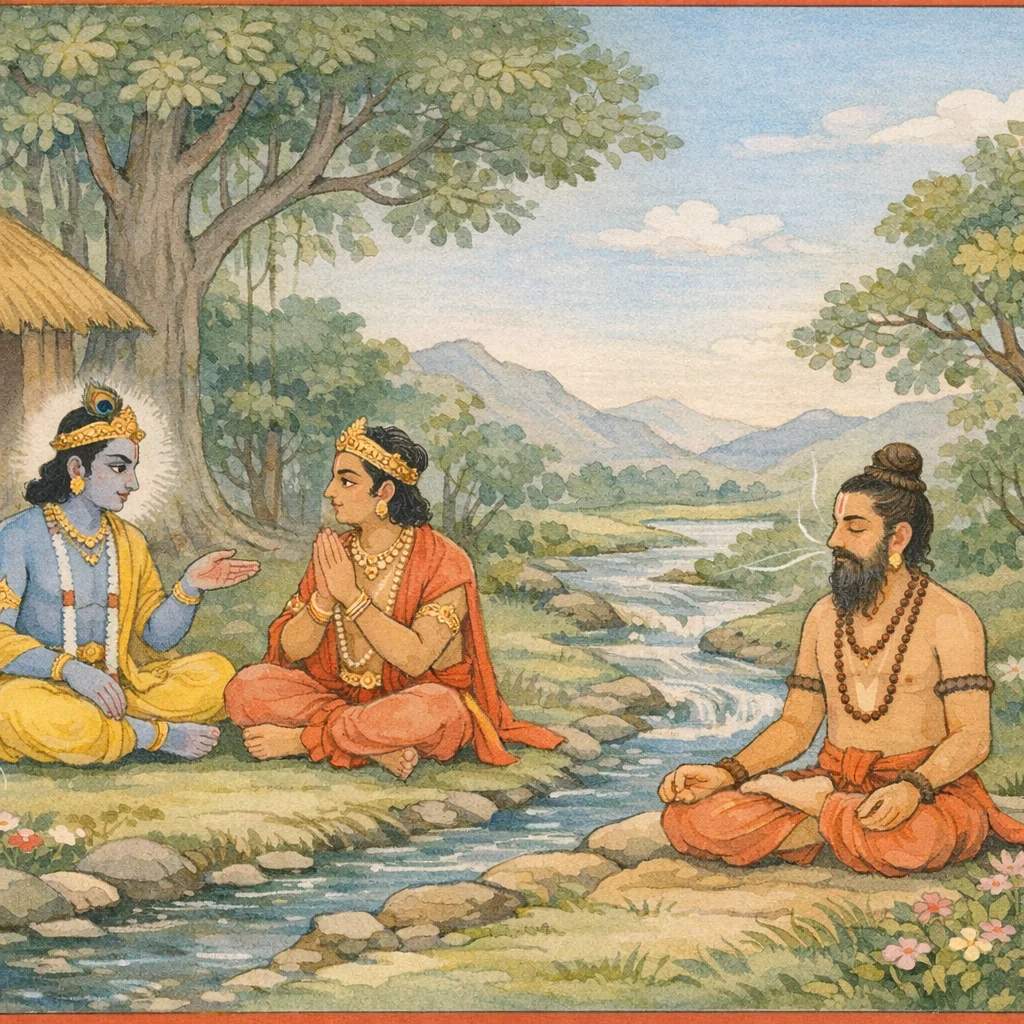
Adhyaya 238
Yoga’s Limbs and Dharma as the Ground of Liberation
Continuing the Ācāra Khaṇḍa’s practical teaching on right conduct, the Lord lists the limbs of yogic discipline and grounds them in dharma as the basis of liberation. He defines yama-like restraints and niyama-like observances with precise ethical marks: ahiṃsā as the cessation of violence, satya as truth spoken with pleasantness, and asteya as not taking what is not given. Brahmacarya is expanded into complete renunciation of sexual indulgence in body, mind, and speech, while aparigraha is the refusal to acquire and hoard even in distress. The observances include outer and inner purity, contentment, and tapas centered on one-pointed concentration rather than mere bodily emaciation. Svādhyāya is taught as purification through japa, and devotion to Hari through praise, remembrance, and worship is presented as contemplative practice supported by āsanas (svastika, padma, ardhāsana). The chapter ends by defining prāṇa and prāṇāyāma as restraint of breath and, correspondingly, restraint of the senses from unreal sense-objects, preparing for deeper interiorization (pratyāhāra/dhyāna).
Shlokas
Verse 1
नाम सप्तत्रिंशदुत्तरद्विशततमो ऽध्यायः श्रीभगवानुवाच / यमश्च नियम।पार्थ आसनं प्राणसंयमः / प्रत्याहारस्तथा ध्यानं धारणार्जुन सप्तमी
This is called the two-hundred-and-thirty-eighth chapter. The Blessed Lord said: Yama and Niyama, O son of Pṛthā; Āsana and the restraint of prāṇa; Pratyāhāra, and also Dhyāna and Dhāraṇā, O Arjuna—these are the seven limbs of yogic discipline.
Verse 2
समाधिरिति चाष्टाङ्गो योग उक्तो विमुक्तये / कर्मणा मनसा वाचा सर्वभूतेषु सर्वदा
The eight-limbed Yoga—culminating in samādhi—has been taught for liberation; and at all times, toward all beings, one should maintain purity and harmlessness through one’s actions, mind, and speech.
Verse 3
हिंसाविरामको धर्मो ह्याहिंसा परमं सुखम् / विधिना या भवेद्धिंसा सा त्वहिंसा प्रकीर्तिता
Dharma is that which brings violence to a halt; indeed, non-violence (ahiṃsā) is the highest happiness. And any act that appears as violence when performed according to righteous rule is, in truth, declared to be non-violence.
Verse 4
सत्यं ब्रूयात्प्रियं ब्रूयान्न ब्रूयात्सत्यमप्रियम् / प्रियं च नानृतं ब्रूयादेष धर्मः सनातनः
One should speak the truth and speak what is pleasing; one should not speak a truth that is harsh. And one should not speak a pleasing falsehood—this is the eternal dharma.
Verse 5
यच्चद्रव्यापहरणं चौर्याद्वाथ बलेन वा / स्तेयं तस्यानाचरणमस्तेयं धर्मसाधनम्
Taking away another’s property—whether by theft or even by force—is called stealing. Refraining from that is asteya (non-stealing), and it is a means for accomplishing dharma.
Verse 6
कर्मणा मनसा वाचा सर्वावस्थासु सर्वदा / सर्वत्र मैथुनत्यागं ब्रह्मचर्यं प्रचक्षते
The wise declare brahmacarya (chastity) to be the total renunciation of sexual indulgence—by body, by mind, and by speech—at all times, in every condition, and everywhere.
Verse 7
द्रव्याणामप्यनादानमापत्स्वपि तथेच्छया / अपरिग्रहमित्याहुस्तं प्रयत्नेन वर्जयेत्
Not accepting even material possessions—willingly, even in times of distress—is what the wise call aparigraha (non-possessiveness). One should diligently avoid its opposite: the urge to acquire and hoard.
Verse 8
द्विधा शौचं मृज्जलाभ्यां बाह्य भावादथान्तरात् / यदृच्छालाभतस्तुष्टिः सन्तोषः सुखलक्षणम्
Purity is twofold: outward, by cleansing with earth (clay/ash) and water, and inward, by the purity of one’s disposition. Contentment (santoṣa)—being satisfied with what comes of its own accord—is the mark of true happiness.
Verse 9
मनसश्चैन्द्रियाणां च ऐकाग्र्यं परमं तपः / शरीरशोषणं वापि कृच्छ्रचान्द्रायणादिभिः
Single-pointed concentration of the mind and the senses is the highest austerity; mere emaciation of the body through hardships—such as the Kṛcchra and Cāndrāyaṇa vows—is not superior to that.
Verse 10
वेदान्तशतरुद्रीयप्रणवादिजप बुधाः / सत्त्वशुद्धिकरं पुंसां स्वाध्यायं परिचक्षते
The wise declare that svādhyāya (sacred self-study)—through japa of Vedānta, the Śatarudrīya, and the Pranava (Oṁ) and the like—is what purifies a person’s sattva (inner nature).
Verse 11
स्तुतिस्मरणपूजादिवाङ्मनः कायकर्मभिः / अनिश्चला हरौ भक्तिरेतदीश्वरचिन्तनम् / आसनं स्वस्तिकं प्रोक्तं पद्ममर्धासनं तथा
By deeds of speech, mind, and body—such as praise, remembrance, and worship—steadfast devotion to Hari is called contemplation of the Lord. For this, the taught postures are the Svastika seat, the Padma (lotus) seat, and likewise the half-seat (Ardhāsana).
Verse 12
प्राणः स्वदेहजो वायुरायामस्तन्निरोधनम् / इन्द्रियाणां विचरतां विषयेषु त्वसत्स्विव
Prāṇa is the life-wind born within one’s own body; prāṇāyāma is the regulation—indeed the restraint—of that breath. It is also the checking of the senses as they roam among sense-objects, which are, as it were, unreal.
Frequently Asked Questions
Because dharma is framed as purity and harmlessness across speech, mind, and action. Speech that is true but injurious violates the non-harming orientation, so truth must be joined with what is pleasing.
Prāṇāyāma is defined not only as restraining the life-wind but also as checking the senses as they move among sense-objects. This directly supports pratyāhāra (withdrawal), preparing the mind for dhāraṇā and dhyāna.