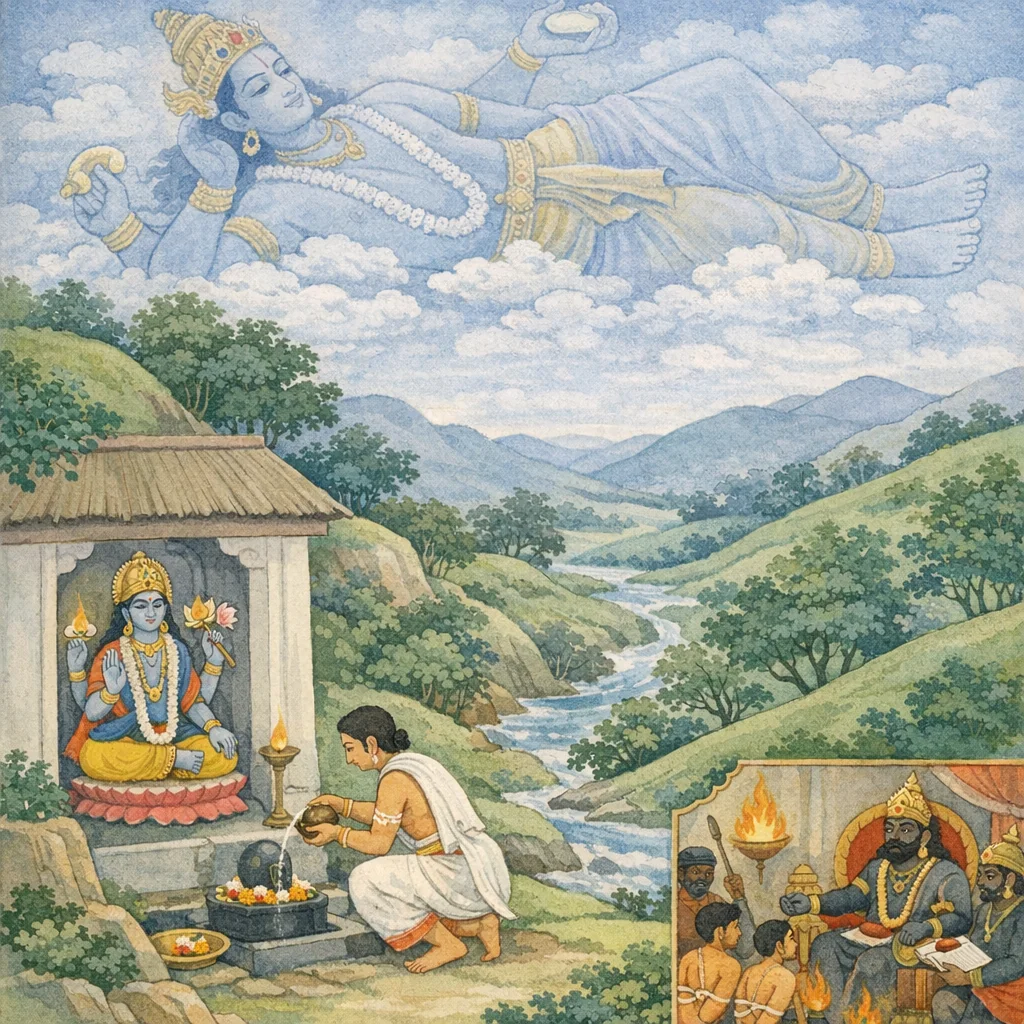
Adhyaya 229
Hari-Pūjā: Puruṣa-sūkta, Bhakti-Supremacy, and Consequences of Neglect
Continuing the Ācāra-khaṇḍa’s practical teaching, Sūta gives an essential and easy method of worshiping Hari (Viṣṇu): offer flowers and water while reciting the Puruṣa-sūkta. He expands this into a cosmic truth—since Viṣṇu pervades the universe and impels the activity of all beings, worship of Him honors all existence. The chapter then turns to karmic and post-mortem accountability, warning that neglect of Viṣṇu is a grave sin that brings Yama’s rebuke and hellish suffering. Yet it also stresses mercy and accessibility: when offerings are lacking, even water alone is sufficient. Contrasting divine aid with the limited support of family, it concludes by placing bhakti above external rites and worldly attainments as the root of true fulfillment and fellowship with the liberated, leading naturally into further disciplines and their spiritual results.
Shlokas
Verse 1
नामाष्टाविंशत्युत्तरद्विशततमो ऽध्यायः सूत उवाच / अशेषलोकनाथस्य सारमाराधनं हरेः / दद्यातु पुरुषसूक्तेण यः पुष्पाण्यप एव च
Sūta said: “This is the two-hundred-and-twenty-ninth chapter. The essential way to worship Hari, the Lord of all worlds, is this: one should offer flowers and water while reciting the Puruṣa-sūkta.”
Verse 2
अर्चितं स्याज्जगदिदं तेन सर्वं चराचरम् / यो न पूजयते विष्णुं तं विद्याद्ब्रह्मघातकम्
When He is worshipped, this entire universe is, as it were, worshipped—everything moving and unmoving. But one who does not worship Viṣṇu should be known as guilty of brahma-hatyā, the gravest sin.
Verse 3
यतः प्रवृत्तिर्भूतानां येन सर्वमिदं ततम् / तं यो न ध्यायते विष्णुं स विष्ठायां क्रिमिर्भवेत्
From Him arises the activity of all beings, and by Him this whole universe is pervaded—whoever does not meditate upon that Viṣṇu becomes a worm in excrement.
Verse 4
नरके पच्यमानस्तु यमेन परिभाषितः / किन्त्वया नार्चितो देवः केशवः क्लेशनाशनः
As you are scorched in hell, Yama rebukes you: “Yet you did not worship Lord Keśava, the God who destroys suffering.”
Verse 5
उदकेनाप्यभावेन द्रव्याणामर्चितः प्रभुः / यो ददाति स्वकं लोकं स त्वया किं न चार्चितः
Even when offerings are lacking, the Lord may be worshipped with nothing more than water. He who grants His own realm—why, then, did you not worship Him?
Verse 6
न तत्करोति सा माता न पिता नापि बान्धवः / यत्करोति हृषीकेशः सन्तुष्टः श्रद्धयार्चितः
Neither mother, nor father, nor even relatives can accomplish what Hṛṣīkeśa accomplishes when He is worshipped with faith and is pleased.
Verse 7
वर्णाश्रमाचारवता पुरुषेण परः पुमान् / विष्णुराराध्यते पन्था नान्यस्तत्तोषकारकः
For one who lives according to the disciplines of varṇa and āśrama, that very path is the worship of the Supreme Person, Lord Viṣṇu; there is no other way that truly brings about His satisfaction.
Verse 8
न दानैर्विविधैर्दत्तैर्न पुष्पैर्नानुलेपनैः / तोषमेति महात्मासौ यथा भक्त्या जनार्दनः
That Great Lord is not truly pleased merely by many kinds of gifts, nor by flowers, nor by fragrant anointments; it is devotion alone by which Janārdana is satisfied.
Verse 9
सम्पदैश्वर्यमाहात्म्यैः सन्तत्या न च कर्मणा / विमुक्तैश्चैकता लभ्या मूलमाराधनं हरेः
Union (oneness) with the liberated is not attained through wealth, lordly power, fame, lineage, or even mere ritual action; its very root is the worship of Hari (Vishnu).
Frequently Asked Questions
Water (udaka) is explicitly stated as sufficient when other offerings are unavailable, especially when accompanied by reverent recitation such as the Puruṣa-sūkta.
It employs karmic-ethical deterrence typical of the Garuḍa Purāṇa’s didactic style: neglect of the all-pervading Supreme is framed as a gravely demeritorious act with afterlife repercussions, underscoring the centrality of Viṣṇu-bhakti.