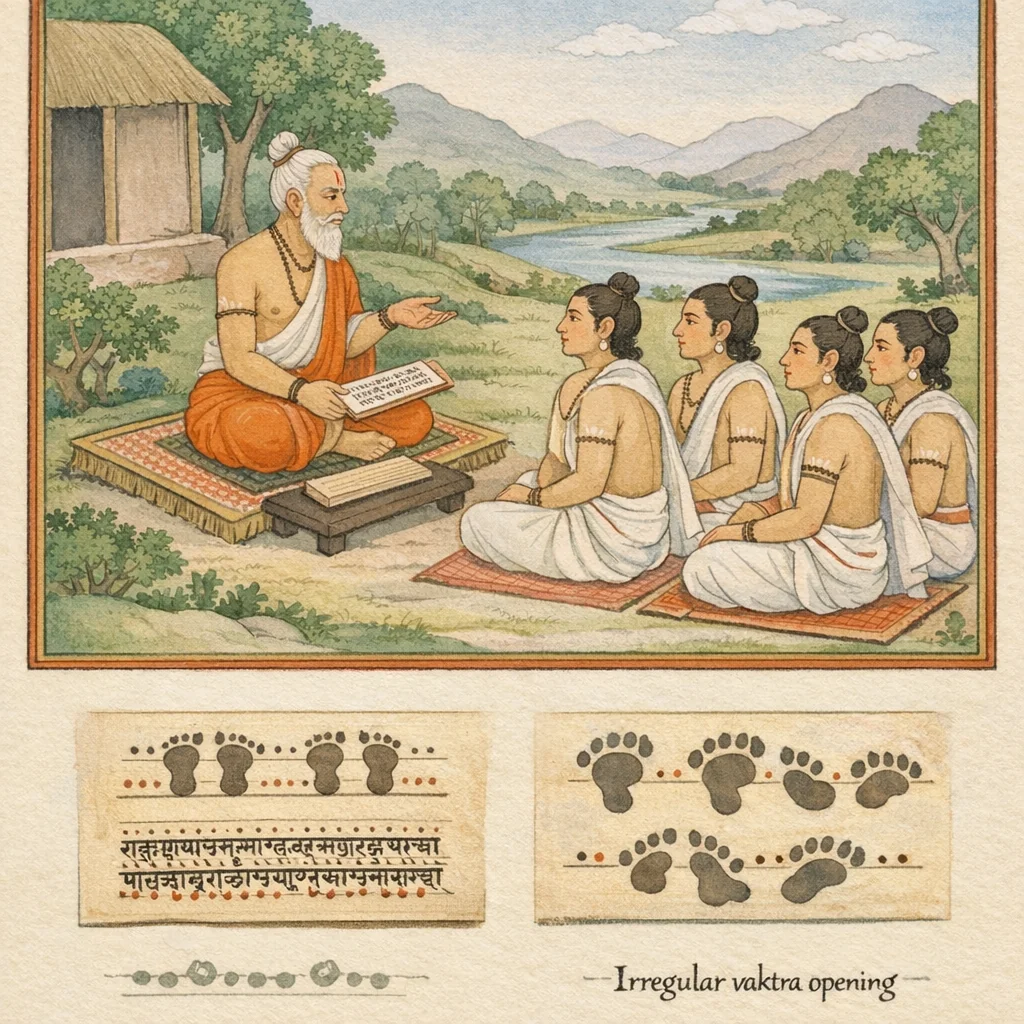
Adhyaya 208
Āryā-Chandas Lakṣaṇa; Gīti-Bheda; Vaitālīya-Vaktra; Mātrā-to-Varṇa Transition
Sūta sets forth the diagnostic marks of the Āryā (gāthā) metre: fixed gaṇa constraints in odd and even pādas, the rule for the seventh syllable, and cadence signs that distinguish pathyā (regular) from vipulā (expanded) by permitted overstepping. He then names internal arrangements that yield subtypes such as Capalā and points out the hallmark of the āryā-jāti. Next he classifies Gīti, Upagīti, and Udgīti according to whether the first-half pattern, the second-half pattern, or an interchange governs both halves. The account widens to norms of mātrā distribution (6 in an odd pāda, 8 in an even), noting traditional placements (Aupacchandasika) and mnemonic gaṇa labels. Vaitālīya is summarized through its ‘vaktra’ (opening) types—regular and irregular—along with named pattern-streams and related metres (Acaladhṛti, Citrā, Padākulaka). The chapter ends with an explicit transition: having stated mora-based metres, it will next explain syllable-based (varṇa) metres, linking this technical survey to the ensuing metrical taxonomy.
Shlokas
Verse 1
नाम सप्तोत्तरद्विशततमो ऽध्यायः सूत उवाच / आर्यालक्ष्म त्वष्ट गणाः सदा जो विषमे न हि / षष्ठे जो न्लौ वापि भवेत् पदं षष्ठे द्वितीयलात्
Sūta said: “Now begins the two-hundred-and-eighth chapter. The defining marks of the Āryā metre are these: the gaṇas are set in a fixed pattern; in the odd pādas there is no ‘jo’ gaṇa. In the sixth position there is ‘jo’, and the sixth foot (pada) may also take ‘nlau’; the second half is determined from that sixth position.”
Verse 2
आदितः सप्तमे ह्रस्वा द्वितीयार्धे शरे ततः / त्रिगणाङ्घ्रिश्च पथ्या स्याद्विपुला वह्निलङ्घनात्
In this metre, the seventh syllable from the beginning should be short (hrasva); in the second half, after the ‘śara’ pattern, the closing cadence is ‘trigaṇāṅghri’. The line is then ‘pathyā’ (regular), and when the ‘vahnilaṅghana’ (“overstepping the fire”) constraint is exceeded, it is called ‘vipulā’ (the expanded variation).
Verse 3
ग्मध्ये द्वितुर्यौ जौ चपला मुखपूर्वादिचापला / द्वितीयार्धे सजघना आर्याजातेश्च लक्षणम्
When, in the middle, there are two turyās and two ja-groups, the (gāthā/āryā) metre is called Capalā (“swift”). If the second half bears the mark of sajaghanā (a prominent hip-region), that is the defining sign of the Āryā-jāti (Āryā metre-class).
Verse 4
आर्या प्रथमार्धलक्ष्म गीतिः स्याच्चेद्दलद्वये / उपगीतिर्द्वितीयार्धादुद्गीतिर्व्यत्ययाद्भवेत्
If, in both halves (dalas), the Āryā metre bears the characteristic pattern of the first half, it is called Gīti. If it follows the pattern of the second half, it is called Upagīti; and if the patterns are interchanged, it becomes Udgīti.
Verse 5
आर्यागीतिश्चान्तगुरुर्गोतिजातेश्च लक्षणम् / षट् कला विषमे चेत्स्युः समे ऽष्टौ न निरन्तराः / समा पराश्रिता न स्याद्वैतालीये रलौ गुरुः
These are the defining marks of the Āryā and Gīti metres, and also of the Antaguru type and the Gati-jāta classification: in an odd pāda there are six mātrās, and in an even pāda there are eight—yet they are not to be taken as an unbroken run. A ‘samā’ (even-pattern) line should not be dependent on another; and in the Vaitālīya metre the gaṇa pattern ‘ra-la’ is heavy (guru).
Verse 6
अन्तेर् यौ पूर्ववदिदमौपच्छन्दसिकं मतम्
Regarding the two (letters) at the end, this is to be understood as before; such is the accepted view according to the Aupacchandasika tradition.
Verse 7
भाद्गौ स्यादापातलिका ज्ञेयाथो दक्षिणान्तिका / पराश्रितो द्वितीयो लः पादेषु निखिलेष्वपि
The syllable-group “bhād-gau” is to be understood as indicating Āpātalikā, and also (as) Dakṣiṇāntikā. The second “la” is dependent on the preceding sound, in all pādas throughout.
Verse 8
उदीच्यवृत्तिरसमे प्राच्यवृत्तिस्तु युग्मके / सपञ्चमश्चतुर्थांशे युगपत्तौ प्रवृत्तकम्
When the count is odd, the rite proceeds in the northern mode (udīcya); when the count is even, it proceeds in the eastern mode (prācya). In the quarter-portion that includes the fifth step, it is to be performed simultaneously, as enjoined.
Verse 9
उदीच्याद्यङ्घ्रिसंयोगाद्युग्मपादैकपादिका / चारुहासिन्ययुग्माङ्घ्रौ वैतालीयस्य संग्रहः
Beginning with the northern type (udīcya), in which the opening (vaktra) is formed by the joining of metrical feet, and including the forms called “paired-foot and single-foot,” as well as “Cāruhāsinī” and “paired-foot,” this is the concise compendium (saṃgraha) of the Vaitālīya metre.
Verse 10
वक्त्रं नाद्यान्नसौ स्यातां चतुर्थाद्यगणो भवेत् / पथ्यावक्त्रं जेन समे विपरीतादिरन्यथा
If the opening (vaktra) is not preceded by the initial group (ādya), then the gaṇa beginning with the fourth is obtained. When the arrangement is even and balanced, it is called a “regular opening” (pathyā-vaktra); otherwise it is “reversed” (viparīta), and so forth.
Verse 11
उसमे नश्च चपला विपुला लघुसप्तमा / निखिले वा सैतवस्य म्रौ न्तौ चाब्धेस्तत्पूर्वकौ
Among them are (streams) named Naś, Capalā, Vipulā, and the seventh called Laghusaptamā. Likewise, taken in full, there are Saitava, and also Mrau and Ntau; these streams mentioned earlier are joined to the ocean.
Verse 12
षोडशलो ऽचलधृतिर्मात्रासमकमुच्यते
A metre of sixteen syllables is called Acaladhṛti, and it is declared to be equal in mātrās (time-units).
Verse 13
नवमलस्तथा गो ऽन्त्यः जो न्लौवाथाम्बुधेर्यथा / विश्लोकः स्यात्तच्चतुष्कद्विगुणाद्वानवासिका
Likewise, the ninth item is declared to be the final “go” (cow), and “jo‑nlau” is reckoned in the manner of the ocean. Thus a verse is formed; and from twice a set of four (units or syllables) arises the recitational metre called vānavāsikā.
Verse 14
बाणाष्टनवकेषु स्याल्लश्चित्रा षोडशात्मिका / सममात्रासमादिष्टं पदाकुलकमीरितम्
In the syllabic arrangement counted as “arrow–eight–nine,” the metre called Citrā is said to consist of sixteen units. When it is prescribed with equal mātrās (time-measures), it is declared to be the metrical form known as Padākulaka.
Verse 15
वृत्तमात्रा विना वर्णैर्ला वर्णा गुरुभिर्विना / गुरुवो लैर्दले नित्यं प्रमाणमिति निश्चितम्
Without vṛtta (metre) and syllabic measure, the letters are not properly constituted; and without guru (long/heavy quantity), the letter “la” is not formed. Therefore the heavy syllables—together with “la” in the group—are always accepted as the standard; this is firmly established.
Verse 16
अष्टाविंशातिला गन्ता प्रथमार्धे द्वितीयके / त्रिंशदस्यां शिखा गन्ता खञ्जातद्व्यत्ययाद्भवेत्
If, on the twenty-eighth lunar day, a person sets out in the first half of the second watch, he becomes one who wanders begging. If, on the thirtieth day, he departs while the śikhā (topknot) is being arranged, lameness may arise through an adverse reversal of conditions.
Verse 17
षोडशानङ्गक्रीडा गा द्वात्रिंशच्चरमे च लाः / सप्तविंशातिला गन्ता दलयो रुचिरा द्वयोः
Sixteen are the “ananga‑krīḍā,” the sports of love; thirty-two are the concluding forms called “lāḥ.” Twenty-seven are the “atilā,” those that move onward; and in pairs are the charming “dalaya” forms.
Verse 18
मात्रावृत्तानि चोक्तानि वर्णवृत्तानि वच्मि वै
The mora-based metres have been stated; now I shall indeed explain the syllable-based metres.
Frequently Asked Questions
Pathyā denotes the regular cadence and constraint-compliant arrangement; vipulā is a sanctioned expanded/variant form produced when a specific constraint is overstepped while still remaining within recognized metrical legality.
They are distinguished by which half-pattern governs both halves: Gīti follows the first-half Āryā pattern in both halves, Upagīti follows the second-half pattern in both halves, and Udgīti interchanges the patterns between halves.