Adhyaya 150
Śvāsa-nidāna: Etiology, Types, Symptom Progression, and Fatal Prognosis
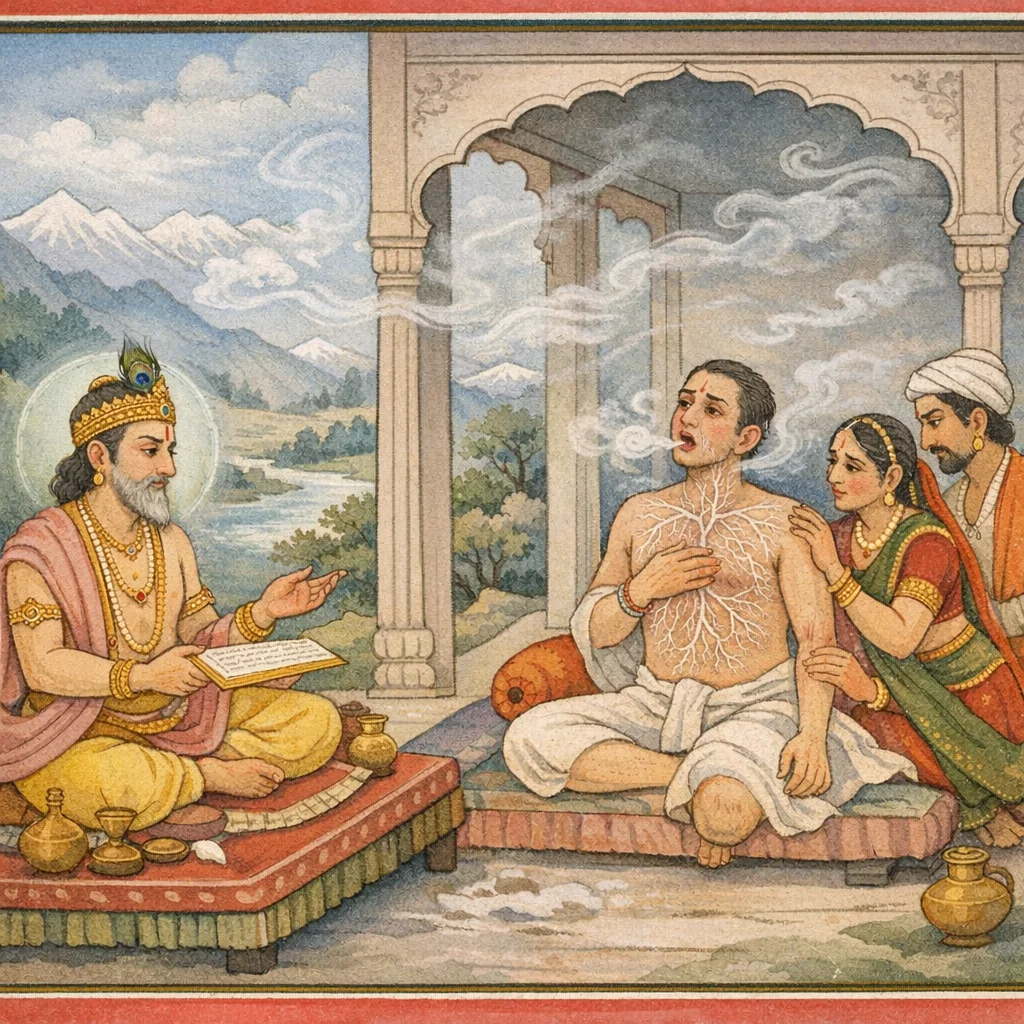
Continuing the Brahma Khanda’s medical-encyclopedic thread in the Garuḍa Purāṇa, Dhanvantari turns from general causation to the nidāna of śvāsa (dyspnea). He lists triggers—cough-aggravated doṣas, gastrointestinal upheaval, toxins, fevers, environmental irritants, marma injury, and cold-water exposure—and classifies five types, stressing kapha obstructing prāṇa-vāyu and srotas pollution in the chest. From pūrvarūpa (premonitory signs) the condition rises stepwise: reverse vāyu movement, cough with throat rattle, faintness, catarrh, orthopnea, parched mouth, and cold-worsened attacks. He distinguishes a yāpya, manageable state in strong patients from refractory cases with fever and syncope, and ends with grave ariṣṭa signs—delirium, loss of radiance, upward gaze, blocked urine and stool, phlegm clogging mouth and ears, and marma-piercing pain—preparing for the next chapter’s move into cikitsā (treatment).
Shlokas
Verse 1
धन्वन्तरिरुवाच / अथातः श्वासरोगस्य निदानं प्रवदाम्यहम् / कासवृद्ध्या भवेच्छ्वासः पूर्वैर्वा दोषकोपनैः
Dhanvantari said: Now I shall declare the causes (nidāna) of the disease of dyspnea (śvāsa). Dyspnea may arise from the worsening of cough, or from earlier aggravations of the bodily doṣas.
Verse 2
आमातिसारवमथुविषपाण्डुज्वरैरपि / रजोधूमानिलैर्मर्मघातादपि हिमाम्बुना
It may also be brought on by dysentery and vomiting; by poisoning, jaundice, and fevers; by dust, smoke, and harsh winds; by blows to the vital points (marma); and even by cold water—thus a person may be driven into suffering.
Verse 3
क्षुद्रकस्तमकश्छिन्नो महानूर्ध्वश्च पञ्चमः / कफोपरुद्धगमनपवनो विष्वगास्थितः
The varieties are: the minor tamaka (kṣudraka), the intermittent type (chinna), the severe type (mahān), and as the fifth, the upward-moving type (ūrdhva)—when prāṇa-vāyu, the vital wind, is obstructed by kapha (phlegm) and spreads diffusely throughout the body.
Verse 4
प्राणोदकान्नवाहीनि दुष्टस्रोतांसि दूषयन् / उरः स्थः कुरुते श्वासमामाशयसमुद्भवम्
Polluting the corrupted srotas—channels that carry vital breath, water, and food—the disorder, lodged in the chest, produces laboured breathing that arises from the stomach.
Verse 5
प्राग्रूपं तस्य हृत्पार्श्वशूलं प्राणविलोमता / आनाहः शङ्खभेदश्च तत्रायासो ऽतिभोजनैः
Its preliminary signs are pain near the heart and in the sides, an abnormal reversal of prāṇa-vāyu’s movement, abdominal distension, and a splitting pain in the temples; in that state, exertion and strain are brought on by overeating.
Verse 6
प्रेरितः प्रेरयन्क्षुद्रं स्वयं स समलं मरुत् / प्रतिलोमं शिरा गच्छेदुदीर्य पवनः कफम्
When impelled, that vāyu itself—tainted and driving the bodily impurities—moves contrary through the channels; the vital air, rising upward, forces kapha (phlegm) toward the head.
Verse 7
परिगृह्यशिरोग्रीवमुरः पार्श्वे च पीडयन् / कासं घुर्घुरकं मोहमरुचिम्पीनसं भृशम्
Grasping the head and neck and pressing hard upon the chest and sides, there arises severe coughing, a rattling in the throat, faintness and delusion, loss of appetite, and intense catarrh.
Verse 8
करोति तीव्रवेगञ्च श्वासं प्राणोपतापिनम् / प्रताम्येत्तस्य वेगेनष्ठीवनान्ते क्षणं सुखी
He begins to breathe with violent force, a breath that torments the life-winds (prāṇa); overwhelmed by its rush he faints, and only at the end—after spitting—does he feel a moment’s relief.
Verse 9
कृच्छ्राच्छयानः श्वसिति निषण्णः स्वास्थ्यमर्हति / उच्छ्रिताक्षो ललाटेन स्विद्यता भृशमार्तिमान्
Lying down, he breathes only with great difficulty; even when seated he does not regain ease. With eyes turned upward and sweat beading on the forehead, he suffers intense agony.
Verse 10
विशुष्कास्यो मुहुः श्वासः काङ्क्षत्युष्णं सवेपथुः / मेघाम्बुशीतप्राग्वातैः श्लेष्मलैश्च विवर्धते
His mouth becomes parched; he gasps again and again for breath, longs for warmth, and trembles. This condition is aggravated by cold, rain-bearing clouds, easterly winds, and phlegm-related (kapha) disorders.
Verse 11
स याप्यस्तमकः साध्यो नरस्य बलिनो भवेत् / ज्वरमूर्छावतः सीतैर्न शाम्येत्प्रथमस्तु सः
That disease called yāpya-astamaka is treatable and can be cured in a strong man; but in one who suffers from fever and fainting, it does not subside at first even with cooling measures.
Verse 12
कासश्वसितवच्छीर्णमर्मच्छेदरुजार्दितः / सस्वेदमूर्छः सानाहो बस्तिदाहविबोधवान्
Afflicted by coughing and laboured breathing, he wastes away, tormented by pain as though the vital points (marma) were cut; drenched in sweat and fainting, swollen with obstruction, burning in the bladder—yet remaining conscious and aware.
Verse 13
अधोदृष्टिः शुताक्षस्तु स्निह्यद्रक्तैकलोचनः / शुष्कास्यः प्रलपन्दीनो नष्टच्छायो विचेतनः
He gazes downward; his eyes are dull and sunken, and one eye is smeared, blood-red. His mouth is parched; he babbles incoherently; his life’s radiance, like a shadow, is lost, and he becomes senseless.
Verse 14
महातामहता दीनो नादेन श्वसिति क्रथन् / उद्धूयमानः संरब्धो मत्तर्षभ इवानिशम्
Overwhelmed by dense darkness, the wretched one breathes with a loud sound, panting and heaving; tossed about and agitated, he rages ceaselessly like an intoxicated bull.
Verse 15
प्रनष्टज्ञानविज्ञानो विभ्रान्तनयनाननः / नेत्रे समाक्षिपन्बद्धमूत्रवर्चा विशीर्णवाक्
With knowledge and discernment lost, his eyes and face bewildered, he rolls his gaze upward; urine and feces are obstructed, and his speech breaks and fails—thus is the dying person seen.
Verse 16
शुष्ककण्ठो मुहुश्चैव कर्णशङ्खाशिरो ऽतिरुक् / यो दीर्घमुच्छ्वसित्यूर्ध्वं न च प्रत्याहरत्यधः
His throat is parched again and again, with acute pain in the ears, temples, and head. He draws long breaths upward and cannot bring them back down—these are signs of death drawing near.
Verse 17
श्लेष्मावृतमुखश्रोत्रः क्रुद्धगन्धवहार्दितः / ऊर्ध्वं समीक्षते भ्रान्तमक्षिणी परितः क्षिपन्
With mouth and ears clogged by phlegm, tormented by violent, foul-smelling winds, he looks upward in confusion, his eyes darting restlessly all around.
Verse 18
मर्मसु च्छिद्यमानेषु परिदेवी निरुद्धवाक् / एते सिध्येयुरव्यक्ताः व्यक्ताः प्राणहरा ध्रुवम्
When the vital points (marmas) are being pierced, she wails, her speech choked off. These forces, while unmanifest, may go unnoticed; but when they become manifest, they surely turn into destroyers of life.
Frequently Asked Questions
The chapter lists kṣudraka-tamaka (minor tamaka), chinna (intermittent), mahān (severe), and ūrdhva (upward-moving) as named types, with the presentation explained through prāṇa-vāyu being obstructed by kapha and spreading abnormally; the passage treats this typology as a diagnostic framework rather than a mere symptom list.
The text describes kapha blocking normal prāṇa-vāyu pathways, forcing vāyu into a contrary (pratiloma) course through the channels; as prāṇa rises upward it drives kapha toward the head, producing throat rattle, cough, catarrh, faintness, and escalating breath distress.