Adhyaya 148
Raktapitta Nidāna and Cikitsā: Causes, Signs, Srotas-Spread, and Śodhana Priority
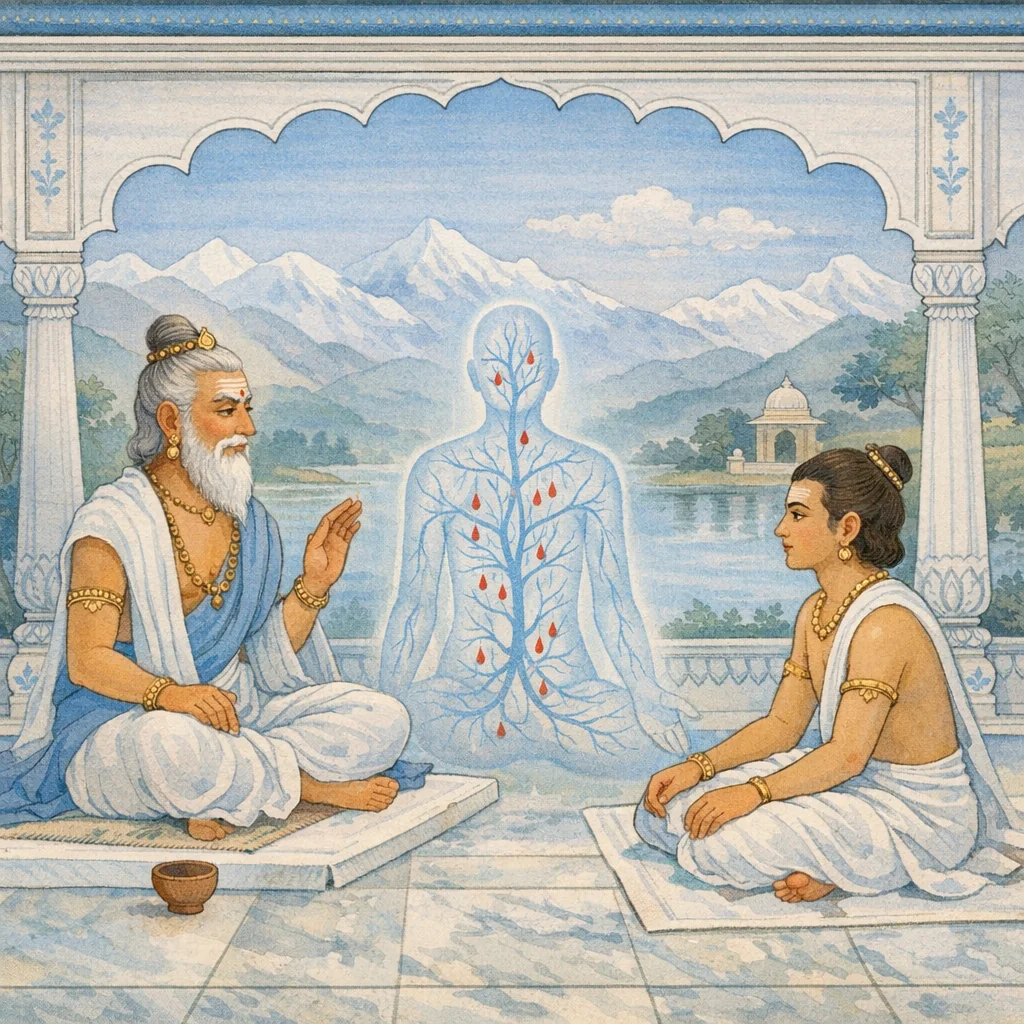
Continuing Dhanvantari’s medical teaching in the Brahma-khaṇḍa, this chapter defines raktapitta as a pitta-driven bleeding disorder caused by excessive intake of heating, irritant tastes and foods, including coarse grains like kodrava, especially in those of pitta-prakṛti. It explains that aggravated pitta thins and congests the blood, notes rakta’s basis in smell and color and its origin from liver and spleen, and lists prodromal signs such as head-heaviness, anorexia, smoky vision, sour eructation, foul vomiting, cough, dyspnea, dizziness, and exhaustion. Diagnostic marks include abnormal redness, fishy breath, and yellow or greenish tints in eyes and tissues; dream-omens foretell impending mental disturbance. The morbid heat spreads through all srotas, producing upward and downward bleeding and even oozing through the pores. In treatment it gives first place to śodhana—especially virecana for pitta—allowing emesis when kapha is associated, and recommends sweet and astringent supports; mixed-doṣa complications may become incurable. It concludes by linking affliction to karmic consequence, preparing the reader for later applied regimens and ethical restraint as preventive medicine.
Shlokas
Verse 1
सप्तचत्वारिंशदुत्तरशततमो ऽध्यायः धन्वन्तरिरुवाच / अथातो रक्तपित्तस्य निदानं प्रवदाम्यहम् / भृशोष्णतिक्तकट्वम्ललवणादिविदाहिभिः
Chapter 148. Dhanvantari said: Now I shall declare the causes of raktapitta (the bleeding disorder). It arises from things that are excessively heating—bitter, pungent, sour, salty—and other burning, irritant factors.
Verse 2
कोद्रवोद्दालकैश्चान्यैस्तदुक्तैरति सेवितैः / कुपितं पैत्तिकैः पित्तं द्रवं रक्तञ्च मूर्छति
By excessive use of kodrava (coarse grains), uddālaka, and other such items already mentioned, pitta is provoked in those of pitta-nature; the blood becomes thin and falls into a fainting, congested state.
Verse 3
तैर्मिथस्तुल्यरूपत्वमागम्य व्याप्नुवंस्तनुम् / पित्तरक्तस्य विकृतेः संसर्गाद्दषणादपि
Through their mutual contact and admixture, the body takes on a like form and the condition pervades the whole frame; and it also arises from the derangement of pitta and blood—whether by association and contagion, or even by biting.
Verse 4
गन्धवर्णानुवृत्तेषु रक्तेन व्यपदिश्यते / प्रभवत्यसृजः स्थानात्प्लीहतो यकृतश्च सः
Among the bodily constituents that correspond to smell and color, it is designated as “blood.” That blood arises from its seat—the spleen and the liver.
Verse 5
शिरोगुरुत्वमरुचिः शीतेच्छा धूमको ऽम्लकः / छर्धितश्छर्दिबै भत्स्यं कासः श्वासो भ्रमः क्लमः
The symptoms are: heaviness of the head, loss of appetite, longing for cold, a smoky haze before the eyes, sour belching; vomiting with foul-smelling matter; cough, breathlessness, dizziness, and exhaustion.
Verse 6
लोहितो न हितो मत्स्यगन्धास्यात्वञ्च विज्वरे / रक्तहारिद्रहरितवर्णता नयनादिषु
An unwholesome reddish discoloration, a fishy-smelling breath even without fever; and the arising of red, turmeric-yellow, and greenish hues in the eyes and other parts—these are noted as diagnostic signs.
Verse 7
नीललोहित पीतानां वर्णानामविवेचनम् / स्वप्ने इन्मादधर्मित्वं भवत्यस्मिन्भविष्यति
If, in a dream, one cannot distinguish blue, red, and yellow, then in the future a madness-like condition will arise for that person.
Verse 8
उर्ध्वं नासाक्षिकर्णास्यैर्मेढ्रयोनिगुदैरधः / कुपितं रोमकूपैश्च समस्तैस्तत्प्रवर्तते
When that inner affliction/heat becomes aggravated, it courses through all the body’s channels—upward through the nose, eyes, ears, and mouth; downward through the penis, vagina, and anus; and also through every pore of the skin.
Verse 9
ऊर्ध्वं साध्यं कफाद्यस्मात्तद्विरेचनसाधितम् / बह्वौषधानि पित्तस्य विरेको हि वरौषधम्
Since disorders of kapha and the like are to be treated by upward-directed therapies, they are remedied through purgative cleansing. For pitta there are many medicines, yet purgation itself is declared the best remedy.
Verse 10
अनुबन्धी कफो यत्र तत्र तस्यापि शुद्धिकृत् / कषायाः स्वादवो यस्य विशुद्धौ श्लेष्मला हिताः
Where kapha (phlegm) tends to persist as an accompanying factor, it too should be cleansed there. For one undergoing purification, astringent and sweet tastes are beneficial when a kapha (mucus) condition is present.
Verse 11
कटुतिक्तकषाया वा ये निसर्गात्कफावहाः / अधो याप्यञ्च नायुष्मांस्तत्प्रच्छर्दनसाधकम्
Substances that are pungent, bitter, or astringent by nature and that raise phlegm—when taken so as to act downward—do not promote longevity; rather, they serve to induce vomiting.
Verse 12
अल्पौषधञ्च पित्तस्य वमनं नावमौषधम् / अनुबन्धि बलं यस्य शान्तपित्तनरस्य च
For disorders of pitta, a mild medicine and emesis (vamana) are not inferior remedies; for the man whose pitta has been pacified, strength follows as a beneficial after-effect.
Verse 13
कषायश्च हितस्तस्य मधुरा एव केवलम् / कफमारुतसंस्पृष्टमसाध्यमुपनामनम्
For that condition, astringent (kaṣāya) remedies are beneficial; and sweet things alone are also suitable. But when it is complicated by kapha and vāta, the swelling/disease called upanāman becomes incurable.
Verse 14
असह्यं प्रतिलोमत्वादसाध्यादौषधस्य च / न हि संशोधनं किञ्चिदस्य च प्रतिलोमिनः
Because it proceeds in a contrary course (pratiloma), it becomes unbearable; and since there is no remedy for what is incurable, there is truly no purification (saṃśodhana) or corrective measure at all for one who acts against the proper order.
Verse 15
शोधनं प्रतिलोमञ्च रक्तपित्ते ऽभिसर्जितम् / एवमेवोपशमनं संशोधनमिहेष्यते
In disorders of raktapitta (bleeding), purificatory therapy (śodhana) and counteracting measures (pratiloma) are prescribed; likewise here, both palliative treatment (upaśamana) and purification are held to be appropriate.
Verse 16
संसृष्टेषु हि दोषेषु सर्वथा छर्दनं हितम् / तत्र दोषो ऽत्र गमनं शिवास्त्र इव लक्ष्यते
When the doṣas (bodily humors) are mingled and deranged together, emesis is beneficial in every way. In that condition, the morbid matter is seen to depart from this body, as though driven forth like Śiva’s weapon.
Verse 17
उपद्रवाश्च विकृतिं फलतस्तेषु साधितम्
In their case, afflictions and distortions are indeed brought about as the fruit (phala) of their deeds, according to karma.
Frequently Asked Questions
Heaviness of head, loss of appetite, craving for cold, smoky sensation before the eyes, sour belching, vomiting with foul vomitus, cough, breathlessness, dizziness, and exhaustion—indicating pitta–rakta instability before overt bleeding.
It states the aggravated inner heat moves through all channels: upward via nose/eyes/ears/mouth, downward via penis/vagina/anus, and also through the pores of the skin—explaining multi-route hemorrhagic presentation.
When doṣas are mixed or kapha persists as an accompanying factor, emesis is said to be beneficial; however, for primary pitta disorders, virecana remains the preferred śodhana.