Adhyaya 24
बलाहकादिसप्तसेनानायकप्रेषणम् (Dispatch of the Seven Commanders beginning with Balāhaka) / Lalitopākhyāna War Continuation
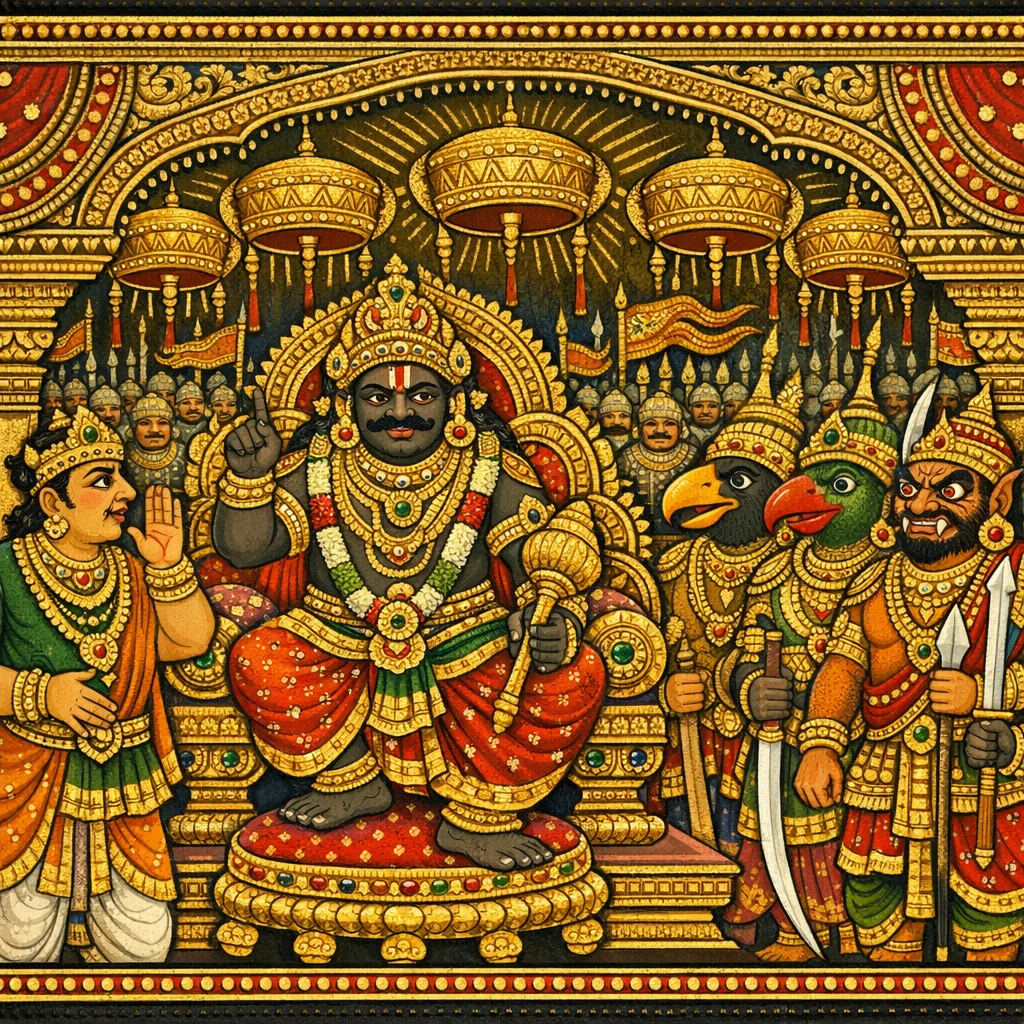
This adhyāya continues the Lalitopākhyāna war narrative, turning from the fall of earlier commanders to Bhaṇḍāsura’s strategic response. A messenger/minister reports that Karaṅka and others were brought down by a deceptive, serpent-like māyā. Enraged and eager to fight again, Bhaṇḍāsura escalates the conflict by summoning seven fierce brother-commanders, born of Kīkasā and mutually supportive, led by Balāhaka: Balāhaka, Sūcīmukha, Phālamukha, Vikarṇa, Vikaṭānana, Karālāyu, and Karaṭaka. He mobilizes a vast host of three hundred akṣauhiṇīs, with cosmic martial imagery—banners scraping the sky, dust veiling the oceans, and drums resounding through all quarters. The chapter is chiefly organizational and anticipatory, cataloging enemy leaders and forces while framing victory in a Shākta vision where māyā, śakti, and cosmic order prevail over mere physical might.
Shlokas
Verse 1
इति ब्रह्माण्डमहापुराणे उत्तरभागे ललितोपाख्याने करङ्कादिपञ्चसेनापतिवधो नाम त्रयोविंशो ऽध्यायः हतेषु तेषु रोषान्धो निश्वसञ्छून्यकेश्वरः / कुजलाशमिति प्रोचे युयुत्साव्याकुलाशयः
Thus, in the Brahmāṇḍa Mahāpurāṇa, in the latter section, in the Lalitā narrative, the twenty-third chapter is called “The Slaying of the Five Commanders, beginning with Karaṅka.” When they had been slain, Śūnyakeśvara, blinded by wrath and breathing hard, uttered “Kujalāśa,” his heart agitated with the desire to fight.
Verse 2
भद्र सेनापते ऽस्माकमभद्रं समुपागतम् / करङ्काद्यश्चमूनाथाः कन्दलद्भुजविक्रमाः
O Bhadra, commander of our host! Misfortune has come upon us. The lords of the army, such as Karaṅka, whose prowess blazed in the strength of their arms, have been struck down.
Verse 3
सर्पिणीमायया सर्वगीर्वाणमदभञ्जनाः / पापीयस्या तया गूढमायया विनिपातिताः
By the māyā called Sarpiṇī, even those who shattered the pride of all the devas were deceived; by her hidden māyā—she, the most wicked—they were cast down to destruction.
Verse 4
बलाहकप्रभृतयः सप्त ये सैनिकाधिपाः / तानुदग्रभुजासत्त्वान्प्राहिणु प्रधनं प्रति
The seven commanders of the host, beginning with Balāhaka—send those mighty beings of towering arms forth to the battlefield.
Verse 5
त्रिशतं चाक्षौहिणीनां प्रस्थापय सहैव तैः / ते मर्दयित्वा ललितासैन्यं मायापरायणाः
Dispatch also three hundred akṣauhiṇīs together with them. Those devoted to māyā will crush the army of Lalitā.
Verse 6
अये विजयमाहार्य संप्राप्स्यन्ति ममान्तिकम् / कीकसगर्भसंजातास्ते प्रचण्डपराक्रमाः
O Vijayamāhārya, they shall come into my very presence; born of Kīkasa’s womb, they are of fierce valor and dreadful might.
Verse 7
बलाहकमुखाः सप्त भ्रातरो जयिनः सदा / तेषामवश्यं विजयो भविष्यति रणाङ्गणे
Seven brothers, cloud-faced, ever victorious—on the battlefield their triumph shall surely be.
Verse 8
इति भण्डासुरेणोक्तः कुटिलाक्षः समाह्वयत् / बलाहकमुखान्सप्त सेनानाथान्मदोत्कटान्
Thus spoken by Bhaṇḍāsura, Kuṭilākṣa summoned the seven Balāhakamukhas—proud commanders, fierce with intoxicated zeal for war.
Verse 9
बलाहकः प्रथमतस्तस्मा त्सूचीमुखो ऽपरः / अन्यः फालमुखश्चैव विकर्णो विकटाननः
Balāhaka was the first; after him came Sūcīmukha; another was Phālamukha; and then Vikarṇa and Vikaṭānana.
Verse 10
करालायुः करटकः सप्तैते वीर्यशालिनः / भण्डासुरं नमस्कृत्य युद्धकौतूहलोल्वणाः
Karālāyu and Karaṭaka—these seven were mighty in strength; bowing to Bhaṇḍāsura, they surged with eager ardor for battle.
Verse 11
कीकसासूनवः सर्वे भ्रातरो ऽन्योन्यमावृताः / अन्योन्यसुसहायाश्च निर्जगमुर्नगरान्तरात्
All the sons of Kīkasa, brothers all, closed ranks around one another; mutually aiding each other, they came forth from within the city.
Verse 12
त्रिशाताक्षौहिणीसेनासेनान्यो ऽन्वगमंस्तदा / उल्लिखन्ति केतुजालैरंबरे घनमण्डलम्
Then the commander marched after them with an army of three hundred akṣauhiṇīs; and the clustered banners seemed to score the cloud-ring across the sky.
Verse 13
घोरसंग्रामिणीपादा घातैर्मर्दितभूतला / पिबन्ति धूलिकाजालैरशेषानपि सागरान्
The feet of that dread battle-host pounded and ground the earth with their blows; and the meshes of dust rose as though to drink up even all the seas.
Verse 14
भेरीनिः साणतंपोट्टपणवानकनिस्वनैः / नभोगुणमयं विश्वमादधानाः पदेपदे
With the blare of bherīs, sāṇas, taṃpoṭṭas, paṇavas, and ānakas, they filled the whole world with the very resonance of the heavens at every step.
Verse 15
त्रिशताक्षौहिणीसेनां तां गृहीत्वा मदेद्धताः / प्रवेष्टुमिव विश्वस्मिन्कैकसेयाः प्रतस्थिरे
Seizing that army of three hundred akṣauhiṇīs, intoxicated with pride, the Kaikaseyas set forth as though to enter the whole world itself.
Verse 16
धृतरोषारुणाः सूर्यमण्डलो द्दीप्तकङ्कटाः / उद्दीप्तशस्त्रभरणाश्चेलुर्द्दीप्तोर्ध्वकेशिनः
Bearing wrath, ruddy as the solar orb, with blazing armlets, laden with kindled weapons, they moved forth with hair uplifted and shining.
Verse 17
सप्त लोकान्प्रमथितुं प्रोषिताः पूर्वमुद्धताः / भण्डासुरेण महता जगद्विजयकारिणा
To crush the seven worlds, those haughty ones had earlier been dispatched by the great Bhaṇḍāsura, the conqueror of the universe.
Verse 18
सप्तलोकविमर्देन तेन दृष्ट्वा महाबलाः / प्रोषिता ललितासैन्यं जेतुकामेन दुर्धिया
Seeing him trample the seven worlds, those mighty ones, of perverse intent and craving conquest, were sent to overcome Lalitā’s host.
Verse 19
ते पतन्तो रणतलमुच्चलच्छत्रपाणयः / शक्तिसेनामभिमुखं सक्रोधमभिदुद्रुवुः
They swooped onto the battlefield, parasols aloft in their hands, and in wrath charged straight toward Śaktisenā.
Verse 20
मुहुः किलकिलाराबैर्घोषयन्तो दिशो दश / देव्यास्तु सैनिकं यत्र तत्र ते जगमुरुद्धताः
Again and again, with “kilakilā” cries, they made the ten directions resound; wherever the Goddess’s soldiers were, thither those arrogant ones marched.
Verse 21
सैन्यं च ललितादेव्याः सन्नद्धं शास्त्रभीषणम् / अभ्यमित्रीणमभवद्बद्धभ्रुकुटिनिष्ठुरम्
And the army of the Goddess Lalitā, fully armed and dreadful with sacred weapons, stood against the foes, brows knit tight, stern and unyielding.
Verse 22
पाशिन्यो मुसलिन्यश्च चक्रिण्यश्चापरा मुने / मुद्गरिण्यः पट्टिशिन्यः कोदण्डिन्यस्तथापराः
O sage, there were those bearing the pāśa (noose), the musala (club), and the cakra (discus); others bore the mudgara (hammer), the paṭṭiśa (axe), and still others the kodaṇḍa, the bow.
Verse 23
अनेकाःशक्तयस्तीव्रा ललितासैन्यसंगताः / पिबन्त्य इव दैत्याब्धिं सान्निपेतुः सहस्रशः
Many fierce and mighty Śaktis, joined to Lalitā’s host, converged by the thousand, as though drinking up the ocean of the Daityas.
Verse 24
आयातायात हे दुष्टाः पापिन्यो वनिताधमाः / मायापरिग्रहैर्दूरं मोहयन्त्यो जडाशयान्
“Come, go—O wicked ones, sinful and base women!” With the grasp of māyā they bewildered, even from afar, those of dull and inert minds.
Verse 25
नेष्यामो भवतीरद्य प्रेतनाथनिकेतनम् / श्वसद्भुजगसंकाशैर्बाणैर त्यन्तभीषणैः / इति शक्तीर्भर्त्सयन्तो दानवाश्चक्रुराहवम्
“Today we shall take you to the dwelling of the Lord of the Pretas!” Thus reviling the Śaktis, the Dānavas began the battle, loosing utterly dreadful arrows, hissing like breathing serpents.
Verse 26
काचिच्चिच्छेद दैत्येन्द्रं कण्ठे पट्टिशपातनात् / तद्गलोद्गलितो रक्तपूर ऊर्ध्वमुखो ऽभवत्
One goddess severed a demon lord's throat with a sharp axe; a torrent of blood gushed upward from his neck.
Verse 27
तत्र लग्ना बहुतरा गृध्रा मण्डलतां गताः / तैरेव प्रेतनाथस्य च्छत्रच्छविरुदञ्चिता
Many vultures gathered there forming a circle, creating the semblance of a parasol for the Lord of the Dead.
Verse 28
काचिच्छक्तिः मुरारातिं मुक्तशक्त्यायुधं रणे / लूनतच्छक्तिनैकेन बाणेन व्यलुनीत च
A Shakti goddess struck down the demon Murarati in battle, cutting his hurled weapon and him with a single arrow.
Verse 29
एका तु गजमारूढा कस्यचिद्दैत्यदुर्मतेः / उरःस्थले स्वकरिणा वप्राघातमशिक्षयत्
Another goddess, mounted on an elephant, taught the chest of an evil-minded demon the crushing blow of her tusker.
Verse 30
काचित्प्रतिभटारूढं दन्तिनं कुंभसीमनि / खड्गेन सहसा हत्वा गजस्य स्वप्रियं व्यधात्
One goddess struck an enemy's elephant on its frontal globes with a sword, granting the beast a swift release.
Verse 31
करमुक्तेन चक्रेण कस्यचिद्देववैरिणः / धनुर्दण्डं द्विधा कृत्वा स्वभ्रुवोः प्रतिमां तनेत्
With a cakra hurled from her hand, she split in two the bow-staff of a certain foe of the Devas, and drew it taut, bending it like the likeness of her own brows.
Verse 32
शक्तिरन्या शरैः शातैः शातयित्वा विरोधिनः / कृपाणपद्मा रोमाल्यां स्वकीयायां मुदं व्यधात्
Another Śakti, with keen-pointed arrows, shattered the opponents; and Kṛpāṇapadmā stirred delight within her own line of bristling hairs.
Verse 33
काचिन्मुद्गरपातेन चूर्णयित्वा विरोधिनः / रथ्यक्रनितंबस्य स्वस्य तेनातनोन्मुदम्
Another, with the fall of a heavy mace, ground the opponents to dust; and by that she spread delight within herself, whose hips were rounded like a chariot-wheel.
Verse 34
रथकूबरमुग्रेण कस्यचिद्दानवप्रभोः / खड्गेन छिन्दती स्वस्य प्रियमुव्यास्ततान ह
With her sword she severed the fierce chariot-pole of a certain lord of the Dānavas, and thus she spread abroad what was dear to her.
Verse 35
अभ्यन्तरं शक्तिसेना दैत्यानां प्रविवेश ह / प्रविवेश च दैत्यानां सेना शक्तिबलान्तरम्
The army of Śakti plunged into the very midst of the Daityas; and the host of the Daityas, in turn, entered the inner core of Śakti’s might.
Verse 36
नीरक्षीरवदत्यन्ताश्लेषं शक्तिसुरद्विषाम् / संकुलाकारतां प्राप्तो युद्धकाले ऽभवत्तदा
In that hour of war, the powers of the Devas and of the Deva-hating foes clung together utterly, like water mingled with milk; and in the time of battle the field became a tangled, confused mass.
Verse 37
शक्तीनां खड्गपातेन लूनशुण्डारदद्वयाः / दैत्यानां करिणो मत्ता महाक्रोडा इवाभवन्
As swords fell upon the śakti-weapons, the Daityas’ maddened elephants, bearing twin tusks, had the tips of their trunks shorn away; and they raged like mighty boars.
Verse 38
एवं प्रवृत्ते समरे वीराणां च भयङ्करे / अशक्ये स्मर्तुमप्यन्तं कातरत्ववतां नृणाम् / भीषणानां भीषणे च शस्त्रव्यापारदुर्गमे
Thus, as the battle raged on, it grew dreadful even for the heroes; for men possessed of cowardice its end could not be imagined—terror among terrors, hard to pass through, made perilous by the ceaseless play of weapons.
Verse 39
बलाहको महागृध्रं वज्रतीक्ष्णमुखादिकम् / कालदण्डोपमं जङ्घाकाण्डे चण्डपराक्रमम्
Balāhaka was like a mighty vulture, with beak and limbs keen as the vajra; and in his shanks there blazed a fierce prowess, like the rod of Kāla, the Time of doom.
Verse 40
संहारगुप्तनामानं पूर्वमग्रे समुत्थितम् / धूमवद्धूसराकारं पक्षक्षेपभयङ्करम्
And another, named Saṃhāragupta, rose up first in the fore; grey of form like drifting smoke, and fearsome with the sweeping beat of his wings.
Verse 41
आरुह्य विविधंयुद्धं कृतवान्युद्धदुर्मदः / पक्षौ वितत्य क्रोशार्धं स स्थितो भीमनिःस्वनैः / अङ्गारकुण्डवच्चञ्चुं विदार्याभक्षयच्चमूम्
He plunged into battles of many kinds, maddened with the pride of war. Spreading his wings to half a krośa, he stood there with a dreadful roar. With a beak like a pit of glowing embers, he tore and devoured the army.
Verse 42
संहारगुप्तं स महागृध्रः क्रूरविलोचनः / बलाहकमुवाहोच्चैराकृष्टधनुषं रणे
That mighty vulture, cruel-eyed, stood as though a guardian of destruction. In the battle he lifted Balāhaka aloft, like a warrior drawing a bow to the full.
Verse 43
बलाहको वपुर्धुन्वन्गृध्रपृष्ठकृतस्थितिः / सपक्षकूटशैलस्थो बलाहक इवाभवत्
Balāhaka shook his body, taking his stand upon the vulture’s back. With wings like mountain peaks, poised on the winged Kūṭa mountain, he seemed like the very cloud called Balāhaka.
Verse 44
सूचीमुखश्च दैत्येन्द्रः सूचीनिष्ठुरपक्षतिम् / काकवाहनमारुह्य कठिनं समरं व्यधात्
Sūcīmukha, lord of the Daityas, bore wings harsh and needle-sharp. Mounting his crow-vehicle, he set in motion a fierce and arduous battle.
Verse 45
मत्तः पर्वतशृङ्गाभश्चञ्चूदण्डं समुद्वहन् / कालदण्डप्रमाणेन जङ्घाकाण्डेन भीषणः
Maddened with arrogance, like a mountain peak, he lifted aloft his beak as a mace. Fearsome was his shank, as long as Kāladaṇḍa, Yama’s rod of Time.
Verse 46
पुष्कलावर्तकसमा जंबालसदृशद्यतिः / क्रोशमात्रायतौ पक्षावुभावपि समुद्वहन्
Like a mighty whirlwind, with strength akin to Jambāla, he bore aloft the ocean itself, his two wings each stretching a krośa in length.
Verse 47
सूचीमुखाधिष्ठितो ऽसौ करटः कटुवासितः / मर्दयञ्चञ्चुघातेन शक्तीनां मण्डलं महत्
That Karaṭa, set upon a needle-like beak and reeking with pungency, crushed with blows of his beak the great circle of the Śakti weapons.
Verse 48
अथो फलमुखः फालं गृहीत्वा निजमायुधम् / कङ्कमारुह्य समरे चकाशे गिरिसन्निभम्
Then Phalamukha seized the phāla, his own weapon; mounting the Kaṅka, he shone in battle like a towering mountain.
Verse 49
विकर्णाख्यश्च दैत्येन्द्रश्चमूभर्ता महाबलः / भेरुण्डपतनारूढः प्रचण्डयुद्धमातनोत्
And Vikarṇa, lord of the Daityas, bearer of the host and of immense might, mounted Bheruṇḍapatana and unleashed a furious war.
Verse 50
विकटानननामानं विलसत्पट्टिशायुधम् / उवाह समरे चण्डः कुक्कुटो ऽतिभयङ्करः
Caṇḍa, the exceedingly fearsome cock, bore into battle Vikaṭānana, who wielded a gleaming paṭṭiśa weapon.
Verse 51
गर्जन्कण्ठस्थरोमाणि हर्षयञ्ज्वलदीक्षणः / पश्यन्पुरः शक्तिसैन्यं चचाल चरणायुधः
Roaring, he made the hairs upon his throat stand on end; with eyes aflame that stirred exultation, he beheld before him the army of Śakti and moved forward, his very feet as weapons.
Verse 52
करालाक्षश्च भूभर्ता षष्ठो ऽत्यन्तगरिष्ठदः / वज्रनिष्ठुरघोषश्च प्राचलत्प्रेतवाहनः
Then Karālākṣa, lord of the earth—the sixth, who lays on an exceeding heaviness—uttering a harsh roar like the vajra, advanced, borne upon a preta as his mount.
Verse 53
श्मशानमन्त्रशूरेणतेन संसाधितः पुरा / प्रेतो भूतसमाविष्टस्तमुवाह रणाजिरे
That preta had formerly been brought to accomplishment by the hero skilled in the cremation-ground mantras; possessed by bhūtas, it bore him upon the field of battle.
Verse 54
अवाङ्मुखो दीर्घबाहुः प्रसारितपदद्वयः / प्रोतो वाहनतां प्राप्तःकरालाक्षमथावहत्
With face bent downward, long-armed, and with both legs outstretched, that preta attained the state of a mount and then bore Karālākṣa.
Verse 55
अन्यः करटको नाम दैत्यसेनाशिखामणिः / सर्दयामास शक्तीनां सैन्यं वेतालवाहनः
Another, named Karaṭaka, the crest-jewel of the Daitya host, mounted upon a vetāla, charged and scattered the army of Śakti.
Verse 56
योजनायतमूर्तिः सन्वेतालः क्रूरलोचनः / श्मशानभूमौ वेतालो मन्त्रेणानेन साधितः
Of a form a yojana in length, that Vetāla, fierce and cruel-eyed; upon the ground of the śmaśāna, the Vetāla was mastered by this very mantra.
Verse 57
मर्दयामास पृतनां शक्तीनां तेन देशितः / तस्य वेतालवर्यस्य वर्तमानोंससीमनि / बहुधायुध्यत तदा शक्तिभिः सह दानवः
At his direction he crushed the host of the Śaktis; and while that foremost Vetāla stood upon the border, then the Dānava fought in many ways together with the Śaktis.
Verse 58
एवमेते खलात्मानः सप्त सप्तार्णवोपमाः / शक्तीनां सैनिकं तत्र व्याकुलीचक्रुरुद्धताः
Thus those wicked-souled ones—seven, like unto seven oceans—through their arrogance threw the Śaktis’ army there into turmoil.
Verse 59
ते सप्त पूर्वं तपसा सवितारमतोषयन् / तेन दत्तो वरस्तेषां तपस्तुष्टेन भास्वता
Formerly those seven, by tapas, pleased Savitṛ, the Sun-god; and the radiant Bhāsvat, satisfied by their austerity, granted them a boon.
Verse 60
कैकसेया महाभागा भवतां तपसाधुना / परितुष्टो ऽस्मि भद्रं वो भवन्तो वृणतां वरम्
“O Kaikaseyas, greatly blessed ones! By your noble tapas I am well pleased. May auspiciousness be yours; choose the boon you desire.”
Verse 61
इत्युक्ते दिननाथेन कैकसेयास्तपः कृशाः / प्रार्थयामासुरत्यर्थं दुर्दान्तं वरमीदृशम्
Thus addressed by the Lord of Day, the Kaikaseyas—wasted by austerity—earnestly entreated for such a boon, a gift hard to restrain.
Verse 62
रणेषु सन्निधातव्यमस्माकं नेत्रकुक्षिषु / भवता घोरतेजोभिर्दहता प्रतिरोधिनः
In battle, be present within our eyes, in the very depth of our gaze; with your dreadful radiance, burn away those who resist.
Verse 63
त्वया यदा सन्निहितं तपनास्माकमक्षिषु / तदाक्षिविषयः सर्वो निश्चेष्टो भवतात्प्रभो
O Lord, whenever you are present in our eyes like a scorching sun, then all that falls within our sight shall become motionless by your power.
Verse 64
त्वत्सान्निध्यसमिद्धेन नेत्रेणास्माकमीक्षिताः / स्तब्धशस्त्रा भविष्यन्ति प्रतिरोधकसैनिकाः
When we behold them with eyes kindled by your nearness, the opposing soldiers shall stand stunned, their weapons frozen fast.
Verse 65
ततः स्तब्धेषु शस्त्रेषु वीक्षणादेव नः प्रभो / निश्चेष्टा रिपवो ऽस्माभिर्हन्तव्याः सुकरत्वतः
Then, O Lord, when their weapons are numbed by our very glance, the foes will be left motionless, and we shall slay them with ease.
Verse 66
इति पूर्वं वरः प्राप्तः कैकसेयौर्दिवाकरात् / वरदानेन ते तत्र युद्धे चेरुर्मधोद्धताः
Thus, in former times, the Kaikaseyas had obtained a boon from Divākara, the Sun-god. By that bestowal of grace, they moved in that battle, proud and inflamed, as though intoxicated with honey.
Verse 67
अथ सूर्यसमाविष्टनेत्रैस्तेस्तु निरीक्षिताः / शक्तयः स्तब्धशस्त्रौघा विफलोत्सा हतां गताः
Then, when they were beheld by eyes pervaded with the Sun’s power, their spears and whole torrents of weapons were stunned; their ardor turned futile, and they sank into defeat.
Verse 68
कीकसातनयैस्तैस्तु सप्तभिः सत्त्वशालिभिः / विष्टंभितास्त्रशस्त्राणां शक्तीनां नोद्यमो ऽभवत्
But by those seven sons of Kīkasāta, endowed with steadfast valor, weapons and astras were held in check; therefore the might of the spears could not be raised again.
Verse 69
उद्यमे क्रियभाणे ऽपि शस्त्रस्तम्भेन भूयसा / अभिभूताः सनिश्वासं शक्तयो जोषमासत
Even when they strove to rise and strike, the greater paralysis of weapons overwhelmed them; the spears, subdued, sat in silence with heavy sighs.
Verse 70
अथ ते वासरं प्राप्य नानाप्रहरणोद्यताः / व्यमर्दयञ्छक्तिसैन्यं दैत्याः स्वस्वामिदेशिताः
Then, when day arrived, those Daityas—arrayed with many kinds of weapons and directed by their respective lords—crushed the army of Śakti there.
Verse 71
शक्तयस्तास्तु सैन्येन निर्व्यापारा निरायुधाः / अक्षुभ्यन्त शरैस्तेषां वज्रकङ्कटभोदिभिः
Those Śaktis, rendered inactive by the army and left without weapons, were shaken by arrows that pierced them as though boring through adamantine armor.
Verse 72
शक्तयो दैत्यशस्त्रौधैर्विद्धगात्राः सृतामृजः / सुपल्लवा रणे रेजुः कङ्कोललतिका इव
Though their bodies were pierced by the mass of Daitya weapons and blood streamed forth, the Śaktis shone in battle like kaṅkola creepers lush with tender leaves.
Verse 73
हाहाकारं वितन्वत्यः प्रपन्ना ललितेश्वरीम् / चुक्रुशुः शक्तयः सर्वास्तैः स्तंभितनिजायुधाः
Spreading the cry of “hā hā,” they sought refuge in Laliteśvarī; and all the Śaktis, their own weapons immobilized by those foes, cried out aloud.
Verse 74
अथ देव्याज्ञया दण्डनाथा प्रत्यङ्गरक्षिणी / तिरस्करणिका देवी समुत्तस्थौ रणाजिरे
Then, at the Goddess’s command, Daṇḍanāthā—the Protectress of the inner limbs—namely the देवी Tiraskaraṇikā, rose up upon the field of battle.
Verse 75
तमोलिप्ताह्वयं नाम विमानं सर्वतोमुखम् / महामाया समारुह्य शक्तीनामभयं व्यधात्
Mahāmāyā mounted the all-facing vimāna called Tamolipta and bestowed fearlessness upon the Śaktis.
Verse 76
तमालश्यामलाकारा श्यामकञ्चुकधारिणी / श्यामच्छाये तमोलिप्ते श्यामयुक्ततुरङ्गमे
Dark-hued like the tamāla tree, she wore a black cuirass; in the black shadow, smeared with gloom, she rode a steed adorned in black.
Verse 77
वासन्ती मोहनाभिख्यं धनुरादाय सस्वनम् / सिंहनादं विनद्येषूनवर्षत्सर्पसन्निभान्
Vāsantī, famed as “Mohanā,” took up the resonant bow; roaring like a lion, she rained down arrows like serpents.
Verse 78
कृष्णरूपभुजङ्ग भानधोमुसलसंनिभान् / मोहनास्त्रविनिष्ठ्यूतान्बाणान्दैत्या न सेहिरे
The arrows discharged by the Mohanāstra were like black serpents, like heavy clubs; the Daityas could not endure them.
Verse 79
इतस्ततो मर्द्यमाना महामायाशिलीमुखैः / प्रकोपं परमं प्राप्ता बलाहकमुखाः खलाः
Smitten from every side by the arrows of Mahāmāyā, those vile ones with cloud-like faces were seized by utmost wrath.
Verse 80
अथो तिरस्करण्यंबा दण्डनाथानिदेशतः / अन्धाभिधं महास्त्रं सा मुमोच द्विषतां गणे
Then Mother Tiraskaraṇyā, at Daṇḍanātha’s command, released upon the host of foes the great weapon called “Andhā”.
Verse 81
बलाहकाद्यास्ते सप्त दिननाथवरोद्धताः / अन्धास्त्रेण निजं नेत्रं दधिरे च्छादितं यथा
Balāhaka and the others—seven in all—were forcefully checked by the Lord of Day, the Sun-god, as though with a weapon of darkness they had covered their own eyes.
Verse 82
तिरस्करणिकादेव्या महामोहनधन्वनः / उद्गतेनान्धबाणेन चक्षुस्तेषां व्यधीयत
By the Goddess Tiraskaraṇikā, wielder of the great-deluding bow, the risen arrow of blindness was loosed, and their eyes were struck.
Verse 83
अन्धीकृताश्च ते सप्त न तु प्रैक्षन्त किञ्चन / तद्वीक्षणस्य विरहाच्छस्त्रस्तम्भः क्षयं गतः
All seven were made blind and could see nothing at all; bereft of sight, the very “pillar of weapons”—their martial restraint—wasted away and came to ruin.
Verse 84
पुनः ससिंहनादं ताः प्रोद्यतायुधपाणयः / चक्रुः समरसन्नाहं दैत्यानां प्रजिघांसया
Then, roaring again with a lion’s cry, weapons raised in their hands, they formed their battle array, intent on slaying the Daityas.
Verse 85
तिरस्करणिकां देवीमग्रे कृत्वा महाबलाम् / सदुपायप्रसङ्गेन भृशं तुष्टा रणं व्यधुः
Setting the mighty Goddess Tiraskaraṇikā at their fore, and seizing upon a fitting stratagem, they rejoiced greatly and entered the fray.
Verse 86
साधुसाधु महाभागे तिरस्करणिकांबिके / स्थाने कृततिरस्कारा द्विपामेषां दुरात्मनाम्
Well done, well done, O greatly blessed one—O Ambikā who bestows disgrace! In the proper place you have rightly dealt contempt to these evil-souled ones who stride like elephants.
Verse 87
त्वं हि दुर्जननेत्राणां तिरस्कारमहौषधी / त्वया बद्धदृशानेन दैत्यचक्रेण भूयते
You indeed are the great remedy of contempt for the eyes of the wicked; by the gaze you have bound, the whole host-wheel of the Daityas is subdued all the more.
Verse 88
देवकार्यमिदं देवि त्वया सम्यगनुष्टितम् / अस्मादृशामजय्येषु यदेषु व्यसनं कृतम्
O Goddess, this is a work for the Devas, and you have carried it out rightly; for you have brought calamity upon those who, like us, were deemed unconquerable.
Verse 89
तत्त्वयैव दुराचारानेतान्सप्त महासुरान् / निहतांल्ललिता श्रुत्वा सन्तोषं परमाप्स्यति
By you alone these seven great Asuras of wicked conduct have been slain; when Lalitā hears of it, she will attain supreme contentment.
Verse 90
एवं त्वया विरचिते दण्डिनीप्रीति माप्स्यति / मन्त्रिण्यपि महाभागायास्यत्येव परां मुदम्
Thus, by what you have brought about, Daṇḍinī will gain delight; and Mantriṇī too, O greatly blessed one, will surely attain the highest joy.
Verse 91
तस्मात्त्वमेव सप्तैतान्निगृहण रणाजिरे / एषां सैन्यं तु निखिलं नाशयाम उदायुधाः
Therefore you alone restrain those seven upon the field of battle; and we, with weapons raised, shall destroy their entire host.
Verse 92
इत्युक्त्वा प्रेरिता ताभिः शक्तिभियुर्द्धकौतुकान् / तमोलिप्तेन यानेन बलाहकबलं ययौ
So saying, urged on by those śakti and exulting in battle, she went in a conveyance smeared with darkness toward the host of Balāhaka.
Verse 93
तामायान्तीं समावेक्ष्य ते सप्ताथ सुराधमाः / पुनरेव च सावित्रं वरं सस्मरुरञ्जसा
Seeing her approach, those seven—base among the sura—at once remembered again the boon of Sāvitra.
Verse 94
प्रविष्टमपि सावित्रं नाशकं तन्निरोधने / तिरस्कृतं तु नेत्रस्थं तिरस्करणितेजसा
Though the Sāvitra had entered, it could not destroy that restraint; though lodged in the eyes, it was eclipsed by the radiance of the power of concealment.
Verse 95
वरदानास्त्ररोषान्धं महाबलपराक्रमम् / अस्त्रेण च रुषा चान्धं बलाहकमहासुरम् / आकृष्य केशेष्वसिना चकर्तान्तर्धिदेवता
Balāhaka, the great asura—blinded by the wrath of the boon-bestowing weapon, mighty in strength and valor—was seized by the hair and cut down with a sword by the hidden divinity.
Verse 96
तस्य वाहनगृध्रस्य लुनाना पत्रिणा शिरः / सूचीमुखस्याभिमुखं तिरस्करणिका व्रजत्
Tiraskaranika severed the head of his vulture mount with an arrow and advanced towards Suchimukha.
Verse 97
तस्य पट्टिशपातेन विलूय कठिनं शिरः / अन्येषामपि पञ्चानां पञ्चत्वमकरोच्छनैः
Severing his hard head with a blow of her Pattisa, she slowly brought about the death of the other five as well.
Verse 98
तैः सप्तदैत्यमुण्डैश्चग्रथितान्योन्यकेशकैः / हारदाम गले कृत्वा ननादान्तर्धिदेवता
The Goddess Antardhi made a garland for her neck with those seven Daitya heads, their hair knotted together, and roared.
Verse 99
समस्तमपि तत्सैन्यं शक्तयः क्रोधसूर्च्छिताः / हत्वा तद्रक्तसलिलैर्बह्वीः प्रावाहयन्नदीः
The Shaktis, frenzied with anger, killed that entire army and caused many rivers to flow with their blood.
Verse 100
तत्राश्चर्यमभूद्भूरि माहामायांबिकाकृतम् / बलाहकादिसेनान्यां दृष्टिरोधनवैभवात्
There, a great wonder occurred, created by Mahamaya Ambika, through the power of obstructing the vision of Balahaka and the others.
Verse 101
हतशिष्टाः कतिपया बहुवित्राससङ्कुलाः / शरणं जग्मुरत्यार्त्ताः क्रन्दन्तं शून्यकेश्वरम्
A few who remained, overwhelmed by many terrors, in utter anguish ran for refuge to Śūnyakeśvara, the Lord of the Void, who was crying aloud.
Verse 102
दण्डिनीं च महामायां प्रशंसन्ति मुहुर्मुहुः / प्रसादमपरं चक्षुस्तस्या आदायपिप्रियुः
Again and again they praised Daṇḍinī and Mahāmāyā; and, receiving her special favor as though it were “another eye,” they rejoiced.
Verse 103
साधुसाध्विति तत्रस्थाः शक्तयः कम्पमौलयः / तिरस्करणिकां देवीमश्लाघन्त पदेपदे
There the Śakti who stood present, their crowns trembling, cried “Sādhu! Sādhu!” and praised the Goddess Tiraskaraṇikā at every step.
Frequently Asked Questions
Seven commander-brothers are listed—Balāhaka, Sūcīmukha, Phālamukha, Vikarṇa, Vikaṭānana, Karālāyu, and Karaṭaka—serving as a narrative index for upcoming duels and as a ritualized catalog of adversarial ‘ego-forces’ in the Shākta reading of Lalitopākhyāna.
It quantifies escalation and signals a new campaign phase; akṣauhiṇī functions as a standardized epic unit, allowing chapters to be compared by force-scale and enabling structured tagging of battle intensity and logistical magnitude.
Māyā appears as a decisive instrument that overturns brute strength—earlier commanders fall to concealed illusion—reinforcing the Shākta premise that victory aligns with higher śakti and cosmic order rather than mere martial power.