Adhyaya 14
Priyavrata-vaṃśa and Saptadvīpa Vibhāga (प्रियव्रतवंशः सप्तद्वीपविभागश्च)
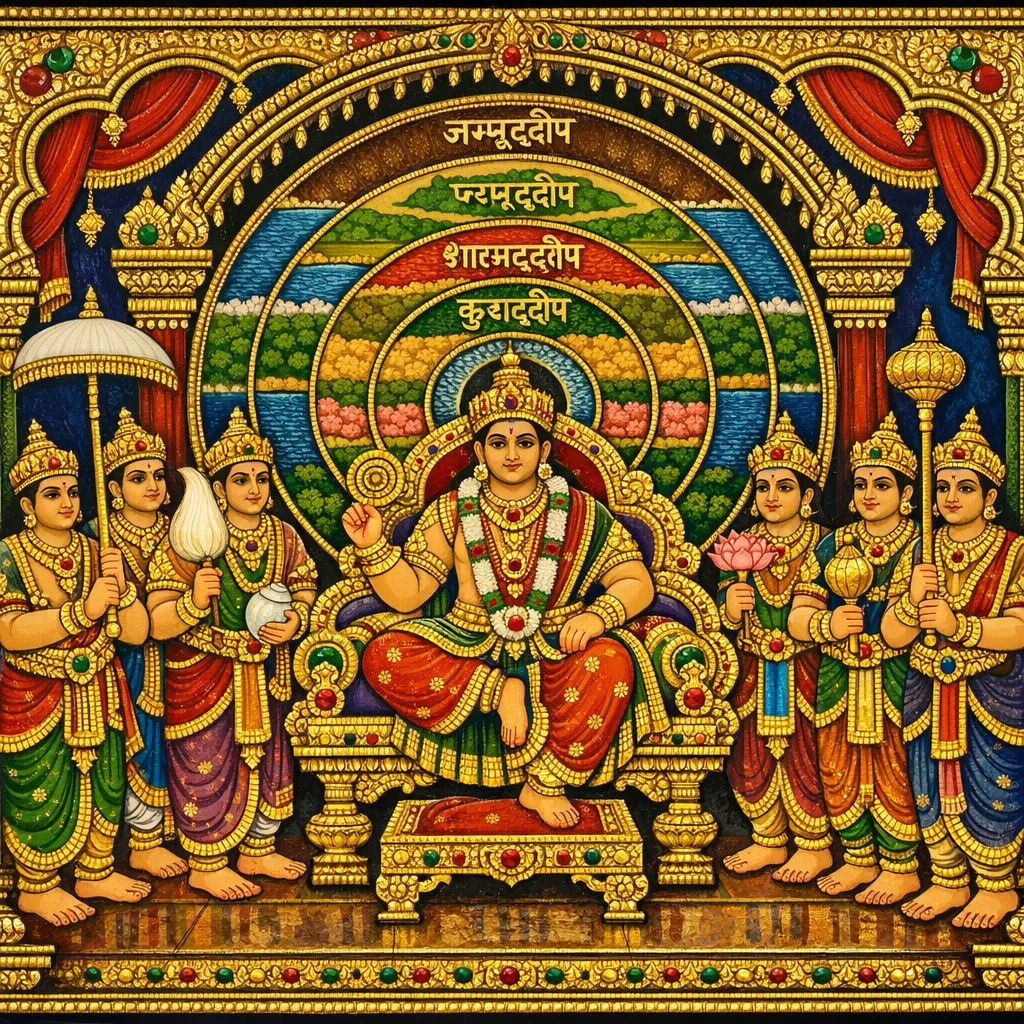
Set within a Purāṇic dialogue, Sūta continues imparting cosmological and genealogical lore. The teaching moves from the general principle that beings recur in past and future cycles with comparable status to a concrete listing of early Svāyambhuva-era lineages. It then centers on the Priyavrata complex: Priyavrata’s descendants and the installation of rulers over the seven dvīpas, turning vaṃśa (genealogy) into a geopolitical map. Named figures are assigned kingship over Jambū, Plakṣa, Śālmala, Kuśa, Krauñca, Śāka, and Puṣkara, showing Purāṇic geography narrated through dynastic administration. The chapter thus bridges temporal theory (manvantara/yuga recurrence) and spatial ordering (dvīpa division), embedding the earth’s macro-structure within ancestral succession and a dharmic mandate for rule.
Shlokas
Verse 1
इति श्रीब्रह्माण्डे महापुराणे वायुप्रोक्ते पूर्वभागे द्वितीये ऽनुषङ्गपादे कालसद्भाववर्णनं नाम त्रयोदशोंऽध्याय सुत उवाच अथान्तरेषु सर्वेषु अतीतानागतेष्विह / तुल्याभिमानिनः सर्वे जायन्ते नामरूपतः
Thus in the Śrī Brahmāṇḍa Mahāpurāṇa, in the former section spoken by Vāyu, in the second Anuṣaṅga-pāda, the thirteenth chapter called “The Description of the True Nature of Time.” Sūta said: In all the intervals here, in times past and yet to come, all are born with the same self-regard, according to name and form.
Verse 2
देवाश्चाष्टविधा ये च तस्मिन्मम्वन्तरे ऽधिपाः / ऋषयो मनवश्चैव सर्वे तुल्यप्रयोजनाः
In that manvantara, the eightfold classes of Devas who preside, and likewise the Ṛṣis and the Manus—all share the same purpose.
Verse 3
महर्षिसर्गः संक्रान्तो वंशं स्वायंभुवस्य तु / विस्तरेणानुपूर्व्या च कीर्त्य मानं निबोधत
The creation of the great Ṛṣis has passed onward; now understand the lineage of Svāyaṃbhuva Manu, to be praised in full and in due order.
Verse 4
मनोः स्वायंभूवस्यासन् दश पौत्रास्तु तत्समाः / यैरियं पृथिवी सर्वा सप्तद्वीपा सपत्तना
Svāyaṃbhuva Manu had ten grandsons, equal to him; through them this whole earth—together with the seven dvīpas and its cities—was spread and filled.
Verse 5
ससमुद्रा करवती प्रतिवर्षं निवेशिता / स्वायंभुवेंऽतरे पूर्वमाद्ये त्रेतायुगे तथा
That land of Karāvatī, encircled by the seas, was established year after year; even before the Manvantara of Svāyambhuva, in the earliest Tretā-yuga, it was so.
Verse 6
प्रियव्रतस्य पुत्रैस्तैः पौत्रैः स्वायंभुवस्य तु / प्रजा सत्त्वतपोयुक्तैस्तैरियं विनिवेशिता
Those sons of Priyavrata—grandsons of Svāyambhuva—endowed with sattva and austerity, duly established and settled this people.
Verse 7
प्रियव्रतात्प्रजोपेतान् वीरान्काम्यान्व्यजायत / कन्या सा तु महाभाग कर्दमस्य प्रजा पतेः
From Priyavrata were born sons attended by peoples—valiant and worthy of desire; and, O greatly fortunate one, that daughter of Prajāpati Kardama too was born.
Verse 8
कन्ये द्वे दश पुत्राश्च सम्राट् कुक्षिश्च ते शुभे / तयोर्वै भ्रातरः शूराः प्रजापतिसमा दश
O auspicious one, Samrāṭ and Kukṣi had two daughters and ten sons; and their ten brothers were heroes, equal to the Prajāpatis.
Verse 9
आग्नीध्रश्चाग्निबा हुश्च मेधा मेधातिथिर्वसुः / ज्योतिष्मान् द्युतिमान्हव्यः सवनः सभ्र एव च
Āgnīdhra, Agnibāhu, Medhā, Medhātithi, Vasu, Jyotiṣmān, Dyutimān, Havya, Savana, and Sabhra—these were their names.
Verse 10
प्रियव्रतो ऽभ्यषिञ्चत्तान्सप्तसप्तसु पार्थिवान् / द्वीपेषु तेषु धर्मेण द्वीपान्ताश्च निबोधत
Priyavrata, in accordance with dharma, anointed seven sets of seven earthly kings in those seven island-continents; learn also the boundaries of those dvipas.
Verse 11
जंबूद्वीपेश्वरं चक्रे आग्नीध्रं सुमहाबलम् / प्लक्षद्वीपेश्वरश्चापि तेन मेधातिथिः कृतः
He appointed the mighty Agnidhra as lord of Jambudvipa, and he likewise established Medhatithi as lord of Plaksadvipa.
Verse 12
शाल्मले तु वपुष्मन्तं राजानं सो ऽभिषिक्तवान् / ज्योतिष्मन्तं कुशद्वीपे राजानं कृतवान्प्रभुः
On Salmala he anointed Vapushmant as king; and on Kusadvipa the sovereign made Jyotishmant the king.
Verse 13
द्युतिमन्तं च राजानं क्रैञ्चद्वीपे ऽभ्यषेचयत् / शाकद्वीपेश्वरं चापि हव्यं चक्रे प्रियव्रतः
On Kraiñcadvipa he anointed Dyutimant as king; and Priyavrata also made Havya the lord of Sakadvipa.
Verse 14
पुष्कराधिपतिं चैव सवनं कृतवान्प्रभुः / पुष्करे सवनस्याथ महावीतः सुतो ऽभवत्
The sovereign made Savana the lord of Pushkara; and on Pushkara, Savana had a son named Mahavita.
Verse 15
धातकिश्चापि द्वावेतौ पुत्रौ पुत्रवता वरौ / महावीतं स्मृतं वर्षं तस्य नाम्ना महात्मनः
Dhātaki too had two sons, noble heirs of that blessed progenitor. By the name of that great-souled one, the region (varṣa) is remembered as Mahāvīta.
Verse 16
नाम्ना च धातकेश्चापि धातकीखण्ड उच्यते / हव्यो व्यजनयत्पुत्राञ् शाकद्वीपेश्वराञ् प्रभुः
By Dhātaki’s name it is called Dhātakīkhaṇḍa. The lord Havya begot sons who became rulers of Śākadvīpa.
Verse 17
जलदं च कुमारं च सुकुमारं मणीवकम् / कुसुमोत्तरमोदाकौ सप्तमं च महाद्रुगम्
Jalada, Kumāra, Sukumāra, Maṇīvaka, Kusumottara, Modāka, and as the seventh, Mahādruga—these were (the sons).
Verse 18
जलदं जलदस्याथ प्रथमं वर्षमुच्यते / कुमारस्य तु कौमारं द्वितीयं परिकीर्तितम्
Jalada’s realm is called Jalada, the first varṣa. Kumāra’s is named Kaumāra, proclaimed as the second.
Verse 19
सुकुमारं तृतीयं तु सुकुमारस्य तत्स्सतम् / मणीवस्य चतुर्थं तु मणीवकमिहोच्यते
The third varṣa, belonging to Sukumāra, is called Sukumāra. The fourth, belonging to Maṇīva, is here named Maṇīvaka.
Verse 20
कुसुमोत्तरवर्षं यत्पञ्चमं कुसुमोत्तरम् / मोदकस्यापि मोदाकं षष्ठं वर्षं प्रकीर्त्तितम्
The fifth realm is famed as Kusumottara, the Varsha called Kusumottara; and the sixth realm is proclaimed Modaka, bestowing delight like the sacred modaka offering.
Verse 21
महाद्रुमस्य नाम्ना च सप्तमं तन्महाद्रुमम् / तेषां तु नामभिस्तानि सप्त वर्षाणि तत्र वै
The seventh realm is known by the name Mahādruma; and there, those seven Varshas are indeed designated by their very names.
Verse 22
क्रैञ्चद्वीपेश्वरस्यापि पुत्रो द्युतिमतस्तु वै / कुशलो मनोनुगस्छोष्णः पावनश्चान्धकारकः
Dyutiman, the lord of Krañca-dvīpa, had sons named Kuśala, Manonuga, Śoṣṇa, Pāvana, and Andhakāraka.
Verse 23
मुनिश्च दुन्दुभिश्चैव सुता द्युतिमतस्तु वै / तेषां स्वनामभिर्देशाः क्रैञ्चद्वीपाश्रयाः शुभाः
Dyutiman also had sons named Muni and Dundubhi; and by their own names the auspicious lands abiding in Krañca-dvīpa became known.
Verse 24
कुशलस्य तु देशो ऽभूत कौशलो नाम विश्रुतः / देशो मनोनुगस्यापि मानोनुगे इते स्मृतः
Kuśala’s land became renowned as Kauśala; and Manonuga’s land is likewise remembered as Mānonuga.
Verse 25
उष्णस्योष्णः स्मृतो देशः पावनस्यापि पावनः / अन्धकारस्य देशस्तु आन्धकारः प्रकीर्त्तितः
The land of heat is remembered as heat itself; the land of the purifying is likewise purifying. But the land of darkness is proclaimed as Āndhakāra.
Verse 26
मुनेश्च मौनिदेशो वै दुन्दुभेर्दुन्दुभिः स्मृतः / एते जनपदाः सप्त क्रैञ्चद्वीपे तु भास्वराः
The land of the sage is called Mauni-deśa, and the land of Dundubhi is remembered as Dundubhi. These seven janapadas shine upon Krañcadvīpa.
Verse 27
ज्योतिष्मतः कुशद्वीपे सप्तैवासन्महौजसः / उद्भिज्जो वेणुमांश्चैव वैरथो लवणो धृतिः
On radiant Kuśadvīpa there were seven janapadas of great splendor: Udbhijja, Veṇumān, Vairatha, Lavaṇa, Dhṛti, and the rest.
Verse 28
षष्ठः प्रभाकरश्चा पि सप्तमः कपिलः स्मृतः / उद्भिज्जं प्रथमं वर्षं द्वितीयं वेणुमण्डलम्
The sixth is called Prabhākara, and the seventh is remembered as Kapila. The first varṣa is Udbhijja; the second is Veṇumaṇḍala.
Verse 29
तृतीयं वै रथाकारं चतुर्थं लवणं स्मृतम् / पञ्चमं धृतिमद्वर्षं षष्ठं वर्षं प्रभाकरम्
The third varṣa is Rathākāra, and the fourth is remembered as Lavaṇa. The fifth varṣa is Dhṛtimat, and the sixth varṣa is Prabhākara.
Verse 30
सप्तमं कपिलं नाम कपिलस्य प्रकीर्त्तितम् / तेषां देशाः कशद्वीपे तत्सनामान एव च
The seventh is named “Kapila,” proclaimed as belonging to Kapila. In Kaśadvīpa, their realms too are known by those very names.
Verse 31
आश्रमाचारयुक्ताभिः प्रजाभिः समलङ्कृताः / शाल्मलस्येश्वराः सप्त सुतास्ते च वपुष्मतः
They were adorned by peoples devoted to the disciplines of the āśramas. Śālmala had seven sons who were lords, all of radiant form.
Verse 32
श्वेतश्च हरितश्चैव जीमूतो रोहितस्तथा / वैद्युतो मानसश्चापि सुप्रभः सप्तमस्तथा
Śveta, Harita, Jīmūta, Rohita, Vaidyuta, Mānasa, and as the seventh, Suprabha—these are their names.
Verse 33
श्वेतस्तु देशः श्वेतस्य हरितस्य सुहारितः / जीमूतस्यापि जीमूतो रोहितस्यापि रोहितः
Śveta’s realm is called Śveta; Harita’s is Suhārita. Jīmūta’s is Jīmūta, and Rohita’s is Rohita.
Verse 34
वैद्युतो वैद्युतस्यापि मानसस्य तु मानसः / सुप्रभः सुप्रभस्यापि सप्तैते देशपालकाः
Vaidyuta’s realm is called Vaidyuta, and Mānasa’s is Mānasa. Suprabha’s too is Suprabha—these seven are the guardians of the lands.
Verse 35
प्लक्ष द्वीपं प्रवक्ष्यामि जंबूद्वीपादनन्तरम् / सप्त मेधातिथे पुत्राः प्लक्षद्वीपेश्वरा नृपाः
Now I shall declare Plakṣa-dvīpa, which comes after Jambūdvīpa. The seven sons of Medhātithi were the sovereign kings of Plakṣa-dvīpa.
Verse 36
ज्येष्ठः शान्तभयो नाम द्वितीयः शिशिरः स्मृतः / सुखोदयस्तृतीयस्तु चतुर्थो नन्द उच्यते
Among them, the eldest was named Śāntabhaya; the second is remembered as Śiśira. The third was Sukhodaya, and the fourth is called Nanda.
Verse 37
शिवस्तु पेचमस्तेषां क्षेमकः षष्ठ उच्यते / ध्रुवस्तु सप्तमो ज्ञेयः पुत्रा मेधातिथेः स्मृताः
Of them, the fifth was Śiva, and the sixth is called Kṣemaka. The seventh should be known as Dhruva—these are remembered as the sons of Medhātithi.
Verse 38
सप्तानां नामभिस्तेषां तानि वर्षाणि सप्त वै / तस्माच्छान्तभयं चैव शिशिरं च सुखोदयम्
By the names of those seven, there are indeed seven varṣas (regions) there. Thus are the varṣas called Śāntabhaya, Śiśira, and Sukhodaya.
Verse 39
आनन्दं च शिवं चैव क्षेमकं च ध्रुवं तथा / तानि तेषां समानानि सप्त वर्षाणि भागशः
Likewise there are Ānanda, Śiva, Kṣemaka, and Dhruva (as varṣa names). Those seven varṣas are apportioned among them in equal shares.
Verse 40
निवेशितानि तैस्तानि पूर्वं स्वायंभूवेन्तरे / मेधा तिथेस्तु पुत्रैस्तैः प्लक्षद्वीपेश्वरैर्नृबैः
All those were established long ago by them in the Svāyambhuva Manvantara; the sons of Tithi—such as Medhā—were kings, lords of Plakṣadvīpa.
Verse 41
वर्णाश्रमाचारयुक्ताः प्लक्षद्वीपे प्रजाः कृताः / प्लक्षद्वीपादिषु त्वेषु शाकद्वीपान्तिकेषु वै
In Plakṣadvīpa the peoples were established, endowed with the observances of varṇa and āśrama; and so too in these islands beginning with Plakṣadvīpa, near to Śākadvīpa.
Verse 42
ज्ञेयः पञ्चसु धर्मो वै वर्णाश्रमविभाजकः / सुखमायुश्च रूपं च बलं धर्मश्च नित्यशः
Among these five, one should know the dharma that apportions varṇa and āśrama; and ever there abide happiness, long life, beauty, strength, and dharma.
Verse 43
पञ्चस्वेतेषु द्वीपेषु सर्वसाधा रणं स्मृतम् / प्रक्षद्वीपः परिष्क्रान्तो जंबूद्वीपं निबोधत
In these five islands, this is remembered as a common ordinance. Plakṣadvīpa has been duly described; now understand Jambūdvīpa.
Verse 44
आग्नीध्रं ज्येष्ठदायादं काम्यापुत्रं महाबलम् / प्रियव्रतो ऽभ्य षिञ्चत्तं जंबूद्वीपेश्वरं नृपम्
Priyavrata, by the rite of abhiṣeka, consecrated Āgnīdhra—the mighty son of Kāmyā and eldest heir—as king, lord of Jambūdvīpa.
Verse 45
तस्य पुत्रा बभूवुर्हि प्रजापतिसमा नव / ज्येष्ठो नाभिरिति ख्यातस्तस्य किंपुरुषो ऽनुजः
He had nine sons, equal to the Prajāpatis. The eldest was famed as Nābhi, and his younger brother was Kiṃpuruṣa.
Verse 46
हरिवर्षस्तृतीयस्तु चतुर्थो ऽभूदिलावृतः / रम्यस्तु पञ्चमः पुत्रो हिरण्वान् षष्ठ उच्यते
The third was Harivarṣa, and the fourth became Ilāvṛta. The fifth son was Ramya, and the sixth is called Hiraṇvān.
Verse 47
कुरुस्तु सप्तमस्तेषां भद्राश्वश्चाष्टमः स्मृतः / नवमः केतुमालश्च तेषां देशान्निबोधत
Among them, the seventh was Kuru, and the eighth is remembered as Bhadrāśva. The ninth was Ketumāla; now learn of their realms.
Verse 48
नाभेस्तु दक्षिणं वर्षं हिमाख्यं तु पिता ददौ / हेमकूटं तु यद्वर्षं ददौ किपुरुषाय तत्
The father bestowed upon Nābhi the southern realm called Hima. And the realm named Hemakūṭa he gave to Kiṃpuruṣa.
Verse 49
नैषधं यत्स्मृतं वर्षं हरिवर्षाय तं ददौ / मध्यमं यत्सुमेरोस्तु ददौ स तदिलावृतम्
The realm remembered as Naiṣadha he gave to Harivarṣa. And the central land of Mount Sumeru he bestowed upon Ilāvṛta.
Verse 50
नीलं तु यत्स्मृतं वर्षं रम्यायैतप्तिता ददौ / श्वेतं यदुत्तरं तस्मात्पित्रा दत्तं हिरण्वते
The region remembered as Nīla-varṣa Taptitā bestowed upon Ramyā; and the northern region, called Śveta-varṣa, the father granted to Hiraṇvat.
Verse 51
यदुत्तरे शृङ्गवतो वर्षं तत्कुरवे ददौ / साल्यवन्तं तथा वर्षं भद्राश्वाय न्यवेदयत्
The northern Śṛṅgavat-varṣa he gave to Kuru; and likewise the Sālyavant-varṣa he presented to Bhadrāśva.
Verse 52
गन्धमादनवर्षं तु केतुमाले न्यवेदयत् / इत्येतानि मयोक्तानि नव वर्षाणि भागशः
And the Gandhamādana-varṣa he offered to Ketumāla. Thus have I spoken, in due divisions, of these nine varṣas.
Verse 53
आग्नी ध्रस्तेषु वर्षेषु पुत्रांस्तानभ्यषेचयत् / यथाक्रमं स धर्मात्मा ततस्तु तपसि स्थितः
In those regions Agnidhra anointed his sons in proper order; and that righteous-souled one thereafter abode in tapas, the life of austerity.
Verse 54
इत्येतौः सप्तभिः कृत्स्ना सप्तद्वीपा निवे शिताः / प्रियव्रतस्य पुत्रैस्तैः पौतैः स्वायंभुवस्य च
Thus were the seven dvīpas in their entirety settled and ordered by those seven sons of Priyavrata, who were also grandsons of Svāyaṃbhuva Manu.
Verse 55
एवं वर्षेषु सर्वेषु सन्निवेशाः पुनः पुनः / क्रियन्ते प्रलये वृत्ते सप्त सप्तसु पार्थिवैः
Thus, in all the varṣas, when the pralaya has passed, the settlements are established again and again by seven earthly kings in the seven regions, seven by seven.
Verse 56
एवं स्वभावः कल्पानां द्वीपानां च निवेशने / यानि किंपुरुषाद्यानि वर्णाण्यष्टौ श्रुतानि तु
Such is the nature of the kalpas and of the placing of the dvīpas; and the eight varṇas—beginning with the Kimpuruṣas—are indeed heard of in the Śruti.
Verse 57
तेषां स्वभावतः सिद्धिः सुखप्रायमयत्नतः / विपर्ययो न तेष्वस्ति जरामृत्युभयं न च
Their attainment is natural to them—mostly blissful and without striving; among them there is no reversal, nor any fear of old age and death.
Verse 58
धर्माधर्मौं न तेष्वास्ता नोत्तमाधममध्यमाः / न तेष्वस्ति युगावस्था क्षेत्रेष्वष्टासु सर्वशः
In them there is neither dharma nor adharma, nor any division into high, low, or middling; and throughout the eight realms there is no condition of the yugas at all.
Verse 59
नाभेर्निसर्गं वक्ष्यामि हिमाह्वे ऽस्मिन्निबोधत / नाभिस्त्वज नयत्पुत्रं मेरुदेव्यां महाद्युतिम्
Now I shall speak of the lineage of Nabhi in this land called Hima—listen well. Nabhi begot upon Merudevi a son of great splendor, named Aja.
Verse 60
ऋषभं पार्थिवश्रेष्ठं सर्वक्षत्रस्य पूर्वजम् / ऋषभाद्भरतो जज्ञे वीरः पुत्रशताग्रजः
Rishabha was the foremost of earthly kings, the prime ancestor of all Kshatriyas. From Rishabha was born the heroic Bharata, eldest among a hundred sons.
Verse 61
सोभिषिच्यर्षभः पुत्रं महाप्रव्रज्यया स्थितः / हिमाह्वं दक्षिणं वर्षं भरताय न्यवेदयत्
Having anointed his son, Rishabha abided in the great renunciation (mahāpravrajyā). He bestowed upon Bharata the southern region called Himāhva.
Verse 62
तस्मात्तु भारतं वर्षं तस्य नाम्ना विदुर्बुधाः / भरतस्यात्मजो विद्वान्सुमतिर्नाम धार्मिकः
Therefore the wise know that land by his name as Bhārata-varṣa. Bharata’s son, learned and devoted to dharma, was known as Sumati.
Verse 63
बभूव तस्मिन् राज्ये तंभरतस्त्वभ्यषेचयत् / पुत्रसंक्रामितश्रीस्तु वनं राजा विवेश सः
In that kingdom he became king; Bharata anointed him. Having transferred the royal splendor to his son, the king himself entered the forest in renunciation.
Verse 64
तेजसस्तत्सुतश्चापि प्रजापतिरमित्रजित् / तेजसस्यात्मजो विद्वानिन्द्रद्युम्न इति स्मृतः
Tejas’s son too became a Prajāpati named Amitrajit. Tejas’s learned son is remembered by the name Indradyumna.
Verse 65
परमेष्ठी सुतश्चापि निधने तस्य चाप्यभूत् / प्रतीहारः कुलं तस्य नाम्ना जज्ञे तदन्वयः
Parameṣṭhī too had a son; and after his passing, in that lineage a clan arose bearing the name “Pratīhāra,” and that descent continued.
Verse 66
प्रतिहर्तेति विख्यातो जज्ञे तस्यापि धीमतः / उन्नेता प्रतिहर्तुस्तु भूमा तस्य सुतः स्मृतः
To that wise one was born a son famed as “Pratihartā.” Pratihartā’s son was Unnetā, and Unnetā’s son is remembered as Bhūmā.
Verse 67
उद्गीथस्तस्य पुत्रो ऽभूतप्रस्ताविश्चापि तत्सुतः / प्रस्तावेस्तु विभुः पुत्रः पृथुस्तस्य सुतो ऽभवत्
Bhūmā’s son was Udgītha, and his son was Prastāvī. Prastāvī’s son was Vibhu, and Vibhu’s son was born as Pṛthu.
Verse 68
पृथोश्चापि सुतो नक्तो नक्तस्यापि गयः सुतः / गयस्यापि नरः पुत्रो नरस्यापि सुतो विराट्
Pṛthu’s son was Nakta, and Nakta’s son was Gaya. Gaya’s son was Nara, and Nara’s son was Virāṭ.
Verse 69
विराट्सुतो महावीर्यो धीमांस्तस्य सुतो ऽभवत् / धीमतश्च महान्पुत्रो महतश्चापि भौवनः
Virāṭ’s son was Mahāvīrya, and his son was born as Dhīmān. Dhīmān’s son was Mahān, and Mahān’s son was also Bhauvana.
Verse 70
भौवनस्य सतस्त्वष्टा विरजास्तस्य चात्मजः / रजा विरजसः पुत्रः शतजिद्रजसस्तथा
From the true being named Bhauvana arose Tvaṣṭā; his son was Virajāḥ. Virajāḥ begot Rajā, and Rajā in turn begot Śatajit.
Verse 71
तस्य पुत्रशतं त्वासीद्राजानः सर्व एव तु / विश्वज्योतिष्प्रधानास्ते यैरिमा वर्द्धिताः प्रजाः
He had a hundred sons, and every one of them was a king. Foremost in the radiance of the cosmos, by them these peoples were increased and nourished.
Verse 72
तैरिदं भारतं वर्षं सप्तद्वीपमिहाङ्कितम् / तेषां वंशप्रसूतैस्तु भुक्तेयं भारती पुरा
By them this Bhārata-varṣa, together with the seven dvīpas, was marked out and ordered here. And those born of their line in ancient times enjoyed and ruled this Bhāratī land.
Verse 73
कृतत्रेतादियुक्तास्तु युगाख्या ह्येकसप्ततिः / ये ऽतीतास्तैर्युगैः सार्धं राजानस्ते तदन्वयाः
Seventy-one (71) cycles called yugas—comprising Kṛta, Tretā, and the rest—have passed away; and with those yugas, the kings of that lineage too have gone into the past.
Verse 74
स्वायंभुवेंऽतरे पूर्वं शतशो ऽथ सहस्रशः / एवं स्वायं भुवः सर्गो येनेदं पूरितं जगत्
Before the Svāyambhuva Manvantara, creations occurred by the hundreds and then by the thousands. Thus, through Svāyambhuva’s sarga, this world was filled to fullness.
Verse 75
ऋषिभिर्दैवतैश्चापि पिर्तृगन्धवराक्षसैः / यक्षभूतपिशाचैश्च मनुष्यमृगपक्षिभिः / तेषां सृष्टिरियं प्रोक्ता युगैः सह विवर्त्तते
By the ṛṣis and the gods, by the Pitṛs, gandharvas and rākṣasas, by yakṣas, bhūtas and piśācas, and by humans, beasts and birds—this creation of theirs is declared; it turns and transforms along with the yugas.
Frequently Asked Questions
The chapter foregrounds the Svāyambhuva-era succession, highlighting Priyavrata’s line and associated descendants, and uses that lineage to explain how early rulers are positioned over the dvīpas.
It enumerates the seven dvīpas and explicitly assigns dvīpa-lordship: Agnīdhra (Jambū), Medhātithi (Plakṣa), Vapuṣmān (Śālmala), Jyotiṣmān (Kuśa), Dyutimān (Krauñca), Havya (Śāka), and Savana (Puṣkara), presenting geography through administrative distribution.
No. The supplied verses belong to the cosmology/genealogy stream (manvantara, vaṃśa, dvīpa-vibhāga). Lalitopākhyāna themes (Śākta vidyās, yantras, and the Bhaṇḍāsura cycle) occur in later portions of the Purāṇa, not in this chapter’s focus.