Adhyaya 57
गङ्गानयनम् (Gaṅgānayana) — “The Bringing/Leading of the Gaṅgā”
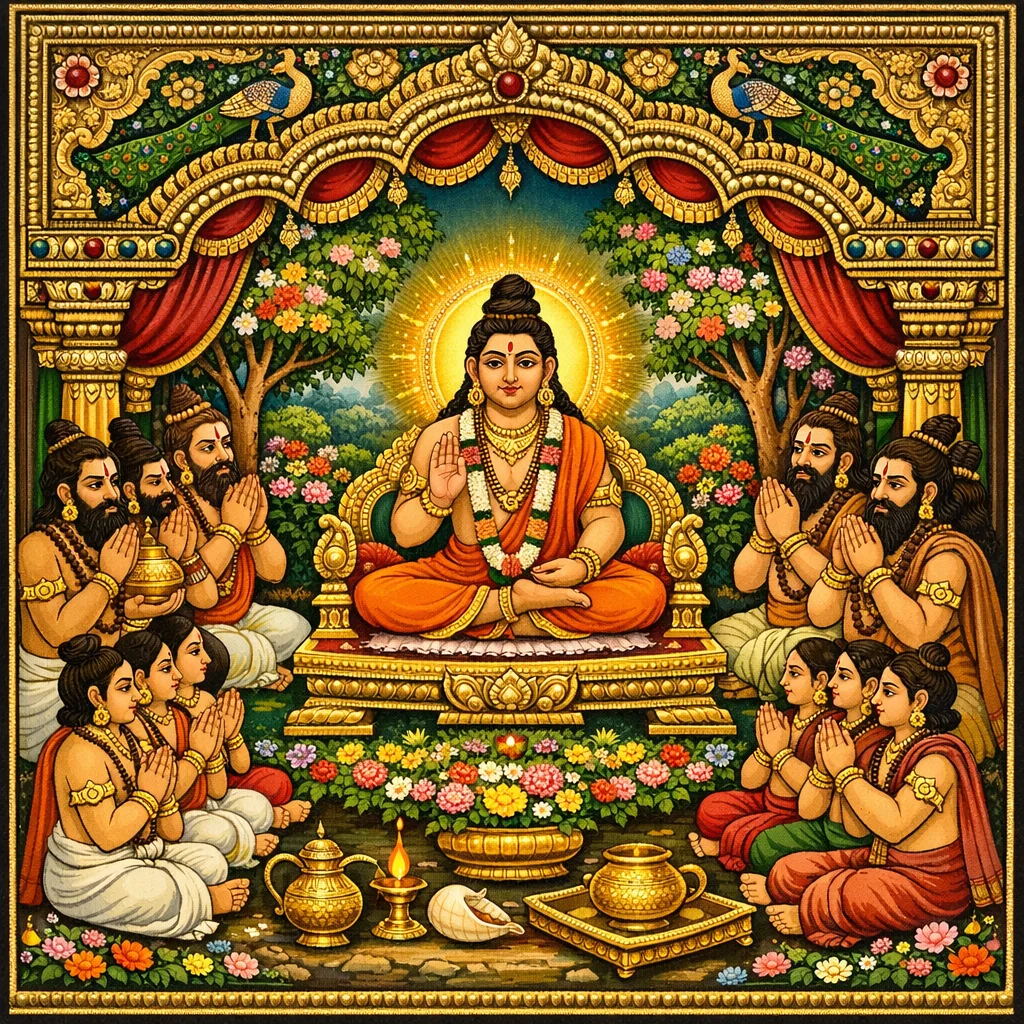
Framed as Jaimini’s narration, the chapter begins with a journey: ascetics such as Śuṣka and Sumitrā, with others, cross many regions of forests and rivers toward Mahendra mountain, longing to behold Rāma. The text then turns to sacred topography, portraying an ideal āśrama-maṇḍala and tapovana—peaceful, with formerly fearsome beings now pacified, abundant all-season flowers and fruits, cool shade, fragrant breezes, and the resonance of Vedic recitation (brahma-ghoṣa). Entering by proper seniority, the sages see a Bhr̥gu-lineage ascetic seated on a brahmāsana, serene amid disciples, his tapas likened to one who once burned the worlds and now practices austerity for appeasement. The visitors bow with disciplined etiquette; the host offers arghya-pādya hospitality and asks their purpose. They identify themselves as Gokarṇa-dwelling munis and request the recovery of a supremely purifying mahākṣetra with its tīrtha, lost into the ocean through the sea’s disruptive action, appealing to the host’s Viṣṇu-aṃśa potency as Bhr̥gu-born to restore or reveal the vanished sacred site—setting up a Gaṅgā-centered intervention and tīrtha-restoration logic.
Shlokas
Verse 1
इति श्रीब्रह्माण्डे महापुराणे वायुप्रोक्ते मध्यमाभागे तृतीय उपोद्धातपादे गङ्गानयनं नाम षट्पञ्चशत्तमो ऽध्यायः जैमिनिरुवाच ततः शुष्कसुमित्राद्या मुनयः शंसितव्रताः / ययुर्दिदृक्षवो रामं महेन्द्रमचलं प्रति
Thus, in the Śrī Brahmāṇḍa Mahāpurāṇa, proclaimed by Vāyu, in the middle section, in the third introductory pāda, is the fifty-sixth chapter called “Gaṅgānayana”. Jaimini said: then the sages such as Śuṣkasumitrā, renowned for their vows, set out wishing to behold Rāma, toward Mount Mahendra.
Verse 2
अतीत्य सुबहून्देशान्वनानि सरितस्तथा / आसेदुरचलश्रेष्ठं क्रमेण मुनिपुङ्गवाः
Crossing many lands, forests, and rivers, those foremost sages gradually reached the most excellent of mountains.
Verse 3
तमारुह्य शनैस्तस्यख्यातमाश्रममण्डलम् / प्रशान्तक्रूरसत्त्वाढ्यं शुभं मध्ये तपोवनम्
Slowly ascending that mountain, they reached its famed circle of āśramas; in the midst lay an auspicious tapovana, where even fierce creatures had grown calm.
Verse 4
सर्वर्त्तुफलपुष्पाढ्यतरुखण्डमनोहरम् / स्निग्धच्छायमनौपम्यं स्वामोदिसुखमारुतम्
That hermitage-land was delightful with groves of trees laden with fruits and flowers in every season; its shade was soft and incomparable, and a pleasant breeze, fragrant with its own perfume, blew there.
Verse 5
तं तदाश्रममासाद्य ब्रह्मघोषेण नादितम् / विविशुर्त्दृष्टमनसो यथावृद्धपुरस्सरम्
Reaching that hermitage resounding with brahmaghoṣa, they fixed their minds in attentive focus and entered in due order, with the elders leading the way.
Verse 6
ब्रह्मासने सुखासीनं मृदुकृष्णाजिनोत्तरे / शिष्यैः परिवृतं शान्तं ददृशुस्ते तपोधनाः
They beheld that treasure of austerity: seated at ease upon the brahmāsana, on a soft black antelope-skin, surrounded by disciples, serene and tranquil.
Verse 7
कालाग्निमिव लोकांस्त्रीन्दग्ध्वा पूर्वं निजेच्छया / तद्दोषशान्त्यै तपसि प्रवृत्तमिव् देहिनम्
He seemed like an embodied being who once, like the fire of Time (kālāgni), burned the three worlds by his own will, and then turned to austerity to quell the taint of that deed.
Verse 8
ते समेत्य भृगुश्रेष्ठं विनयाचारशालिनः / ववन्दिरे महामौनं भक्तिप्रणतकन्धराः
They, endowed with humility and proper conduct, approached the foremost of the Bhṛgus; with necks bowed in devotion, they paid reverence to that great silent sage (mahāmauna).
Verse 9
ततस्तानागतान्दृष्ट्वा मुनीन्भृगुकुलोद्वहः / अर्घपाद्यादिभिः सम्यक्पूजयामास सादरम्
Then, seeing those sages who had arrived, the foremost of the Bhṛgu lineage duly worshipped them with reverence, offering arghya, pādya, and other rites of honor.
Verse 10
तानासीनान्कृतातिथ्यानृषीन्देशान्तरागतान् / उवाच भृगुशार्दूलः स्मितपूर्वमिदं वचः
When the sages from distant lands had been seated and duly received as guests, the “tiger” of the Bhṛgu line spoke these words, preceded by a gentle smile.
Verse 11
स्वागतं वो महाभागा यूयं सर्वे समागताः / करणीयं किमस्माभिर्वदध्वमविचारितम्
Welcome to you, O greatly blessed ones; you have all gathered here. Tell us without hesitation what we should do.
Verse 12
ततस्ते मुनयो रामं प्रणम्येदमथाब्रुवन् / अवेह्यस्मान्मुनिश्रेष्ठ गोकर्णनिलयान्मुनीन्
Then those sages bowed to Rāma and said: “O best of munis, know us to be the sages who dwell at Gokarṇa.”
Verse 13
खनद्भिः सागरैर्भूमिं कस्मिंश्चित्कारणान्तरे / सतीर्थं तन्महाक्षेत्रं पतितं सागरांभसि
For some other cause, the seas dug into the earth; and that great sacred region, together with its tīrthas, fell into the waters of the ocean.
Verse 14
उत्सारितार्मवजलं क्षेत्रं तत्सर्वपावनम् / उपलब्धुमभीप्सामो भवतस्तु न संशयः
That kṣetra from which the ocean’s waters have been driven back is a tirtha that purifies all. We long to obtain it; through you there is no doubt.
Verse 15
विष्णोरंशेन संजातो भवान्भृगुकुले किल / तस्मात्कर्तुमशक्यं ते त्रैलोक्ये ऽपि न किञ्चन
You were born in the Bhṛgu lineage as a portion of Viṣṇu; therefore, even in the three worlds nothing is impossible for you.
Verse 16
वाञ्छितार्थप्रदो लोके त्वमेवेत्यनुशुश्रुम / वयं त्वामागताः सर्वे रामैतदभियाचितुम्
We have heard that in this world you alone bestow the wished-for boon. Therefore, O Rāma, we have all come to entreat you for this.
Verse 17
स त्वमात्मप्रभावेण क्षेत्रप्रवरमद्य तत् / दातुमर्हसि विप्रेन्द्र समुत्सार्यार्मवोदकम्
Therefore, O foremost of brāhmaṇas, by your own spiritual power drive back the ocean’s waters and grant us today that most excellent kṣetra.
Verse 18
राम उवाच एतत्सर्वमशेषण विदितं मे तपोधनाः / करणीयं च वः कृत्यं मया नात्र विचारणा
Rāma said: “O sages rich in austerity, all this is fully known to me. The duty that must be done for you I shall do; here there is no hesitation.”
Verse 19
किं तु युष्मदभिप्रेतं कर्म लोके सुदारुणम् / शस्त्रसंग्रहणाच्छक्यं मयापि न तदन्यथा
Yet the deed you desire is exceedingly harsh in this world. It can be accomplished only by gathering weapons; for me too, it cannot be otherwise.
Verse 20
दत्तसर्वाभयो ऽहं वै न्यस्तशस्त्रः शमान्वितः / तपः समास्थितश्चर्तु प्रागेव पितृ शासनात्
I have granted fearlessness to all, laid down my weapons, and am endowed with calm. By my father’s command, I had already long ago taken up austerity.
Verse 21
न जातु शस्त्रग्रहणं करिष्यामीत्यहं पुरा / प्रतिश्रुत्य सतां मध्ये तपः कर्त्तुमिहानघाः
O blameless ones, long ago, in the midst of the righteous, I vowed: ‘Never shall I take up weapons’; here I am to perform austerity.
Verse 22
शस्त्रग्रहणसाध्यत्वाद्युष्मदीप्सितवस्तुनः / किङ्कर्त्तव्यं मयात्रेति मम डोलायते मनः
Since what you seek can be attained only by taking up weapons, my mind wavers: ‘What am I to do here?’
Verse 23
शुष्क उपाच / सतां संरक्षणार्थाय शस्त्रसंग्रहणं तु यत् / तन्नच्यावयते सत्यद्यथोक्तं ब्रह्मणा पुरा
Śuṣka said: Gathering weapons for the protection of the righteous does not swerve from truth, just as Brahmā declared in ancient times.
Verse 24
तस्मादस्मद्धितार्थाय भवता ग्राह्यमायुधम् / धर्म एव महांस्तेन चरितस्ते भविष्यति
Therefore, for our welfare, you should accept this weapon; by it you shall accomplish a great act of dharma.
Verse 25
जैमिनिरुवाच एवं संप्रार्थ्यमानस्तु मुनिभिर्भृगुपुङ्गवः / तमनुद्रुत्य मेधावी धर्ममुद्दिश्य केवलम्
Jaimini said: thus entreated by the sages, the wise foremost of Bhrigu’s line pursued him, intent solely upon dharma.
Verse 26
स तैः सह मुनिश्रेष्ठो दिशं दक्षिणपश्चिमाम् / समुद्दिश्य चचौ राजन्द्रष्टुकामः सरित्पतिम्
With those sages, the foremost of seers set out toward the southwest, longing to behold the Lord of rivers.
Verse 27
स सह्यमचलश्रेष्ठमवतीर्य भृगूद्वहः / तत्परं सरितां पत्युस्तीरं प्राप महामनाः
The great-souled scion of Bhrigu descended from the lofty Sahya range and swiftly reached the bank of the Lord of rivers.
Verse 28
स ददर्श महाभागः परितो मारुताकुलम् / आकरं सर्वरत्नानां पूर्यमाणमनारतम्
That fortunate one beheld all around the tumult of winds, and the mine of every jewel, ceaselessly filling without pause.
Verse 29
अपरिज्ञेयगांभीर्यं महातामिव मानसम् / दुष्पारपारं सर्वस्य विविधग्रहसंहतिम्
Its depth was unknowable, like the mind of the great; for all it was hard to cross and without far shore, as though a host of many planets.
Verse 30
अप्रधृष्य तमं लोके धातारमिव केवलम् / आत्मानमिव चात्मत्वे न्यक्कृताखिलमुद्धतम्
In the world it was most unconquerable, like Dhātā alone; and in the nature of the Self it was as the Ātman, humbling all exalted pride.
Verse 31
आश्रयं सर्वसत्त्वानामापगानां च पार्थिवः / अत्यर्थचपलोत्तुगतरङ्गशतमालिनम्
O Pārthiva, it is the refuge of all beings and of the rivers; exceedingly restless, adorned with garlands of hundreds of towering waves.
Verse 32
उपान्तोपलसंघातकुहरान्तरसंश्रयात् / विशीर्यमाणलहरीशतफेनौघसोभितम्
Resting in the hollows amid the piled rocks along the shore, it shone with torrents of foam from hundreds of waves breaking apart.
Verse 33
गंभीरघोषं जलधिं पश्यन्मुनिगणैः सह / संसेव्यमानस्तरलैर्लहरीकणशीतलैः
Beholding the deep-voiced ocean together with the hosts of sages, he was soothed by the cool spray-drops of the swift, shimmering waves.
Verse 34
मुहूर्त्तमिव राजेन्द्र तीरेनदनदीपतेः / विशश्रमे महाबाहुर्द्रष्टुकामः प्रचेतसम्
O Rajendra, upon the riverbank of the Lord of waters, mighty-armed Rama rested for a moment, longing to behold Pracetas (Varuna).
Verse 35
ततो रामः समुत्थाय दक्षिणाभिमुखः स्थितः / मेघगंभिरया वाचा वरुणं वाक्यमब्रवीत्
Then Rama rose, stood facing the south, and in a cloud-deep, thunderous voice spoke to Varuna.
Verse 36
अहं मुनिगणैः सार्द्धमागतस्त्वद्दिदृक्षया / तस्मात्स्वरूपधृङ्मह्यं प्रचेतो देहि दर्शनम्
I have come with the host of sages, yearning to see you; therefore, O Pracetas, assume your true form and grant me your darśana.
Verse 37
इति श्रुत्वापि तद्वाक्यं वरुणो यादसां पतिः / न चचाल निजस्थानान्नृप धीरतरस्त्वयम्
O king, even after hearing those words, Varuna, lord of the water-born, did not stir from his own abode; he was steadier still than you.
Verse 38
पुनः पुनश्च रामेण समाहूतो ऽपि तोयराट् / न ददौ दर्शनं तस्मै प्रतिवाच्यं च नाभ्यधात्
Though Rama called again and again, the King of waters granted him no darśana, nor did he utter any reply.
Verse 39
अलङ्घनीयं तद्वाक्यं वरुणेनावधीरितम् / अत्यन्तमिति कार्यार्थी विदुषा समुपेक्षितम्
Varuṇa’s utterance was not to be transgressed, yet it was treated with contempt. Deeming it “too extreme,” even the wise man seeking the work’s fulfillment set it aside.
Verse 40
ततः प्रचेतसा वाक्यं मन्यमानो ऽवधीरितम् / चुकोप तमभिप्रेक्ष्य रामः शस्त्रभृतां वरः
Then, thinking Pracetas’ (Varuṇa’s) word had been dishonored, Rāma—the foremost of weapon-bearers—grew wrathful the moment he beheld him.
Verse 41
संक्षुब्धसागराकारः स तदा स्वबलाश्रयात् / निस्तोयमर्णवं कर्तुमियेष रुषितो भृशम्
He then became like a storm-tossed sea; relying on his own might, fiercely enraged, he resolved to make the ocean waterless.
Verse 42
ततो जलमुपस्पृश्य समीपे विजयं धनुः / ततः प्रणम्य मनसा शर्वं रामो महाद्धनुः
Then he touched water in purification and took up the nearby bow named Vijaya; thereafter Rāma, the mighty archer, bowed in his heart to Śarva (Śiva).
Verse 43
गृहीत्वारोपयामास क्रोधसंरक्तलोचनः / अभिमृश्य धनुःश्रेष्ठं सगुणं भृगुसत्तमः
With eyes reddened by wrath, the foremost of Bhṛgu’s line (Rāma) seized it and raised it; feeling the supreme bow, he set its string in place.
Verse 44
पश्यतां सर्वभूतानां ज्याघोषमकरोत्तदा / ज्याघोषः शुश्रुवे तस्य दिविस्पृगतिनिष्ठुरः
Before all beings who looked on, he then raised the dreadful roar of the bowstring. That harsh jyā-ghoṣa of his was heard as though it grazed the very heavens.
Verse 45
चचाल निखिलायेन सप्तद्वीपार्मवा मही / ततः सरभसं रामश्चापे कालानलोपमम्
The whole earth, with its seven island-continents and oceans, trembled all at once. Then Rāma, in fierce haste, made his bow terrible like the fire of the world’s end.
Verse 46
सुवर्मपुङ्खं विशिखं संदधे शरसत्तमम् / तस्मिन्नस्त्रं महाघोरं भार्गवं वह्निदैवतम्
He set in place the finest arrow, with golden fletching and a keen point. Upon it he fixed the most dreadful Bhārgava astra, whose presiding deity is Agni, lord of fire.
Verse 47
युयोज भृगुशार्दूलः समन्त्राभ्यासमोक्षणम् / ततश्चचाल वसुधा सशैलवनकानना
The tiger of Bhṛgu’s line employed it, releasing it with the practiced power of mantras. Then the earth shook, with its mountains, forests, and groves.
Verse 48
प्रक्षोभं परमं जग्मुर्देवासुरमहोरगाः / संधितास्त्रं भृगुश्रेष्ठं क्रोधसंरक्तलोचनम्
Gods, asuras, and mighty serpents were seized by the utmost turmoil. For they beheld the foremost of Bhṛgu with his astra already fixed, his eyes reddened with wrath.
Verse 49
दृष्ट्वा संभ्रान्तमनसो बभूवुः सचराचराः / सदिग्दाहभ्रपटलैरभवन्संवृता दिशः
Seeing this, all beings—moving and unmoving—became bewildered at heart. The quarters were veiled on every side by sheets of smoke-clouds, as though the directions themselves were burning.
Verse 50
ववुश्च परुषा वाता रजोव्याप्ता महारवाः / मन्दरश्मिरशीतांशुरभूतसंरक्तमण्डलः
Harsh winds blew, and dreadful roars rose up, thick with dust. The cool-rayed moon, its light grown faint, appeared with a blood-reddened disk.
Verse 51
सोल्कापाताशनिर्वृष्टिर्बभूव रुधिरोदका / किमेतदिति संभ्रान्ता धूमोद्गारातिभीषणम्
A rain of meteors and thunderbolts fell, and the waters turned to blood. “What is this?” they cried in panic; the belching smoke was terrifying beyond measure.
Verse 52
अधिरोपितदिव्यास्त्रं प्रचकर्ष महाशरम् / धनुर्विकर्षमाणं तं स्फुरज्ज्वालाग्रसायकम्
He drew forth the mighty arrow, charged with a divine weapon. As he pulled the bow, the dart with a flame-tipped point flashed and quivered.
Verse 53
ददृशुर्मुनयो रामं कल्पान्तानलसन्निभम् / आकर्णाकृष्टकोदण्डमण्डलाभ्यं तरस्थितम्
The sages beheld Rama, blazing like the fire at the end of an age. He stood poised with irresistible force, his Kodanda bow drawn back to the ear.
Verse 54
तस्य प्रतिभयाकारं दुष्प्रापमभवद्वपुः / विकृष्टधनुषस्तस्य रूपमुग्रं रवेरिव
His body became a fearsome form, hard for any to approach; with his bow drawn, his visage was fierce like the sun.
Verse 55
कल्पान्ते ऽभ्युदितस्येव मण्डलं परिवेषितम् / कल्पान्ताग्नसमज्वालाभीषणं स्फुरतो वपुः
It was like the sun’s disk rising at the end of an age, encircled by a halo; his flashing body was dreadful, like the flames of the final fire.
Verse 56
तस्यालक्ष्यत चक्रम्य हरेरिव च मण्डलम् / स्फुरत्क्रोधानलज्वालापरीतस्यातिरौद्रताम्
Around him a circle was seen, like the mandala of Hari’s discus; wrapped in the flickering flames of wrath-fire, his utmost ferocity blazed forth.
Verse 57
अवाप विष्णोः स तदा नरसिंहाकृतेरिव / वपुर्विकृष्टचापस्य भृकुटीकुटिलाननम्
Then he assumed a body like Narasiṃha, the form of Viṣṇu; with his bow drawn, his face grew terrible, twisted by a furrowed brow.
Verse 58
रामस्याभूद्भवस्येव दिधक्षोस्त्रिपुरं पुरा / जाज्वल्यमानवपुषं तं दृष्ट्वा सहसा भयात्
Rama’s aspect became like Bhava (Śiva) of old, when he set out to burn Tripura; seeing that blazing-bodied one, all were suddenly seized by fear.
Verse 59
प्रसीद जय रामेति तुष्टुवुर्मुनयो ऽखिलाः / ततो ऽस्त्राग्निस्फुरद्धूमपटलैः शकलीकृतम्
All the sages praised him, crying, “Be gracious—victory to Rama!” Then, by the billowing, flashing veils of smoke from the fire of the divine weapons, everything was shattered to pieces.
Verse 60
बभूव च्छन्नमंभोधेरन्तः पुरमशैषतः / ज्वलदस्त्रानलज्वालाप रितापपराहतः
The city within the ocean was wholly shrouded on every side. Scorched by the burning tongues of flame from the fiery weapons, it was grievously afflicted.
Verse 61
अत्यरिच्यत संभ्रान्तसलिलौघ उदन्वतः / तिमिङ्गिलतिमिग्राहनक्रमत्स्याहिकच्छपाः
The ocean’s agitated torrents swelled beyond measure. Timiṅgila and timigrāha, sea-crocodiles, fishes, serpents, and turtles were thrown into turmoil.
Verse 62
प्रजग्मुः परमामार्त्तिं प्राणिनः सलिलेशयाः / उत्पतन्निपतत्ताम्यन्नानासत्त्वोद्धतोर्मिभिः
The creatures that dwelt in the waters fell into utmost distress. Hurled up and cast down by waves made violent by countless beings, they grew faint and frantic.
Verse 63
प्रक्षोभं भृशमंभोधिः सहसा समुपागमत् / त्रासरासं च विपुलमंभसा प्लवता सह
The ocean suddenly rose in fierce agitation. With the surging, drifting waters, dread and a vast uproar swelled mightily.
Verse 64
उद्वेलतामितस्तप्ताः सलिलान्तरचारिणः / ततस्तस्माच्छराज्ज्वालाः फूत्कृताशेष भीषणाः
Creatures moving within the surging waters were scorched by heat on every side. Then from that arrow burst forth hissing flames, utterly dreadful.
Verse 65
निरूपितमिव व्यक्तं निश्चेरुः सर्वतो दिशम् / ततः प्रचण्डपवनैः सर्वतः परिवर्त्तितम्
Those flames, as though clearly set forth, streamed out toward every quarter. Then fierce winds whirled it about from all sides.
Verse 66
अग्निज्वालामयं रक्तवितानाभमलक्ष्यत / प्रलयाब्धेरिवात्यर्थमस्त्राग्निव्याकुलांभसः
The waters, thrown into turmoil by the weapon’s fire, appeared exceedingly like the ocean at dissolution—like a crimson canopy, made wholly of tongues of flame.
Verse 67
समुद्रिक्ततया तस्य तरङ्गास्तीरमभ्ययुः / अस्त्राग्निविद्धाकुलितजलघोषेण भूयसा
In its swelling fury, its waves rushed toward the shore. The roar of the waters, struck and churned by the weapon’s fire, grew ever louder.
Verse 68
ककुभो बधिरीकुवन्नलक्ष्यत पयोनिधिः / परितो ऽस्त्रानलज्वालापरिवीतजलाविलः
The ocean, its waters muddied and churned, was seen encircled on every side by the flames of the weapon’s fire, as though it deafened the quarters with its din.
Verse 69
जगाम परमामार्त्तिं सह्यः सद्यस्तदाश्रयः / आकर्णाकृष्टकोदण्डं दृष्ट्वा रामं पयोनिधिः
The Ocean, taking refuge by Sahya, fell at once into supreme distress on seeing Śrī Rāma with the Kodanda bow drawn back to the ear.
Verse 70
विषादमगमत्तीव्रं यमं दृष्ट्वेव पातकी / भयकंपितसर्वाङ्गस्ततो नदनदीपतिः
Like a sinner who, on seeing Yama, sinks into fierce despair, the lord of rivers—the Ocean—trembled in every limb with fear.
Verse 71
विहाय सहजं धैर्यं भीरुत्वं समुपागमत् / ततः स्वरूपमास्थाय सर्वाभरणभूषितः
Casting aside his natural fortitude, he fell into fear; then, assuming his true form, he was adorned with every ornament.
Verse 72
उत्तीर्यमाणः स्वजलं वरुणः प्रत्यदृश्यत / कृताञ्जलिः सार्वहस्तः प्रचेता भार्गवान्तिकम्
Varuṇa appeared, rising up from his own waters; with palms joined, offering reverence with all his hands, Pracetā (Varuṇa) drew near to the Bhārgava.
Verse 73
त्वरयाभ्यायायौ शीघ्रसायकाद्भीतभीतवत् / अभ्येत्याकृष्टधनुषः स तस्य चरणाब्जयोः
Terrified of the swift-flying arrows, he hurried forward; drawing near to Śrī Rāma with bow still drawn, he fell at the Lord’s lotus feet.
Verse 74
अब्रवीच्च भृशं भीतः संभ्रमाकुलिताक्षरम् / रक्ष मां भृगुशार्दूल कृपया शरणागतम्
Terrified, he spoke in faltering, agitated words: “O Bhṛguśārdūla, in compassion protect me; I have come seeking refuge.”
Verse 75
अपराधमिमं राम मया कृतमजानता / स्थितो ऽस्मि तव निर्देशेशाधि किं करवाणि वै
“O Rāma, this offense was done by me unknowingly. I stand under your command; what, then, shall I do now?”
Frequently Asked Questions
A group of Gokarṇa-based sages travel to Mahendra, enter a sanctified āśrama, honor a Bhr̥gu-lineage ascetic, and request his help in recovering or re-establishing a supremely purifying kṣetra/tīrtha that has fallen into the ocean—preparing the ground for a Gaṅgā-related resolution.
Ātithi-satkāra (guest-honoring) is foregrounded: the host properly receives the visiting munis with arghya and pādya and invites their intention, modeling āśrama-dharma as the social technology that authorizes sacred knowledge transmission.
It is chiefly tīrtha-geographic with genealogical legitimation: the problem concerns a displaced sacred site and its tīrtha, while the capacity to resolve it is grounded in the host’s Bhr̥gu lineage and Viṣṇu-aṃśa authority within the Purāṇic world-map.