Adhyaya 44
Bhārgava-Charita: Rāma (Paraśurāma) Returns to Jamadagni’s Āśrama
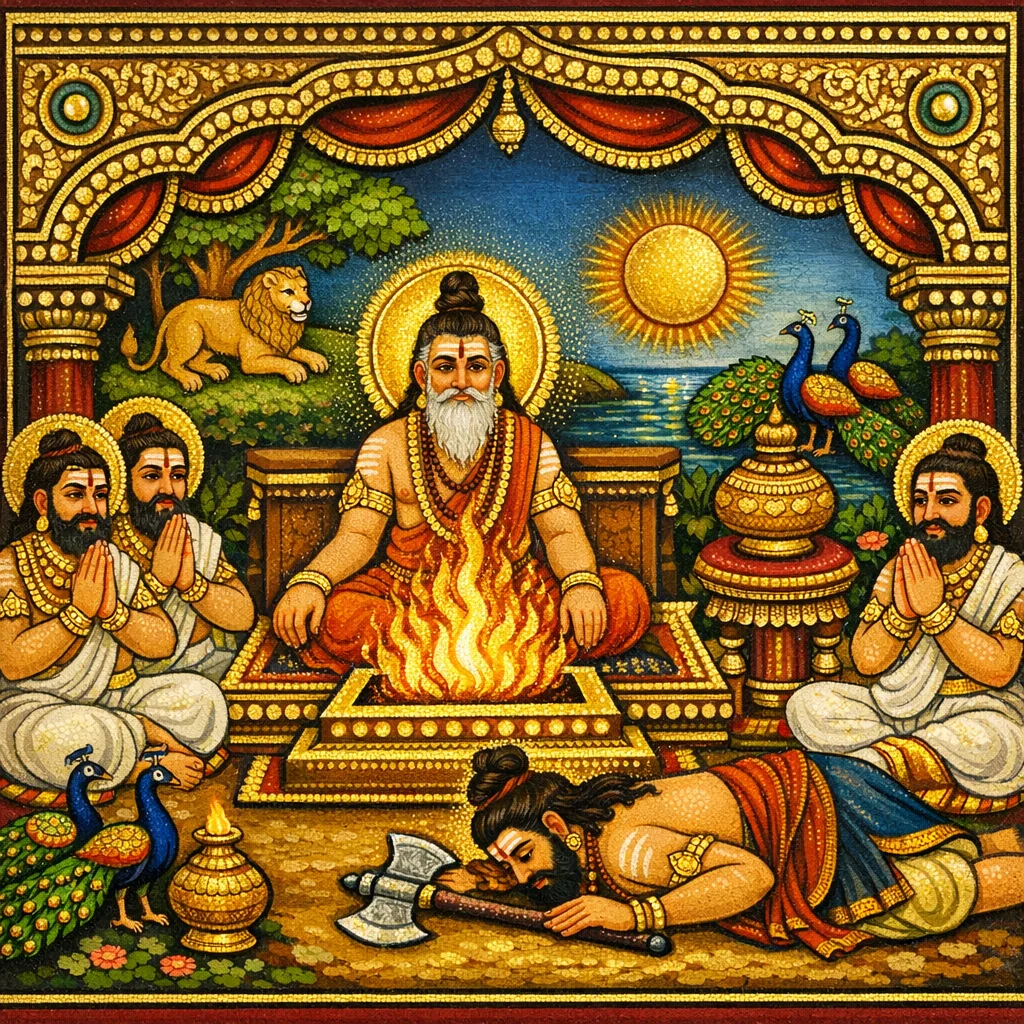
Framed as Vasiṣṭha’s narration to a king, this chapter continues the Bhārgava cycle. Rāma (Paraśurāma), Bhṛgu’s descendant, is called akṛtavraṇa (“unwounded,” unshaken in conflict) as he passes through human settlements, while kṣatriyas hide wherever they see him to save their lives. He reaches his father Jamadagni’s āśrama, portrayed as a pacified microcosm where natural hostilities cease (lion with deer, serpent with mouse), agnihotra smoke rises, peacocks cry and dance, and evening water-offerings (jalāñjali) are made facing the sun. Resident students, under brahmacarya vows, regularly study Veda and śāstra. Entering, Rāma is honored by dvijas and their sons with victory-cries and salutations. He meets Jamadagni, prostrates in aṣṭāṅga obeisance, declares himself his father’s servant, and then greets his mother. Rāma reports the defeat and killing of Kārttavīrya (Kārttavīrya Arjuna), presenting it as dharmic punishment for an offense against the sage, with royal violence framed as retribution under ascetic authority.
Shlokas
Verse 1
इति श्री ब्रह्माण्डे महापुराणे वायुप्रोक्ते मध्यमाभागे तृतीय उपोद्धातपादे भार्गवचरिते त्रिचत्वारिंशत्तमो ऽध्यायः // ४३// वसिष्ठ उवाच राजन्नेवं भृगुर्विद्वान्पश्यञ्जनपदान्बहून् / समाजगाम धर्मात्माकृतव्रणसमन्वितः
Thus, in the Śrī Brahmāṇḍa Mahāpurāṇa, proclaimed by Vāyu, in the middle section, the third introductory pāda of the Bhārgava narrative, is the forty-third chapter. Vasiṣṭha said: O King, thus the wise Bhṛgu, beholding many realms, came there—righteous in soul and steadfast in sacred vows.
Verse 2
निलिल्युः क्षत्त्रियाः सर्वे यत्र तत्र निरीक्ष्य तम् / व्रजन्तं भार्गवं मार्गे प्राणरक्षणतत्पराः
Seeing him, all the kṣatriyas hid themselves wherever they could; beholding the Bhārgava moving along the road, they were intent only on saving their lives.
Verse 3
अथाससाद राजेन्द्र रामः स्वपितुराश्रमम् / शान्तसत्त्वसमाकीर्णं वेदध्त्रनिनिनादितम्
Then, O best of kings, Rāma reached his father’s āśrama—filled with tranquil beings and resounding with the chant of the Vedas.
Verse 4
यत्र सिंहा मृगा गावो नागमार्ज्जारमूषकाः / समं च रन्ति संहृष्टा भयं त्यक्त्वा सुदूरतः
There, lions, deer, cows, serpents, cats, and mice—casting fear far away—moved about together in glad harmony.
Verse 5
यत्र धूमं समीक्ष्यैव ह्यग्निहोत्रसमुद्भवम् / उन्नदन्ति मयूराश्च नृत्यन्ति च महीपने
There, at the very sight of the smoke rising from the agnihotra, peacocks cried out and danced upon the earth.
Verse 6
यत्र सायन्तने काले सूर्यस्याभिमुखं द्विजैः / जलाञ्जलीन्प्रक्षिपद्भिः क्रियते भूर्चलाविला
There, at eventide, the twice-born face Surya and cast forth water as anjali; the ground trembles beneath their steps, stirred and clouded with dust.
Verse 7
यत्रान्तेवासिभिर्नित्यं वेदाः शास्त्राणि संहिताः / अभ्यस्यन्ते मुदा युक्तैर्ब्रह्मचर्यव्रते स्थितैः
There the ashram’s resident students daily, with glad hearts, rehearse the Vedas, the shastras, and the samhitas, steadfast in the vow of brahmacharya.
Verse 8
अथ रामः प्रसन्नात्मा पश्यन्नाश्रमसंपदम् / प्रविवेश शनै राजन्नकृतव्रणसंयुतः
Then Rama, serene of soul, beholding the ashram’s prosperity, O king, entered slowly, unscarred and without a wound.
Verse 9
जयशब्दं नमःशब्दं प्रोच्चरद्भिर्द्विजात्मजैः / द्विजैश्च सत्कृतो रामः परं हर्षमुपागतः
As the sons of the twice-born cried “Jaya!” and “Namaḥ!”, and the brahmins honored him, Rama was filled with supreme delight.
Verse 10
आश्रमाभ्यन्तरे तत्र संप्रविश्य निजं गृहम् / ददर्श पितरं रामो जमदग्निं तपोनिधिम्
Entering the ashram’s inner precincts and his own dwelling, Rama beheld his father Jamadagni, a very treasury of austerity.
Verse 11
साक्षाद्भृगुमिवासीनं निग्रहानुग्रहक्षमम् / पपात चरणोपान्ते ह्यष्टाङ्गालिङ्गितावनिः
Seeing the sage seated as if Bhrigu himself, able both to restrain and to bestow grace, he fell at the edge of his feet, embracing the earth in eight-limbed prostration.
Verse 12
रामो ऽहं तवा दासो ऽस्मि प्रोच्चरन्निति भूपते / जग्राह चरणौ चापि विधिवत्सज्जनाग्रणीः
Crying, “O king, I am Rama; I am your servant,” the foremost of the righteous duly took hold of his two feet according to sacred custom.
Verse 13
अथ मातुश्च चरणवभिवाद्य कृताञ्जलिः / उवाच प्रणतो वाक्यं तयोः संहर्षकारणम्
Then, with palms joined, he bowed to his mother’s feet as well; bending in humility, he spoke words that became the cause of joy for them both.
Verse 14
राम उवाच पितस्तव प्रभावेण तपसो ऽतिदुरासदः / कार्त्तवीर्यो हतो युद्धे समुत्रबलवाहनः
Rama said, “Father, by the power of your austerities, Karttavirya—so hard to overcome, supported by mighty troops and steeds—has been slain in battle.”
Verse 15
यस्ते ऽपराधं कृतवान्दुष्टमन्त्रिप्रचोदितः / तस्य दण्डो मया दत्तः प्रसह्य मुनिपुङ्गव
“O foremost of sages, the one who wronged you, urged on by wicked ministers—I have dealt him punishment, firmly and by force.”
Verse 16
भवन्तं तु नमस्कृत्य गतो ऽहं ब्रह्मणोंऽतिकम् / तं नमस्कृत्य विधिवत्स्वकार्यं प्रत्यवेदयम्
Having bowed to you, I went to Brahmā’s presence; and after duly saluting him, I reported my own task.
Verse 17
समामुवाच भगवाञ्छ्रुत्वा वृत्तान्तमादितः / व्रज स्वकार्यसिद्ध्यर्थं शिवलोकं सनातनम्
Hearing the account from the beginning, the Blessed Lord said to me: “Go to the eternal Śivaloka, that your purpose may be fulfilled.”
Verse 18
श्रुत्वाहं तद्वयस्तात नमस्कृत्य पिता महम् / गतवाञ्छिवलोकं वै हरदर्शनकाङ्क्षया
Hearing this, dear father, I bowed to Pitāmaha Brahmā and went to Śivaloka, longing for the darśana of Hara (Śiva).
Verse 19
प्रविश्य तत्र भगवन्नुमया सहितः शिवः / नमस्कृतो मया देवो वाञ्छितार्थ प्रदायकः
Entering there, O Blessed One, I beheld Śiva together with Umā. I bowed to that Deva who grants the desired boon.
Verse 20
तदग्रे निखिलः स्वीयो वृत्तान्तो विनिवेदितः / मया समाहितधिया स सर्वं श्रुतवानपि
Before him, with a composed mind, I presented my entire account; and he listened to it all.
Verse 21
श्रुत्वा विचार्य त त्सर्वं ददौ मह्यं कृपान्वितः / त्रैलोक्यविजयं नाम कवचं सर्वसिद्धिदम्
Having heard and considered all of it, he, moved by compassion, bestowed upon me the armor-charm named “Trailokyavijaya,” the giver of all attainments.
Verse 22
तल्लब्ध्वा तं नमस्कृत्य पुष्करं समुपागतः / तत्राहं साधयित्वा तु कवचं हृष्टमानसः
Having obtained it and bowing to him, I went to Pushkara. There I performed the discipline of that kavacha, my heart filled with joy.
Verse 23
कार्त्तवीर्यं निहत्याजौ शिवलोकं पुनर्गतः / तत्र तौ तु मया दृष्टौ द्वारे स्कन्दविनायकौ
Having slain Kārttavīrya in battle, I returned again to Śivaloka. There at the gate I beheld Skanda and Vināyaka.
Verse 24
तौनमस्कृत्य धर्मज्ञ प्रवेष्टुं चोद्यतो ऽभवम् / स मामवेक्ष्य गामपो विशन्तं त्वरयान्वितम्
O knower of dharma, after bowing to them both I was about to enter. Seeing me hasten in, the gatekeeper looked upon me.
Verse 25
वारयामास सहसा नाद्यावसर इत्यथ / मम तेन पितस्तत्र वाग्युद्धं हस्तकर्षणम्
He suddenly restrained me, saying, “This is not the time today.” Then, there arose between him and me a battle of words, even a pulling and grappling of hands.
Verse 26
सञ्जातपरशुक्षेममतो ऽभूद्भृगुनन्दन / स तज्ज्ञात्वा समुद्गृह्य मामधश्चोर्द्ध्वमेव च
Then the sacred axe of Bhṛgu’s son was made secure. Knowing this, he lifted me up and swung me downward and upward alike.
Verse 27
करेण भ्रामयामास पुनश्चानीतवांस्ततः / तं दृष्ट्वातिक्रुधा क्षिप्तः कुठारो हि मया ततः
With his hand he whirled me around and then drew me near again. Seeing him, I, seized by fierce wrath, hurled the axe at once.
Verse 28
दन्तो निपति,स्तस्य ततो देव उपागतः / पार्वती तत्र रुष्टाभूत्तदा कृष्णः समागतः
His tooth fell out; then the Deva came there. Pārvatī grew wrathful in that place, and at that very time Kṛṣṇa arrived.
Verse 29
राधया सहितस्तेन सानुनीता वरं ददौ / मह्यं कृष्मो जगामाथ तेन मैत्रीं विधाय च
Kṛṣṇa, accompanied by Rādhā, soothed him and granted a boon. Then, establishing friendship with me, Kṛṣṇa departed.
Verse 30
ततः प्रणम्य देवेशौ पार्वतीपरमेश्वरौ / आगतस्तव सान्निध्यमकृतव्रणसंयुतः
Then, bowing to Pārvatī and Parameśvara, the Lords of the gods, I came into your presence, untouched by any wound.
Verse 31
वसिष्ठ उवाच इत्यक्त्वा भार्गवो रामो विरराम च भूपते / जमदग्निरुवाचेदं रामं शत्रुनिबर्हणम्
Vasiṣṭha said: Having spoken thus, Rāma of Bhṛgu’s line, O king, fell silent. Then Jamadagni said: O Rāma, destroyer of foes, hear these words.
Verse 32
जमदग्निरुवाच क्षत्रहत्याभिभूतस्त्वं तावद्दोषोपशान्तये / प्रयश्चित्तं ततस्तावद्यथावत्कर्तुमर्हसि
Jamadagni said: You are burdened by the sin of slaying kṣatriyas; therefore, to pacify that fault, you must duly perform the prescribed expiation (prāyaścitta).
Verse 33
इत्युक्तः प्राह पितरं रामो मतिमतां वरः / प्रायश्चित्तं तु तद्योग्यं त्वं मे निर्देष्टुमर्हसि
Thus addressed, Rāma—foremost among the wise—said to his father: “Deign to instruct me in the expiation (prāyaścitta) that is fitting for me.”
Verse 34
जमदग्निरुवाच व्रतैश्च नियमैश्चैव कर्षयन्देहमात्मनः / शाकमूलफलाहारो द्वादशाब्दं तपश्चर
Jamadagni said: By vows and sacred disciplines, subdue your body; living on greens, roots, and fruits, practice austerity for twelve years.
Verse 35
वसिष्ठ उवाच इत्युक्तः प्रणिपत्यैनं मातरं च भृगूद्वहः / प्रययौ तपसे राजन्नकृतव्रणसंयुतः
Vasiṣṭha said: Thus instructed, Rāma—the pride of Bhṛgu’s line—bowed down to him and to his mother; O king, unwounded and steadfast in his vows, he departed to undertake austerity.
Verse 36
स गत्वा पर्वत वरं महेन्द्रमरिकर्षणः / कृत्वाऽश्रमपदं तस्मिंस्तपस्तेपे सुदुश्चरम्
He, the subduer of foes, went to the excellent mountain Mahendra. There he established a hermitage-site and performed austerities most difficult to endure.
Verse 37
व्रतैस्तपोभिर्नियमैर्देवताराधनैरपि / निन्ये वर्षाणि कति चिद्रामस्तस्मिन्महामनाः
By vows, austerities, disciplines, and worship of the deities as well, great-souled Rama spent there a number of years.
Frequently Asked Questions
The Bhārgava lineage: the narrative centers on Bhṛgu’s line through Jamadagni and his son Rāma (Paraśurāma), using their actions to exemplify how sage-line authority shapes kṣatriya fate.
Cosmology appears as āśrama-ecology: the hermitage is portrayed as a harmonized world where predator–prey oppositions subside, ritual fires (agnihotra) structure daily time, and evening offerings to the sun encode a lived cosmological orientation.
No. The sampled material belongs to Bhārgava-carita (Paraśurāma–Jamadagni cycle), not the Lalitopākhyāna; it focuses on dharma, āśrama life, and the reporting of Kārttavīrya’s punishment rather than Śākta vidyā/yantra themes.