Adhyaya 26
रामस्य पितृसेवा-तीर्थाटन-वृत्तान्तः (Rama’s filial service and ordered pilgrimage; setting for the Haihaya episode)
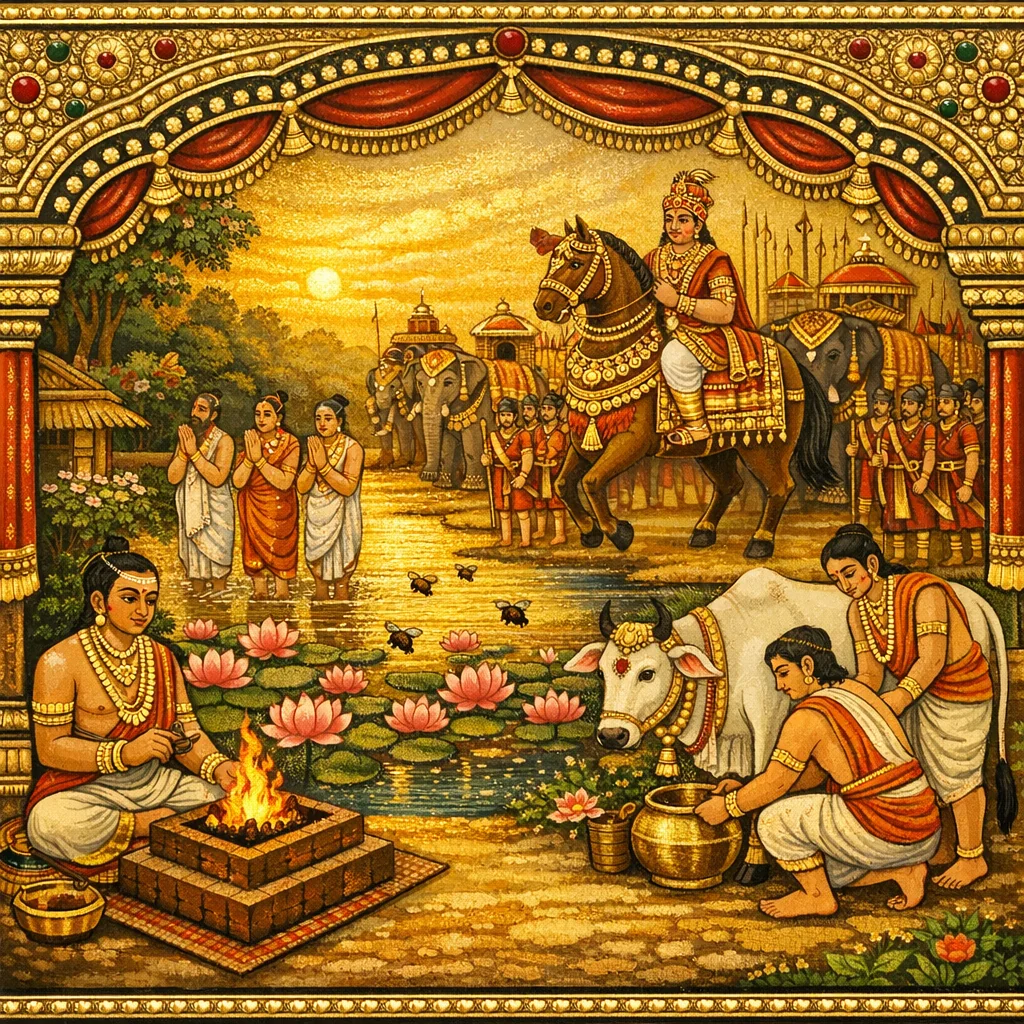
Adhyāya 26 continues the Bhārgava/Rāma cycle in a sage’s courtly narration. Vasiṣṭha says that when questioned, Rāma, with folded hands, recounts to his parents all his deeds: austerities done at the command of the family preceptor, orderly pilgrimage through the tīrthas by Śambhu’s instruction, and the slaying of daityas for the devas—marked by Hara’s grace, with no wound-signs upon him. Hearing the full account, the parents grow ever more delighted, and Rāma is shown as exemplary in filial service and impartial regard for his brothers. The narrative then shifts: at that very time the Haihaya lord sets out to hunt with a fourfold army. Dawn on the Narmadā is painted—reddening sky, fragrant breezes, birdsong, lotus and bees—while sages finish river rites and return to their āśramas; scenes of domestic sacrifice (cows milked for homa, the bustle of agnihotra) establish an ordered sacrificial world soon to be disturbed by approaching royal power.
Shlokas
Verse 1
इति श्रीब्रह्माण्डे महापुराणे वायुप्रोक्ते मध्यभागे तृतीय उपोद्धातपादेर्ऽजुनोपाख्याने भार्गवचरिते पञ्चविंशतितमो ऽध्यायः // २५// वशिष्ठ उवाच इति पृष्टस्तदा ताभ्यां रामो राजन्कृताञ्जलिः / तयोरकथयत्सर्वमात्मना यदनुष्ठितम्
Thus, in the Śrī Brahmāṇḍa Mahāpurāṇa, in the middle section spoken by Vāyu, in the third introductory portion, within the Arjuna episode and the Bhārgava narrative, is the twenty-fifth chapter. Vasiṣṭha said: O King, then, questioned by those two, Rāma with joined palms told them all that he himself had duly performed.
Verse 2
निदेशाद्वै कुलगुरोस्तपश्चरणमात्मनः / शंभोर्निदेशात्तीर्थानामटनं च यथाक्रमम्
By the command of the family preceptor he undertook his own austerities; and by the command of Śambhu (Śiva) he journeyed, in due order, to the sacred tīrthas.
Verse 3
तदाज्ञयैव दैत्यनां वधं चामरकारणात् / हरप्रसादादत्रापि ह्यकृतव्रणदर्शनम्
By that very command, for the sake of the gods, he also slew the daityas; and by the grace of Hara (Śiva), even here no mark of any wound was seen upon him.
Verse 4
एतत्सर्वमशेषेण यदन्यच्चात्मना कृतम् / कथयामास तद्रामः पित्रोः संप्रीयमाणयोः
All this, and whatever else he had done by his own hand, Rāma related without remainder; and his two parents were filled with ever-growing delight.
Verse 5
तौ च तेनोदितं सर्वं श्रुत्वा तत्कर्म विस्तरम् / हृष्टौ हर्षान्तरं भूयो राजन्नाप्नुवतावुभौ
O King, hearing from him the full and detailed account of those deeds, they both rejoiced and attained an even greater, inward joy once more.
Verse 6
एवं पित्रोर्महाराज शुश्रूषां भृगुपुङ्गवः / प्रकुर्वंस्तद्विधेयात्मा भ्रातॄणां चाविशेषतः
O great king, the foremost of the Bhṛgu line thus served his father and mother; obedient at heart, he treated his brothers too with equal regard, without distinction.
Verse 7
एतस्मिन्नेव काले तु कदाचिद्धैहयेश्वरः / इत्येष मृगयां गान्तुं चतुरङ्गबलान्वितः
At that very time, one day, the lord of the Haihayas set out to go hunting, attended by a fourfold army.
Verse 8
संरज्यमाने गगने बन्धूककुसुमारुणैः / ताराजालद्युतिहरैः समन्तादरुणांशुभिः
The sky all around was suffused with dawn-red rays like bandhūka blossoms, whose crimson light stole away the splendor of the net of stars.
Verse 9
मन्दं वीजति प्रोद्धूतकेतकीवनराजिभिः / प्राभातिके गन्धवहे कुमुदाकरसंस्पृशि
The fragrant breeze of dawn blew gently, bearing the scent of scattered rows of ketakī groves, and brushing the pools where kumuda lilies bloom.
Verse 10
वयांसि नर्मदातीरतरुनीडाश्रयेषु च / व्याहरन्स्वाकुला वाचो मनःश्रोत्रसुखावहाः
Birds, sheltered in nests among the trees along the Narmadā’s bank, chirped aloud; their eager, sweet calls brought delight to both mind and ear.
Verse 11
नर्मदातीरतीर्थं तदवतीर्याघहारिणि / तत्तोये मुनिवृन्देषु गृणात्सुब्रह्म शाश्वतम्
Descending to the sacred ford upon the Narmadā’s bank, the sin-dispelling one, he, in those waters amid the hosts of sages, sang the eternal praise of Subrahma.
Verse 12
विधिवत्कृतमैत्रेषु सन्निवृत्य सरित्तटात् / आशमं प्रति गच्छत्सु मुनिमुख्येषु कर्मिषु
Having duly performed the rites of amity, they withdrew from the riverbank; and the foremost sages, steadfast in sacred duties, set forth toward the āśrama.
Verse 13
प्रत्येकं वीरपत्नीषु व्यग्रासु गृहकर्मसु / होमार्थं मुनिकल्पाभिर्दुह्यमानासु धेनुषु
Each hero’s wife was busied with the works of the household; and for the homa, women like sages were milking the cows.
Verse 14
स्थाने मुनिकुमारेषु तं दोहं हि नयत्सु च / अग्निहोत्राकुले जाते सर्वभूतसुखावहे
As the young sons of sages carried that milk to their appointed places, the agnihotra court grew bustling and alive, bringing joy to all beings.
Verse 15
विकसत्सु सरोजेषु गायत्सु भ्रमरेषु च / वाशत्सु नीडान्निष्पत्य पतत्रिषु समन्ततः
Lotuses were opening wide, and the bees were singing; and all around, birds sprang from their nests, calling out on every side.
Verse 16
अनति व्यग्रमत्तेभतुरङ्गरथगामिनाम् / गात्राल्हादविवर्द्धन्यां वेलायां मन्दवायुना
With a gentle breeze came the hour that increases delight in the limbs; even the hurried course of maddened elephants, horses, and chariots grew calm.
Verse 17
गच्छत्सु चाश्रमोपान्तं प्रसूनजलहारिषु / स्वाध्या यदक्षैर्बहुभिरजिनांबरधारिभिः
As those who carried flowers and water went near the āśrama, many ascetics clad in deer-skin garments, absorbed in svādhyāya, turned their japa beads.
Verse 18
सम्यक् प्रयोज्यमानेषु मन्त्रेषूच्चावचेषु च / प्रैषेषूच्चार्यमाणेषु हूयमानेषु वह्निषु
Mantras of higher and lower tones were being rightly employed; the praiṣa calls were uttered, and oblations were offered into the sacred fires.
Verse 19
यथा वन्मन्त्रतन्त्रोक्तक्रियासु विततासु च / ज्वलदग्निशिखाकारे तमस्तपनतेजसि
As in the forest the rites taught in mantra and tantra were spread forth in full, so a radiance shaped like a blazing flame scorched and dispelled the darkness.
Verse 20
प्रतिहत्य दिशः सर्वा विवृण्वाने च मेदिनीम् / सवितर्युदयं याति नैशे तमसि नश्यति
Driving back the darkness from every quarter and unveiling the earth, it moves toward the rising of Savitṛ; the night’s gloom vanishes.
Verse 21
तारकासु विलीनासु काष्ठासु विमलासु च / कृतमैत्रादिको राजा मृगयां हैहयेश्वरः
When the stars had faded and the woods were clear, the king—lord of the Haihayas—having fulfilled duties such as amity, set out for the hunt.
Verse 22
निर्ययौ नगरात्तस्मात्पुरोहितसमन्वितः / बलैः सर्वैः समुदितैः सवाजिरथकुञ्जरैः
He departed that city accompanied by his royal priest; all forces had assembled, with horses, chariots, and elephants.
Verse 23
सचिवः सहितः श्रीमान् सवयोभिश्च राजभिः / महता बलभारेण नमयन्वसुधातलम्
The splendid king went with his ministers and with kings of his own age; under the vast weight of his host, he seemed to bow the very face of the earth.
Verse 24
नादयन्रथघोषेण ककुभः सर्वतो नृपः / स्वबलौघपदक्षेपप्रक्षुण्णावनिरेणुभिः
The king made every quarter resound with the roar of chariots; dust from the earth, churned up by the marching of his host, veiled the land.
Verse 25
ययौ संच्छादयन्व्योम विमानशतसंकुलम् / संप्रवश्य वनं घोरं विन्ध्योद्रेर्बलसंचयैः
He marched on, as though veiling the sky crowded with hundreds of vimānas; then, with masses of troops upon the slopes of the Vindhya, he entered the dreadful forest.
Verse 26
भृशं विलोलया मास समन्ताद्राजसत्तमः / परिवार्य वनं तत्तु स राजा निजसैनिकैः
That excellent king surrounded that forest with his soldiers and agitated it violently on all sides.
Verse 27
मृगान्नानाविधान्हिंस्रान्निजघान शितैः शरैः / आकर्णकृष्टकोदण्डयोधमुक्तैः शितेषुभिः
He struck down various ferocious beasts with sharp arrows released by warriors pulling their bowstrings back to their ears.
Verse 28
निकृत्तगात्राः शार्दूला न्यपतन्भुवि केचन / उदग्रवेगपादातखड्गखण्डितविग्रहाः
Some tigers fell to the ground with severed limbs, their bodies cut apart by the swords of foot soldiers moving with great speed.
Verse 29
वराहयूथपाः केचिद्रुधिरार्द्रा धरामगुः / प्रचण्डशाक्तिकोन्मुक्तशक्तिनिर्भिन्नमस्तकाः
Some leaders of boar herds fell to the earth soaked in blood, their heads pierced by spears thrown by fierce spearmen.
Verse 30
मृगौघाः प्रत्यपद्यन्त पर्वता इव मेदिनीम् / नाराचा विद्धसर्वाङ्गाः सिंहर्क्षशरभादयः
Multitudes of beasts—lions, bears, Sarabhas, and others—fell to the earth like mountains, their whole bodies pierced by iron arrows.
Verse 31
वसुधामन्वकीर्यन्त शोणितार्द्राः समन्ततः / एवं सवागुरैः कैश्चित्पतद्भिः पतितैरपि
The earth was strewn on all sides with creatures wet with blood; thus, some were falling along with their snares, and others had already fallen.
Verse 32
श्वभिश्चानुद्रुतैः कैश्चिद्धावमानैस्तथा मृगैः / आत्तैर्विक्रोशमानैश्च भीतैः प्राणभयातुरैः
Pursued by dogs, the deer were running away; some, being caught, were screaming, terrified and anxious for their very lives.
Verse 33
युगापाये यथात्यर्थं वनमाकुलमाबभौ / वराहसिंहशार्दूलश्वाविच्छशकुलानि च
The forest appeared extremely agitated, just like at the end of a Yuga, filled with boars, lions, tigers, porcupines, and families of hares.
Verse 34
चमरीरुरुगोमायुगवयर्क्षवृकान्बहून् / कृष्णसारान्द्वीपिमृगान्रक्तखड्गमृगानवि
There were Yaks, Ruru deer, jackals, Gayals, bears, many wolves, blackbucks, leopards, and rhinoceroses.
Verse 35
विचित्राङ्गान्मृगानन्यान्न्यङ्कूनपि च सर्वशः / बालान्स्तनन्धयान्यूनः स्थविरान्मिथुनान्गणान्
There were other animals with various limbs, Nyanku deer everywhere, young ones, suckling infants, the old, couples, and herds.
Verse 36
निजघ्नुर्निशितैः शस्त्रैः शस्त्रवध्यान्हि सैनिकाः / एवं हत्वा मृगान् घोरान्हिंस्रप्रायानशेषतः
The soldiers killed the beasts deserving of death with sharp weapons. Thus, they completely destroyed the terrible and violent animals.
Verse 37
श्रमेण महता युक्ता बभूवुर्नृपसैनिकाः / मध्ये दिनकरे प्राप्ते ससैन्यः स तदा नृपः
The king's soldiers were overcome by great fatigue. When the sun reached the meridian, the king, accompanied by his army...
Verse 38
नर्मदां धर्मसंतप्तः पिपासुरगमच्छनैः / अवतीय ततस्तस्यास्तोये सबलवाहनः
...slowly went to the Narmada river, scorched by the heat and thirsty. Having descended into her waters with his forces and vehicles...
Verse 39
विजागाह शुभे राजा क्षुत्तृष्णापरिपीडितः / स्नात्वा पीत्वा च सलिलं स तस्याः सुखशीतलम्
...the King, tormented by hunger and thirst, plunged into the auspicious waters. Having bathed and drunk her pleasantly cool water...
Verse 40
बिसांकुराणि शुभ्राणि स्वादूनि प्रजघास च / विक्रीड्य तोये सुचिरमुत्तीर्य सबलो नृपः
...he ate sweet white lotus sprouts. After playing in the water for a long time, the King emerged with his army.
Verse 41
विशश्राम च तत्तीरे तरुखण्डोपमण्डिते / आलंबपाने तिग्मांशौ ससैन्यः सानुगो नृपः
The king, with his army and attendants, rested on that bank adorned with groves of trees, as the sharp-rayed sun was setting.
Verse 42
निश्चक्राम पुरं गन्तुं विन्ध्याद्रिवनगह्वरात् / स गच्छन्नेव ददृशे नर्मदा तीरमाश्रितम्
He set out from the forested ravines of the Vindhya mountains to go to the city; and as he walked, he beheld a place resting upon the bank of the Narmadā.
Verse 43
आश्रमं पुण्यशीलस्य जमदग्नेर्महात्मनः / ततो निवृत्य सैन्यानि दूरे ऽवस्थाप्य पार्थिवः
Seeing the hermitage of the great-souled Jamadagni, pure in holy conduct, the king turned back and stationed his troops at a distance.
Verse 44
परिचारैः कतिपथैः सहितो ऽयात्तदाशमम् / गत्वा तदाश्रमं रम्यं पुरोहितसमन्वितः
With his priest and a few attendants, he came to that hermitage; reaching the lovely āśrama, he entered within.
Verse 45
उपेत्य मुनिशार्दूलं ननाम शिरसा नृपः / अभिनं द्याशषा तं वै जमदग्निर्नृपोत्तमम्
The king approached the tiger among sages and bowed his head in reverence; and Jamadagni warmly welcomed that foremost of rulers.
Verse 46
पूजयामास विधिवदर्घपाद्यासनादिभिः / संभावयित्वा तां पूजां विहितां मुनिना तदा
Then he worshiped in due rite with arghya, pādya, a seat, and other offerings, and reverently honored that pūjā as prescribed by the sage.
Verse 47
निषसादासने शुभ्र पुरस्तस्य महामुनेः / तमासीनं नृपवरं कुशासनगतो मुनिः
He sat upon a bright, auspicious seat before the great sage; and the muni, seated on a kuśa-grass seat, beheld that foremost king seated there.
Verse 48
पप्रच्छ कुशलप्रश्नं पुत्रमित्रादिबन्धुषु / सह संकथयंस्तेन राज्ञा मुनिवरोत्तमः
He asked after the welfare of sons, friends, and other kinsmen; and the foremost of sages conversed with the king as they spoke together.
Verse 49
स्थित्वा नातिचिरं कालमातिथ्यार्थं न्यमन्त्रयत् / ततः स राजा सुप्रीतो जमदग्नि मभाषत
After staying but a short while, he invited him for the sake of hospitality; then the king, greatly pleased, spoke to Jamadagni.
Verse 50
महर्षे देहि मे ऽनुज्ञां गमिष्यामि स्वकं पुरम् / समग्रवाहनबलो ह्यहं तस्मान्महामुने
O maharṣi, grant me leave—I shall go to my own city; O great muni, for I am here with my full retinue of vehicles and martial force.
Verse 51
कर्तु न शक्यमा तिथ्यं त्वया वन्याशिना वने / अथवा त्वं तपःशक्त्या कर्तुमातिथ्यमद्य मे
In this forest, you who live on wild fare cannot easily offer hospitality; yet by the power of your austerity, you may grant me sacred welcome today.
Verse 52
शक्नोष्यपि पुरीं गन्तुं मामनुज्ञातुर्हसि / अन्यथा चेत्खलैः सैन्यैरत्यर्थं मुनिसत्तम
Though you are able to go to the city, you should seek my leave; otherwise, wicked armies will cause grievous distress, O best of sages.
Verse 53
तपस्विनां भवेत्पीडा नियमक्षयकारिका / वसिष्ठ उवाच इत्येवमुक्तः स मुनिस्तं प्राहस्थीयतां क्षणम्
Affliction may befall ascetics and wear away their sacred observances. Vasiṣṭha said: thus addressed, the muni replied to him, “Stay here for a moment.”
Verse 54
सर्वं संपादयिथ्ये ऽहमातिथ्यं सानुगस्य ते / इत्युक्त्वाहूय तां दोग्ध्रीमुवाचायं ममातिथिः
I shall provide the full hospitality for you, together with your attendants. Saying so, he summoned the milkmaid and declared, “This is my guest.”
Verse 55
उपाग तस्त्वया तस्मात्क्रियतामद्य सत्कृतिः / इत्युक्ता मुनिना दोग्ध्री सातिथेयमशेषतः / दुदोह नृपतेराशु यद्योग्यं मुनिगौरवात्
A guest has come to you; therefore, render him due honor today. Thus instructed by the muni, the milkmaid swiftly drew forth for the king all that was fitting for the guest-offering, out of reverence for the sage.
Verse 56
अथाश्रमं तत्सुरराजसद्मनिकाशमासीद्भृगुपुङ्गवस्य / विभूतिभेदैरविचिन्त्यरुपमनन्यसाध्यं सुरभिप्रभावात्
Then the āśrama of the foremost Bhṛgu appeared like the palace of the king of the gods. By manifold divine splendors its form was inconceivable; through the sacred power of Surabhī it was peerless, unattainable by any other.
Verse 57
अनेकरत्नोज्ज्वलचित्रहेमप्रकाशमालापरिवीतमुच्चैः / पूर्णेन्दुशुभ्राभ्रविषक्तशृङ्गैः प्रासादसंघैः परिवीतमन्तः
That lofty āśrama shone with countless gems, encircled by garlands of wondrous golden radiance. Within, it was ringed by clusters of palaces whose peaks were white as the full moon, clinging to the clouds.
Verse 58
कांस्यारकूटारसताम्रहेमदुर्वर्णसौधो पलदारुमृद्भिः / पृथग्विमिश्रैर्भवनैरनेकैः सद्भासितं नेत्रमनोभिरामैः
It was adorned with many dwellings—mansions of bronze, arakūṭa, rasa, copper, and gold in varied hues, and houses of palāśa wood and clay—set apart and intermingled, delightful to the eye and the mind.
Verse 59
महार्हरत्नोज्ज्वलहेमवेदिकानिष्कूटसोपानकुटीविटङ्ककैः / तुलाकपाटर्गलकुड्यदेहलीनिशान्तशालाजिरशोभितैर्भृशम्
It was richly adorned with golden platforms blazing with precious gems, with projecting porticoes, stairways, cottages, and roof-ornaments. It was further beautified by well-balanced doors, bolts, walls, thresholds, tranquil halls, and inner courtyards.
Verse 60
वलभ्यलिन्दाङ्गपाचारुतोरणैरदभ्रपर्यन्तचतुष्किकादिभिः / स्तंभेषु कुड्येषु च दिव्यरत्नविचित्रचित्रैः परिशोभमानैः
The āśrama was adorned with valabhya and verandas, courtyards and graceful toraṇa gateways, and with catuṣkikā and other structures of broad extent. Upon pillars and walls, wondrous images inlaid with celestial gems gleamed, making it shine all the more.
Verse 61
उच्चावचै रत्नवरैर्विचित्रसुवर्णसिंहासनपीठिकाद्यैः / स भक्ष्यभोज्यादिभि रन्नपानैरुपेतभाण्डोपगतैकदेशैः
There were wondrous golden thrones, footstools and seats, adorned with excellent gems of many kinds; and in various places were set vessels filled with foods to be eaten and enjoyed, with diverse grains and drinks.
Verse 62
गृहैरमर्त्योचितसर्वसंपत्समन्वितैर्नेत्रमनो ऽभिरामैः / तस्याश्रमं सन्नगरोपमानं बभौ वधूभिश्चमनोहराभिः
With houses delightful to eye and mind, endowed with every prosperity fit for the immortals, and with enchanting brides, his hermitage shone forth like a city.
Frequently Asked Questions
It advances the Bhārgava Rāma (Paraśurāma) biographical strand while introducing the Haihaya royal presence (Daihayeśvara), positioning an imminent interaction/conflict between a Bhārgava exemplar and a Kṣatriya power bloc.
The Narmadā tīra is foregrounded through dawn and āśrama-ritual descriptions; it authenticates the setting as a tīrtha landscape and frames the transition from orderly sacrificial life to the intrusion of the Haihaya lord’s hunt.
Rāma’s acts are legitimized by layered authority: kulaguru injunction (tapas), Śambhu’s command (tīrtha-krama), and deva-protection (daitya-vadha), culminating in Hara’s grace—presented as a model where obedience and ritual order yield righteous power.