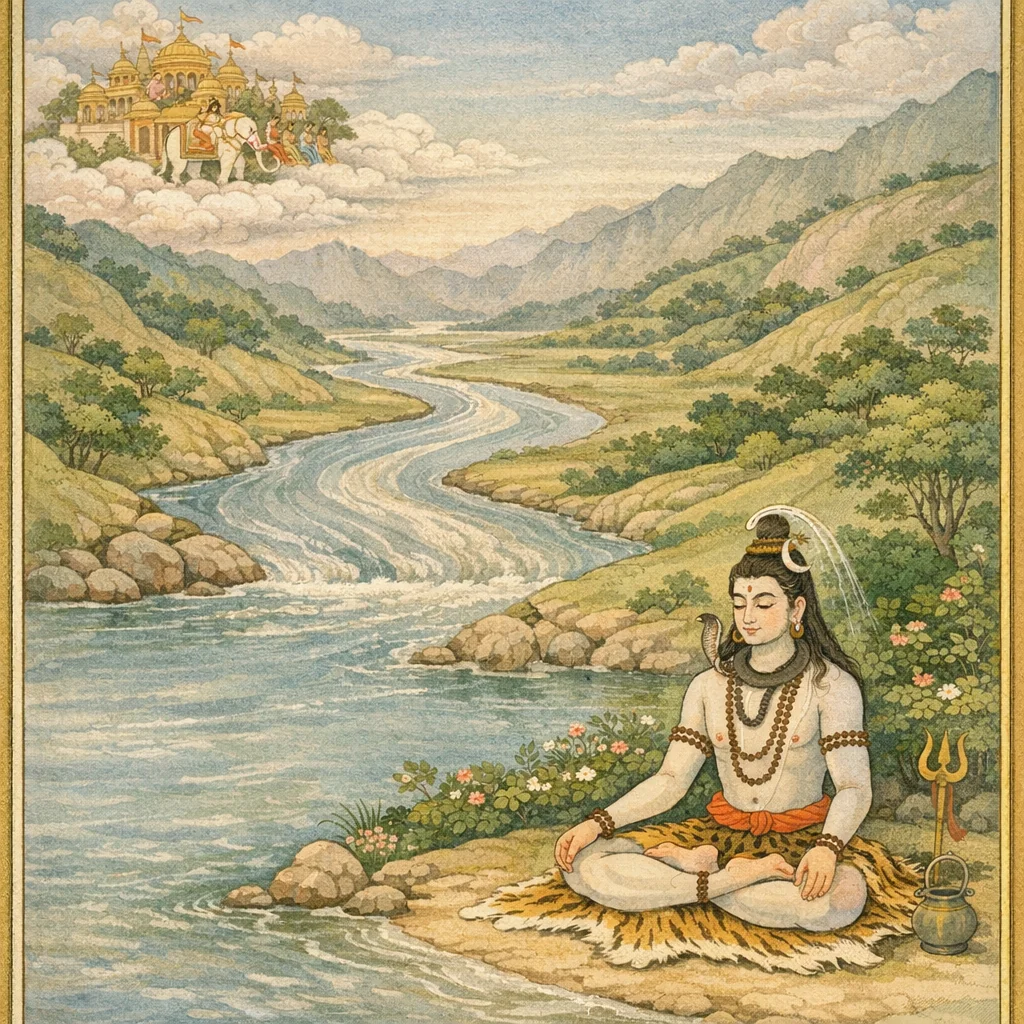
Adhyaya 147: Apsaroyugam Tirtha: The Confluence that Grants Worldly Enjoyment and Liberation
Adhyaya 147 proclaims the tīrtha-māhātmya of Apsaroyugam, a sacred confluence on the southern bank associated with the Gaṅgā. Brahmā tells Nārada that even remembering this place is auspicious, and that bathing and related rites there grant release from bondage; its fruits extend to women as well, and a barren woman is said to gain offspring by a disciplined three‑month observance with her husband involving bathing and gifts. The chapter then explains the name through an origin legend: Indra, seeking to break Viśvāmitra’s austerities amid his rivalry with Vasiṣṭha, sends apsarases—first Menakā and then others—to tempt the sage. Two apsarases, Gambhīrā and Atigambhīrā, are cursed by Viśvāmitra to become rivers, yet are promised restoration of their divine forms when they meet the Gaṅgā. Their union and confluence with the Gaṅgā becomes famed as Apsaroyugam, where Śiva is declared present as the giver of both bhukti and mukti; bathing there and receiving Śiva’s darśana is said to free one from all bonds.
Chapter Arc
{"opening_hook":"ब्रह्मा—नारद संवाद के रूप में अध्याय आरम्भ होता है: केवल ‘अप्सरोयुगम्’ का स्मरण भी मङ्गलकारी कहा जाता है, और स्नान-दानादि से बन्धन-क्षय तथा मोक्ष का आश्वासन देकर पाठक को तुरंत तीर्थ-फल की प्रतिज्ञा में खींच लेता है।","rising_action":"तीर्थ-फल का विस्तार सामाजिक-धार्मिक धरातल तक जाता है—विशेषतः स्त्रियों के लिए भी समान अधिकार/फल का कथन, और ‘वन्ध्या’ स्त्री के लिए पति सहित त्रैमासिक व्रत (नियमित स्नान, दान, संयम) द्वारा सन्तान-प्राप्ति का विधान; इसके बाद नाम-व्युत्पत्ति हेतु इन्द्र–विश्वामित्र प्रसंग में तनाव बढ़ता है, जहाँ इन्द्र बार-बार तपोभङ्ग की योजना बनाता है।","climax_moment":"विश्वामित्र के क्रोध-शाप से दो अप्सराएँ—गम्भीरा और अतिगम्भीरा—नदी-रूप में परिणत होती हैं, और उन्हें यह प्रतिज्ञा/अनुग्रह मिलता है कि गङ्गा-सङ्गम पर पुनः दिव्य-रूप-प्राप्ति होगी; वही संगम ‘अप्सरोयुगम्’ बनता है, जहाँ शिव की सन्निधि ‘भुक्ति-मुक्ति-प्रदाता’ के रूप में निर्णायक सिद्धान्त बनकर प्रकट होती है।","resolution":"अध्याय तीर्थ-माहात्म्य के निष्कर्ष पर लौटता है: अप्सरोयुगम् में स्नान तथा शिव-दर्शन से सर्वबन्धन-विमोचन, पाप-क्षय, और लोक-परलोक-सिद्धि का फल; कथा-कारण (एतियोलॉजी) और विधि-फल (प्रयोजन) दोनों को जोड़कर तीर्थ की प्रतिष्ठा स्थिर की जाती है।","key_verse":"“अप्सरोयुगमे तीर्थे स्नात्वा दृष्ट्वा च शङ्करम् ।\nसर्वबन्धविनिर्मुक्तो भुक्तिं मुक्तिं च विन्दति ॥”\n(भावार्थ: अप्सरोयुगम् तीर्थ में स्नान करके और शङ्कर का दर्शन करके मनुष्य समस्त बन्धनों से मुक्त होकर भोग और मोक्ष—दोनों को प्राप्त करता है।)"}
Thematic Essence
{"primary_theme":"तीर्थ-माहात्म्य: अप्सरोयुगम् संगम में स्नान-दर्शन से भुक्ति-मुक्ति","secondary_themes":["नाम-व्युत्पत्ति (etiology) द्वारा भूगोल का पौराणिकीकरण","तप बनाम देव-राजनीति: इन्द्र का तपोभङ्ग-प्रयत्न","स्त्री-समावेशन: वन्ध्या-स्त्री हेतु व्रत-विधान और फल-श्रुति","शाप-से-कल्याण: दैवी दण्ड का लोकहितकारी रूपान्तरण"],"brahma_purana_doctrine":"‘तीर्थ-स्मरण’ को भी पुण्य-कारक मानते हुए, ‘स्नान + दान + शिव-दर्शन’ को एक संयुक्त मोक्ष-उपाय (soteriological triad) के रूप में प्रतिष्ठित करना—जहाँ शिव ‘भुक्ति’ और ‘मुक्ति’ दोनों के दाता हैं।","adi_purana_significance":"‘आदि पुराण’ के रूप में यह अध्याय दिखाता है कि पुराण-परम्परा कैसे भूगोल (नदी-संगम), कथा (अप्सरा-शाप), और धर्म (व्रत-दान-स्नान) को जोड़कर सार्वजन्य साधना-पथ बनाती है—स्मरण से लेकर प्रत्यक्ष तीर्थ-सेवा तक।"}
Emotional Journey
{"opening_rasa":"शान्त","climax_rasa":"अद्भुत","closing_rasa":"शान्त","rasa_transitions":["शान्त → श्रद्धा/भक्ति-प्रधान शान्त","शान्त → रौद्र (विश्वामित्र-क्रोध)","रौद्र → अद्भुत (नदी-रूपान्तरण व संगम-प्रभाव)","अद्भुत → शान्त (शिव-सन्निधि, मोक्ष-निश्चय)"],"devotional_peaks":["अप्सरोयुगम् के ‘स्मरण-मात्र’ पुण्य का उद्घोष","संगम-स्थल पर शिव के ‘भुक्ति-मुक्ति-प्रदाता’ रूप का प्रतिपादन","स्नान और शिव-दर्शन से ‘सर्वबन्धन-विमोचन’ की फलश्रुति"]}
Tirtha Focus
{"tirthas_covered":["अप्सरोयुगम् (Apsaroyugam Tīrtha)","गङ्गा (Gaṅgā)","गङ्गाद्वार (Gaṅgādvāra)","दक्षिणतीर/दक्षिणा गङ्गा (southern bank reference)","कालञ्जर (Kālañjara)"],"jagannath_content":null,"surya_content":null,"cosmology_content":null}
Shlokas in Adhyaya 147
Verse 1
ब्रह्मोवाच अप्सरोयुगम् आख्यातम् अप्सरासंगमं ततः तीरे च दक्षिणे पुण्यं स्मरणात् सुभगो भवेत् //
Verse 1: At the opening of the new chapter, the Purāṇa continues its exposition on Dharma and the rites of worship.
Verse 2
मुक्तो भवत्य् असंदेहं तत्र स्नानादिना नरः स्त्री सती संगमे तस्मिन्न् ऋतुस्नाता च नारद //
This entry shows only the numeral “2” and provides no Sanskrit text, so a faithful translation cannot be produced.
Verse 3
वन्ध्यापि जनयेत् पुत्रं त्रिमासात् पतिना सह स्नानदानेन वर्तन्ती नान्यथा मद्वचो भवेत् //
This entry contains only the numeral “3” and no Sanskrit wording, so no reliable translation can be provided.
Verse 4
अप्सरोयुगम् आख्यातं तीर्थं येन च हेतुना तत्रेदं कारणं वक्ष्ये शृणु नारद यत्नतः //
Only the numeral “4” is shown here, with no Sanskrit or English text; therefore it cannot be translated.
Verse 5
स्पर्धासीन् महती ब्रह्मन् विश्वामित्रवसिष्ठयोः तपस्यन्तं गाधिसुतं ब्राह्मण्यार्थे यतव्रतम् //
This item contains only the numeral “5” and no source text, so it cannot be translated into other languages.
Verse 6
गङ्गाद्वारे समासीनं प्रेरितेन्द्रेण मेनका तं गत्वा तपसो भ्रष्टं कुरु भद्रे ममाज्ञया //
This entry shows only the numeral “6” and provides no Sanskrit śloka, so an appropriate translation cannot be given.
Verse 7
तदोक्तेन्द्रेण सा मेना विश्वामित्रं तपश्च्युतम् कृत्वा कन्यां तथा दत्त्वा जगामेन्द्रपुरं पुनः //
This is the sacred verse (no. 7) preserved in the venerable Brahma Purana.
Verse 8
तस्यां गतायां सस्मार गाधिपुत्रो ऽखिलं कृतम् तं तु देशं परित्यज्य तीर्थं तु सुरवल्लभम् //
This is the sacred verse (no. 8) as transmitted in the Brahma Purana.
Verse 9
जगाम दक्षिणां गङ्गां यत्र कालञ्जरो हरः तपस्यन्तं तदोवाच पुनर् इन्द्रः सहस्रदृक् //
This is the sacred verse (no. 9), suitable for devotional recitation and scholarly study.
Verse 10
उर्वशीं च ततो मेनां रम्भां चापि तिलोत्तमाम् नैवेत्य् ऊचुर् भयत्रस्ताः पुनर् आह शचीपतिः //
This is the sacred verse (no. 10), setting forth the ancient and profound puranic meaning.
Verse 11
गम्भीरां चातिगम्भीराम् उभे ये गर्विते तदा ते ऊचतुर् उभे देवं सहस्राक्षं पुरंदरम् //
This is the sacred verse (no. 11), revered as holy utterance within the puranic tradition.
Verse 12
गम्भीरातिगम्भीरे ऊचतुः आवां गत्वा तपस्यन्तं गाधिपुत्रं महाद्युतिम् च्यावयावो नृत्यगीतै रूपयौवनसंपदा //
This verse (12) is preserved in the Purāṇa to disclose its sacred meaning and encyclopedic knowledge.
Verse 13
यासाम् अपाङ्गे हसिते वाचि विभ्रमसंपदि नित्यं वसति पञ्चेषुस् ताभिः को ऽत्र न जीयते //
This verse (13) continues the Purāṇic tradition, elucidating Dharma and the order of the cosmos.
Verse 14
ब्रह्मोवाच तथेत्य् उक्ते सहस्राक्षे ते आगत्य महानदीम् ददृशाते तपस्यन्तं विश्वामित्रं महामुनिम् //
This verse (14) teaches that hearing and contemplating the sacred word leads to merit and wisdom.
Verse 15
मृत्योर् अपि दुराधर्षं भूमिस्थम् इव धूर्जटिम् सहस्रम् एकं वर्षाणाम् ईक्षितुं न च शक्नुतः //
This verse (15) declares that revering Dharma and observing discipline is the path to well-being and peace.
Verse 16
दूरे स्थिते नृत्यगीतचाटुकाररते तदा विलोक्य मुनिशार्दूलस् ततः कोपाकुलो ऽभवत् //
This verse (16) concludes that the wise should preserve śraddhā (faith) and study the Purāṇa to know the truth.
Verse 17
प्रतीपाचरणं दृष्ट्वा क्रोधः कस्य न जायते निस्पृहो ऽपि महाबाहुस् तम् इन्द्रं प्रहसन्न् इव //
Verse (17) is regarded as sacred utterance within the ancient Purana, fit for devotion and study.
Verse 18
आभ्यां मुक्तः सहस्राक्षो ह्य् अप्सरोभ्यां ब्रुवन्न् इव शशाप ते स गाधेयो द्रवरूपे भविष्यथः //
Verse (18) sets forth a profound meaning in accordance with the ancient Purana tradition.
Verse 19
द्रवितुं मां समायाते यतस् त्व् इह ततो लघु ततः प्रसादितस् ताभ्यां शापमोक्षं चकार सः //
Verse (19) should be heard with reverence and contemplated with wisdom.
Verse 20
भवेतां दिव्यरूपे वां गङ्गया संगते यदा तच्छापात् ते नदीरूपे तत्क्षणात् संबभूवतुः //
Verse (20) points to knowledge and Dharma, for the purification of the mind.
Verse 21
अप्सरोयुगम् आख्यातं नदीद्वयम् अतो ऽभवत् ताभ्यां परस्परं चापि ताभ्यां गङ्गासुसंगमः //
Verse (21) should be kept within the heart as instruction for those who seek the Truth.
Verse 22
सर्वलोकेषु विख्यातो भुक्तिमुक्तिप्रदः शिवः तत्रास्ते दृष्ट एवासौ सर्वसिद्धिप्रदायकः //
This is only the citation for Brahma Purana 147.22; the Sanskrit original is not provided here, so the verse’s actual content cannot be translated.
Verse 23
तत्र स्नात्वा तु तं दृष्ट्वा मुच्यते सर्वबन्धनात् //
Only the identifier 147.23 is given; without the Sanskrit text, a meaningful translation of the verse cannot be produced.
Frequently Asked Questions
The chapter foregrounds tīrtha-soteriology: disciplined approach to a sanctified confluence (smaraṇa, snāna, dāna, and darśana) is framed as a practical means to dissolve bondage and obtain both worldly welfare and liberation, while also warning against the destabilizing force of distraction deployed against ascetic resolve.
By integrating mythic causation with sacred topography, the chapter exemplifies a foundational Purāṇic function: it authorizes pilgrimage geography through etiological narrative, linking cosmic actors (Indra, apsarases, Śiva) and exemplary sages (Viśvāmitra) to a named site whose ritual efficacy becomes part of the Purāṇa’s archival map of dharma in place.
The Adhyaya institutes Apsaroyugam as a pilgrimage-confluence where स्नान (bathing) and Śiva-दर्शन (seeing Śiva at the site) are the core practices; it additionally prescribes a three-month observance involving bathing and charitable giving (snāna-dāna) for those seeking progeny, explicitly including women within the tīrtha’s promised results.