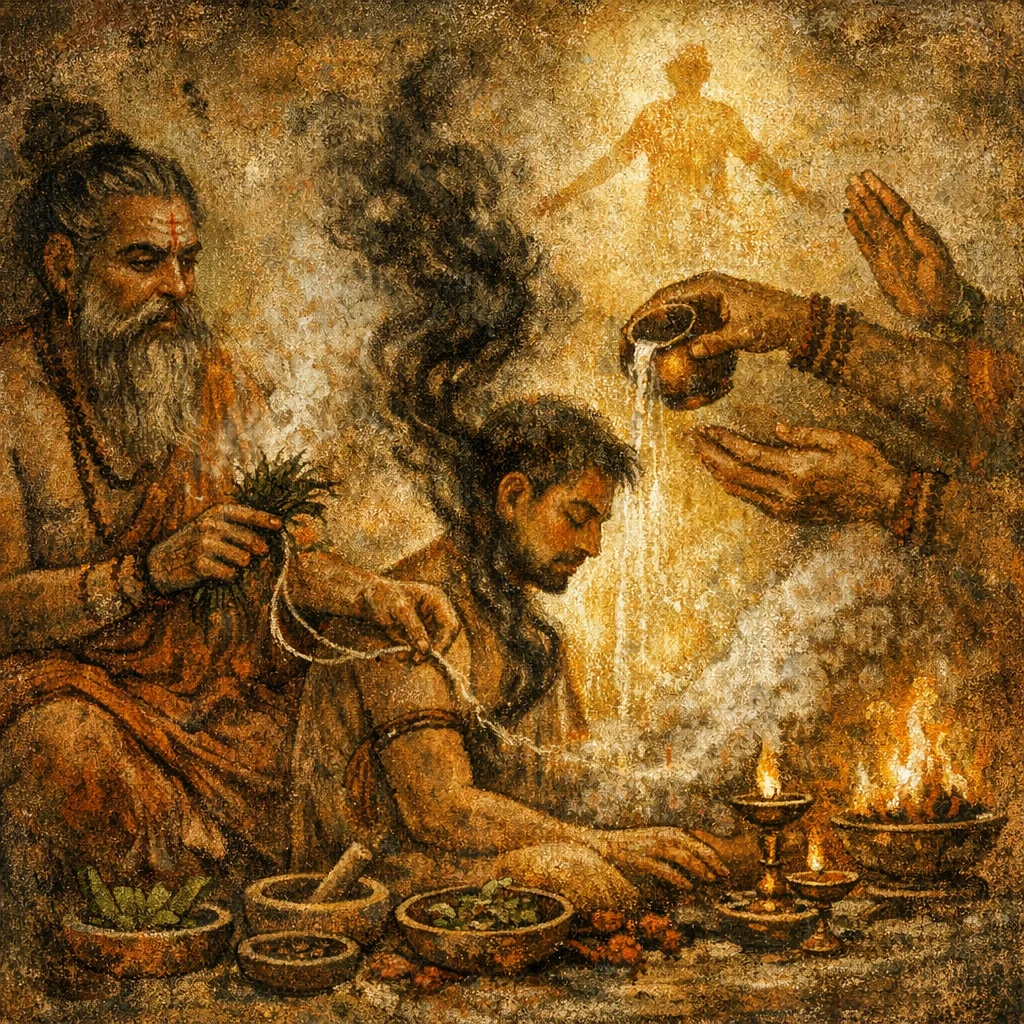
Sukta 9
Rishi: Atharvanic/Aṅgirasa tradition (hymn-level attribution varies by anukramaṇī; to be normalized against the project’s chosen index).
Devata: Bhaga / auspicious prosperity-personification (with overlap into a generalized ‘beneficent presence’).
Chandas: Anuṣṭubh (11/8-based Atharvanic anuṣṭubh cadence; to be metrically verified against pada counts in the project pipeline).
Mantras
Mantra 1
दीर्घायुःप्राप्तिः। दशवृक्ष मुञ्चेमं रक्षसो ग्राह्या अधि यैनं जग्राह पर्वसु । अथो एनं वनस्पते जीवानां लोकमुन्नय
O Ten-tree, release this man from the Rākṣasa, from the Seizer that hath fastened on him in the joints. And, O Lord of the Forest, moreover lead him upward unto the world of the living.
Mantra 2
आगादुदगादयं जीवानां व्रातमप्यगात्। अभूदु पुत्राणां पिता नृणां च भगवत्तमः
Hither he hath come; forth hath he arisen: this one hath reached the host of the living. Verily he became the Father of sons, and of men the most bounteous and fortunate.
Mantra 3
अधीतीरध्यगादयमधि जीवपुरा अगान्। शतं ह्यस्य भिषजः सहस्रमुत वीरुधः
Over the plagues hath this passed onward; over the strongholds of life hath it gone. For his are a hundred healers, a thousand moreover, and herbs besides.
Mantra 4
देवास्ते चीतिमविदन् ब्रह्माण उत वीरुधः । चीतिं ते विश्वे देवा अविदन् भूम्यामधि
The Gods discovered for thee thy gathered store of power; the Brahmans too, and the Plants. Thy gathered store of power—all the Gods discovered it, upon the Earth.
Mantra 5
यश्चकार स निष्करत् स एव सुभिषक्तमः । स एव तुभ्यं भेषजानि कृणवद् भिषजा शुचिः
He who hath wrought (the cure), he hath brought it forth: he verily is the most excellent of physicians. He, even he, being pure, as a healer, shall for thee make ready the medicaments.
Frequently Asked Questions
Both. It begins in a paustika mode—inviting auspicious fortune to settle among the living—and then expresses that same beneficence as healing power that passes beyond plagues and activates remedies.
Itī is an Atharvavedic term for afflictive outbreaks—often understood as epidemic or widely spreading diseases/harms—that must be ‘overpassed’ and left behind to protect life.
The verses mention herbs (vīrudh) and medicaments (bheṣajāni) in general, but do not require a named plant or a specific amulet. In practice, it can be recited as a blessing alone or spoken over water/medicine before use.