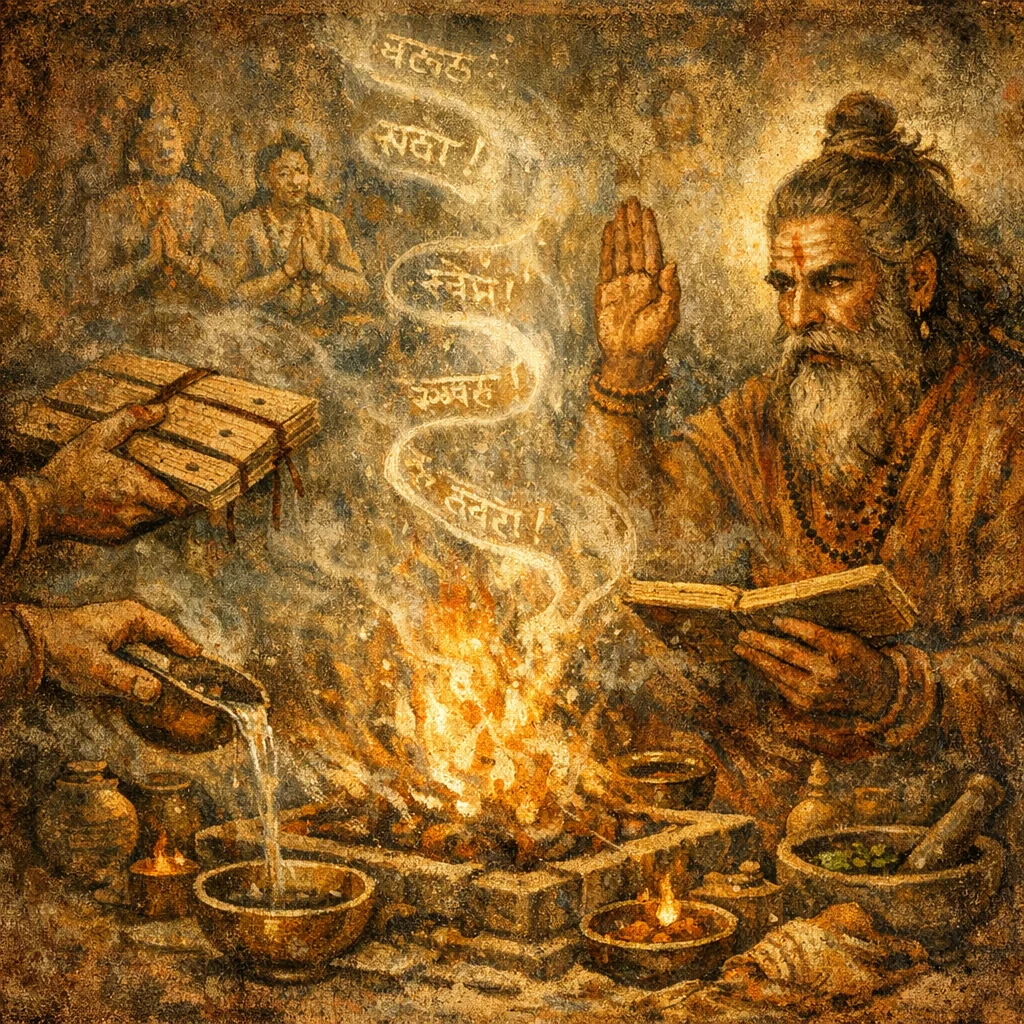
Sukta 23
Rishi: Anukramaṇī attribution uncertain for this enumerative segment (often treated as liturgical formulae rather than seer-specific); consult Śaunaka Anukramaṇī for 19.23.
Devata: Ṛc (the verse) as a personified liturgical power; indirectly Agni as carrier via svāhā.
Chandas: Not a metrical verse; a yajus-like formula (prose/short liturgical utterance).
Mantras
Mantra 1
आथर्वणानां चतुरृचेभ्यः स्वाहा
Svāhā to the Atharvanic four-versed sets.
Mantra 2
पञ्चर्चेभ्यः स्वाहा
Svāhā to the five-versed sets.
Mantra 3
षळृचेभ्यः स्वाहा
Svāhā to the six-versed sets.
Mantra 4
सप्तर्चेभ्यः स्वाहा
Svāhā to the seven-versed sets.
Mantra 5
अष्टर्चेभ्यः स्वाहा
Oblation—Svāhā!—unto the Eight-versed (set of Ṛcs).
Mantra 6
नवर्चेभ्यः स्वाहा
Oblation—Svāhā!—unto the Nine-versed (set of Ṛcs).
Mantra 7
दशर्चेभ्यः स्वाहा
Oblation—Svāhā!—unto the Ten-versed (set of Ṛcs).
Mantra 8
एकादशर्चेभ्यः स्वाहा
Oblation—Svāhā!—unto the Eleven-versed (set of Ṛcs).
Mantra 9
द्वादशर्चेभ्यः स्वाहा
Oblation—Svāhā!—unto the Twelve-versed (set of Ṛcs).
Mantra 10
त्रयोदशर्चेभ्यः स्वाहा
Oblation—unto the thirteen ṛc-verses: Svāhā.
Mantra 11
चतुर्दशर्चेभ्यः स्वाहा
Oblation—unto the fourteen ṛc-verses: Svāhā.
Mantra 12
पञ्चदशर्चेभ्यः स्वाहा
Oblation—unto the fifteen ṛc-verses: Svāhā.
Mantra 13
षोडशर्चेभ्यः स्वाहा
Oblation—unto the sixteen ṛc-verses: Svāhā.
Mantra 14
सप्तदशर्चेभ्यः स्वाहा
Oblation—unto the seventeen ṛc-verses: Svāhā.
Mantra 15
अष्टादशर्चेभ्यः स्वाहा
Oblation—Svāhā—to the eighteen Ṛc-verses.
Mantra 16
एकोनविंशतिः स्वाहा
Oblation—Svāhā—to Nineteen.
Mantra 17
विंशतिः स्वाहा
Oblation—Svāhā—to Twenty.
Mantra 18
महत्काण्डाय स्वाहा
Oblation—Svāhā—to the Great Section.
Mantra 19
तृचेभ्यः स्वाहा
Oblation—Svāhā—to the Triads (of verses).
Mantra 20
एकर्चेभ्यः स्वाहा
Oblation—Svāhā!—unto the Single-Ṛc’s.
Mantra 21
क्षुद्रेभ्यः स्वाहा
Oblation—Svāhā!—unto the Lesser Ones.
Mantra 22
एकानृचेभ्यः स्वाहा
Oblation—Svāhā!—unto the Single Anṛc’s.
Mantra 23
रोहितेभ्यः स्वाहा
Oblation—Svāhā!—unto the Rohitas.
Mantra 24
सूर्याभ्यां स्वाहा
Oblation—Svāhā!—unto the Two Sūryas.
Mantra 25
व्रात्याभ्यां स्वाहा
Oblation, svāhā, unto the two Vratyas.
Mantra 26
प्राजापत्याभ्यां स्वाहा
Oblation, svāhā, unto the two Prajāpatyas.
Mantra 27
विषासह्यै स्वाहा
Oblation, svāhā, unto the Poison-overcoming (Power).
Mantra 28
मङ्गलिकेभ्यः स्वाहा
Oblation, svāhā, unto the Auspicious Ones.
Mantra 29
ब्रह्मणे स्वाहा
Oblation, svāhā, unto Brahman (the sacred Power).
Mantra 30
ब्रह्मज्येष्ठा संभृता वीर्याऽणि ब्रह्माग्रे ज्येष्ठं दिवमा ततान । भूतानां ब्रह्मा प्रथमोत जज्ञे तेनार्हति ब्रह्मणा स्पर्धितुं कः
Brahman is the eldest: gathered are the potencies; Brahman, eldest at the beginning, stretched forth the heaven. Of beings Brahmā was born the first; with that—by Brahman—who is meet to strive in rivalry?
Frequently Asked Questions
It functions as ritual indexing: each named verse-set is treated as a specific recipient, so the offering is correctly allocated and no portion is lost through miscount or omission.
The immediate recipient is the Ṛc/verse-set as a personified liturgical power; svāhā implies Agni as the carrier who conveys the oblation to that designated recipient.
The closing mantra acts as a seal: it grounds the rite in the unsurpassable primacy of Brahman/Brahmā, protecting the ritual’s authority and efficacy against rival claims or instability.