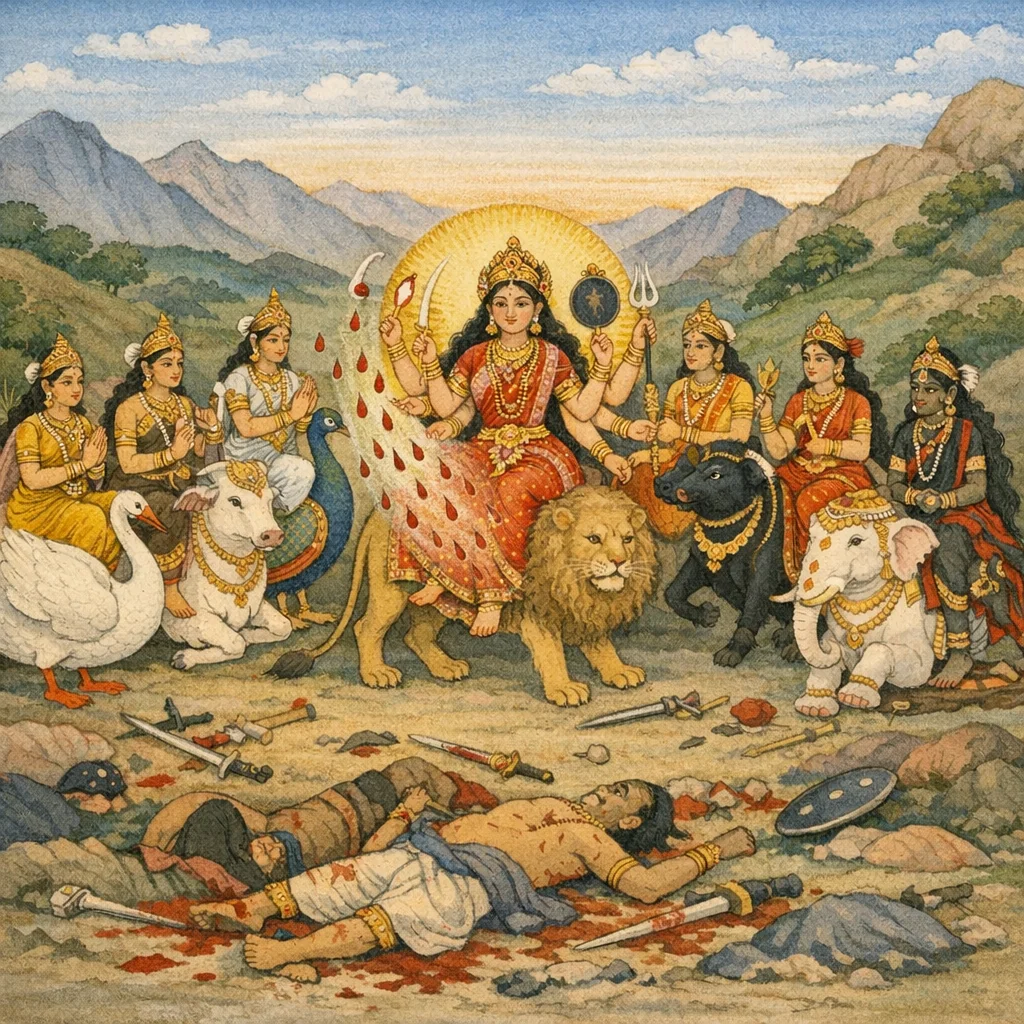
Adhyaya 30: The Slaying of Raktabīja and Niśumbha–Śumbha; the Manifestation of the Mātṛkās and the Devas’ Hymn
रक्तबीज-शुम्भनिशुम्भ-वधः (Raktabīja-Śumbha-Niśumbha-Vadhaḥ)
Matrikas and the Devas' Hymn
Within the Pulastya–Nārada narrative frame, this Adhyāya presents a distinctly Śākta battle-episode embedded in the Vāmana Purāṇa’s broader syncretic theology. After Caṇḍa and Muṇḍa are slain and the asura host routed, the formidable Raktabīja is deployed with vast akṣauhiṇī forces. In response, the Goddess (Kauśikī/Caṇḍikā) externalizes a full iconographic spectrum of Mātṛkās—Brāhmī, Māheśvarī, Kaumārī, Vaiṣṇavī, Vārāhī, Māhendrī (Aindrī), and Nārasiṃhī—each marked by vehicle, weaponry, and bodily emblems, thereby staging a theological map of divine powers across sectarian lines. The tactical crux is Raktabīja’s blood-generated replication, countered by the Goddess’ command that the blood be consumed, culminating in his depletion and death. Niśumbha’s hubristic proposal and subsequent defeat leads to Śumbha’s fall, after which the devas offer a formal stuti and receive the Goddess’ assurances of future manifestations (e.g., Carcikā, Śākambharī) for the protection of dharma.
Divine Beings
Sacred Geography
Mortal & Asura Figures
Key Content Points
- Pulastya narrates to Nārada the escalation after Caṇḍa–Muṇḍa’s death: Raktabīja is commissioned with immense akṣauhiṇī support, prompting the Goddess’ lion-roar and battlefield theophany.
- Iconographic emergence of the Saptamātṛkās (and allied forms): Brāhmī (haṃsa-vimāna, sūtra-kamaṇḍalu), Māheśvarī (vṛṣa, triśūla, serpentine ornaments), Kaumārī (mayūra, śakti), Vaiṣṇavī (garuḍa, śaṅkha-cakra-gadā, śārṅga), Vārāhī (daṃṣṭrā, muśala), Māhendrī/Aindrī (gaja, vajra-aṅkuśa), Nārasiṃhī (nakhā, cosmic ferocity).
- Raktabīja’s asura-dharma of proliferating from fallen blood is neutralized by blood-consumption; his शक्ति is exhausted and he is destroyed, followed by Niśumbha’s defeat and Śumbha’s decapitation; the devas’ stuti frames the Goddess as a composite of Brahmā–Śiva–Viṣṇu powers and promises future avatāra-like interventions.
Shlokas in Adhyaya 30
Verse 1
इति श्रीवामनपुराणे एकोनत्रिंशोध्यायः पुलस्त्य उवाच चण्डमुण्डौ च निहतौ सैन्यं च विद्रुतम् समादिदेशातिबलं रक्तबीजं महासुरम् अक्षौहिणीनां त्रिंशद्भिः कोटिभिः परिवारितम्
Pulastya said: When Caṇḍa and Muṇḍa had been slain and the army had fled in disorder, (the asura side) then dispatched the exceedingly mighty great demon Raktabīja, surrounded by thirty koṭis of akṣauhiṇīs.
Verse 2
तमापतन्तं दैत्यानां बलं दृष्ट्वैव चण्डिका मुमोच सिंहनादं वै ताभ्यां सह महेश्वरी
Seeing that force of the daityas rushing upon (her), Caṇḍikā released a lion-like roar; Maheśvarī (the Goddess), together with those two (her attendant powers), did so indeed.
Verse 3
निनदन्त्यास्ततो देव्या ब्रह्माणी मुखतो ऽभवत् हंसयुक्तविमानस्था साक्षसूत्रकमण्डलुः
Then, as the Goddess roared, Brahmāṇī emerged from her mouth, seated in a celestial car yoked with swans, bearing the rosary and the sacred thread, and holding the water-pot.
Verse 4
माहेश्वरी त्रिनेत्रा च वृषारूढा त्रिशूलिनी महाहिवलया रौद्रा जाता कुण्डलिनी क्षणात्
Then, in an instant, Māheśvarī came into being—three‑eyed, mounted upon the bull, bearing the trident; adorned with a great serpent as her bracelet, fierce in aspect, her power coiled (kuṇḍalinī) and ready to strike.
Verse 5
कण्ठादथ च कौमारी बर्हिपत्रा च शक्तिनी समुद्भूता च देवर्षे मयूरवरवाहना
And then, O divine seer, from (his) throat arose Kaumārī—wielding the spear (śakti), adorned with peacock feathers, and riding upon a splendid peacock as her mount.
Verse ["Fierce Śaiva-Śākta battle imagery", "Devī’s terror-as-weapon (laughter as śakti)", "Gaṇeśa/Vināyaka in martial role", "Restoration of dharma through divine force"]
बाहुभ्यां गरुडारूढा शङ्खचक्रगदासिनी शार्ङ्गबाणधरा जाता वैष्णवी रूपशालिनी
From (his) arms was born Vaiṣṇavī, radiant in form—mounted upon Garuḍa, bearing conch, discus, mace, and sword, and holding the Śārṅga bow and its arrows.
Verse 7
महोग्रमुशला रौद्रा दंष्ट्रोल्लिखितभूतला वाराही पृष्ठतो जाता शेषनागोपरि श्थिता
Fierce and terrible, bearing a mighty mace, and gouging the surface of the earth with her tusks—Vārāhī was born from (Śiva’s) back, and she stood upon the serpent Śeṣa.
Verse 8
वज्राङ्कुशोद्यतकरा नानालङ्कारभूषिता जाता गजेन्द्रपष्ठस्था माहेन्द्री स्तनमण्डलात्
With hands raised holding the thunderbolt and the elephant-goad, adorned with many ornaments—Māhendrī was born from the circle of the breast, seated upon the back of the lordly elephant.
Verse 9
विक्षिपन्ती सटाक्षेपैर्ग्रहनक्षत्रतारकाः नखिनी हृदयाज्जाता नारसिंही सुदारुणा
With tosses of her mane she scattered the planets, lunar mansions, and stars. Clawed (and fierce), Nārasiṃhī—most dreadful—was born from the heart.
Verse 10
ताभिर्निपात्यमानं तु निरीक्ष्य बलमासुरम् ननाद भूयो नादान् वै चण्डिका निर्भया रिपून् तन्निनादं महच्छ्रुत्वा त्रैलोक्यप्रतिपूरकम्
Seeing the asura host being struck down by them, fearless Caṇḍikā again roared mighty roars at the enemies. Hearing that great roar, which filled the three worlds, (the scene of battle was shaken/awakened by it).
Verse 11
समाजगाम देवेशः शूलपाणिस्त्रिलोचनः अभ्येत्य वन्द्य चैवैनां प्राह वाक्यं तदाम्बिकं
Then the Lord of the gods—three-eyed, bearing the trident—came there. Approaching and paying reverence to her, he spoke words to Ambikā.
Verse 12
समायातो ऽस्मि वै दुर्गे देह्याज्ञां किं करोमि ते तद्वाक्यसमकालं च देव्या देहोद्भवा शिवा
“I have come, O Durgā; give me your command—what shall I do for you?” At the very moment of those words, Śivā arose from the body of the Goddess.
Verse 15
यजन्तु ब्राह्मणाद्यामी वर्णा यज्ञांश्च साम्प्रतम् नोचेद् बलावलेपेन भवन्तो योद्धुमिच्छथ
“Let the social orders beginning with the brāhmaṇas now perform sacrifices. Otherwise, if through pride in strength you wish to fight…”
Verse Andhaka Vadha
तदागच्छध्वमव्यग्रा एषाहं विनिषूदये यतस्तु सा शिवं दौत्ये न्ययोजयत् नारद
“Then (she said): ‘Come here, unperturbed; I shall destroy (them).’ For it was for this very reason that she had appointed Śiva as her messenger, O Nārada.”
Verse 20
मारी त्रिशूलेन जघान चान्यान् खट्वाङ्गपातैरपरांश्च कौशिकी महाजलक्षेपहतप्रभावान् ब्राह्मी तथान्यानसुरांश्चकार
Mārī struck down some of the others with a trident; Kauśikī felled other demons by blows of the khaṭvāṅga-staff. Brāhmī, by hurling great masses of water, shattered the power (splendour/energy) of still other Asuras and thus dealt with them.
Verse 21
माहेश्वरी शूलविदारितोरसश् चकार दग्धानपरांश्च वैष्णवी शक्त्या कुमारी कुलिशेन चैन्द्री तुण्डेन चक्रेण वराहरूपिणी
Māheśvarī tore open the chests of some with her trident; Vaiṣṇavī burned others. Kumārī struck with her spear, and Aindrī with Indra’s thunderbolt. Varāha-rūpiṇī, in the form of the Boar, dealt with foes by her snout and by the discus.
Verse 26
तमापतन्तं प्रसमीक्ष्य मातरः शस्त्रैः शिताग्रैर्दितजं ववर्षुः यो रक्तबिन्दुर्न्यपतत् पृथिव्यां स तत्प्रमाणस्त्वसुरो ऽपि जज्ञे
Seeing him rushing in, the Mothers showered the son of Diti with sharp-pointed weapons. Yet whatever drop of blood fell upon the earth, from it an Asura of the same measure (in form and size) was born.
Verse 39
मम खङ्गनिपातं हि नेन्द्रो धारयितुं क्षमः निवर्त्तय मतिं युद्धाद् भार्या मे भव साम्प्रतम्
“Indeed, even Indra is not capable of withstanding the descent of my sword. Turn your mind away from battle; become my wife now.”
Verse 40
इत्थं निशुम्भवचनं श्रुत्वा योगीश्वरी मुने विहस्य भावगम्भीरं निशुम्भं वाक्यमब्रवीत्
Hearing Niśumbha’s words spoken in that manner, O sage, the Yogīśvarī (Kauśikī) smiled and addressed Niśumbha—whose intent was deep and resolute—with these words.
Verse 43
तमापतन्तं निस्त्रिंशं षड्भिर्बर्हिणराजितैः चिच्छेद चर्मणा सार्द्ध तदद्भुतमिवाभवत्
As that sword (nistriṃśa) came rushing down, (Ambikā) cut it into six pieces—splendidly adorned with peacock-feather-like brilliance—together with the shield; and it appeared as something wondrous.
Verse 45
तस्यापतत एवाशु करौ श्लिष्टौ समौ दृढौ गदया सह चिच्छेद क्षुरेप्रेण रणे ऽम्बिका
As he rushed in, Ambikā swiftly severed in battle—using a razor-edged weapon—the two hands, clasped together, equal and firm, along with the mace.
Verse 46
तस्मिन्नपतिते रौद्रे सुरशत्रौ भयङ्करे चण्डाद्य मातरो हृष्टाश्चक्रुः किलकिलाध्वनिम्
When that fierce and terrifying enemy of the gods had fallen, the Mothers—beginning with Caṇḍā—rejoiced and raised a loud, ululating cry of triumph.
Verse 47
गगनस्थास्ततो देवाः शतक्रतुपुरोगमाः जयस्व विजयेत्यूचुर्हृष्टाः शत्रौ निपातिते
Then the gods, stationed in the sky and led by Śatakratu (Indra), delighted at the enemy’s fall, cried out: “Be victorious! Win!”
Verse 48
ततस्तूर्याण्यवाद्यन्त भूतसंघैः समन्ततः पुष्पवृष्टिं च मुमुचुः सुराः कात्यायनीं प्रति
Then, all around, the hosts of bhūtas sounded the trumpets; and the gods showered down a rain of flowers toward Kātyāyanī.
Verse 49
निशुम्भं पतितं दृष्ट्वा शुम्भः क्रोधान्महामुने वृन्दारकं समारुह्य पाशपाणिः समभ्यगात्
Seeing Niśumbha fallen, Śumbha—O great sage—rose in fury. Mounting (his elephant) Vṛndāraka and holding a noose in his hand, he advanced to attack.
Verse VamP 30Vamana Purana
तमापतन्तं दृष्ट्वाथ सगजं दानवेश्वरम् जग्रा ह चतुरो वाणांश्चन्द्रार्धाकरवर्चसः
Then, seeing the lord of the Dānavas rushing in upon her, mounted on his elephant, she (whose splendor was like the crescent-moon) seized four arrows.
Verse Devī as the martial protectress of the devas (Śakti in a battle-bestowing mode)
क्षुरप्राभ्यां समं पादौ द्वौ चिच्छेद द्विपस्य सा द्वाभ्यां कुम्भे जघानाथ हसन्ती लीलयाम्बिका
With two razor-edged arrows she cut off both feet of the elephant at once; and with two more she struck its temples. Laughing, Ambikā did this as if in play.
Verse 57
श्रुत्वा सुराः सुररिपु निहतौ मृडान्या सेन्द्राः ससूर्यमरुदश्विवसुप्रधानाः आगत्य तं गिरिवरं विनयावनम्रा देव्यास्तदा स्तुतिपदं त्विदमीरयन्तः // वम्प्_30.55 देवा ऊचुः/ नमो ऽस्तु ते भगवति पापनाशिनि नमो ऽस्तु ते सुररिपुदर्पशातनि नमो ऽस्तु ते हरिहरराज्यदायिनि नमो ऽस्तु ते मखभुजकार्यकारिणि // वम्प्_30.56 नमो ऽस्तु ते त्रिदशरिपुक्षयङ्करि नमो ऽस्तु ते शतमखपादपूजिते नमो ऽस्तु ते महिषविनासकारिणि नमो ऽस्तु ते हरिहरभास्करस्तुते
Hearing that the enemy of the gods had been slain by Mṛḍānī (the Goddess), the gods—headed by Indra, together with Sūrya, the Maruts, the Aśvins, and the Vasus—came to that excellent mountain. Bowing down in humility, they then addressed the Goddess with these words of praise: “The gods said: Homage to you, O Blessed Goddess, destroyer of sin. Homage to you, who shatter the pride of the enemies of the gods. Homage to you, who bestow sovereignty upon Hari and Hara. Homage to you, who accomplish the purposes of the Lord of sacrifice (Indra). Homage to you, who bring about the destruction of the foes of the Thirty (the gods). Homage to you, worshipped at the feet of the performer of a hundred sacrifices (Indra). Homage to you, who destroy Mahiṣa. Homage to you, praised by Hari, Hara, and Bhāskara (the Sun).”
Verse 61
नमो ऽस्तु विश्वेश्वरि पाहि विश्वं निषूदयारीन् द्विजदेवतानाम् नमो ऽस्तु ते सर्वमयि त्रिनेत्रे नमो नमस्ते वरदे प्रसीद
Homage to you, O Sovereign Lady of the universe—protect the world. Destroy the enemies of the twice-born and of the gods. Homage to you, O all-pervading one, O three-eyed Goddess. Homage, homage to you, O giver of boons—be gracious.
Verse 62
ब्रह्माणी त्वं मृडानी वरशिखिगमना शक्तिहस्ता कुमारी वाराही त्वं सुवक्त्रा खगपतिगमना वैष्णवी त्वं सशार्ङ्गो दुर्दृश्या नारसिंही घुरघुरितरवा त्वं तथैन्द्री सवज्रा त्वं मारी चर्ममुण्डाशवगमनरता योगिनी योगसिद्धा
You are Brahmāṇī; you are Mṛḍānī. You are Kumārī, who moves with the splendid peacock, holding the spear in your hand. You are Vārāhī, fair-faced; you are Vaiṣṇavī, who moves with the lord of birds and bears the Śārṅga bow. You are the hard-to-beheld Nārasiṃhī, whose roar is a deep, rumbling sound; likewise you are Aindrī, bearing the thunderbolt. You are Mārī—delighting in riding the horse, clad in hide, and adorned with a garland of skulls; you are Yoginī, accomplished in yogic powers.
Verse 63
नमस्ते त्रिनेत्रे भगवति तवचरणानुषिता ये अहरहर्विनतशिरसो ऽवनताः नहि नहि परिभवमस्त्यशुभं च स्तुतिबलिकुसुमकराः सततं ये
Salutation to you, O Three‑eyed Goddess. Those who are devoted to your feet—bowing their heads day after day, ever humbled—do not, do not meet with humiliation, nor with inauspiciousness; they who constantly offer praise, oblations, and flowers (to you) are thus protected.
Verse 65
इमां स्तुतिं भक्तिपरा नरोत्तमा भवद्भिरुक्तामनुकीर्त्तयन्ति दुःस्वप्ननाशो भविता न संशयो वरस्तथान्यो व्रियतामभीप्सितः
This hymn, spoken by you—O best of men—will be recited by those devoted in bhakti. The destruction of evil dreams will occur—of this there is no doubt; and let another boon, desired (by the devotee), also be chosen.
Verse 67
देव्युवाच/ भूयो भविष्याम्यसृगुक्षितानना हराननस्वेदजलोद्भवा सुराः अन्धासुरस्याप्रतिपोषणे रता नाम्ना प्रसिद्धा भुवनेषु चर्चिका
The Goddess said: “Again I shall come to be—my face sprinkled with blood; and, O gods, I shall arise from the water of sweat upon Hara’s (Śiva’s) face. Engaged in the thwarting (non-nourishing) of Andhāsura, I shall be renowned in the worlds by the name Carcikā.”
Verse 70
भूयो विपक्षक्षपणाय देवा विन्ध्ये भविष्यम्यृषिरक्षणार्थम् दुर्वृत्तचेष्टान् विनिहत्य दैत्यान् भूयः समेष्यामि सुरालयं हि
“Again, O gods, for the destruction of the hostile party, I shall come to the Vindhya region for the protection of the seers. Having slain the daityas whose conduct and actions are wicked, I shall again return to the abode of the gods.”
Verse man-lion
पुलस्त्य उवाच इत्येवमुक्त्वा वरदा सुराणां कृत्वा प्रणामं दिवजपुङ्गवानाम् विसृज्य भूतानि जगाम देवी खं सिद्धसंघैरनुगम्यमाना
Pulastya said: “Having spoken thus, the boon-giving Goddess, after making obeisance to the foremost of the gods, dismissed the attendant beings and departed into the sky, being followed by hosts of siddhas.”
Verse 73
इदं पुराणं परमं पवित्रं देव्या जयं मङ्गलदायि पुंसाम् श्रोतव्यमेतन्नियतैः सदैव रक्षोघ्नमेतद्भगवानुवाच
“This Purāṇa is supremely pure; it is a ‘victory’ (jaya) for the Goddess and bestows auspiciousness upon people. It should always be listened to by the disciplined (niyata). It destroys rākṣasas (demonic forces)—thus the Blessed Lord declared.”
Frequently Asked Questions
The Goddess externalizes powers that are explicitly Brahmā-, Śiva-, Viṣṇu-, Skanda-, Indra-, Varāha-, and Narasiṃha-coded (Brāhmī, Māheśvarī, Vaiṣṇavī, Kaumārī, Aindrī/Māhendrī, Vārāhī, Nārasiṃhī). This functions as syncretic theology: the supreme Devī is praised as the integrated source of multiple divine agencies rather than a rival cultic principle, and Śiva’s participation (as messenger and allied force) reinforces mutual legitimacy across traditions.
This Adhyāya is primarily martial and hymnic rather than topographical. Explicit pilgrimage mapping of Kurukṣetra/Sarasvatī-basin sites is not foregrounded here; the only spatial markers are cosmological (Rasātala as the asuras’ destined realm and Triviṣṭapa/Devaloka as the devas’ restored sphere).
Raktabīja’s power is that each blood-drop falling to earth generates a new asura of equal measure. The Goddess counters this by ordering the blood to be consumed before it touches the ground, causing the blood-source to dry up (raktakṣaya), after which he becomes hīnabala and is finally destroyed.