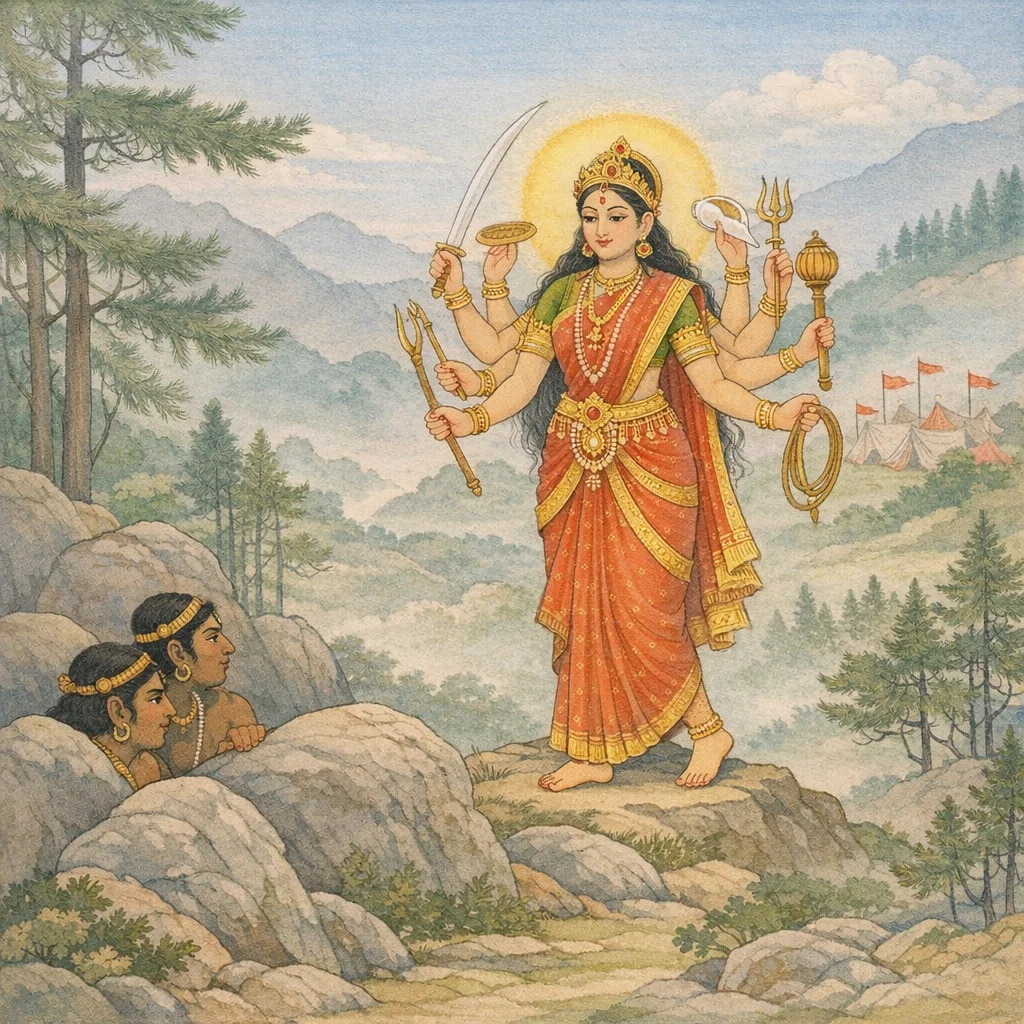
Adhyaya 20: Chanda and Munda Discover Katyayani; Mahishasura’s Proposal and the Vishnu-Panjara Protection
कात्यायनी-दर्शनं महिषासुर-दूतवाक्यं च विष्णुपञ्जर-रक्षा (Kātyāyanī-Darśanaṃ, Mahiṣāsura-Dūta-Vākyaṃ ca, Viṣṇupañjara-Rakṣā)
Mahishasura's Proposal
Within the Pulastya–Nārada narrative frame, this adhyāya shifts to a Śākta episode that is nevertheless interpreted through the Vāmana Purāṇa’s characteristic syncretic theology. Caṇḍa and Muṇḍa, scouts of Mahiṣāsura, behold Kātyāyanī dwelling on a Vindhya peak and report her extraordinary iconographic beauty and martial potency (notably her many arms and weapons). Mahiṣāsura’s court responds with asura-dharma: emissaries, boasts of universal sovereignty, and a demand for the “strī-ratna.” Through Dundubhi, the asura proposes marriage, to which the Goddess replies by invoking a customary “śulka” (bride-price) defined as victory over her in battle—thereby converting erotic conquest into a dharmic-ritualized combat condition. As the daitya host advances, the devas urge protective armor; the Goddess refuses conventional kavaca, and protection is supplied instead by the Viṣṇupañjara, a Vaishnava protective formula taught earlier by Śambhu. The chapter culminates in the assertion that with Cakrapāṇi present in the mind, no martial humiliation is possible—an explicit Hari–Hara consonance embedded in a Devi narrative.
Divine Beings
Sacred Geography
Mortal & Asura Figures
Key Content Points
- Pulastya narrates how Caṇḍa and Muṇḍa discover Kātyāyanī on the Vindhya mountain and deliver an embellished iconographic description to Mahiṣāsura, framing her as both “strī-ratna” and battlefield power.
- Dundubhi, envoy of Mahiṣāsura (Rambhā’s son), proclaims asura sovereignty over svarga, pātāla, and the worlds; Kātyāyanī answers with the asura court’s own legal idiom by stipulating a śulka: whoever defeats her in battle becomes her husband.
- As the daitya army approaches, the devas request kavaca; the Goddess declines, and the narrative introduces the Viṣṇupañjara—taught by Śambhu—highlighting Shaiva–Vaishnava synthesis and the supremacy of Vishnu-centered protective remembrance in war.
Shlokas in Adhyaya 20
Verse 1
इति श्रीवामनपुराणे एकोनविंशो ऽध्यायः पुलस्त्य उवाच ततस्तु तां तत्र तदा वसन्तीं कात्यायनीं शैलवरस्य शृङ्गे अपश्यतां दानवसत्तमौ द्वौ चण्डश् च मुण्डश्च तपस्विनीं ताम्
Pulastya said: Then, at that time, the two foremost among the Dānavas—Caṇḍa and Muṇḍa—saw there Kātyāyanī, dwelling upon the peak of the excellent mountain, that ascetic woman.
Verse 2
दृष्ट्वैव शौलादवतीर्य शीघ्रमाजग्मतुः स्वभवनं सुरारी दृष्ट्वोचतुस्तौ महिषासुरस्य दूताविदं चण्डमुण्डौ दितीशम्
Having seen her, they quickly descended from the mountain and went to their own abode. Seeing (their lord), the two messengers of Mahiṣāsura—Caṇḍa and Muṇḍa—reported this matter to Diti’s son (the Daitya king).
Verse 3
स्वस्थो भवान् किं त्वसुरेन्द्र साम्प्रतमागच्छ पश्याम च तत्र विन्ध्यम् तत्रास्ति देवी सुमहानुभावा कन्या सुरूपा सुरसुन्दरीणाम्
(They said:) ‘Are you well now, O lord of the Asuras? Come—let us go and see the Vindhya there. There is a Goddess of very great majesty, a maiden of exquisite beauty, surpassing the heavenly maidens.’
Verse 4
जितास्तया तोयधरालकैर्हि जितः शशङ्को वदनेन तन्व्या नेत्रैस्त्रिभिस्त्रीणि हुताशनानि जितानि कण्ठेन जितस्तु शङ्खः
By her cloud-laden locks, the rain-bearing clouds are conquered; by the slender maiden’s face, the moon is conquered. By her three eyes, the three fires are outshone; by her throat, the conch is surpassed.
Verse 5
स्तनौ सुवृत्तावथ मग्नचूचुकौ स्थितौ विजित्येव गजस्य कुम्भौ त्वां सर्वजोतारमिति प्रतर्क्य कुचौ स्मरेणैव कृतौ सुदुर्गौ
Her breasts—well-rounded, with nipples slightly recessed—stand as though they have conquered an elephant’s temples. Thinking, ‘You are the enkindler of all splendor,’ Love (Smara) has made those breasts exceedingly hard to overcome (irresistible/fortified).
Verse 6
पीनाः सशस्त्राः पिरघोपमाश्च भुजास्तथाष्टादश भान्ति तस्याः पराक्रमं वै भवतो विदित्वा कामेन यन्त्रा इव ते कृतास्तु
Her arms—full, weapon-bearing, and comparable to iron clubs—eighteen in number, shine forth. Knowing your valor, Love has fashioned them as though they were restraining devices (yantras).
Verse 7
मध्यं च तस्यास्त्रिवलीतरङ्गं विभाति दैत्येन्द्र सुरोमराजि भयातुरारोहणकातरस्य कामस्य सोपानमिव प्रयुक्तम्
O lord of the Daityas, the middle of that woman—rippling with the three folds—shines with a beautiful line of hair, as though it were a staircase set in place for Kāma (Love), who is anxious to climb, trembling in fear (of you).
Verse 8
सा रोमराजी सुतरां हि तस्या विराजते पीजकुचावलग्ना आरोहणे त्वद्भयकातरस्य स्वेदप्रवाहो ऽटसुर मन्मथस्य
That line of hair of hers shines all the more, clinging to the full breasts; (it is) like the flow of sweat of Manmatha, O demon, who—frightened by you—is anxious as he climbs (toward her).
Verse 9
नाभिर्गभीरा सुतरां विभाति प्रदक्षिणास्याः परिवर्तमाना तस्यैव लावण्यगृहस्य मुद्रा कन्दर्पराज्ञा स्वयमेव दत्ता
Her deep navel shines exceedingly, turning as if to the right (in a graceful spiral); it is as though it were the seal of that very ‘house of beauty,’ bestowed by King Kandarpa (Cupid) himself.
Verse 10
विभाति रम्यं जघनं मृगाक्ष्याः समन्ततो मेखलयावजुष्टम् मन्याम तं कामनराधिपस्य प्राकारगुप्तं नगरं सुदुर्गम्
The lovely hips of the doe-eyed maiden shine, encircled on all sides by a girdle. We deem them to be the well-fortified city of the lord of love, protected by ramparts and very hard to conquer.
Verse 11
वृत्तावरोमौ च मृदू कुमार्याः शोभेत ऊरू समनुत्तमौ हि आवासनार्थं मकरध्वजेन जनस्य देशाविव सन्निविष्टौ
The maiden’s thighs—rounded, hairless, and soft—shine as unsurpassed. They seem like two regions of the world set in place for the dwelling of Makaradhvaja (the Love-god).
Verse 12
तञ्जानुयुग्मं महिषासुरेन्द्र अर्द्धेन्नतं भाति तथैव तस्याः सृष्ट्वा विधाता हि निरूपणाय श्रान्तस्तथा हस्ततले ददौ हि
And her pair of knees, slightly raised, shines likewise—O lord of the buffalo-demons. Having created them for perfect proportion, the Creator (Vidhātṛ), as if wearied, placed them upon the palm of his hand.
Verse 13
जङ्घे सुवृत्ते ऽपि च रोमहीने शोभेत दैत्येश्वर ते तदीये आक्रम्य लोकानिव मिर्मिताया रूपार्जितस्यैव कृताधरौ हि
O lord of the Daityas, her two shanks—well-rounded and hairless—would indeed befit you. She appears as though fashioned to stride across the worlds; her lower lip (and nether region) seems perfectly made, as if beauty itself had been gained (and embodied) in her form.
Verse 14
पादौ च तस्याः कमलोदराभौ प्रयत्नतस्तौ हि कृतौ विधात्रा आज्ञापि ताभ्यां नखरत्नमाला नक्षत्रमाला गगने यथैव
Her two feet, resembling the interior of a lotus, were indeed fashioned with great care by the Creator (Vidhātṛ). And by their command, the jeweled garland of nails appeared like a garland of stars in the sky.
Verse 15
एवंस्वरूपा दनुनाथ कन्या महोग्रशस्त्राणि च धारयन्ती दृष्ट्वा यथेष्टं न च विद्म का सा सुताथवा कस्यचिदेव बाला
O lord of the Danu-line (Danavas), seeing this maiden of such a form, bearing exceedingly dreadful weapons, we do not know who she is—whose daughter indeed this young girl might be.
Verse 17
तद्भूतले रत्नमनुत्तमं स्थितं स्वर्गं परित्यज्य महासुरेन्द्र गत्वात्थ विन्ध्यं स्वयमेव पश्य कुरुष्व यत् ते ऽभिमतं क्षमं च // वम्प्_20.16 श्रुत्वैव ताभ्यां महिषासुरस्तु देव्याः प्रवृत्तिं कमनीयरूपाम् चक्रे मतिं नात्र विचारमस्ति इत्येवमुक्त्वा महिषो ऽपि नास्ति
“On the surface of the earth there stands an unsurpassed jewel; abandoning even heaven, O great lord of asuras, go to the Vindhya and see it with your own eyes, and do what is agreeable and fitting to you.” Hearing this from those two, Mahiṣāsura learned of the Goddess’s activity and her charming form; he formed a resolve—‘there is no need for deliberation here.’ Having spoken thus, the Buffalo(-demon) was (set) no more (i.e., he departed/ceased waiting).
Verse 18
प्रागेव पुंसस्तु शुभाशुभानि स्थाने विधात्रा प्रतिपादितानि यस्मिन् यथायानि यतो ऽथविप्र स नीयते वा व्रजति स्वयं वा
Indeed, a man’s auspicious and inauspicious (results) are assigned beforehand by the Creator in their proper places. Therefore, O brāhmaṇa, from wherever and in whatever manner (those results are to occur), he is led there—or he goes there of his own accord.
Verse 19
ततोनु मुण्डं नमरं सचण्डे विडालनेत्रं सपिशङ्गवाष्कलम् उग्रायुधं चिक्षुररक्तबीजौ समादिदेशाथ महासुरेन्द्रः
Then the great lord of asuras issued commands (to summon/deploy) Muṇḍa, Namara, Caṇḍa, Viḍālanetra, Piśaṅgavāṣkala, Ugrāyudha, Cikṣura, and Raktabīja.
Verse 20
आहत्य भेरी रमकर्कशास्ते स्वर्गं परित्यज्य महीधरं तु आगम्य मूले शिविरं निवेश्य तस्थुश्च सञ्जा दनुनन्दनास्ते
Having beaten the war-drum—harsh and resounding—they abandoned heaven and came to the mountain. Reaching its base, they pitched a camp and stood ready there, those sons of Danu.
Verse 21
ततस्तु दैत्यो महिषासुरेण संप्रेषितो दानवयूथपालः मयस्य पुत्रो रिपुसैन्यमर्दी स दुन्दुभिर्दुन्दुभिनिःखनस्तु
Then a Daitya leader of Dānava troops, sent by Mahiṣāsura—Dundubhi, the son of Maya, a crusher of enemy armies and a blower/beater of the war-drum—(set out).
Verse 22
अभ्येत्य देवीं गगनस्थितो ऽपि स दुन्दुभिर्वाक्यमुवाच विप्र कुमारि दूतो ऽस्मि महासुरस्य रम्भात्मजस्याप्रतिमस्य युद्धे
Approaching the Goddess—though remaining stationed in the sky—Dundubhi spoke these words, O Brāhmaṇa: “O maiden, I am the messenger of the great Asura, the incomparable son of Rambhā, in this matter of war.”
Verse 23
कात्यायानी दुन्दुभिमभ्युवाच एह्येहि दैत्येन्द्र भयं विमुच्य वाक्यं च यद्रम्भसुतो बभाषे वदस्व तत्सत्यमपेतमोहः
Kātyāyanī addressed Dundubhi: “Come, come, O lord of the Daityas; cast off fear. And whatever statement the son of Rambhā has spoken—declare that truthfully, free from delusion.”
Verse 24
तथोक्तवाक्ये दितिजः शिवायास्तयज्याम्बरं भूमितले निषण्णः सुखोपविष्टः परमासने च रम्भात्मजेनोक्तमुवाच वाक्यम्
When she had spoken thus, the Dānava (son of Diti), in the presence of Śivā (the Goddess), casting aside his garment and sitting on the ground, then seated comfortably upon the highest seat, spoke the words as uttered by the son of Rambhā.
Verse 25
दुन्दुभिरुवाच एवं समाज्ञापयते सुरारिस्त्वां देवि दैत्यो महिषासुरस्तु यथामरा हीनबलाः पृथिव्यां भ्रमान्ति युद्धे विजिता मया ते
Dundubhi said: “Thus does the enemy of the gods (I) command you, O Goddess—(I), the Daitya Mahīṣāsura: just as the gods, weakened in strength, wander upon the earth, they have been conquered by me in battle.”
Verse 26
स्वर्गं मही वायुपथाश्च वश्याः पातालमन्ये च महेश्वराद्याः इन्द्रो ऽस्मि रुद्रो ऽस्मि दिवाकरो ऽस्मि सर्वेषु लोक्ष्वधिपो ऽस्मि बाले
“Heaven, earth, and the paths of the wind are under my control; so too the netherworld, and even others beginning with Maheśvara. I am Indra; I am Rudra; I am the Sun. In all the worlds, O child, I am the lord.”
Verse 27
न सो ऽस्ति नाके न महीतले वा रसातले देवभटो ऽसुरो वा यो मां हि संग्राममुपेयिवांस्तु भूतो न यक्षो न जिजीविषुर्यः
“There is none in heaven, nor on earth, nor in Rasātala—no god’s champion and no asura—who, having approached me in battle, has remained: neither a bhūta nor a yakṣa, nor anyone wishing to live.”
Verse 28
यान्येव रत्नानि महीतले वा स्वर्गे ऽपि पातालतले ऽथ मुग्धे स्रावणि मामद्य समागतानि वीर्यार्जितानीह विशालनेत्रे
“Whatever treasures there are on earth, and also in heaven, and in the netherworld—O deluded one—today they have come to me here, in the month of Śrāvaṇa, O wide-eyed one, earned by my valor.”
Verse 30
स्त्रीरत्नमग्र्यं भवती च कन्या प्राप्तो ऽस्मि शैलं तव कारणेन तस्माद् भजस्वेह जगत्पतिं मां पतिस्तवार्हे ऽस्मि विभुः प्रभुश्च // वम्प्_20.29 पुलस्त्य उवाच/ इत्येवमुक्ता दितिजेन दुर्गा कात्यायनी प्राह मयस्य पुत्रम् सत्यं प्रभुर्दानवराट् पृथिव्यां सत्यं च युद्धे विजितामराश्च
“You are the foremost jewel among women, and a maiden. Because of you I have come to this mountain. Therefore accept me here—the lord of the world. I am fit to be your husband, being mighty and sovereign.” Pulastya said: Thus addressed by the Diti-born (daitya), Durgā Kātyāyanī spoke to Maya’s son: “True indeed—you are a powerful lord, a king of the Dānavas upon the earth; and true also that in battle you have conquered the gods.”
Verse 31
किं त्वस्ति दैत्येश कुले ऽस्मदीये धर्मो हि शुल्काख्य इति प्रसिद्धः तं चेत् प्रदद्यान्महिषो ममाद्य भजामि सत्येन पतिं हयारिम्
“But, O lord of the Daityas, in our lineage there is a dharma well-known as ‘śulka’ (the bride-price). If today you would give that—(even) a buffalo—then truly I will accept you as my husband, O Hayāri.”
Verse 32
श्रुत्वाथ वाक्यं मयजो ऽब्रवीच्च शुल्कं वदस्वाम्बुजपत्रनेत्रे दद्यात्स्वमूर्धानमपि त्वदर्थे किं नाम शुल्कं यदिहैव तभ्यम्
Hearing her words, Maya’s son replied: “Name the śulka, O lotus-petal-eyed one. For your sake I would give even my own head. What indeed is the śulka—tell it here and now.”
Verse 33
पुलस्त्य उवाच इत्येवमुक्ता दनुनायकेन कात्यायनी सस्वनमुन्नदित्वा विहस्य चैतद्वचनं बभाषे हिताय सर्वस्य चराचरस्य
Pulastya said: Thus addressed by the lord of the Danavas, Kātyāyanī, raising a resonant sound (with a loud utterance), laughed and spoke these words, for the welfare of all beings—moving and unmoving.
Verse 34
श्रीदेव्युवाच कुले ऽस्मदीये शृणु दैत्य शुल्कं कृतं हि यत्पूर्वतरैः प्रसह्य यो जेष्यते ऽस्मत्कुलजां रणाग्रे तस्याः स भर्त्तापि भविष्यतीति
The Blessed Goddess said: Hear, O Daitya, the bride-price/condition established in our lineage long ago by the ancients, even forcibly: whoever conquers a maiden of our line in the forefront of battle—he indeed shall become her husband.
Verse 35
पुलस्त्य उवाच/ तच्छ्रुत्वा वचनं देव्या दुन्दुभिर्दानवेश्वरः गत्वा निवेदयामास महिषाय यथातथम्
Pulastya said: Having heard the Goddess’ words, Dundubhi, the lord of the Danavas, went and reported them to Mahiṣa exactly as they were.
Verse 36
स चाभ्यगान्महातेजाः सर्वदैत्यपुरः सरः आगत्य विन्ध्यशिखरं योद्धधुकामः सरस्वतीम्
And that mighty one advanced—Saras, the foremost of all the Daityas. Coming to the peak of the Vindhya, he desired to wage battle at (the region of) the Sarasvatī.
Verse 37
ततः सेनापतिर्दैत्यो चिक्षुरो नाम नारद सेनाग्रगामिनं चक्रे नमरं नाम दानवम्
Then the Daitya commander, named Cikṣura—O Nārada—made the Dānava named Namara the leader who would go at the front of the army (vanguard).
Verse 38
स चापि तेनाधिकृतश्चतुरङ्गं समूर्जितम् बलेकदेशमादाय दुर्गा दुद्राव वेगितः
And he too, being appointed by him, took a reinforced fourfold army—one division of the force—and swiftly rushed toward the fortress/stronghold.
Verse 39
तमापतन्तं वीक्ष्याथ देवा ब्रह्मपुरोगमाः ऊचुर्वाक्यं महादेवीं वर्म ह्याबन्ध चाम्बिके
Seeing him rushing down/charging, the gods—headed by Brahmā—addressed Mahādevī: “O Ambikā, fasten (upon us) the armor (of protection).”
Verse 40
अथोवाच सुरान् दुर्गा नाहं बध्नामि देवताः कवचं को ऽत्र संतिष्ठेत् ममाग्रे दानवाधमः
Then Durgā said to the gods: “I do not bind (or fasten on) the deities. Who here would stand (needing) armor, when that vile daitya stands before me?”
Verse 41
यदा न देव्या कवचं कृतं शस्त्रनिबर्हणम् तदा रक्षार्थमस्यास्तु विष्णुपञ्जरमुक्तवान्
When the Goddess’s armor—made to neutralize weapons—was not (in place), then, for the sake of protection, he declared the ‘Viṣṇu-pañjara’ (Viṣṇu’s protective enclosure).
Verse 42
सा तेन रक्षिता ब्रह्मन् दुर्गा दानवसत्तमम् अवध्यं दैवतैः सर्वेर्महिषं प्रत्यपीयत्
O brāhmaṇa, protected by that (Viṣṇu-pañjara), Durgā advanced against Mahiṣa, the foremost of dānavas, who was invulnerable to all the gods.
Verse 43
एवं पुरा देववरेण शंभुना तद्वैष्णवं पञ्जरमायताक्ष्याः प्रोक्तं तया चापि हि पादघातैर्निषूदितो ऽसौ महिषासुरेन्द्रः
Thus, in former times, that Vaiṣṇava ‘Pañjara’ (protective formula) was taught by Śambhu, the best of the gods, to the wide-eyed goddess; and by her—indeed—through blows of her feet, that lord of the Mahiṣa-asuras was slain.
Verse 44
एवंप्रभावो द्विज विष्णुपञ्जरः सर्वासु रक्षास्वधिको हि गीतः कस्तस्य कुर्याद् युधि दर्फहानिं यस्य स्थितश्चेतसि चक्रपाणिः
O twice-born, such is the power of the Viṣṇu-pañjara; it is sung as superior among all protections. Who could cause defeat or the loss of pride in battle for one in whose heart Cakrapāṇi (Viṣṇu) stands established?
Frequently Asked Questions
The protection of Kātyāyanī is explicitly mediated through the Viṣṇupañjara, a Vaishnava protective formula, yet it is said to have been taught earlier by Śambhu (Shiva). This narrative move frames Shaiva authority as endorsing Vishnu-centered remembrance, presenting a functional Hari–Hara concord within a Devi-centered battle episode.
The chapter’s topography is primarily Vindhya-centric: Kātyāyanī is located on a Vindhya peak, and the daitya forces march to that mountain and encamp at its base. No Kurukṣetra–Sarasvatī tirtha catalog or ritual bath merits are foregrounded in this adhyāya; the sanctification is by narrative localization (Vindhya as the Goddess’s seat) rather than by a detailed pilgrimage itinerary.
Kātyāyanī states that in her lineage the recognized śulka is: whoever defeats a woman of her kula in battle becomes her husband. The condition reframes Mahiṣāsura’s desire into a regulated combat criterion, emphasizing asura-dharma’s transactional logic while asserting the Goddess’s sovereignty and the inevitability of martial confrontation.