Sarga 60
कुम्भकर्णविबोधनम् (The Awakening of Kumbhakarna)
युद्धकाण्ड
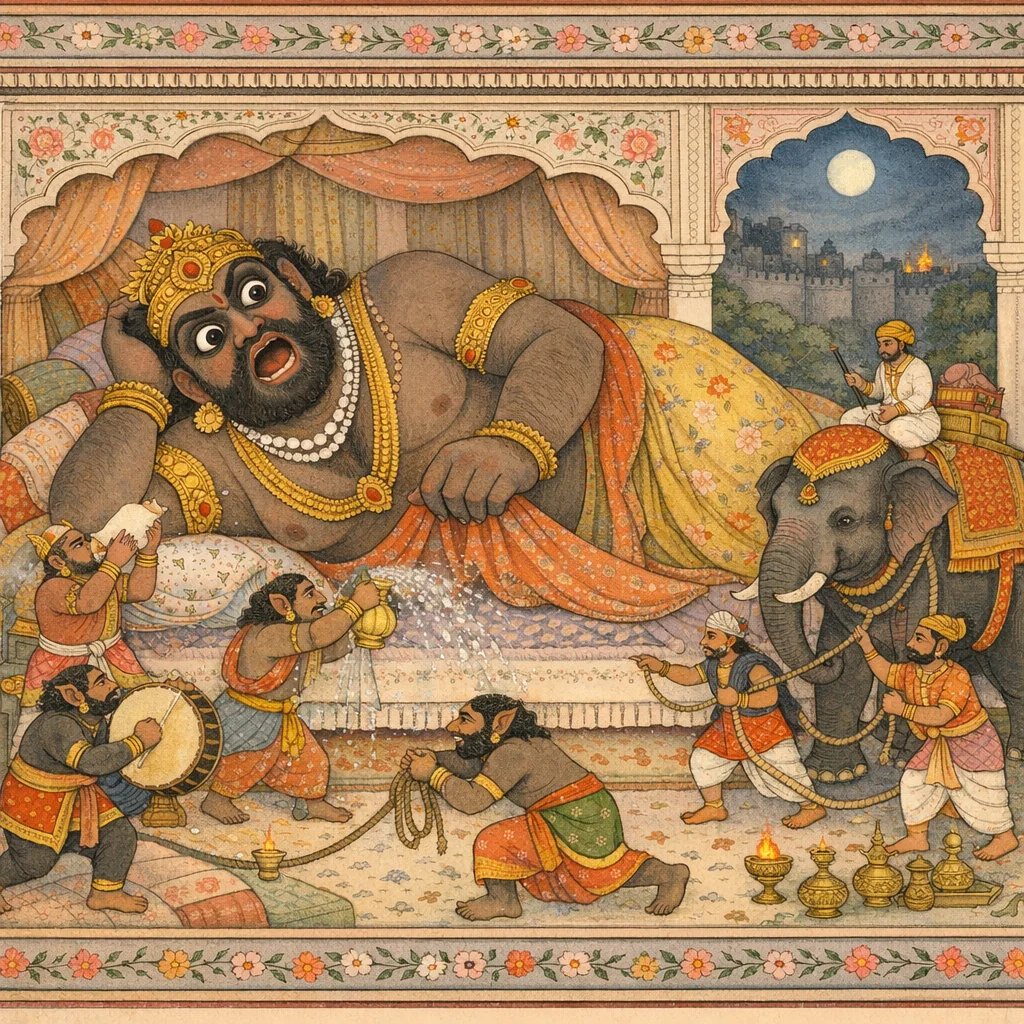
Sarga 60 presents a court-and-war interlude in which Rāvaṇa, returning to Laṅkā humiliated by Rāma’s arrows, interprets his crisis through remembered curses and prophecies: the violation of Vedavatī and maledictions associated with figures such as Umā, Nandīśvara, Rambhā, and Varuṇa’s daughter, alongside Brahmā’s warning that danger would arise from humans. He orders intensified defense at the gates and the urgent awakening of Kumbhakarṇa, whose slumber is attributed to Brahmā’s curse and whose martial reputation is invoked as a last strategic counterweight. A large contingent of rākṣasas attempts to rouse him through escalating sensory and physical measures—food offerings, perfumes, conches and drums, blows with clubs and trees, pouring water, binding and striking, even driving elephants over his body—until hunger and impact finally break the trance. Kumbhakarṇa awakens with apocalyptic imagery (mouth like the underworld, eyes like blazing planets), consumes massive quantities of meat, blood, fat, and wine, and questions the emergency. Minister Yūpākṣa reports that the threat is not divine but human—Rāma and the Vānara host—citing prior damage to Laṅkā and Rāvaṇa’s narrow escape. Kumbhakarṇa vows immediate conquest and proceeds, shaking the earth; his emergence alarms the Vānara leaders, many fleeing or seeking refuge in Rāma, thereby marking a psychological turning point before the next phase of combat.
Shlokas
Verse 1
सप्रविश्यपुरींलङ्कांरामबाणभयार्धितः ।भग्नदर्पस्तदाराजाबभूवव्यथितेन्द्रियः ।।।।
Entering the city of Laṅkā, the king—harried by fear of Rāma’s arrows—found his pride shattered, his senses shaken and unsteady.
Verse 2
मातङ्गइवसिंहेनगरुडेनेवपन्नगः ।अभिभूतोऽभवद्राजाराघवेणमहात्मना ।।।।
Humbled by the high-souled Rāghava (Rāma), the king (Rāvaṇa) stood subdued—like an elephant checked by a lion, and like a serpent overpowered by Garuḍa.
Verse 3
ब्रह्मदण्डप्रतीकानांविद्युत्सदृशवर्चसाम् ।स्मरन्राघवबाणानांविव्यथेराक्षसेश्वरः ।।।।
The lord of the Rākṣasas grew troubled, remembering Rāghava’s arrows—comet-like as the Brahma-daṇḍa and flashing with lightning’s brilliance.
Verse 4
नकाञ्चनमयंदिव्यमाश्रित्यपरमासनम् ।विप्रेक्षमाणोरक्षांसिरावणोवाक्यमब्रवीत् ।।।।
Seated upon a splendid, divine throne of gold, Rāvaṇa, gazing upon the rākṣasas, spoke these words.
Verse 5
सर्वंतत्खलुमेमोघंयत्तप्तंपरमंतपः ।यत्समानोमहेन्द्रेणमानुषेणास्मिर्जितः ।।।।
Truly, all that supreme austerity I performed has become futile—since I, who deemed myself equal to Mahendra, have been defeated by a mere human.
Verse 6
इदंतद्ब्रह्मणोघोरंवाक्यंमामभ्युपस्थितम् ।मानुषेभ्योविजानीहिभयंत्वमितितत्तथा ।।।।
“That dreadful utterance of Brahmā has now come upon me: ‘Know that your peril will arise from human beings’—and so it proves true.”
Verse 7
देवदानवगन्धर्वैर्यक्षराक्षसपन्नगैः ।अवध्यत्वंमयाप्राप्तंमानुषेभ्योनयाचितम् ।।।।
“From devas, dānavas, gandharvas, yakṣas, rākṣasas, and serpents I obtained the boon of invulnerability; but from humans I did not ask for it.”
Verse 8
विदितंमानुषंमन्येरामंदशरथात्मजम् ।इक्ष्वाकुकुलजातेनअनरण्येनयत्पुरा ।।।।उत्पत्स्यतेहिमद्वंशेपुरुषोराक्षसाधनु ।यस्त्वांसपुत्रंसामात्यंसबलंसाश्वसारथिम् ।।।।निहनिष्यतिसङ्ग्रामेत्वांकुलाधम दुर्मते ।
I believe I now recognize that human—Rāma, the son of Daśaratha—of whom Anaraṇya, born in the Ikṣvāku line, once foretold to me: ‘In my lineage a man will indeed be born who will slay you in battle—along with your sons, your ministers, your forces, your horses and charioteers—O vile rākṣasa, disgrace of your clan, evil-minded one.’
Verse 9
विदितंमानुषंमन्येरामंदशरथात्मजम् ।इक्ष्वाकुकुलजातेनअनरण्येनयत्पुरा ।।6.60.8।।उत्पत्स्यतेहिमद्वंशेपुरुषोराक्षसाधनु ।यस्त्वांसपुत्रंसामात्यंसबलंसाश्वसारथिम् ।।6.60.9।।निहनिष्यतिसङ्ग्रामेत्वांकुलाधम दुर्मते ।
I believe I now recognize that human—Rāma, the son of Daśaratha—of whom Anaraṇya, born in the Ikṣvāku line, once foretold to me: ‘In my lineage a man will indeed be born who will slay you in battle—along with your sons, your ministers, your forces, your horses and charioteers—O vile rākṣasa, disgrace of your clan, evil-minded one.’
Verse 10
शप्तोऽहंवेदवत्याचयदासाधर्षितापुरा ।।।।सेयंसीतामहाभागाजाताजनकनन्दिनी ।
When I once violated Vedavatī, I was cursed by her; and now that very one has been born as the blessed Sītā, Janaka’s beloved daughter.
Verse 11
उमानन्दीश्वरश्चापिरम्भावरुणकन्यका ।।।।यथोक्तास्तन्मयाप्राप्तंनमिथ्याऋषिभाषितम्
So too did Umā, Nandīśvara, Rambhā, and Varuṇa’s daughter speak as foretold; and I have met with exactly that—what seers declared is not false.
Verse 12
एतदेवाभ्युपागम्ययत्नंकर्तुमहार्हथ ।।।।राक्षसाश्चापितिष्ठन्तुचर्यागोपुरमूर्थसु ।
Knowing this very situation, you must exert yourselves to do what must be done; let the rākṣasas also take their positions—keeping watch upon the gate-towers.
Verse 13
सचाप्रतिमगाम्भीर्योदेवदानवदर्पहा ।।।।ब्रह्मशापाभिभूतस्तुकुम्भकर्णोविबोध्यताम् ।
And let Kumbhakarṇa be awakened—he whose depth is unmatched, who can crush the pride of devas and dānavas, yet who lies overpowered by Brahmā’s curse.
Verse 14
सपराजितमात्मानंप्रहस्तंचनिषूदितम् ।।।।ज्ञात्वारक्षोबलंभीममादिदेशमहाबलः ।
Knowing himself to have been repulsed, and that Prahasta had been slain, the mighty one issued orders to the fearsome rākṣasa host.
Verse 15
द्वारेषुयत्नःक्रियतांप्राकारश्चाधिरुह्यताम् ।।।।निद्रावशसमाविष्टःकुम्भकर्णोविबोद्यताम् ।
Let effort be applied at the gates, and let the ramparts be manned; and let Kumbhakarṇa, fallen under the dominion of sleep, be awakened.
Verse 16
सुखंस्वपितिनिश्चिन्तःकालोपहतचेतनः ।।।।नवषट् सप्तचाष्टौचमासान् स्वपितिराक्षसः ।
That rākṣasa sleeps at ease, without worry, his awareness dulled by long time; for six, seven, eight—even nine months—he sleeps on.
Verse 17
मन्त्रयित्वाप्रसुप्तोऽयमितस्तुनवमेऽहनि ।।।।तंतुबोधयतक्षिप्रंकुम्भकर्णंमहाबलम् ।
After counsel, he has lain asleep from here for nine days; therefore wake that mighty Kumbhakarṇa quickly.
Verse 18
सतुसङ् ख्येमहाबाहुःककुदस्सर्वरक्षसाम् ।।।।वानरान् राजपुत्रौचक्षिप्रमेवहनिष्यति
In battle, that broad-armed one—foremost among all the Rākṣasas—will swiftly destroy many Vānaras, and even the two princes (Rāma and Lakṣmaṇa).
Verse 19
एषःकेतुःपरंसङ् ख्येमुख्योवैसर्वरक्षसाम् ।।।।कुम्भकर्णःसदाशेतेमूढोग्राम्यसुखेरतः ।
This one is the distinguished standard-bearer in battle, truly the chief among all the Rākṣasas—Kumbhakarṇa. Yet, deluded, he lies asleep always, absorbed in coarse pleasures in the form of sleep.
Verse 20
रामेणहिनिरस्तस्यसङ्ग्रामेऽस्मिन् सुदारुणे ।।।।भविष्यतिनमेशोकःकुम्भकर्णेविबोधिते ।
Cast down by Rāma in this most dreadful battle, I shall have no sorrow once Kumbhakarṇa has been awakened.
Verse 21
किंकरिष्याम्यहंतेनशक्रतुल्यबलेनहि ।।।।ईदृशेव्यसनेघोरेयोनसाह्यायकल्पते ।
What can I accomplish with him—even though his strength is like Indra’s—if, in such a dreadful crisis, he is of no help to me?
Verse 22
तेतुतद्वचनंश्रुत्वाराक्षसेन्द्रस्यराक्षसाः ।।।।जग्मुःपरमसम्भ्रान्ताःकुम्भकर्णनिवेशनम् ।
Hearing the words of the lord of the Rākṣasas, the Rākṣasas—greatly agitated—went to Kumbhakarṇa’s dwelling.
Verse 23
तांप्रविश्यमहाद्वारंसर्वतोयोजनायताम् ।।।।कुम्भकर्णगुहांरम्यांसर्वगन्धप्रवाहिनीम् ।कुम्भकर्णस्यनिःश्वासादवधूतामहाबलाः ।।।।प्रतिष्ठमानाःकृच्छ्रेणयत्नात्प्रविविशुर्गुहाम् ।
Entering that delightful cavern-dwelling of Kumbhakarṇa—with vast gates, extending a yojana in every direction, and filled with streams of every fragrance—the mighty ones were blown back by Kumbhakarṇa’s breath; yet, forcing their footing with difficulty and effort, they pressed on and entered the cavern.
Verse 24
तांप्रविश्यमहाद्वारंसर्वतोयोजनायताम् ।।6.60.23।।कुम्भकर्णगुहांरम्यांसर्वगन्धप्रवाहिनीम् ।कुम्भकर्णस्यनिःश्वासादवधूतामहाबलाः ।।6.60.24।।प्रतिष्ठमानाःकृच्छ्रेणयत्नात्प्रविविशुर्गुहाम् ।
Entering that delightful cavern—auspicious and paved with golden flooring—they saw the tiger among the Rākṣasas lying asleep, dreadful to behold.
Verse 25
तांप्रविश्यगुहांरम्यांशुभांकाञ्चनकुट्टिमाम् ।।।।ददृशुर्नैरृतव्याघ्रंशयानंभीमविदर्शनम् ।
Entering that delightful cavern—auspicious and paved with golden flooring—they saw the tiger among the Rākṣasas lying asleep, dreadful to behold.
Verse 26
तेतुतंविकृतंसुप्तंविकीर्णमिवपर्वतम् ।।।।कुम्भकर्णंमहानिद्रंसहिताःप्रत्यबोधयन् ।
Then, gathered together, they tried to rouse Kumbhakarṇa—sleeping in that monstrous form—like a mountain sprawled and scattered, sunk in a heavy slumber.
Verse 27
ऊर्ध्वरोमाञ्चिततनुंश्वसन्तमिवपन्नगम् ।भ्रामयन्तम् न्विश्श्वसैःशयानम् भीमविदर्शमम् ।।।।भीमनासापुटंतंतुपातालोविपुलाननम् ।शयनेन्यस्तसर्वाङ्गंमेदोरुधिरगन्धिनम् ।।।।काञ्चनाङ्गदनद्धाङ्गंकिरीटिनमरिन्दमम् ।ददृशुर्नैरृतव्याघ्रंकुम्भकर्णमरिन्दमम् ।।।।
They beheld Kumbhakarṇa lying asleep—his body bristling with raised hair, breathing like a serpent, and with each heavy exhalation making his massive form seem to writhe—terrible to look upon.
Verse 28
ऊर्ध्वरोमाञ्चिततनुंश्वसन्तमिवपन्नगम् ।भ्रामयन्तम् न्विश्श्वसैःशयानम् भीमविदर्शमम् ।।6.60.27।।भीमनासापुटंतंतुपातालोविपुलाननम् ।शयनेन्यस्तसर्वाङ्गंमेदोरुधिरगन्धिनम् ।।6.60.28।।काञ्चनाङ्गदनद्धाङ्गंकिरीटिनमरिन्दमम् ।ददृशुर्नैरृतव्याघ्रंकुम्भकर्णमरिन्दमम् ।।6.60.29।।
His nostrils were monstrous, his face as vast as the underworld; sprawled upon his bed with every limb flung out, he reeked of fat and blood.
Verse 29
ऊर्ध्वरोमाञ्चिततनुंश्वसन्तमिवपन्नगम् ।भ्रामयन्तम् न्विश्श्वसैःशयानम् भीमविदर्शमम् ।।6.60.27।।भीमनासापुटंतंतुपातालोविपुलाननम् ।शयनेन्यस्तसर्वाङ्गंमेदोरुधिरगन्धिनम् ।।6.60.28।।काञ्चनाङ्गदनद्धाङ्गंकिरीटिनमरिन्दमम् ।ददृशुर्नैरृतव्याघ्रंकुम्भकर्णमरिन्दमम् ।।6.60.29।।
They saw Kumbhakarṇa—adorned with golden armlets, crowned, a tamer of foes—the ‘tiger among the Rākṣasas’, famed as a crusher of enemies.
Verse 30
ततश्चक्रुर्महात्मानंकुम्भकर्णाग्रतस्तदाचाग्रतः ।।।।मांसानांमेरुसङ्काशंराशिंपरमतर्पणम् ।
Then, before Kumbhakarṇa, they set a mountain-like heap of meat—vast as Meru—meant to rouse and satisfy him to the fullest.
Verse 31
मृगाणांमहिषाणांचवराहाणांचसञ्चयान् ।।।।चक्रुर्नैरृतशार्दूलाराशिमन्नस्यचाद्भुतम् ।
Those Rākṣasas—like tigers—piled up heaps of deer, buffalo, and boar, forming a wondrous mass of food.
Verse 32
ततश्शोणितकुम्भांश्चमद्यानिविविधानिच ।।।।पुरस्तात्कुम्भकर्णस्यचक्रुस्त्रिदशशत्रवः ।
Then the enemies of the gods set before Kumbhakarṇa jars of blood and many kinds of intoxicating drink.
Verse 33
लिलिपुश्चपरार्ध्येनचन्दनेनपरन्तपम् ।।।।दिव्यैराश्वासयामामासुर्माल्यैर्गन्धैस्सुगन्धिभिः ।
They anointed that mighty one with costly sandal-paste, and tried to rouse and refresh him with divine garlands and fragrant perfumes.
Verse 34
धूपंसुगन्धांश्चससृजुस्तुष्टवुश्चपरन्ततम् ।।।।जलदाइवचानेदुर्यातुधानास्ततस्ततः ।
They sent forth fragrant incense and praised him; and the Yātudhānas roared from place to place like thunderclouds.
Verse 35
शङ्खांनापूरयामासुश्शशाङ्कसदृशप्रभान् ।।।।तुमुलंयुगपच्छापिविनेदुश्चाप्यमर्षिताः ।
They blew conches shining like the moon, and—fired with rage—raised a tremendous uproar all at once.
Verse 36
नेदुरास्फोटयामासुश्चिक्षिपुस्तेनिशाचराः ।।।।कुम्भकर्णविबोधार्थंचक्रुस्तेविपुलंस्वनम् ।
The night-roaming rākṣasas drew near; they slapped and clapped, and to awaken Kumbhakarṇa they raised a mighty, resounding din.
Verse 37
सशङ्खभेरीपणवप्रणादमास्फोटितक्षेवळितसिंहनादम् ।दिशोद्रवन्तस्त्रिदिवंकीरन्तःश्रुत्वाविहंगाःसहसानिपेतुः ।।।।
Hearing that uproar—conches and kettle-drums, the clapping and tumult, and a lion-like roar—the birds that ranged through the sky scattered in all directions and suddenly fell.
Verse 38
यदाभृशंतैर्निनदैर्महात्मानकुम्बकर्णोबुबुधेप्रसुप्तः ।ततोमुसुण्ठीर्मुसलानिसर्वेरक्षोगणास्तेजगृहुर्गदाश्च ।।।।
But even amid those fierce cries, the great-bodied Kumbhakarṇa did not awaken from sleep. Then all those companies of rākṣasas seized mallets, clubs, and maces.
Verse 39
तंशैलशृङ्गैर्मुसलैर्गदाभिर्वृक्षैस्तरैर्मुद्गरमुष्टिभिश्च ।सुखप्रसुप्तंभुविकुम्भकर्णंरक्षांस्युदग्राणितदानिजघ्नुः ।।।।
Then the rākṣasas, worked into fervor, struck Kumbhakarṇa as he lay comfortably asleep on the ground—using rock-peaks, clubs, maces, trees, hammers, and even their fists.
Verse 40
तस्यनिःश्वासवातेनकुम्भकर्णस्यरक्षसः ।राक्षसाबलवन्तोऽपिस्थातुनाशक्नुवन्पुरः ।।।।
By the gust of that rākṣasa Kumbhakarṇa’s breath, even the mighty rākṣasas could not stand before him.
Verse 41
ततःपरिहितागाढंराक्षसाभीमविक्रमाः ।मृदङ्गपणवान् भेरीश्शङ्खकुम्भगणांस्तथा ।।।।
Then the rākṣasas of dreadful prowess took up in earnest the abandoned instruments—drums, paṇavas, kettle-drums, and likewise groups of conch-like clay pots—
Verse 42
दशराक्षससाहस्रंयुगपत्पर्यवारयन् ।नीलाञ्जनचयाकारंतेतुतंप्रत्यबोधयन् ।।।।अभिघ्नन्तोनदन्तश्चनैवसंविविदेतुसः ।
Ten thousand rākṣasas surrounded him all at once—him who looked like a heap of dark collyrium—and tried to rouse that one, striking and shouting; yet he did not respond at all.
Verse 43
यदाचैनंनशेकुस्तेप्रतिबोधयितुंतदा ।।।।ततोगुरुतरंयत्नंदारुणंसमुपाक्रमन् ।
When they could not awaken him even then, they undertook an even heavier and harsher effort.
Verse 44
आश्वानुष्ट्रान् खरन्नागान् जघ्नुर्दण्डकशाङ्कुशैः ।।।।भेरीशङ्खमृदङ्गांश्चसर्वप्राणैरवादयन् ।
They drove on horses, camels, donkeys, and elephants with staffs, whips, and goads; and with all their breath and strength they sounded kettle-drums, conches, and drums.
Verse 45
निजघ्नुश्चास्यगात्राणिमहाकाष्ठकङ्करैः ।।।।मुद्गरैर्मुसलैश्चापिसर्वप्राणसमुद्यतैः ।
They struck his limbs with great wooden clubs and heavy cudgels, and also with mallets and pestles—mustering all their strength—in an attempt to rouse him.
Verse 46
तेननादेवमहतालङ्कासमभिपूरिता ।।।।सपर्वतवनासर्वासोऽपिनैवप्रबुध्यते ।
By that tremendous uproar, all Laṅkā was filled—along with its mountains and forests—yet even then he did not awaken.
Verse 47
ततस्सहस्रंभेरीणांयुगसत्समहन्यत ।।।।मृष्टकाञ्चनकोणानामासक्तानांसमन्ततः ।
Then a thousand war-drums were gathered and beaten incessantly on every side with beaters tipped with polished gold.
Verse 48
एवमप्यन्तिद्रिस्तुयदानैवप्रबुध्यत ।।।।शापस्यवशमापन्नस्ततःक्रुद्धानिशाचराः ।
Even after all this, when that sleeper still did not awaken—having fallen under the power of a curse—the night-roaming rākṣasas became enraged.
Verse 49
महाक्रोधसमाविष्टास्सर्वेभीमपराक्रमाः ।।।।तद्रक्षोबोधयिष्यन्तश्चक्रुरन्येपराक्रमम् ।
All of them—terrible in prowess—overcome by great anger, made yet another vigorous attempt, determined to awaken that rākṣasa.
Verse 50
अन्येभेरीस्समाजघ्नुरन्येचक्रुर्महास्वनम् ।।।।केशानन्येप्रलुलुपुःकर्णावन्येदशन्तिच ।
Some beat the drums; others raised a tremendous shout; some tugged at his hair, and others even bit his ears.
Verse 51
उदकुम्बशतान्यन्येसमसिञ्चन्तकर्णयोः ।।।।नकुम्भकर्णःपस्पन्देमहानिद्रावशंगतः ।
Others poured hundreds of water-pails into his ears; yet Kumbhakarṇa—fallen under the power of deep sleep—did not so much as stir.
Verse 52
अन्येचबलिनस्तस्यकूटमुद्गरपाणयः ।।।।मूर्ध्निवक्षसिगात्रेषुपातन् कूटमुद्गरान् ।
And other strong ones, wielding heavy mallets, let those mallets fall upon his head, his chest, and his limbs.
Verse 53
रज्जुबन्धनबद्धाभिश्शतघ्नीभिश्चसर्वशः ।।।।वध्यमानोमहाकायोनप्राबुध्यतराक्षसः ।
Though struck on every side with śataghnīs and bound fast with ropes, that huge-bodied rākṣasa still did not awaken.
Verse 54
वारणानांसहस्रंचशरीरेऽस्यप्रधावितम् ।।।।कुम्बकर्णस्तदाबुद् ध्वास्पर्शंपरमबुध्यत ।
A thousand elephants were driven across his body; then Kumbhakarṇa perceived the contact, yet did not comprehend what it was.
Verse 55
सपात्यमानैर्गिरिशृङ्गवृक्षैरचिन्तयंस्तान्विपुलान् प्रहारान् ।निद्राक्ष्यात् क्षुद्भयपीडितश्चविजृम्भमाणस्सहसोत्पपाप ।।।।
Struck by massive blows from falling mountain-peaks and trees, he paid them no heed; but as his sleep wore off and hunger pressed him, he yawned and suddenly sprang up.
Verse 56
सनागभोगाचलशृङ्गकल्पौविक्षिप्यबाहूगिरशृङ्गसारौ ।निवृत्यवक्त्रंवडवामुखाभंनिशाचरोऽसौविकृतंजजृम्भे ।।।।
Flinging out his arms—like mountain-peaks entwined with serpent-coils, hard as rocky summits—that night-roamer turned his face; his mouth, like the submarine fire, opened in a dreadful yawn.
Verse 57
तस्यजाजृम्भमाणस्यवक्त्रंपातालसन्निभम् ।ददृशेमेरुशृङ्गाग्रेदिवाकरइवोदितः ।।।।
As he yawned, his mouth—like the netherworld—appeared as though the sun had risen over the summit of Mount Meru.
Verse 58
सजृम्भमाणोऽतिबलःप्रद्धोनिशाचरः ।निःश्वासश्चास्यसञ्जज्ञेपर्वतादिवमारुतः ।।।।
Yawning as he fully awakened, that exceedingly strong night-roamer exhaled; his breath arose like a wind blowing from a mountain.
Verse 59
रूपमुत्तिष्ठतस्तस्यकुम्भकर्णस्यतद्बभौ ।तपान्तेसबलाकस्यमेघस्येवविवर्षतः ।।।।
As Kumbhakarṇa rose, his form appeared like a rain-cloud at the end of summer—dark, heavy, and ready to pour down.
Verse 60
तस्यदीप्ताग्निसदृशेविद्युत्सदृशवर्चसी ।ददृशातेमहानेत्रेदीप्ताविवमहाग्रहौ ।।।।
His vast eyes were seen blazing like fire, radiant like lightning—glowing as though they were two great planets.
Verse 61
ततस्त्वदर्शयन् सर्वान्भक्ष्यांश्चविविधान् बहून् ।वराहान्महिषांश्चैवबभक्षसमहाबलः ।।।।
Thereafter, seeing many kinds of foods set out, that mighty one devoured boars and buffaloes as well.
Verse 62
आददुन्भुक्षितोमांसंशोणितंतृषितःपिबन् ।मेदःकुम्भांश्चमद्यांश्चपपौशक्ररिपुस्तदा ।।।।
Having eaten the meat, and being thirsty, the enemy of Śakra drank blood; and then he also drank jars of fat and wine.
Verse 63
ततस्तृप्तइतिज्ञात्वासमुत्पेतुर्निशाचराः ।शिरोभिश्चप्रणम्यैनंसर्वतःपर्यवारयन् ।।।।
Then, realizing that he was satisfied, the night-roaming rākṣasas rose up, bowed to him with lowered heads, and surrounded him on all sides.
Verse 64
निद्राविशदनेत्रस्तुकलुषीकृतलोचनः ।चारयन् सर्वतोदृष्टिंतान् ददर्शनिशाचरान् ।।।।
With eyes still dulled by sleep, he swept his gaze in every direction and saw those night-roaming rākṣasas around him.
Verse 65
ससर्वान् सान्त्वयामासनैरृतान् नैरृतर्षभः ।बोधनाद्विस्मितश्चापिराक्षसानिदमब्रवीत् ।।।।
He—the foremost among the rākṣasas—reassured all those rākṣasas; and, astonished at being awakened, he spoke to them as follows.
Verse 66
किमर्थमहमादृत्यभवद्भिःप्रतिबोधितः ।कच्छित्सुकुशलंराज्ञोभयंवानेषनकिम् ।।।।
“For what reason have you, with such urgency, awakened me? Is the king safe—and is there no danger upon him?”
Verse 67
अथवाध्रुवमन्येभ्योभयंपरमुपस्थितम् ।यदर्थमेवत्वरितैर्भवद्भिःप्रतिबोधितः ।।।।
“Or else, surely some great danger from enemies has arisen—because of which you hurriedly awakened me.”
Verse 68
अद्यराक्षसराजस्यभयमुत्पाटयाम्यहम् ।दारयिष्येमहेन्द्रंवाशातयिष्येतथानलम् ।।।।
“Today I shall tear out the fear from the rākṣasa-king. I could even shatter Mahendra—or quell even fire itself.”
Verse 69
नह्यल्पकारणेसुप्तंबोधयिष्यतिमांगुरुः ।तदाख्यातार्थतत्त्वेनमत्प्रबोधनकारणम् ।।।।
“For no trivial cause would my elders wake me while I slept. Therefore, tell me truthfully the real reason for waking me.”
Verse 70
एवंब्रुवाणंसम्रब्धंकुम्भकर्णमरिन्दमम् ।यूपाक्षःसचिवोराज्ञःकृताञ्जलिरभाषत ।।।।
As Kumbhakarṇa—tamer of foes—spoke thus in anger, Yūpākṣa, the king’s minister, with joined palms, replied to him.
Verse 71
ननोदेवकृतंकिञ्चिद्भयमस्तिकदाचन ।मानुषान्नोभयंराजंस्तुमुलंसम्प्रबाधते ।।।।
“O king, there is no fear at all arising from the devas; rather, a fierce danger from humans is now pressing upon us.”
Verse 72
नदैत्यदानवेभ्योवाभयमस्तिहितादृशम् ।यादृशंमानुषंराजन् भयमस्मानुपस्थितम् ।।।।
O King, never before have we faced a fear like this—neither from the Daityas nor the Dānavas—as the fear that has now arisen for us from a mere human.
Verse 73
वानरैःपर्वताकारैर्लङ्केयंपरिवारिता ।सीताहरणसन्तप्ताद्रामान्नस्तुमुलंभयम् ।।।।
This Laṅkā is hemmed in by vānaras shaped like mountains; and because of the anguish caused by Sītā’s abduction, a fierce fear has risen for us from Rāma.
Verse 74
एकेनवानरेणेयंपूर्वंदग्धामहापुरी ।कुमारोनिहतश्चाक्षस्सानुयात्रःसकुञ्जरः ।।।।
Earlier, this great city was burned by a single vānara; and Prince Akṣa was slain—along with his followers and even his elephants.
Verse 75
स्वयंरक्षोधिपश्चापिपौलस्त्योदेवकण्टकः ।मृतेतिसंयुगेमुक्तोरामेणादित्यतेजसा ।।।।
Even the lord of rākṣasas himself—Paulastya, the scourge of the gods—was released in battle by Rāma of sun-like splendor, though he was as good as dead.
Verse 76
यन्नदेवैःकृतोराजानापिदैत्यैर्नदानवैः ।कृतःसइहरामेणविमुक्तःप्राणसंशयात् ।।।।
What neither the gods nor the Daityas nor the Dānavas ever accomplished—this was done here by Rāma: that king was freed from the very brink of death.
Verse 77
सयूपाक्ष्वचश्श्रुत्वाभ्रातुर्युधिपराभवम् ।कुम्भकर्णोविवृत्ताक्षोयूपाक्षमिदमब्रवीत् ।।।।
Hearing Yūpākṣa’s words about his brother’s setback in battle, Kumbhakarṇa—eyes rolling with fury—spoke to Yūpākṣa as follows.
Verse 78
सर्वमद्यैवयूपाक्षहरिसैन्यंसलक्ष्मणम् ।राघवंचरणेजित्वाततोद्रक्ष्यामिरावणम् ।।।।
Yūpākṣa, today itself I shall conquer in battle the entire vānara host, along with Lakṣmaṇa and Rāghava; then I will go and see Rāvaṇa.
Verse 79
राक्षसांस्तर्पयिष्यामिहरीणांमांसशोणितैः ।रामलक्ष्मणयोश्चापिस्वयंपास्यामिशोणितम् ।।।।
I will glut the rākṣasas with the flesh and blood of the vānaras; and I myself will drink the blood of Rāma and Lakṣmaṇa as well.
Verse 80
तत्तस्यवाक्यंब्रुवतोनिशम्यसगर्वितंरोषविवृद्धदोषम् ।महोदरोनैरृतयोधमुख्यःकृताञ्जलिर्वाक्यमिदंबभाषे ।।।।
Hearing those words as he spoke—swollen with pride and made harsher by anger—Mahodara, foremost among the rākṣasa warriors, with folded hands addressed him thus.
Verse 81
रावणस्यवचःश्रुत्वागुणदोषौविमृश्यच ।पश्चादपिमहाबाहो शत्रून्युधिविजेष्यसि ।।।।
O mighty-armed one, having heard Rāvaṇa’s words, weigh well their merits and faults; only then will you conquer the enemies in battle.
Verse 82
महोदरवचश्श्रुत्वाराक्षसैःपरिवारितः ।कुम्भकर्णोमहातेजास्सम्प्रतस्थेमहाबलः ।।।।
Hearing Mahodara’s words, Kumbhakarṇa—mighty in strength and blazing in energy—set out, surrounded by rākṣasas.
Verse 83
सुप्तमुत्थाप्यभीमाक्षंभीमरूपपराक्रमम् ।राक्षसास्त्वरिताजुग्मर्दशग्रीन्विवेशनम् ।।।।
Having roused the sleeping Kumbhakarṇa—fearsome-eyed, formidable in form and valor—the rākṣasas hurried to the dwelling of Daśagrīva.
Verse 84
ततोगत्वादशग्रीवमासीनंपरमासने ।ऊचुर्बद्धाञ्जलिपुटास्सर्वएवनिशाचराः ।।।।
Then, approaching Daśagrīva seated upon a splendid throne, all the night-roamers spoke with hands folded in reverence.
Verse 85
प्रबुद्धोऽयंकुम्भकर्णभ्रातातेराक्षसेश्वर ।कथंतत्रैवनिर्यातुद्रक्ष्यसेतमिहागतम् ।।।।
O lord of rākṣasas, your brother Kumbhakarṇa has awakened and has come here. How shall he proceed—how do you wish to see him?
Verse 86
रावणस्त्वब्रवीद्धृष्टोराक्षसांस्तानुपस्थितान् ।द्रष्टुमेनमिहेच्छामियथान्यायंचपूज्यताम् ।।।।
Rāvaṇa, heartened, spoke to the rākṣasas standing before him: “I wish to see him now; honor him in the manner that propriety requires.”
Verse 87
तथेत्युक्त्वातुतेसर्वेपुनरागम्यराक्षसाः ।कुम्भकर्णमिदंवाक्यमूचूरावणचोदिताः ।।।।
Saying “So be it,” all those rākṣasas returned and, urged by Rāvaṇa’s command, spoke these words to Kumbhakarṇa.
Verse 88
द्रष्टुंत्वांकांक्षतेराजासर्वराक्षसपुङ्गवः ।गमनेक्रियतांबुद्धिर्भ्रातरंसम्प्रहर्षयः ।।।।
“The king, foremost among all rākṣasas, longs to see you. Resolve to depart; go and gladden your brother.”
Verse 89
कुम्भकर्णस्तुदुर्धर्षोभ्रातुराज्ञायशासनम् ।तथेत्युक्त्वामहावीर्यश्शयनादुत्पपातह ।।।।
Kumbhakarṇa—unassailable and of great valor—acknowledged his brother’s command, saying “So be it,” and sprang up from his bed.
Verse 90
प्रक्षाळ्यवदनंहृष्टस्स्नातःपरमभूषितः ।पिपासुस्त्वरयामासपानंबलसमीरणम् ।।।।
Joyful, Kumbhakarṇa washed his face, bathed, and—adorned with splendid ornaments—being thirsty, ordered at once a drink that would rouse his strength.
Verse 91
ततस्तेत्वरितास्तत्रराक्षसारावणाज्ञया ।मद्यकुम्भांश्चविविधान् क्षिप्रमेवोपहारयन् ।।।।
Then, by Rāvaṇa’s command, the rākṣasas there hurriedly brought at once many kinds of wine in jars.
Verse 92
पीत्वाघटसहस्रेद्वेगमनायोपचक्रमे ।ईषत्समुत्कटोमत्तस्तेजोबलसमन्वितः ।।।।
Having drunk two thousand jars, he set about to depart—slightly roused and intoxicated, yet filled with vigor and strength.
Verse 93
कुम्भकर्णोबभौहृष्टःकालान्तकयमोपमः ।भ्रातुस्सभवनंगच्छन्रक्षोबलसमन्वितः ।।।।कुम्भकर्णःपदन्यासैरकम्पयतमेन्दिीम् ।
Kumbhakarṇa, delighted, looked like Yama the destroyer at the end of time. Surrounded by rākṣasa forces, he went toward his brother’s palace; and by the placing of his steps he made the earth tremble.
Verse 94
सराजमार्गंवपुषाप्रकाशयन् सहस्ररश्मिर्धरणीमिवांशुभिः ।जगामतत्राञ्जलिमालयावृतश्शतक्रतुर्गेहमिवस्वयम्भुवः ।।।।
Illuminating the royal road with his body—like the thousand-rayed sun lighting the earth with its beams—he went on, surrounded by rākṣasas with joined palms, as if Śatakratu (Indra) were going to the house of the Self-born (Brahmā).
Verse 95
तंराजमार्गस्थममित्रघातिनंवनौकसस्तेसहसाबहिस्स्थिताः ।दृष्टवाऽप्रमेयंगिरिशृङ्गकल्पंवितत्रसुस्तेहरियूथपालाः ।।।।
Seeing him on the royal road—the slayer of foes—immeasurable in size, like a mountain peak, the vānaras stationed outside, along with their troop-leaders, were suddenly struck with alarm.
Verse 96
केचिच्छरण्यंशरणंस्मरामंव्रजन्तिकेचिद् व्यथिताःपतन्ति ।केचिद्धशस्मव्यथिताःपतन्तिकेचिद्भयार्ताभुविशेरतेस्म ।।।।
Some ran to Rāma as refuge—the true giver of shelter; some, shaken, collapsed; some, distressed, fled in every direction; and some, overcome by fear, lay down upon the ground.
Verse 97
तमद्रिशृङ्गप्रतिमंकिरीटिनंस्पृशन्तमादित्यमिवाऽत्मतेजसा ।वनौकसःप्रेक्ष्यविवृद्धमद्भुतं 3 भयार्धितादुद्रुविरेततस्ततः ।।।।
Seeing him—crowned, like a mountain peak, as if touching the sun by his own radiance—marvelous and grown to a vast size, the vānaras, oppressed by fear, scattered and ran in all directions.
Frequently Asked Questions
The chapter frames Rāvaṇa’s political response to defeat: rather than restitution (returning Sītā), he escalates militarization by invoking past curses and awakening Kumbhakarṇa, illustrating how adharmic choices persist even when consequences are clearly foreseen.
The discourse emphasizes that power without moral restraint is unstable: remembered violations generate binding consequences (śāpa), and strategic strength (awakening a champion) cannot erase the deeper causal chain set in motion by unethical acts.
Laṅkā’s defensive architecture (gates, walls, royal road) and Kumbhakarṇa’s vast residence/guhā are foregrounded, alongside culturally marked instruments and offerings (conches, drums, incense, garlands, wines) used in ritualized attempts to awaken a warrior.