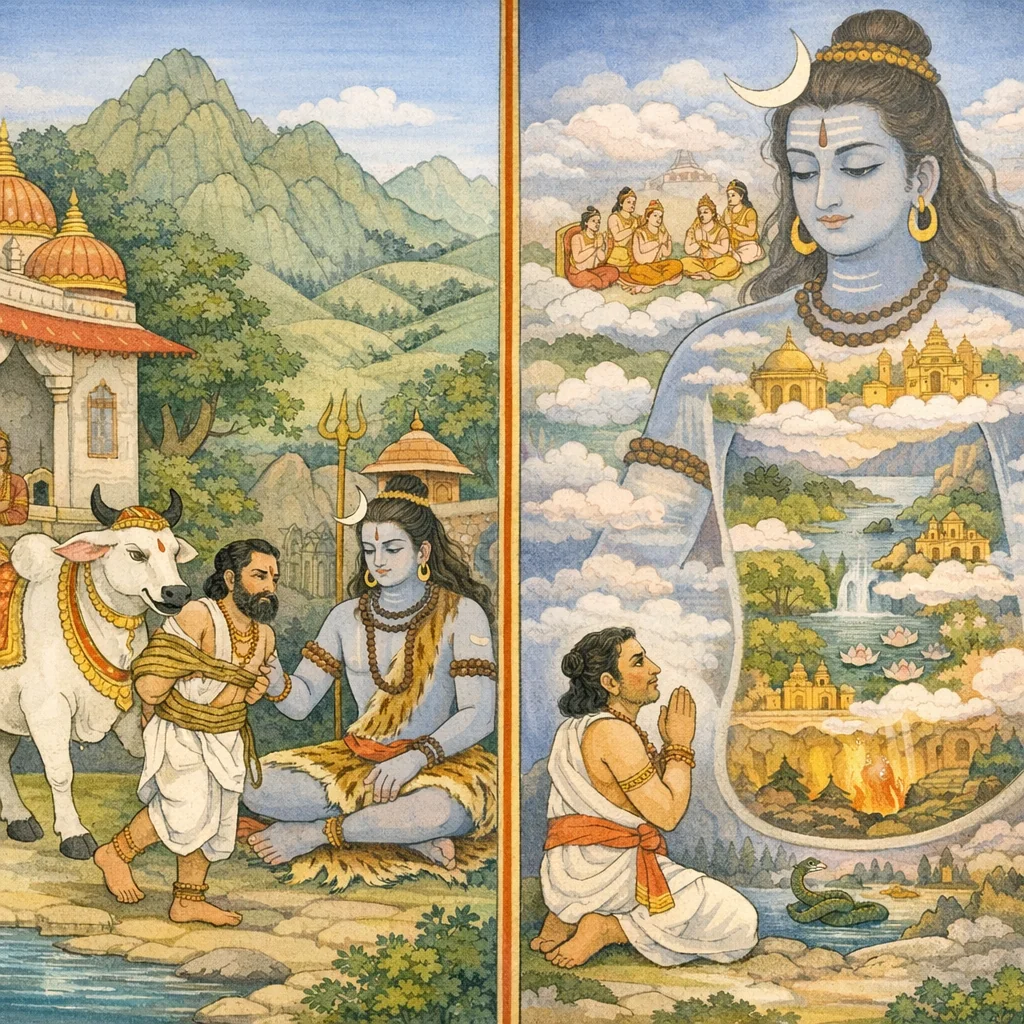
Adhyaya 43: Shukra’s Saṃjīvanī, Shiva’s Containment of the Asuras, and Indra’s Recovery of Power
शुक्रसंजीवनी–शिवोदरप्रवेश–जम्भवध (Śukra-Saṃjīvanī–Śivodara-Praveśa–Jambha-Vadha)
Shiva Contains the Asuras
Pulastya narrates to Nārada a war-episode that foregrounds the Vāmana Purāṇa’s syncretic theology: Śaiva guardianship and Vaiṣṇava martial sovereignty operate as a single providential order. When Andhaka’s forces are broken by Śiva’s pramathas, the asuras seek refuge in Śukra’s ritual expertise; the Bhārgava revives the fallen through the Saṃjīvanī-vidyā, temporarily reversing death on the battlefield. Nandī reports this ‘unbearable’ restoration to Śaṅkara, who neutralizes the threat by physically containing Śukra within his own body—an iconographic and metaphysical assertion of Śiva’s supremacy over occult power. Inside Śiva’s cosmic interior, Śukra beholds the totality of beings and worlds, a miniature cosmography that sacralizes Śiva as viśvarūpa. Released and renamed ‘Śukra,’ he returns to the asuras, yet the tide turns: Viṣṇu and Brahmā devastate the daitya host, and Indra—humbled—receives a new weapon from Agni, enabling the slaying of Jambha. The chapter thus integrates asura-dharma, mantra-vidyā, and divine kingship within a unified Harihara horizon.
Divine Beings
Sacred Geography
Mortal & Asura Figures
Key Content Points
- Andhaka petitions Śukra after the pramathas rout the asura army; Śukra employs the Saṃjīvanī-vidyā to revive slain daityas, escalating the conflict through ritual technology.
- Nandī captures Śukra and delivers him to Śiva; Śiva swallows the Bhārgava, prompting an interior cosmographic vision and a boon-request culminating in Śukra’s release and naming.
- A prolonged dvandva-yuddha follows with extensive pairing of deities, pramathas, and asuras; Viṣṇu’s and Brahmā’s interventions break the daitya momentum.
- Indra’s vajra fails against Bala; Indra seeks refuge in Viṣṇu, then Agni grants him a new śakti-weapon, leading to Jambha’s death and the daitya retreat.
- Andhaka attempts a deceptive approach toward Pārvatī by assuming Śiva-like form; the goddess evades him (including concealment in a white arka-flower), and the war resumes.
Shlokas in Adhyaya 43
Verse None explicitly mentioned in this verse
इति श्रीवामनपुराणे द्विचत्वारिंशो ऽध्यायः पुलस्त्य उवाच ततः स्वैसैन्यमालक्ष्य निहतं प्रमथैरथ अन्धको ऽभ्येत्य शुक्रं तु इदं वचनमब्रवीत्
Thus, in the Śrī Vāmana Purāṇa, the forty-second chapter (concludes). Pulastya said: Then, seeing his own army slain by the Pramathas, Andhaka approached Śukra and spoke these words.
Verse 21
तं दृष्ट्वा भगवान् ब्रह्म प्राह शक्रपुरोगमान् साहाय्यं क्रियतां शंभोरेतदन्तरमुत्तमम्
Vendo isso, o Bem-aventurado Brahmā falou aos deuses liderados por Śakra (Indra): “Prestem auxílio a Śaṃbhu (Śiva); este é o intervalo mais oportuno.”
Verse 22
पितामहोक्तं वचनं श्रुत्वा देवाः सवासवाः समापतन्त वेगेन शिवसैन्यमथाम्बरात्
Tendo ouvido as palavras de Pitāmaha (Brahmā), os deuses—juntamente com Vāsava (Indra)—precipitaram-se velozmente do céu em direção ao exército de Śiva.
Verse 23
तेषामापततां वेगः प्रमथानां बले बभौ आपगानां महावेगं पतन्तीनां महार्णवे
śuddhajāmbhūnadamayaṃ kiṅkiṇījālamaṇḍitam śakrāya preṣayāmāsurviśvāvasupurogamāḥ
Verse ["Śiva (implied)"]
त्रिनयन हर भव शङ्कर उमापते जीमूतकेतो शुहागृह श्मशाननिरत भूतिविलेपन सूलपाणे पशुपते गोपते तत्पुरुषसत्त्म नमो नमस्ते |Vamana Purana
Lumapit siya, labis na nagngangalit, at napaliligiran ng mga Pramatha. Doon ay nasilayan niya ang Mandara, ang pinakadakila sa mga bundok, at gayundin ay nakita niya ang kanyang ama.
Verse 35
आदित्यान् वसवो रुद्रान् विश्वेदेवान् गणांस्तथा यक्षान् किंपुरुषाद्यादीन् गन्धर्वाप्सरसां गणान्
Ele viu os Ādityas, os Vasus, os Rudras e os Viśvedevas, e igualmente as hostes de assistentes divinos; viu também Yakṣas, Kiṃpuruṣas e outros seres afins, e as companhias de Gandharvas e Apsaras.
Verse 36
मुनीन् मनुजसाध्यांश्च पशुकीटपिपीलिकान् वृक्षगुल्मान् गिरीन् वल्ल्यः फलमूलौषधानि च
tato haraḥ prāha vaco yaśasyaṃ—mālinīm api, jayāṃ ca vijayāṃ caiva, jayantīṃ ca aparājitām.
Verse 38
अव्यक्तांश्चैव व्यक्तांश्च सगुणान्निर्गुणानपि स दृष्ट्वा कौतुकाविष्टः परिबभ्राम भार्गवः तत्रासतो भार्गवस्य दिव्यः संवत्सरो गतः
Ele viu também o imanifesto (avyakta) e o manifesto (vyakta), e aqueles com qualidades (saguṇa) e aqueles além das qualidades (nirguṇa). Ao ver isso, Bhārgava, tomado de assombro, pôs-se a vagar; e, enquanto ali permanecia, passou para ele um ano divino (divya saṃvatsara).
Verse 39
न चानमलभद् ब्रह्मंस्ततः श्रान्तो ऽभवत् कविः स श्रन्तं वीक्ष्य चात्मानं नालभन्निर्गमं वशी भिक्तिनम्रो महादेवं शरणं समुपागम्
But he did not attain Brahman; therefore the poet-sage became weary. Seeing himself exhausted, though self-controlled, he found no way out. Bowed down in devotion, he approached Mahādeva as his refuge.
Verse 40
शुक्र उवाच/ विश्वरूप महारूप विश्वरूपाक्षसूत्रधृक् सहस्राक्ष महादेव त्वामहं शरणं गतः
Śukra said: “O All-formed One, O Great-formed One; O bearer of the rosary whose beads are the eyes of the universe; O thousand-eyed Great God—unto You I have come for refuge.”
Verse 42
नमो ऽस्तु ते शङ्कर शर्व शंभो सहस्रनेत्राङ्घ्रिभुजङ्गभूषण दृष्ट्वैव सर्वान् भुवनांस्तवोदरे श्रान्तो भवन्तं शरणं प्रपन्नः // वम्प्_43.41 इत्येवमुक्ते वचने महात्मा शंभुर्वचः प्राह ततो विहस्य निर्गच्छ पुत्रो ऽसि ममाधुना त्वं शिश्नेन भो भार्गववंशचन्द्र
“Homage to You, O Śaṅkara, O Śarva, O Śaṃbhu—You whose ornaments are serpents, whose feet and arms (are mighty), and who is thousand-eyed. Having beheld all the worlds within Your belly, I am exhausted; I have sought refuge in You.” When these words were spoken, the great-souled Śaṃbhu replied, then smiling: “Come forth! From this moment you are my son, O moon of the Bhārgava lineage—(emerging) through my phallus.”
Verse 43
नाम्ना तु शुक्रेति चराचरास्त्वां स्तोष्यन्ति नैवात्र विचारमन्यत् इत्येवमुक्त्वा भगवान् मुमोच शिश्नेन शुक्रं स च निर्जगाम
“Indeed, by the name ‘Śukra’ all moving and unmoving beings will praise you—there is no doubt about this.” Having spoken thus, the Blessed Lord released Śukra through his phallus, and he came forth.
Verse 44
विनिर्गतो भार्गाववंशचन्द्रः शुक्रत्वमापद्य महानुभावः प्रणम्य शंभुं स जगाम तूर्ण महासुराणां बलमुत्तमौजाः
That illustrious one—like a moon among the Bhārgava lineage—having attained the status of Śukra (the preceptor of the Asuras), and being of great prowess, bowed to Śambhu (Śiva) and swiftly went to the host of the great Asuras, endowed with excellent energy.
Verse 45
भार्गवे पुनरायाते दानवा मुदिताभवन् पुनर्युद्धाय विदधुर्मतिं सह गणेश्वरैः
Quando o Bhārgava retornou, os Dānavas alegraram-se; e, juntamente com os Gaṇeśvaras, decidiram novamente voltar à guerra.
Verse 46
गणेश्वरास्तानसुरान् सहामरागणैरथ युयुधुः संकुलं युद्धं सर्व एव जयेप्सवः
Então os Gaṇeśvaras, juntamente com as hostes dos imortais (os Devas), combateram aqueles Asuras numa batalha confusa e cerrada—todos desejosos de vitória.
Verse 47
ततो ऽसुरगणानां च देवतानां च युध्यताम् द्वन्द्वयुद्धूं समभवद् घोररूपं तपोधन
Então, enquanto as hostes de Asuras e de Devas combatiam, surgiu um terrível espetáculo de duelos em pares, combate singular contra singular—ó tesouro de austeridade.
Verse 48
अन्धको नन्दिनं युद्धं शङ्कुकर्णं त्वयःशिराः कुम्भध्वजं बलिर्धीमान् नन्दिषेणं विरोचनः
Andhaka combateu Nandin; Śaṅkukarṇa lutou contra Tvayaḥśiras; o sábio Bali combateu Kumbhadhvaja; e Virocana combateu Nandiṣeṇa.
Verse 49
अश्वग्रीवो विशाखं च शाखो वृत्रमयोधयत् वाणस्तथा नैगमेयं बलं राक्षसपुङ्गवः
Aśvagrīva combateu Viśākha; Śākha combateu Vṛtra; e, do mesmo modo, Vāṇa, o mais eminente entre os Rākṣasas, combateu Naigameya.
Verse 50
विनायको माहावीर्य परश्वधधरो रणे संक्रुद्धो राक्षसश्रेष्ठं तुहुण्डं समयोधयत् दुर्योधनश्च बलिनं घण्टाकर्णमयोधयत्
Vināyaka, of great prowess, bearing an axe, enraged in battle, engaged in combat with the foremost of Rākṣasas, Tuhuṇḍa. And Duryodhana fought the mighty (Rākṣasa) Ghaṇṭākarṇa.
Verse 51
हस्ती च कुण्डजठरं ह्लादो वीरं घटोदरम् एते हि बलिनां श्रेष्ठा दानवाः प्रमथास्तथा संयोधयन्ति देवर्षे दिव्याब्दानां शतनि षट्
Narrator within the Purāṇic frame; verse reports a key encounter as Indra is opposed.
Verse 53
सम्भुनामासुरपतिः स ब्रह्मणमयोधयत् महौजसं कुजम्भश्च विष्णुं दैत्यान्तकारिणम्
The Asura-lord named Sambhu fought with Brahmā; and Kujambha, possessed of great might, fought with Viṣṇu, the destroyer of the Daityas.
Verse 54
विवस्वन्तं रणे शाल्वो वरुणं त्रिशिरास्तथा द्विमूर्धा पवनं सोमं राहुर्मित्रं विरूपधृक्
In battle, Śālva fought Vivasvān (the Sun); Triśiras fought Varuṇa; Dvimūrdhā fought Pavana (the Wind); Rāhu fought Soma (the Moon); and Virūpadhṛk fought Mitra.
Verse 55
अष्टौ ये वसवः ख्याता धराद्यास्ते महासुरान् अष्टावेव महेष्वासान् वारयामासुराहवे
Os oito Vasus afamados—começando por Dharā—contiveram em batalha oito grandes Asuras, arqueiros de imenso poder.
Verse 56
सरभः शलक्षः पाकः पुरो ऽथ विपृथुःपृथुः वातापि चेल्वलश्चैव नानाशस्त्रास्त्रयोधिनः
“Sarabhā, Śalakṣa, Pāka e depois Puro; também Vipṛthu e Pṛthu; e Vātāpi e Celvala—todos guerreiros versados em diversas armas e projéteis (astras).”
Verse 57
विश्वेदेवगणान् सर्वान् विष्वक्सेनपुरोगमान् एक एव रणे रौद्रः कालनेमिर्महासुरः
radiant and exceedingly formidable in battle.”"
Verse 59
द्वावश्विनौ च नरको भास्करानेव शम्बरः साध्यान् मरुद्गणांश्चैव निवातकवचादयः
Narrator to the sage-interlocutor; emphasizing the paradox of wind-speed horses taking a year to reach Shiva’s attendant host.
Verse 61
यदा न शकिता योद्धुं दैवतैरमरारयः तदा मायं समाश्रित्य ग्रसन्तः क्रमशो ऽव्ययान्
When the enemies of the immortals (the asuras) were unable to fight against the gods, then, resorting to māyā (illusion/occult power), they began to swallow up, one by one, those who were imperishable.
Verse 62
ततो ऽभवच्छैलपृष्ठं प्रावृडभ्रसमप्रभैः आवृतं वर्जितं सर्वैः प्रमथैरमरैरपि
Then the mountain-plateau became covered with masses of clouds whose radiance resembled the monsoon-clouds; and it was abandoned by all—by the Pramathas and even by the immortals (Devas).
Verse 63
दृष्ट्वा शून्यं गिरिप्रस्थं ग्रस्तांश् च प्रमथामरान् क्रोधादुत्पादयामास रुद्रो जृम्भायिकां वशी
VamP 43.64
Verse 65
जृम्भमाणेषु च तदाच दानवेषु गणेश्वराः सुराश्च निर्ययुस्तूर्णं दैत्यदेहेभ्य आकुला
Então, quando as hostes dos Dānava começaram a bocejar e a escancarar-se, os senhores das Gaṇas e os deuses, em agitação, saíram depressa dos corpos dos Daityas.
Verse 66
मेघप्रभेभ्यो दैत्येभ्यो निर्गच्छन्तो ऽमरोत्तमाः शोभन्ते पद्मपत्राक्षा मेघेभ्य इव विद्युतः
Emergindo dos Daityas cujo esplendor era como o das nuvens, esses supremos entre os imortais—de olhos como folhas de lótus—brilharam como o relâmpago que sai das nuvens.
Verse 67
गणामरेषु च समं निर्गतेषु तपोधन अयुध्यन्त महात्मानो भूय एवातिकोपिताः
E quando as Gaṇas e os imortais saíram juntos em igual medida, ó rico em ascese, aqueles grandes de alma—plenos de poder ascético—tornaram a combater, agora tomados de ira extrema.
Verse 68
ततस्तु देवैः सगणैः दानवाः शर्वपालितैः पराजीयन्त संग्रामे भूयो भूयस्त्वहर्निशम्
Então os Dānavas, embora protegidos por Śarva (Śiva), foram repetidamente derrotados na guerra pelos Devas juntamente com suas hostes acompanhantes—de novo e de novo, dia e noite.
Verse 69
ततस्त्रिनेत्रः स्वैं संध्यां सप्ताब्धशतिके गते काले ऽभ्युपासत तदा सो ऽष्टादशभुजो ऽव्ययः
Então o Três-Olhos (Śiva) realizou a sua própria adoração do crepúsculo (saṃdhyā-upāsanā) quando o tempo havia alcançado o sétimo centésimo ano; nesse momento, o Imperecível manifestou-se com dezoito braços.
Verse 70
संस्पृश्यापः सरस्वत्यां स्नात्वा च विधिना हरः कृतार्थो भक्तिमान् मूर्ध्ना पुष्पाञ्जलिमुपाक्षिपत्
Touching the waters and bathing in the Sarasvatī according to proper rite, Hara (Śiva)—fulfilled in purpose and devoted—offered a handful of flowers, raising it to his head in reverence.
Verse 71
ततो ननाम शिरसा ततश्चक्रे प्रदक्षिणम् हिरण्यगर्भेत्यादित्यमुपतस्थे जजाप ह
Then he bowed his head; then he performed circumambulation. Addressing the Sun (Āditya) with the epithet “Hiraṇyagarbha,” he worshipped him and recited (a mantra) indeed.
Verse 72
त्वष्ट्रे नमो नमस्ते ऽस्तु सम्यगुच्चार्य शूलधृक् ननर्त भावगम्भीरं दोर्दण्डं भ्रामयन् बलात्
Having correctly uttered, “Homage to Tvaṣṭṛ; may there be repeated salutations to you,” the trident-bearer danced with profound emotion, forcefully whirling his forearm like a staff.
Verse 73
परिनृत्यति देवेशे गणाश्चैवामरास्तथा नृत्यन्ते भावसंयुक्ता हरस्यानुविलासिनः
As the Lord of gods danced, the gaṇas and the immortals likewise danced—filled with emotion—sportively following Hara’s movements.
Verse 74
सन्ध्यामुपास्य देवेशः परिनृत्य यथेच्छया युद्धाय दानवैः सर्वैस्त्रिनेत्रभुजपालितैः
Having performed the twilight worship, the Lord of the gods, after circling and dancing as he pleased, advanced to battle against all the Dānavas, who were protected by the arms of the Three-eyed one.
Verse 75
ततो ऽमरगणाः सर्वैस्त्रिनेत्रभुजपालितैः दानवा निर्जिताः सर्वे बलिभिर्भयवर्जितैः
Then the hosts of the immortals—protected by the arms of the Three-eyed one—defeated all the Dānavas, who were mighty and free from fear.
Verse 76
स्वबलं निर्जितं दृष्ट्वा मत्वाजेयं च शङ्कम् अन्धकः सुन्दमाहूय इदं वचनमब्रीत्
Seeing his own forces defeated, and judging Śaṅka to be unconquerable, Andhaka summoned Sunda and spoke these words.
Verse 77
सुन्द भ्रातासि मे वीर विश्वस्यः सर्ववस्तुषु तद्वदाम्यद्य यद्वाक्यं तच्छ्रुत्वा यत्क्षमं कुरु
“Sunda, you are my brother, a hero, and trustworthy in every matter. Therefore I shall tell you today what I have to say; having heard it, do what is fitting (and within your power).”
Verse 78
दुर्जयो ऽसौ रणपटुर्धर्मात्मा कारणान्तरैः समासते हि हृदये पद्माक्षी शैलनन्दिनी
“He is hard to conquer, skilled in battle, and righteous in nature, for—by other (hidden) causes—the lotus-eyed one and the daughter of the Mountain abide in his heart.”
Verse 79
तदुत्तिष्ठस्व गच्छामो यत्रास्ते चारुहासिनी तत्रैनां मोहयिष्यामि हररूपेण दानव
“So rise up; let us go to where the fair-smiling woman is. There I shall delude her, O Dānava, by assuming the form of Hara (Śiva).”
Verse 80
भवान् भवस्यानुचरो भव नन्दी गणेश्वरः ततो गत्वाथ भुक्त्वा तां जेष्यामि प्रमथान् सुरान्
“You shall become Nandī, the lord of Śiva’s gaṇas, an attendant of Bhava (Śiva). Then, having gone forth and enjoyed her, I shall conquer the Pramathas and the gods.”
Verse 81
इत्वेवमुक्ते वचने बाढं सुन्दो ऽम्भयभाषत समजायत शैलादिरन्धकः शङ्करो ऽप्यभूत्
“When these words had thus been spoken, Sundo replied, ‘So be it.’ From the mountain and the like (i.e., from rocky mass), Andhaka came into being; and Śaṅkara too manifested (in response).”
Verse 82
नन्दिरुद्रौ ततो भूत्वा महासुरचमूपती संप्राप्तौ मन्दरगिरिं प्रहारैः क्षतविग्रहौ
“Then, becoming Nandī and Rudra, the two great asura commanders reached Mount Mandara, their bodies wounded by blows.”
Verse 83
हस्तमालम्ब्य सुन्दस्य अन्धको हरमन्दिरम् विवेश निर्विशङ्केन चित्तेनासुरसत्तमः
Andhaka, the foremost among the Asuras, taking hold of Sunda’s hand, entered Hara’s temple-abode with a mind free of apprehension.
Verse 84
ततो गिरिसुता दूरादायान्तं वीक्ष्य चान्धकम् महेश्वरवपुश्छ्न्नं प्रहारैर्जर्जरच्छविम्
Then the Daughter of the Mountain, seeing Andhaka approaching from afar—his body disguised in the form of Maheśvara, yet his complexion/appearance battered and torn by blows—(took note of him).
Verse 85
सुन्दं शैलादिरूपस्थमवष्टम्याविशत् ततः तं दृष्ट्वा मालिनीं प्राह सुयशां विजयां जयाम्
Then, having seized Sunda—who had assumed a mountain-like form—he proceeded further; and seeing Mālinī, he addressed her, (calling her) ‘Suyaśā, Vijayā, Jayā’.
Verse 86
जये पश्यस्व देवस्य मदर्थे विग्रहं कृतम् शत्रुभिर्दानववरैस्तदुत्तिष्ठस्व सत्वरम्
“O Jaya, look—because of me the Lord has been made to suffer bodily injury by the enemy, the foremost of Dānavas. Therefore rise up at once!”
Verse 87
घृतमानय पौराणं बीजिकां लवणं दधि व्रणभङ्गं करिष्यामि स्वयमेव पिनाकिनः
“Bring ghee—old (well-prepared) ghee—along with bījikā, salt, and curd. I myself will treat and heal the wound of the bow-bearing Lord (Pinākin).”
Verse 88
कुरुष्व शीघ्रं सुयशे स्वभर्तुर्व्रणनाशनम् इत्येवमुक्त्वा वचनं समत्थाय वरासनात्
“Do quickly, O Suyaśā, the removal of your husband’s wound.” Having spoken these words, she rose up from the excellent seat.
Verse 89
अभ्युद्ययौ तदा भक्त्वा मन्यमाना वृषध्वजम् शूलपाणेस्ततः स्थित्वा रूपं चिह्नानि यत्नतः
Then she rose up, having shown devotion, thinking (him to be) Vṛṣadhvaja (Śiva). Standing near the trident-bearing Lord, she carefully observed his form and distinguishing marks.
Verse 90
अन्वियेष ततो ब्रह्मन्नोभौ पार्श्वस्थितौ वृषौ सा ज्ञात्वा दानवं रौद्रं मायाच्छादितविग्रह्म्
Then, O Brāhmaṇa, she searched (and examined) the two bulls standing at the sides. Having understood (the truth), she recognized the fierce Dānava whose body was concealed by illusion.
Verse 91
अपयानं तदा चक्रे गिरिराजसुता मुने देव्याश्चिन्तितमाज्ञाय सुन्दं त्यक्त्वान्धको ऽसुरः
Then the daughter of the King of Mountains (Pārvatī), O sage, made a withdrawal/retreat. Understanding the goddess’s intention, the Asura Andhaka abandoned Sunda and (departed).
Verse 92
समाद्रवत वेगेन हरकान्तां विभावरीम् समाद्रवत दैतेयो येन मार्गेण सागमत्
She—Vibhāvarī, the beloved of Hara—ran swiftly. The Daitya also ran after her, along the very path by which she had gone.
Verse 93
अपस्कारान्तरं भञ्जन् पादप्लुतिभिराकुलः तमापतन्तं दृष्ट्वैव गिरिजा प्राद्रवद् भयात्
Breaking through the intervening spaces without pause, and agitated with bounding strides, he rushed upon her. Seeing him charging in, Girijā fled in fear.
Verse 94
गृहं त्यक्त्वा हयुपवनं सखीभिः सहिता तदा तत्राप्यनुजगामासौ मदान्धो मुनिपुङ्गव
Abandoning her dwelling, she then went to the Hayu-grove, accompanied by her friends. Even there that one—blind with intoxication—followed her, O best of sages.
Verse 95
तथापि न शशषैनं तपसो गोपनाय तु तद्भयादाविशद् गौरी श्वेतार्ककुसुमं शुचि
Even so, she was not able to conceal him by means of her austerity. Out of fear of him, the pure Gaurī entered into a white arka-flower.
Verse 96
विजडयाद्या महागुल्मे संप्रयाता लयं मुने नष्टायामाथ पार्वत्यां भूयो हैरण्यलोचनिः
Then, O sage, (she/that form) entered dissolution within a great thicket. And when Pārvatī had disappeared, Hiraṇyalocana again (came forth/acted).
Verse 97
सुन्दं हस्ते समादाय स्वसैन्यं पुनरागमत् अन्धके पुरायाते स्वबलं मुनिसत्तम
Taking Sunda by the hand, he returned again with his own army. When Andhaka had gone ahead earlier, O best of sages, (he returned) to his own force.
Verse 98
प्रावर्तत महायुद्धं प्रमथासुरयोरथ ततो ऽमरगणश्रेष्ठो विष्णुश्चक्रगदाधरः
Then a great battle commenced between the Pramathas and the Asuras. Thereupon Viṣṇu, foremost among the hosts of the immortals, bearing the discus and the mace, (entered the fray).
Verse 99
निजघानासुरबलं शङ्करप्रियकाम्यया शार्ङ्गचापच्युतैर्बाणैः संस्यूता दानवर्षभाः
Desiring to please Śaṅkara, he struck down the Asura forces; and by arrows released from the Śārṅga bow, the bull-like Dānavas were pierced through.
Verse 100
पञ्च षट् सप्त चाष्टौ वा व्रघ्नपादैर्घना इव गदया कांश्चिदवधीत् चक्रेणान्यान् जनार्दनः
Five, six, seven, or even eight (at a time)—like clouds driven by the feet of a storm—Janārdana slew some with the mace, and others with the discus.
Verse 101
खङ्गेन च चकर्तान्यान् दृष्ट्यान्यान् भस्मासाद्व्यधात् हलेनाकृष्य चैवान्यान् मु सलेन व्यचूर्णयत्
With a sword he cut down some; with a mere glance he reduced others to ashes; drawing yet others toward him with a plough, he crushed them with a pestle.
Verse 102
गरुडः पक्षपाताभ्यां तुण्डेनाप्युरसाहनत् स चादिपुरुषो धाता पुराणाः प्रपितामहः
Garuḍa struck (the foes) with the blows of his wings, and also with his beak and his breast. And that Primeval Person— the Sustainer, the Ancient One, the Great-Grandfather— (was present/active).
Verse 103
भ्रामयन् विपुलं पद्ममभ्यषिञ्चत वारिणा संस्पृष्टा ब्रह्मतोयेन सर्वतीर्थमयेन हि
Whirling a vast lotus, he sprinkled (them) with water; for they were touched by ‘brahma-water’, indeed water that embodies the power of all tīrthas.
Verse 104
गणामरगणाश्चासन् नवनागशताधिकाः दानवास्तेन तोयेन संस्पृष्टाश्चाघहारिणा
Hosts of Gaṇas and Maruts were there, numbering more than nine hundred Nāgas. The Dānavas, touched by that water—water that removes sin—(were affected thereby).
Verse 105
सवाहनाः क्षयं जग्मुः कुलिशेनेव पर्वताः दृष्ट्वा ब्रह्महरी युद्धे घातयन्तौ महासुरान्
Together with their mounts, they went to destruction, like mountains struck by the thunderbolt—on seeing Brahmā and Hari in battle, slaying the great Asuras.
Verse 106
शतक्रतुश्च दुद्राव प्रगृह्य कुलिशं बली तमापतन्तं संप्रेक्ष्य बलो दानवसत्तमः
And Śatakratu (Indra) rushed forward, powerfully grasping the thunderbolt. Seeing him charging, Bala—the foremost among the Dānavas—(reacted/engaged).
Verse 107
मुक्त्वा देवं गदापाणिं विमानस्थं च पद्मजम् शक्रमेवाद्रवद् योद्धुं मुष्टिमुद्याम्य नारद बलवान् दानवपतिरजेयो देवदानवै
O Nārada, the mighty lord of the Dānavas—unconquerable by gods and Dānavas—having left aside the god bearing the mace (Gadāpāṇi) and also Padmajā (Brahmā) seated in his aerial car, rushed to fight Śakra (Indra), raising his fist.
Verse 109
तमापतन्तं त्रिदशेश्वरस्तु दोष्णां सहस्रेण यताबलेन वज्रं परिभ्राम्य बलस्य मूर्ध्नि चिक्षेप हे मूढ हतो ऽस्युदीर्य // वम्प्_43.108 स तस्य मूर्ध्नि प्रवरो ऽपि वज्रो जगाम तूर्णं हि सहस्रधा मुने बलो ऽद्रवद् देवपतिश्च भीतः पराङ्मुखो ऽभृत् समरान्महर्षे
As Bali rushed upon him, the lord of the Thirty (Indra), exerting his strength with a thousand arms, whirled his thunderbolt and hurled it upon Bali’s head, crying, “O fool, you are slain!” Yet that excellent thunderbolt, striking his head, quickly shattered into a thousand pieces, O sage. Bali pressed on, while the lord of the gods, terrified, turned away and withdrew from the battle, O great seer.
Verse 110
तं चापि जम्भो विमुखं निरीक्ष्य भूत्वाग्रतः प्राह न युक्तमेतत् तिष्ठस्व राजासि चराचरस्य न राजधर्मे गदितं पलायनम्
Seeing him (Indra) turned away, Jambha came to the front and said: “This is not proper. Stand firm—you are the king of all that moves and does not move. In the dharma of kings, flight is not enjoined.”
Verse 111
सहस्राक्षो जम्भवाक्यं निखम्य भीतस्तूर्णं विष्णुमागान्महर्षे उपेत्याह श्रूयतां वाक्यमीश त्वं मे नाथो भूतभव्येश विष्णो
Indra of the thousand eyes, having heard Jambha’s words, became afraid and quickly went to Viṣṇu. Approaching him, he said: “O Lord, hear my statement. You are my protector, O Viṣṇu, Lord of beings—of what has been and what is yet to be.”
Verse 112
जम्भस्तर्जयते ऽत्यर्थं मां निरायुधमीक्ष्य हि आयुधं देहि भगवान् त्वामहं शरणं गतः
“Jambha is terrifying me exceedingly, for he has seen me without weapons. Grant me a weapon, O Blessed Lord; I have come to you for refuge.”
Verse 113
तमुवाच हरिः शक्रं त्यक्त्वा दर्प व्रजाधुना प्रार्थयस्वायुधं वह्निं स ते दास्यत्यसंशयम्
Hari said to Śakra: “Abandon pride and go now. Request as your weapon Vahni (Agni); he will give it to you without doubt.”
Verse 114
जनार्दनवचः श्रुत्वा शक्रस्त्वरितविक्रमः शरणं पावकमगादिदं चोवाच नारद
Hearing the words of Janārdana, Śakra—swift in action—went for refuge to Pāvaka (Agni). And he spoke as follows, O Nārada.
Verse 115
शक्र उवाच निघ्ननो मेबलं वज्रं कृशानो शतधा गतम् एष चाहूयते जम्भस्तस्माद्देह्यायुधं मम
Śakra said: ‘My strength and my vajra have been rendered ineffective; O Kṛśānu, (my weapon) has become as though shattered into a hundred pieces. And this (foe) is called Jambha; therefore, give me my weapon.’
Verse 116
पुलस्त्य उवाच तमाह भगवान् वह्निः प्रीतो ऽसि तव वासव यत्त्वं दर्प परित्यज्य मामेव शरणं गतः
Pulastya said: Then the blessed Vahni (Agni) spoke to him: ‘O Vāsava, I am pleased with you, because you have abandoned pride and have come to me alone for refuge.’
Verse 117
इत्युच्चार्य स्वशक्त्यास्तु शक्तिं निष्क्राम्य भावतः प्रादादिन्द्राय भगवान् रोचमानो दिवं गतः
{"primary_rasa": "raudra", "secondary_rasa": "vira", "intensity": 8, "emotional_arc": "Direct engagement culminates in a decisive strike; the opponent collapses, and the victor moves on without pause.", "mood_keywords": ["decisive blow", "valor", "shock", "momentum", "battle efficiency"]}
Verse 120
जम्भमुष्टिनिपातेन भग्नकुम्भकटो गजः निपपात यथा शैलः शक्रवज्रहतः पुरा
Struck down by Jambha’s fist-blow, the elephant—its temples and frontal region shattered—fell to the ground like a mountain, as if formerly smitten by Indra’s thunderbolt.
Verse 121
पतमानाद् द्विपेन्द्रात् तु शक्रश्चाप्लुत्य वेगवान् त्यक्त्वैव मन्दरगिरिं पपात वसुधातले
ครั้นแล้วเหล่าเทพ—มีปิตามหะ (พรหมา) เป็นผู้นำ—ได้เห็นเจ้าแห่งคณะคณาถูกเหล่าผู้มีกำลังมหาศาลรุมตีและกระหน่ำอย่างหนัก
Verse 126
शुद्धजाम्भूनदमयं किङ्किणीजालमण्डितम् शक्राय प्रेषयामासुर्विश्वावसुपुरोगमाः
127
Verse 130
इत्येवमुक्ते गवांस्त्यक्त्वा स्यन्दनमुत्तमम् क्षमातलं निपपातैव परिभ्रष्टस्रगम्बरः
When this was said, he abandoned the excellent chariot and fell onto the surface of the earth, his garlands and garments slipping out of place.
Verse 131
चलन्मौलिर्मुक्तकचः परिभ्रष्टायुधाङ्गदः पतमानं सहस्राक्षं दृष्ट्वा भूः समकम्पत
His crown shaking, his hair loosened, his weapons and armlets displaced—seeing Sahasrākṣa (Indra) falling, the earth trembled.
Verse 132
पृथिव्यां कम्पमानायां शमीकर्षेस्तपस्विनी भार्याब्रवीत् प्रभो बालं बहिः कुरु यथासुखम्
When the earth was trembling, the ascetic’s wife at Śamīkarṣa said, “Lord, take the child outside, comfortably (and safely).”
Verse 133
स तु शीलावचः श्रुत्वा किमर्थमिति चाव्रवीत् सा चाह श्रूयतां नाथ दैवज्ञपरिभाषितम्
Hearing those gentle words, he said, “For what reason?” She replied, “Listen, my lord, to what is stated by the experts in omens (daivajñas).”
Verse 134
यदेयं कम्पते भूमिस्तदा प्रक्षिप्यते बहिः यद्बाह्यतो मुनिश्रेष्ठ तद् भवेद् द्विगुणं मुने
etad-vākya: 'these words/this statement'; śrutvā: 'having heard'; bāla/putraka: 'child, little son'; dvija: 'twice-born (brahmin)'; nirāśaṅka: 'without doubt/fear, unhesitating'; bahiḥ: 'outside'; śīghram: 'quickly'; prākṣipat: 'threw/cast'; kṣmā-tala: 'earth’s surface/ground'.
Verse ["Subjugation of Andhaka", "Divine time-scale (thousands of years)", "Movement between sacred locales (abode ↔ mountain)", "Śaiva gaṇa agency"]
इत्येवमुक्ते देवर्षे बहिर्निर्गम्य वेगवान् ददर्श बालद्वितयं समरूपमवस्थितम्
devatāḥ: the gods / divineVamana Purana,44,85,VamP 44.85,dadṛśe ca gireḥ putrīṃ śvetārkakusumasthitām samāyātaṃ nirīkṣyaiva sarvalakṣaṇasaṃyutam,ददृशे च गिरेः पुत्रीं श्वेतार्ककुसुमस्थिताम् समायातं निरीक्ष्यैव सर्वलक्षणसंयुतम्,Andhaka Vadha,Mythic Narrative / Encounter (vision of the mountain’s daughter),Adhyaya 44 (Andhaka episode; meeting/seeing Girijā),85,dadṛśe ca gireḥ putrīṃ śvetārkakusumasthitām samāyātaṃ nirīkṣyaiva sarvalakṣaṇasaṃyutam,dadṛśe ca gireḥ putrīṃ śvetārka-kusuma-sthitām samāyātaṃ nirīkṣyaiva sarva-lakṣaṇa-saṃyutam,And he saw the daughter of the mountain
Verse 138
तं दृष्ट्वा देवताः पूज्य भार्यां चाद्भुतदर्शनाम् प्राह तत्त्वं न विन्दामि यत् पृच्छामि वदस्व तत्
Having seen her—his wife of wondrous appearance—(he) honored the deities and then said: “I do not grasp the truth (of this matter). Tell me what I ask; speak that.”
Verse 139
बालस्यास्य द्वितीयस्य के भविष्यद्गुणा वद भाग्यानि चास्य यच्चोक्तं कर्मतत् कथयाधुना
“Tell (me): what future qualities will this second child have? And tell now his fortunes as well—(and) that karma which has been spoken of (as his).”
Verse 140
साब्रवीन्नाद्य ते वक्ष्ये वदिष्यामि पुनः प्रभो सो ऽब्रवीद् वद मे ऽद्यैव नोचेन्नाश्नामि भोजनम्
She said: “Not today will I tell you; I shall speak again (another time), O lord.” He said: “Tell me today itself; otherwise I will not eat food.”
Verse nandinaṃ ca tathā harṣādāliliṅge gireḥ sutām athovācaiṣa dāsaste kṛto devi mayāndhakaḥ
सा प्राह श्रूयतां ब्रह्मन् वदिष्ये वचनं हितम् कातरेणाद्य यत्पृष्टं भाव्यः कारुरयं कि
นันทินทร์ก็โอบกอดธิดาแห่งภูเขาด้วยความยินดี แล้วพระศิวะตรัสว่า “โอ้เทวี อันธกะผู้นี้ เราได้ทำให้เป็นผู้รับใช้ของเจ้าแล้ว”
Verse 142
इत्युक्तावति वाक्ये तु बाल एव त्वेचेतनः जगाम साह्यं शक्रस्य कर्तुं सौत्यविशारदः
When those words had thus been spoken, a certain youth—though seemingly unthinking/insensible—set out to render assistance to Śakra (Indra), being skilled in the office of a charioteer.
Verse 150
सशरं पञ्चवर्णाभं सितरक्तासितारुणम् पाण्डुच्छायं सुरश्रेष्ठस्तं जग्राह समार्गणम्
Then the foremost of the gods took up that arrow together with its quiver—an arrow of five-hued radiance: white, red, black, and tawny, with a pale sheen—ready for battle.
Verse 157
तावापतन्तौ भगवान् निरीक्ष्य सुदर्शनेनारिविनाशनेन विष्णुः कुजम्भं निजघान वेगात् स स्यन्दनाद् गामगमद् गतासुः
Seeing those two charging, the Blessed Lord Viṣṇu, with Sudarśana—the destroyer of enemies—struck down Kujambha with speed; and he, his life departed, fell from his chariot to the ground.
Verse 159
तस्मिन् हते भ्रातरि माधवेन जम्भस्ततः क्रोधवशं जगाम क्रोधान्वितः शक्रमुपाद्रवद् रणे सिंहं यतैणो ऽतिविपन्नबुद्धिः // वम्प्_43.158 तमापतन्तं प्रसमीक्ष्य शक्रस्त्यक्त्वैव चापं सशरं महात्मा जग्राह शक्तिं यमदण्डकल्पां तामग्निदत्तां रिपवे ससर्ज
When his brother had been slain by Mādhava (Viṣṇu), Jambha then came under the sway of wrath. Filled with anger, he charged at Śakra in battle—like a deer rushing upon a lion—his judgment utterly ruined. (Adjacent verse cited in the input:) Seeing him rushing in, the great-souled Śakra, abandoning his bow with its arrows, seized a spear like Yama’s staff, given by Agni, and hurled it at the enemy.
Frequently Asked Questions
Within Pulastya’s narration to Nārada, Śiva and Viṣṇu function as complementary sovereignties: Śiva neutralizes the asuras’ mantra-based advantage (Śukra’s Saṃjīvanī) by swallowing and controlling the Bhārgava, while Viṣṇu (with Brahmā) executes decisive battlefield destruction. The episode frames a syncretic theology where ritual containment (Śaiva) and cosmic protection/war-kingship (Vaiṣṇava) jointly restore dharmic order.
The chapter explicitly situates Śiva’s sandhyā-upāsanā and ritual purification at the Sarasvatī (सरस्वती), reinforcing the river’s sanctifying authority within the Purāṇa’s broader Sarasvatī-basin pilgrimage imagination. Mandara (मन्दरगिरि) appears as the principal battle-topos, and the ‘Hara-mandira’ setting anchors the narrative in a recognizable Śaiva sacred space rather than an abstract battlefield alone.
This adhyāya does not advance the Bali–Vāmana dāna narrative directly. Instead, it develops the Purāṇa’s wider theological program—especially the management of asura power (asura-dharma plus mantra-vidyā) through Śiva’s supremacy over occult revival and Viṣṇu’s role as daityāntakārin—thereby preparing the ideological ground for later Vaiṣṇava-centered episodes.