Sukta 7
Rishi: Atharvanic tradition (specific ṛṣi attribution varies by anukramaṇī for AV 9.7; requires edition-specific confirmation).
Devata: Dhātṛ and Savitar (functional deities of stabilization and impulsion).
Chandas: Mixed/irregular (short formulaic pādas; often treated as anustubh-fragment in AV ritual use).
Mantras
Mantra 1
गौः प्रजापतिश्च परमेष्ठी च शृङ्गे इन्द्रः शिरो अग्निर्ललाटं यमः कृकाटम्
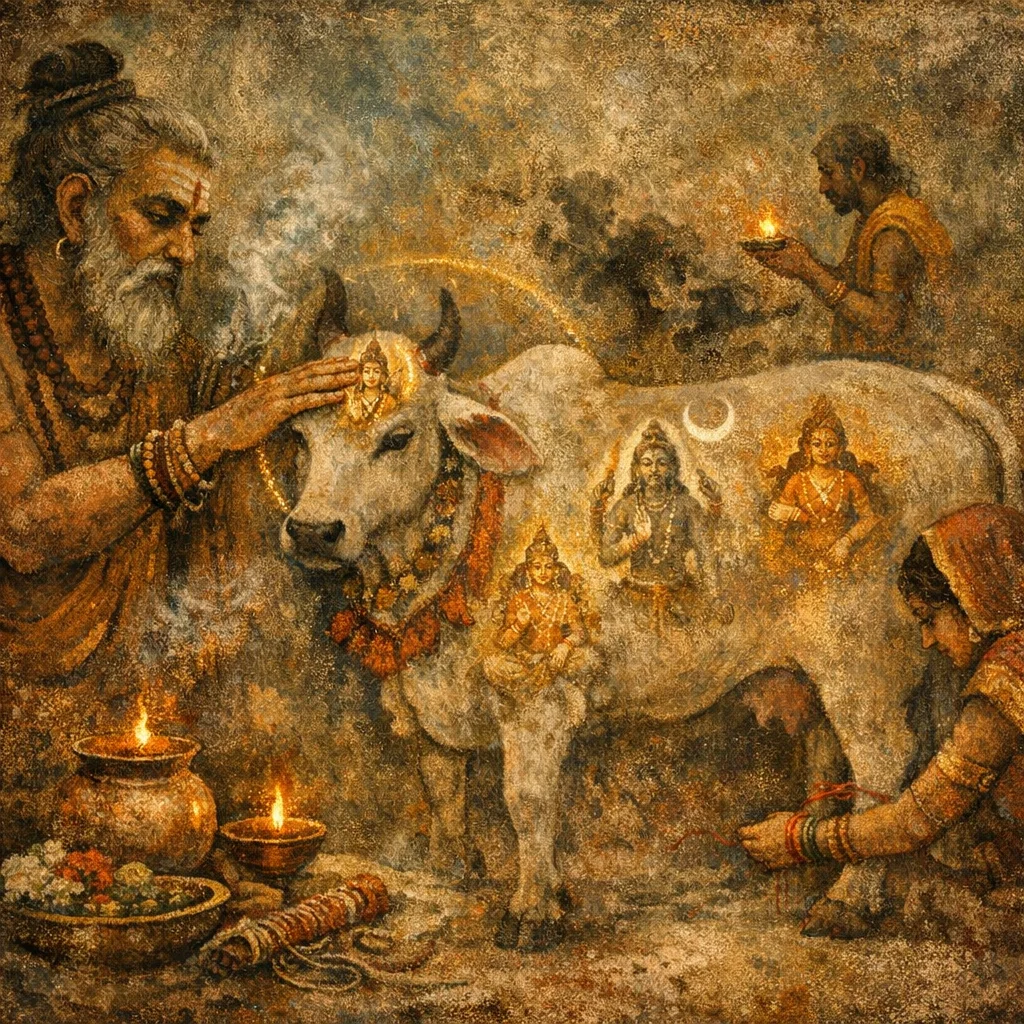
The Cow: Prajāpati and Parameṣṭhin are in her horns; Indra is her head; Agni her forehead; Yama her nape of the neck.
Mantra 2
सोमो राजा मस्तिष्को द्यौरुत्तरहनुः पृथिव्यऽधरहनुः
King Soma is the brain; Heaven is the upper jaw; Earth is the lower jaw.
Mantra 3
विद्युज्जिह्वा मरुतो दन्ता रेवतिर्ग्रीवाः कृत्तिका स्कन्धा घर्मो वहः
Lightning is the tongue; the Maruts are the teeth; the Revatis are the necks; the Kṛttikās the shoulders; heat is the back that bears.
Mantra 4
विश्वं वायुः स्वर्गो लोकः कृष्णद्रं विधरणी निवेष्यः
All is Vāyu; the world is heavenly. The black wood is a support, to be set in place.
Mantra 5
श्येनः क्रोडो३ऽन्तरिक्षं पाजस्यं१ बृहस्पतिः ककुद् बृहतीः कीकसाः
The hawk is the breast; the mid-air is vigor; Bṛhaspati is the hump; the Bṛhatīs are the bones.
Mantra 6
देवानां पत्नीः पृष्टय उपसदः पर्शवः
The Consorts of the Gods are the back-parts; the Upasads are the flanks; the ribs are their enclosing stays.
Mantra 7
मित्रश्च वरुणश्चांसौ त्वष्टा चार्यमा च दोषणी महादेवो बाहू
Mitra and Varuṇa are the shoulders; Tvaṣṭṛ and Aryaman are the forearms; Mahādeva is the two arms.
Mantra 8
इन्द्राणी भसद् वायुः पुच्छं पवमानो बालाः
Indrāṇī is the seat; Vāyu is the tail; Pavamāna is the hairs.
Mantra 9
ब्रह्म च क्षत्रं च श्रोणी बलमूरू
Brahman and Kṣatra are the hips; Strength is the thighs.
Mantra 10
धाता च सविता चाष्ठीवन्तौ जङ्घा गन्धर्वा अप्सरसः कुष्ठिका अदितिः शफाः
Dhātṛ and Savitṛ are the knee-joints; the shanks are Gandharvas and Apsarases; the ankles are Kuṣṭhikās; Aditi is the hoofs (the feet).
Mantra 11
चेतो हृदयं यकृन्मेधा व्रतं पुरीतत्
Mind, heart, liver; intelligence, the sacred observance, and the inmost membrane—(these are set in their places).
Mantra 12
क्षुत् कुक्षिरिरा वनिष्ठुः पर्वताः प्लाशयः
Hunger, the belly; refreshment; the bladder; the mountains, and the spleens—(these are assigned their stations).
Mantra 13
क्रोधो वृक्कौ मन्युराण्डौ प्रजा शेपः
Wrath (is) the kidneys; fury (is) the testicles; progeny (is) the member—(thus are the powers disposed).
Mantra 14
नदी सूत्री वर्षस्य पतय स्तना स्तनयित्नुरूधः
The river, threaded (in its course); the lords of rain; the breasts; the thundering one; the udder—(these are the forms of outpouring).
Mantra 15
विश्वव्यचास्चर्मौषधयो लोमानि नक्षत्राणि रूपम्
All-pervading (is) the skin; the herbs; the hairs; the constellations—(all this is) form.
Mantra 16
देवजना गुदा मनुष्याऽ आन्त्राण्यत्रा उदरम्
The Gods’ folk are the lower parts; men are the intestines: here is the belly.
Mantra 17
रक्षांसि लोहितमितरजना ऊबध्यम्
The Rākṣasas are the red; the alien folk are for binding fast.
Mantra 18
अभ्रं पीबो मज्जा निधनम्
Cloud is the fat; marrow is the place of laying-down (the end).
Mantra 19
अग्निरासीन उत्थितोऽश्विना
Agni, though seated, hath risen up—O Aśvins.
Mantra 20
इन्द्रः प्राङ् तिष्ठन् दक्षिणा तिष्ठन् यमः
Indra stands facing east; to the right stands Yama.
Mantra 21
प्रत्यङ् तिष्ठन् धातोदङ् तिष्ठन्त्सविता
Standing turned backward—of Dhātṛ; standing turned upward—Savitar.
Mantra 22
तृणानि प्राप्तः सोमो राजा
Unto the grasses hath come King Soma.
Mantra 23
मित्र ईक्षमाण आवृत्त आनन्दः
Mitra, beholding, is turned back: joy is returned.
Mantra 24
युज्यमानो वैश्वदेवो युक्तः प्रजापतिर्विमुक्तः सर्वम्
Being yoked, the All-gods’ power is yoked; Prajāpati is loosed—(and) all (is secured).
Mantra 25
एतद् वै विश्वरूपं सर्वरूपं गोरूपम्
This, verily, is of all forms, of every form—cow-formed.
Mantra 26
उपैनं विश्वरूपाः सर्वरूपाः पशवस्तिष्ठन्ति य एवं वेद
Near unto him stand the cattle—of every shape, of all shapes—whoso thus hath knowledge.
Frequently Asked Questions
It is used to protect and stabilize the household or cattle-pen, to reverse harmful influences, and to attract/hold livestock-prosperity through Dhātṛ’s fixing power and Savitar’s uplifting impulse.
The backward-turning (praty-añc) stationing functions as a ritual reversal—sending danger away—while the upward (ud-añc) stationing directs vitality, luck, and increase toward a higher, thriving state.
Not strictly, but it alludes to setting a ‘black wood’ support (kṛṣṇadruma) in place as a stabilizing ward; many recitation-only uses treat the ‘support’ as symbolic emplacement in the protected space.