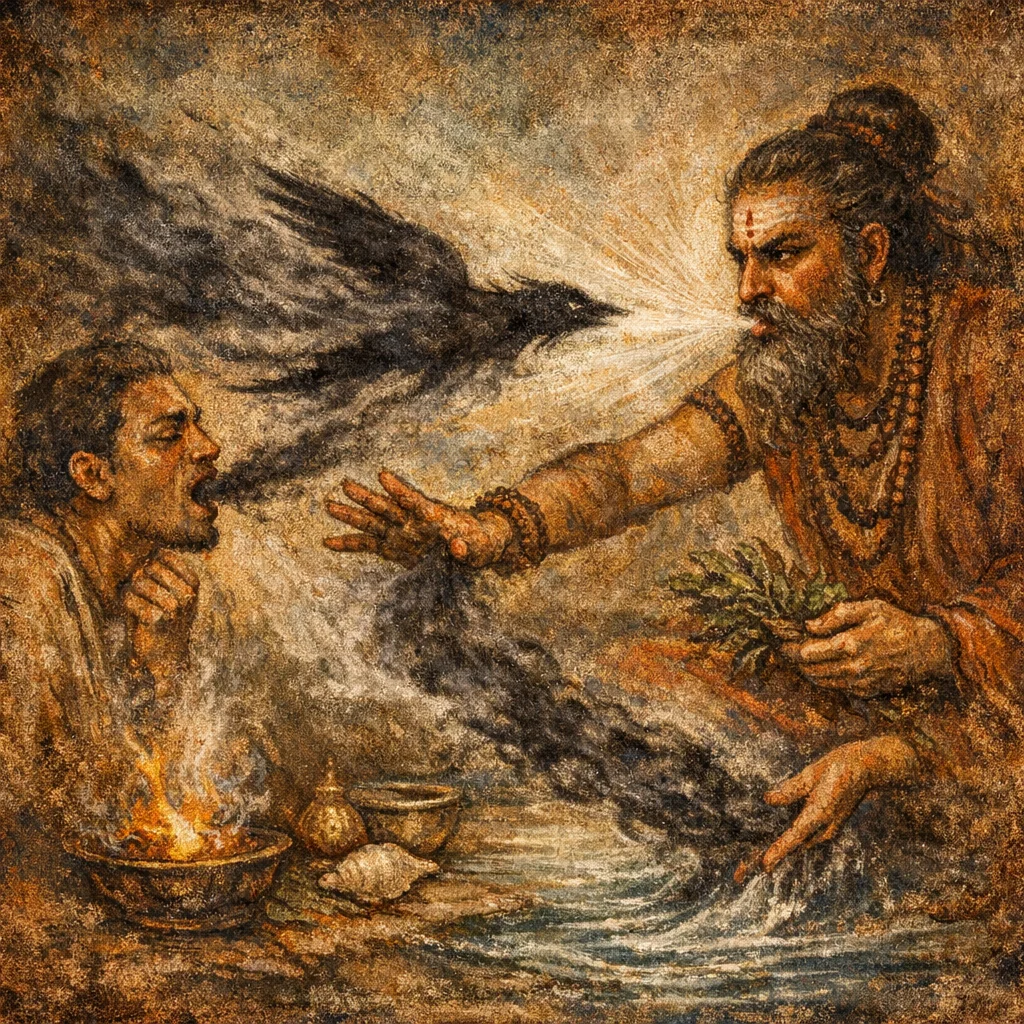
Sukta 105
Rishi: Atharvanic tradition (often transmitted without a distinct ṛṣi-name for short bhaiṣajya charms in Book 6; varies by Anukramaṇī).
Devata: Kāsa (personified cough) as the addressed entity; implicit aid of Vāyu (wind) as carrier-away.
Chandas: Anuṣṭubh (with Atharvanic cadence)
Mantras
Mantra 1
कासशमनम्। यथा मनो मनस्केतः परापतत्याशुमत्। एवा त्वं कासे प्र पत मनसोऽनु प्रवाय्यऽम्
As thought, whose token is the mind, darts swiftly forth and far away,—even so, O Cough, do thou fly forth; after the mind, be blown away.
Mantra 2
यथा बाणः सुसंशितः परापतत्याशुमत्। एवा त्वं कासे प्र पत पृथिव्या अनु संवतम्
As a well-whetted arrow swiftly flies away,—even so, O Cough, fly forth; along the earth, unto the far meeting-bound.
Mantra 3
यथा सूर्यस्य रश्मयः परापतन्त्याशुमत्। एवा त्वं कासे प्र पत समुद्रस्यानु विक्षरम्
As the Sun’s rays swiftly stream and fly abroad,—even so, O Cough, fly forth; along to the sea, unto dissolution’s outflow.
Frequently Asked Questions
It treats cough as a personified intruder (Kāsa) and commands it to leave the patient immediately, sending it away into wind, across the earth to a far limit, and finally into the sea for dissolution.
No. The hymn itself does not prescribe any substance; it works as a spoken expulsion-charm. Some traditions may add supportive water or symbolic gestures, but they are optional.
These are models of fast, unstoppable movement. By aligning the command with such natural speed, the mantra ‘forces’ the cough to move outward rapidly and not remain lodged in the body.