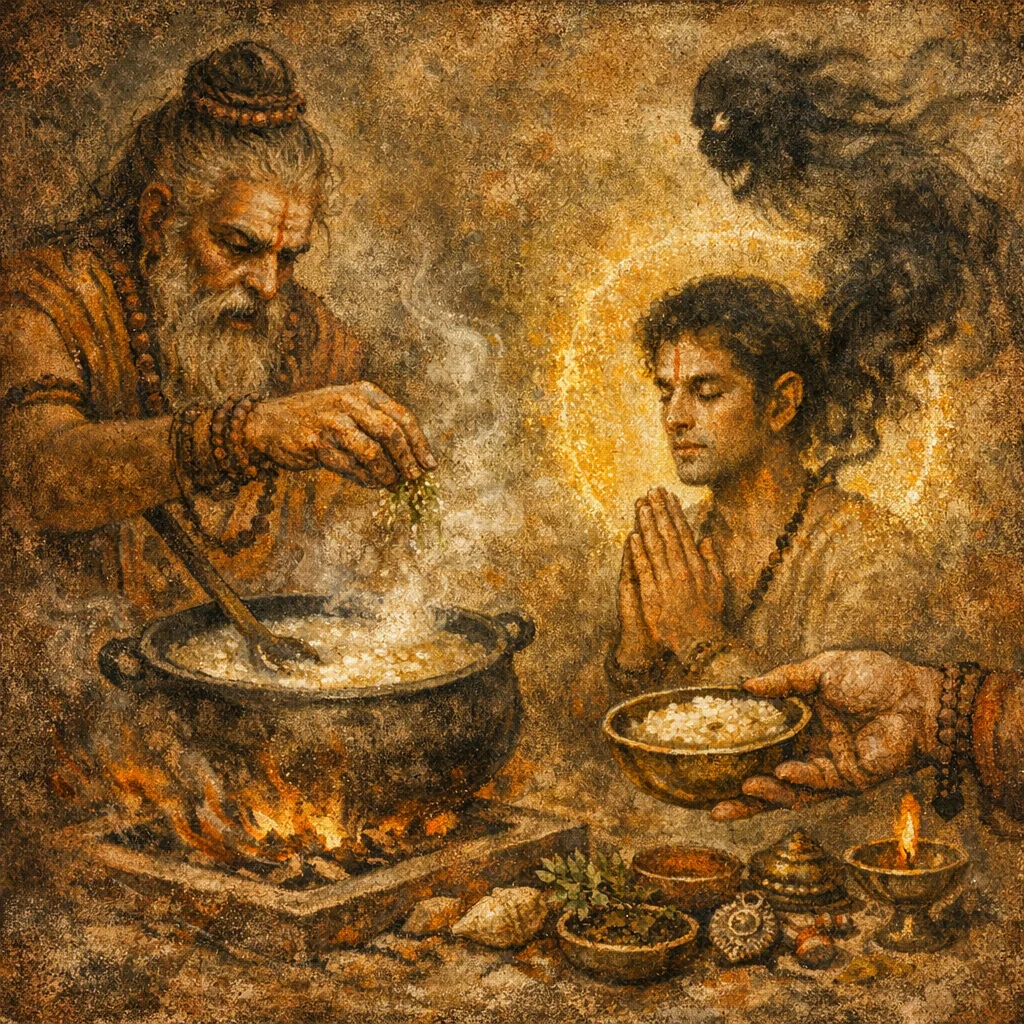
Sukta 35
Rishi: Atharvanic tradition (Aṅgiras/Atharvan attribution typical for apamṛtyu material; exact r̥ṣi to be verified against Anukramaṇī for AV 4.35).
Devata: Brahman/Brāhmaṇaspati principle embodied in brahma-odana; life-breath (Prāṇa) and death-transcendence motif.
Chandas: Triṣṭubh-like cadence (to be confirmed by metrical scan; Saunaka AV often mixes triṣṭubh/jagatī in such stanzas).
Mantras
Mantra 1
मृत्युसंतरणम्। बयमोदनं प्रथमजा ऋतस्य प्रजापतिस्तपसा ब्रह्मणेऽपचत्। यो लोकानां विधृतिर्नाभिरेषात् तेनौदनेनाति तराणि मृत्युम्
A death-crossing charm. This boiled rice—first-born of Order—Prajāpati by fervent heat cooked for Brahman-power. This was the worlds’ upholding, their navel and centre: with that same odana may I pass beyond Death.
Mantra 2
येनातरन् भूतकृतोऽति मृत्युं यमन्वविदन् तपसा श्रमेण । यं पपाच ब्रह्मणे ब्रह्म पूर्वं तेनौदनेनाति तराणि मृत्युम्
Wherewith the makers of beings crossed beyond Death—what they, by heat and strenuous effort, thereafter found; what Brahman, in the beginning, cooked for brahman-power—with that same odana may I pass beyond Death.
Mantra 3
यो दाधार पृथिवीं विश्वभोजसं यो अन्तरिक्षमापृणाद् रसेन । यो अस्तभ्नाद् दिवमूर्ध्वो महिम्ना तेनौदनेनाति तराणि मृत्युम्
He who upheld the Earth, all-nourishing; who filled the Mid-air with sap; who propped aloft the Heaven by his greatness—with that same odana may I pass beyond Death.
Mantra 4
यस्मान्मासा निर्मितास्त्रिंशदराः संवत्सरो यस्मान्निर्मितो द्वादशारः । अहोरात्रा यं परियन्तो नापुस्तेनौदनेनाति तराणि मृत्युम्
From whom the months were fashioned, thirty-spoked; from whom the year was fashioned, twelve-spoked; whom days and nights, circling round, have not attained—with that same odana may I pass beyond Death.
Mantra 5
यः प्राणदः प्राणदवान् बभूव यस्मै लोका घृतवन्तः क्षरन्ति । ज्योतिष्मतीः प्रदिशो यस्य सर्वास्तेनौदनेनाति तराणि मृत्युम्
He who became the Giver of breath, yea, breath-bestowing; for whom the worlds, rich in ghee, distil their streams; whose every quarter is luminous with light—by that Odana may I pass beyond Death.
Mantra 6
यस्मात् पक्वादमृतं संबभूव यो गायत्र्या अधिपतिर्बभूव । यस्मिन् वेदा निहिता विश्वरूपास्तेनौदनेनाति तराणि मृत्युम्
From the cooked oblation immortality was brought to birth; it became the overlord of the Gāyatrī; within it the Vedas, of every form, are laid away: by that Odana may I pass beyond Death.
Mantra 7
अव बाधे द्विषन्तं देवपीयुं सपत्ना ये मेऽप ते भवन्तु । ब्रह्मौदनं विश्वजितं पचामि शृण्वन्तु मे श्रद्दधानस्य देवाः
Away I smite the hater, the god-drinker; the rivals who are mine—away with them, let them be gone. I cook the Brahma-Odana, all-conquering: let the Gods hearken unto me, who act in faith.
Frequently Asked Questions
It is boiled rice/gruel ritually identified with Brahman-power—treated as a cosmic, life-bearing food that can carry the reciter beyond the grasp of untimely death.
In Atharvanic usage it primarily targets apamṛtyu (premature/inauspicious death) and severe peril, aiming to restore prāṇa and extend life within the ordered span, rather than denying mortality altogether.
By cooking odana with ghee, reciting the verses over it, and having the beneficiary consume it; the repeated refrain ‘by that odana may I pass beyond Death’ functions as the operative intention.