Sukta 88
Rishi: Bṛhaspati/Angiras-tradition (RV-derived; AV 20 is largely Rigvedic material)
Devata: Bṛhaspati
Chandas: Triṣṭubh (Rigvedic style)
Mantras
Mantra 1
यस्तस्तम्भ सहसा वि ज्मो अन्तान् बृहस्पतिस्त्रिषधस्थो रवेण । तं प्रत्नास ऋषयो दीध्यानाः पुरो विप्रा दधिरे मन्द्रजिह्वम्
He who with might propped wide the earth’s far ends—Bṛhaspati, triple-seated, with his roar: him the seers of old, the kindled sages, the inspired, set in the forefront, gladdening-tongued.
Mantra 2
धुनेतयः सुप्रकेतं मदन्तो बृहस्पते अभि ये नस्ततस्रे। पृषन्तं सृप्रमदब्धमूर्वं बृहस्पते रक्षतादस्य योनिम्
The Shakers, exulting, of good guidance—O Br̥haspati—who have pressed on against us: the speckled, the stout, the unassailable strength—O Br̥haspati—do thou guard us from his very seat of birth.
Mantra 3
बृहस्पते या परमा परावदत आ त ऋतस्पृशो नि षेदुः । तुभ्यं खाता अवता अद्रिदुग्धा मध्व श्चोतन्त्यभितो विरप्शम्
O Br̥haspati, those (streams) which from the highest far region have come hither unto thee—touching Order—have taken their seat. For thee, dug out, well-provided, pressed by the stone, they drip with sweetness round about the wide-working One.
Mantra 4
बृहस्पतिः प्रथमं जायमानो महो ज्योतिषः परमे व्योऽमन्। सप्तास्यस्तुविजातो रवेण वि सप्तरश्मिरधमत् तमांसि
Br̥haspati, first as he was born, in the highest heaven of mighty light: seven-mouthed, of manifold birth, with his roar, seven-rayed, he blew apart the darknesses.
Mantra 5
स सुष्टुभा स ऋक्वता गणेन वलं रुरोज फलिगं रवेण । बृहस्पतिरुस्रिया हव्यसूदः कनिक्रदद् वावशतीरुदाजत्
He, with good praise, he with the hymn-singer and the troop, brake Vala, the stony barrier, with his roar. Br̥haspati, begetter of oblation, crying aloud, drave forth the ruddy kine, lowing as they came.
Mantra 6
एवा पित्रे विश्वदेवाय वृष्णे यज्ञैर्विधेम नमसा हविर्भिः । बृहस्पते सुप्रजा वीरवन्तो वयं स्याम पतयो रयीणाम्
Thus to the Father, the All-divine, the strong Bull, with sacrifices would we do service—with reverence, with oblations. O Br̥haspati, may we be rich in good offspring, rich in heroes; may we be lords of riches.
Frequently Asked Questions
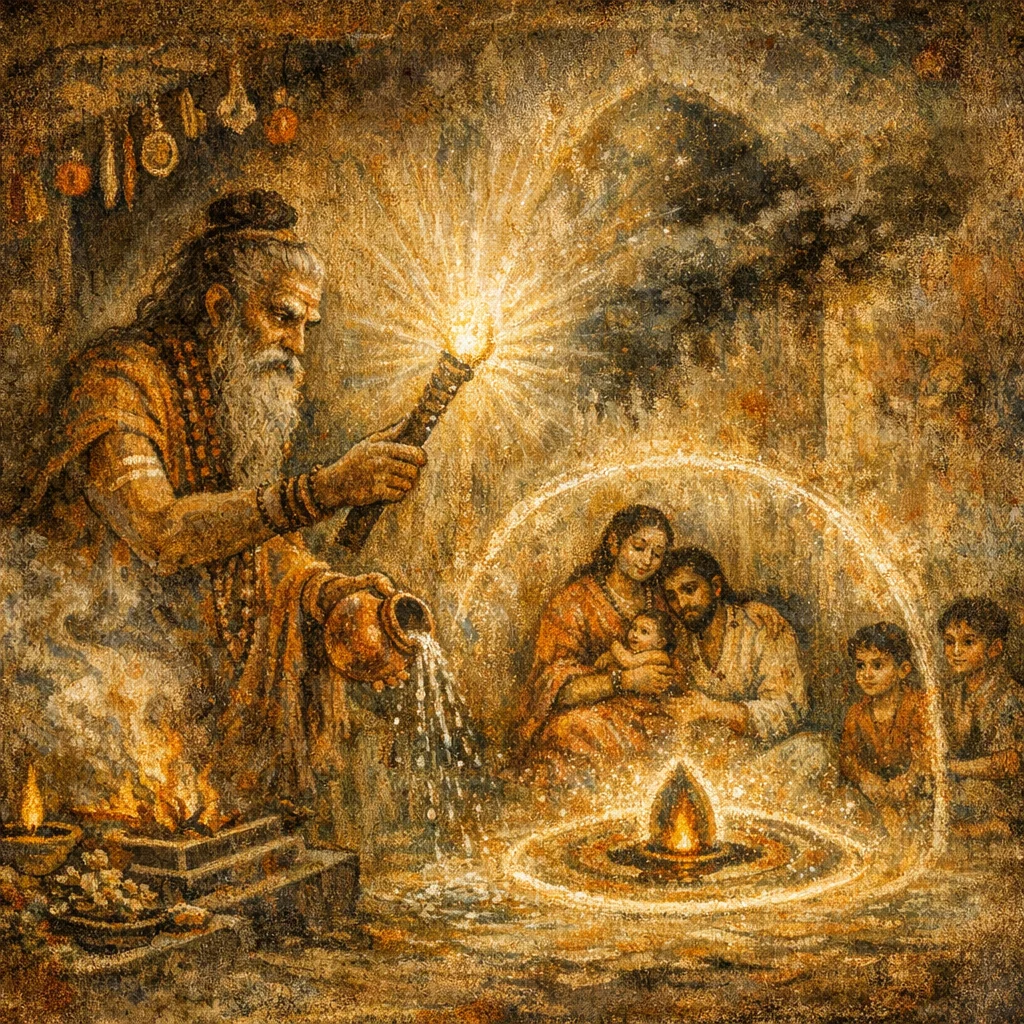
Here yoni means the seat or origin-point—such as a home’s threshold, an altar-seat, a lineage base, or any vulnerable entry where harm can arise or return. The hymn asks Bṛhaspati to guard that point so danger cannot re-enter.
Vala is the mythic enclosure that hides cows/light; breaking it symbolizes removing a hard blockage—confinement, binding illness, or hostile obstruction—so vitality and prosperity can flow out again.
It is recited aloud to establish Bṛhaspati ‘in front’ as guardian, especially before travel, conflict, or after a perceived intrusion. Many practitioners add simple boundary gestures (circling the threshold/altar) to match the hymn’s focus on guarding the yoni.