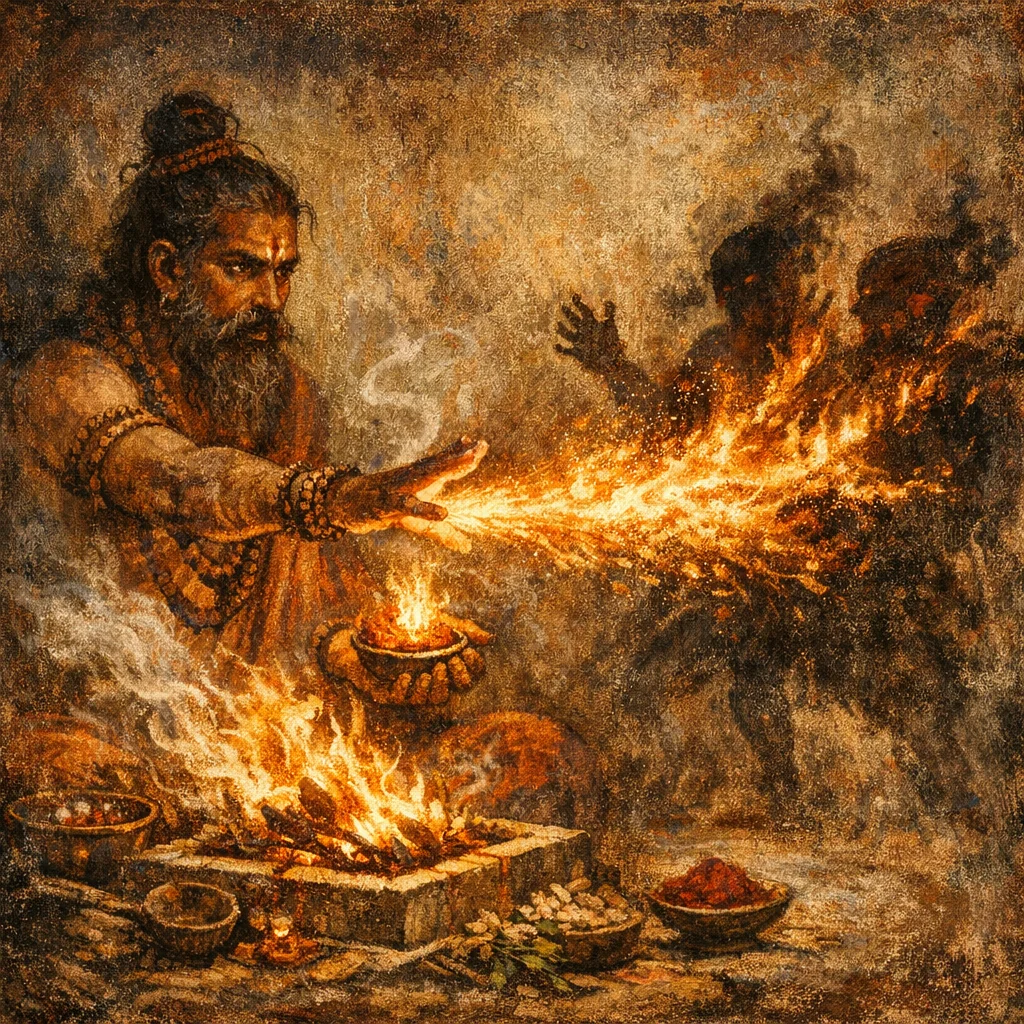
Sukta 19
Rishi: Atharvanic tradition (specific ṛṣi attribution for this verse is not securely determinable from the single mantra alone)
Devata: Agni
Chandas: Anuṣṭubh-like cadence (exact metrical diagnosis requires full hymn context and pada scansion)
Mantras
Mantra 1
शत्रुनाशनम्। अग्ने यत् ते तपस्तेन तं प्रति तप यो३स्मान् द्वेष्टि यं वयं द्विष्मः
O Agni, with that ardour which is thine—therewith scorch him in requital, who hateth us, whom we account our foe.
Mantra 2
अग्ने यत् ते हरस्तेन तं प्रति हर यो३स्मान् द्वेष्टि यं वयं द्विष्मः
O Agni, with that thy burning bolt—what heat is thine—smite him in requital, who hateth us, whom we ourselves do hate.
Mantra 3
अग्ने यत् तेऽर्चिस्तेन तं प्रत्यर्च यो३स्मान् द्वेष्टि यं वयं द्विष्मः
O Agni, with that flame of thine, blaze thou back upon him—who hateth us, whom we do hate.
Mantra 4
अग्ने यत् ते शोचिस्तेन तं प्रति शोच यो३स्मान् द्वेष्टि यं वयं द्विष्मः
O Agni, with that flame of thine, scorch him in requital—him who hateth us, whom we ourselves do hate.
Mantra 5
अग्ने यत् ते तेजस्तेन तमतेजसं कृणु यो३स्मान् द्वेष्टि यं वयं द्विष्मः
O Agni, with that splendour of thine, make him splendourless—who hateth us, whom we do hate.
Frequently Asked Questions
It is used to protect oneself and one’s household by ritually reversing hatred or harmful intent back onto the person who is sending it.
Agni is the visible, immediate power of fire; the hymn treats his flame and heat as an executable force that can burn, scorch, and neutralize an enemy’s potency.
The primary ‘substance’ is the fire itself. Traditional performance may add kindling and a small oblation, but the hymn’s main mechanism is directing Agni’s arciṣ/śocis/tejas through recitation.