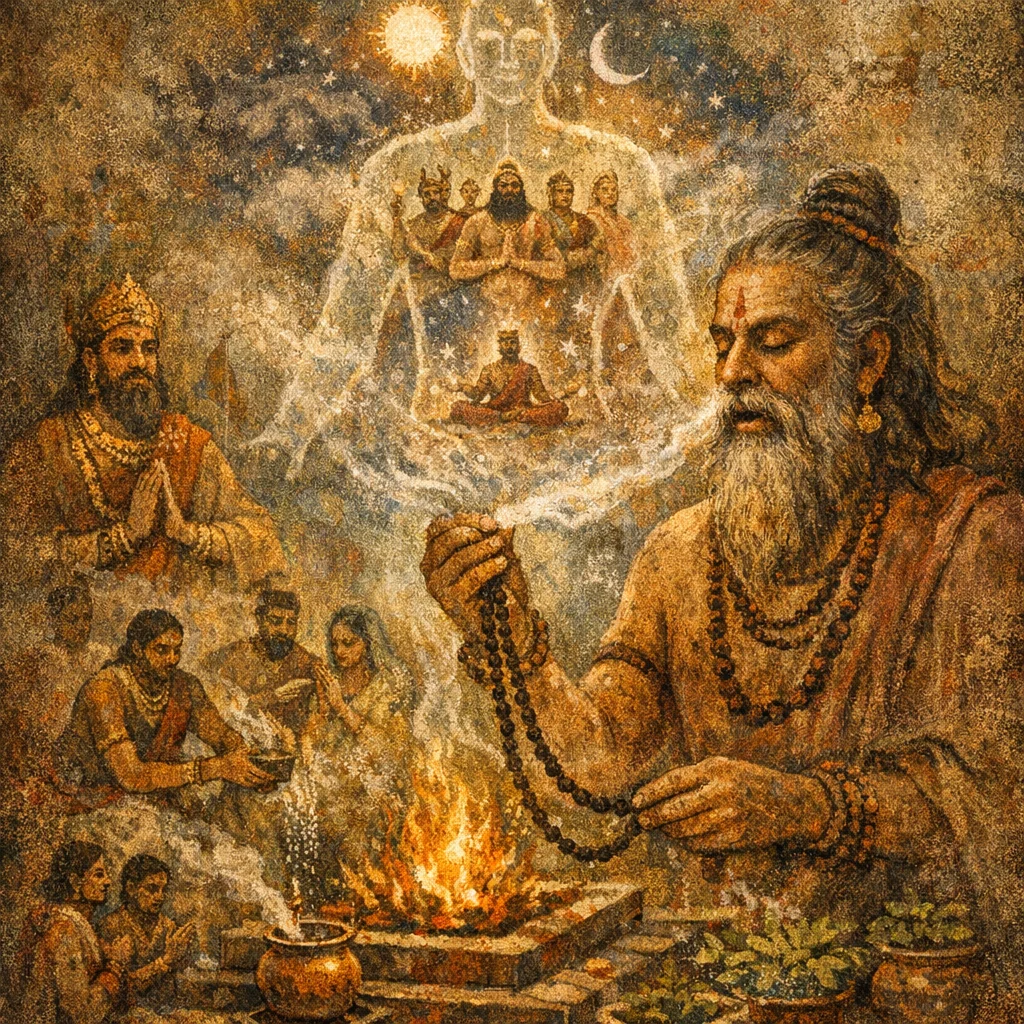
Sukta 6
Rishi: Traditionally connected with Nārāyaṇa/Puruṣa tradition (late Atharvanic compilation drawing on RV 10.90).
Devata: Puruṣa (Cosmic Person) / the sacrificial-cosmic order.
Chandas: Triṣṭubh-like cadence in the RV model; Atharvanic transmission often treated as mixed/late.
Mantras
Mantra 1
जगद्बीज पुरुषः। सहस्रबाहुः पुरुषः सहस्राक्षः सहस्रपात्। स भूमिं विश्वतो वृत्वात्यतिष्ठद् दशाङ्गुलम्
The Puruṣa is the world’s seed: thousand-armed is the Puruṣa, thousand-eyed, thousand-footed. Encompassing earth on every side, he stood beyond it by the measure of ten fingers.
Mantra 2
त्रिभिः पद्भिर्द्यामरोहत् पादस्येहाभवत् पुनः । तथा व्यऽक्रामद् विष्वङशनानशने अनु
With three steps he mounted to the sky; one quarter of him came to be here again. Thus he strode forth in every direction, following after both eating and not-eating.
Mantra 3
तावन्तो अस्य महिमानस्ततो ज्यायांश्च पूरुषः । पादोऽस्य विश्वा भूतानि त्रिपादस्यृतं दिवि
So great are his majesties; and greater yet than that is the Puruṣa. One quarter of him is all beings; his three quarters are the ṛta in heaven.
Mantra 4
पुरुष एवेदं सर्वं यद् भूतं यच्च भाव्यम्। उतामृतत्वस्येश्वरो यदन्येनाभवत् सह
Puruṣa—this very one—is all this, whatever hath been and whatever is to be; and he is lord of immortality, in that he came to be together with what is other.
Mantra 5
यत् पुरुषं व्यदधुः कतिधा व्यऽकल्पयन्। मुखं किमस्य किं बाहू किमूरू पादा उच्येते
When they disposed the Puruṣa, and in how many ways they ordered him—what was his mouth, what were his arms, what were called his thighs and feet?
Mantra 6
ब्राह्मणोऽस्य मुखमासीद् बाहू राजन्योऽभवत्। मध्यं तदस्य यद् वैश्यः पद्भ्यां शूद्रो अजायत
The Brāhmaṇa was his mouth; his arms became the Rājanya. That which was his middle—this was the Vaiśya; from his feet the Śūdra was born.
Mantra 7
चन्द्रमा मनसो जातश्चक्षोः सूर्यो अजायत । मुखादिन्द्रश्चाग्निश्च प्राणाद् वायुरजायत
The Moon was born from mind; from the eye the Sun was born. From the mouth were Indra and Agni; from the breath Vāyu was born.
Mantra 8
नाभ्या आसीदन्तरिक्षं शीर्ष्णो द्यौः समवर्तत । पद्भ्यां भूमिर्दिशः श्रोत्रात् तथा लोकां अकल्पयन्
From the navel was the mid-air; from the head the heaven was wholly evolved. From the feet was the earth; from the ear the quarters: thus they ordered the worlds.
Mantra 9
विराडग्रे समभवद् विराजो अधि पूरुषः । स जातो अत्यरिच्यत पश्चाद् भूमिमथो पुरः
Virāj came into being in the beginning; upon Virāj the Puruṣa was produced. When born, he overpassed—behind the earth and also before it.
Mantra 10
यत् पुरुषेण हविषा देवा यज्ञमतन्वत । वसन्तो अस्यासीदाज्यं ग्रीष्म इध्मः शरद्धविः
When with the Puruṣa for oblation the Gods stretched forth the Sacrifice, Spring thereof was the ghee, Summer the fuel-stick, Autumn the offering.
Mantra 11
तं यज्ञं प्रावृषा प्रौक्षन् पुरुषं जातमग्रशः । तेन देवा अयजन्त साध्या वसवश्च ये
That Sacrifice the Rainy Season sprinkled; the Puruṣa, born first of all. Therewith the Gods sacrificed—yea, the Sādhyas and the Vasus also.
Mantra 12
तस्मादश्वा अजायन्त ये च के चोभयादतः । गावो ह जज्ञिरे तस्मात् तस्माज्जाता अजावयः
From that were Horses born, and all that have two rows of teeth; Cows verily from that were born; from that, from that sprang Goats and Sheep.
Mantra 13
तस्माद् यज्ञात् सर्वहुत ऋचः सामानि जज्ञिरे । छन्दो ह जज्ञिरे तस्माद् यजुस्तस्मादजायत
From that all-offered Sacrifice were born the Ṛc and Sāman; the metres verily were born therefrom; from that the Yajus from that arose.
Mantra 14
तस्माद् यज्ञात् सर्वहुतः संभृतं पृषदाज्यऽम्। पशूंस्तांश्चक्रे वायव्याऽनारण्या ग्राम्याश्च ये
From that all-offered Sacrifice was gathered the pṛṣad-ājya; and it made the beasts—those of the air, the forest-dwellers, and the village-tame besides.
Mantra 15
सप्तास्यासन् परिधयस्त्रिः सप्त समिधः कृताः । देवा यद् यज्ञं तन्वाना अबध्नन् पुरुषं पशुम्
Seven were its mouths; the enclosing-fences were set; thrice seven kindling-sticks were made. When the Gods, spreading forth the Sacrifice, bound fast the Man as victim-beast.
Mantra 16
मूर्ध्नो देवस्य बृहतो अंशवः सप्त सप्ततीः । राज्ञः सोमस्याजायन्त जातस्य पुरुषादधि
From the head of the mighty God there sprang the rays—seven and seventy. They were born as of King Soma, from the Puruṣa, when he had come to birth.
Frequently Asked Questions
It explains creation as a sacrificial ordering of the Cosmic Person (Puruṣa), from whom the worlds, social roles, and even Vedic speech-forms arise.
Not primarily. It functions more as a social-cosmogonic and śānti-oriented hymn: it stabilizes authority, hierarchy, and ritual legitimacy by rooting them in a sacred prototype.
Because it makes Vedic speech cosmically primordial. If the Veda and its metres arise from the first yajña, then reciting them is not just symbolic—it participates in the same ordering power.