Adhyaya 79
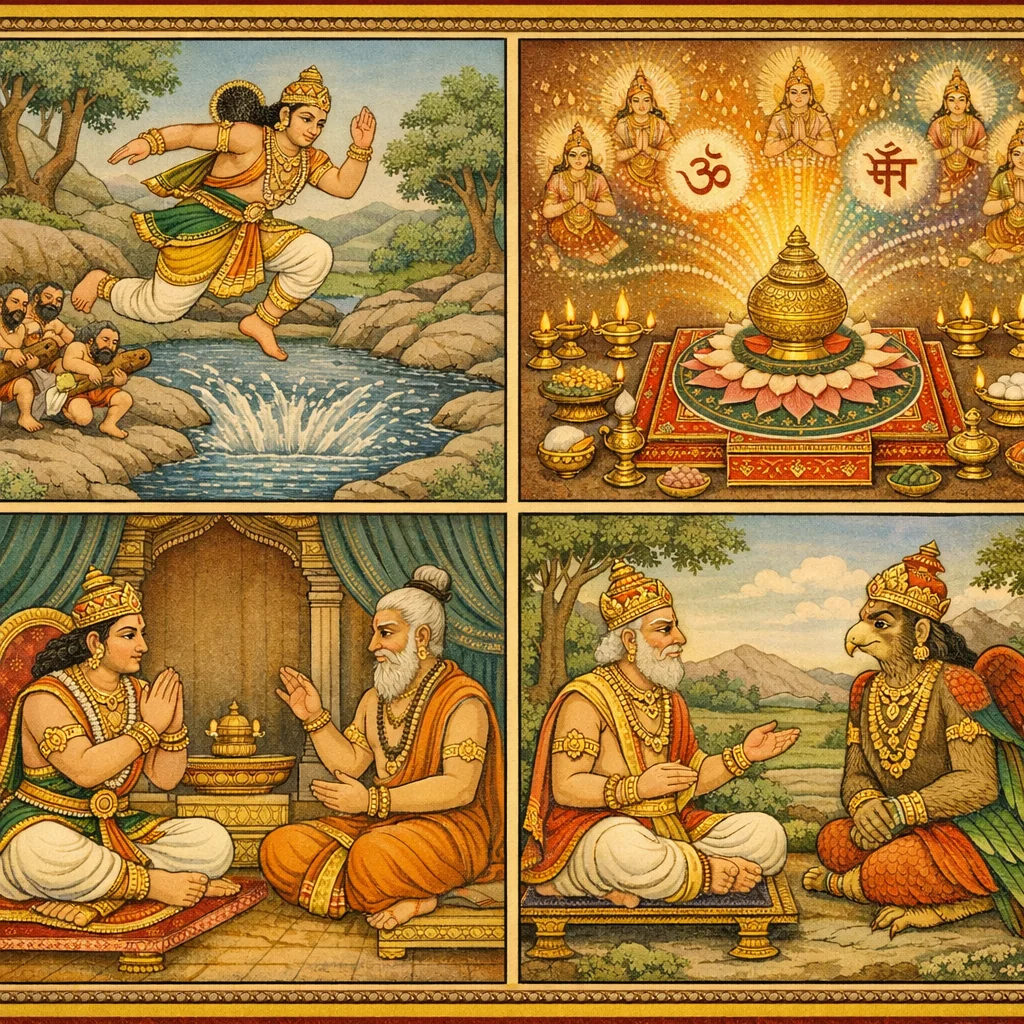
This adhyāya is framed as Sūta’s account to the inquiring ṛṣis. It begins by pointing out a renowned liṅga in the southern part of the sacred region, praised as a purifier of sins and transgressions. During Dakṣa’s properly arranged yajña, the Vālakhilya sages carry samidh (fuel-sticks) to assist but are blocked by a water-filled hollow on the path. Indra (Śakra), passing toward the sacrifice, sees their struggle yet—out of curiosity and pride—leaps over the obstacle, humiliating them. The sages then take a ritual vow, using Atharvanic mantras and a consecrated kalaśa set within a maṇḍala to generate a substitute “Śakra”; ominous portents arise for Indra, who seeks counsel from Bṛhaspati. Bṛhaspati explains the signs as the result of Indra’s disrespect toward ascetics. Indra appeals to Dakṣa, and Dakṣa negotiates with the sages: the mantra-born power will not be annulled, but redirected so that the emergent being becomes Garuḍa—glorified as Viṣṇu’s mount—rather than a rival Indra. The chapter ends with reconciliation and a phala statement: worship of the liṅga and performance of homa in the associated kuṇḍa, with faith or even in a niṣkāma (desireless) spirit, grants desired results and rare spiritual attainment, teaching pilgrimage ethics and reverence for brāhmaṇas and ṛṣis.
Shlokas
Verse 1
। सूत उवाच । तस्यैव दक्षिणे भागे वालखिल्यैः प्रतिष्ठितम् । लिंगमस्ति सुविख्यातं सर्वपातकनाशनम्
Sūta said: On its very southern side there is a renowned liṅga, established by the Vālakhilya sages, which destroys all sins.
Verse 2
यमाराध्य च तैः पूर्वं शक्रामर्षसमन्वितैः । गरुडो जनितः पक्षी ख्यातो विष्णुरथोऽत्र यः
After they had formerly worshipped that (liṅga/deity), filled with indignation toward Śakra (Indra), Garuḍa—the bird famed here as Viṣṇu’s mount—was brought into being.
Verse 3
ऋषय ऊचुः । कथं तेषां समुत्पन्नः शक्रस्योपरि सूतज । प्रकोपो वालखिल्यानां संजज्ञे गरुडः कथम्
The sages said: “O son of Sūta, how did their wrath against Śakra (Indra) arise? And how was Garuḍa born from the Vālakhilyas’ anger?”
Verse 4
सूत उवाच । पुरा प्रजापतिर्दक्षस्तस्मिन्क्षेत्रे सुशोभने । चकार विधिवद्यज्ञं संपूर्णवरदक्षिणम्
Sūta said: “Long ago, Prajāpati Dakṣa, in that splendid sacred region, performed a sacrifice according to rule, complete with excellent dakṣiṇā—ritual gifts to the priests.”
Verse 5
ततः शक्रादयो देवाः सहायार्थं निमंत्रिताः । दक्षेण मुनयश्चैव तथा राजर्षयोऽमलाः
Then Śakra (Indra) and the other gods were invited by Dakṣa to lend their aid; and sages, as well as spotless royal seers, were summoned too.
Verse 6
तथा वेदविदो विप्रा यज्ञकर्मविचक्षणाः । गृहस्थाश्रमिणो ये च ये चारण्यनिवासिनः
Likewise, Veda-knowing brāhmaṇas skilled in the rites of sacrifice were invited—both those living the householder discipline and those dwelling in the forest.
Verse 7
अथ ते वालखिल्याख्या मुनयः संशितव्रताः । एकां समिधमादाय साहाय्यार्थं प्रजापतेः । प्रस्थिता यज्ञवाटं तं भारार्ताः क्लेशसंयुताः
Then the sages known as the Vālakhilyas—steadfast in their vows—each took up a single samidh, a firewood-stick for the sacred fire, and set out to aid Prajāpati, making for that sacrificial enclosure, burdened by the load and beset by hardship.
Verse 8
अथ तेषां समस्तानां मार्गे गोष्पदमागतम् । जलपूर्णं समायातमकालजलदागमे
Then, upon the path of them all, there appeared a hollow like a cow’s hoofprint, filled with water, formed by the untimely coming of rain-clouds.
Verse 9
ततस्तरीतु कामास्ते क्लिश्यमाना इतस्ततः । समिद्भारश्रमोपेता देवराजेन वीक्षिताः
Wishing to cross, they struggled here and there; wearied by the burden of firewood, they were noticed by the king of the gods, Indra.
Verse 10
गच्छता तेन मार्गेण मखे दक्षप्रजापतेः । ततश्चिरं समालोक्य स्मितं कृत्वा स कौतुकात् । जगामाथ समुल्लंघ्य ऐश्वर्यमदगर्वितः
As he went along that path toward the sacrifice of Dakṣa Prajāpati, he watched for a long while; then, smiling out of mere amusement, he leapt across—swollen with the pride born of his lordly power.
Verse 11
ततस्ते कोपसंयुक्ताः शक्राद्दृष्ट्वा पराभवम् । निवृत्य स्वाश्रमं गत्वा चक्रुर्मंत्रं सनिश्चयम्
Then, filled with anger on seeing the insult from Śakra, they turned back; and after going to their own hermitage, they firmly resolved and performed a mantra-rite.
Verse 12
शाक्रं पदं समासाद्य यस्मादेतेन पाप्मना । अतिक्रांता वयं सर्वे तस्मात्पात्यः स सत्पदात्
“Since, upon reaching the station of Śakra, we have all been overstepped by this sinful one, therefore he must be made to fall from that noble rank.”
Verse 13
अन्यः शक्रः प्रकर्तव्यो मंत्रवीर्यसमुद्भवः । आथर्वणैर्महासूक्तैराभिचारिकसंभवैः
“Another Indra must be brought forth—born of the potency of mantra—by the Atharvanic great hymns that arise from compelling rites (abhicāra).”
Verse 14
येन व्यापाद्यते तेन शक्रोऽयं मदगर्वितः । मखमाहात्म्यसंपन्नः स्वल्पबुद्धिपरा क्रमः
“By that very means let this Indra—intoxicated with arrogant pride—be brought to destruction; though linked to the grandeur of the sacrifice, his conduct is ruled by petty understanding.”
Verse 16
गर्भोपनिषदेनैव नीलरुद्रैर्द्विजोत्तमाः । रुद्रशीर्षेण काम्येन विष्णुसूक्तयुतेन चं
Those best among the twice-born performed the rite using the Garbhopaniṣad, the Nīlarudra hymns, the desired Rudraśīrṣa, and also together with the Viṣṇu-sūkta.
Verse 17
निधाय कलशं मध्ये मंडलस्योदकावृतम् । होमांते तत्र संस्पर्शं चक्रुस्तस्य जलैः शुभैः
Placing a water-covered ritual pot (kalaśa) at the center of the maṇḍala, at the conclusion of the homa they performed there the rite of touching and aspersion with its auspicious water.
Verse 18
एतस्मिन्नंतरे शक्रः प्रपश्यति सुदारुणान् । उत्पातानात्मनाशाय जायमानान्समंततः
Just then Śakra (Indra) beheld terribly dreadful portents arising on every side—omens pointing toward his own ruin.
Verse 19
वामो बाहुश्च नेत्रं च मुहुः स्फुरति चास्य वै । न च पश्यति नासाग्रं जिह्वाग्रं च तथा हनुम्
His left arm and his eye kept twitching again and again; and he could not see the tip of his nose, the tip of his tongue, nor his jaw.
Verse 20
शिरोहीनां तथा छायां गगने भास्करद्वयम् । अरुंधतीं ध्रुवं चैव न च विष्णुपदानि सः
He saw a headless shadow, and two suns in the sky; he could not see Arundhatī, nor Dhruva, nor even the footprints—sacred marks—of Viṣṇu.
Verse 21
न च मंदं न चाकाशे संस्थितां स्वर्धुनीं हरिः । स्वपन्पश्यति कृष्णांगीं नित्यं नारीं धृतायुधाम्
He did not see the Moon, nor the heavenly Gaṅgā stationed in the sky; and in sleep he continually beheld a dark-limbed woman bearing weapons.
Verse 22
मुक्तकेशीं विवस्त्रां च कृष्णदंतां भयानकाम् । तान्दृष्ट्वा स महोत्पातान्देवराजो बृहस्पतिम्
He saw a terrifying woman—hair unbound, unclothed, with blackened teeth. Seeing such great portents, Indra, king of the gods, turned to Bṛhaspati.
Verse 23
पप्रच्छ भयसंत्रस्तः किमेतदिति मे गुरो । जायंते सुमहोत्पाता दुर्निमित्तानि वै पृथक्
Trembling with fear, he asked: “What is this, my Guru? Great portents are arising—distinct evil omens, each in its own way.”
Verse 24
किं मे भविष्यति प्राज्ञ विनाशः सांप्रतं वद । किं वा त्रैलोक्य राज्यस्य किं वा वित्तादिकस्य च
“What will befall me, O wise one? Tell me at once—will there be destruction? And what of my sovereignty over the three worlds, and of my wealth and all the rest?”
Verse 25
बृहस्पतिरुवाच । ये त्वया मदमत्तेन वालखिल्या महर्षयः । उल्लंघिताः स्थिता मार्गे गोष्पदं तर्त्तुमिच्छवः
Bṛhaspati said: “Those Vālakhilya great seers, whom you—intoxicated with pride—insulted by leaping over them as they stood upon the path, wishing to cross even a mere cow’s-hoofprint of water…”
Verse 26
तैरेवाथर्वणैर्मंत्रैस्त्वकृतेऽस्ति शचीपते । कृतो होमः सुसंपूर्णः कलशश्चाभिमंत्रितः
“O Indra, lord of Śacī, by those very Atharvan mantras a rite has been set in motion against you: the fire-offering (homa) has been completed in full, and the ritual water-pot (kalaśa) has likewise been duly consecrated with mantra.”
Verse 27
युष्माकं सुविनाशाय सर्वदेवाधिनायकः । भविष्यति न संदेहो मंत्रैराथर्वणैर्हरिः
“For your utter destruction, Hari—lord over the chiefs of all the gods—will surely manifest through the Atharvan mantras; of this there is no doubt.”
Verse 28
तस्य तद्वचनं श्रुत्वा सहस्राक्षो भयान्वितः । दक्षं गत्वा च दीनास्यः प्रोवाच तदनंतरम्
Hearing those words, Indra of the thousand eyes was seized by fear. He went to Dakṣa, and with downcast face spoke to him immediately thereafter.
Verse 29
अस्मन्नाशाय मुनिभिर्वालखिल्यैः प्रजापते । प्रोद्यमो विहितः सम्यक्छक्रस्यान्यस्य वै कृते
O Prajāpati (Dakṣa), the Vālakhilya sages have rightly set in motion an undertaking for our ruin—indeed, it is being done on behalf of another Indra.
Verse 30
तान्वारय स्वयं गत्वा यावन्नो जायते परः । शक्रोऽस्मद्ध्वंसनार्थाय नास्ति तेषामसाध्यता
Go yourself and restrain them before another Indra is brought forth. For the sake of our destruction, there is nothing impossible for them to accomplish.
Verse 31
अथ दक्षो द्रुतं गत्वा शक्राद्यैरमरैर्वृतः । प्रहसंस्तानुवाचेदं विनयेन समन्वितः
Then Dakṣa quickly went, surrounded by the immortals headed by Indra; smiling, and filled with courtesy, he addressed them thus.
Verse 32
किमेतत्क्रियते विप्राः कर्म रौद्रतमं महत् । त्रैलोक्यं व्याकुलं येन सर्वमेतद्व्यवस्थितम्
O brāhmaṇa sages, what is this being done—this mighty deed, most fierce in its effect—by which the three worlds are thrown into turmoil and all this upheaval has arisen?
Verse 33
अथ ते दक्षमालोक्य समायातं स्वमाश्रयम् । संमुखाश्चाभ्ययुस्तूर्णं प्रगृहीतार्घ्यपाणयः
Then they, seeing Dakṣa arrive at their hermitage, quickly came forward to meet him, holding the offering of welcome (arghya) in their hands.
Verse 34
अर्घ्यं दत्त्वा यथान्यायं पूजां कृत्वाथ भक्तितः । प्रोचुश्च प्रणता भूत्वा स्वागतं ते प्रजापते
Having offered arghya according to proper rule and performed worship with devotion, they spoke—bowing low—“Welcome to you, O Prajāpati.”
Verse 35
आदेशो दीयतां शीघ्रं यदर्थमिह चागतः । अपि प्राणप्रदानेन करिष्यामः प्रियं तव
“Quickly give your command—tell us the purpose for which you have come here. Even at the cost of our very lives, we shall do what is dear to you.”
Verse 36
दक्ष उवाच । एतद्रौद्रतमं कर्म सर्वदेवभयावहम् । त्याज्यं युष्माभिरव्यग्रैरेतदर्थमिहागतः
Dakṣa said: “This is an exceedingly fierce act, bringing fear even to all the gods. You, being steady and undistracted, must abandon it. It is for this very purpose that I have come here.”
Verse 37
मुनय ऊचुः । वयं शक्रेण ते यज्ञे समायाताः सुभक्तितः । उल्लंघिता मदोद्रेकात्कृत्वा हास्यं मुहुर्मुहुः
The sages said: “At Indra’s request we came to your sacrifice with sincere devotion. Yet, overcome by a surge of pride, we repeatedly transgressed and made sport of it again and again.”
Verse 38
शक्रोच्छेदाय चास्माभिः शकोऽन्यो वीर्यमंत्रतः । प्रारब्धः कर्तुमत्युग्रैर्होमांतश्च व्यवस्थितः
“And for the destruction of Śakra (Indra), by means of potent mantras we began to bring forth another ‘Śakra’; and with exceedingly fierce intent we proceeded, prepared to carry the rite through to the concluding oblations.”
Verse 39
तत्कथं मंत्रवीर्यं तत्क्रियते मोघमित्यहो । वेदोक्तं च विशेषेण तस्मादत्र वद प्रभो
Then how, alas, could the power of mantra be made fruitless? Since the Veda especially affirms it, therefore, O Lord, explain it here to us.
Verse 40
त्वमेव यदि शक्तः स्यादन्यथा कर्तुमेव हि । कुरुष्व वा स्वयं नाथ नास्माकं शक्तिरीदृशी
If you alone are able to do otherwise, then indeed do it. Or, O Protector, accomplish it yourself—such power is not ours.
Verse 41
दक्ष उवाच । सत्यमेतन्महाभागा यद्युष्माभिः प्रकीर्तितम् । नान्यथा शक्यते कर्तुं वेदमन्त्रोद्भवं बलम्
Dakṣa said: “What you have stated, O noble ones, is true. The strength that arises from Vedic mantras cannot be made otherwise.”
Verse 42
तद्य एष कृतो होमो युष्माभिर्वेदमंत्रतः । देवराजार्थमव्यग्रैः कलशश्चाभिमंत्रितः
Therefore, this homa you have performed with Vedic mantras—and the kalaśa (water-pot) you have consecrated with steady minds for the sake of the king of the gods—will not be in vain.
Verse 43
सोऽयं मद्वचनाद्राजा भविष्यति पतत्रिणाम् । तेजोवीर्यसमोपेतः शक्रादपि सुवीर्यवान्
By my word, this one shall become the king of birds—endowed with splendor and valor, even more mighty than Śakra (Indra).
Verse 44
एतस्य देवराजस्य क्षंतव्यं मम वाक्यतः । तत्कृतं मूढभावेन यदनेन विचेष्टितम्
At my request, forgive this king of the gods. Whatever misconduct he committed was done in foolishness and delusion.
Verse 45
एवमुक्त्वाथ तेषां तं सहस्राक्षं भयातुरम् । दर्शयामास दक्षस्तु विनयावनतं स्थितम्
Having spoken thus, Dakṣa then showed them that Thousand-eyed one (Indra), distressed with fear, standing there bowed down in humility.
Verse 46
तेऽपि दृष्ट्वा सहस्राक्षं वेपमानं कृतांजलिम् । प्रोचुर्माऽतिक्रमं शक्र ब्राह्मणानां करिष्यसि
Seeing Sahasrākṣa (Indra) trembling with folded hands, they said: “O Śakra, do not commit any transgression against the brāhmaṇas.”
Verse 47
भूयो यदि दिवेशानामाधिपत्यं प्रवांछसि । अपि मन्दोऽपि मूर्खोऽपि क्रियाहीनोऽपि वा द्विजः । नावज्ञेयो बुधैः क्वापि लोकद्वय मभीप्सुभिः
“If you desire again the lordship over the gods, know this: even if a brāhmaṇa is dull, ignorant, or even lacking in ritual performance, the wise—who seek welfare in both worlds—must never despise him anywhere.”
Verse 48
इन्द्र उवाच । अज्ञानाद्यदि वा ज्ञानाद्यन्मया कुकृतं कृतम् । तत्क्षंतव्यं द्विजैः सर्वैर्विशेषाद्दक्ष वाक्यतः
Indra said: “Whether through ignorance or knowingly, whatever wrong I have done—may all the brāhmaṇas forgive it, especially in accordance with Dakṣa’s word.”
Verse 49
प्रगृह्यतां वरोऽस्माकं यः सदा वर्तते हृदि । प्रदास्यामि न संदेहो नादेयं विद्यते मम
Accept the boon that ever abides in my heart for you. I shall grant it—without doubt; there is nothing I will refuse.
Verse 50
मुनय ऊचुः । अस्मिन्कुण्डे नरो होमं यः कुर्याच्छ्रद्धयाऽन्वितः । एतल्लिंगं समभ्यर्च्य तस्याऽस्तु हृदि वांछितम्
The sages said: “Whoever, filled with faith, performs homa in this sacred kuṇḍa and duly worships this liṅga—may the desire held in his heart be fulfilled.”
Verse 51
इन्द्र उवाच । एतल्लिंगं समभ्यर्च्य योऽत्र होमं करिष्यति । कुंडेऽत्र वांछितं सद्यः सफलं स हि लप्स्यते
Indra said: “Whoever worships this liṅga and performs homa here—at this kuṇḍa—will indeed obtain his desired aim at once, crowned with success.”
Verse 52
निष्कामो वाऽथ संपूज्य लिंगमेतच्छुभावहम् । प्रयास्यति परां सिद्धिं त्रिदशैरपि दुर्लभाम्
Or, if one is desireless, then by fully worshiping this auspicious liṅga, he will attain the supreme perfection—rare even among the gods.
Verse 53
सूत उवाच । एवमुक्त्वा सहस्राक्षो वालखिल्यान्मुनीश्वरान् । ऐरावतं समारुह्य दक्षयज्ञे ततो गतः
Sūta said: Having spoken thus to the Vālakhilya sages, the thousand-eyed Indra mounted Airāvata and then departed for Dakṣa’s sacrifice (yajña).
Verse 54
दक्षोऽपि विधिवद्यज्ञं चकार द्विजसत्तमाः । संहृष्टैर्वालखिल्यैस्तैरुपविष्टैः समीपतः
O best of the twice-born, Dakṣa too performed the yajña according to proper rule, while the delighted Vālakhilya sages sat nearby.
Verse 158
ततस्ते शुचयो भूत्वा स्कंदसूक्तेन पावकम् । जुहुवुश्च दिवारात्रौ क्षुरिकोक्तेन सोद्यमाः
Then, having become purified, they offered oblations into the sacred fire with the Skanda-sūkta; and, exerting themselves diligently, they performed the offerings day and night in the manner taught by Kṣurika.