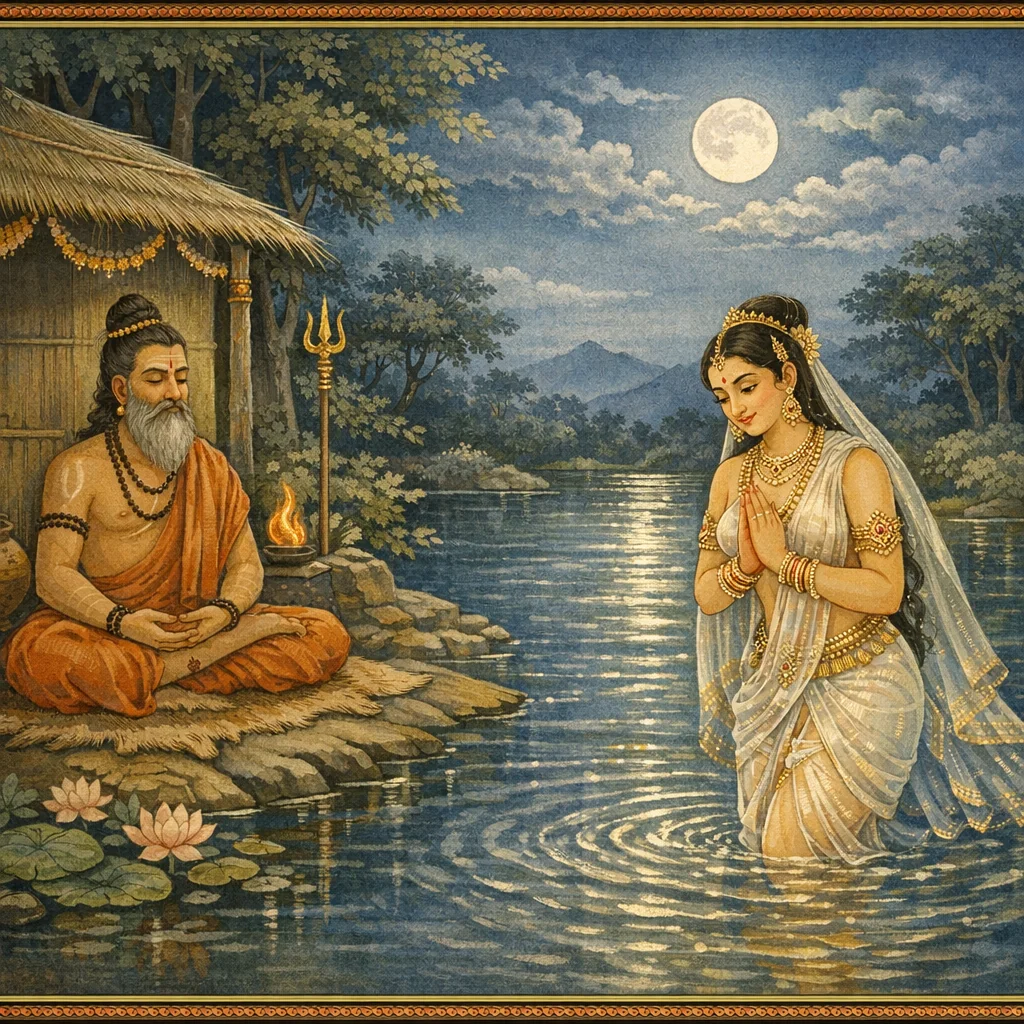
Adhyaya 42
This chapter offers a twofold teaching. First, Sūta extols an auspicious kuṇḍa connected with the sage Viśvāmitra, said to fulfill wishes and cleanse sin. Bathing there on Caitra-śukla-tṛtīyā is declared to bestow exceptional beauty and auspiciousness; for women it is especially linked with progeny and good fortune. The tīrtha’s holiness is then grounded in an ancient sacred spring where Gaṅgā is described as self-established, granting immediate release from wrongdoing to those who bathe. Ancestor rites performed there yield inexhaustible results, and gifts, offerings, and recitation produce unending merit. A striking exemplum follows: a doe, wounded by a hunter’s arrow, enters the water and dies; by the water’s power she becomes Menakā, a celestial apsaras, and later returns to bathe on the same calendrical conjunction. The chapter then turns to extended household ethics: Menakā meets Viśvāmitra and inquires into ideal domestic and marital conduct (strī-dharma). The text lays down devotion and fidelity, disciplined speech, proper service, cleanliness, regulated consumption, care for dependents, honoring teachers, supporting the transmission of śāstra, and fitting social associations—integrating place-glory, ritual timing, merit, and normative ethics as complementary instruments of dharma.
Shlokas
Verse 1
। सूत उवाच । विश्वामित्रसमुद्भूतं कुण्डं तत्रापरं शुभम् । संतिष्ठते द्विजश्रेष्ठाः सर्वकामप्रदायकम्
Sūta said: There, O best of Brahmins, another auspicious sacred pool stands—arisen from Viśvāmitra—granting the fulfillment of all desires.
Verse 2
तत्र चैत्रतृतीयायां कृते स्नाने भवेन्नरः । दिव्यरूपधरः साक्षात्कामोऽन्यो द्विजसत्तमाः
There, if a man bathes on the third lunar day of Caitra, he becomes a bearer of divine beauty—like another Kāma himself, O best of Brahmins.
Verse 3
नारी वा श्रद्धयोपेता तत्र स्नात्वा प्रजावती । भवेत्सौभाग्यसंयुक्ता स्पृहणीयतमा क्षितौ
Or, if a woman—endowed with faith—bathes there, she becomes blessed with children, endowed with good fortune, and most admired upon the earth.
Verse 4
ऋषय ऊचुः । तीर्थं तस्य मुनेस्तत्र कस्मिन्काले व्यवस्थितम् । निर्मलं केन निःशेषं वद त्वं सूतनंदन
The sages said: At what time did that sage’s tīrtha become established there? By what cause did it become completely pure? Tell us, O son of Sūta.
Verse 5
सूत उवाच । तत्रास्ति निर्झरः पूर्वं सामान्यो द्विजसत्तमाः । अवधूतो धरापृष्ठे माहात्म्येन व्यवस्थितः
Sūta said: There once was a spring, quite ordinary, O best of Brahmins; but upon the earth it became exalted—established through its revealed greatness.
Verse 6
यत्र देवनदी गंगा स्वयमेव व्यवस्थिता । यस्यां स्नातः पुमान्सद्यः सर्वपापैः प्रमुच्यते
For there the Gaṅgā—the river of the gods—has established herself of her own accord; and one who bathes in her is instantly released from all sins.
Verse 7
यस्तत्र कुरुते श्राद्धं पितॄनुद्दिश्य भावितः । तदक्षयं भवेच्छ्राद्धं पितॄणां तृप्तिकारकम्
Whoever, with a devoted mind, performs śrāddha there for the sake of the ancestors—his śrāddha becomes imperishable, bringing satisfaction to the Pitṛs.
Verse 8
यत्किंचिद्दीयत दानं तस्मिंस्तीर्थवरे द्विजाः । हुतजप्यादिकं चैव तदनंतफलं भवेत्
O Brahmins, whatever gift is given at that most excellent tīrtha—and likewise fire-offerings, japa, and kindred rites—becomes of endless fruit.
Verse 9
कस्यचित्त्वथ कालस्य मृगी व्याधशराहता । प्रविष्टा सलिले तस्मिंस्तत्र पञ्चत्वमागता
Now at a certain time, a doe, struck by a hunter’s arrow, entered those waters, and there met her end.
Verse 10
चैत्रशुक्लतृतीयायां मध्याह्ने द्विजसत्तमाः । नक्षत्रे यमदैवत्ये मार्तंडस्य च वासरे
O best of the twice-born, it was at midday on the third lunar day of the bright fortnight of Caitra—under the asterism presided over by Yama—and on the day of Mārtaṇḍa (the Sun).
Verse 11
अथ तत्तोयमाहात्म्यान्मेनकानाम साऽभवत् । अप्सरास्त्रिदशेंद्रस्य समंताच्चारुहासिनी
Then, through the greatness of those sacred waters, she became known as Menakā—an apsaras of Indra, lord of the gods—smiling with enchanting beauty all around.
Verse 12
स्मरमाणाऽथ सा तस्य प्रभावं वरवर्णिनी । तीर्थमागत्य सद्भक्त्या स्नानं तत्र समाचरत् । चैत्रशुक्लतृतीयायां यामर्क्षे सूर्यवासरे
Remembering its wondrous power, that exquisitely beautiful one came to the tīrtha and, with true devotion, performed bathing there—on the third day of the bright fortnight of Caitra, under the Yama asterism, on a Sunday.
Verse 13
एकदा दिवसे तस्मिन्भ्रममाणो मुनीश्वरः । विश्वामित्र इति ख्यातस्तत्रायातस्तपोऽन्वितः
One day, on that occasion, the lordly sage—renowned as Viśvāmitra—arrived there while wandering, endowed with the power of austerity.
Verse 14
साऽपि स्वर्गात्समायाता देवतादर्शनार्थतः । पूजयित्वाथ तं देवं प्रस्थिता त्रिदिवं प्रति
She too descended from heaven to behold the deity; and having worshipped that god, she set out again toward Tridiva, the celestial realm.
Verse 15
सा दृष्ट्वा तं मुनिं तत्र भ्रममाणमितस्ततः । यौवनस्थं सुरूपाढ्यं पंचबाणमिवापरम्
Seeing that sage there, wandering to and fro—youthful and richly handsome, like another Pañcabāṇa (Kāma)—she was struck by his charm.
Verse 16
व्रतप्रभावजैर्व्याप्तं तेजोभिर्भास्करं यथा । बाल्यात्प्रभृति चीर्णेन तपसा दग्धकिल्बिषम्
He was suffused with radiance born of the power of vows, like the sun; and by austerities practiced from childhood onward, his sins had been burned away.
Verse 17
सा तस्य दर्शनादेव कामबाणप्रपीडिता । सानंदाः सुरतार्थाय समीपं समुपाद्रवत्
From the very sight of him, she was pierced by the arrows of desire; and joyfully, seeking union, she hastened close to him.
Verse 18
स दृष्ट्वाऽदृष्टपूर्वां तां मार्गपृच्छाकृते ततः । सम्मुखः प्रययौ तूर्णं प्रहृष्टेनांतरात्मना
Seeing her—one he had never beheld before—he hastened to meet her face to face, as though to ask the way, his inmost heart brimming with delight.
Verse 19
उवाच देशं तां पृच्छन्स्त्रीधर्मांश्च विशेषतः । शुभलाभोऽस्तु ते भद्रे मनसा कर्मणा गिरा
He spoke, asking about that region and, most especially, about the dharmas proper to women: “Auspicious gain be yours, O gentle lady, in thought, in deed, and in speech.”
Verse 20
सदैव वासुदेवस्य भक्तिश्चाव्यभिचारिणी । कच्चित्त्वं वर्तसे पुत्रि पतिपादपरायणा । चारित्रविनयोपेता सर्वदा प्रियवादिनी
“Do you ever abide in unwavering bhakti to Vāsudeva? O daughter, do you live intent on serving at your husband’s feet—endowed with good conduct and humility, and always speaking words that are dear?”
Verse 21
कच्चित्त्वं सर्वदाभीष्टा पत्युर्दानैस्तथार्च्चनैः । बंधून्स्वमित्रवर्गं च तत्पुरः पृष्ठतोपि वा
“Do you always remain pleasing to your husband through gifts and acts of worship—honouring also his kinsmen and his circle of friends, whether in his presence or even behind his back?”
Verse 22
कच्चिद्भर्तरि संसुप्ते त्वं निशवशमेष्यसि । उत्थानमप्रबुद्धे च करोषि वरवर्णिनि
“When your husband has fallen asleep, do you then retire for the night? And before he has awakened, O fair-complexioned one, do you rise up (to begin your duties)?”
Verse 23
कच्चित्प्रातः समुत्थाय करोषि गृहमार्जनम् । स्वयमेव वरारोहे मण्डनं चोपमण्डनम्
Do you rise at dawn and cleanse the house? O noble lady, do you yourself attend to proper adornment and the neat ordering of dress and appearance?
Verse 24
कच्चिदेवान्नमस्कृत्य गुरुं च तदनंतरम् । करोषि त्वं प्राणयात्रां दत्त्वान्नं शक्तितो जलम्
Having bowed to the gods and thereafter to the guru, do you sustain life’s journey by first giving food and, according to your capacity, water?
Verse 25
कच्चिदस्तंगते सूर्ये नान्नमश्नासि भाभिनि । अदत्त्वा वा स्वभृत्येभ्यः साधुभ्यश्च विशेषतः
When the sun has set, O radiant one, do you refrain from eating—especially without first giving to your own dependents and, above all, to holy sādhus?
Verse 26
कच्चित्पिबसि पानीयं सप्तवारविशोधितम् । निबिडेन स्ववस्त्रेण पालयंती जलोद्भवान्
Do you drink water purified by filtering it seven times—carefully straining it through a thick cloth, so as to protect the tiny creatures born in water?
Verse 27
कच्चिद्दयासमोपेता गात्रक्लेशकरानपि । यूकामत्कुणदंशादीन्पुत्रवत्परिरक्षसि
Endowed with compassion, do you protect—like your own children—even those that cause bodily discomfort, such as lice, bugs, mosquitoes, and the like?
Verse 28
कच्चित्साधुमुखान्नित्यं शिवधर्मं सुभक्तितः । शृणोषि भक्तितो भद्रे प्रकरोषि च सादरम्
O blessed one, do you regularly listen with sincere devotion to Śiva’s dharma from the lips of holy people, and do you practice it with reverent care?
Verse 29
क्वचिच्छ्रुत्वाऽगमं पुण्यं प्रकरोषि च पूजनम् । शास्त्रस्य वाचकस्यापि व्याख्यातुश्च विशेषतः
And having heard some sacred, merit-bearing teaching of the Āgamas, do you then perform worship—honouring even the reciter of the scripture, and especially the one who expounds it?
Verse 30
कच्चित्पुराणशास्त्राणि प्रणीतानि जनेश्वरैः । संलेख्याक्षररम्याणि साधुभ्यः संप्रयच्छसि
O noble lady, do you see that the Purāṇic scriptures—composed by great rulers—are copied out in beautiful, pleasing letters and then respectfully given as a gift to the virtuous?
Verse 31
यः श्रुत्वा सर्व शास्त्राणि निष्क्रयं न प्रयच्छति । शास्त्रचौरः स विज्ञेयो न चैवाप्नोति तत्फलम्
He who listens to all the scriptures yet offers no proper fee or recompense should be known as a thief of scripture; he does not attain the fruit of that learning.
Verse 32
कच्चिच्छिवालये नृत्यगीतवाद्यादिकाः क्रियाः । बलिपूजोपहारांश्च त्वं करोषि च शक्तितः
Do you, to the best of your ability, perform in Śiva’s temple acts of worship such as dance, song, and instrumental music, and also make offerings—bali, pūjā, and other upahāras?
Verse 33
कच्चित्प्रावरणं वस्त्रं सुभगे सर्वमेव च । संप्रयच्छसि साधुभ्यः प्रणिपातपुरःसरम्
O fortunate one, do you bestow garments and coverings of every kind upon the virtuous, first offering a reverent prostration?
Verse 34
वृथा पर्यटनं नित्यं कच्चिन्न परमंदिरे । त्वं करोषि विशालाक्षि विशेषेण निशागमे
O wide-eyed lady, do you refrain from wandering aimlessly each day—especially at night—outside the sacred precincts of the great temple?
Verse 35
कच्चिन्नाश्नासि भद्रे त्वं स्वभर्तरि बुभुक्षिते । आज्ञाभंगं प्रयत्नेन कच्चित्तत्र प्ररक्षसि
O good lady, do you refrain from eating when your own husband is hungry, and do you carefully guard against disobeying his rightful instructions?
Verse 36
कच्चित्प्रकुपिते कांते नोत्तराणि प्रयच्छसि । तस्यकोपप्रणाशार्षं प्रियं कच्चिच्च जल्पसि
When your beloved is angered, do you avoid sharp replies, and do you instead speak what is pleasing—fit to dissolve his anger?
Verse 37
कच्चित्त्वं प्रोषिते कांते मलिनांबरधारिणी । जायसे च तथा दीना विवर्णवदना कृशा
When your beloved is away, do you become one who wears soiled garments—dejected, pale-faced, and thin?
Verse 39
कच्चिन्मंदिरपृष्ठे त्वं न धत्से भिन्नभाजनम् । उच्छिष्टं वा जनैस्त्यक्तमपि कार्योपकारकम्
Do you refrain from keeping behind the temple broken vessels, or leftover food—things cast away by people—even if they might seem useful for some task?
Verse 40
कच्चिन्न कुरुषे मैत्रीं बंधकीभिः समं शुभे । धात्रीभिर्मालिकस्त्रीभी रजकीभिश्च भामिनि
O auspicious lady, do you refrain from forming intimate friendships with courtesans, wet-nurses, garland-sellers’ women, and washerwomen, O passionate one?
Verse 41
कञ्चिद्दधासि नित्यं त्वं मुखं कुंकुमरंजितम् । शिरः पुष्पसमाकीर्णं नेत्रे कज्जलरंजिते
You always wear a face reddened with vermilion; your head is strewn with flowers, and your eyes are darkened with collyrium.