Adhyaya 4
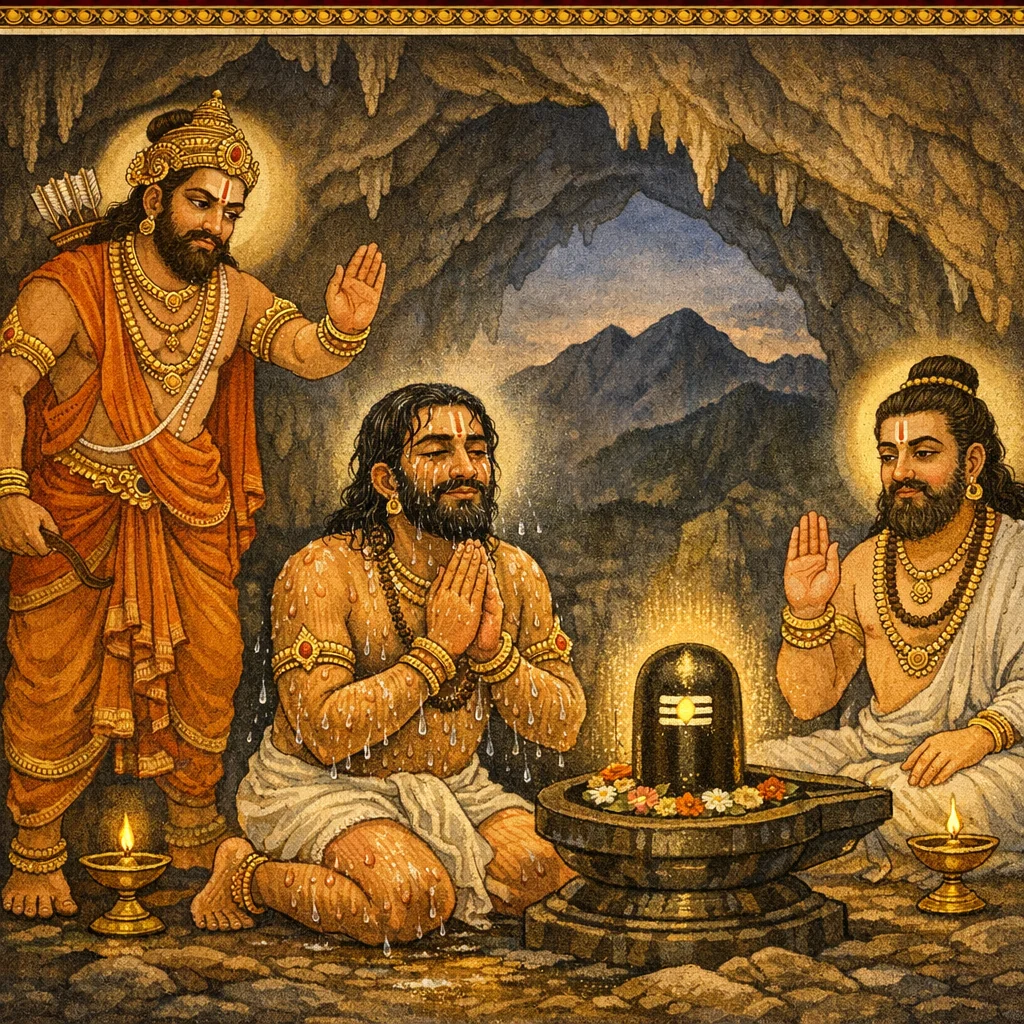
Sūta recounts Triśaṅku’s firm resolve: after Vasiṣṭha’s sons curse him into caṇḍāla status, he seeks Viśvāmitra alone as his refuge. Reaching Kurukṣetra, Triśaṅku finds Viśvāmitra’s riverside āśrama, yet is first rebuked by disciples who fail to recognize him because of bodily marks. He then declares his identity and explains the dispute—his request for a sacrifice that would raise him to heaven with his very body was refused, and he was abandoned and cursed. Viśvāmitra, set in rivalry with Vasiṣṭha’s line, promises a remedy through a tīrtha-yātrā to restore purity and ritual eligibility. A broad pilgrimage circuit is listed—Kurukṣetra, Sarasvatī, Prabhāsa, Naimiṣa, Puṣkara, Vārāṇasī, Prayāga, Kedāra, the Śravaṇā river, Citrakūṭa, Gokarṇa, Śāligāma, and more—yet Triśaṅku remains unpurified until they reach Arbuda. There Mārkaṇḍeya directs them to the Hāṭakeśvara liṅga in the Anarta region, connected with pātāla and the Jāhnavī waters. Entering the subterranean passage, Triśaṅku bathes ritually and, upon darśana of Hāṭakeśvara, is freed from caṇḍāla status and regains his radiance. Viśvāmitra then instructs him to perform a properly furnished sacrificial session and petitions Brahmā to accept a rite enabling embodied ascent. Brahmā replies with a doctrinal constraint: heaven is not attained by sacrifice while retaining the same body, underscoring Vedic procedure and the normal rule of relinquishing the body.
Shlokas
Verse 1
। सूत उवाच । त्रिशंकुरिति संचिन्त्य विश्वामित्रं महामुनिम् । मनसा सुचिरं कालं ततश्चक्रे विनिश्चयम्
Sūta said: Reflecting on Triśaṅku and on the great sage Viśvāmitra for a long time in his mind, he then arrived at a firm decision.
Verse 2
विश्वामित्रं परित्यज्य नान्योस्ति भुवनत्रये । यः कुर्यान्मे परित्राणं दुःखादस्मात्सुदारुणात्
“Apart from Viśvāmitra, there is no one in the three worlds who could deliver me from this exceedingly dreadful sorrow.”
Verse 3
कुरुक्षेत्रं समुद्दिश्य प्रतस्थे स ततः परम् । सुश्रांतः क्षुत्पिपासार्तो मार्गपृच्छापरायणः
Then, setting his aim toward Kurukṣetra, he set out. Worn out and afflicted by hunger and thirst, he proceeded by continually asking the way.
Verse 4
ततः कालेन संप्राप्य कुरुक्षेत्रं स पार्थिवः । यत्नेनान्वेषयामास विश्वामित्राश्रमं ततः
In due course, that king reached Kurukṣetra. Then, with earnest effort, he began to seek the āśrama—the hermitage of sage Viśvāmitra.
Verse 5
एवं चान्वेषमाणेन तेन भूमिभृता तदा । सुदूरादेव संदृष्टं नीलद्रुमकदम्बकम्
As he searched in this way, the ruler beheld from far away a cluster of kadamba trees, their trunks dark with a blue hue.
Verse 6
उपरिष्टाद्बकैर्हंसैर्भ्रममाणैः समंततः । आटिभिर्मद्गुभिश्चैव समन्ताज्जलपक्षिभिः
All around—above and on every side—the sky and waters teemed with water-birds: cranes and swans circling, and other aquatic fowl such as the āṭi-birds and madgu, moving everywhere in that sacred region.
Verse 7
स मत्वा सलिलं तत्र पिपासार्तो महीपतिः । प्रतस्थे सत्वरो हृष्टो जलवातहृतक्लमः
Thinking there was water there, the king—tormented by thirst—set out at once, swift and glad, his weariness eased by the cool breeze and the nearness of the waters.
Verse 8
अथापश्यन्मनोहारि सौम्यसत्त्वनिषेवितम् । आश्रमं नदितीरस्थं मनःशोकविनाशनम्
Then he beheld a charming āśrama, frequented by gentle beings, set upon the riverbank—an abode that dispels the sorrow of the heart.
Verse 9
पुष्पितैः फलितैर्वृक्षैः समंतात्परिवारितम् । विविधैर्मधुरारावैर्नादितं विहगोत्तमैः
It was encircled on every side by trees in blossom and heavy with fruit, and it resounded with many kinds of sweet calls from excellent birds.
Verse 10
क्रीडंति नकुलाः सर्पैरूलूका यत्र वायसैः । मूषकैर्वृषदंशाश्च द्वीपिनो विविधैर्मृगैः
There, mongooses played with serpents; owls with crows; mice with vṛṣadaṃśa-creatures; and even leopards with various deer—enmities were stilled in that holy precinct.
Verse 11
अथापश्यन्नदीतीरे स तपस्विगणावृतम् । स्वाध्यायनिरतं दांतं विश्वामित्रं तपोनिधिनम्
Then, on the riverbank, he saw Viśvāmitra—treasure-house of austerity—surrounded by companies of ascetics, disciplined and self-controlled, devoted to svādhyāya, the sacred study.
Verse 12
तेजसा तपसातीव दीप्यमानमिवानलम् । चीरवल्कलसंवीतं शालवृक्षं समाश्रितम्
Blazing with the splendor of intense austerity like fire itself, clothed in bark-garments and rags, he was seated taking refuge by a śāla tree.
Verse 13
अथ गत्वा स राजेन्द्रो दूरस्थोऽपि प्रणम्य तम् । अष्टांगेन प्रणामेन स्वनाम परिकीर्तयन्
Then the king went forward; even from a distance he bowed to him, offering an eight-limbed prostration (aṣṭāṅga praṇāma) and announcing his own name in reverence.
Verse 14
तथान्यानपि तच्छिष्यान्कृताञ्जलिपुटः स्थितः । यथाक्रमं यथाज्येष्ठं श्रद्धया परया युतः
In the same manner, he stood with hands joined in añjali, offering reverence also to the other disciples—according to their order and seniority—endowed with the highest faith.
Verse 15
धूलिधूसरितांगं तं ते तु दृष्ट्वा महीपतिम् । चंडाल इति मन्वानाश्चिह्नैर्गात्रसमुद्भवैः
But seeing that king, his limbs greyed by dust, they—judging by the bodily signs that had arisen upon him—took him to be a caṇḍāla.
Verse 16
भर्त्सयामासुरेवाथ वचनैः परुषाक्षरैः । धिक्छब्दैश्च तथैवान्ये याहियाहीति चासकृत्
Then they began to revile him with harsh words; others too kept hurling cries of “Shame!” and repeatedly shouted, “Go away, go away!”
Verse 17
कस्त्वं पापेह संप्राप्तो मुनीनामाश्रमोत्तमे । वेदध्वनिसमाकीर्णे साधूनामपि दुर्लभे
“Who are you, sinner, who has come here into this most excellent hermitage of sages—filled with the sound of the Vedas—a place difficult even for the virtuous to obtain?”
Verse 18
तस्माद्गच्छ द्रुतं यावन्न कश्चित्तापसस्तव । दत्त्वा शापं करोत्याशु प्राणानामपि संक्षयम्
“Therefore go away quickly—before any ascetic, upon cursing you, swiftly brings about even the destruction of your life-breath.”
Verse 19
त्रिशंकुरुवाच । त्रिशंकुर्नाम भूपोऽहं सूर्यवंशसमुद्भवः । शप्तो वसिष्ठपुत्रैश्च चंडालत्वे नियोजितः
Triśaṅku said: “I am the king named Triśaṅku, born of the Solar dynasty. I have been cursed by the sons of Vasiṣṭha and appointed to the state of a caṇḍāla.”
Verse 20
सोऽहं शरणमापन्नः शापमुक्त्यै द्विजोत्तमाः । विश्वामित्रं जगन्मित्रं नान्या मेऽस्ति गतिः परा
“Therefore I have come seeking refuge, O best of the twice-born, for release from the curse. Viśvāmitra—friend of the world—is my only support; for me there is no higher refuge.”
Verse 21
विश्वामित्र उवाच । वसिष्ठस्य भवान्याज्यस्तत्पुत्राणां विशेषतः । तत्कस्मादीदृशे पापे तैस्त्वमद्य नियोजितः
Viśvāmitra said: “You are worthy of honor from Vasiṣṭha, and especially from his sons. Why then have they today subjected you to such a sinful condition?”
Verse 22
कोऽपराधस्त्वया तेषां कृतः पार्थिवसत्तम । प्राणद्रोहः कृतः किं वा दारधर्षणसंभवः
“What offense have you committed against them, O best of kings? Did you commit violence against life—or was it some outrage involving another’s wife?”
Verse 23
त्रिशंकुरुवाच । अनेनैव शरीरेण स्वर्गाय गमनं प्रति । मया संप्रार्थितो यज्ञो वसिष्ठान्मुनिसत्तमात्
Triśaṅku said: “With this very body I longed to go to heaven. Therefore I entreated Vasiṣṭha, the foremost of sages, to perform a yajña for that purpose.”
Verse 24
तेनोक्तं न स यज्ञोऽस्ति येन स्वर्गे प्रगम्यते । अनेनैव शरीरेण मुक्त्वा देहांतरं नृप
He told me: “There is no sacrifice by which one reaches heaven with this very body, without abandoning it and taking another body, O king.”
Verse 25
तच्छ्रुत्वा स मया प्रोक्तो यदि मां न नयिष्यति । स्वर्गं चानेन कायेन सद्यो यज्ञप्रभावतः
Hearing that, I said to him: “If you will not lead me to heaven with this very body—immediately, by the power of the sacrifice—(then …)”
Verse 26
तदन्यं गुरुमेवाद्य कर्ताहं नास्ति संशयः । एतज्ज्ञात्वा मुनिः प्राह यत्क्षेमं तत्समाचर
“Today I shall take none but that very one as my guru—of this there is no doubt.” Knowing his resolve, the sage said, “Do that which leads to your welfare and spiritual safety.”
Verse 27
ततोऽहं तेन संत्यक्तस्तत्पुत्रान्प्राप्य निष्ठुरान् । प्रोक्तवानथ तत्सर्वं यद्वसिष्ठस्य कीर्तितम्
Then I was abandoned by him; and encountering his harsh sons, I related to them everything that had been spoken and proclaimed by Vasiṣṭha.
Verse 28
ततस्तैः शोकसंतप्तैः शप्तोस्मि मुनिसत्तम । नीतश्चेमां दशां पापां चंडालत्वे नियोजितः
Thereafter, by those who were afflicted with grief, I was cursed, O best of sages; and I was driven into this sinful condition—assigned to the state of a caṇḍāla.
Verse 29
सोऽहं त्वां मनसा ध्यात्वा सुदूरादिहरागतः । आशां गरीयसीं कृत्वा कुरुक्षेत्रे मुनीश्वर
I, meditating on you within my mind, have come here from a great distance, placing my highest hope in you—O lord among sages—here at Kurukṣetra.
Verse 30
नासाध्यं विद्यते किंचित्त्रिषु लोकेषु ते मुने । तस्मात्कुरु प्रतीकारं दुःखितस्य ममाधुना
O sage, nothing is impossible for you in the three worlds. Therefore, now provide a remedy for me who am in distress.
Verse 31
सूत उवाच । तस्य तद्वचनं श्रुत्वा विश्वामित्रो मुनीश्वरः । वसिष्ठस्पर्धयोवाच मुनिमध्ये व्यवस्थितः
Sūta said: Hearing his words, the sage-lord Viśvāmitra—standing amidst the sages—spoke, moved by rivalry with Vasiṣṭha.
Verse 32
अहं त्वां याजयिष्यामि तेन यज्ञेन पार्थिव । गच्छसि त्रिदिवं येन इष्टमात्रेण तत्क्षणात्
O king, I shall have you perform a sacrifice by that rite; by it you will go to heaven—indeed, the very moment the offering is completed.
Verse 33
त्वमेवं विहितो भूप वासिष्ठैरंत्यजस्तु तैः । मया भूयोऽपि भूपालः कर्तव्यो नात्र संशयः
O king, though you have been reduced to an outcaste state by those followers of Vasiṣṭha, I shall make you a king again—of this there is no doubt.
Verse 34
तस्मादागच्छ भूपाल तीर्थयात्रां मया सह । कुरु तीर्थप्रभावेण येन त्वं स्याः शुचिः पुनः
Therefore come, O king, and undertake pilgrimage with me to the sacred tīrthas. By the power of those holy fords, act rightly, so that you may become pure once again.
Verse 35
तथा यज्ञक्रियार्हश्च चंडालत्वविवर्जितः । नास्ति तत्पातकं यच्च तीर्थस्नानान्न नश्यति
Thus you will again be fit for the rites of yajña, freed from the condition of a caṇḍāla. There is no sin at all that does not perish through bathing at the sacred tīrthas.
Verse 36
सूत उवाच । एवं स निश्चयं कृत्वा गाधिपुत्रो मुनीश्वरः । त्रिशंकुं पृष्ठतः कृत्वा तीर्थयात्रामथाव्रजत्
Sūta said: Having thus made his resolve, the great sage Viśvāmitra, son of Gādhi, set out on pilgrimage to the sacred tīrthas, taking Triśaṅku along behind him.
Verse 37
कुरुक्षेत्रं सरस्वत्यां प्रभासे कुरुजांगले । पृथूदके गयाशीर्षे नैमिषे पुष्करत्रये
He visited Kurukṣetra, the Sarasvatī region, Prabhāsa, and Kurujāṅgala; also Pṛthūdaka, Gayāśīrṣa, Naimiṣa, and the threefold Puṣkara.
Verse 38
वाराणस्यां प्रयागे च केदारे श्रवणे नदे । चित्रकूटे च गोकर्णे शालिग्रामेऽचलेश्वरे
He went to Vārāṇasī and to Prayāga; to Kedāra; to the Śravaṇa river; to Citrakūṭa and Gokarṇa; and to Śāligrāma and Acaleśvara.
Verse 39
शुक्लतीर्थे सुराज्याख्ये दृषद्वति नदे शुभे । अथान्येषु सुपुण्येषु तीर्थेष्वायतनेषु च
At Śuklatīrtha, at the place called Surājya, and at the auspicious river Dṛṣadvatī—he likewise visited other supremely holy tīrthas and sacred sanctuaries.
Verse 40
एवं तस्य नरेंद्रस्य सार्धं तेन महात्मना । अतिक्रांतो महान्कालो भ्रममाणस्य भूतले
Thus, as that king wandered upon the earth together with the great-souled sage, a long span of time passed.
Verse 41
मुच्यते न च पापेन चंडालत्वेन स द्विजाः । एवंविधेषु तीर्थेषु स्नातोपि च पृथक्पृथक्
O twice-born ones, though he bathed again and again in tīrthas of this kind, he was freed neither from sin nor from the state of being a caṇḍāla.
Verse 42
ततः क्रमात्समायातः सोऽर्बुदं पर्वतं प्रति । तत्रारुह्य समालोक्य पापघ्नमचलेश्वरम्
Then, in due course, he came to Mount Arbuda. Ascending it, he beheld Acaleśvara—the Immovable Lord who destroys sin.
Verse 43
यावदायतनात्तस्मान्निर्गच्छति मुनीश्वरः । तावत्तेनेक्षितो नाममार्कंडो मुनिसत्तमः
As the lordly sage was about to depart from that sanctuary, the foremost of sages—Mārkaṇḍa by name—caught sight of him.
Verse 44
सोऽपि दृष्ट्वा जगन्मित्रं विश्वामित्रं मुनीश्वरम् । प्रोवाचाथ कुतः प्राप्तः सांप्रतं त्वं मुनीश्वर
Seeing him—Viśvāmitra, lord among sages and friend of the world—Mārkaṇḍa spoke: “From where have you come just now, O venerable sage?”
Verse 45
कोऽयं तवानुगो रौद्रो दृश्यते चांत्यजाकृतिः । एतत्सर्वं समाचक्ष्व पृच्छतो मम सन्मुने
“And who is this fierce attendant following you, appearing in the form of an outcaste? Tell me all of this, O good sage, for I ask.”
Verse 46
विश्वामित्र उवाच । एष पार्थिवशार्दूलस्त्रिशंकुरिति विश्रुतः । वसिष्ठस्य सुतैर्नीतश्चंडालत्वं प्रकोपतः
Viśvāmitra said: “This tiger among kings is renowned as Triśaṅku. Through the wrath of Vasiṣṭha’s sons, he has been driven into the state of a Caṇḍāla.”
Verse 47
मया चास्य प्रतिज्ञातं सप्तद्वीपवतीं महीम् । प्रभ्रमिष्याम्यहं यावन्मेध्यत्वं त्वमुपेष्यसि
“And I pledged to him that I would roam over the earth with its seven continents until you attain purity, fit for sacred rites.”
Verse 48
भ्रांतोऽहं भूतले यानि तीर्थान्यायतनानि च । नचैष मेध्यतां प्राप्तः परिश्रांतोस्मि सांप्रतम्
“I have wandered over the earth to whatever holy fords and sacred shrines there are; yet he has not attained purity. Now I am utterly wearied.”
Verse 49
तस्मात्सर्वां महीं त्यक्त्वा लज्जया परया युतः । द्वीपान्महार्णवांस्त्यक्त्वा संप्रयास्याम्यतः परम्
Therefore, in profound shame, abandoning the whole earth and leaving behind the continents and the great oceans, I shall depart from here to a realm beyond.
Verse 50
मा वसिष्ठस्य पुत्राणामुपहासपदं गतः । प्रतिज्ञारहितो विप्र सत्यमेद्ब्रवीम्यहम्
May I not become an object of mockery to Vasiṣṭha’s sons. O brāhmaṇa, I speak this truth: I must not be found bereft of my vow.
Verse 51
श्रीमार्कंडेय उवाच । यद्येवं मुनिशार्दूल कुरुष्व वचनं मम । सप्तद्वीपवतीं पृथ्वीं मा त्यक्त्वा कुत्रचिद्व्रज
Śrī Mārkaṇḍeya said: “If it is so, O tiger among sages, do as I say. Do not abandon this earth with its seven continents and go elsewhere.”
Verse 52
एतस्मात्पर्वतात्क्षेत्रं हाटकेश्वरसंज्ञितम् । अस्ति नैरृतदिग्भागे देशे चानर्तसंज्ञके
From this mountain, in the south-western quarter, there lies a sacred region known as Hāṭakeśvara, in the country called Anarta.
Verse 53
तत्राद्यं स्थापितं लिंगं हाटकेन सुरोत्तमैः । यत्तत्संकीर्त्यते लोके पाताले हाटकेश्वरम्
There, Hāṭaka, together with the foremost of the gods, first established a liṅga. That very shrine is celebrated in the world as Hāṭakeśvara in Pātāla.
Verse 54
पातालजाह्नवीतोयं यत्रैवास्ति द्विजोत्तम । उद्धृते शंभुना लिंगे विनिष्क्रांतं रसातलात्
O best of the twice-born, right there is the water called “Pātāla-Jāhnavī.” When Śambhu (Śiva) raised up the liṅga, that water issued forth from Rasātala.
Verse 55
तत्र प्रविश्य यत्नेन पातालं वसुधाधिपः । करोतु जाह्नवीतोये स्नानं श्रद्धासमन्वितः
There, entering Pātāla with due effort, let the lord of the earth, endowed with faith, perform a sacred bath in the waters of Jāhnavī.
Verse 56
पश्चात्पश्यतु तल्लिंगं हाटकेश्वरसंज्ञितम् । भविष्यति ततः शुद्धश्चंडालत्वविवर्जितः
Afterwards, let him behold that liṅga known as Hāṭakeśvara. Then he will be purified, freed from the state of caṇḍāla-hood.
Verse 57
त्वमपि प्राप्स्यसि श्रेयः परं हृदयसंस्थितम् । ततोन्यदपि यत्किंचित्तत्रैव तपसि स्थितः
You too will attain the highest good, abiding within the heart. Thereafter, whatever else you seek, remaining there itself in austerity (tapas), you will obtain.
Verse 58
सूत उवाच । तस्य तद्वचनं श्रुत्वा विश्वामित्रो मुनीश्वरः । त्रिशंकुना समायुक्तो गतस्तत्र द्रुतं ततः
Sūta said: Hearing those words, the lordly sage Viśvāmitra, accompanied by Triśaṅku, quickly went to that very place.
Verse 59
पाताले देवमार्गेण प्रविश्य नृपसत्तमम् । त्रिशंकुं स्नापयामास विधिदृष्टेन कर्मणा
Entering Pātāla by the divine path, he bathed Triśaṅku—the best of kings—by a rite performed in accordance with the prescribed rule.
Verse 60
स्नातमात्रोथ राजा स हाटकेश्वदर्शनात् । चंडालत्वेन निर्मुक्तो बभूवार्कसमद्युतिः
As soon as the king had bathed, by the very sight of Hāṭakeśvara he was released from caṇḍāla-hood and became radiant like the sun.
Verse 61
ततस्तं स मुनिः प्राह प्रणतं गतकल्मषम् । दिष्ट्या मुक्तोसि राजेंद्र चंडालत्वेन सांप्रतम्
Then the sage spoke to him—bowed down and cleansed of defilement: “By good fortune, O best of kings, you are now freed from caṇḍāla-hood.”
Verse 62
दिष्ट्या प्राप्तः परं तेजो दिष्ट्या प्राप्तः परं तपः । तस्माद्यजस्व सत्रेण विधिवद्दक्षिणावता
By good fortune you have attained supreme splendor; by good fortune you have attained supreme austerity. Therefore, perform a satra (sacrificial session) in due form, complete with proper gifts (dakṣiṇā).
Verse 63
येन संप्राप्स्यसे सिद्धिं नित्यं या हृदये स्थिता । त्वत्कृते प्रार्थयिष्यामि स्वयं गत्वा पितामहम्
By that rite you will attain success, ever abiding in the heart. For your sake, I shall go myself and petition Pitāmaha (Brahmā).
Verse 64
मखांशं सर्वदेवाद्यो येन गृह्णाति ते मखे । तस्मादत्रैव संभारान्सर्वान्यज्ञसमुद्भवान् । आनय ब्रह्मलोकाच्च यावदागमनं मम
He by whom the foremost of all the gods receives his share in your sacrifice—therefore bring here all the sacrificial requisites that arise from and belong to the yajña, and bring them also from Brahmaloka, until my return.
Verse 65
बाढमित्येव सोऽप्याह स मुनिः संशितव्रतः । पितामहमुपागम्य प्रणिपत्याब्रवीद्वचः
“So be it,” he replied—the sage of firm vows. Approaching Pitāmaha (Brahmā) and bowing down, he spoke these words.
Verse 66
याजयिष्याम्यहं भूपं त्रिशंकुं प्रपितामह । मानुषेण शरीरेण येन गच्छति ते पदम्
“O Pratitāmaha (Brahmā), I shall cause King Triśaṅku to perform the sacrifice, by which—still in a human body—he may go to your abode.”
Verse 67
तस्मादागच्छ तत्र त्वं यज्ञवाटं पितामह । सर्वैः सुरगणैः सार्धं शिवविष्णुपुरःसरैः
“Therefore, O Pitāmaha (Brahmā), come there to the sacrificial arena—together with all the hosts of gods, led in the front by Śiva and Viṣṇu.”
Verse 68
प्रगृहाण स्वहस्तेन यज्ञभागं यथोचितम् । सशरीरो दिवं याति येनासौ त्वत्प्रसादतः
“Accept with your own hand the sacrificial portion, as is proper. By that, through your favor, he will go to heaven with his body.”
Verse 69
ब्रह्मोवाच । न यज्ञकर्मणा स्वर्गःस्वेन कायेन लभ्यते । मुक्त्वा देहांतरं ब्रह्मंस्तस्मान्मैवं वदस्व माम्
Brahmā said: “Heaven is not won by sacrificial acts while one still clings to this very body. Only after casting off the body and taking another may one reach it; therefore, O Brahman, speak not to me in this manner.”
Verse 70
वयमग्निमुखाः सर्वे हविर्गृह्णामहे मखे । वेदोक्तविधिना सम्यग्यजमानहिताय वै
“We all, with Agni as our mouth, receive the oblations in the sacrifice—duly, according to the procedure enjoined by the Veda—for the welfare of the sacrificer indeed.”
Verse 71
तस्माद्वह्निमुखे भूयः स जुहोति हविर्द्विज । ततः संप्राप्स्यति स्वर्गं त्वत्प्रसादादसंशयम्
“Therefore, O twice-born one, let him offer the oblation again into the mouth of Fire. Then, by your grace, he will attain heaven—without doubt.”