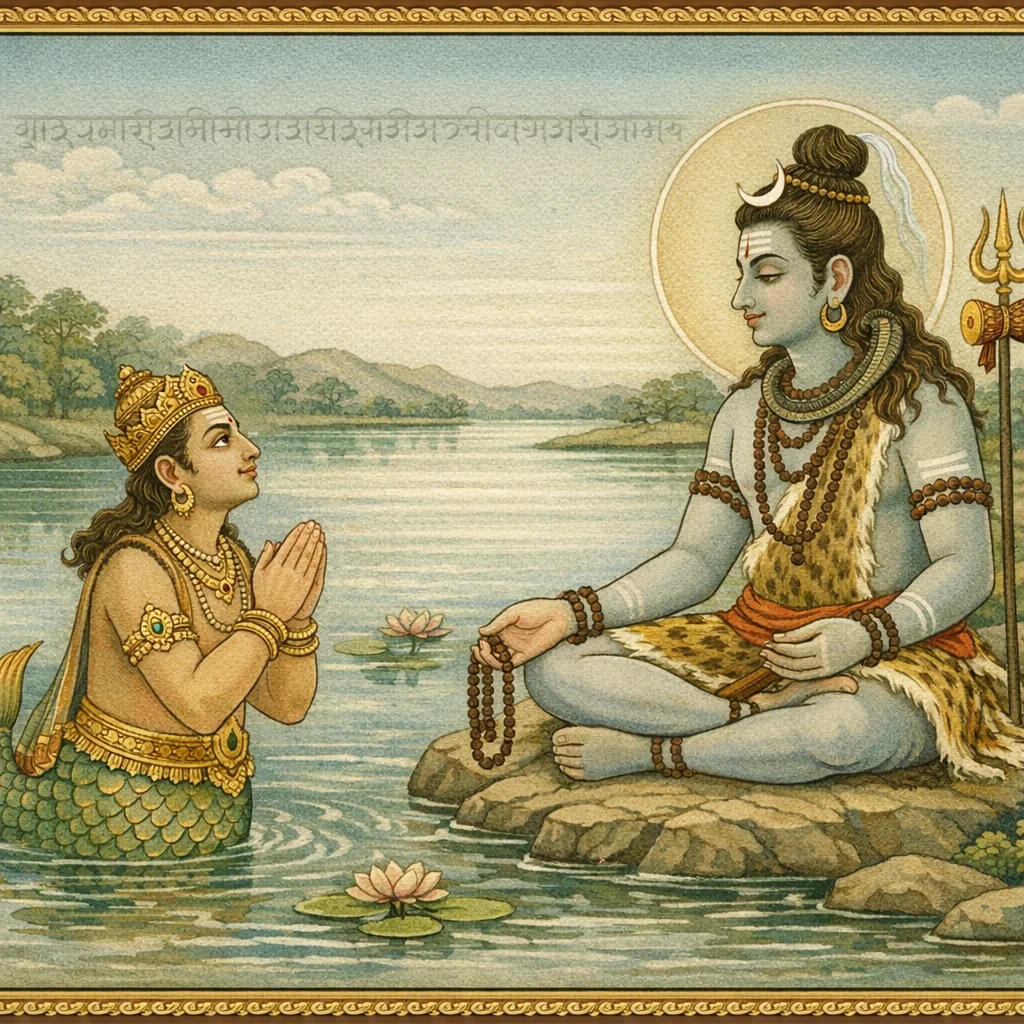
Adhyaya 263
The chapter begins with Īśvara’s teaching on karma, jñāna, and yoga: actions cease to bind when performed with a purified mind, non-attachment, and bhakti, and offered to Hari/Viṣṇu. It presents śama (inner calm), vicāra (discernment), santoṣa (contentment), and sādhu-saṅga (holy company) as the “four gatekeepers” of the mokṣa-path, envisioned as a city, and declares guru-upadeśa decisive for realizing brahma-bhāva and attaining jīvanmukti while living. A mantra-centered frame follows, praising the dvādaśākṣara (twelve-syllable) formula as a purifying seed and support for meditation, and extolling Cāturmāsya as an auspicious season whose observance and devout hearing burn accumulated faults. The narrative then turns to Brahmā’s account: Hara encounters a wondrous fish-being; the fish tells of being abandoned from anxiety over lineage and trapped for long ages, yet awakened to jñāna-yoga by Śiva’s words. Released, he is named Matsyendranātha, a foremost yogin—free of envy, established in non-duality, renunciant, and devoted to brahma-sevā—and the chapter closes by proclaiming the merit of hearing this story, especially in Cāturmāsya, as yielding exalted fruit comparable to an Aśvamedha.
Shlokas
Verse 1
ईश्वर उवाच । यदि चेत्तामसं कर्म त्यक्त्वा कर्मसु जायते । तदा ज्ञानमयो योगी जीवतां मोक्षदायकः
Īśvara said: If one abandons tamasic action and yet remains engaged in rightful duties, then that yogin—made of knowledge—becomes a giver of liberation even while living.
Verse 2
यदा निर्ममता देहे यदा चित्तं सुनिर्मलम् । यदा हरौ भक्तियोगस्तदा बन्धो न कर्मणा
When there is non-possessiveness toward the body, when the mind is thoroughly pure, and when devotion to Hari becomes one’s yoga—then action no longer binds.
Verse 3
कुर्वन्नेव हि कर्माणि मनः शांतं नृणां यदा । तदा योगमयी सिद्धिर्जायते नात्र संशयः
Even while performing actions, when a person’s mind becomes tranquil, then yogic attainment arises—there is no doubt of it.
Verse 4
गुरुत्वं स्थानमसकृदनुभूय महामतिः । जीवन्विष्णुत्वमासाद्य कर्म संगात्प्रमुच्यते
Having repeatedly experienced the state of true spiritual authority (gurutva), the great-minded one attains Viṣṇu-hood while living and is freed from attachment to action (karma).
Verse 5
कर्माणि नित्यजातानि नित्यनैमित्तिकानि च । इच्छया नैव सेव्यानि दुःखतापविवृद्धये
Daily duties and the prescribed occasional rites should not be pursued merely from personal desire, for that only increases suffering and the inner heat of distress.
Verse 6
कर्मणामीशितारं च विष्णुं विद्धि महेश्वरि । तस्मिन्संत्यज्य सर्वाणि संसारान्मुच्यतेऽखिलात्
O Maheśvarī, know Viṣṇu to be the sovereign governor of all actions. By renouncing everything into Him—placing all deeds within Him—one is completely liberated from the entirety of saṃsāra.
Verse 7
एतदेव परं ज्ञानमेतदेव परं तपः । एतदेव परं श्रेयो यत्कृष्णे कर्मणोऽर्पणम्
This alone is the highest knowledge; this alone is the highest austerity. This alone is the supreme good: offering one’s actions to Kṛṣṇa.
Verse 8
अयं हि निर्मलो योगो निर्गुणः स उदाहृतः । तद्विष्णोः कर्म जनितं शुभत्व प्रतिपादनम्
This indeed is called the stainless yoga; it is declared to be beyond the guṇas. It arises from action related to Viṣṇu and establishes auspiciousness—purity and well-being.
Verse 9
तावद्भ्रमंति संसारे पितरः पिंडतत्पराः । यावत्कुले भक्तियुतः स्तो नैव प्रजायते
So long do the ancestors wander in saṃsāra, intent only on the piṇḍa-offerings, as long as a devotee endowed with bhakti is not born in that lineage.
Verse 10
तावद्द्विजानि गर्जंति तावद्गर्जति पातकम् । तावत्तीर्थान्यनेकानि यावद्भक्तिं न विंदति
So long do the twice-born disputingly roar, so long does sin roar; so long are there ‘many’ tīrthas—until one truly attains bhakti.
Verse 11
स एव ज्ञानवांल्लोके योगिनां प्रथमो हि सः । महाक्रतूनामाहर्ता हरिभक्तियुतो हि सः
He alone is truly wise in the world; he indeed is foremost among yogins. He is the real accomplisher of great sacrifices—because he is endowed with devotion to Hari.
Verse 12
निमिषं निर्नयन्मेषं योगः समभिजायते । वाणीजये योगिनस्तु गोमेधश्च प्रकीर्तितः
By restraining even the blink of the eye, yoga arises fully. And for the yogin, victory over speech is proclaimed to be the equivalent of the go-medha sacrifice.
Verse 13
मनसो विजये नित्यमश्वमेधफलं लभेत् । कल्पनाविजयान्नित्यं यज्ञं सौत्रामणिं लभेत्
By constant victory over the mind one gains the fruit of the Aśvamedha. By constant victory over imagination and mental construction, one gains the merit of the Sautrāmaṇi sacrifice.
Verse 14
देहस्योत्सर्जनान्नित्यं नरयज्ञः प्रकीर्तितः । पंचेंद्रियपशून्हत्वाऽनग्नौ शीर्षे च कुण्डले
By the constant casting off of attachment to the body, the nara-yajña is proclaimed. Having “slain” the five beasts of the senses—without outward fire—the yogin bears the marks upon the head and the earrings as signs of the inner rite.
Verse 15
गुरूपदेशविधिना ब्रह्मभूतत्वमश्नुते । स योगी नियताहारोदण्डत्रितयधारकः
By the method of the guru’s instruction, one attains the state of being Brahman. Such a yogin is disciplined in diet and bears the “three staffs” (tri-daṇḍa)—the triple restraint of body, speech, and mind.
Verse 16
त्रिदंडी स तु विज्ञेयो ज्ञाते देवे निरंजने । मनोदण्डः कर्मदण्डो वाग्दंडो यस्य योगिनः
Know that yogin to be the true tridaṇḍin who has realized the stainless, passionless Lord—he whose disciplines are restraint of mind, discipline of action, and discipline of speech.
Verse 17
स योगी ब्रह्मरूपेण जीवन्नेव समाप्यते । अज्ञानी बाध्यते नित्यं कर्मभिर्बंधनात्मकैः
That yogin, even while living, becomes fulfilled in the form of Brahman; but the ignorant person is ever bound and afflicted by actions that are of the nature of bondage.
Verse 18
कुर्वन्नेव हि कर्माणि ज्ञानी मुक्तिं प्रयाति हि । यदा हि गुरुभिः स्थानं ब्रह्मणः प्रतिपाद्यते
Indeed, even while performing actions, the knower of truth proceeds to liberation—when, through the gurus, the “state/abode” of Brahman is rightly taught and firmly established.
Verse 19
तदैष मुक्तिमाप्नोति देहस्तिष्ठति केवलम् । यावद्ब्रह्मफलावाप्त्यै प्रयाति पुरुषोत्तमः
Then he attains liberation (mokṣa), while the body merely remains; until, for the attainment of Brahman’s supreme fruit, the Highest Person (Puruṣottama) leads him onward to final consummation.
Verse 20
तावत्कर्ममयी वृत्तिर्ब्रह्म वृक्षांतराभवेत् । अवांतराणि पर्वाणि ज्ञेयानि मुनिभिः सदा
So long as one’s movement is still shaped by karma, Brahman is as though “between the branches of a tree”—only partially glimpsed; therefore the intermediate stages (parvans) should always be understood by sages.
Verse 21
मोक्षमार्गो द्विजैश्चैव श्रुतिस्मृतिसमुच्चयात् । मोक्षोऽयं नगराकारश्चतुर्द्वार समाकुलः
The path to liberation is set forth by the twice-born (dvija) from the combined testimony of Śruti and Smṛti. This mokṣa is like a city, furnished with four gates.
Verse 22
द्वारपालास्तत्र नित्यं चत्वारस्तु शमादयः । त एव प्रथमं सेव्या मनुजैर्माक्षदायकाः
There, the ever-present gatekeepers are four—beginning with tranquility (śama). They are to be served first by human beings, for they bestow the “fruit” of liberation.
Verse 23
शमश्च सद्विचारश्च संतोषः साधुसंगमः । एते वै हस्तगा यस्य तस्य सिद्धिर्न दूरतः
Tranquility (śama), right discernment (sadvicāra), contentment (saṃtoṣa), and the company of the holy (sādhusaṅgama)—whoever holds these as if in his very hand, for him success in yoga and liberation is not far away.
Verse 24
योगसिद्धिर्विष्णुभक्त्या सद्धर्माचरणेन च । प्राप्यते मनुजैर्देवि ह्येतज्ज्ञानमलं विदुः
O Goddess, yogic attainment is gained by people through devotion to Viṣṇu and through the practice of true dharma; the wise know this as the stainless purity of spiritual knowledge.
Verse 25
ज्ञानार्थं च भ्रमन्मर्त्यो विद्यास्थानेषु सर्वशः । सद्यो ज्ञानं सद्गुरुतो दीपार्चिरिव निर्मला
Though a mortal may wander everywhere in search of knowledge, pure knowledge arises at once from a true guru—like the spotless flame of a lamp.
Verse 26
मुहूर्तमात्रमपि यो लयं चिंत यति ध्रुवम् । तस्य पापसहस्राणि विलयं यांति तत्क्षणात्
Even one who contemplates, for only a single muhūrta, the sure dissolution (of ego and world into the Supreme) — for him thousands of sins immediately pass into destruction at that very moment.
Verse 27
रागद्वेषौ परित्यज्य क्रोधलोभविवर्जितः । सर्वत्र समदर्शी च विष्णुभक्तस्य दर्शनम्
Abandoning attachment and aversion, free from anger and greed, and seeing with equal vision everywhere—this is the mark of one who has the true ‘darśana’ (presence and realization) of a devotee of Viṣṇu.
Verse 29
मायाधिपटलैर्हीनो मिथ्या वस्तुविरागवान् । कुसंसर्गविहीनश्च योगसिद्धेश्च लक्षणम्
Free from the veils cast by māyā, dispassionate toward unreal objects, and devoid of corrupt company—these are the signs of one who has attained yogic accomplishment.
Verse 30
ममतावह्निसंयोगो नराणां तापदायकः । उत्पन्नः शमनं तस्य योगिनां शांतिचारणम्
Union with the fire of “mine-ness” (possessive attachment) brings burning torment to people. When it arises, its pacification is found in the yogins’ discipline and the path of peace.
Verse 31
इन्द्रियाणामथोद्धृत्य मनसैव निषेधयेत् । यथा लोहेन लोहं च घर्षितं तीक्ष्णतां व्रजेत्
Having restrained the senses, one should check them by the mind alone—just as iron, when rubbed against iron, becomes sharpened.
Verse 32
बुद्धिर्हि द्विविधा देहे देया ग्राह्या विशुद्धिदा । संसारविषया त्याज्या परब्रह्मणि सा शुभा
Indeed, in the embodied state, the intellect (buddhi) is of two kinds: one to be given up and one to be accepted—the latter grants purification. The intellect fixed on worldly objects should be abandoned; that which rests in the Supreme Brahman is auspicious.
Verse 33
अहंकारो यथा देवि पापपुण्यप्रदायकः । ज्ञाते तत्त्वे शुभफले कृतः संधाय नान्यथा
O Goddess, the ego-sense (ahaṃkāra) becomes the giver of sin and merit. But when the true principle is known and the auspicious fruit is understood, it is to be rightly “joined” and harnessed—never otherwise.
Verse 34
श्यामलं च उपस्थं च रूपातीतान्नराः शिवम् । हृदिस्थं सिरशिस्थं च द्वयं बद्धविमुक्तये
Transcending form, people seek Śiva beyond appearances; and for the liberation of the bound, they contemplate the twofold presence—Śiva abiding in the heart and Śiva abiding in the head.
Verse 36
एतदक्षरमव्यकममृतं सकलं तव । रूपरूपविष्णुरूपरूपमूर्तिनिवेदितम्
This is Your Imperishable—unmanifest, deathless, and complete—made known through form after form, through Viṣṇu’s forms, and through the manifold embodiments of divine manifestation.
Verse 37
यदा गुरुः प्रसन्नात्मा तस्य विश्वं प्रसीदति । गुरुश्च तोषितो येन संतुष्टाः पितृदेवताः
When the guru’s heart is pleased, the whole world becomes gracious to the disciple. And by whom the guru is satisfied, his ancestors and the gods too become satisfied.
Verse 38
गुरूपदेशः प्रतिमा सद्विचारः समे मनः । क्रिया च ज्ञानसहिता मोक्षसिद्धेर्हि लक्षणम्
The marks of attaining liberation are these: instruction from the Guru, worship through a sacred image, noble discernment, an even and steady mind, and ritual practice joined with true knowledge.
Verse 39
क्रियापतिर्विष्णुरेव स्वयमेव हि निष्क्रि यः । स च प्राणविरूपाय द्वादशाक्षरवीजकः
Viṣṇu alone is the Lord of sacred rites—yet He Himself is actionless. And for the unfolding of the life-breath (prāṇa) He is present as the seed-mantra in the form of the twelve-syllabled formula.
Verse 40
द्वादशाक्षरकं चक्रं सर्वपापनिबर्हणम् । दुष्टानां दमनं चैव परब्रह्मप्रदायकम्
The twelve-syllabled wheel is the destroyer of all sins; it subdues the wicked and bestows the gift of the Supreme Brahman.
Verse 41
एतदेव परं ब्रह्म द्वादशाक्षररूपधृक् । मया प्रकाशितं देवि स्कन्दे हि विमलं तव
This itself is the Supreme Brahman, bearing the form of the twelve-syllabled mantra. O Goddess, I have revealed it in the Skanda tradition for your sake—pure and stainless.
Verse 42
एतत्सारं योगिनां ध्यानरूपं भक्तिग्राह्यं श्रद्धया चिन्तयेच्च । चातुर्मास्ये जन्मकोट्यां च जातं पापं दग्ध्वा मुक्तिदः कैटभारिः
This is the very essence—meditated upon by yogins and grasped through devotion; one should contemplate it with faith. In the Cāturmāsya season, Kaiṭabhāri (Viṣṇu) burns away sins amassed over crores of births and grants liberation.
Verse 43
ब्रह्मोवाच । एतस्मिन्नगरे तत्र क्षीरसागरमध्यतः । उज्जहार विमानाग्रे तेजोभाराभिपीडितः
Brahmā said: In that city, from the midst of the Milk Ocean, he drew it forth and set it upon the forepart of the celestial car, as though pressed down by the weight of its radiance.
Verse 44
उरो बाहुकृतिं कुर्वन्सान्निध्यं समुपागतः । महामत्स्योऽज्ञातपूर्वः सन्निधानेऽनहंकृतिः
Making a gesture with his chest and arms, he drew near into close presence. There appeared a gigantic fish, never seen before—standing nearby, without pride or ego.
Verse 45
हुंकारगर्भे मत्स्यं च दृष्ट्वा तं स महेश्वरः । तेजसा स्तंभयामास वाक्यमेतदुवाच ह
Seeing that fish within the womb of the “huṃ” sound, Maheśvara immobilized it by his fiery splendor, and then spoke these words.
Verse 46
कस्त्वं मत्स्योदरस्थश्च देवो यक्षोऽथ मानुषः । कथं जीवसि देहांतर्गतो मम वद प्रभो
“Who are you—dwelling within the fish’s belly—god, yakṣa, or human? How do you live, having entered inside a body? Tell me, O Lord.”
Verse 47
मत्स्य उवाच । अहं मत्स्योदरे क्षिप्तः समुद्रे क्षीरसंभवे । मात्रा तु पितृवाक्येन नायं मम कुलान्वितः
The fish said: “I was cast into the belly of a fish in the ocean that is born of milk. But by my mother—following my father’s command—this one is not of my lineage.”
Verse 48
कुलक्षयभयात्तेन जातं स्वकुलनाशनम् । गंडांतयोगजनितो बालो न गृहकर्मकृत्
Out of fear that the lineage might perish, there arose—ironically—the ruin of his own family. A child was born under the dreaded gaṇḍānta conjunction, and he did not take up the duties of household life.
Verse 49
इति मात्रा दुःखितया निरस्तः शृणु वंशजः । झषेणापि गृहीतोऽस्मि कालो मेऽत्र महानभूत्
‘Thus I was cast out by my sorrowing mother—listen, O descendant. I was even seized by a great fish, and my time there became long indeed.’
Verse 50
तव वाक्यामृतैरेभिर्ज्ञानयोगो महानभूत् । तेन त्वं सकलो ज्ञातो मया मूर्तोऽथ मूर्त्तगः
By these nectar-like words of yours, the great path of knowledge-yoga awakened. Through that, I came to know you fully—as the embodied Lord, the One who moves in embodied form.
Verse 51
अनुज्ञां मम देवेश देहि निष्क्रमणाय च । यथाऽहं पितृपो ब्रह्मन्भवान्याश्चापि लक्ष्यते
Grant me your permission, O Lord of the gods, to depart as well, so that I may be known as one who has repaid the debt to the ancestors, O Brahman, and so that Bhavānī too may acknowledge it.
Verse 52
हर उवाच विप्रोऽसि सुतरूपोऽसि पूज्योस्यासि बभाषतः । बहिर्निष्क्रम वेगेन स्तंभितोऽसि महाझषः
Hara said: “You are a brāhmaṇa; your form is excellent; you are worthy of worship. As you spoke, the great fish has been immobilized. Come out quickly!”
Verse 53
ततोऽसौ शिरसा जात उत्क्लेशान्मत्स्ययोजितः । ततो हि विकृतं वक्त्रं क्षणाद्बहिरुपागतः
Then he emerged headfirst, distressed, having been bound within the fish. Indeed, in a moment he came out, his face altered and disfigured by the ordeal.
Verse 56
यस्मान्मत्स्योदराज्जातो योगिनां प्रवरो ह्ययम् । तस्मात्तु मत्स्य नाथेति लोके ख्यातो भविष्यति
Since this one—the best among yogins—was born from the belly of a fish, therefore he will become renowned in the world by the name “Matsyanātha”.
Verse 57
अच्छेद्यः स्यान्नरतनुर्ज्ञानयोगस्य पारगः । निर्मत्सरोऽपि निर्द्वंद्वो निराशो ब्रह्मसेवकः
He will have an inviolable human body, will cross to the far shore of jñāna-yoga, and will be free from envy, beyond dualities, without craving, devoted to the service of Brahman.
Verse 58
जीवन्मुक्तश्च भविता भुवनानि चतुर्दश । इत्युक्तश्च महेशानं प्रणमंश्च पुनःपुनः । महेश्वरेण सहितो मंदराचलमाययौ
He shall become liberated while yet alive (jīvanmukta), renowned throughout the fourteen worlds. Thus addressed, he bowed again and again to Maheśāna; and, accompanied by Maheśvara, he went to Mount Mandara.
Verse 59
ब्रह्मोवाच । कृत्वा प्रदक्षिणं देवीं स्कन्दमालिंग्य सोऽगमत्
Brahmā said: “Having circumambulated the Goddess (pradakṣiṇā) and embraced Skanda, he departed.”
Verse 60
ततः सा पार्वती हृष्टा प्राप्य ज्ञानमनुत्तमम् । एवं सा परमां सिद्धिं प्रणवस्यप्रभा जनम्
Then Pārvatī, rejoicing, attained unsurpassed knowledge. Thus she reached the supreme accomplishment—illumined by the power and radiance of the Pranava (Oṃ).
Verse 61
सा प्राप्य जगतां माता द्वादशाक्षरजांबुना । इमां मत्स्येन्द्रनाथस्य चोत्पत्तिं यः शृणोति च
Thus the Mother of the worlds attained that state through the nectar-like power of the twelve-syllabled mantra. Whoever hears this account of Matsyendranātha’s birth…
Verse 62
चातुर्मास्ये विशेषेण सोऽश्वमेधफलं लभेत्
Especially during Cāturmāsya, he would obtain merit equal to that of an Aśvamedha sacrifice.
Verse 263
इति श्रीस्कांदे महापुराण एकाशीतिसाह्स्र्यां संहितायां षष्ठे नागरखण्डे हाटकेश्वरक्षेत्रमाहात्म्ये शेषशाय्युपाख्याने ब्रह्मनारदसंवादे चातुर्मास्यमाहात्म्ये मत्स्येन्द्रनाथोत्पत्तिकथनं नाम त्रिषष्ट्युत्तरद्विशततमोऽध्यायः
Thus ends the chapter entitled “The Account of Matsyendranātha’s Origin,” being the 263rd chapter, in the Śrī Skanda Mahāpurāṇa, in the Ekāśītisāhasrī Saṃhitā, in the sixth division, the Nāgara-khaṇḍa—within the Hāṭakeśvara sacred-region Māhātmya, the Śeṣaśāyī sub-narrative, and the Brahmā–Nārada dialogue on the greatness of Cāturmāsya.
Verse 281
सर्वेषामपि जीवानां दया यस्य हृदि स्थिरा । शौचाचारसमायुक्तो योगी दुःखं न विंदति
The yogin in whose heart compassion for all beings stands firm—and who is endowed with purity and right conduct—does not meet with suffering.
Verse 854
रूपवान्प्रतिमायुक्तो मत्स्यगंधेन संयुतः । सोमकांतिसमस्तत्र ह्यभवद्दिव्यगंधभाक्
He became handsome and well-proportioned, yet was marked by the smell of fish. There, radiant with moonlike lustre, he nonetheless came to possess a wondrous, distinctive fragrance.
Verse 895
उमापि प्रणतं चामुं सुतं स्वोत्संगभाजनम् । चकार तस्य नामापि हरः परमहर्षितः
Umā too received that bowed son into her own lap. And Hara (Śiva), greatly delighted, also bestowed a name upon him.