Adhyaya 190
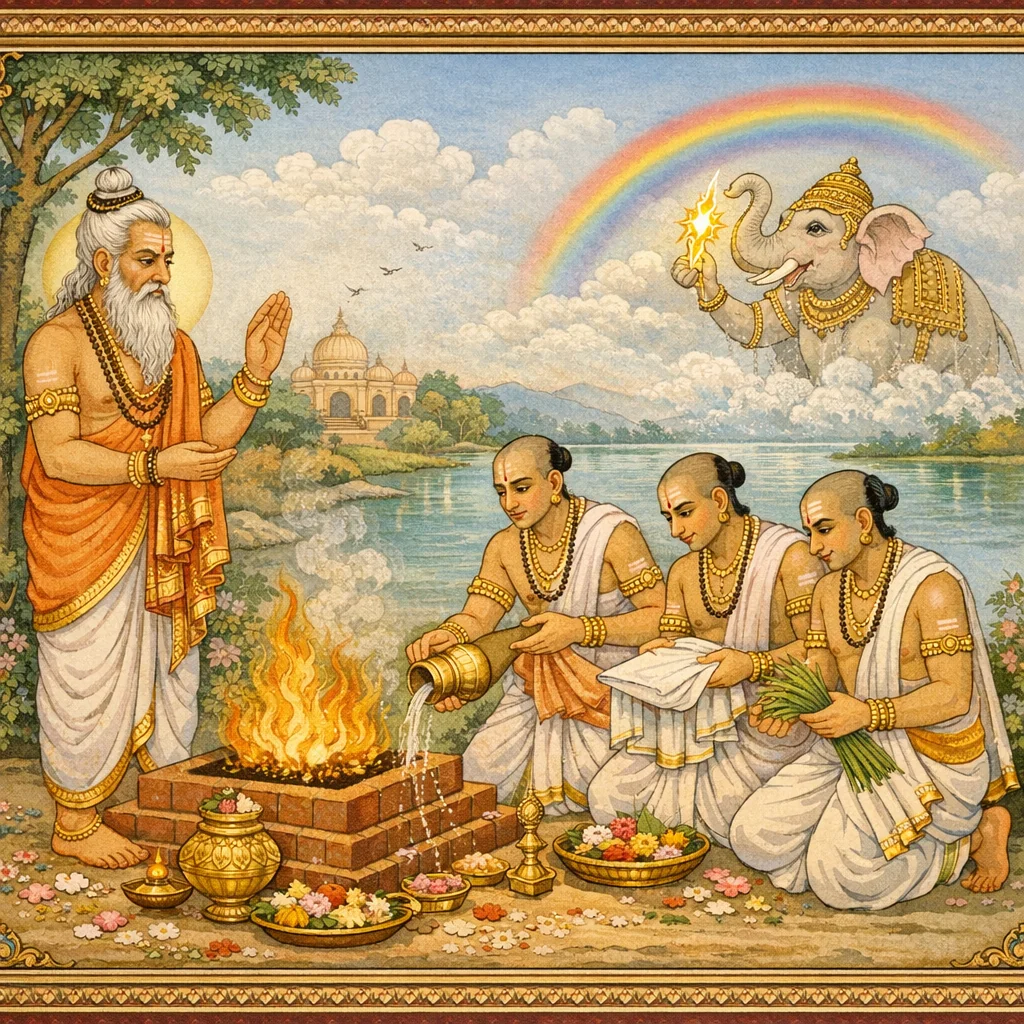
Chapter 190, narrated by Sūta, unfolds as a layered theological instruction. A Brahmin completes a five-night (pañcarātra) observance in Hāṭakeśvara-kṣetra and consults learned Nāgara Brahmins about an offering that could “redeem” the land amid Kali-age fears of ritual taint. Brahmā explains the cosmic placement of tīrthas—Naimiṣa on earth, Puṣkara in the mid-region (antarīkṣa), and Kurukṣetra spanning the three worlds—and promises Puṣkara’s accessible presence on earth from Kārttika śukla ekādaśī through pañcadaśī, praising faithful bathing and śrāddha as yielding imperishable fruit. The narrative then turns to yajña-completion: Pulastya arrives to confirm the rite’s correctness and prescribes Varuṇa-related concluding acts, including avabhṛtha snāna, declaring that at that moment tīrthas converge and participants are purified. Because of the crowd, Brahmā instructs Indra to signal the bathing time by casting into the water a deer-skin tied to a bamboo; Indra asks for an annual royal reenactment, promising protection, victory, and removal of the year’s sin for bathers. Finally, the personified disease Yakṣmā petitions for ritual recognition—arguing that Brahmin satisfaction is essential to yajña-fruit—so Brahmā institutes a rule of bali at the end of Vaiśvadeva for householders who maintain sacred fires, and assures that in this Nāgara setting Yakṣmā will not arise, making the chapter both a tīrtha-origin account and a charter of ritual norms.
Shlokas
Verse 1
सूत उवाच । एवं क्रतुः स संजातः पञ्चरात्रं द्विजोत्तमाः । हाटकेश्वरजे क्षेत्रे सर्वकाम समृद्धिमान्
Sūta said: “Thus that sacrificial rite was carried out for five nights, O best of the twice-born, in the kṣetra of Hāṭakeśvara—abounding in the fulfillment of every desired aim.”
Verse 2
विप्रांश्च भिक्षुकांश्चैव दीनांधांश्च विशेषतः । समाप्तौ तस्य यज्ञस्य संतर्प्य सकलांस्ततः । ऋत्विजो दक्षिणाभिस्तान्यथोक्तान्द्विजसत्तमान्
He especially satisfied the brāhmaṇas, the mendicants, and above all the poor and the blind. Then, when that sacrifice was completed, having duly refreshed and honored everyone, he bestowed upon the officiating priests the prescribed honoraria (dakṣiṇā).
Verse 3
ततः स चानयामास नागरान्ब्राह्मणोत्तमान् । चातुश्चरणसंपन्नाञ्छ्रुतिस्मृति समन्वितान्
Then he invited the foremost brāhmaṇas of the city—endowed with the fourfold qualifications and firmly grounded in both Śruti and Smṛti.
Verse 4
कृतांजलिपुटो भूत्वा ततस्तान्प्राह सादरम् । यद्भूमौ तु मया तीर्थं पुष्करं संनिवेशितम्
Then, with hands joined in reverence, he respectfully addressed them: “On this very earth I have established the sacred ford (tīrtha) known as Puṣkara.”
Verse 5
कलिकालस्य भीतेन द्वितीयं ब्राह्मणोत्तमाः । येन नो नाशमभ्येति म्लेच्छैरपि समाश्रितम्
“O best of brāhmaṇas, out of fear of the age of Kali I have set in place a second refuge—so that it may not fall into ruin, even if it should come to be occupied by mlecchas.”
Verse 6
हाटकेश्वरदेवस्य प्रभावेन महात्मनः । कलिकाले च सम्प्राप्ते तीर्थान्यायतनानि च
“By the power of the great-souled Lord Hāṭakeśvara, when the age of Kali arrives, the holy fords (tīrthas) and the divine shrines as well retain their sacred potency.”
Verse 7
म्लेच्छैः स्पृष्टान्यसंदिग्धं प्रयागादीनि कृत्स्नशः । यज्ञस्तु विहितस्तेन भयायं तत्कृतेन च
Indeed, places such as Prayāga and all the rest are, without doubt, wholly defiled by the touch of the mlecchas. Therefore he arranged a yajña, and fear arose because of what was done.
Verse 8
तस्माद्वदथ किं दानं युष्मद्भूमेश्च निष्क्रये । प्रयच्छामि च यज्ञस्य येन मे स्यात्फलं द्विजाः
Therefore tell me: what gift should be given as the redemption-price for your land? I shall grant it for the sake of the yajña, so that I, O twice-born ones, may obtain its fruit.
Verse 9
ब्राह्मणा ऊचुः । यदि यच्छसि चास्माकं दक्षिणां यज्ञसंभवाम् । तदस्माकं स्ववासेन स्थानं नय पवित्रताम्
The Brāhmaṇas said: “If you wish to give us the dakṣiṇā arising from the yajña, then by our own dwelling here, lead this place into purity.”
Verse 10
यदेतद्भवता चात्र पुष्करं तीर्थमुत्तमम् । स्थापितं तस्य नो ब्रूहि माहात्म्यं सुरसत्तम । येन स्नानादिकाः सर्वाः क्रियाः कुर्मः पितामह
“Since you have established here the supreme sacred ford, Puṣkara, tell us its greatness, O best among the gods, so that we may perform all rites beginning with bathing. O Pitāmaha, instruct us.”
Verse 11
ब्रह्मोवाच । एतत्तीर्थं मया सृष्टमंतरिक्षस्थितं सदा । किं न श्रुतं पुराणेषु भवद्भिर्द्विजसत्तमाः
Brahmā said: “This sacred ford was created by me and ever abides in the mid-region (antarikṣa). Have you not heard of it in the Purāṇas, O best of the twice-born?”
Verse 12
पृथिव्यां नैमिषं तीर्थमन्तरिक्षे च पुष्करम् । त्रैलोक्ये तु कुरुक्षेत्रं विशेषेण व्यवस्थितम्
On earth, Naimiṣa is the sacred tīrtha; in the mid-region, Puṣkara. And across the three worlds, Kurukṣetra stands established with special eminence.
Verse 13
तद्युष्माकं हितार्थाय पंचरात्रं धरातले । आगमिष्यत्यसंदिग्धं मम वाक्यप्रणोदितम्
Therefore, for your welfare, it will certainly come to the earth for five nights—impelled by my command, without any doubt.
Verse 14
कार्तिक्यां शुक्लपक्षे तु ह्येकादश्यां दिने स्थिते । यावत्पंचदशी तावत्तिथिः पापप्रणाशिनी
In the bright fortnight of Kārttika, from the day of Ekādaśī up to Pañcadaśī, that span of lunar days is a destroyer of sins.
Verse 15
पंचरात्रस्य मध्ये तु यः स्नानं च करिष्यति । श्राद्धं वा श्रद्धया युक्तस्तस्य स्यादक्षयं हि तत्
Whoever, in the midst of the five-night observance, performs sacred bathing (snāna)—or performs śrāddha endowed with faith—indeed, that act becomes imperishable for him.
Verse 16
अह तु पंचरात्रं तद्ब्रह्मलोकादुपेत्य च । संश्रयं तु करिष्यामि तीर्थेऽत्रैव द्विजोत्तमाः
“I, for that five-night period, shall come from Brahmaloka and take up residence right here at this tīrtha, O best of the twice-born.”
Verse 17
ब्राह्मणा ऊचुः । तव मूर्तिं करिष्यामः स्थानेऽत्र प्रपितामह । तस्यां संक्रमणं नित्यं तस्मात्कार्यं त्वयाविभो
The Brāhmaṇas said: “O venerable Forefather, we shall fashion your sacred image here in this very place. Therefore, O Lord, grant your continual descent and entry into it each day.”
Verse 18
तीर्थं चैव सदाप्यऽत्र समागच्छतु चांबरात् । लोकानां पापनाशाय तथा त्वं कर्तुमर्हसि
“And may this tīrtha ever come here also from the heavens; for the destruction of the people’s sins, it is fitting that you bring this to pass.”
Verse 19
एषा नो दक्षिणा देव यज्ञस्यैव समुद्भवा
“O God, this is our dakṣiṇā—the priestly fee—born of the sacrifice itself.”
Verse 20
एवं कृते सुरश्रेष्ठ सफलः स्यात्क्रतुस्तव । प्रतिज्ञा च तथा सत्या तस्माद्दानाय निर्मिता
“If this is done, O best among the gods, your sacrifice will bear fruit; and your vow will likewise be made true. Therefore this gift has been prepared for offering.”
Verse 21
श्रीब्रह्मोवाच । मन्त्राहूतं ततः श्रेष्ठं नभोमार्गाद्द्विजोत्तमाः । हाटकेश्वरजे क्षेत्रे पुष्करं चागमिष्यति
Śrī Brahmā said: “Then, O best of the twice-born, the excellent tīrtha invoked by mantras will come by the path of the sky; and Puṣkara too will arrive in the sacred field of Hāṭakeśvara.”
Verse 22
अघमर्षं जपंश्चैव यः करिष्यति तोयगः । मम मूर्तेः पुरः स्थित्वा पैलमन्त्रपुरःसरम्
Whoever, offering water, also chants the Aghamarṣaṇa hymn while standing before my image—beginning with the Paila-mantra—
Verse 23
जपिष्यति द्विजश्रेष्ठाः सवनानां चतुष्टयम् । ब्रह्मलोकात्समागत्य प्रश्रोष्या मि च तद्द्विजाः
—he shall chant, O best of Brahmins, the fourfold set of the savanas. And I too, coming from Brahmaloka, will listen to that, O twice-born.
Verse 24
सूत उवाच । अथ ते नागराः सर्वे पुष्पदानप्रपूर्वकम् । अनुज्ञां प्रददुस्तुष्टा यज्ञफलसमाप्तये
Sūta said: Then all those citizens, first offering gifts of flowers, gladly granted their consent, so that the fruit of the sacrifice might be brought to its full completion.
Verse 25
एतस्मिन्नंतरे प्राप्तः पुलस्त्योऽध्वर्युसत्तमः । यत्र स्थाने स्थितो ब्रह्मा नागरैः परिवारितः
In the meantime, Pulastya—the foremost among the adhvaryu priests—arrived at the place where Brahmā was seated, surrounded by the citizens.
Verse 26
अब्रवीच्च समाप्तस्ते यतः संपूर्णदक्षिणः । प्रायश्चित्तैर्विरहितो यथा नान्यस्य कस्यचित्
And he said: “Your rite has concluded, for it has been completed with all due priestly fees (dakṣiṇā), and it is free from any need of expiatory rites (prāyaścitta)—unlike that of anyone else.”
Verse 27
अतः परं कर्मशेषं किंचिदस्ति पितामह । वारुणेष्टिर्जपश्चैव तत्करिष्यामि सांप्रतम्
Now then, O Grandfather Brahmā, does any portion of the rite yet remain? The Vāruṇī Iṣṭi and the prescribed japa as well—I shall perform them at once.
Verse 28
तथा चाऽवभृथस्नानं प्रकर्तव्यं त्वया सह । तस्मादुत्तिष्ठ गच्छामो यत्र तोयव्यवस्थितम्
And the avabhṛtha bath must also be performed together with you. Therefore rise—let us go to where the waters are duly arranged for the rite.
Verse 29
येनेष्टिवारुणीं तत्र कुर्मो विप्रैर्यथोचितैः । चतुर्भिर्ब्रह्मपूर्वैश्च मया चाग्नीध्रहोतृभिः
There we shall perform the Vāruṇī Iṣṭi with the appropriate brāhmaṇas, as prescribed—four priests beginning with the Brahman-priest, and also with me, together with the agnīdhra and hotṛ priests.
Verse 30
यथावह्नौ तथा तोये मन्त्रवत्तद्भवंशुभम् । हूयते संविधानेनयज्ञपात्रैः सम न्वितम्
Just as oblations are offered into fire, so too into water—accompanied by mantras—the auspicious offering is duly poured in proper sequence, with the prescribed sacrificial vessels.
Verse 31
वरुणस्य प्रतुष्ट्यर्थं स्नानं कार्यं त्वयैव च । ऋत्विग्भिः सहितेनैव सर्वारिष्टप्रशांतये
For the full satisfaction of Varuṇa, you must indeed perform the bath—together with the officiating ṛtvij priests—so that every misfortune may be pacified.
Verse 32
यस्तत्र समये स्नानं करिष्यति त्वया सह । अन्योऽपि मानवः कश्चिद्विपाप्मा स भविष्यति
Whoever, at that very time, bathes there along with you—even any other person at all—shall become free from sin.
Verse 33
यानीह संति तीर्थानि त्रैलोक्ये सचराचरे । वारुणीमिष्टिमासाद्य तानि यांति च संनिधौ
Whatever sacred fords exist in the three worlds—among all moving and unmoving beings—on the occasion of the Vāruṇī Iṣṭi they come here into close proximity, gathering their presence.
Verse 34
तस्मात्सर्वप्रयत्नेन दीक्षितेन समन्वितम् । तत्र स्नानं प्रकर्तव्यं जलमध्ये तु सार्थिभिः । ब्राह्मणैः क्षत्रियैर्वैश्यैः सर्वैरव भृथोत्सवे
Therefore, with every effort, and duly sanctified through proper dīkṣā and observance, one should perform the sacred bath there—indeed in the midst of the waters—together with the caravan-traders; and at the Avabhṛtha festival-bath, Brāhmaṇas, Kṣatriyas, and Vaiśyas—everyone—should bathe.
Verse 35
तस्माद्विसर्जयाद्यैतान्ब्राह्मणांस्तावदेव च । एतेऽपि च करिष्यंति स्नानं तत्र त्वया सह
Therefore, send these Brāhmaṇas on at once; they too will perform the sacred bath there together with you.
Verse 36
सूत उवाच । तच्छ्रुत्वा प्रस्थितो ब्रह्मा ज्येष्ठकुण्डतटं शुभम् । गायत्र्या सहितो हृष्टः कृतकृत्यत्वमागतः
Sūta said: Hearing those words, Brahmā set out for the auspicious bank of Jyeṣṭha-kuṇḍa. Accompanied by Gāyatrī, he rejoiced, having attained the sense of fulfilled purpose.
Verse 37
अथ तद्वचनं श्रुत्वा सुराः सर्वे तथा द्विजाः । पुलस्त्यश्च शुभार्थाय स्नानार्थं प्रस्थितास्तदा । ब्रह्मणा सहिता हृष्टाः पुत्रदारसमन्विताः
Then, hearing that instruction, all the gods and the twice-born—along with Pulastya—set out at that time for the sacred bath, seeking auspiciousness. United with Brahmā, they went joyfully, accompanied by sons and wives.
Verse 38
अथ संकीर्णता जाता समंताज्ज्येष्ठपुष्करे । स्नानार्थमागतैर्लोकैरूर्ध्वबाहुभिरेव च
Then a great crowding arose on every side at Jyeṣṭhapuṣkara, with people arriving for the sacred bath—raising their arms aloft in fervent devotion.
Verse 39
न तत्र लक्ष्यते ब्रह्मा न तत्कर्म च वारुणम् । क्रियमाणैर्द्विजैस्तत्र व्याप्ते भूमि तलेऽखिले
There Brahmā could not be seen, nor could that Varuṇa-related rite be made out, for the entire ground there was filled everywhere with twice-born men engaged in performing the rituals.
Verse 40
अथांते कर्मणस्तस्य ब्रह्मा प्राह शतक्रतुम् । हितार्थं सर्वलोकस्य विनयावनतं स्थितम्
Then, at the conclusion of that rite, Brahmā spoke to Śatakratu (Indra), who stood there bowed in humility—speaking for the welfare of all the worlds.
Verse 41
न मां ज्ञास्यति दूरस्था जनाः स्नानार्थमागताः । मज्जमानं जले पुण्ये सम्मर्देऽस्मिञ्जलोद्भवे
“People who have come for bathing, standing at a distance, will not recognize me as I immerse myself in this holy water, amid this press of the crowd born of the waters.”
Verse 42
तस्मान्नागं समारुह्य निजं वृत्रनिषूदन । एणस्य कृष्णसारस्य वंशांते चर्म न्यस्य च
Therefore, O slayer of Vṛtra, mount your own elephant; and set upon the tip of a bamboo staff the skin of an antelope—the blackbuck—just as has been spoken.
Verse 43
ततस्तत्स्नानवेलायां क्षेप्तव्यं सलिले त्वया । येन लोकः समस्तोऽयं वेत्ति कालं तु स्नानजम्
Then, at the very time of that bathing, you should cast it into the water, so that all these people may know the proper time for the bathing rite.
Verse 44
स्नानं च कुरुते श्रेयः संप्राप्नोति यथोदितम् । दूरस्थोऽपि सुवृद्धोऽपि बालोऽपि च समागतः । स्नानजं लभते श्रेयः संदृष्टेऽपि यथोदितम्
Whoever performs the sacred bath attains the promised spiritual good, exactly as declared. Even one who is far away, even the very old, and even a child who has come there—each obtains the merit born of bathing; even by merely beholding the tīrtha, the stated benefit is gained.
Verse 45
सूत उवाच । बाढमित्येव संप्रोच्य सत्वरं प्रययौ हरिः
Sūta said: Having replied, “So be it,” Hari promptly set out in haste.
Verse 46
ततो नागं समारुह्य धृत्वा वंशं करे निजे । मृगचर्माग्रसंयुक्तं तोयमध्ये व्यवस्थितः
Then, mounting the serpent and holding a bamboo staff in his own hand—its tip fitted with a deer-hide—he positioned himself in the midst of the waters.
Verse 47
एतत्कर्मावसाने स स्नातुकामे पितामहे । तच्चर्म प्राक्षिपत्तोये स्वयमेव शतक्रतुः
When the rite was completed and Pitāmaha desired to bathe, Śatakratu himself cast that deer-hide into the water.
Verse 48
एतस्मिन्नन्तरे देवाः सर्वे गन्धर्वगुह्यकाः । मानुषाश्च विशेषेण स्नातास्तत्र समाहिताः
Meanwhile, all the gods—together with Gandharvas and Guhyakas—and especially the human beings, bathed there and remained intent and composed.
Verse 49
एतस्मिन्नन्तरे ब्रह्मा शक्रं प्रोवाच सादरम् । कृतस्नानं सुरैः सार्धं विनयावनतं स्थितम्
At that time Brahmā addressed Śakra with respect—Śakra who, having bathed along with the gods, stood there with humble deference.
Verse 50
सहस्राक्षं त्वया कष्टं मन्मखे विपुलं कृतम् । आनीता च तथा पत्नी गायत्री च सुमध्यमा
O Sahasrākṣa, you have undertaken great hardship in my sacrifice. And you also brought your wife—Gāyatrī, the fair-waisted one.
Verse 51
तस्माद्वरय भद्रं ते यं वरं मनसि स्थितम् । सर्वं तेऽहं प्रदास्यामि यद्यपि स्यात्सुदुर्लभम्
Therefore, choose a boon—may it be well with you—whatever boon rests in your mind. I shall grant you everything, even if it is exceedingly difficult to obtain.
Verse 52
इन्द्र उवाच । यदि तुष्टोऽसि मे देव यदि देयो वरो मम । यदि त्वां प्रार्थयाम्यद्य भूयात्तु तादृशं विभो
Indra said: If you are pleased with me, O Lord, and if a boon is to be granted to me—then, as I petition you today, let that very favor be so, O mighty one.
Verse 53
वर्षेवर्षे तु यः कुर्यात्संप्राप्तेऽस्मिन्दिने शुभे । मृगचर्म समादाय वंशाग्रे यो महीपतिः
But whoever, year after year, performs this observance when this auspicious day arrives—taking up a deer-hide and (standing/acting) at the tip of a bamboo staff—O lord of the earth…
Verse 54
नागप्रवरमारुह्य स्वयमेव पितामह । यथाऽहं प्रक्षिपेत्तोये स स्यात्पापविवर्जितः
Mounted upon the foremost of the Nāgas, Pitāmaha (Brahmā) himself cast it into the water; therefore, whoever performs this act in that manner becomes free from sin.
Verse 55
अजेयः सर्वशत्रूणां सर्वव्यसनवर्जितः । ये करिष्यंति च स्नानमनेन मृगचर्मणा
Unconquerable by all enemies and free from every calamity—such shall they be, who will perform the bath using this deer-skin as prescribed.
Verse 56
सार्धमन्येऽपि ये लोका अपि पापसमन्विताः । तेषां वर्षकृतं पापं त्वत्प्रसादात्प्रणश्यतु
And even those other people as well, though burdened with sin—may the sins committed over the course of a year be destroyed for them by your gracious favor.
Verse 57
ब्रह्मोवाच । एतत्सर्वं सहस्राक्ष तव वाक्यमसंशयम् । भविष्यति न संदेहः सर्वमेतन्मयोदितम्
Brahmā said: “All this, O Thousand-eyed one, is indeed as you have spoken—without doubt. It shall come to pass; there is no uncertainty, for all this has been affirmed by me.”
Verse 58
यो राजा श्रद्धया युक्तो देशस्यास्य समुद्भवः । आनर्तस्य गजारूढो मृगचर्म क्षिपिष्यति
That king—born in this very land and endowed with faith—of Ānarta, mounted upon an elephant, will cast away the deer-skin, as the rite requires.
Verse 59
अत्र कुण्डे मदीये तु मां संपूज्य तटस्थितम् । सर्वलोकहितार्थाय संप्राप्ते प्रतिपद्दिने
Here, in my own pond, having duly worshipped me as I stand upon the bank—on the day of Pratipad, undertaken for the welfare of all people—
Verse 60
समाप्ते कुतपे काले विजयी स भविष्यति । कार्तिक्यां च व्यतीतायां द्वितीयेऽह्नि व्यवस्थिते
When the Kutapa time has concluded, he will become victorious. And when the observance in Kārtikī has passed, on the duly fixed second day—
Verse 61
तथा तत्कालमासाद्य ये करिष्यंति मानवाः । स्नानं तच्च दिनेऽत्रैव वर्षपापविवर्जिताः । आधिव्याधिविमुक्ताश्च ते भविष्यंत्यसंशयम्
Likewise, those people who, arriving at that very time, will perform the bath here on that day—shall be freed from the sins of a year; and released from affliction and disease, they will surely become so, without doubt.
Verse 62
सूत उवाच । एतस्मिन्नंतरे प्राप्तो यक्ष्माख्यो दारुणो गदः । अचिकित्स्योऽपि देवानां तथा धन्वंतरेरपि
Sūta said: Meanwhile there arose a dreadful disease called Yakṣmā—incurable even for the gods, and even for Dhanvantari as well.
Verse 63
नीलांबरधरः क्षामो दीनो दण्डसमाश्रितः । क्षुत्कुर्वञ्छ्लेष्मणा तावत्कृच्छ्रात्संधारयन्पदम्
Clad in blue garments, emaciated and wretched, leaning upon a staff—sneezing with phlegm, he could scarcely keep his footing, with great difficulty.
Verse 64
ततश्च प्रणतो भूत्वा वाक्यमेतदुवाच सः
Then, bowing down in reverence, he spoke these words.
Verse 65
यक्ष्मोवाच । तव यज्ञमहं श्रुत्वा दूरादेव पितामह । क्षुत्क्षामकंठश्चायातः समाप्तावद्य कृच्छ्रतः
Yakṣmā said: “O Grandfather, hearing of your sacrifice from far away, I have come—my throat parched and my body wasted by hunger. Today I have arrived with great difficulty, just as the rite is concluding.”
Verse 66
दक्षेणाहं पुरा सृष्टश्चंद्रार्थं कुपितेन च । रोहिणीं सेवमानस्य संत्यक्तान्यासुतस्य च
“Long ago I was created by Dakṣa, in anger, for the sake of the Moon—because the Moon attended only to Rohiṇī and neglected the other daughters.”
Verse 67
ततो माहेश्वरादेशात्तेन तुष्टेन तस्य च । पक्षमेकं कृतं मह्यं तस्यास्वादनकर्मणि
Then, by Maheśvara’s command, and as he was pleased, one fortnight was granted to me for the act of “tasting”—my allotted share in that rite.
Verse 68
अन्यपक्षे न किंचिच्च येन तृप्तिः प्रजायते । यज्ञस्यैव तु सर्वस्य तर्पयित्वा द्विजोत्तमम्
In the other fortnight there is nothing by which satisfaction arises. Therefore, for the sake of the entire yajña, one should satisfy—by tarpaṇa—the best of the twice-born, the foremost brāhmaṇa.
Verse 69
ततस्तद्वचनं ग्राह्यं तर्पितोऽहमसंशयम् । पौर्णमास्यां ततो देव यस्य यज्ञस्य कृत्स्नशः
Therefore that statement should be accepted: on the full-moon day (pūrṇamāsī) I am satisfied, without doubt; then, O Deva, that sacrifice is complete in its entirety.
Verse 70
यस्य नो ब्राह्मणो ब्रूते यज्ञस्यांते प्रतर्पितः । तर्पितोऽस्मीति तत्तस्य वृथा स्याद्यज्ञजं फलम् । यदि कोटिगुणं दत्तमपि श्रद्धासमन्वितम्
If, at the end of a yajña, the brāhmaṇa—though duly satisfied—does not declare, “I am satisfied,” then the fruit born of that sacrifice becomes futile for him, even if he has given gifts a millionfold and even if endowed with faith (śraddhā).
Verse 71
एतच्छ्रुत्वा त्वया देव पठ्यमानं श्रुताविह । तस्मात्सम्यक्स्थिते यज्ञे ब्राह्मणं तर्पयेत वै
Hearing this here as you recite it, O Deva, and knowing it to be grounded in Śruti, therefore, when the yajña is properly underway, one should indeed satisfy the brāhmaṇa.
Verse 72
प्रत्यक्षं मे यथा तृप्तिरन्नेनैव प्रजायते । त्वत्प्रसादात्सुरश्रेष्ठ तथा नीतिर्विधीयताम्
Just as, for me, satisfaction plainly arises only from food, so—by your grace, O best of gods—let the proper rule be established accordingly.
Verse 73
सूत उवाच । तच्छ्रुत्वा पद्मजस्तस्य पथ्यंपथ्यं वचोऽखिलम् । श्रुतिं प्रमाणतां नीत्वा ततो वचनमब्रवीत्
Sūta said: Hearing all his words—what was wholesome and what was not—Padmaja (Brahmā), taking Śruti as the authoritative standard, then spoke in reply.
Verse 74
अद्यप्रभृति वै विप्राः साग्नयः स्युर्धरातले । तैः सर्वैर्वैश्वदेवांते बलिर्देयस्तथाखिलः
From this day onward, O brāhmaṇas, may you live upon the earth as householders maintaining the sacred fires. And by all of you, at the conclusion of the Vaiśvadeva rite, the complete offering (bali) should indeed be given.
Verse 75
दत्त्वाऽन्येभ्योथ देवेभ्यस्तव तृप्तिर्भविष्यति । तव पक्षे द्वितीये तु सत्यमेतन्मयोदितम्
Having given (offerings) to the other deities as well, then your satisfaction will arise. In your second fortnight, this is truly what I have declared.
Verse 76
ये विप्रास्तु बलिं दद्युर्वैश्वदेवांत आगते । न तेषामन्वये चापि त्वया सेव्योऽत्र कश्चन
But those brāhmaṇas who give the bali when the Vaiśvadeva rite has reached its conclusion—none of them, nor anyone in their lineage, should be afflicted or attended by you here.
Verse 77
यक्ष्मोवाच । तीर्थेऽस्मिंस्तावके देव सदाहं तपसि स्थितः । तिष्ठामि यदि वादेशस्तावको जायते मम
Yakṣma said: “O God, in this sacred tīrtha that is yours, I have ever remained established in tapas, in austerity. I shall stay—if indeed a dwelling-place within your domain is appointed for me.”
Verse 78
ब्रह्मोवाच । यद्येवं कुरु चान्यत्र त्वमाश्रमपदं निजम् । संप्राप्य भूमिदेशे च कञ्चिद्यदभिरोचते । अर्थयित्वा द्विजानेतान्यथा यज्ञकृते मया
Brahmā said: “If so, then do this: elsewhere establish your own āśrama, your hermitage-abode. Having reached some tract of land that pleases you, request it from these brāhmaṇas, just as formerly I entreated them for the sake of a yajña, a sacrifice.”
Verse 79
सूत उवाच । तच्छ्रुत्वा प्रार्थयामास चमत्कारपुरोद्भवान् । तेभ्यः प्राप्य ततो भूमिं चकाराथाश्रमं निजम्
Sūta said: “Hearing that, he petitioned those brāhmaṇas who had arisen from the wondrous city. Having obtained land from them, he then established his own āśrama, his hermitage.”
Verse 80
तत्र यः कुरुते स्नानं प्रतिपद्दिवसे स्थिते । सूर्यवारेण मुच्येत यक्ष्मणा सेवितोऽपि वा
Whoever bathes there on the day of Pratipad—when it falls on a Sunday—is set free, even if afflicted by Yakṣma.
Verse 81
अद्यापि दृश्यते चात्र प्रत्ययस्तस्य संभवे । सर्वेषामाहिताग्नीनां नागराणां विशेषतः । कलि कालेऽपि संप्राप्ते न यक्ष्मा संप्रजायते
Even today, here one sees proof of its efficacy. For all who have established the sacred fires (āhita-agni)—especially the people of Nāgara—though the age of Kali has arrived, Yakṣma does not arise.
Verse 82
तथा चतुष्पदानां च तेषां गृहनिवासिनाम् । न तस्य भेषजानि स्युर्न मंत्रा न चिकित्सकाः
Likewise, for their four-footed animals that dwell in their homes, for that ailment there is no need of medicines—nor of mantras, nor of physicians.
Verse 190
इति श्रीस्कांदे महापुराण एकाशीतिसाहस्र्यां संहितायां षष्ठे नागरखण्डे हाटकेश्वरक्षेत्रमाहात्म्ये ब्रह्मयज्ञावभृथयक्ष्म तीर्थोत्पत्तिमाहात्म्यवर्णनंनाम नवत्युत्तरशततमोऽध्यायः
Thus, in the Śrī Skanda Mahāpurāṇa, in the Saṃhitā of eighty-one thousand verses, in the sixth book, the Nāgara Khaṇḍa, within the Māhātmya of the sacred region of Hāṭakeśvara, ends Chapter (190) entitled “The Description of the Greatness of the Origin of Yakṣma Tīrtha connected with the Avabhṛtha of the Brahma-yajña.”